
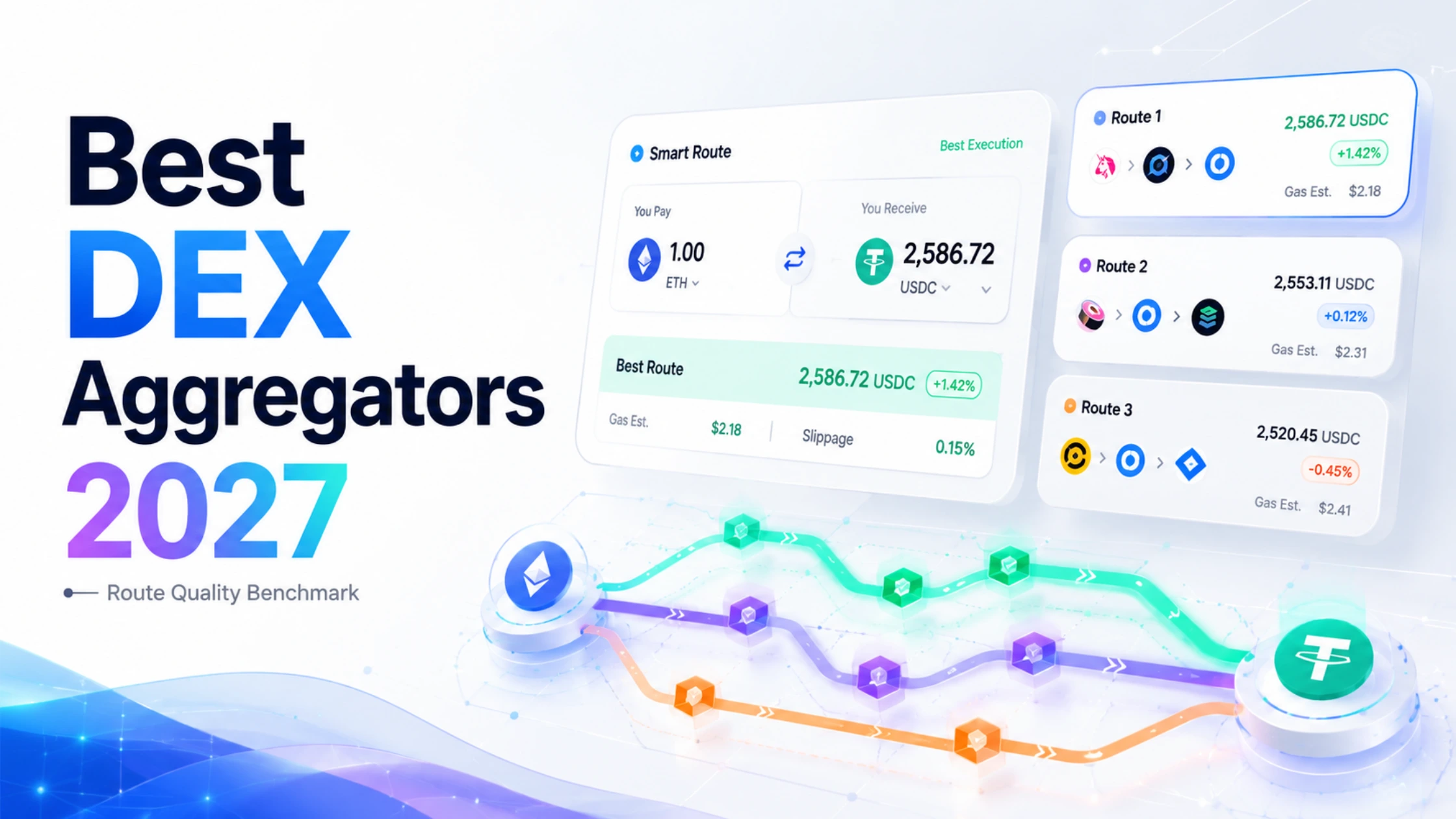
Which DEX aggregator gives the best crypto swap execution in 2027? Decentralised News compares Jupiter, Matcha/0x, CoW Swap, 1inch, OKX DEX and KyberSwap across quoted output, actual output, route splitting, MEV protection, gas, failures and $100 to $100,000 trades.
Data checked: 30 August 2026.
Eligibility rule: Only DEX aggregators independently verified as operational at the time of publication are included. Platforms that discontinue trading, shut down, become inaccessible or cease maintaining their aggregation product are removed from the live benchmark rather than retained for historical completeness.
Summary
The best DEX aggregator is not necessarily the platform displaying the highest quote.
The important number is:
what actually reaches your wallet.
Modern DEX aggregators increasingly compete using:
- AMM liquidity
- professional market makers
- RFQ
- route splitting
- multi-hop routing
- solver auctions
- intent-based execution
- private transaction routing
- MEV protection
- gas abstraction
- transaction simulation
- adaptive settlement
That means there can be a meaningful difference between:
Quoted Output
and:
Actual Net Output.
Decentralised News therefore created the proprietary DN DEX Route Quality Benchmark.
It is designed to test standardized swaps at:
$100
$1,000
$10,000
and:
$100,000
while measuring:
Quote → Actual Execution → Gas → Slippage → Failure → MEV Protection → Net Value
Our current architecture-based assessment finds:
Best for Large EVM Swaps
Matcha / 0x
Its combination of AMMs, professional RFQ liquidity, split routing and execution infrastructure makes it particularly compelling for larger EVM orders.
Best Solana DEX Aggregator
Jupiter
Jupiter has evolved into a meta-aggregator where several independent routing engines and RFQ liquidity sources compete for each order.
Best for MEV-Protected Large EVM Trades
CoW Swap
Its solver competition, batch auctions, Coincidence of Wants and advanced orders provide a fundamentally different execution model.
Best Broad Multichain Intent Aggregator
1inch
Its current ecosystem combines aggregation, intent-based execution, MEV protection and cross-chain functionality across more than a dozen networks.
Best Broad Web3 Aggregation Ecosystem
OKX DEX
Its current architecture aggregates hundreds of DEXs across more than 30 chains while adding solver-based Intent Swap and sophisticated smart routing.
Best Adaptive EVM Routing Alternative
KyberSwap
KyberSwap combines broad liquidity aggregation with Smart Settlement, which can reconsider liquidity at execution rather than relying entirely on the route that looked best when the quote was generated.
But these are architecture-based starting positions.
DN will not treat them as permanent execution rankings until synchronized observed tests determine:
Which aggregator consistently puts the most value in the user’s wallet?
Quick Verdict
If you trade primarily on Solana:
Start with Jupiter.
If you are executing a large trade on Ethereum, Base, Arbitrum or another supported EVM chain:
Compare Matcha/0x and CoW Swap first, then check 1inch, OKX DEX and KyberSwap.
If MEV protection is particularly important:
CoW Swap and 1inch deserve serious attention.
If you want broad cross-chain reach:
1inch and OKX DEX are particularly strong starting points.
For any trade above:
$10,000
our recommendation is different:
Do not rely on one aggregator quote.
At:
$100,000
even a:
0.20%
execution improvement is worth:
$200.
The difference between routers can become far more important than the advertised protocol fee.
DEX Aggregators Included in the 2027 Benchmark
As of 30 August 2026, DN independently verified active swap interfaces or current operational documentation for:
- Jupiter
- Matcha / 0x
- CoW Swap
- 1inch
- OKX DEX
- KyberSwap
Operational status is now a prerequisite for inclusion.
A platform will not remain in future DN rankings simply because it was once prominent.
DN DEX Aggregator Starting Ranking 2027
This is an architecture-based baseline, not a fabricated live-execution ranking.
Rank | Aggregator | Best For | Core Advantage | Main Limitation |
1 | Matcha / 0x | Large EVM swaps | RFQ + AMMs + professional liquidity | Large-order edge still needs continuous independent testing |
2 | Solana | Meta-aggregation + RFQ | Primarily Solana focused | |
3 | MEV-sensitive EVM trades | Solver competition + batch auctions | Narrower chain universe than broad multichain aggregators | |
4 | 1inch | Multichain intent execution | Broad coverage + intents + MEV protection | Execution mode affects economics |
5 | Broad Web3 aggregation | 30+ chains + 400+ DEXs + solver execution | Routing architecture is complex | |
6 | KyberSwap | Adaptive EVM execution | Smart Settlement + broad liquidity | Less differentiated in professional RFQ than some leaders |
The ranking can change once DN accumulates actual execution data.
That is intentional.
Why DN Does Not Rank DEX Aggregators From Marketing Claims Alone
A DEX aggregator cannot be properly evaluated from:
- fee schedules
- number of chains
- number of liquidity sources
- website claims
alone.
You must observe execution.
A platform might win:
USDC → ETH at $100
and lose:
USDC → ETH at $100,000.
Another might dominate:
Ethereum
and perform differently on:
Base.
Another might return the highest quote but suffer:
- greater quote drift
- higher gas
- worse transaction landing
The DN methodology therefore separates:
Architecture Quality
What the system is capable of doing.
from:
Observed Route Quality
What happened when the trade was actually tested.
Observed execution should ultimately matter more.
What Is the DN DEX Route Quality Benchmark?
The benchmark asks:
Which route delivers the highest reliable net output?
Not:
Which platform claims the lowest fee?
The fundamental equation is:
Net Execution Value = Actual Output Value − Gas − Explicit Execution Costs
We then score how reliably the platform converted its quoted output into actual execution.
DN Route Quality Score
Maximum:
100
Actual Net Output: 55 Points
This is the most important category.
The aggregator producing the highest usable value after gas should receive the largest weighting.
Quote Fidelity: 15 Points
Measure:
Actual Output ÷ Quoted Output × 100
Example:
Quoted:
$99,800 equivalent
Actual:
$99,750
Quote fidelity:
approximately:
99.95%.
A slightly lower quote that executes faithfully can be superior to a higher quote that consistently deteriorates.
Gas Efficiency: 10 Points
Gas should be measured in economic terms.
A route requiring:
$8 gas
but delivering:
$30 more crypto
is better than a route costing:
$1 gas
while producing:
$20 less output.
The metric is:
net value after gas.
Execution Reliability: 10 Points
Track:
- success
- revert
- expiry
- partial fill
- resubmission
A high quote that frequently fails deserves a lower score.
MEV Protection: 5 Points
Reward meaningful protection against:
- front-running
- sandwich attacks
- harmful transaction ordering
Execution Speed: 5 Points
Measure:
Quote → Confirmation
Speed is useful, but it should not outweigh actual value received.
Standard DN Test Sizes
$100
Tests:
- small-user economics
- gas sensitivity
- minimum fees
$1,000
Representative active retail trade.
$10,000
Routing differences become materially more important.
$100,000
Professional routing begins to matter substantially.
At this level:
- RFQ
- solvers
- market makers
- route splitting
- MEV protection
- price impact
can materially change the result.
Test by Chain, Not Just Platform
A universal ranking would hide too much.
DN should maintain separate leaderboards.
Solana DEX Aggregator Benchmark
Primary test candidates:
- Jupiter
- 1inch
- OKX DEX
- other currently verified Solana aggregators where comparable functionality exists
Ethereum DEX Aggregator Benchmark
Compare:
- Matcha / 0x
- CoW Swap
- 1inch
- OKX DEX
- KyberSwap
Base DEX Aggregator Benchmark
Compare the currently supported EVM platforms using identical:
- pair
- notional
- timestamp
- wallet assumptions
Arbitrum DEX Aggregator Benchmark
Repeat independently.
The winner on Ethereum does not automatically become the winner on Arbitrum.
Standard Test Pairs
Stablecoin → Stablecoin
Example:
USDC → USDT
Measures:
- pegged-asset routing
- gas
- RFQ
- stablecoin depth
Blue Chip → Stablecoin
Example:
ETH → USDC
or:
SOL → USDC
Measures general execution quality.
Blue Chip → Blue Chip
Example:
ETH → WBTC
Tests intermediate routing and fragmented liquidity.
Long-Tail Token → Stablecoin
This is where routing intelligence can become particularly important.
A route may involve:
TOKEN → WETH → USDC
rather than one direct pool.
DN DEX Route Quality Benchmark
Compare synchronized DEX aggregator quotes or record actual completed swaps. Score routes using net output, quote fidelity, gas efficiency, execution reliability, MEV protection and confirmation speed.
| Aggregator | Use | Quoted Output ($) | Actual Output ($) | Gas ($) | Time | Success | MEV Protected | Open |
|---|
1. Matcha / 0x: Best Starting Point for Large EVM Swaps
Matcha remains operational and continues to serve as 0x’s consumer-facing decentralized trading interface.
Its current interface supports:
- swaps
- limit orders
- cross-chain trading
- multiple asset categories
- multiple networks
0x’s underlying infrastructure adds an important professional liquidity layer:
RFQ.
Professional market makers submit firm quotes that compete with available AMM liquidity.
The RFQ quote is used only when it improves the outcome.
This is particularly relevant for larger trades.
Why RFQ Matters
Most conventional DEX routing starts with:
public liquidity pools.
0x can additionally ask:
professional market makers.
Suppose a $100,000 trade receives:
AMM Route
$99,530 output.
Market Maker A
$99,640.
Market Maker B
$99,690.
The aggregator can route toward the better professional quote when valid.
0x currently states that RFQ market makers must beat available AMM pricing to enter the route and that the RFQ portion receives firm quote execution rather than AMM-style slippage.
Multiplex Routing
One transaction can combine:
- several AMMs
- RFQ
- intermediate assets
Example:
30%
Uniswap
25%
another liquidity source
45%
RFQ market maker
if that maximizes output.
That becomes increasingly useful as trade size grows.
Matcha Auto
Matcha also provides a more abstracted execution experience through Matcha Auto.
Its infrastructure can:
- simulate transactions
- manage gas execution
- route through professional liquidity
- use private execution infrastructure
This can reduce user exposure to harmful public-mempool execution.
Limit Orders
Matcha also offers limit orders.
That makes the platform more useful for traders who do not want to accept an immediate swap quote.
DN Verdict
Best architecture-based starting point for large EVM market swaps.
The important word is:
starting.
DN’s synchronized $10,000 and $100,000 testing should determine whether the RFQ architecture consistently translates into superior actual execution.
2. Jupiter: Best Solana DEX Aggregator
Jupiter’s current swap architecture has evolved into something more sophisticated than one router searching DEX pools.
Its recommended Meta-Aggregator allows several routing systems to compete for an order.
Current routing engines include:
- Iris
- JupiterZ RFQ
- DFlow
- OKX
Jupiter then manages transaction landing through the broader execution flow.
This makes Jupiter effectively an:
aggregator of aggregators and liquidity systems.
Why Meta-Aggregation Matters
A conventional router asks:
Which combination of Solana pools gives the best result?
Jupiter can also ask:
Which entire routing engine gives the best result?
One route might originate from:
on-chain AMMs.
Another from:
professional RFQ liquidity.
Another from:
another routing system.
They compete for the order.
JupiterZ RFQ
JupiterZ V2 currently connects professional market makers through real-time quote infrastructure.
Current documentation lists more than:
15 active market makers
and more than:
100 supported tokens
within JupiterZ’s professional RFQ environment.
Firm market-maker liquidity can become particularly relevant on larger trades.
Route Splitting
Jupiter routing can divide trades into several paths and dynamically use intermediate markets.
That can uncover routes that are not obvious from the direct token pair.
Managed Transaction Landing
Jupiter also manages transaction submission for its Meta-Aggregator execution route.
This matters because execution is not finished when a quote is generated.
The transaction still has to:
- reach the network
- land successfully
- avoid excessive quote drift
Gasless Support
Jupiter’s current Meta-Aggregator also provides gas abstraction under qualifying circumstances.
But DN treats:
gasless
as an execution mechanism rather than evidence of zero economic cost.
The relevant number remains:
actual net output.
DN Verdict
The Solana benchmark every serious aggregator comparison should start with.
Jupiter’s own architecture validates DN’s underlying thesis:
Competition between routers can be more powerful than blindly trusting one router.
3. CoW Swap: Best for MEV-Protected Large EVM Trades
Referral code: DECENTRALISED
CoW Swap takes a fundamentally different approach from a conventional pathfinding aggregator.
Instead of simply constructing a swap route, users submit:
trade intents.
Professional:
solvers
compete to create the most advantageous valid settlement.
Batch Auctions
CoW Protocol groups orders into:
batch auctions.
Solvers compete for the right to settle those trades.
The winning solver is the one producing the strongest valid user-surplus outcome.
That changes the incentives around execution.
Coincidence of Wants
CoW can also identify cases where two user demands offset one another.
Example:
User A
Wants:
ETH → USDC
User B
Wants:
USDC → ETH
The protocol may be able to match part of that demand without routing every dollar through an AMM pool.
This can reduce:
- price impact
- AMM fees
under the right conditions.
MEV Protection
CoW’s solver architecture and batch settlement model are deliberately structured around reducing harmful MEV exposure.
This makes it especially interesting for:
- treasury trades
- large token swaps
- volatile conditions
where broadcasting one large swap directly into the public mempool could create a significant extraction opportunity.
TWAP Orders
CoW also supports:
Time-Weighted Average Price orders.
This is particularly relevant for large positions.
Instead of trying to execute:
$1 million
in one transaction, the user can divide execution across time.
That can reduce:
- immediate price impact
- timing risk
CoW’s own current guidance describes TWAP as particularly relevant for large trades.
Limit Orders
CoW supports limit orders alongside immediate swaps and TWAP execution.
This makes it one of the more sophisticated trader-facing DEX aggregation environments.
Cross-Chain
CoW Swap’s current live interface also supports cross-chain swaps.
That expands its role beyond conventional same-chain Ethereum settlement.
DN Verdict
Our strongest architecture-based starting choice for MEV-sensitive large EVM trades.
For $100,000 tests, CoW should be compared directly against:
- Matcha/0x
- 1inch
- OKX DEX
- KyberSwap
rather than evaluated from headline fees.
4. 1inch: Best Broad Multichain Intent-Based Aggregator
1inch remains one of DeFi’s best-known aggregation infrastructures.
Its current swap environment spans more than a dozen networks, including:
- Ethereum
- Arbitrum
- Base
- Optimism
- Polygon
- BNB Chain
- Avalanche
- Gnosis
- Linea
- zkSync Era
- Sonic
- Unichain
- Robinhood Chain
- Solana
depending on specific product functionality.
Intent-Based Execution
1inch has evolved beyond conventional route aggregation.
Its intent-based execution allows:
resolvers
to compete to fulfil orders.
That separates:
what the user wants
from:
exactly how the transaction must be executed.
A professional resolver can determine an efficient execution route within the user’s constraints.
MEV Protection
1inch’s intent-based execution is designed to protect swaps against:
- front-running
- sandwich-style attacks
This is one reason the platform remains important in a large-trade benchmark.
Solana
1inch also supports Solana.
Its Solana intent architecture uses a Dutch-auction mechanism where resolvers compete to execute the swap.
That makes 1inch one of the few large aggregators relevant to both:
EVM
and:
Solana
comparisons.
Cross-Chain Swaps
The current 1inch interface advertises cross-chain swaps across:
13+ networks.
This gives the platform one of the broader footprints in the comparison.
Limit Orders
1inch additionally supports:
- swapping
- trading
- limit functionality
through its broader trading ecosystem.
DN Verdict
Best all-round choice for users wanting one broad intent-based aggregation ecosystem across EVM networks and Solana.
It may not win every individual network.
Its advantage is breadth combined with sophisticated execution.
5. OKX DEX: Best Broad Web3 Aggregation Ecosystem
Referral code: DECENTRALISED
OKX DEX is integrated into the broader OKX Web3 Wallet environment.
Its current infrastructure aggregates liquidity across:
30+ public blockchains
25+ cross-chain bridges
and:
400+ DEXs.
It supports more than:
300,000 tokens
according to the current OKX Web3 documentation.
That makes it one of the broadest aggregation environments currently operating.
X Routing
OKX’s proprietary:
X Routing
system evaluates multiple execution paths and can divide a transaction across several DEXs.
The router considers factors including:
- price
- liquidity
- gas
- slippage
when constructing a route.
Intent Swap
OKX DEX Aggregator+ adds:
Intent Swap.
Instead of committing immediately to one fixed transaction route, the user signs an intent.
Professional solvers then compete in a batch auction to deliver execution.
OKX says its system automatically checks whether the Intent route offers a better price than conventional aggregation.
This is particularly interesting for large orders.
Why This Matters
Imagine:
Traditional Router
Best route:
$99,520
Solver A
$99,610
Solver B
$99,670
The intent architecture creates another layer of competition.
That is increasingly how high-quality decentralized execution is evolving.
MEV Protection
OKX DEX includes MEV protection within its current aggregation environment.
Its system is designed to reduce exposure to harmful transaction ordering and sandwich-style execution.
Cross-Chain Aggregation
OKX also aggregates numerous bridge routes.
This allows users to compare more complex:
Swap → Bridge → Swap
execution paths from one interface.
That deserves a separate DN cross-chain benchmark because bridge quality should not be hidden inside a same-chain DEX score.
DN Verdict
The broadest all-in-one Web3 execution environment in this comparison.
The critical question for DN testing is whether its enormous liquidity universe and solver infrastructure consistently translate into:
higher actual net output.
6. KyberSwap: Best Adaptive EVM Routing Alternative
KyberSwap remains operational and actively developing its aggregation infrastructure.
Its live interface currently provides:
- swaps
- limit orders
- cross-chain swaps
- liquidity aggregation
across supported networks.
Kyber’s normal aggregation layer already scans hundreds of DEXs and liquidity sources.
Its more interesting 2026 innovation is:
Smart Settlement.
The Quote-Time Problem
Consider:
18:00:00
Pool A gives the best quote.
18:00:04
Another transaction removes liquidity from Pool A.
18:00:06
Your swap executes.
A conventional transaction may:
- execute at a worse price
- hit slippage tolerance
- revert
KyberSwap designed Smart Settlement to address this gap.
Smart Settlement
Rather than assuming the pool selected at quote time will still be optimal at execution, Smart Settlement can prepare alternative candidate pools.
At execution, the smart contract can compare them and select the candidate providing the strongest token output.
That creates:
execution-time adaptability.
This is exactly the sort of architecture DN’s:
Quote Fidelity
metric is designed to evaluate.
Smart Settlement and JIT Liquidity
Kyber also explicitly positions Smart Settlement as protection against liquidity that appears deep at quote time but disappears before execution.
That can occur with:
- changing market-maker quotes
- temporary liquidity
- volatile pools
An alternative source can potentially be used if the original route deteriorates.
Limit Orders
KyberSwap supports limit-order functionality in addition to immediate swaps.
Cross-Chain
Its live interface also supports cross-chain swaps.
Kyber’s wider 2026 roadmap continues to expand its cross-chain routing stack.
DN Verdict
A credible EVM execution contender with a particularly interesting approach to quote-to-fill deterioration.
KyberSwap should remain in DN’s live benchmark because Smart Settlement can be directly tested using:
Quoted Output vs Actual Output.
Feature Matrix
Feature | Matcha / 0x | Jupiter | CoW Swap | 1inch | OKX DEX | KyberSwap |
Route splitting | ✓ | ✓ | Solver-based | ✓ | ✓ | ✓ |
Professional RFQ liquidity | ✓ | ✓ | Private/solver liquidity | Resolver-based | Solver-based | ✓ |
Intent execution | Selected modes | RFQ/meta execution | ✓ | ✓ | ✓ | Evolving |
MEV protection | ✓ | ✓ / route dependent | Excellent | ✓ | ✓ | Route dependent |
Gas abstraction | Matcha Auto | Selected routes | Solver economics | Intent modes | Intent dependent | Route dependent |
Limit orders | ✓ | Product dependent | ✓ | ✓ | ✓ | ✓ |
TWAP | Not core | Not core | ✓ | Product dependent | Product dependent | Product dependent |
Cross-chain | ✓ | Separate ecosystem | ✓ | ✓ | ✓ | ✓ |
Large-trade architecture | Excellent | Excellent on Solana | Excellent | Strong | Strong | Strong |
Adaptive execution | Simulation/private execution | Managed landing | Solver settlement | Resolver execution | Solver routing | Smart Settlement |
Quoted Output vs Actual Output
This is the central DN distinction.
Suppose:
Aggregator A
Quoted:
40.00 ETH
Aggregator B
Quoted:
39.96 ETH
You would expect A to win.
Now execution happens.
Aggregator A
Actual:
39.82 ETH
Aggregator B
Actual:
39.95 ETH
B was the better route.
The quote screen alone produced the wrong answer.
DN Quote Fidelity Metric
Formula:
Actual Output ÷ Quoted Output × 100
Higher is better.
An aggregator consistently achieving:
99.98% quote fidelity
may be more dependable than one frequently advertising aggressive quotes and underdelivering.
The DN Overquote Rate
DN should also calculate:
Material Under-Delivery Events ÷ Successful Trades
Example:
Platform A
2 material under-deliveries from 100 tests.
Platform B
Platform A receives stronger quote-reliability marks.
Failure Rate
Calculate:
Failed Transactions ÷ Attempted Transactions
This matters particularly on EVM networks because a failed transaction can still consume gas.
Expected Failure Cost
Example:
Average failed gas:
$8
Failure rate:
5%.
Expected failure cost per attempt:
$0.40.
That should become part of long-run execution economics.
Route Splitting: Useful but Not Automatically Better
A visually complicated route is not proof of good execution.
Consider:
Route A
One pool.
Gas:
$4
Output:
$99,700
Route B
Five pools.
Gas:
$19
Output:
$99,710
Route B technically delivers more tokens before gas.
Route A produces more:
net value.
DN therefore does not award points simply for using more liquidity sources.
MEV Protection Should Be Measured Economically
A route can claim:
MEV protected
but the important question remains:
Did that protection improve the user’s outcome?
For a:
$100
trade, the effect may be negligible.
For:
$100,000
in volatile on-chain liquidity, it can become material.
Best DEX Aggregator for $100
Priorities:
- low gas
- low interface fee
- execution reliability
For Solana:
Jupiter
is our starting benchmark.
For inexpensive EVM chains:
compare:
- Matcha
- 1inch
- OKX
- KyberSwap
For Ethereum:
gas can materially alter the result.
Best DEX Aggregator for $1,000
At this size:
- price
- gas
- routing
all begin to matter.
For EVM, compare at least:
- Matcha
- CoW Swap
- 1inch
- OKX DEX
- KyberSwap
Best DEX Aggregator for $10,000
At $10,000, getting several synchronized quotes becomes worthwhile.
RFQ and solver competition begin to become more commercially meaningful.
EVM shortlist
- Matcha / 0x
- CoW Swap
- 1inch
- OKX DEX
- KyberSwap
Solana
- Jupiter
- other supported operational aggregators with comparable execution
Best DEX Aggregator for $100,000
This is where the DN benchmark becomes particularly valuable.
At $100,000:
- RFQ matters
- private liquidity matters
- solvers matter
- price impact matters
- route splitting matters
- MEV matters
- quote fidelity matters
Never assume that the aggregator winning:
$100
will also win:
$100,000.
Best for Large EVM Trades
Our current architecture-based shortlist:
Matcha / 0x
Professional RFQ plus public AMM liquidity.
CoW Swap
Solver competition and batch settlement.
1inch
Resolver-based execution.
OKX DEX
Conventional aggregation plus Intent Swap.
KyberSwap
Adaptive Smart Settlement.
These five should be tested simultaneously.
Best for Large Solana Trades
Jupiter
remains the primary benchmark.
Its Meta-Aggregator already follows a philosophy similar to DN’s methodology:
make several routing systems compete.
Best for MEV Protection
Our strongest current shortlist:
CoW Swap
Batch auctions and solver architecture.
1inch
Intent-based resolver execution.
Matcha / 0x
Private and professional liquidity execution modes.
OKX DEX
Integrated MEV protection.
Jupiter
RFQ and managed execution can reduce several conventional execution risks.
Best for Limit Orders
Current candidates include:
- Matcha
- CoW Swap
- 1inch
- OKX DEX
- KyberSwap
This should eventually become a separate DN study because limit-order quality involves different metrics from immediate swap routing.
Best for TWAP
CoW Swap
is particularly notable.
For very large transactions, reducing immediate market impact can be more important than obtaining the highest instantaneous quote.
Best for Cross-Chain Aggregation
Strong current candidates include:
- 1inch
- OKX DEX
- Matcha/0x
- CoW Swap
- KyberSwap
But DN should separate:
same-chain aggregation
from:
cross-chain execution.
A cross-chain benchmark must measure:
Source Swap + Bridge + Destination Swap + Time + Failure Risk
Required DN Benchmark Fields
Every standardized test should record:
Timestamp
Exact UTC time.
Chain
Ethereum, Solana, Base, Arbitrum and so on.
Block or Slot
Where practical.
Pair
Example:
USDC → ETH.
Trade Size
$100, $1,000, $10,000 or $100,000.
Aggregator
Platform tested.
Quoted Output
Expected tokens.
Actual Output
Tokens actually delivered.
Gas
Native asset and USD equivalent.
Price Impact
Where disclosed.
Minimum Received
Where disclosed.
Route
Pools, market makers or solver structure where visible.
MEV Protection
Enabled / unavailable / unclear.
Transaction Status
Successful, failed, expired or partial.
Confirmation Time
Seconds.
Transaction Hash
For DN’s actual executed tests.
One Test Is Not Enough
A proper benchmark needs repetition.
DN should eventually collect at least:
10 observations per Pair × Chain × Size
across different market sessions.
That would enable us to report:
- median actual output
- win rate
- average gas
- median quote fidelity
- failure rate
- worst execution
- best execution
Median Execution Matters More Than a Lucky Win
Suppose:
Aggregator A
wins three tests by large margins.
Aggregator B
wins seven tests by smaller margins.
For routine execution, B may be more reliable.
DN should therefore publish:
Win Rate
alongside:
Median Net Output.
Proposed Live DN DEX Route Quality Table
Aggregator | $100 Win Rate | $1K Win Rate | $10K Win Rate | $100K Win Rate | Quote Fidelity | Failure Rate |
Matcha / 0x | Test | Test | Test | Test | Test | Test |
Jupiter | Test | Test | Test | Test | Test | Test |
CoW Swap | Test | Test | Test | Test | Test | Test |
1inch | Test | Test | Test | Test | Test | Test |
OKX DEX | Test | Test | Test | Test | Test | Test |
KyberSwap | Test | Test | Test | Test | Test | Test |
Publishing:
Test
until DN has observed data is better than inventing authoritative-looking numbers.
How to Compare DEX Aggregators Yourself
For a material swap:
Step 1
Open several currently operational aggregators.
Step 2
Use identical:
- wallet
- network
- input token
- output token
- amount
Step 3
Capture quotes within approximately:
30 to 60 seconds.
Step 4
Compare:
net expected value after gas.
Step 5
Inspect:
- price impact
- minimum received
- MEV protection
- route
Step 6
Refresh stale RFQ quotes.
Step 7
Choose the route offering the strongest combination of:
net output
execution protection
and:
reliability.
Quote Age Matters
Professional market-maker quotes can expire quickly.
If the user waits too long:
- the RFQ can expire
- another route can become better
- the transaction may need requoting
DN should record:
quote age at submission
where practical.
Slippage Settings Must Be Standardized
A fair benchmark cannot compare:
Aggregator A
0.10% slippage tolerance
against:
Aggregator B
1%.
Settings should be standardized where architecture permits.
Where automatic slippage is integral to the platform, that difference should be documented.
Why Actual Output Is the DN Moat
Anyone can compile:
- number of chains
- protocol fee
- route screenshots
- product features
That content is easy to reproduce.
What is harder to copy is:
At 14:03:12 UTC, which aggregator delivered the highest net output on a $100,000 USDC → ETH swap?
Now repeat that:
- every week
- across Ethereum
- across Solana
- across Base
- across Arbitrum
- across several pairs
- across several order sizes
That becomes a proprietary dataset.
Best DEX Aggregator by User Type
User | DN Starting Choice |
Solana trader | Jupiter |
Large EVM trader | Matcha / CoW Swap |
MEV-sensitive trader | CoW Swap |
Multichain DeFi user | 1inch |
Broad Web3 trader | OKX DEX |
EVM user wanting adaptive execution | KyberSwap |
DAO executing large trades | CoW Swap / Matcha |
Trader comparing RFQ liquidity | Matcha / Jupiter |
Cross-chain user | OKX DEX / 1inch |
These are starting points, not guarantees that the platform will produce the best live quote.
Frequently Asked Questions
What is the best DEX aggregator in 2027?
There is no universal winner across every chain, pair and trade size.
Our architecture-based starting choices are:
Matcha/0x for large EVM swaps
Jupiter for Solana
CoW Swap for MEV-sensitive EVM trades
and:
1inch for broad multichain intent execution.
Actual DN rankings will increasingly be determined by synchronized execution tests.
What is the best Solana DEX aggregator?
Jupiter is our current starting benchmark.
Its Meta-Aggregator allows several routing engines and RFQ liquidity sources to compete for execution.
What is the best Ethereum DEX aggregator?
For material trades, compare:
- Matcha / 0x
- CoW Swap
- 1inch
- OKX DEX
- KyberSwap
The winner can change by size and market conditions.
Is Jupiter better than 1inch?
Jupiter is more deeply specialized around Solana.
1inch has much broader multichain coverage.
The answer depends on the network and pair.
Is CoW Swap a DEX aggregator?
Yes, but its execution architecture differs from conventional smart-order routing.
It uses intents, solvers and batch auctions.
Is Matcha the same as 0x?
Matcha is the consumer-facing decentralized trading platform built around 0x execution infrastructure.
Does OKX have a DEX aggregator?
Yes.
OKX DEX is integrated into the OKX Web3 Wallet and currently aggregates liquidity across hundreds of DEXs and more than 30 public chains.
Is KyberSwap still operational?
Yes as of the latest DN verification on 30 August 2026.
Its swap, limit-order and cross-chain interfaces remain live, and Smart Settlement was introduced in 2026.
Which aggregator is best for MEV protection?
CoW Swap, 1inch, Matcha/0x protected routes and OKX DEX all have meaningful MEV-protection mechanisms.
Their architectures differ.
Which aggregator is best for a $100,000 trade?
There is no responsible universal answer without a synchronized quote comparison.
For EVM, we would compare at minimum:
- Matcha / 0x
- CoW Swap
- 1inch
- OKX DEX
- KyberSwap
What is an RFQ?
RFQ means:
Request for Quote.
Professional market makers provide prices for a specific transaction.
What is a solver?
A solver is an execution participant that attempts to satisfy a user’s trade intent under specified constraints.
Is route splitting always better?
No.
Additional routes can increase:
- gas
- contract complexity
- execution risk
The goal is maximum net output, not maximum routing complexity.
What is quote fidelity?
Quote fidelity measures how closely actual output matches quoted output.
Why might actual output differ from the quote?
Possible reasons include:
- market movement
- pool changes
- transaction delay
- liquidity removal
- slippage
- execution mechanics
What is the most important DEX aggregator metric?
Actual net output after execution costs.
Final Verdict
DEX aggregation is evolving from:
price comparison
into:
execution competition.
The early DEX aggregator asked:
Which pool offers the best price?
The next generation asked:
Which combination of pools offers the best route?
The 2027 generation increasingly asks:
Which combination of routers, market makers, solvers and liquidity sources can reliably deliver the strongest actual execution?
That changes the ranking.
Matcha / 0x currently provides one of the strongest architectures for large EVM trades because professional RFQ liquidity competes with public AMMs.
Jupiter is the Solana benchmark because several routers and RFQ sources can compete inside its Meta-Aggregator.
CoW Swap remains one of the most distinctive execution environments because solver competition, batch auctions and MEV protection are fundamental rather than bolt-on features.
1inch provides one of the strongest multichain combinations of aggregation, intent-based execution, MEV protection and cross-chain infrastructure.
OKX DEX has developed one of the broadest aggregation environments in Web3, with hundreds of DEXs, more than 30 chains, Intent Swap and extensive cross-chain infrastructure.
KyberSwap provides a particularly interesting approach to the difference between quote-time and execution-time liquidity through Smart Settlement.
But DN’s long-term winner should not be determined by:
- brand recognition
- number of chains
- advertised fees
- marketing claims
It should be determined by:
Quote
↓
Execution
↓
Gas
↓
Actual Output
↓
Reliability
↓
Net Value
The best DEX aggregator is ultimately the one that:
reliably puts the most value in the user’s wallet.
That is what the DN DEX Route Quality Benchmark is designed to measure.
Affiliate Disclosure
Some links in this article are affiliate or referral links, including selected links to CoW Swap and OKX Web3. Decentralised News may receive compensation or referral benefits when eligible users access partner platforms through those links.
Affiliate relationships do not influence:
- platform inclusion
- rankings
- Route Quality Scores
- execution testing
- risk analysis
- editorial conclusions
Only operational platforms are eligible for current recommendation.
Disclaimer
This article is for educational and informational purposes only and is intended for readers aged 18 and over. Decentralized exchanges, aggregators, bridges, smart contracts and self-custody involve financial and technical risks. Liquidity, routes, gas fees, market-maker quotes, price impact and execution quality change continuously. Verify the network, token contract, route, minimum received and transaction details before signing.
Related reading:
What Is the Cheapest Way to Swap Crypto? CEX vs DEX Aggregator vs Wallet Swap
Best Crypto Exchanges for Team Trading in 2027: Subaccounts, Permissions, APIs and Withdrawal Controls Ranked
Best Crypto Exchanges for Freelancers and Remote Workers in 2027: Receive, Spend and Cash Out Stablecoins
Best Multi-Asset Crypto Exchanges in 2027: Trade Crypto, Stocks, Commodities and FX From One Platform
Crypto Exchange KYC Friction Index: Which Exchanges Make Verification Easiest?
The Crypto Platform Selector 2027: Find the Best Exchange, DEX, Wallet or Tool for Your Needs
Crypto Execution Quality Index 2027: Which Exchanges Actually Give Traders the Best Fills?
Best Crypto Exchange VIP Programs: Fees, Qualification and Benefits Compared
Best Crypto Exchanges for DCA in 2027: Recurring Buy Fees, Spreads and True Costs Compared
Crypto Liquidation Fairness Index 2026: Which Exchanges Liquidate Traders Most Fairly?
Which Crypto Exchange Has the Best Customer Support? DN Response-Time Benchmark 2027





