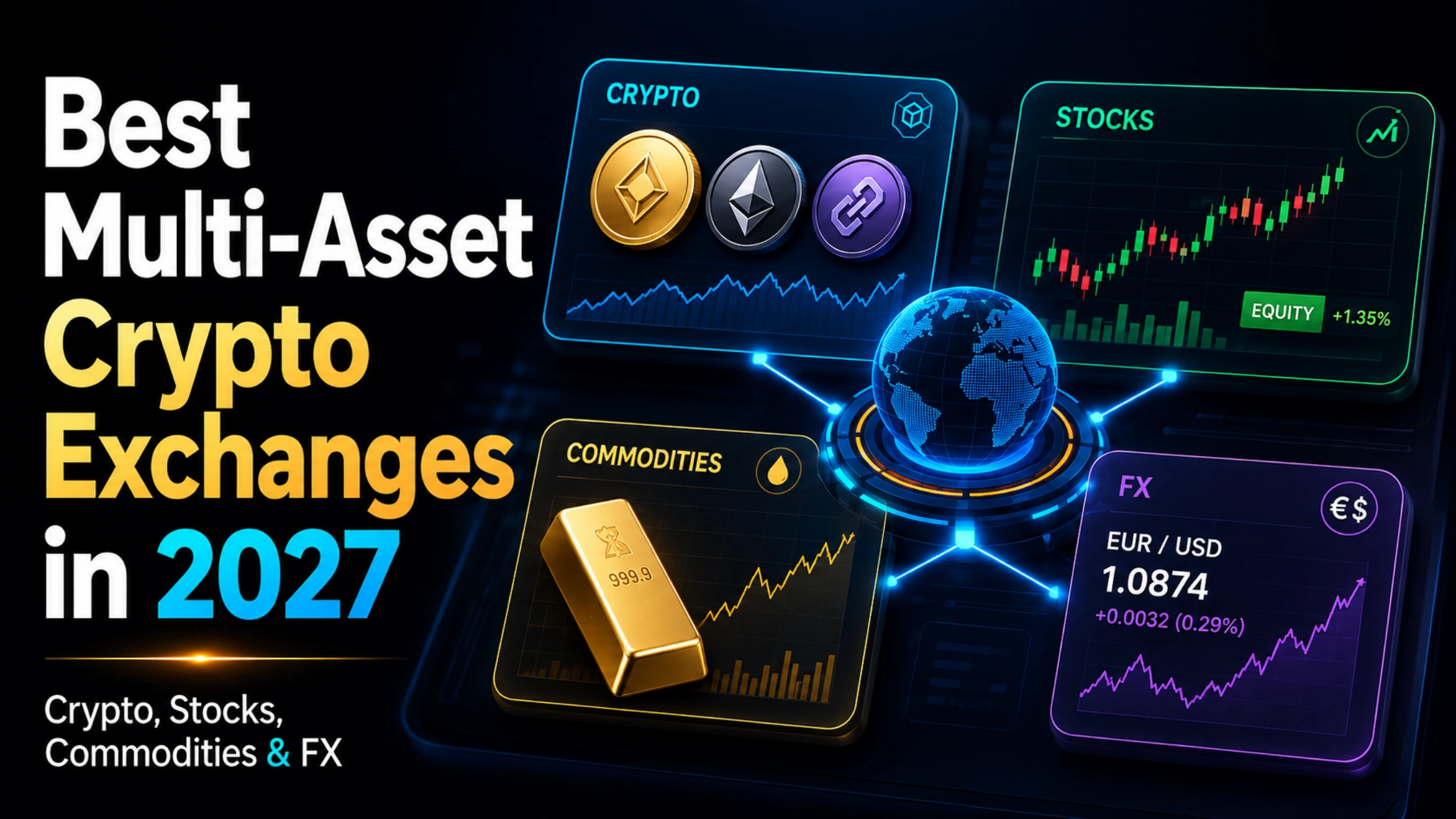
Compare the best multi-asset crypto exchanges and trading platforms for 2027. We rank Bitget, Kraken, Bybit, Crypto.com and other leading platforms for crypto, stocks, tokenized equities, stock perps, commodities, FX, indices and options using the proprietary DN Multi-Asset Authenticity Ladder.
Data checked: 29 August 2026. Product availability, leverage, market access and legal structure vary significantly by jurisdiction and may change during 2027.
Summary
The line between a crypto exchange and a traditional multi-asset brokerage is disappearing.
A growing number of platforms now allow users to move between:
- Bitcoin
- altcoins
- U.S. equities
- tokenized stocks
- equity perpetuals
- gold
- silver
- oil
- commodities
- FX
- stock indices
- options
without maintaining completely separate trading ecosystems.
But there is a major problem.
“Trade Apple” does not always mean you own Apple shares.
Depending on the platform, AAPL exposure might be:
- an actual share
- a 1:1 backed tokenized equity
- a conventional futures or synthetic instrument
- a perpetual derivative
- a CFD-style economic contract
Those products can have completely different:
- legal rights
- custody
- dividends
- voting rights
- settlement
- leverage
- liquidation risk
- counterparty risk
Decentralised News therefore created the proprietary DN Multi-Asset Authenticity Ladder.
Our current findings:
- Bitget: Best overall combination of multi-asset breadth and different exposure structures.
- Kraken: Best combination of crypto, asset-backed tokenization and regulated traditional futures.
- Bybit: Best for leveraged 24/7 multi-asset trading.
- Crypto.com: Strongest crypto-native alternative combining tokenized equities and multi-asset perpetuals.
- Robinhood: Best U.S. benchmark for actual shares plus regulated futures and crypto, although products sit across separate regulated accounts.
- eToro: Best established brokerage-style multi-asset benchmark.
- MEXC: Best derivatives-heavy alternative for stock and index perpetual exposure.
The central conclusion is simple:
Do not ask only what markets a platform offers. Ask what you legally and economically own when you place the trade.
Quick Verdict
For the broadest verified multi-asset proposition, Bitget currently takes our top position.
The reason is not simply that it offers more tickers.
Its 2026 product stack now includes different layers of exposure within the same ecosystem:
- spot crypto
- crypto perpetuals
- broker-style U.S. shares through Stock+
- 1:1 backed tokenized U.S. equities through rTokens
- stock perpetuals
- commodity derivatives
- FX-related derivatives
- index-linked products
- more than 2,800 U.S. stock options
That means an investor can sometimes decide not just which asset to trade, but how to obtain exposure to it.
For example, Tesla exposure might be expressed through:
actual stock ownership
or
a tokenized stock
or
a leveraged perpetual derivative.
That is a materially more sophisticated multi-asset architecture.
Kraken comes extremely close, especially for investors who value asset authenticity.
Its xStocks are 1:1 backed tokenized representations of equities and ETFs rather than uncollateralized synthetic contracts, while Kraken has also moved aggressively into regulated traditional futures.
Eligible U.S. customers can access exchange-listed futures spanning:
- equities indices
- commodities
- currencies
- crypto
through the same broader Kraken Pro ecosystem.
Outside the U.S., Kraken additionally offers:
- crypto perpetuals
- FX perpetuals
- equity perpetuals
- index exposure
- gold
- silver
- oil
subject to jurisdiction.
Bybit wins on leveraged breadth.
Its platform now combines crypto with:
- xStocks
- TradFi perpetuals
- forex
- metals
- oil
- commodities
- indices
- hundreds of stock CFDs
But many of those traditional-market products provide economic exposure rather than ownership.
That distinction is exactly why DN created the Authenticity Ladder.
Best Multi-Asset Crypto Platforms 2027
Rank | Platform | Best For | Highest Authenticity Available | Main Trade-Off |
1 | Best overall multi-asset stack | Actual U.S. shares | Product architecture is complex | |
2 | Best authentic crypto + TradFi bridge | Actual crypto / exchange-listed futures / 1:1 xStocks | Major regional differences | |
3 | Best leveraged multi-asset trading | Actual crypto / 1:1 xStocks | Much TradFi exposure is perp or CFD | |
4 | Crypto.com | Tokenized equities + multi-asset perps | Actual U.S. shares in eligible U.S. brokerage product / 1:1 tokens elsewhere | FX coverage is weaker |
5 | Robinhood | U.S. regulated multi-asset benchmark | Actual stocks + actual crypto | Separate regulated accounts; U.S.-centric |
6 | eToro | Traditional multi-asset benchmark | Actual non-leveraged stocks in eligible markets | Many non-equity markets use CFDs |
7 | Stock/index perpetual traders | Actual spot crypto | TradFi exposure overwhelmingly derivative |
The ranking rewards both breadth and clarity of legal exposure.
The DN Multi-Asset Authenticity Ladder
This is the central methodology behind the ranking.
A platform does not receive equal credit merely because its interface contains the words:
Tesla
Gold
or
EUR/USD.
The product underneath matters.
Level 1: Actual Asset
Highest authenticity
You legally or beneficially own the relevant asset.
Examples:
- BTC bought on a withdrawable spot market
- shares held through a securities brokerage
- fractional equity ownership through an eligible broker
For equities, Level 1 normally provides the strongest connection to:
- actual shares
- shareholder economic rights
- corporate actions
- brokerage custody
Voting treatment can still vary for fractional holdings or intermediated structures.
DN Authenticity Level
1 / 5
Level 2: Tokenized Security or Fully Backed Tokenized Asset
The investor holds a blockchain token economically linked to a real security.
A properly structured product may be backed:
1 token : 1 underlying asset
but the tokenholder is not necessarily the registered shareholder.
Depending on structure, users may receive:
- price exposure
- dividend equivalents
- stock-split adjustments
- transferability on-chain
but may lack:
- voting rights
- direct issuer communications
- direct legal ownership of the underlying share
Examples include:
- Kraken xStocks
- Bybit xStocks
- Crypto.com Tokenized Stocks
- Bitget rTokens
DN Authenticity Level
2 / 5
This is materially different from an unbacked synthetic.
Level 3: Synthetic or Conventional Futures Exposure
The customer owns a financial contract whose value references another asset.
This includes conventional exchange-listed futures and some index-linked synthetic instruments.
The user does not own:
- the stock
- the commodity
- the currency
simply because the contract references it.
A CME gold future and physical gold are different products.
However, regulated exchange-listed futures can provide transparent:
- contract specifications
- margin
- clearing
- settlement
- expiry
which can make them institutionally robust despite not conferring ownership.
DN Authenticity Level
3 / 5
Level 4: Perpetual Derivative
A perpetual contract tracks the underlying market without expiry.
Pricing normally relies on:
- index price
- mark price
- funding rate
- oracle/reference markets
Examples:
AAPLUSDT perpetual
XAUUSD perpetual
EURUSD perpetual
You are trading the price.
You do not own:
- Apple shares
- gold
- euros
DN Authenticity Level
4 / 5
Perpetuals can provide excellent capital efficiency.
They should simply not be confused with ownership.
Level 5: CFD-Style Economic Exposure
A CFD creates a contract between the customer and the provider or brokerage structure based on the price movement of an underlying market.
No underlying asset ownership is created.
CFDs commonly involve:
- leverage
- spread
- overnight financing
- broker counterparty exposure
- market-hour restrictions
Examples can include:
- stock CFDs
- commodity CFDs
- index CFDs
- FX CFDs
DN Authenticity Level
5 / 5
This does not automatically mean “bad.”
A sophisticated trader might deliberately prefer a CFD for:
- leverage
- short selling
- hedging
- intraday trading
The point is simply:
Know what you are buying.
Why the Authenticity Ladder Matters
Suppose four apps all display:
NVIDIA
One might offer:
Platform A
Actual NVDA shares.
Platform B
A 1:1 backed NVDA token.
Platform C
NVDA perpetual futures.
Platform D
NVDA CFD.
These positions could show almost identical price charts.
But economically and legally they are different products.
The investor’s rights differ.
The settlement differs.
The counterparty differs.
The trading hours differ.
The leverage differs.
The dividend treatment differs.
The liquidation risk differs.
Calling all four:
“stock trading”
creates unnecessary confusion.
DN Multi-Asset Authenticity Checker
Discover whether the position you are considering represents an actual asset, a 1:1 backed token, a synthetic contract, a perpetual derivative or CFD-style economic exposure.
What Do You Want to Trade?
DN Authenticity Result
DN Multi-Asset Authenticity Ladder
The tool lets readers choose:
- platform
- asset class
- country/region
- ownership preference
- leverage requirement
- 24/7 requirement
The tool then identifies:
- likely product structure
- DN Authenticity Level
- direct ownership status
- typical trading hours
- settlement model
- leverage characteristics
- principal structural risk
This turns the article into a decision tool rather than another exchange listicle.
1. Bitget: Best Overall Multi-Asset Crypto Platform
Referral code: nqef
Bitget has made one of the most aggressive moves from conventional crypto exchange toward what it calls a universal exchange.
Its currently documented multi-asset stack includes:
- spot crypto
- crypto perpetuals
- U.S. shares
- tokenized shares
- stock perpetuals
- commodity derivatives
- metal derivatives
- FX-related products
- indices
- U.S. stock options
This makes Bitget unusually difficult to classify simply as a cryptocurrency exchange.
Bitget Stock+: Actual Shares
One particularly important development is Bitget Stock+.
Unlike Bitget’s tokenized rTokens, Stock+ is designed as broker-style access to actual U.S.-listed equities and ETFs through licensed securities partners.
Current functionality includes access to thousands of U.S. stocks and ETFs.
Eligible investors can access:
- original U.S. stock tickers
- fractional shares
- corporate actions
- brokerage-style positions
- stock transfers in supported circumstances
Under the DN framework:
Bitget Stock+
Authenticity Level 1
This is genuine equity ownership rather than merely price tracking.
Bitget rTokens: Tokenized Stocks
Bitget also offers a separate crypto-native structure.
Reality-issued rTokens represent tokenized U.S. equity exposure.
Examples include:
- rAAPL
- rNVDA
- rTSLA
These tokens are backed 1:1 by underlying shares held through the relevant custody/brokerage structure.
The economic mapping includes elements such as:
- share-price movements
- dividends
- stock splits
But users should not confuse rTokens with being the registered shareholder of Apple or Tesla.
Under the DN ladder:
Bitget rToken
Authenticity Level 2
Why Having Both Matters
This creates a genuinely interesting choice.
A long-term investor might select:
Stock+ → actual share ownership
while a crypto-native trader might choose:
rToken → tokenized equity
because rTokens can integrate with:
- unified margin
- crypto trading strategies
- tokenized collateral
- extended-hours trading
The correct product therefore depends on the objective.
Bitget Stock Perpetuals
Bitget also offers stock futures/perpetual products.
Current contracts include exposure to companies and ETFs such as:
- Apple
- Amazon
- Coinbase
- Circle
- Meta
- Microsoft
- MicroStrategy
- Nvidia
- Palantir
- QQQ
depending on current listings.
These are derivatives.
They do not provide underlying share ownership.
DN Authenticity
Level 4
Commodities on Bitget
Bitget has expanded into commodity-related perpetual products.
Current verified categories include exposure to markets such as:
- gold
- silver
- platinum
- palladium
- copper
- Brent
- crude oil
- natural gas
depending on live contract availability.
These are derivatives rather than physical commodities.
Someone trading XAUUSDT is not taking delivery of bullion.
DN Authenticity
Usually:
Level 4
FX on Bitget
Bitget also supports selected FX-related trading products.
These provide economic exposure to currency pairs.
They should not be confused with:
holding euros in a EUR bank account
or:
exchanging USD for physical EUR.
The FX product is a trading instrument.
DN Authenticity
Typically:
Level 4 or 5 depending on product
Bitget U.S. Stock Options
Another major differentiator appeared in July 2026.
Bitget launched access to more than:
2,800 U.S. stock options.
At launch the product supported actions including:
- buy call
- buy put
- sell to close
and later expanded into pre-market options trading for selected major stocks and ETFs.
This creates genuine cross-asset hedging possibilities.
For example:
Long BTC + Long Nvidia Shares + SPY Put
can increasingly exist inside one broader platform ecosystem.
DN Verdict
Best overall verified multi-asset stack entering 2027.
The downside is complexity.
Bitget now has enough overlapping equity products that users need to understand whether they are selecting:
- Stock+
- rToken
- stock perpetual
- stock option
before trading.
That complexity is precisely what the Authenticity Ladder is designed to solve.
2. Kraken: Best Authentic Crypto-to-Traditional-Market Bridge
Kraken has taken a different route.
Rather than relying primarily on CFDs, it has expanded through:
- tokenized equities
- perpetual derivatives
- regulated futures infrastructure
This gives Kraken one of the strongest authenticity profiles among crypto-native venues.
Kraken Spot Crypto
Spot crypto remains:
Authenticity Level 1
when the user purchases a transferable digital asset such as BTC or ETH that can be withdrawn on-chain.
The customer owns the digital asset claim itself rather than a price derivative.
Kraken xStocks
Kraken’s xStocks platform now covers more than 100 tokenized stocks and ETFs, with the company targeting considerably broader coverage.
Examples include:
- Apple
- Tesla
- Nvidia
- Alphabet
- Coinbase
- SPY
- QQQ
- gold-related ETFs
Each xStock is designed as a 1:1 backed representation of an underlying equity or ETF.
xStocks can be transferred on-chain in eligible markets.
However, Kraken explicitly notes that holding an xStock does not create direct ownership of the underlying share.
DN Authenticity
Level 2
That distinction is important.
TSLAx tracks Tesla.
It is not identical to owning a conventional Tesla brokerage share.
Kraken xStocks Perpetuals
Kraken additionally introduced perpetual futures referencing tokenized equities.
Eligible traders can gain 24/7 leveraged exposure to markets including:
- individual U.S. equities
- S&P 500
- Nasdaq-100
- gold-linked products
without owning the underlying tokenized asset.
DN Authenticity
Level 4
Kraken Commodities
Kraken’s derivatives expansion now includes instruments tracking assets including:
- gold
- silver
- crude oil
depending on region.
The platform’s contract specifications in August 2026 included perpetual contracts tied to:
- WTI crude oil
- silver
- gold
alongside its large crypto derivatives market.
Again:
gold perpetual ≠ gold ownership.
Kraken FX Perpetuals
Kraken also offers perpetual futures referencing foreign-exchange markets.
The reference pricing is linked to underlying FX indices.
Users therefore receive:
currency price exposure
rather than actual bank deposits denominated in that currency.
Authenticity
Level 4
Kraken U.S. Traditional Futures
Where Kraken becomes particularly interesting is in the United States.
Kraken Derivatives US provides access to regulated futures markets through the broader Kraken infrastructure.
Current product categories include futures referencing:
- S&P 500
- Nasdaq-100
- gold
- oil
- currencies
- agricultural commodities
- crypto
through venues including CME-group exchanges and Bitnomial.
These are conventional exchange-listed futures.
DN Authenticity
Level 3
The investor does not own the underlying commodity or index.
But this is very different from an opaque synthetic contract.
The contract has:
- formal specifications
- expiry
- regulated venue
- clearing architecture
- defined settlement
Kraken Collateral
Kraken’s international multi-collateral derivatives environment supports a broad basket of collateral assets.
Depending on product and jurisdiction, traders can use:
- USD
- USDT
- crypto assets
- other eligible collateral
This creates useful capital efficiency for users already holding crypto.
Trading Hours
Product structure matters.
Spot crypto
24/7.
xStocks on Kraken
Generally extended trading throughout the week, with on-chain portability creating additional possibilities outside conventional exchange hours.
xStocks perpetuals
24/7 where supported.
FX
Underlying reference-market structure still matters.
Regulated TradFi futures
Follow the relevant futures-exchange trading schedule rather than crypto-style perpetual rules.
DN Verdict
Best bridge between authentic crypto ownership, 1:1 tokenization and regulated traditional derivatives.
Kraken’s biggest disadvantage is geographic fragmentation.
A U.S. customer, EEA customer and South African customer can see materially different product menus.
3. Bybit: Best for Leveraged 24/7 Multi-Asset Trading
Referral code: 46164
Bybit has developed one of the broadest traditional-market trading environments found inside a crypto platform.
Its architecture now includes three separate equity exposure models:
xStocks
Tokenized stocks.
TradFi Perpetuals
Crypto-style perpetual contracts referencing traditional assets.
Bybit CFD
CFD-style markets delivered through its MT5-compatible TradFi infrastructure.
Understanding the distinction is essential.
Bybit xStocks
Bybit’s xStocks provide tokenized exposure designed to be backed 1:1 by real shares.
Users can trade tokenized companies through the spot environment.
They do not receive conventional shareholder ownership.
DN Authenticity
Level 2
Bybit TradFi Perpetuals
Bybit TradFi perpetuals bring the familiar crypto derivatives model to traditional markets.
Current categories include:
- stocks
- gold
- silver
- crude oil
- forex
- indices
depending on live availability.
These products can trade:
24/7
because the contract itself is not the underlying traditional asset.
They use perpetual-futures mechanics including:
- margin
- funding
- liquidation
- index/mark pricing
DN Authenticity
Level 4
Why 24/7 Stock Trading Needs Interpretation
This is an important distinction.
Apple shares on Nasdaq do not suddenly become continuously traded shares because a crypto exchange offers an AAPL perpetual at 03:00 Sunday morning.
The perpetual market is independently providing:
synthetic continuous price discovery.
That can be extremely useful.
But it is still a derivative.
Bybit CFD
Bybit’s CFD environment dramatically increases instrument breadth.
Current documentation says users can access hundreds of markets spanning:
- forex
- U.S. stock CFDs
- indices
- metals
- oil
- commodities
The product is integrated with:
- Bybit web
- Bybit mobile
- MetaTrader 5
but uses its own CFD account structure.
Current Bybit documentation says the CFD infrastructure is powered through Infra Capital under its Mauritius FSC framework.
DN Authenticity
Level 5
Bybit FX
Forex is one of Bybit CFD’s strongest categories.
Dozens of FX contracts are available.
Depending on conditions, leverage can be substantially higher than typically available through regulated retail brokers in stricter jurisdictions.
That makes risk management particularly important.
Bybit Commodities
Available traditional-market exposure includes assets such as:
- gold
- silver
- crude oil
- other commodities
through either:
TradFi Perpetual
or
CFD
structures.
A trader should therefore check which product they have opened.
Bybit Collateral
TradFi perpetuals use Bybit’s Unified Trading Account environment.
The CFD system uses a separate MT5 CFD balance, although it remains integrated within the broader Bybit interface.
This makes the phrase:
“one account”
slightly misleading.
The user has one Bybit relationship but not necessarily one universal legal or margin account for every product.
DN Verdict
Best platform for traders who want maximum leveraged cross-asset breadth.
It ranks below Bitget and Kraken on authenticity because a larger percentage of the traditional-market suite consists of Levels 4 and 5.
That may be irrelevant for a day trader.
It is highly relevant for someone who thinks they are investing in actual shares.
4. Crypto.com: Strong Tokenized-Equity and Perpetual Ecosystem
Crypto.com has also moved rapidly toward a multi-asset model.
Its 2026 expansion includes:
- spot crypto
- tokenized stocks
- equity perpetuals
- commodity perpetuals
- U.S. index perpetuals
- actual U.S. brokerage equities for eligible U.S. customers
- institutional options
Crypto.com Tokenized Stocks
Crypto.com Tokenized Stocks are designed to track publicly traded equities:
1:1
with underlying shares held through partner and custody arrangements.
The tokens are issued on blockchain infrastructure and can trade around the clock where available.
The customer receives economic exposure.
But Crypto.com explicitly states that tokenized stockholders generally do not receive:
- direct ownership of the underlying shares
- voting rights
- direct shareholder communications
DN Authenticity
Level 2
Crypto.com Actual Stocks
In the United States, Crypto.com separately offers conventional stock brokerage access.
Eligible customers can buy:
- actual U.S. stocks
- ETFs
- fractional shares
through the stock-account infrastructure.
DN Authenticity
Level 1
This is a useful reminder that one brand can provide multiple legally different products.
Equity Perpetuals
Crypto.com Exchange introduced equity perpetual contracts in 2026.
These allow traders to gain leveraged exposure to public companies without owning their shares.
DN Authenticity
Level 4
Commodity and Index Perpetuals
Crypto.com additionally launched perpetual contracts referencing:
Metals
- gold
- silver
- platinum
- palladium
- copper
Energy
- crude oil
- natural gas
U.S. indices
- Nasdaq-100 exposure
- S&P 500 exposure
These are crypto-settled derivatives.
DN Authenticity
Level 4
Options
Crypto.com also expanded its options offering.
Its Exchange launched fully funded OTC vanilla options aimed principally at:
- institutions
- VIP clients
- foundations
This is not the same as a broad retail options order book.
DN Verdict
One of the strongest emerging multi-asset crypto ecosystems.
Its biggest gap against Bitget and Kraken is currently breadth in direct FX market access.
5. Robinhood: The U.S. Authenticity Benchmark
Robinhood is not primarily a crypto exchange.
It belongs in this article because it provides an important benchmark for what actual multi-asset access can look like.
Within the Robinhood ecosystem, eligible U.S. customers can access:
- actual stocks
- ETFs
- equity options
- spot crypto
- futures
- stock-index futures
- metals futures
- energy futures
- currency futures
- crypto futures
Robinhood Stocks
Conventional stocks represent:
DN Authenticity Level 1
The customer holds securities through a regulated broker-dealer structure.
Robinhood Crypto
Spot cryptocurrency sits through Robinhood Crypto rather than the securities broker.
Transferable crypto holdings therefore represent:
DN Authenticity Level 1
for the digital asset itself.
However, cryptocurrency does not receive SIPC protection simply because equities in another Robinhood account do.
Robinhood Futures
Robinhood’s futures offering provides exposure to:
- equity indices
- energy
- currencies
- crypto
- metals
- other commodities
These are conventional futures contracts.
DN Authenticity
Level 3
One App Does Not Mean One Legal Account
This is one of the most important lessons in the article.
Robinhood may show several asset classes through one interface.
But current documentation distinguishes between:
- Robinhood Financial for securities
- Robinhood Crypto for crypto
- Robinhood Derivatives for futures
That is actually useful clarity.
The same principle should be applied to crypto exchanges.
DN Verdict
Best U.S. benchmark for legally distinct but highly integrated multi-asset access.
6. eToro: Best Established Multi-Asset Brokerage Benchmark
eToro has operated a multi-asset model for much longer than most crypto-native exchanges.
Its global platform currently covers thousands of instruments across:
- stocks
- ETFs
- crypto
- commodities
- currencies
- indices
- options in eligible markets
Actual Asset vs CFD
The distinction matters enormously on eToro.
In eligible structures, an unleveraged:
BUY
position in a stock can represent exposure to the underlying equity.
Leveraged or short positions can instead operate through CFD structures depending on jurisdiction and product.
FX, commodities and indices are commonly provided through derivative exposure.
This makes eToro an almost perfect example of why DN’s Authenticity Ladder is necessary.
Apple BUY 1x
Potentially:
Level 1
Apple leveraged position
Potentially:
Level 5
Same ticker.
Different legal product.
DN Verdict
Excellent established multi-asset benchmark, particularly for investors combining traditional markets with crypto.
It is less crypto-native than Bitget, Kraken or Bybit.
7. MEXC: Best High-Leverage Stock and Index Futures Alternative
MEXC has expanded its perpetual-futures architecture beyond cryptocurrency.
Current verified products include numerous stock futures tracking companies such as:
- Coinbase
- Robinhood
- Nvidia
- Apple
- Amazon
- Alphabet
- Meta
- Tesla
MEXC has also launched index-style derivatives referencing:
- S&P 500
- SPY
- semiconductor ETFs
- volatility products
- regional equity ETFs
depending on live listings.
MEXC Stock Futures
MEXC explicitly notes that these contracts allow users to trade stock-price movements using crypto collateral without owning the underlying equity.
DN Authenticity
Level 4
24/7 Trading
Some MEXC stock and index contracts trade continuously.
That does not mean the underlying U.S. security itself trades continuously.
The derivative market is generating its own off-hours price.
This creates opportunities around:
- earnings
- geopolitical events
- weekend news
but also introduces:
- basis risk
- liquidity risk
- oracle/index risk
- gap risk when the underlying market reopens
DN Verdict
Strong derivatives-focused alternative, but not a complete ownership-oriented multi-asset platform.
Multi-Asset Coverage Matrix
Platform | Spot Crypto | Actual Stocks | Tokenized Stocks | Stock Perps | Commodities | FX | Indices | Options |
Bitget | ✓ | ✓ | ✓ | ✓ | ✓ | ✓ | ✓ | ✓ |
Kraken | ✓ | Limited by structure/region | ✓ | ✓ | ✓ | ✓ | ✓ | Limited |
Bybit | ✓ | No broad direct-share product | ✓ | ✓ | ✓ | ✓ | ✓ | Crypto options / product dependent |
Crypto.com | ✓ | ✓ in eligible U.S. product | ✓ | ✓ | ✓ | Limited | ✓ | ✓ / institutional + regional |
Robinhood | ✓ | ✓ | No core tokenized-equity product | Futures rather than crypto-style stock perps | ✓ | ✓ through futures | ✓ | ✓ |
eToro | ✓ | ✓ | Limited | CFD structure instead | ✓ | ✓ | ✓ | ✓ in eligible markets |
MEXC | ✓ | No | No broad direct product | ✓ | Partial | Limited | ✓ | No broad multi-asset options suite |
Availability varies materially by jurisdiction.
Best Platform for Actual Stock Ownership
Bitget Stock+
Best crypto-native starting point based on currently verified product breadth.
Robinhood
Excellent U.S. brokerage benchmark.
Crypto.com Stocks
Strong option for eligible U.S. customers.
eToro
Actual stock investing is available under qualifying unleveraged structures and jurisdiction-specific terms.
Best Platform for Tokenized Stocks
Kraken
One of the most mature xStocks ecosystems.
Bitget
rTokens combine 1:1 backing with integration into unified margin and crypto-native workflows.
Crypto.com
Strong 1:1 backed token architecture with 24/7 trading.
Bybit
xStocks provide tokenized-equity access alongside much broader derivative markets.
Best Platform for Stock Perpetuals
Bybit
Particularly strong combination of 24/7 access and TradFi derivatives.
Bitget
Large and expanding stock-perpetual universe.
Kraken
Strong regulated and tokenization-linked architecture.
Crypto.com
Increasingly broad equity perpetual offering.
MEXC
Attractive for high-leverage perpetual traders.
Best Platform for Commodities
For crypto-native leveraged exposure:
Bybit, Bitget, Kraken and Crypto.com
all deserve consideration.
But product structures differ.
Bybit
Perpetual or CFD.
Bitget
Crypto-margined derivative/perpetual.
Kraken
Perpetual internationally or exchange-listed futures in eligible U.S./EU contexts.
Crypto.com
Perpetual.
Robinhood
Traditional listed futures.
These should not be treated as equivalent forms of commodity ownership.
Best Platform for FX
Bybit
Broad CFD/TradFi FX coverage.
Bitget
Growing FX derivative stack.
Kraken
FX perpetuals and traditional currency futures depending on jurisdiction.
eToro
Long-established FX/CFD environment.
Robinhood
Currency futures rather than spot retail FX.
Again:
EUR/USD perpetual ≠ EUR/USD CFD ≠ currency future ≠ actually holding euros.
Best Platform for Options
Bitget has become particularly notable because of its U.S. stock options expansion.
For traditional listed equity options, platforms such as:
- Bitget through its relevant stock infrastructure
- Robinhood
- eToro in eligible markets
can be relevant.
For crypto-native options, product availability shifts toward platforms such as:
- Bybit
- Crypto.com
- specialist derivatives exchanges
The best options platform should ultimately be assessed separately because options require their own analysis of:
- strike depth
- expiries
- spreads
- market-maker quality
- Greeks
- exercise model
- settlement
Trading Hours: Why “24/7 Stocks” Needs Context
One of the most important marketing claims in this sector is:
24/7 stock trading.
But three very different things can sit behind that sentence.
Actual Shares
Traditional shares remain anchored to exchange trading and settlement systems.
Extended trading may exist.
But conventional markets still have defined sessions.
Tokenized Shares
A token representing a share can potentially trade:
24/7
because the token transfer system itself does not need Nasdaq to be open.
The question becomes:
How is fair value determined when the underlying equity market is closed?
Potential mechanisms include:
- market makers
- last available underlying price
- off-hours liquidity
- cross-venue tokenized markets
This can create larger spreads when traditional markets are closed.
Perpetual Futures
A perpetual can trade continuously because it is an independent derivative market.
Its pricing might rely on:
- index
- oracle
- funding
- internal mark-price mechanisms
This enables 24/7 speculation.
It can also create weekend basis divergence.
CFDs
CFDs usually follow underlying-market or broker trading sessions.
Many operate approximately:
24/5
rather than 24/7.
Collateral Is Becoming the Real Competitive Battleground
The next stage of multi-asset competition is not simply:
How many markets can I trade?
It is:
Can the assets I already hold collateralize the other markets I want to trade?
Consider a user holding:
- BTC
- USDC
- Nvidia token
- gold exposure
A mature unified account could allow those assets to contribute toward margin for:
- crypto futures
- stock futures
- commodity futures
Bitget is moving particularly aggressively in this direction through its Unified Trading Account.
Kraken’s Multi-M collateral architecture follows a similar principle for eligible derivatives.
Crypto.com has also moved toward one-wallet cross-product infrastructure.
This is where crypto-native exchanges may ultimately gain an advantage over conventional brokerages.
But Cross-Collateral Creates New Risk
Suppose you hold:
$100,000 Bitcoin
and use it as collateral for:
$150,000 Nvidia perpetual exposure.
Then:
- BTC falls
- Nvidia falls
- collateral value falls
- margin requirement rises
The trader can be liquidated even though neither asset independently would have caused the same problem.
Multi-asset collateral therefore creates:
capital efficiency
and:
cross-asset liquidation contagion.
The more unified the account becomes, the more important portfolio-level risk management becomes.
Settlement Models Compared
Spot Crypto
Usually near-instant internal settlement.
On-chain withdrawal follows blockchain confirmation.
Actual Shares
Traditional brokerage and clearing infrastructure.
Tokenized Shares
Potentially near-instant internal or blockchain settlement.
Conventional Futures
Variation margin and formal contract settlement.
Perpetual Futures
Continuous mark-to-market with funding.
CFDs
Broker-led contract settlement and financing.
Understanding the settlement model can matter as much as the trading fee.
What Happens to Dividends?
This is another easy place for investors to misunderstand the product.
Actual Share
Eligible shareholder receives the dividend according to brokerage/custody rules.
Tokenized Share
The token structure may pass through:
- dividend equivalent
- cash payment
- additional tokens
depending on issuer terms.
Stock Perpetual
Normally no conventional dividend ownership.
Instead, expected dividend effects may influence:
- index pricing
- funding
- fair value
CFD
Dividend adjustments may be credited or debited depending on:
- long/short position
- broker rules
These are not the same thing.
What Happens to Voting Rights?
Actual shares
Potential voting rights subject to custody/fractional structure.
Tokenized equities
Often:
no direct voting rights.
Perpetuals
None.
CFDs
None.
A user planning to hold a company for ten years should care more about this distinction than a trader holding an Nvidia perpetual for two hours.
What Happens During a Stock Split?
A properly structured product should have explicit rules.
Actual stocks
Broker adjusts the share count.
Asset-backed token
Issuer adjusts token economics or quantity.
Perpetual
Contract specification or reference price is adjusted.
CFD
Broker adjusts position according to contract terms.
The operational mechanism differs even where the portfolio value should theoretically remain equivalent.
Multi-Asset Regulation Is Not One Licence
Another misconception is that:
“Exchange X is regulated.”
A platform may operate:
- crypto exchange
- securities brokerage
- futures business
- CFD business
- tokenization service
through different legal entities.
For example, one app can contain:
three or four different regulated relationships.
That is not necessarily negative.
In many cases it is exactly how financial regulation is supposed to work.
The important question is:
Which legal entity is my counterparty for this specific trade?
Users should check:
- account terms
- regulatory entity
- jurisdiction
- investor protection
- custody structure
for the actual product being used.
Best Multi-Asset Platform by Trader Type
User Type | DN Starting Choice | Why |
Crypto + actual stocks | Bitget | Stock+ plus crypto ecosystem |
Crypto + tokenized equities | Kraken | Mature xStocks architecture |
24/7 multi-asset trader | Bybit | Broad perpetual coverage |
Multi-asset derivatives trader | Bitget / Bybit | Stocks, FX, commodities and crypto |
U.S. regulated futures trader | Kraken / Robinhood | Traditional listed futures infrastructure |
Tokenized-equity investor | Kraken / Crypto.com / Bitget | 1:1 backed structures |
U.S. stock + crypto investor | Robinhood / Crypto.com | Actual equities plus crypto ecosystem |
High-leverage stock trader | Bybit / MEXC | Perpetual and CFD exposure |
Equity options trader | Bitget / Robinhood | Broad stock-option access |
Long-term shareholder | Actual brokerage product | Prefer Level 1 ownership |
Which Product Should a Long-Term Investor Choose?
If the objective is:
Own Apple for 20 years
our preference order is generally:
1. Actual Share
Strongest legal ownership structure.
2. Properly Collateralized Tokenized Share
Potentially useful where conventional brokerage access is difficult.
3. Synthetic Derivative
Usually less appropriate for long-duration ownership.
4. Perpetual
Funding and liquidation make this structurally different from long-term investing.
5. CFD
Financing and counterparty structure can make very long holding periods inefficient.
The answer changes completely for an intraday trader.
Which Product Should an Active Trader Choose?
For a trader interested in:
- leverage
- shorting
- 24/7 access
- macro hedging
- capital efficiency
Levels 3 to 5 may actually be preferable.
A gold perpetual can be more useful than physical bullion if the objective is:
short gold for six hours after CPI.
A CFD can be more useful than buying shares if the objective is:
hedge an earnings announcement.
Authenticity is not the same as suitability.
The ladder identifies the structure.
The trader decides whether the structure fits the strategy.
Multi-Asset Platform Checklist
Before trading a non-crypto market through a crypto exchange, ask:
What am I actually buying?
Share, token, future, perpetual or CFD?
Do I own the underlying asset?
Yes or no?
Who holds the underlying asset?
If tokenized, identify the custodian.
Is it fully backed?
Look for explicit reserve or collateral structure.
Do I receive dividends?
Actual or equivalent?
Do I receive voting rights?
Usually only actual equity ownership provides the strongest claim.
Can I withdraw it?
Can the token leave the platform?
What are the trading hours?
24/7 does not automatically mean better liquidity.
How is the price determined when the underlying market is closed?
This is particularly important for weekend stock perpetuals.
What collateral do I use?
USD?
USDC?
USDT?
BTC?
Can my other positions cause liquidation?
Unified margin creates portfolio contagion.
Which legal entity provides the product?
Do not assume one licence covers everything.
Frequently Asked Questions
What is the best multi-asset crypto exchange in 2027?
Bitget currently provides the broadest verified combination of crypto, actual U.S. stock access, tokenized stocks, stock perpetuals, commodities, FX-related derivatives, indices and stock options.
Kraken is our preferred alternative where authenticity and regulated futures infrastructure carry greater weight.
Can I trade crypto and stocks from the same account?
Yes.
Platforms including Bitget, Kraken, Bybit, Crypto.com, Robinhood and eToro provide different combinations of crypto and equity exposure.
However, the legal account or product structure can differ within the same app.
Which crypto exchange offers actual stocks?
Bitget’s Stock+ product provides broker-style access to actual U.S. shares through licensed securities partners.
Crypto.com provides conventional U.S. equity brokerage access for eligible U.S. customers.
Traditional multi-asset brokers such as Robinhood and eToro also provide direct equity ownership under eligible structures.
Which crypto exchanges offer tokenized stocks?
Current examples include:
- Kraken
- Bitget
- Bybit
- Crypto.com
Product availability depends on jurisdiction.
Are tokenized stocks real stocks?
Not exactly.
Properly backed tokenized equities can be collateralized 1:1 by real underlying shares.
But holding the token normally does not mean the customer is the registered shareholder.
Do tokenized stocks have voting rights?
Often not.
Check the issuer terms.
Are stock perpetuals real stocks?
No.
Stock perpetuals are derivative contracts tracking a stock price.
They provide no underlying share ownership.
Can I trade gold on a crypto exchange?
Yes.
Platforms including Kraken, Bitget, Bybit and Crypto.com provide gold-related markets.
But most are derivatives rather than physical gold ownership.
Can I trade forex on a crypto exchange?
Yes.
Kraken, Bybit and Bitget currently provide different forms of FX-related derivative exposure.
These products are not equivalent to holding the actual fiat currencies.
Which crypto exchange offers the best stock perpetuals?
Bybit and Bitget are among the strongest current candidates, with Kraken, Crypto.com and MEXC also offering equity-linked perpetual products.
Which exchange is best for actual ownership?
For equities, use a product explicitly structured as brokerage share ownership rather than a perpetual or CFD.
Bitget Stock+, Robinhood and qualifying brokerage-style products are examples.
What does 24/7 stock trading mean?
It can mean:
- a tokenized stock trades around the clock
- a stock perpetual trades around the clock
It does not necessarily mean ordinary shares on Nasdaq or NYSE trade continuously.
Are CFDs the same as perpetual futures?
No.
Both are derivatives, but their pricing, financing, counterparty, settlement and trading mechanics differ.
Which is better, tokenized stocks or stock perpetuals?
It depends on the objective.
Tokenized stocks are more suitable for investors seeking asset-backed equity exposure.
Perpetuals can be more suitable for:
- leverage
- shorts
- short-term trading
- 24/7 speculation
Are multi-asset exchanges safe?
Multi-asset breadth does not establish safety.
Users should separately examine:
- exchange solvency
- regulation
- custody
- account security
- liquidation rules
- counterparty structure
Can I use crypto as collateral to trade stocks?
Certain multi-asset exchanges increasingly allow crypto or stablecoin collateral to support traditional-asset derivatives.
The exact collateral rules depend on platform and product.
Final Verdict
The crypto exchange is evolving into something much larger.
The emerging category is not simply:
crypto exchange + a few stock tickers.
It is a new type of universal trading platform where:
- cryptocurrency
- equities
- tokenized securities
- commodities
- currencies
- indices
- options
can increasingly coexist within the same interface and collateral environment.
Bitget currently leads our overall ranking because its product stack extends from actual U.S. share ownership through Stock+ all the way to tokenized equities, perpetuals, commodity/FX derivatives and thousands of stock options.
Kraken ranks extremely highly because the quality of its exposure is particularly strong. Spot crypto provides genuine digital-asset ownership, xStocks are 1:1 backed tokenized equities, and its move into regulated traditional futures gives users a bridge to established derivatives infrastructure.
Bybit provides the strongest proposition for aggressive leveraged multi-asset traders. Its TradFi perpetuals and CFD architecture cover an exceptionally broad range of markets, but customers need to understand that much of this exposure sits at Levels 4 and 5 of the Authenticity Ladder.
Crypto.com is rapidly building a compelling combination of tokenized stocks, conventional U.S. equities and multi-asset perpetuals.
Robinhood and eToro remain important benchmarks because they show how mature traditional multi-asset brokerage architecture handles the distinction between actual assets and derivatives.
MEXC is increasingly relevant for traders who primarily want stock and index perpetuals rather than ownership.
But the larger conclusion matters more than the ranking.
In 2027, asking:
“Can I trade stocks on this crypto exchange?”
is no longer sufficient.
The important question is:
“When I press Buy, what exactly do I own?”
Is it:
the asset?
a token backed by the asset?
a synthetic contract?
a perpetual?
a CFD?
The ticker may look identical.
The economic and legal reality may not be.
That is what the DN Multi-Asset Authenticity Ladder is designed to expose.
Affiliate Disclosure
Some links in this article are affiliate links. Decentralised News may receive compensation if an eligible reader opens an account through one of these links. Affiliate relationships do not influence rankings, authenticity classification, methodology, risk analysis or editorial conclusions.
Disclaimer
This article is for educational and informational purposes only and is intended for readers aged 18 and over. Crypto assets, tokenized securities, futures, perpetuals, CFDs, options and leveraged products can result in substantial or total financial loss. Availability, legal structure, leverage, settlement, investor protections and regulation vary by jurisdiction. Verify current product terms directly with the relevant provider before trading.
Related reading:
Crypto Exchange KYC Friction Index: Which Exchanges Make Verification Easiest?
The Crypto Platform Selector 2027: Find the Best Exchange, DEX, Wallet or Tool for Your Needs