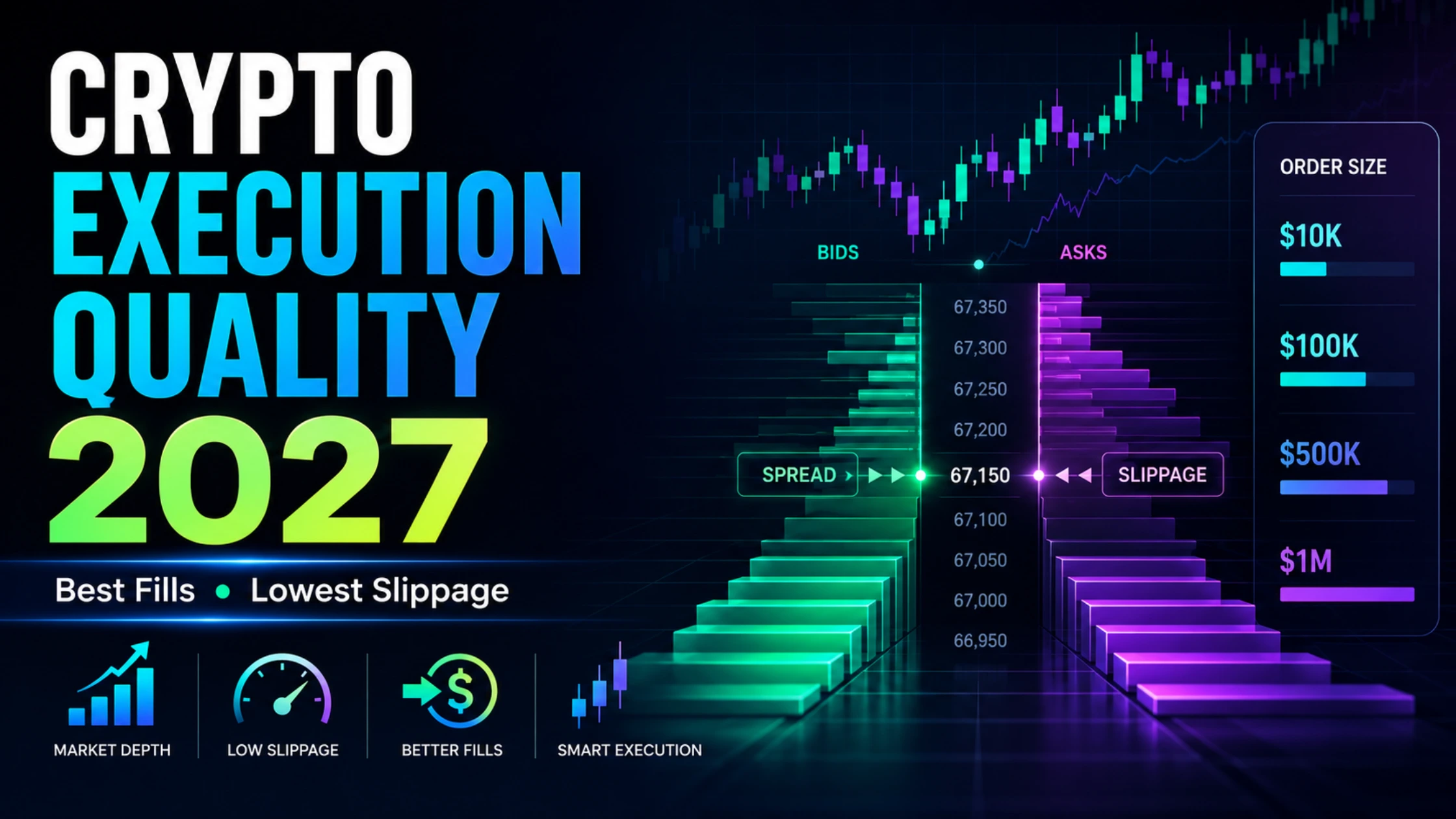
The DN Crypto Execution Quality Index 2027 compares Binance, OKX, Bitget, Bybit, Kraken, MEXC, Gate.com, WOO X and specialist venues using spread, depth, slippage, market impact, fees, API infrastructure and large-order execution.
Last methodology review: August 2026
Affiliate disclosure: Some links in this research are affiliate links. Decentralised News may receive compensation if a reader registers or trades through an eligible link. Affiliate relationships do not influence rankings, scores, methodology or conclusions.
Summary
The cheapest crypto exchange is not necessarily the cheapest place to execute a trade. The DN Execution Quality Score evaluates exchanges using executable depth, slippage, market impact, spread, fee economics, order handling and resilience. Current market-depth evidence gives Binance the strongest large-order profile overall, while OKX, Bitget and Bybit form the most competitive second tier.
Key Findings
- Binance currently has the strongest evidence for large BTC execution, particularly as order size approaches $500,000 to $1 million.
- Bitget performs particularly well in near-touch spot liquidity, making it more competitive than headline volume rankings alone may suggest.
- OKX becomes increasingly relevant for systematic and derivatives traders because execution infrastructure, futures depth and API capacity matter alongside spot liquidity.
- Bybit remains a major derivatives execution venue, particularly for traders combining perpetual futures with portfolio-level collateral management.
- A $10,000 order and a $1 million order should not use the same exchange-selection methodology.
- For large traders, slippage can matter considerably more than advertised trading fees.
- Altcoin execution quality can diverge sharply from BTC and ETH execution quality on the same exchange.
The DN Execution Quality Index
Most exchange rankings compare trading fees.
Professional traders should ask a different question:
How much does it actually cost me to complete the trade?
A nominal 0.02% trading fee is irrelevant if a trader loses another 0.15% crossing a weak order book.
Decentralised News therefore defines execution cost as:
Effective Execution Cost = Trading Fee + Spread Cost + Slippage + Market Impact + Execution Failure Cost
The DN Execution Quality Score, or DN EQS, evaluates the factors that determine whether displayed liquidity translates into an economically efficient fill.
DN Execution Quality Score Methodology
Component | Weight | What DN Measures |
Executable depth | 30% | Capital available close to the prevailing market price |
Slippage and market impact | 25% | Price deterioration as order size increases |
Spread quality | 15% | Distance between executable bid and ask |
Maker/taker economics | 10% | Effective trading cost after applicable fee tier |
API and order handling | 10% | Order submission, modification, cancellation and systematic-trading capacity |
Stress resilience | 10% | Likelihood that usable liquidity persists during volatile markets |
Evidence Classification
Every DN execution study should classify evidence as:
Observed: directly collected by Decentralised News.
Calculated: mathematically derived from observed or sourced data.
Modelled: produced by the DN Execution Quality methodology.
Exchange-reported: published by the trading venue itself.
Third-party sourced: measured independently by an external market-data provider.
The scores in this edition are primarily modelled scores informed by current third-party liquidity observations and exchange documentation. They should not be interpreted as a claim that Decentralised News personally submitted every order size on every venue.
That distinction matters.
DN Execution Quality Score 2027
Rank | Exchange | DN EQS | Strongest Use Case | Evidence Confidence |
1 | 94/100 | Large BTC/ETH spot and derivatives execution | High | |
2 | 89/100 | Systematic, derivatives and high-volume trading | High | |
3 | 87/100 | Near-touch liquidity and active futures trading | Medium-High | |
4 | 84/100 | Perpetual futures and multi-position traders | High | |
5 | 81/100 | High-quality regulated spot execution | Medium | |
6 | 79/100 | Broad asset access and selected spot liquidity | Medium | |
7 | 77/100 | Broad markets and API-driven trading | Medium | |
8 | 75/100 | Active and institution-oriented execution | Medium |
Specialist classification: Deribit is treated separately because its strongest execution proposition is crypto derivatives and especially options, making a universal spot-versus-derivatives score less meaningful.
The scores are a research model, not permanent facts. Crypto liquidity moves rapidly between venues, assets and market regimes.
Why Binance Currently Leads
The evidence for Binance is strongest when trade size becomes large.
Independent liquidity research covering selected centralized exchanges between June 15 and July 14, 2026 found Binance leading cumulative BTC and ETH spot depth near the market. At the wider 0.03% band, Binance recorded approximately $3.5 million of cumulative depth in the study, versus $2.56 million for Bitget, $1.76 million for MEXC and $1.7 million for OKX.
Large-order slippage data points in the same direction.
A May 2026 TokenInsight study measured median BTC spot slippage on a $500,000 sell at approximately 0.015% on Binance. At $1 million, the median was approximately 0.022%.
That difference is economically significant.
At $1 million:
- 0.02% execution loss = $200
- 0.10% execution loss = $1,000
- 0.25% execution loss = $2,500
- 0.50% execution loss = $5,000
A trader obsessing over a five-basis-point fee difference while ignoring a 20-basis-point liquidity difference is optimizing the wrong variable.
Binance also led the BTC futures-depth sample in CoinGlass’ Q1 2026 research, ahead of OKX and Bybit.
DN verdict
Best current all-round execution candidate for very large BTC and ETH orders.
For smaller altcoins, individual order books still need to be assessed independently.
DN referral code: CPA_00SXKU7IO9
Availability and referral-code eligibility can vary by jurisdiction.
2. OKX: Best High-Volume Alternative for Systematic Traders
OKX takes second position because execution quality involves more than raw spot depth.
Its strongest case emerges from the combination of:
- substantial derivatives liquidity
- competitive BTC/ETH books
- institutional infrastructure
- portfolio-margin capabilities
- REST and WebSocket trading
- high-capacity order-management infrastructure
- subaccounts
- sophisticated derivatives markets
Independent Q1 2026 data placed OKX second behind Binance in average BTC futures depth within the measured group.
Its API architecture is particularly relevant for algorithmic traders. OKX documentation states that trading-related REST and WebSocket rate limits are shared where applicable, while subaccounts can support substantial order-request capacity.
That does not automatically mean orders fill faster.
It means the infrastructure is designed for traders whose strategies depend on frequent order submission, amendments and cancellations.
DN verdict
Best all-round alternative to Binance for systematic and derivatives-heavy high-volume trading.
Open an OKX account via Decentralised News
Referral code: 2136301
3. Bitget: Stronger Execution Competitor Than Many Traders Assume
Bitget deserves particular attention because recent near-touch liquidity data has been strong.
TokenInsight’s July 2026 research placed Bitget second behind Binance at the wider 0.03% BTC/ETH spot-depth band in its selected exchange sample.
Its May study also measured approximately 0.018% median slippage on a $500,000 BTC spot sell, close to Binance’s 0.015% result in the same study.
For sophisticated market makers, Bitget’s economics can become more interesting still.
The exchange operates institutional liquidity-incentive structures in which qualifying futures market makers can receive negative maker fees on designated market groups.
That distinction is important.
A retail fee schedule tells you what an ordinary trader pays.
A professional market-making schedule tells you what an exchange is willing to pay sophisticated participants to improve its book.
DN verdict
One of the strongest challengers for BTC/ETH spot execution and a serious venue for active futures traders.
Open Bitget via Decentralised News
Referral code: nqef
4. Bybit: Strong for Derivatives and Portfolio-Level Execution
Bybit remains particularly important for perpetual futures traders.
CoinGlass’ Q1 2026 research placed Bybit among the three largest measured BTC futures venues by ±1% two-sided depth, behind Binance and OKX.
Its spot market was also competitive in the same research.
For a professional derivatives trader, however, the attraction is broader than book depth.
Bybit‘s Unified Trading Account architecture can allow traders to manage collateral and multiple positions within a more integrated margin structure.
That matters because execution efficiency is partly a capital-efficiency problem.
An exchange with marginally cheaper fills can still be economically inferior if a trader must immobilize considerably more collateral to run the same strategy.
DN verdict
Particularly strong for perpetual futures traders managing multiple simultaneous positions.
Open Bybit via Decentralised News
Referral code: 46164
5. Kraken: Strong Spot Market Quality, Particularly for Fiat-Oriented Traders
Kraken occupies a different position.
It is less compelling as a universal high-frequency perpetual-futures venue than some offshore competitors, but remains relevant for:
- BTC and ETH spot execution
- large fiat flows
- institutional trading
- OTC
- regulated-market access
- traders prioritizing counterparty quality alongside execution
Independent exchange benchmarking has continued to place Kraken among the industry’s highest-quality centralized exchanges when security, governance and market quality are included.
That matters for HNW investors.
Execution quality should not be reduced to saving two basis points while ignoring custody, counterparty and settlement risk.
DN verdict
A strong candidate for HNW spot traders whose execution workflow includes substantial fiat movement and institutional requirements.
Explore Kraken via Decentralised News
6. MEXC: Strong Near-Touch Liquidity, But Automation Economics Need Attention
MEXC is a useful example of why the DN Index does not rank exchanges by one metric.
Recent independent research found MEXC extremely competitive in very tight BTC/ETH spot-depth bands.
Its market-maker programme also includes maker rebates for qualifying professional participants.
But algorithmic traders need to inspect the fee schedule carefully.
MEXC introduced futures API trading in 2026 and subsequently changed the fee structure. Importantly, the exchange states that API futures trades can have a separate fee structure from trades placed through its website or app.
That can completely change strategy economics.
A bot generating enormous turnover may care far more about the API-specific rate than the promotional rate displayed on an exchange homepage.
DN verdict
Potentially compelling for selected spot markets and broad asset access, but API traders should calculate their own effective fee structure before deployment.
Open MEXC via Decentralised News
Referral code: 16yJL
7. Gate.com: Broad Market Coverage With Serious API Infrastructure
Gate.com‘s principal strength is breadth combined with increasingly sophisticated trading infrastructure.
For quantitative traders operating across many tokens, that matters because the “best” execution venue may not be the venue with the deepest BTC book.
Gate’s API documentation includes substantial order-management capacity across spot and futures environments, with rate limits varying according to endpoint and account classification.
For market-making strategies, fill-ratio-based restrictions are particularly important.
A strategy that repeatedly submits and cancels orders without producing fills can eventually encounter different infrastructure economics from a strategy that generates productive liquidity.
This is exactly the kind of operational detail conventional exchange reviews usually ignore.
DN verdict
Worth considering for systematic traders who need broad asset coverage, particularly where the required market is unavailable on deeper tier-one venues.
Open Gate.com via Decentralised News
Referral code: 6139199
8. WOO X: Execution-Oriented Alternative for Active Traders
WOO X is designed more explicitly around active trading than many retail-first exchanges.
Its fee structure incorporates variables including trading volume and participation level, while institutional and active-trading infrastructure remain central to the platform’s positioning.
WOO X should therefore be evaluated at the account-specific effective-fee level, rather than from a single advertised rate.
The limitation for the current DN Index is evidence coverage.
There is less directly comparable public large-order depth and slippage evidence available across identical sampling windows than for Binance, OKX, Bitget and Bybit.
That reduces confidence in a precise cross-venue ranking.
DN verdict
An execution-focused venue worth testing, but DN currently assigns lower evidence confidence than to the four leaders.
Open WOO X via Decentralised News
Referral code: NCYDOFZF
Deribit: The Specialist Choice for Crypto Options
Deribit should not be forced into the same ranking as general-purpose spot exchanges.
It remains most relevant to:
- systematic options traders
- volatility desks
- delta-neutral portfolios
- futures/options combinations
- block trading
- advanced derivatives execution
Deribit‘s current fee structure includes automatic volume-based tiers, with progressively lower fees for qualifying high-volume traders.
At the highest tiers, futures makers can receive rebates.
Options are particularly different because execution quality depends on more than depth in one instrument.
A sophisticated trader may need to evaluate:
- bid/ask width
- implied-volatility consistency
- strike liquidity
- maturity liquidity
- multi-leg execution
- portfolio margin
- block liquidity
DN verdict
Specialist execution leader for serious crypto-options traders rather than a universal exchange winner.
Open Deribit via Decentralised News
$10K vs $100K vs $500K vs $1M: Why Rankings Change
The DN Execution Quality Index evaluates order size separately because liquidity is nonlinear.
$10,000 Order
For liquid BTC and ETH markets, depth is rarely the primary constraint.
The trader should focus more heavily on:
- spread
- taker fee
- routing
- order type
- API reliability
DN preferred group
Binance, OKX, Bitget, Bybit
At this size, differences may be measured in dollars rather than thousands of dollars.
$100,000 Order
Depth begins to matter more.
A trader should measure the amount available within:
- 1 basis point
- 3 basis points
- 5 basis points
- 10 basis points
The exchange with the narrowest quoted spread can lose if only a small quantity is available at the displayed best price.
DN preferred group
Binance, Bitget, OKX, Bybit
For less liquid altcoins, a $100,000 order can already represent meaningful market impact.
$500,000 Order
At half a million dollars, execution quality becomes a first-order cost.
Current third-party BTC spot evidence gives Binance the clearest advantage, with Bitget showing particularly competitive results in one recent independent study.
The trader should now consider:
- market impact
- average execution price
- order slicing
- passive versus aggressive routing
- execution time
- information leakage
DN preferred BTC group
Binance → Bitget / OKX → Bybit
The precise order behind Binance is market and time dependent.
$1 Million Order
At $1 million, headline trading fees become increasingly inadequate as a venue-selection metric.
On BTC, independently measured data currently provides the strongest public execution case for Binance.
But professionals should ask another question:
Should the entire $1 million be sent to one exchange at all?
For sophisticated traders, the optimal strategy may involve:
- TWAP
- VWAP
- passive order placement
- iceberg orders
- OTC RFQ
- multi-venue routing
- block trading
- liquidity aggregation
For altcoins, a $1 million aggressive order can substantially exceed safe immediate liquidity even on a major exchange.
That is when execution architecture becomes more important than exchange rankings.
DN Execution Quality Slider
Select:
- $10,000
- $100,000
- $500,000
- $1,000,000
Then choose:
- BTC/ETH
- Major altcoin
- Long-tail altcoin
And:
- Spot
- Perpetual futures
The tool dynamically changes the importance of spread, fees, slippage and executable depth as order size increases.
Important: The slider is a DN research model, not a live order-routing recommendation. Real-time order books should always be checked immediately before execution.
Quoted Spread Is Not Executable Spread
This is one of the biggest mistakes in retail exchange comparisons.
Imagine:
Exchange A
Best ask: $100,001
Quantity available: $8,000
Exchange B
Best ask: $100,004
Quantity available: $250,000
A website may report Exchange A as having the tighter spread.
A $200,000 buyer may actually receive a better average fill on Exchange B.
The professional metric is therefore not simply:
best ask minus best bid
It is:
volume-weighted executable price for the required order size.
That is why DN gives executable depth three times the weight of headline fees.
Slippage vs Market Impact
The concepts are related but not identical.
Slippage is the difference between the expected trade price and the actual execution price.
Market impact is the price movement caused by the trade consuming liquidity.
A large aggressive order can create its own slippage.
Consider a hypothetical $1 million purchase:
Expected price: $100,000
Average fill: $100,100
Execution slippage:
0.10%
Dollar impact:
$1,000
If another venue charges an additional 0.02% in fees but reduces slippage by 0.08%, the apparently “more expensive” exchange is actually cheaper.
Why Maker Fees Can Be Misleading
Professional traders frequently attempt to earn the spread rather than cross it.
But a negative maker fee is not free money.
A market maker faces:
- adverse selection
- queue risk
- inventory exposure
- cancellation risk
- informed flow
- latency
- funding
- hedging costs
The relevant equation is:
Expected Maker P&L = Spread Capture + Rebate − Adverse Selection − Inventory Cost − Hedging Cost
An exchange offering a maker rebate can therefore still produce worse economics than a venue charging a small maker fee.
This is why a future extension of the DN Index will include a dedicated DN Effective Maker Economics Score.
Order Rejections Are an Execution Cost
An order that never reaches the market has infinite slippage relative to the intended execution.
Algorithmic traders should track:
- API rejection rate
- acknowledgement latency
- cancellation acknowledgement
- amendment reliability
- stale connection frequency
- WebSocket sequence gaps
- rate-limit events
- duplicate-order protection
These metrics are particularly important for:
- market makers
- arbitrageurs
- liquidation strategies
- delta hedgers
- high-frequency systematic traders
DN therefore allocates part of the Execution Quality Score to operational execution infrastructure.
What Happens During Market Stress?
The deepest exchange on a quiet Tuesday afternoon may not be the deepest exchange during a liquidation cascade.
Liquidity can disappear precisely when traders need it most.
The next stage of the DN benchmark will therefore separate:
Normal Market EQS
from:
Stress Market EQS
Stress testing should measure:
- spread expansion
- depth deterioration
- slippage deterioration
- API availability
- order rejection
- liquidation congestion
- index-price divergence
The ultimate question is not:
“How deep is the order book?”
It is:
“How much of that liquidity survives when volatility explodes?”
BTC vs Altcoins: Never Extrapolate
An exchange can be excellent for BTC and poor for a specific altcoin.
BTC typically benefits from:
- more market makers
- deeper collateral markets
- more arbitrage connections
- higher institutional participation
- larger derivatives markets
Long-tail assets may have:
- shallow books
- concentrated liquidity
- large price gaps
- few professional market makers
- severe cross-exchange fragmentation
The DN Index therefore recommends pair-level execution analysis, not blind reliance on an exchange-level score.
Best Exchange by Trader Type
High-Net-Worth Spot Investor
Priorities:
depth, fiat settlement, OTC access, counterparty quality.
DN shortlist: Binance, Kraken, OKX.
High-Volume Perpetual Futures Trader
Priorities:
depth, taker economics, portfolio margin, API stability.
DN shortlist: Binance, OKX, Bybit, Bitget.
Market Maker
Priorities:
maker economics, queue quality, API infrastructure, market-maker programmes.
DN shortlist: Bitget, Binance, OKX, MEXC, Gate.com.
Algorithmic Trader
Priorities:
WebSockets, API limits, rejection behaviour, latency, fee structure.
DN shortlist: OKX, Binance, Bybit, Bitget, Gate.com.
Options Quant
Priorities:
options depth, volatility surface, Greeks, portfolio margin, block execution.
DN specialist choice: Deribit.
The Biggest Lesson: Stop Comparing Fees in Isolation
The traditional exchange comparison asks:
Which exchange has the lowest fees?
The professional question is:
Which exchange minimizes my total cost of completing the trade?
Those questions can produce completely different answers.
A $10,000 retail order can reasonably prioritize fees and spread.
A $1 million institutional order should prioritize:
- executable depth
- expected slippage
- market impact
- execution architecture
- settlement and counterparty risk
- fees
This is the central principle behind the DN Execution Quality Score.
DN Methodology Shield
The Crypto Execution Quality Index is designed as a living research benchmark.
Future data collection should capture standardized order-book snapshots for identical trading pairs at synchronized timestamps.
For each venue DN should record:
- best bid
- best ask
- spread
- ±1 bp depth
- ±3 bp depth
- ±5 bp depth
- ±10 bp depth
- simulated VWAP at $10K
- simulated VWAP at $100K
- simulated VWAP at $500K
- simulated VWAP at $1M
- maker fee
- taker fee
- API order limits
- observed rejection rate where measurable
Snapshots should be collected repeatedly rather than once.
A single order-book screenshot is not an execution benchmark.
The objective is eventually to publish:
median execution cost
P90 execution cost
normal-market execution
and
stress-market execution
separately.
This would allow readers to determine not merely which exchange looks cheapest, but which venue produces the most reliable execution distribution.
FAQ
Which crypto exchange has the best execution quality?
Current public liquidity evidence gives Binance the strongest overall case for large BTC and ETH execution, with OKX, Bitget and Bybit forming a highly competitive second group. The best venue still depends on the trading pair, order size and market type.
What is the DN Execution Quality Score?
The DN Execution Quality Score is a Decentralised News methodology that evaluates executable depth, slippage, market impact, spread, trading economics, order infrastructure and resilience rather than ranking exchanges by headline fees alone.
What is the best exchange for a $1 million Bitcoin trade?
Recent independent BTC liquidity and slippage research provides the strongest public evidence for Binance among the venues examined. A professional trader may nevertheless obtain better execution using algorithmic slicing, OTC or multi-venue routing rather than placing a single $1 million market order.
Does the lowest trading fee mean the cheapest execution?
No. Spread, slippage and market impact can exceed the trading fee, particularly on large orders and less-liquid cryptocurrencies.
Is Bitget liquid enough for large trades?
Recent third-party research has shown strong near-touch BTC and ETH liquidity on Bitget, including competitive measured BTC slippage at the $500,000 order level. Conditions vary by pair and time.
Is OKX good for algorithmic traders?
OKX provides REST and WebSocket trading APIs, substantial derivatives markets and high-capacity order-management infrastructure. Its combination of liquidity and API architecture makes it one of the stronger venues for systematic trading.
Is Bybit suitable for high-volume perpetual trading?
Bybit remains one of the major crypto derivatives venues and has ranked strongly in independent BTC futures-depth comparisons. Its Unified Trading Account can also be relevant for traders managing multiple derivatives positions.
Which exchange is best for crypto options?
Deribit remains a specialist venue worth evaluating for sophisticated BTC and ETH options strategies, particularly where volatility, portfolio margin and multi-leg execution matter.
Final Verdict
The DN Crypto Execution Quality Index 2027 changes the exchange-selection question.
Do not ask:
“Who advertises the lowest fee?”
Ask:
“Where can my order actually be completed at the lowest total economic cost?”
For small BTC or ETH trades, several leading exchanges may produce similar outcomes.
As notional rises toward $100,000, $500,000 and $1 million, the differences become more meaningful.
Current evidence gives Binance the strongest large-order execution profile, while OKX, Bitget and Bybit form the most credible challenger group.
Kraken remains important for institutional and fiat-oriented spot workflows. MEXC and Gate.com deserve attention where breadth and specialised markets matter. WOO X is an execution-focused alternative. Deribit belongs in a specialist category for options traders.
But no leaderboard should be permanent.
Liquidity migrates.
Market makers change venues.
Fee tiers change.
APIs change.
Volatility changes everything.
That is why the DN Execution Quality Index should evolve from a static article into a continuously updated execution research asset.
The exchange with the lowest fee is not necessarily the exchange with the cheapest fill.
That is the distinction professional traders should care about.
18+ Educational Disclaimer: Digital assets and leveraged derivatives involve substantial risk. This research is educational and informational only and does not constitute financial, investment, legal or tax advice. Exchange access, products, leverage, fees and eligibility vary by jurisdiction. Past or modelled execution quality does not guarantee future execution. Verify current order books, fees and platform terms before trading.