Last fact checked: August 15, 2026
Research edition: DN Tokenized Equity Authenticity Index
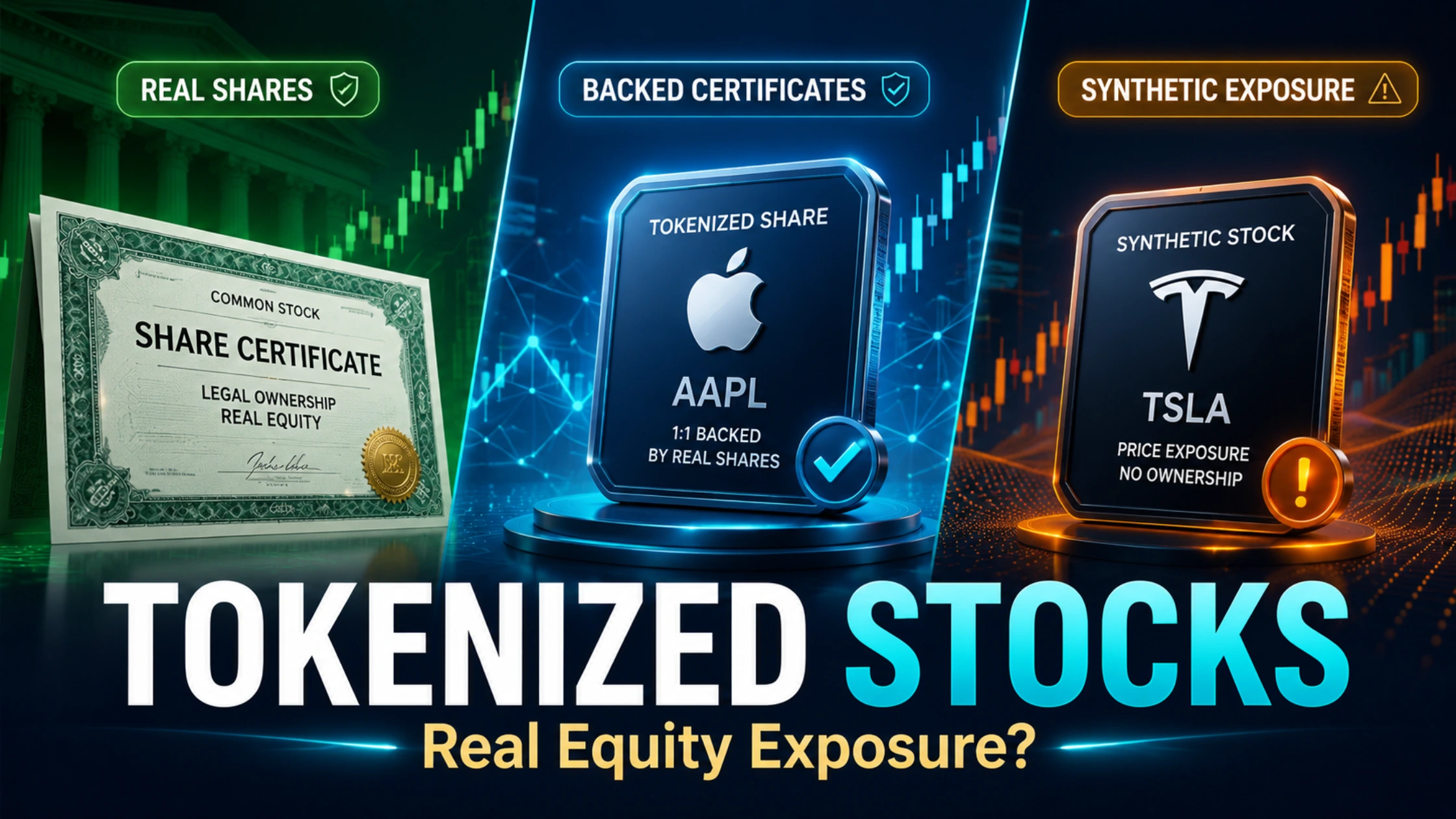
Not every tokenized stock represents actual stock ownership. The DN Tokenized Equity Authenticity Index ranks tokenized equities by beneficial ownership, backing, dividends, voting rights, redemption, trading access and bankruptcy protection.
Key Findings
A token can track Apple, Nvidia, Tesla or another listed stock almost perfectly and still not make its holder a shareholder of that company.
That distinction has become increasingly important as tokenized equities move from experimental blockchain products into mainstream trading platforms.
Some tokenized equities are actual company shares recorded onchain.
Others represent an indirect securities entitlement to shares held by a custodian.
Others are notes or certificates backed by real shares.
And some are derivatives whose value follows a stock even though the tokenholder has no ownership interest in the underlying equity whatsoever.
The U.S. Securities and Exchange Commission formalized much of this distinction in January 2026, separating issuer-sponsored tokenized securities, custodial tokenized securities and synthetic tokenized securities. The legal structure and rights of the holder matter more than whether a product happens to use the words “stock token.”
The DN Tokenized Equity Authenticity Index therefore asks a different question from most tokenized-stock rankings:
If you buy the token, what do you actually own?
Current DN Tokenized Equity Authenticity Leaders
Rank | Product / Structure | DN Authenticity Score | DN Classification | Do You Own the Underlying Equity? |
1 | Superstate Opening Bell / Tokenized GLXY | 98/100 | Native issuer-sponsored equity | Yes |
2 | Dinari dShares | 88/100 | Custodial tokenized equity entitlement | Indirect economic interest via custody structure |
3 | Ondo Stocks | 83/100 | Fully backed secured total-return note | No direct title |
4 | Swarm Stock Certificate Tokens | 79/100 | Prospectus-based asset-backed certificate | Legal rights via certificate structure, not direct registered share ownership |
5 | xStocks by Backed | 77/100 | Fully backed tracker certificate | No |
6 | Robinhood Classic Stock Tokens | 54/100 | Tokenized derivative contract | No |
The most important finding
1:1 backing does not automatically mean 1:1 ownership.
That sentence explains much of the tokenized-equity market.
A token issuer can hold one Nvidia share for every token outstanding while the tokenholder legally owns:
- a certificate
- a note
- a contractual claim
- a security entitlement
- or another derivative instrument
rather than Nvidia common stock itself.
DN Verdict
The current tokenized-stock market should not be described as one homogeneous asset class.
It is better understood as an authenticity spectrum.
At the highest end is Tokenized GLXY through Superstate Opening Bell. Galaxy’s tokenized shares are actual Galaxy Digital Class A common stock. Superstate acts as the SEC-registered transfer agent, and ownership is recorded through the company’s shareholder infrastructure. Tokenized GLXY holders retain the same rights and privileges as holders of traditionally recorded GLXY shares.
Dinari represents a different but still highly equity-like model. A dShare is backed 1:1 by an underlying security held through a registered U.S. broker-dealer, and Dinari says the underlying share is held in a custodial brokerage account in Dinari’s name on the tokenholder’s behalf. Economic rights, including cash-equivalent dividends, follow the holder, and tokens can be redeemed by liquidating the underlying share.
Ondo Stocks and xStocks occupy another category. Both are backed by real securities, but holders do not become shareholders of the referenced company. Ondo holders instead receive a secured note designed to reproduce total-return economics, while xStocks are tracker certificates providing economic exposure to underlying equities.
Robinhood Classic Stock Tokens sit further down the authenticity spectrum. Robinhood explicitly describes them as derivative contracts rather than ownership of the corresponding stock.
None of these structures is automatically “bad.”
They simply provide different legal and economic things.
Why “Tokenized Stock” Does Not Necessarily Mean Stock
Consider six products all displaying:
AAPL
Each may rise when Apple shares rise.
Each may fall when Apple shares fall.
All six may therefore look almost identical on a trading screen.
But legally, investors might be holding six very different instruments.
One could be:
Actual Apple common stock
The blockchain is simply part of the shareholder record.
Another could be:
A securities entitlement
A regulated intermediary holds the underlying share for the investor.
Another:
A collateralized note
A special-purpose issuer holds Apple shares while the token represents a contractual claim against the issuer.
Another:
A tracker certificate
Real shares exist as collateral but the tokenholder does not own them.
And another:
A derivative
The investor owns a contract that references Apple’s price.
That creates what DN calls:
The Equity Authenticity Gap
The Equity Authenticity Gap is the difference between the asset a token appears to represent economically and the rights its holder actually possesses legally.
A product can have almost perfect price tracking and still have a substantial Equity Authenticity Gap.
The SEC’s 2026 Tokenized Securities Taxonomy
The SEC’s January 2026 statement provides one of the clearest official ways to understand the market.
It identifies three particularly important structures.
1. Issuer-Sponsored Tokenized Securities
The company whose stock is being tokenized participates directly in the process.
The blockchain can become part of the official system used to record security ownership.
The underlying security does not merely back the token.
The tokenized instrument is the security.
This is the model most closely represented by Tokenized GLXY.
2. Custodial Tokenized Securities
A third party holds shares in custody and creates an onchain representation of the investor’s interest.
The token can represent a direct or indirect interest through a security entitlement.
This model can remain extremely close economically to traditional stock ownership, but investors introduce intermediary and custody layers that do not exist in precisely the same form with issuer-sponsored tokenization.
Dinari dShares most closely resemble this category among the products DN reviewed.
3. Synthetic Tokenized Securities
A third party issues another security or derivative whose return references a stock.
The instrument may be fully collateralized.
It may track the stock extremely accurately.
But the tokenholder does not necessarily own any interest in the referenced company’s equity.
The SEC describes examples including linked securities and tokenized security-based swaps.
That distinction is essential:
Collateralization answers “what backs the issuer’s obligation?” Ownership answers “what security do I legally hold?”
Those are not the same question.
The DN Tokenized Equity Authenticity Ladder
DN classifies tokenized stocks into five levels.
Grade A+: Native Equity
The token is the actual security or the blockchain record directly represents ownership on the issuer’s official shareholder record.
Example: Tokenized GLXY.
Grade A: Custodial Equity Entitlement
Real equity sits with a regulated custodian and the token evidences the holder’s direct or indirect securities entitlement.
Economic shareholder rights substantially pass through.
Example: Dinari dShares.
Grade B: Asset-Backed Equity Tracker
The issuer owns corresponding securities, but the investor legally owns a note, certificate or other instrument rather than the referenced company’s stock.
Examples: Ondo Stocks, xStocks, Swarm certificate structures.
Grade C: Collateralized Derivative
The investor owns a derivative linked to the stock’s economic performance.
Underlying shares may exist, but they principally hedge or collateralize the provider’s contractual obligation.
Example: Robinhood Classic Stock Tokens.
Grade D: Pure Synthetic Exposure
No reliable 1:1 underlying equity backing exists.
The instrument provides purely synthetic price exposure.
This category may include certain perpetual futures, CFDs and other equity-linked crypto derivatives.
These are not tokenized equities under the DN authenticity definition, even if a platform markets them adjacent to tokenized stocks.
How the DN Tokenized Equity Authenticity Index Works
The index scores each structure out of 100.
Metric | Weight | What DN Measures |
Beneficial ownership / legal claim | 25% | What the tokenholder legally owns |
Underlying share backing & custody | 15% | Whether real shares exist and how they are custodied |
Issuer & legal structure transparency | 10% | Identity, documentation and regulatory structure |
Dividend & corporate-action rights | 10% | Whether economic benefits pass through |
Voting & shareholder rights | 10% | Whether governance rights survive tokenization |
Redemption / conversion rights | 10% | Ability to convert or redeem the token |
Bankruptcy protection | 15% | Treatment if issuer/custodian fails |
Transfer & trading transparency | 5% | Transferability, hours and liquidity structure |
Total | 100% |
The weighting intentionally gives legal ownership and bankruptcy treatment more importance than trading hours.
Being able to trade something on Sunday does not make it equity.
What DN Verified
Research date: August 15, 2026
For this edition, Decentralised News reviewed current:
- issuer documentation
- product legal descriptions
- custody structures
- shareholder-right disclosures
- dividend treatment
- corporate-action procedures
- redemption mechanics
- transferability
- trading availability
- bankruptcy protections
- regulatory disclosures
- primary company filings
- SEC tokenized-securities guidance
Where platform marketing and legal disclosures use different terminology, DN gives greater weight to the legal structure.
What We Did Not Verify
The index does not claim to independently verify:
- every custodian account balance
- every token’s complete reserve position
- private legal agreements unavailable publicly
- every investor’s beneficial-owner status under every jurisdiction
- individual tax treatment
- every corporate-action distribution
- every redemption request
- secondary-market liquidity at every venue
- institutional arrangements available only privately
- how a bankruptcy court would ultimately rule in a novel tokenization dispute
Legal ownership can also vary by jurisdiction.
The scores should therefore be understood as structural authenticity measurements based on currently available documentation, not legal opinions about any individual investor’s rights.
1. Superstate Opening Bell / Tokenized GLXY: The Current Authenticity Benchmark
DN Tokenized Equity Authenticity Score: 98/100
Classification: Grade A+ Native Equity
Best for: Understanding what genuine issuer-sponsored tokenized equity looks like.
Superstate’s tokenization of Galaxy Digital’s GLXY shares changes the benchmark against which every other “tokenized stock” should be measured.
These are not notes referencing Galaxy.
They are not tracker certificates collateralized by Galaxy shares.
They are not derivatives.
They are Galaxy Digital Class A common stock.
Galaxy announced the structure in September 2025, describing Tokenized GLXY as the first time a public company had tokenized its SEC-registered equity directly on a major blockchain. Superstate acts as an SEC-registered transfer agent and records legal ownership as tokens move between approved wallets.
Galaxy’s own SEC filings state that Tokenized GLXY holders retain the same rights and privileges as holders of Traditional GLXY.
Beneficial ownership
Full equity ownership.
Once converted into Tokenized GLXY, the share remains Galaxy Class A common stock.
The token is not merely collateralized by a share.
The tokenized format is another way the investor holds the share.
Who is the issuer?
Galaxy Digital Inc.
Superstate is the digital transfer agent enabling the onchain format.
This distinction matters.
The company whose stock is involved has explicitly authorized the tokenization.
Underlying shares
There is no separate 1:1 wrapper requiring a token issuer to hold another Galaxy share somewhere else.
The tokenized asset is the Galaxy share in tokenized form.
Galaxy describes Superstate minting one Tokenized GLXY for each eligible traditional share reformatted into the onchain system.
Dividend rights
Because Tokenized GLXY is the same class of common stock, the holder retains the rights applicable to that security.
If Galaxy makes a shareholder distribution that applies to its Class A common stock, tokenized holders remain stockholders rather than merely beneficiaries of an issuer-created economic adjustment.
Voting rights
Yes.
This is one of the clearest differentiators from most third-party stock tokens.
Tokenized GLXY holders retain the same rights and privileges as traditional GLXY holders.
Conversion back to traditional shares
Tokenized GLXY can be reformatted back into the traditional securities infrastructure.
Galaxy documents the process for moving tokenized shares back through Superstate and Equiniti and ultimately into a conventional brokerage account.
That is much stronger than:
Sell this token for whatever its cash value happens to be.
It means the investor can move between tokenized and conventional formats of the actual security.
Trading hours
This is where Tokenized GLXY currently loses two points.
Tokenized shares can be transferred bilaterally between allowlisted wallets, but Galaxy’s August 2026 SEC filing says automated-market-maker DEX trading has not yet been enabled.
So:
ownership authenticity is excellent
while:
secondary onchain liquidity remains immature.
That is an important reminder that authenticity and liquidity are different things.
DN Verdict
The strongest equity-authenticity structure DN reviewed.
Tokenized GLXY provides the cleanest answer to the question:
What do I own?
Galaxy stock.
2. Dinari dShares: Best Third-Party Custodial Equity Model
DN Score: 88/100
Classification: Grade A Custodial Equity Entitlement
Best for: Investors and developers seeking stock-like economic rights while keeping assets onchain.
Dinari takes second place because its token structure attempts to preserve far more of the economics of stock ownership than a typical tracker certificate.
Dinari says every dShare is backed 1:1 by an underlying public-market security.
When a user purchases a dShare, Dinari Securities, an SEC-registered and FINRA-member broker-dealer, acquires the underlying security through a custodial brokerage account.
A corresponding token is then minted to the verified wallet.
What does the holder actually own?
Dinari describes the underlying security as being held in a custodial brokerage account in Dinari’s name on the holder’s behalf.
It explicitly compares the structure with conventional “street name” brokerage ownership, where legal title may appear under an intermediary while economic rights belong to the customer.
DN therefore classifies dShares as:
custodial tokenized equity entitlement
rather than native issuer-sponsored stock.
That distinction keeps them below Tokenized GLXY but substantially above ordinary synthetic stock tokens.
Underlying shares
1:1.
Dinari states every dShare in circulation has a corresponding underlying security held in custody.
Current documentation names Alpaca Securities LLC, a FINRA-member broker-dealer, as custodian.
Dinari also says reserves undergo independent audit.
Dividend rights
This is one of dShares’ strongest features.
If the underlying company pays a cash dividend, Dinari says the dShare holder receives the equivalent value in stablecoins on the same schedule.
That is more transparent than a product where dividend economics are merely embedded into a rebasing formula.
Corporate actions
Dinari says:
- dividends
- stock splits
- and other corporate actions
are mirrored through the dShare structure.
Voting rights
This is the major authenticity gap.
Current public product documentation emphasizes economic rights, not full shareholder governance rights.
Dinari’s earlier protocol documentation explicitly described withholding shareholder voting direction from tokenholders. Because voting treatment can evolve and the current product page does not establish routine pass-through voting, DN scores this category conservatively.
This is precisely why:
economic ownership and governance ownership should be measured separately.
Redemption
dShares can be burned for redemption.
The underlying security is sold and the proceeds are returned to the investor in stablecoins.
That establishes a direct economic connection between:
token supply → underlying shares → redemption value.
Trading hours
Dinari says dShares can trade 24/5 on integrated marketplaces.
Bankruptcy treatment
Underlying securities are held with an independent third-party custodial broker rather than Dinari’s ordinary operating accounts.
That separation is important.
However, DN did not find the same explicit product-level bankruptcy-remote language in current dShares public materials that Ondo and Backed publish for their structures.
For that reason, Dinari does not receive full marks in the bankruptcy category.
DN Verdict
dShares provide the strongest third-party custodial equity model in the current index.
The investor does not have precisely the same issuer-direct relationship as Tokenized GLXY, but the combination of 1:1 custody, pass-through economics and redemption makes the product substantially more equity-like than a simple price tracker.
3. Ondo Stocks: Best Secured Economic-Exposure Structure
DN Score: 83/100
Classification: Grade B+ Fully Backed Secured Total-Return Note
Best for: Investors prioritizing strong asset backing, bankruptcy protections, liquidity infrastructure and DeFi compatibility rather than direct shareholder rights.
Ondo demonstrates why an instrument can be very strongly backed without being actual stock ownership.
Ondo tokenized stocks are issued by Ondo Global Markets (BVI) Limited.
The tokens are designed to provide the economic return of an underlying publicly traded security, including the effect of dividends and corporate actions.
But Ondo explicitly says the tokenholder does not receive direct title to the underlying shares.
Underlying shares
Ondo says its tokenized stocks are fully backed on a 1:1 basis plus a buffer by corresponding securities held through a regulated custodial broker-dealer, together with cash in transit.
This is significant.
But the shares are held in the name of or for the benefit of the Ondo issuing entity.
The tokenholder is not inserted onto the referenced company’s shareholder register.
The Ondo distinction: security interest instead of share ownership
Ondo’s investor-protection architecture is unusually strong for a third-party tracker.
A third-party Security Agent holds a first-priority security interest in the underlying securities for the benefit of tokenholders.
The structure also uses:
- a bankruptcy-remote special-purpose vehicle
- independent director arrangements
- overcollateralization
- regulated U.S. custody
- daily attestations
- periodic reconciliation
- audited smart contracts
according to Ondo’s current documentation.
That is why Ondo scores highly despite not conveying direct equity ownership.
Beneficial ownership
Ondo is unusually candid here.
Its documentation explains that, unlike a conventional brokerage customer who may be treated as beneficial owner of shares, Ondo tokenholders do not receive ordinary shareholder voting or statutory information rights.
Whether a particular holder could be considered a beneficial owner for certain tax purposes depends on local law and individual circumstances.
DN therefore classifies the product as:
secured economic exposure
rather than:
tokenized share ownership.
Dividend rights
Ondo does not normally pay a conventional shareholder dividend to the token wallet.
Instead, Ondo Stocks operate as total-return trackers.
Dividend economics, net of applicable withholding, are reinvested into the product’s exposure.
That means one token does not necessarily continue representing exactly one underlying share over time.
This creates an important distinction.
Traditional shareholder
Receives dividend.
Ondo tokenholder
Receives the economic effect of reinvested dividends through the token’s evolving exposure.
Both may produce similar total-return economics.
They are not legally the same right.
Voting rights
No.
Ondo explicitly states tokenholders do not receive shareholder voting rights or ordinary statutory shareholder information rights from the referenced company.
Redemption
Tokenholders can redeem for the then-value of the corresponding underlying assets in cash or stablecoins, subject to product requirements.
Ondo also documents instant minting and redemption infrastructure for eligible trading sessions and products.
Trading hours
Most Ondo Stocks generally trade 24/5, with select instruments extending into Off-Hours sessions that bring them closer to continuous availability.
Ondo also warns that liquidity and arbitrage are weaker while conventional underlying markets are closed, potentially increasing spreads and price dislocations.
That caveat is important.
Blockchain markets can remain open while the market producing the underlying reference price is closed.
Where to access Ondo-powered tokenized stocks
Bitget currently advertises access to hundreds of Ondo-powered stock tokens alongside its wider tokenized-equity offering.
Referral code: nqef
Availability depends on jurisdiction and account eligibility.
DN Verdict
Ondo is not actual share ownership.
But among products designed around secured economic exposure rather than direct equity title, its combination of underlying collateral, first-priority security interest, bankruptcy remoteness and transparency sets a high benchmark.
4. Swarm Stock Certificate Tokens: Strong Legal Backing, More Complex Holder Rights
DN Score: 79/100
Classification: Grade B Asset-Backed Security Certificate
Best for: Investors interested in prospectus-based tokenized securities held in self-custody.
Swarm is one of the earlier regulated attempts to bring public stocks into permissioned DeFi.
Its tokenized equities are structured as Stock Certificate Tokens issued through a regulated framework rather than as native shares of the referenced companies.
Swarm says the products are backed 100% by real securities held with institutional or independent custodians and are redeemable against the value of the underlying assets.
More recent Swarm materials also describe tokenholders as retaining enforceable legal rights in relation to the securities supporting the tokens.
What does the holder own?
Not direct registered stock in Microsoft, Nvidia or another referenced company.
The holder owns a regulated certificate instrument whose value and legal protections are tied to shares held in custody.
That puts Swarm in the asset-backed certificate category.
Underlying shares
100% asset-backed, according to Swarm.
The securities are acquired through traditional markets and held by independent/institutional custody providers.
Redemption
Swarm documents redemption against the value of the underlying security.
Trading hours
Swarm’s tokenized equities have historically been designed for 24/7 trading through its permissioned DeFi infrastructure.
Voting and dividends
Current public summaries provide less granular standardized disclosure about routine voting and dividend pass-through than DN found for products such as Dinari.
Rather than infer shareholder rights from the fact that real shares are held underneath, DN scores these categories conservatively.
This illustrates another important rule of the index:
If a right is not clearly conveyed to the tokenholder, DN does not assume it exists.
DN Verdict
Swarm has a strong asset-backed and prospectus-oriented architecture.
Greater standardized public disclosure around governance rights, corporate actions and bankruptcy waterfalls would increase its DN authenticity score.
5. xStocks by Backed: Real Shares Underneath, But You Are Not the Shareholder
DN Score: 77/100
Classification: Grade B Asset-Backed Tracker Certificate
Best for: Liquid, transferable onchain exposure to major stocks and ETFs where direct shareholder rights are not required.
xStocks provide one of the best examples of why the phrase “1:1 backed tokenized stock” can be misunderstood.
Backed Assets (JE) Limited issues xStocks as tokenized tracker certificates.
Backed states each xStock is fully collateralized 1:1 by the corresponding security held through licensed third-party custodians, and the instruments use a bankruptcy-remote structure.
That sounds extremely close to equity ownership.
Legally, however, there is a major distinction.
Kraken’s xStocks risk disclosure explicitly states that holders:
- do not own the underlying company shares
- have no voting rights
- have no legal claim on the underlying shares
- have no residual claim on the underlying company’s assets
- do not receive ordinary shareholder information rights
That disclosure is critical.
1:1 Backed Does Not Mean 1:1 Owned
Suppose Backed issues:
1 million AAPLx
and custody contains:
1 million Apple shares.
The collateral ratio may be perfect.
But the Apple shareholder is still the entity within the custody structure.
The AAPLx holder owns the tracker certificate.
This is the difference between:
Asset backing
“What assets support my instrument?”
and:
Equity ownership
“Whose name or entitlement represents ownership of the actual share?”
Both matter.
Dividend treatment
xStocks do not generally distribute cash dividends as ordinary shareholder dividends.
Instead, economic benefits from dividends can be incorporated through a rebasing or multiplier mechanism so that the token’s exposure reflects corporate actions.
Again:
economic equivalence does not equal legal equivalence.
Voting rights
None.
xStock holders cannot vote underlying shares.
They are not ordinary shareholders of the referenced company.
Redemption
Eligible tokenholders can redeem xStocks through Backed for the underlying asset’s cash value, subject to fees and conditions.
That is different from taking delivery of a conventional brokerage share.
Bankruptcy protection
This is one of xStocks’ strongest areas.
Backed Assets describes the issuer as operating through a bankruptcy-remote structure.
However, bankruptcy remoteness does not eliminate every counterparty risk.
Kraken’s risk disclosure warns that insolvency of a depositary institution could delay or prevent access to underlying stocks serving as collateral.
So the structure reduces one category of risk without removing the full custody chain.
Transferability and trading
xStocks are designed as freely transferable onchain instruments and are available across multiple blockchains and venues.
Bybit currently offers xStocks on its spot platform, while Kraken has expanded the product to more than 100 stock and ETF references during 2026.
Access xStocks through Kraken
xStocks availability varies by jurisdiction and is not the same as holding conventional shares through a brokerage account.
DN Verdict
xStocks provide strong collateralized stock exposure and excellent onchain portability.
But the product should be understood accurately:
Real shares back the token. The token itself is not the underlying share.
That difference is why xStocks rank below native and custodial-equity-entitlement models in the DN authenticity index.
6. Robinhood Classic Stock Tokens: A Derivative, Not Equity Ownership
DN Score: 54/100
Classification: Grade C Tokenized Derivative
Best for: Eligible European users seeking convenient stock-price exposure where direct equity ownership and self-custody are not required.
Robinhood removes much of the ambiguity itself.
Its European documentation explicitly states:
Classic Stock Tokens are derivative contracts.
They follow underlying securities but do not give the investor ownership of the referenced shares.
That makes the product relatively easy to classify.
Underlying assets
Robinhood says underlying securities are held by a U.S.-licensed institution in an account belonging to Robinhood Europe.
Those securities support and hedge the product.
But the investor’s legal relationship is with Robinhood Europe under the derivative contract.
Beneficial ownership
No direct or indirect ownership of the referenced share is conveyed through the token itself.
Robinhood explicitly says investors are not buying the actual stock.
Dividend rights
Robinhood Classic Stock Tokens can provide dividend-equivalent economics when eligible.
That does not turn the investor into a shareholder.
The payment arises through the derivative structure.
Voting rights
No.
Robinhood explicitly states that holders do not receive ordinary voting rights because they do not own the underlying stock.
Redemption
Classic Stock Tokens cannot currently be transferred to another wallet or brokerage.
The investor exits by selling the derivative through Robinhood and receiving value in euros.
There is no conversion process where the token becomes a conventional share of the referenced company.
Trading hours
Robinhood currently advertises 24-hour trading from Monday through Friday for Classic Stock Tokens.
Bankruptcy treatment
This is where the derivative structure becomes especially important.
Robinhood’s own risk disclosures warn that investors can lose up to their full invested capital due to market conditions or Robinhood insolvency.
This risk exists because the investor holds a contractual claim against the derivative issuer rather than the referenced stock itself.
DN Verdict
Robinhood’s product has substantial distribution and user-experience advantages.
But on the narrow question this index measures:
Does this represent authentic ownership of the referenced equity?
the answer is:
No.
It is an equity-linked derivative recorded using blockchain infrastructure.
DN Tokenized Equity Rights Matrix
Product | Actual Share? | 1:1 Underlying Backing | Dividend Economics | Voting Rights | Convert/Redeem | Bankruptcy Structure |
Tokenized GLXY | Yes | Not a wrapper | Yes | Yes | Convert to traditional GLXY | Same equity ownership structure |
Dinari dShares | Indirect custodial entitlement | Yes | Yes, stablecoin equivalent | Not routinely passed through / not established in current product docs | Yes | Third-party segregated custody |
Ondo Stocks | No | Yes + buffer | Yes, total-return reinvestment | No | Cash/stablecoin value | Bankruptcy-remote SPV + security interest |
Swarm Tokens | No direct registered share | Yes | Product specific | Not clearly standardized publicly | Yes | Custodial/prospectus protections |
xStocks | No | Yes | Economic effect via rebasing/multiplier | No | Cash value | Bankruptcy-remote issuer structure |
Robinhood Classic Tokens | No | Provider holds underlying assets | Dividend-equivalent economics | No | Sell derivative only | Counterparty exposure to Robinhood |
Dividend Rights Are More Complicated Than “Yes” or “No”
Three tokenized-stock products can all advertise dividend exposure while doing completely different things.
Model 1: Actual shareholder dividend
The investor owns stock.
If the company pays shareholders, the tokenized shareholder receives the distribution through the normal shareholder framework.
Example: Native issuer-sponsored equity.
Model 2: Pass-through dividend
The custodian owns or holds the underlying stock for investors.
It receives the dividend and passes the economic amount to the tokenholder.
Example: Dinari dShares.
Model 3: Reinvested dividend economics
The issuer receives dividends and adjusts the token’s underlying exposure or multiplier.
The tokenholder benefits economically but never receives a shareholder dividend.
Examples: Ondo Stocks and xStocks.
Model 4: Contractual dividend equivalent
A derivative issuer pays an amount designed to mimic the dividend.
The payment exists because of the derivative contract.
Example: Robinhood Classic Stock Tokens.
These four mechanisms can produce similar portfolio returns.
They should not be described as the same legal right.
Voting Rights Are the Fastest Authenticity Test
If you want to understand whether a “tokenized stock” is genuinely close to stock ownership, ask:
Who votes the underlying shares?
If the answer is:
You do
the structure is unusually close to actual equity.
If the answer is:
The custodian
The token issuer
Nobody
or:
Tokenholders do not have voting rights
then the product is not fully equivalent to conventional share ownership.
Voting rights are not important to every retail investor.
But they are extraordinarily useful for determining what the instrument really is.
Bankruptcy: The Question Most Tokenized-Stock Comparisons Ignore
Price tracking receives enormous attention.
Bankruptcy treatment receives far less.
It should be the reverse.
There are actually three different insolvency events investors need to consider.
1. The Underlying Company Fails
Suppose a company whose shares are tokenized enters bankruptcy.
A conventional shareholder has whatever residual claim attaches to that equity under the applicable corporate and bankruptcy framework.
That claim may ultimately be worth zero.
But it is still an equity claim.
A synthetic tokenholder may not possess that right.
xStocks, for example, explicitly state that holders have no legal claim to residual assets of the underlying company.
This is a profound distinction that becomes most visible when something goes wrong.
2. The Token Issuer Fails
Now suppose Apple is perfectly healthy.
But the company that issued the Apple-linked token becomes insolvent.
The question becomes:
Who legally owns the Apple shares backing the tokens?
and:
Can tokenholders enforce a claim against those assets?
Structures such as Ondo and Backed attempt to address this with bankruptcy-remoteness, segregated vehicles, security interests or other creditor protections.
A derivative counterparty structure can create substantially greater direct issuer exposure.
3. The Custodian Fails
Even if the token issuer survives, the securities custodian can become insolvent or operationally unable to deliver assets.
Backed’s xStocks disclosures explicitly recognize that custodian insolvency could delay or potentially prevent access to underlying collateral.
This is why:
Tokenized equity risk = underlying company risk + token issuer risk + custodian risk + blockchain/smart-contract risk + liquidity risk.
Traditional brokerage equity does not eliminate risk either.
But tokenization can introduce additional layers that investors need to identify.
The DN Equity Authenticity Test
Before buying any tokenized stock, ask these eight questions.
1. Am I legally a shareholder?
Not:
Does the token price follow a share?
Ask whether you own the security itself.
2. Who is the issuer?
Is it:
- the public company
- a regulated broker
- an SPV
- a certificate issuer
- a crypto exchange
- or a derivatives entity?
3. Where are the underlying shares?
Find the custodian.
Look for:
- regulated broker-dealer
- independent custodian
- segregated account
- reserve attestations
- identifiable legal entity
4. What happens to dividends?
Are they:
- paid directly
- passed through
- reinvested
- rebased
- contractually replicated
- or retained?
5. Can I vote?
This quickly reveals whether the token preserves actual shareholder governance rights.
6. Can I redeem for a real share?
Distinguish:
share conversion
from:
cash-value redemption.
Those are materially different.
7. What happens if the token issuer goes bankrupt?
Look for:
- bankruptcy-remoteness
- segregation
- security interests
- custody structure
- creditor priority
8. What actually happens when traditional markets close?
A blockchain can operate 24/7.
Nasdaq does not.
When the underlying market is closed:
- arbitrage can weaken
- spreads can widen
- liquidity can disappear
- token prices can diverge from underlying stocks
Ondo explicitly warns about this dynamic in its Off-Hours architecture.
DN Tokenized Equity Authenticity Checker
Use this tool to examine the legal and economic structure of leading tokenized-equity products.
DN Tokenized Equity Authenticity Checker
See what major tokenized-stock structures actually represent. Scores reflect the DN Tokenized Equity Authenticity Index, last reviewed August 15, 2026.
This tool describes product structures, not investment quality or expected returns. Legal rights can vary by jurisdiction and may change. Always review the current prospectus, offering documents and product terms before investing.
Which Product Provides the Most “Real” Equity Exposure?
If authenticity means:
Does the blockchain token represent the actual corporate share?
the current answer is:
Tokenized GLXY
It sits alone at the top of this comparison.
Which Is Closest Among Third-Party Products?
Dinari dShares.
Its custodial architecture preserves substantial economic rights and connects every circulating token with an actual security held through regulated brokerage custody.
Which Has the Strongest Bankruptcy Architecture Without Direct Equity Ownership?
Ondo Stocks.
The combination of:
- full underlying backing
- buffer collateral
- bankruptcy-remote structure
- first-priority security interest
- third-party security agent
makes the structure particularly strong even though the tokenholder is not the shareholder.
Which Has the Strongest Permissionless Onchain Distribution?
xStocks.
Backed has designed xStocks to be freely transferable across multiple blockchains and integrated into exchanges and DeFi, although that portability comes without direct shareholder governance rights.
The Price Can Track Perfectly and the Product Can Still Be Synthetic
Suppose:
Apple stock = $250
Apple-linked token = $250
The correlation is 100%.
That proves only:
the price tracks Apple.
It does not prove:
- Apple recognizes you as shareholder
- you can vote
- you receive shareholder communications
- you own underlying shares
- you can transfer into a brokerage account
- you have residual corporate claims
- underlying assets are bankruptcy remote
Price accuracy is therefore a market-quality metric, not an ownership-authenticity metric.
DN will track these separately.
Trading 24/7 Creates Another Hidden Risk
Tokenized equities are frequently promoted around continuous markets.
The blockchain can indeed remain open on:
- Saturday
- Sunday
- public holidays
- overnight sessions
But the underlying stock market may be closed.
That creates what DN calls the:
Reference Market Gap
The Reference Market Gap occurs when the token continues trading while the primary market responsible for price discovery in the underlying stock is closed.
During those periods:
- underlying liquidity cannot be accessed normally
- authorized market makers may have less ability to hedge
- arbitrage weakens
- spreads may widen
- token prices can drift away from the reference stock
Ondo explicitly recognizes this problem in its off-hours documentation.
24/7 availability should therefore not automatically be interpreted as 24/7 institutional liquidity.
Redemption Quality Matters More Than Many Investors Realize
A credible tokenized equity should have a mechanism tying the token’s value back to the underlying security.
But redemption has several levels.
Level 1: Convert token directly into the underlying share
Strongest equity authenticity.
Example:
Tokenized GLXY can be reformatted back into conventional GLXY shares.
Level 2: Burn token and liquidate corresponding underlying share
Strong economic linkage.
Example:
Dinari dShares.
Level 3: Redeem token for cash value of collateral
Strong economic linkage but no equity delivery.
Examples:
Ondo Stocks and xStocks.
Level 4: Sell the tokenized derivative back to the platform
No direct collateral-redemption relationship for the investor.
Example:
Robinhood Classic Stock Tokens.
This hierarchy is another useful shortcut for understanding how far a product sits from actual equity ownership.
Coinbase Could Change the Ranking
Coinbase is one of the most important products currently on the DN watchlist.
In June 2026, Coinbase announced that its planned non-U.S. tokenized stocks would be 1:1 backed and represent true equity ownership, including dividend payments and complete shareholder rights.
On August 11, Coinbase also announced an international tokenization hub in Abu Dhabi’s ADGM, saying tokenized securities issued within that structure would be fully backed by underlying shares and that verified holders would receive shareholder rights including dividends and voting.
That architecture could place Coinbase very high in the DN Index.
However, DN will not award a full product score based only on architectural announcements.
Before ranking a specific Coinbase tokenized-stock product, we want to see the live instrument’s:
- issuing entity
- offering document
- ownership registration mechanism
- voting process
- dividend process
- custody arrangement
- token transfer rules
- conversion/redemption mechanism
- insolvency treatment
That is how the index is intended to work.
Announced rights are not scored as demonstrated product rights until the corresponding live product documentation can be verified.
Tokenized Stocks vs Stock Perpetuals
These should never be combined into one category.
Tokenized stock
Attempts to replicate or represent ownership/economic exposure to an existing equity.
Stock perpetual
A derivative contract referencing the stock’s price.
The trader usually posts collateral and takes a long or short leveraged exposure.
There is no expectation of:
- ownership
- dividends as shareholder distributions
- voting
- security entitlement
- redemption into stock
Platforms increasingly offer both products.
DN therefore treats RWA perpetuals under the separate RWA Perpetual Authenticity Index rather than including them in this equity benchmark.
Tokenized Stocks vs CFDs
The distinction is similar.
A CFD gives contractual exposure to a price difference.
It does not make the trader a shareholder.
A token existing on blockchain does not change that economic reality.
The correct classification follows the rights embedded in the instrument, not the technology used to record it.
A Better Definition of “Real Tokenized Equity”
For the purposes of DN research, a product qualifies as Full-Fidelity Tokenized Equity when:
- The token itself represents the security or a legally enforceable security entitlement.
- Ownership changes are recognized by the relevant shareholder or custody record.
- Economic shareholder rights flow to the holder.
- Corporate actions are reflected.
- The ownership structure remains identifiable during insolvency.
- The token can be converted, redeemed or otherwise reconciled with the underlying security.
- The legal relationship is disclosed clearly.
A product can still be useful without meeting every criterion.
It simply should not be described as economically identical to owning the stock.
DN Pro Tip: Ignore the Logo and Read the Legal Instrument
If you see:
TSLA
next to a Tesla logo, that tells you almost nothing about the instrument.
Find the documentation that tells you whether it is:
- Tesla common stock
- a securities entitlement
- a note
- a certificate
- a derivative
- a perpetual future
- a CFD
The legal noun is often more informative than the marketing headline.
DN Pro Tip: Search the Documentation for These Eight Phrases
Before purchasing a tokenized equity, search its documents for:
beneficial owner
voting rights
dividend
underlying securities
custodian
redemption
bankruptcy
liquidation
If those sections are vague, that itself is useful information.
DN Pro Tip: Do Not Confuse Self-Custody With Equity Ownership
Being able to withdraw a stock token into MetaMask or another wallet is an important property.
But wallet custody answers:
Who controls the token?
It does not necessarily answer:
Who owns the underlying share?
An xStock can be self-custodied while its holder still has no ownership claim against the referenced public company.
The two ideas should remain separate.
What a Perfect Tokenized Stock Would Look Like
The theoretical 100/100 product would combine:
Actual equity
The token itself represents the legally recognized corporate share.
Full shareholder rights
Voting, dividends, communications and corporate-action participation remain intact.
Onchain shareholder record
Transfers update legal ownership.
Self-custody
Investors can control tokens in approved wallets.
Continuous compliant transfers
Eligible investors can move assets without manual intermediaries.
Deep liquidity
Traditional market makers and onchain liquidity interoperate.
Direct format conversion
Tokenized and conventional shares can convert seamlessly.
Clear bankruptcy treatment
No unnecessary issuer-wrapper claim sits between the shareholder and company.
24/7 price discovery
Underlying liquidity and token liquidity remain synchronized.
No current product perfectly delivers all of these simultaneously.
That is why the remaining two points matter even for Tokenized GLXY.
The Long-Term DN Tokenized Equity Dataset
Future versions of the index will maintain a permanent product database containing:
| Field | What DN Tracks |
| Product | Tokenized equity name |
| Reference equity | Underlying ticker |
| Actual issuer | Entity issuing the token/instrument |
| Underlying company | Company whose stock is referenced |
| Legal instrument | Share, entitlement, note, certificate, derivative |
| Token network | Ethereum, Solana, Base, etc. |
| Underlying custodian | Institution holding real shares |
| Backing ratio | 1:1 or other |
| Reserve verification | Audit / attestation |
| Beneficial ownership | Yes / indirect / no |
| Dividend treatment | Direct / pass-through / reinvested / synthetic |
| Voting | Yes / no |
| Corporate actions | Treatment |
| Redemption | Shares / cash / platform sale |
| Bankruptcy protection | Structure |
| Transferability | Onchain / custodial |
| Trading hours | Current session |
| Jurisdictions | Eligibility |
| Last verified | Date |
| DN Authenticity Score | 0–100 |
That dataset allows the index to evolve as tokenized equities change.
What Would Make a Product’s DN Score Rise?
A product can improve its score through:
- legally establishing direct equity ownership
- providing tokenholder voting
- strengthening bankruptcy remoteness
- identifying custodians transparently
- publishing reserve attestations
- providing direct stock conversion
- clarifying corporate-action rights
- improving legal disclosures
What Would Make a Score Fall?
DN would reduce a score if:
- collateral stops matching token supply
- a custodian becomes unidentified
- redemption is suspended
- shareholder benefits disappear
- the issuer changes legal structure
- bankruptcy protections weaken
- tokenholder rights become less enforceable
- the product converts to purely synthetic exposure
This makes the index dynamic rather than promotional.
What Changed in the 2026 Tokenized Equity Market?
The most important development is not that more stock tickers are appearing on blockchains.
It is that tokenization models are beginning to separate clearly into different legal categories.
The SEC’s 2026 taxonomy gives the market useful language:
issuer-sponsored equity
custodial tokenized securities
synthetic tokenized securities
Meanwhile:
- issuer-sponsored Tokenized GLXY demonstrates that actual public-company equity can exist on a public blockchain
- Dinari is expanding the custodial-security-entitlement model
- Ondo has built a large asset-backed total-return architecture
- xStocks has expanded onchain transferable stock exposure across major venues
- Robinhood has scaled tokenized derivatives to mainstream European users
- Coinbase has announced a forthcoming architecture designed around full shareholder rights
The phrase tokenized stock is therefore becoming less useful on its own.
The next phase of the market will be about:
Which rights survive the tokenization process?
Frequently Asked Questions
Are tokenized stocks real stocks?
Sometimes.
Tokenized GLXY is actual Galaxy Class A common stock recorded in tokenized format.
Other products such as xStocks or Ondo Stocks are backed by shares but do not make the tokenholder a shareholder of the referenced company.
Robinhood Classic Stock Tokens are derivative contracts.
What is the most authentic tokenized stock structure?
DN currently ranks issuer-sponsored native tokenization highest.
The underlying company or its official transfer agent records ownership through the blockchain infrastructure, rather than another company creating a separate instrument that references the stock.
Which tokenized equity ranks highest in the DN Index?
Superstate Opening Bell / Tokenized GLXY, with a DN Tokenized Equity Authenticity Score of 98/100.
Galaxy states Tokenized GLXY is its Class A common stock and holders retain the same rights and privileges as conventional GLXY shareholders.
Are xStocks actual shares?
No.
xStocks are 1:1 collateralized by underlying shares, but holders do not own the referenced stock and do not receive ordinary voting rights or legal claims on the underlying company’s shares.
Are Ondo tokenized stocks actual shares?
No.
Ondo tokenized stocks are designed to provide total-return economic exposure to underlying securities. They are fully backed and have strong creditor protections, but holders do not receive direct title or ordinary shareholder voting rights.
Do Dinari dShares represent real stock?
Dinari dShares are backed 1:1 by real securities held through a regulated broker-dealer custodial account. Dinari says the shares are held in its name on the holder’s behalf and that economic rights remain with the holder. DN therefore classifies dShares as a custodial tokenized equity entitlement rather than a synthetic tracker.
Are Robinhood Stock Tokens real shares?
No.
Robinhood explicitly defines Classic Stock Tokens as derivatives that track underlying securities rather than ownership of the securities themselves.
Do tokenized stocks pay dividends?
It depends on the structure.
A native tokenized shareholder can retain ordinary dividend rights.
Dinari passes equivalent cash dividends to eligible dShare holders.
Ondo incorporates dividend economics into total-return exposure.
xStocks generally reflect the economics through rebasing or multiplier adjustments.
Robinhood may provide dividend-equivalent economics through its derivative contract.
Do tokenized stock holders get voting rights?
Not automatically.
Tokenized GLXY holders retain ordinary shareholder rights.
Ondo, xStocks and Robinhood explicitly do not provide ordinary voting rights in the referenced company. Dinari’s current standard public product materials do not establish routine voting pass-through as a standard holder feature.
Does 1:1 backing mean I own the share?
No.
It means the issuer or structure holds an approximately corresponding quantity of collateral.
Your legal instrument could still be a certificate, note or derivative.
Can tokenized stocks trade 24/7?
Some can trade or transfer outside conventional market hours.
But 24/7 blockchain availability does not guarantee 24/7 liquidity in the underlying security. Price dislocations may become larger while traditional markets are closed.
Can I redeem tokenized stock for a real share?
It depends.
Tokenized GLXY can be moved back into conventional GLXY form.
Dinari dShares are generally redeemed by selling the underlying security and returning proceeds.
Ondo and xStocks provide value-based redemption rather than ordinary brokerage delivery of the referenced shares.
Robinhood Classic Stock Tokens cannot currently be converted into underlying shares.
Are tokenized stocks protected if the issuer goes bankrupt?
It depends entirely on the legal structure.
Some issuers use bankruptcy-remote entities or security interests.
Others expose holders more directly to the token issuer as contractual counterparties.
This is one of the most important factors to verify before investing.
Primary Research Sources
The DN Tokenized Equity Authenticity Index prioritizes:
- Securities regulator guidance
- Public-company filings
- Official prospectuses and offering documents
- Issuer legal documentation
- Transfer-agent information
- Custodian disclosures
- Reserve reports and attestations
- Product terms
- Corporate-action documentation
- Platform trading rules
Marketing claims are not treated as equivalent to legal rights.
Affiliate Disclosure
Decentralised News may receive compensation when readers register or use certain platforms linked in this article, including Kraken and Bitget.
Commercial relationships do not affect which tokenized equities are included, their authenticity classifications or their DN scores.
A non-affiliate product can and does rank above affiliate-supported platforms where its structure scores more strongly.
The Bottom Line
The tokenized-stock market has reached the point where asking:
“Is it backed by shares?”
is no longer enough.
The better questions are:
Do I own those shares?
Who is the registered or beneficial owner?
Who gets the dividend?
Who gets the vote?
Can I convert the token into actual stock?
What happens if the token issuer fails?
What happens if the custodian fails?
Those questions reveal an enormous difference between products that can look nearly identical on a trading screen.
The inaugural DN Tokenized Equity Authenticity Index finds that Superstate’s Tokenized GLXY currently represents the clearest example of full-fidelity tokenized public equity, because the token represents Galaxy Digital Class A common stock itself rather than a separate third-party security referencing it.
Dinari dShares rank second through a strong custodial-equity model that preserves substantial economic rights and direct 1:1 share backing.
Ondo Stocks provide exceptionally strong asset backing and bankruptcy protections but intentionally deliver secured economic exposure rather than direct shareholder ownership.
Swarm and xStocks occupy the asset-backed certificate layer, where real securities sit underneath the tokens but holder rights differ from ordinary shareholders.
Robinhood Classic Stock Tokens demonstrate the other end of the spectrum: blockchain-recorded derivative contracts that provide stock-price exposure without equity ownership.
The distinction can be summarized in one sentence:
A token can be backed by a stock, track a stock and trade like a stock without legally being that stock.
That is the gap the DN Tokenized Equity Authenticity Index is designed to measure.
As more equities move onchain, the winning products will not necessarily be those with the most tickers or longest trading hours.
They will be the products able to answer the simplest question with the least ambiguity:
What, exactly, does the tokenholder own?
18+ educational content. Tokenized securities, equity-linked tokens and derivatives can involve market, issuer, custodian, smart-contract, liquidity, regulatory and counterparty risks. Product availability and legal rights vary by jurisdiction. This article does not constitute investment, financial, legal or tax advice. Investors should review the current offering documents and obtain professional advice where appropriate.
Related reading:
Best RWA Crypto Tokens for 2026: Tokenized Stocks, Bonds & Commodities
Top 10 Tokenized Stocks Platforms & Tokens in 2026
Tokenized Stocks vs Equity Perps vs CFDs: Three Roads to the Same Exposure