Tokenized Stocks vs Equity Perps vs CFDs: Three Roads to the Same Exposure
Nvidia exposure from a crypto wallet now comes in three structurally different contracts. The DN Exposure Route Score prices all three for your exact trade, and the answer flips at roughly the one-month mark.
Decentralised News · Updated June 11, 2026 · Reading time 13 min · Tool included
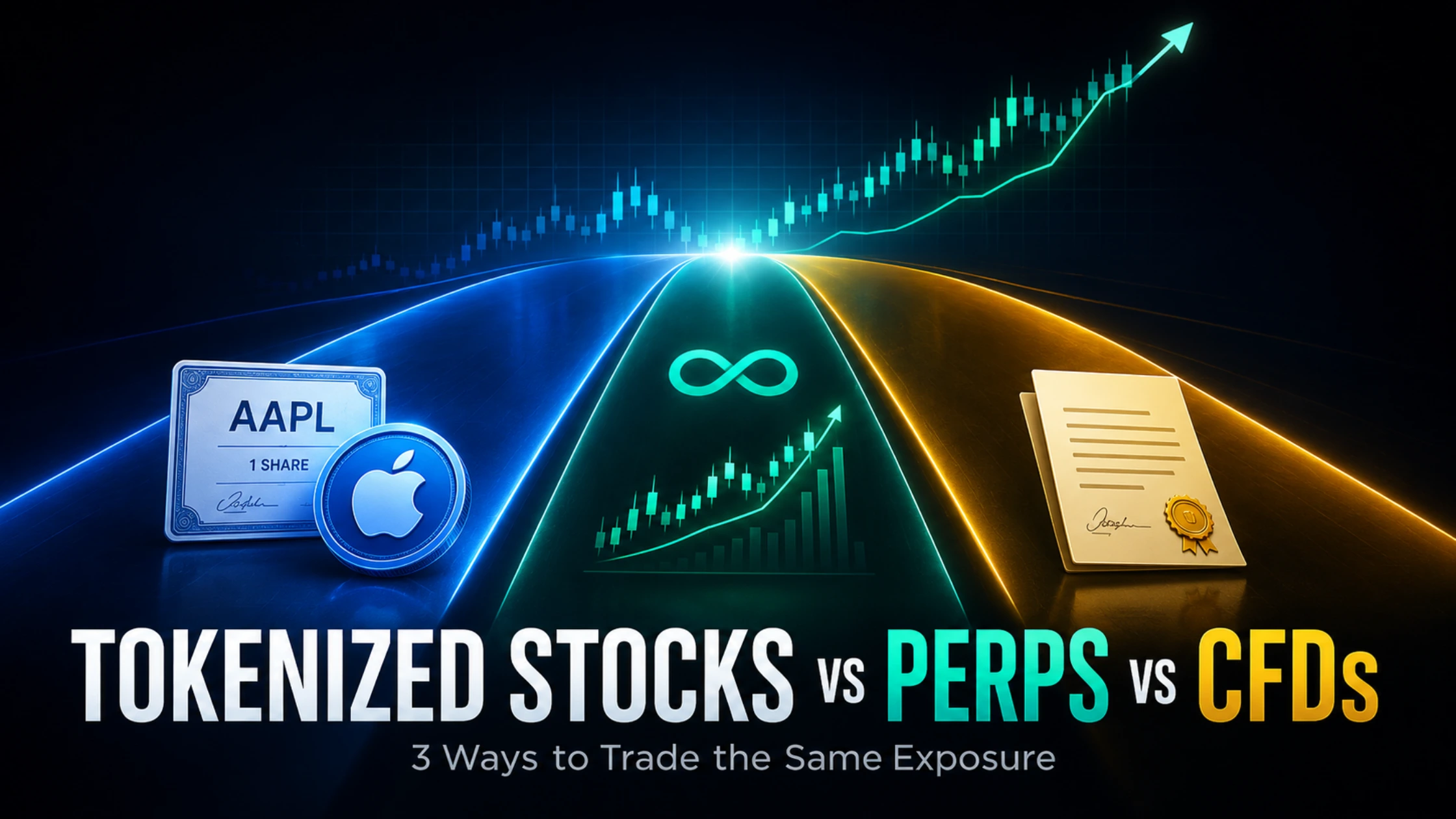
The difference between tokenized stocks and CFDs, in one breath: a tokenized stock is an asset you hold, backed one-to-one by real shares sitting with a regulated issuer, with dividends folded into the token's value; a CFD is a contract you hold against a broker, with financing charged for every night you keep it open and the broker as your counterparty. The equity perp is the third road, the crypto-native one: a synthetic onchain contract with leverage up to 50x, self-custodied collateral, and its own financing meter running. All three give you the same Nvidia price. They are entirely different financial objects, and the right one is decided by arithmetic, not preference.
This choice barely existed two years ago, and now it is one of the fastest-growing questions in retail finance. Tokenized equities went from a rounding error to a market with over $1 billion in capitalization and more than 185,000 holders by March 2026, with the xStocks standard alone clearing more than $25 billion in cumulative volume. On the synthetic side, Ostium carries 33 US single-name equities with roughly nine-tenths of its open interest in non-crypto markets. The week this page was last updated, both roads collided in public: SpaceX's June 12 Nasdaq debut arrived with tokenized share access on Kraken and Bybit while half a dozen other venues listed pre-IPO perps instead, one of which crashed 45 percent in half an hour on a data bug and had to compensate traders. Same company, three contracts, wildly different risk. That is this article in miniature.
Three contracts, anatomized
Road 1: Tokenized stocks, the asset
A tokenized stock like Tesla's TSLAx is a tracker certificate issued 1:1 against real shares held by a regulated issuer (for the xStocks standard, Jersey-licensed Backed Assets, whose parent Backed Finance was acquired by Kraken in December 2025, folding minting and settlement directly into the exchange). You can buy fractions from a dollar, trade 24 hours on weekdays with the most liquid names around the clock, withdraw the token to your own wallet, and use it as DeFi collateral. Dividends are not wired to you; the token rebases, your balance growing to absorb the payout automatically, which quietly makes tokenized stocks an accumulating instrument. What you do not get: voting rights, and direct legal ownership of the share itself, since the certificate is structurally a debt claim on the issuer. There is no leverage and no financing cost, and that absence of a running meter is, as the math below shows, the entire long-game advantage. Availability is geofenced: not offered in the US, Canada, UK or Australia, which makes this fundamentally a product for the rest of the world, including every market we cover from Cape Town.
Road 2: Equity perps, the position
An equity perpetual is price exposure with nothing behind it but collateral and an oracle. On Ostium, the category leader for real-world-asset perps, you post USDC on Arbitrum from a self-custodied wallet, choose from 33 US equities alongside indices, gold, oil and FX, and open up to 50x leveraged positions for an opening fee measured in single basis points, with top-of-book pricing licensed from the underlying market. gTrade runs the same model with its own market list and fee engine. Three honest properties define the road. You pay to hold: non-crypto positions accrue a rollover or funding charge for as long as they stay open, the meter that eventually hands the long-game win to tokenized. You earn no dividends: the contract tracks price only, and when a stock goes ex-dividend the price drop is yours while the payout is not. And stock perps keep stock hours: because the reference price comes from the live exchange feed, single-name equity perps trade when the underlying market trades, with gap risk managed at the open, not abolished. Ostium even ships zero-days-to-expiry equity perps that force-close before the bell precisely to delete overnight gap risk. What you get in exchange is the best capital efficiency of any road, instant self-custodied settlement, and a short seller's dream: shorting Nvidia from a wallet, no borrow desk required.
Road 3: CFDs, the legacy contract
The contract-for-difference is the pre-crypto answer to the same desire, and it still serves one purpose well: multi-asset leverage under one roof at brokers like PrimeXBT, where crypto margin can drive positions across indices, gold and FX. Structurally it is the weakest road. Your counterparty is the broker's dealing desk, which often internalizes your flow; your funds sit with the broker; financing is charged nightly on the full notional, typically benchmark-plus, and dividend adjustments are credited to longs only partially after withholding. CFDs are also the road regulators have already mapped: banned for US retail entirely. The honest case for the CFD in 2026 is narrow: regulated-broker familiarity and asset breadth for traders who have not yet made the jump onchain.
The arithmetic that picks the road
Strip away ideology and the three roads reduce to two cost shapes. Tokenized stocks charge you once, at the door: roughly 0.7 percent for a full round trip in fees and spread, then nothing, with dividends actually paying you back the longer you stay. Perps and CFDs charge you almost nothing at the door (0.1 to 0.2 percent round trip) and then bleed you daily: financing on the full exposure, plus the silent forfeiture of dividends. One-off cost versus running meter always produces a crossover, and at representative rates (7 percent annualized perp financing, 8 percent CFD financing) it lands almost exactly at one month:
| Holding period | Tokenized (net cost) | Equity perp | CFD | Cheapest road |
|---|---|---|---|---|
| 3 days | 0.70% | 0.16% | 0.27% | Perp |
| 2 weeks | 0.68% | 0.38% | 0.51% | Perp |
| 30 days | 0.67% | 0.71% | 0.86% | Tokenized |
| 90 days | 0.60% | 1.92% | 2.19% | Tokenized |
| 1 year | 0.30% | 7.50% | 8.26% | Tokenized |
| 1 year, 2% dividend stock | −1.30% | 9.10% | 8.50% | Tokenized, and it pays you |
Costs as a percentage of exposure, assuming a 0.4 percent dividend yield except where stated; full assumptions are in the methodology box and every one of them is tunable in the tool. Three readings worth keeping. The crossover sits at roughly 31 days at zero dividend and pulls in to about 20 days on a 2 percent payer, because the perp trader loses the dividend twice, once as forfeited income and once as the ex-dividend price drop. Held a full year, the leveraged roads cost 25 times more than the tokenized one. And on a dividend stock held long enough, the tokenized road's net cost goes negative: the rebasing dividends outearn the entry fees, an outcome no contract with a financing meter can ever reach.
Price all three roads for your exact trade. Every assumption is visible and tunable.
Educational model, not financial advice. Representative retail rates; your venue's live fees, spreads, funding and withholding will differ, and leverage adds liquidation risk this model does not price. Tokenized stocks are unavailable in some jurisdictions including the US. Some links are referral links that support our free tools at no cost to you. Other publications may embed this tool with a followed credit link to the canonical page on decentralised.news.
The decision framework, road by road
- Holding under a month, or trading with leverage: the equity perp wins on arithmetic and structure. Self-custodied collateral, basis-point entry, up to 50x, and the only road where shorting a single stock from a wallet is trivial. Ostium is the deepest dedicated venue for it, with gTrade the long-running alternative with its own market list.
- Holding past the crossover, building a position, or buying dividend payers: tokenized stocks, where the meter never runs and the dividends compound into the token. Kraken is the canonical xStocks venue, now vertically integrated with the issuer itself, and Bybit lists the same standard beside its derivatives stack, convenient if your collateral already lives there.
- Hedging a stock view inside a broader multi-asset book: a CFD-style account still earns its place for breadth under one margin umbrella; PrimeXBT covers crypto, indices, gold and FX from one crypto-funded account.
- Income on a position you already hold: tokenized stocks double as DeFi collateral, and pairing a long tokenized holding with covered-call-style structures is the equity version of the playbook in our DN Options Edge Score manual.
Two instruments extend this one. The full venue-by-venue map of which tickers are reachable through which platforms, with rights and redemption terms, is the DN Tokenized Equity Access Map. And for the special, treacherous case of pre-listing exposure, where this week's SpaceX debut showed tracker certificates and pre-IPO perps diverging by 45 percent of mark-to-market in a single data glitch, the DN IPO Reality Score prices what those products are actually worth.
What each road is really exposed to
Cost is the recurring decision; risk is the structural one. The tokenized holder's tail risk is the issuer: a 1:1 backed, regulated tracker certificate is excellent collateralized engineering, but it is legally a claim on a company, not a share in your name, and the fine print on some offerings concedes the collateral may not always be the underlying shares themselves. The perp trader's tail risk is the machine: oracle integrity at the market open after a weekend of news, protocol solvency, and the liquidation engine's behavior in exactly the moments leverage matters. The CFD trader's tail risk is the oldest one in the book: the counterparty is also the house. None of these is disqualifying. All of them belong in position sizing, which is why counterparty structure carries a quarter of the Exposure Route Score, and why the same discipline we apply to exchanges in the DN Counterparty Risk Score applies here unchanged.
Frequently asked questions
A tokenized stock is an asset: a 1:1 backed tracker certificate you can hold, self-custody and earn rebased dividends on, with no financing cost. A CFD is a contract against a broker: leveraged, financed nightly on the full notional, with the broker's dealing desk as your counterparty and only partial dividend credits.
Tokenized stocks are spot instruments backed by real shares, with dividends reinvested and no leverage. Stock perps are synthetic contracts offering up to 50x leverage with self-custodied collateral, but they charge ongoing financing, forfeit dividends, and trade only during the underlying market's hours.
It depends almost entirely on holding period. At representative rates the crossover is near 30 days: perps are cheapest for shorter holds because entry costs are basis points, while tokenized stocks are cheapest beyond a month because they carry no financing, and on dividend stocks held long enough their net cost turns negative.
Yes, indirectly. On the xStocks standard, dividends are automatically reinvested: the token rebases so your balance grows to reflect the payout. You do not receive cash, and you do not receive voting rights.
On Kraken, xStocks trade 24 hours on weekdays with the most liquid names available around the clock, and once withdrawn to a self-hosted wallet they trade 24/7 onchain. Stock perps, by contrast, follow the underlying exchange's hours because their reference price comes from the live market feed.
No. xStocks are restricted to non-US clients in eligible countries and are also unavailable in Canada, the UK and Australia. Equity CFDs are likewise banned for US retail traders.
Yes, through equity perps: venues like Ostium and gTrade let you open short positions on single names like NVDA or TSLA from a self-custodied wallet with USDC collateral, no borrow desk required. Tokenized stocks are long-only instruments.
Tokenized: the backing shares sit with a regulated issuer while the token can sit in your own wallet. Perps: your collateral stays self-custodied until trade settlement, with oracle and protocol risk in exchange. CFDs: the broker holds your funds and is simultaneously your counterparty.
A 0 to 100 comparison of the three exposure routes for your specific trade, weighing relative all-in cost at 55 points, counterparty and custody structure at 25, and flexibility at 20. It compares structures at representative rates and is not a recommendation or a probability of profit.
Decentralised News publishes research, not financial advice. Leveraged products carry substantial risk of loss including liquidation; tokenized securities carry issuer and structural risks and are unavailable in several jurisdictions including the United States. Market figures and product details are as of June 11, 2026 and change. Some links are referral links that support our free tools at no cost to you. The DN Exposure Route Score methodology, and the wider instrument suite documented in the editor's books Blockchain Applied and Tokenized Trillions, is open to challenge via the contact page.