
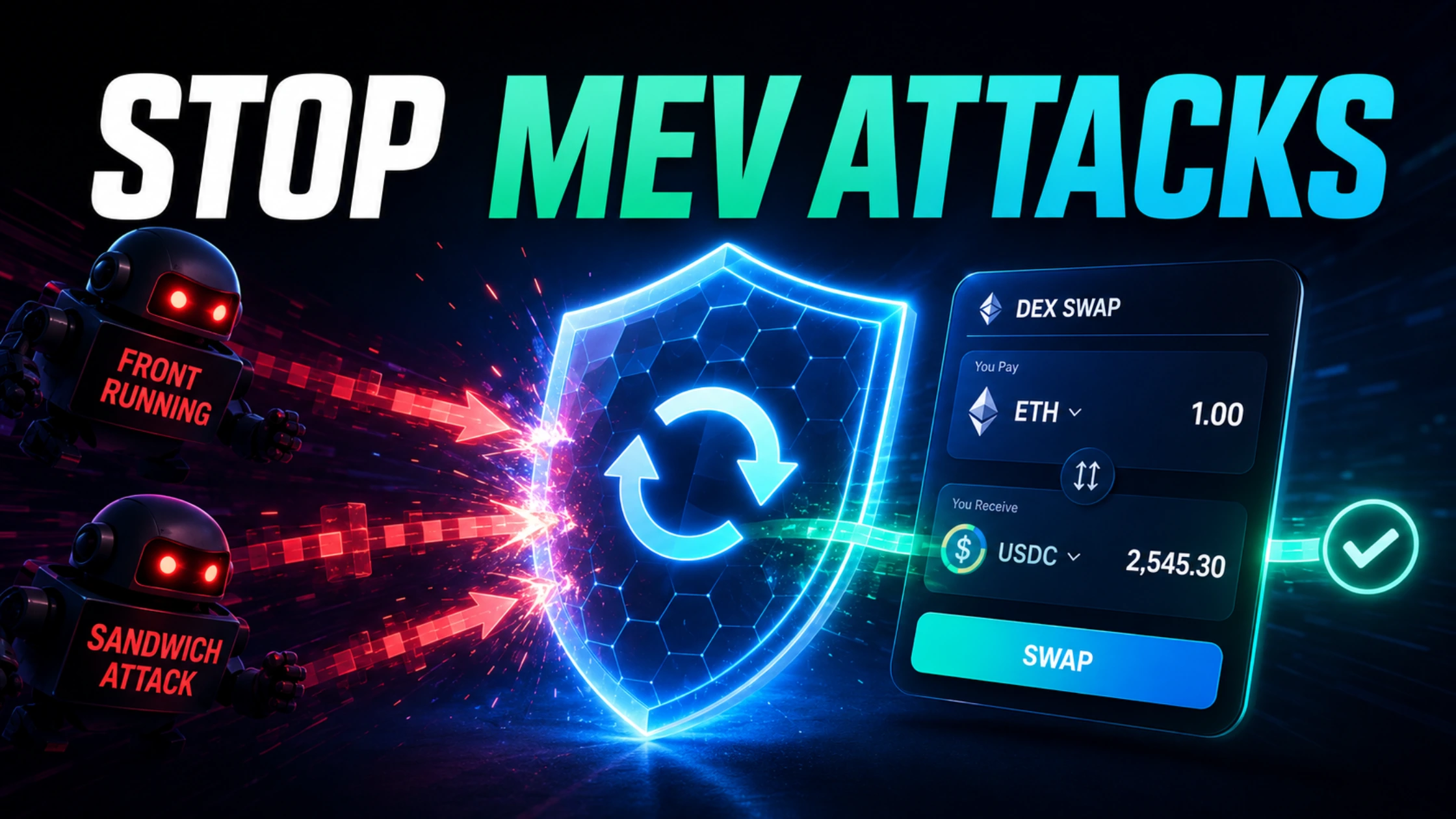
How MEV-Resistant DEXs Stop Front-Running & Sandwich Attacks in 2026
Key Takeaways (DN MEV Defense Summary)
- The Invisible Mempool Tax: Maximal Extractable Value (MEV) bots extract hundreds of millions annually from everyday DeFi users through sandwich attacks, front-running, and toxic order reordering in public transaction mempools.
- Intent-Based Solvers & ZK-Validiums: Modern MEV-resistant trading platforms eliminate public mempool vulnerability. Platforms like deBridge use intent-based solver competition (DLN), while Lighter DEX and Evedex employ off-chain matching with zero-knowledge (ZK) validity proofs to guarantee execution prices.
- Private RPC Defense: Setting up private RPC endpoints (such as Flashbots Protect or MEV-Blocker) ensures your transactions bypass public mempools entirely, guaranteeing zero sandwich loss on automated swaps.
Featured MEV-Protected Execution Venues & Private Routing Portals
Protect your trades from front-running, sandwich attacks, and mempool exploitation using our verified partner portals:
- 🔹 deBridge DLN (Intent-Based Cross-Chain): Launch deBridge MEV-Protected Swaps — Partner Link:
20473 - 🔹 Lighter DEX (ZK Off-Chain Order Book): Trade on Lighter ZK Exchange — Referral Code:
659323WR - 🔹 Evedex (Low-Latency Off-Chain Engine): Claim Evedex VIP API Key — Promo Code:
9e3mk2nx
1. The Invisible Mempool Tax: How MEV Bots Extract Billions
Every time you submit an automated swap or futures trade on a standard Automated Market Maker (AMM) using a public RPC node, your transaction sits temporarily in a public waiting area known as the mempool.
Sophisticated searcher bots constantly scan this public queue. When they spot a large pending buy order (e.g., $50,000 worth of an altcoin), they execute a classic Sandwich Attack:
- Front-Run: The bot pays a higher gas fee to insert its own buy order before yours, artificially driving up the token price.
- Victim Execution: Your trade executes at an inflated price, suffering maximum allowable slippage.
- Back-Run: The bot immediately sells its tokens after your trade, instantly pocketing the price difference as risk-free profit.
In 2026, as trading volume shifts further onchain, relying on legacy public AMMs without MEV protection exposes traders to severe, invisible capital decay.
To determine how traders can completely eliminate front-running, Decentralised News audited the top MEV-resistant architectures across cross-chain bridges, ZK order books, and private execution solvers.
2. DN Mempool Protection Score (DN-MPS) Framework
Our research team evaluates DEX MEV resistance using five technical criteria:
- Mempool Privacy Architecture: Whether order payloads are exposed to public block builders prior to state inclusion.
- Intent Solver Competition: The presence of professional third-party solvers competing to fulfill trade outcomes at guaranteed rates.
- Execution Slippage Variance: Discrepancy between quoted trade estimates and final delivered token balances.
- ZK Validity Proof Batching: Utilization of zero-knowledge validity proofs to finalize state changes off-chain.
- Cross-Chain Slippage Integrity: Protection against price degradation when bridging and swapping across high-latency networks.
3. MEV Protection Architectures Compared
Below is a benchmark breakdown of the top MEV-resistant trading models in 2026:
| Execution Model | MEV Defense Mechanism | Typical Slippage | Best Use Case | Verified Partner Portal |
|---|---|---|---|---|
| Intent-Based Solvers (deBridge) | Off-chain solver competition; 0-TVL peer-to-peer settlement | 0% Unexpected Slippage | Cross-chain and same-chain token swaps | deBridge DLN Portal |
| ZK-Validium CLOB (Lighter DEX) | Off-chain order book matching with ZK-SNARK batch settlement | Deterministic (Limit Orders) | High-frequency perpetuals & order book trading | Lighter ZK Exchange (659323WR) |
| Hybrid Off-Chain Engine (Evedex) | Private off-chain matching engine; onchain cryptographic settlement | Sub-50ms Fixed Fill | Algorithmic trading & automated grid bots | Evedex VIP Portal (9e3mk2nx) |
| Public AMM Pools | None (Public Mempool Exposure) | High (Vulnerable to Sandwiches) | Low-volume altcoin swaps | Not Recommended for Large Sizes |
4. Protocol Deep Dives: Top MEV-Resistant Platforms
1. deBridge (DLN) — Intent-Based Peer-to-Peer Execution
deBridge revolutionizes cross-chain and same-chain swaps through its intent-based deBridge Liquidity Network (DLN). Instead of depositing capital into vulnerable liquidity pools, users broadcast an "intent" (e.g., "Swap 10 SOL on Solana for USDC on Arbitrum").
MEV Shield: Professional market makers and solvers compete to fulfill your order using their own liquidity. Because the solver guarantees the fill rate before executing the trade onchain, you are completely insulated from mempool sandwich attacks and pool slippage.
💡 Trader Pro Tip: Execute MEV-protected cross-chain swaps directly on the deBridge DLN Portal to lock in guaranteed rates with zero sandwich loss.
2. Lighter DEX — High-Performance Zero-Knowledge Order Book
Lighter DEX is a decentralized perpetual futures and spot trading venue powered by zero-knowledge (ZK) technology. By moving matching engine logic off-chain, Lighter eliminates public mempool exposure entirely.
MEV Shield: Orders are submitted, matched, and ordered off-chain before being cryptographically verified in batches via ZK validity proofs onchain. MEV searchers cannot see or reorder your transactions because quotes never sit in a public mempool.
💡 Trader Pro Tip: Register on Lighter DEX via Code 659323WR to receive bonus points and VIP fee tier upgrades.
3. Evedex — Sub-50ms Off-Chain Matching Engine
Evedex combines CEX-grade execution speed with Web3 self-custody. Designed specifically for quantitative algorithms and retail day traders, Evedex prevents latency arbitrage and front-running through private matching channels.
MEV Shield: Trades execute within a private off-chain order book engine operating at sub-50ms speeds, settling state changes onchain asynchronously.
💡 Trader Pro Tip: Access low-latency private trading channels on the Evedex VIP Portal (Code 9e3mk2nx).
5. Step-by-Step: Configuring Private RPCs in MetaMask / Rabby
If you must trade on standard AMM pools, configuring a Private RPC Endpoint in your Web3 wallet prevents your pending transactions from appearing in public mempools.
How to Add MEV-Blocker to Your Wallet:
- Open your Web3 wallet (MetaMask, Rabby, or Coinbase Wallet) and navigate to Network Settings.
- Select Add Network / Custom RPC.
- Network Name: MEV-Blocker Private RPC
- New RPC URL:
https://rpc.mevblocker.io - Chain ID:
1(Ethereum Mainnet) - Symbol:
ETH - Save & Connect: All transaction payloads submitted through this network will route directly to trusted block builders, shielding your trades from sandwich bots and returning backrun rebates directly to your wallet.
Frequently Asked Questions (FAQ)
What is a sandwich attack in DeFi?
A sandwich attack is a form of front-running where an automated MEV bot spots a pending buy order in the public mempool. The bot buys the token right before you (front-run), forcing you to buy at a higher price, and then immediately sells right after you (back-run) to profit from your slippage.
How do intent-based DEXs like deBridge prevent MEV?
Intent-based DEXs do not send trades directly to an AMM pool. Instead, you sign a binding intent specifying your desired output. Professional solvers compete off-chain to fulfill your trade at the agreed price using their own liquidity, taking on all execution risk and eliminating mempool exploitation.
Are private RPC endpoints safe to use?
Yes. Reputable private RPCs (such as Flashbots Protect or MEV-Blocker) are non-custodial relayers that hide your pending transactions from public mempools and send them directly to cooperative block validators. They cannot steal your funds or alter your signed transaction payloads.





