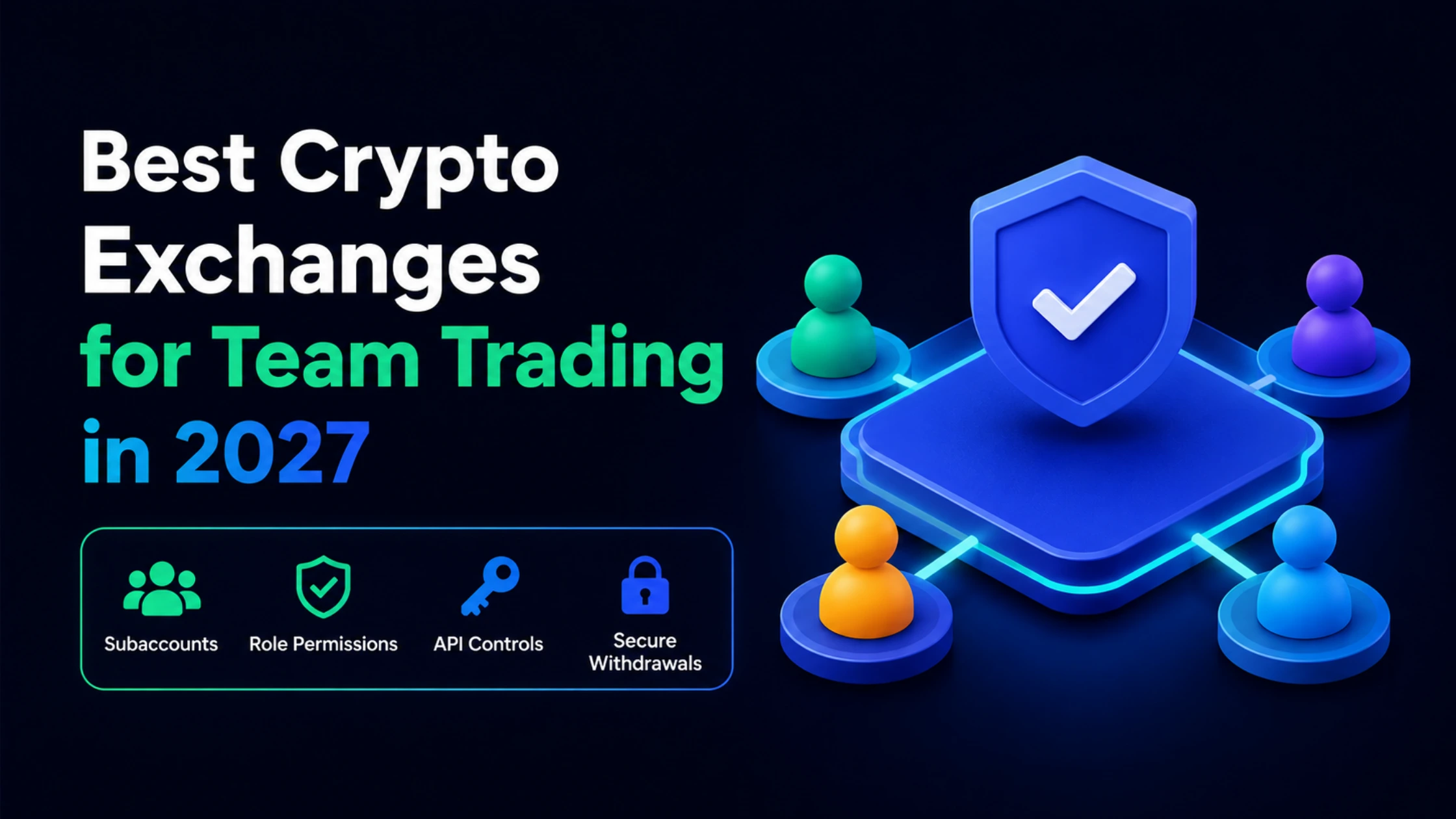
Which crypto exchanges are best for trading teams in 2027? We compare Kraken, Coinbase Prime, Deribit, Binance, OKX, Bybit and Bitget across subaccounts, role permissions, trade-only access, API controls, withdrawal approvals, audit logs, portfolio margin and master-account governance.
Data checked: 29 August 2026. Institutional features, account limits, permissions and regional availability can change during 2027.
Summary
A professional trading team should almost never operate by sharing one unrestricted exchange login.
A better architecture separates:
Research
from
Trading
from
APIs
from
Treasury
from
Withdrawals
from
Administration.
The most important question is therefore not:
Which exchange has the most subaccounts?
It is:
Can I let five people and three trading systems operate without giving any one of them unnecessary control over the firm’s money?
Decentralised News created the DN Trading Team Control Matrix to answer that question.
We evaluate:
- segregated subaccounts
- individual user identities
- reusable roles
- read-only access
- trade-only permissions
- withdrawal permissions
- withdrawal approvals
- API-key scopes
- IP restrictions
- strategy/account segregation
- audit and event logs
- reporting
- master-account controls
- portfolio margin
- separation of duties
Our current findings:
- Kraken Organizations: Best overall team-governance architecture.
- Coinbase Prime: Best institutional consensus and treasury-control architecture.
- Deribit: Best for derivatives and options teams requiring isolated margin pools.
- Binance: Best large-scale exchange structure for subaccounts, algorithms and portfolio-margin traders.
- OKX: Best alternative for high-throughput API teams and sophisticated margin architecture.
- Bybit: Best straightforward setup for derivatives teams using multiple trading subaccounts.
- Bitget: Best flexible alternative for teams combining subaccounts, APIs and its Unified Trading Account ecosystem.
The biggest distinction is this:
Subaccounts are not the same as permissions.
An exchange might let a company create 20 subaccounts while still providing much less control over what individual humans can do inside them.
Quick Verdict
For a genuine multi-user organization, Kraken currently offers the strongest overall governance architecture we reviewed.
Its new Organizations framework allows institutional customers to create multiple segregated accounts and separately define:
- who can read
- who can trade
- who can transfer
- who can request withdrawals
- who can approve withdrawals
- who can manage API keys
- who can manage other team members
- who can change governance policies
Most importantly, Kraken separates:
Account Roles
from
Workflow Profiles.
That means a trader might receive:
Read + Trade
on:
Strategy Account A
while having:
no withdrawal permission
and:
no access whatsoever
to:
Treasury Account B.
A separate operations user can receive funding privileges.
A separate approver can approve withdrawal requests.
And Kraken enforces a crucial institutional principle:
A member cannot approve their own request.
That is genuine separation of duties.
Coinbase Prime is even stronger in some formal treasury-control areas.
It allows organizations to create multiple portfolios with individual users and permissions and supports approval policies using:
- Initiators
- Approvers
- Team Managers
- Traders
- Auditors
- Authorized Signatories
Transfer policies can change according to transaction size and can require multiple approvals or even video verification.
For larger regulated funds, foundations and institutional treasuries, this is exceptionally strong.
However, Coinbase Prime is a more specialized institutional product and does not provide the same conventional crypto-exchange experience for every trading organization.
Deribit is arguably the strongest choice for dedicated options and derivatives teams.
Its subaccounts have independent:
- collateral
- positions
- margin
- API keys
- API rate limits
and can each run their own portfolio-margin configuration.
That is powerful strategy isolation.
DN Trading Team Control Matrix 2027
Rank | Platform | DN Team Control Score | Best For | Primary Strength |
1 | Kraken Organizations | 97/100 | Trading firms and structured teams | Roles + approvals + segregation |
2 | Coinbase Prime | 96/100 | Funds, institutions and treasury teams | Consensus-based governance |
3 | 91/100 | Options and derivatives desks | Margin and strategy isolation | |
4 | 90/100 | Large algorithmic trading teams | Mature subaccount infrastructure | |
5 | 89/100 | API-intensive trading firms | APIs + portfolio margin | |
6 | 86/100 | Derivatives teams | Simple subaccount segregation | |
7 | 84/100 | Multi-strategy teams | Flexible subaccounts + UTA |
These are team-control scores, not overall exchange rankings.
They do not directly measure:
- trading fees
- liquidity
- solvency
- execution quality
- jurisdiction
- custody quality
Those should be assessed separately.
What Is the DN Trading Team Control Matrix?
A trading team needs more than additional usernames.
Consider a seven-person firm:
Founder / CIO
Needs portfolio visibility.
Head Trader
Needs trading authority.
Trader A
Needs to trade Strategy A only.
Trader B
Needs to trade Strategy B only.
Research Analyst
Needs read-only market and account information.
Operations Manager
Needs internal transfers.
CFO / Treasury
Needs withdrawal control.
Now add:
Trading Bot A
Needs:
Read + Trade
but absolutely not:
Withdraw.
Reporting System
Needs:
Read only.
Treasury Script
Might require fund transfers but should not control trading.
If everybody shares:
admin@email.com + password + unrestricted API
the organization has created unnecessary operational risk.
DN Trading Team Control Methodology
The maximum score is:
100
1. Account Segregation: 15 Points
We assess whether the organization can isolate:
- balances
- positions
- orders
- P&L
- trading history
- strategies
across separate accounts.
2. Human Roles and Permissions: 15 Points
Can the platform distinguish between:
- administrator
- trader
- auditor
- treasury
- read-only user
- approver
or does every human user effectively gain the same capabilities?
3. Withdrawal Separation: 15 Points
This is one of the most heavily weighted categories.
We look for:
- trade-only users
- subaccounts unable to withdraw externally
- dedicated withdrawal permissions
- withdrawal-address restrictions
- multi-party approval
A trader normally does not need external withdrawal rights.
4. API Governance: 15 Points
We evaluate:
- read-only API
- trade-only API
- withdrawal API
- account-specific API keys
- IP allowlisting
- API-key administration
- independent rate limits
5. Approval Workflows: 15 Points
Can sensitive operations require:
Initiator → Approver → Execution
rather than allowing one user to complete everything?
We assess approvals around:
- withdrawals
- internal transfers
- team changes
- API creation
- withdrawal-address changes
- governance rules
6. Audit and Reporting: 10 Points
We look for:
- transaction logs
- account history
- security events
- activity trail
- downloadable reports
- API reporting
7. Master-Account Control: 5 Points
Can the main organization:
- create
- freeze
- fund
- monitor
- restrict
its child accounts?
8. Margin and Risk Segregation: 5 Points
Professional trading teams need to determine whether one strategy can liquidate another.
We reward:
- independent margin pools
- portfolio margin
- isolated subaccount risk
9. Organizational Scalability: 5 Points
Can the architecture realistically support:
- multiple desks
- multiple strategies
- multiple traders
- automated systems
- treasury operatons
without becoming operationally unmanageable?
DN Trading Team Control Matrix
Compare crypto exchanges according to the controls your organization actually needs. Choose your team type and priorities to reweight the ranking for human governance, API automation, treasury security, strategy segregation and margin efficiency.
Your Team
Critical Requirements
Your Team Ranking
| Platform | Roles | API | Approvals | Isolation | Margin | Audit |
|---|
The tool lets firms select their operating model.
Examples:
Quant Team
Prioritizes:
- APIs
- IP restrictions
- subaccounts
- rate limits
- portfolio margin
DAO Treasury
Prioritizes:
- withdrawal approvals
- separation of duties
- audit logs
- read-only oversight
Prop Trading Firm
Prioritizes:
- trader segregation
- APIs
- derivatives
- subaccounts
- portfolio margin
Research Team
Prioritizes:
- read-only access
- reporting
- limited trading permissions
The tool then reweights the rankings according to the team’s actual requirements.
This produces a more useful answer than assuming every organization operates identically.
1. Kraken Organizations: Best Overall Team Governance
Kraken significantly strengthened its institutional account architecture in 2026 through Organizations.
The system is designed around:
Organization
↓
Accounts
↓
Members
↓
Account Roles
↓
Workflow Profiles
↓
Approval Policies
This creates substantially more granular governance than a conventional exchange subaccount system.
Segregated Accounts
Each Kraken Organization can operate multiple accounts.
Every account has its own:
- balances
- open orders
- trading history
- access permissions
A user granted access to one account receives no automatic access to another.
This means a firm could create:
Account 1
BTC market-making strategy.
Account 2
Altcoin discretionary strategy.
Account 3
Treasury.
Account 4
Research / testing.
Capital and permissions remain segregated.
Kraken Account Roles
Roles determine:
What can this person do and on which accounts?
Current permissions include:
- Read
- Trade
- Earn Allocate
- Earn Deallocate
- Withdraw
- Transfer
The firm can create reusable roles.
Example:
Trader Role
Read + Trade
on:
Desk A accounts
No withdrawal rights.
Treasury Role
Read + Transfer + Withdraw
on:
Treasury accounts
No trading rights.
Auditor
Read access without operational control.
This is the right conceptual model for professional firms.
Kraken Workflow Profiles
Kraken then adds a second layer.
Workflow Profiles determine what the person can do within governed operations.
Possible capabilities include:
- View
- Initiate
- Approve
- Execute
These can apply to workflows including:
- Withdrawal Request
- Transfer Request
- Manage Team & Access
- Manage API Keys
- Manage Accounts
- Manage Addresses
- Manage Policies
That creates a highly valuable separation.
A person might have permission to:
initiate a withdrawal
without being able to:
approve it.
Separation of Duties
One of Kraken Organizations’ strongest features is simple:
Users cannot approve their own requests.
This rule is enforced by the system.
It cannot simply be switched off by an administrator.
For institutional security, this is a major advantage.
Withdrawal Governance
Suppose a treasury operator requests:
500,000 USDC withdrawal.
The request can enter an approval workflow.
Another authorized person must review it.
The person initiating the withdrawal cannot approve their own request.
That makes compromised individual credentials less powerful.
API Governance
Kraken Organizations also allows programmatic access through organization-scoped API keys.
Keys can be assigned to specific accounts.
Permissions can include activities such as:
- Read
- Trade
- Transfer
- Withdraw
depending on configuration.
API withdrawal requests can still be routed into human approval workflows.
This is particularly powerful.
A trading system can generate the request.
Humans retain final treasury control.
Security Event Trail
Kraken records organizational security events showing information such as:
- action
- person
- account
- origin
- result
This significantly improves internal auditing and incident investigation.
Current Limitation
Kraken Organizations remains newer than some institutional systems.
Current functionality also differs between the main account and additional accounts.
Some advanced products remain more restricted in organizational permissioning than spot trading.
Teams heavily dependent on:
- futures
- options
- OTC
should verify precisely which Organization permissions currently apply before migrating production infrastructure.
DN Verdict
Best overall team-control architecture among mainstream crypto-native exchanges currently reviewed.
Kraken has moved beyond:
subaccount management
toward:
actual organizational governance.
2. Coinbase Prime: Best Institutional Consensus Architecture
Coinbase Prime is included regardless of affiliate availability because leaving it out would weaken a serious institutional comparison.
Prime’s account structure is built around:
Organization → Entity → Portfolio
Organizations can contain multiple investment entities.
Entities can contain multiple portfolios.
Each portfolio can maintain its own:
- assets
- users
- permissions
- trading balances
- vault balances
- policies
Coinbase Prime Roles
Prime supports formal user roles and permissions.
These include functions such as:
- Administrator
- Team Manager
- Initiator
- Approver
- Trader
- Full Trader
- Auditor
- Authorized Signatory
Roles can operate at:
Entity Level
User has corresponding authority across the entity’s portfolios.
Portfolio Level
User has permissions only within specified portfolios.
This is an extremely powerful distinction for organizations operating:
- several funds
- several mandates
- several trading desks
Portfolio Segregation
Prime allows organizations to create additional portfolios to separate:
- trading strategies
- funds
- geographical operations
- investment mandates
Each portfolio can maintain separate:
- balances
- user permissions
- transfer policies
Consensus Controls
This is one of Coinbase Prime’s strongest features.
Sensitive actions can require consensus.
An organization can specify:
M of N approvals
before an activity completes.
Approval structures can cover:
- entity activity
- portfolio activity
- transfers
- withdrawals
Size-Based Transfer Policies
Prime goes further.
Transfer approval requirements can vary according to transaction size.
Published thresholds currently extend from:
$10,000
through:
$100 million.
A team could theoretically configure:
Below $10,000
1 approval.
$100,000+
2 approvals.
$1 million+
3 approvals.
$10 million+
additional verification.
That is much closer to institutional treasury management than conventional exchange withdrawal controls.
Video Approval
Prime can also require video verification for certain high-sensitivity actions.
This adds another human authentication layer beyond:
- password
- API
- security key
API Governance
Coinbase Prime’s API architecture is highly granular.
Keys can operate at:
- portfolio level
- entity level
- organization level
API scopes can be configured:
- by endpoint
- by endpoint category
- READ
- WRITE
and can use IP allowlisting.
This is excellent for institutional integrations.
Reporting
Prime supports portfolio-level audit and reporting capabilities.
That makes it particularly suitable for:
- fund administrators
- finance teams
- auditors
- reconciliation systems
DN Verdict
Best formal treasury-governance environment in the comparison.
For a regulated fund, corporate treasury or foundation, Coinbase Prime can arguably rank first.
Kraken leads our overall team-trading ranking because it combines sophisticated governance with a more exchange-native trading structure.
3. Deribit: Best for Options and Derivatives Trading Teams
For derivatives teams, Deribit remains unusually strong.
Its account architecture supports up to:
20 subaccounts
under a main account.
Each subaccount can have independent:
- balances
- collateral
- positions
- margin
- API keys
- API limits
- login credentials
- security keys
Why Margin Separation Matters
Imagine two strategies.
Strategy A
Short-volatility options portfolio.
Strategy B
Directional BTC futures.
If both operate inside one margin pool, losses in Strategy B can consume collateral supporting Strategy A.
Separate subaccounts prevent that.
Each strategy can receive its own risk budget.
Deribit Portfolio Margin
Deribit supports sophisticated margin structures including:
- Segregated Standard Margin
- Segregated Portfolio Margin
- Cross Collateral Standard Margin
- Cross Collateral Portfolio Margin
Margin configuration is selected independently for each account or subaccount.
It is not automatically inherited from the main account.
That gives risk teams considerable flexibility.
Subaccount Trading Access
A subaccount can use separate login credentials.
The user sees only the relevant subaccount.
That is useful where:
Trader A
should not see:
Strategy B
or the firm’s total treasury balance.
API Isolation
Each subaccount can maintain:
up to eight API keys
with API access limited to that subaccount.
Each subaccount also receives its own API rate limits.
This is particularly valuable for quantitative desks.
Strategy A’s trading system does not need to share:
- API credentials
- positions
- order-rate quota
with Strategy B.
Instrument Restrictions
Deribit subaccounts can also be restricted from accessing specific instrument types.
This creates another layer of strategy discipline.
Withdrawal Security
Subaccounts cannot withdraw externally.
Withdrawals must be performed from the main account.
That is exactly what many firms should want.
Trading staff can manage positions without controlling external asset movement.
Main Account Oversight
The master account retains access across its subaccounts.
This gives the firm’s central risk function oversight without forcing individual traders to share one account.
Where Deribit Falls Behind Kraken and Coinbase
Deribit’s architecture is excellent for:
- trading segregation
- APIs
- margin isolation
but less extensive for formal human governance.
Kraken Organizations and Coinbase Prime provide richer:
- reusable human roles
- multi-party workflows
- approval structures
- administrative governance
DN Verdict
Best platform in this comparison for an options or derivatives desk whose primary requirement is strategy and margin segregation.
4. Binance: Best Mature Subaccount Infrastructure for Large Trading Teams
Referral code: CPA_00SXKU7IO9
Binance has long offered subaccounts for:
- institutional traders
- multi-strategy users
- algorithmic teams
The architecture allows a master account to organize several trading environments.
Strategy Segregation
Subaccounts can separate:
- funds
- trading activity
- strategies
- teams
- APIs
They can also maintain independent trading rate limits.
This is particularly important for market-making infrastructure.
One strategy generating enormous API traffic does not necessarily consume the same subaccount order quota as another strategy.
Master-Account Capital Control
Binance allows internal transfers between:
- main account
- subaccounts
- supported wallet types
including trading environments such as:
- Spot
- Margin
- Futures
depending on structure.
These transfers can also be automated through API infrastructure.
External Withdrawals
A major team-security advantage is that ordinary subaccount structures can restrict direct external withdrawals.
Funds generally need to return through the master-account structure for external movement.
That helps create:
Trade Desk
without creating:
Treasury Desk.
API Permissions
Binance APIs can be configured according to the actions required.
A well-designed trading operation should normally configure trading systems with:
Read + Trade
rather than:
Withdraw.
Internal-transfer capabilities should also be restricted according to need.
Portfolio Margin
Binance supports:
- Cross Margin
- Isolated Margin
- Portfolio Margin
for qualifying trading structures.
Portfolio Margin can improve capital efficiency where positions hedge one another.
That makes Binance particularly attractive to larger derivatives desks.
Why Binance Does Not Rank First
Binance’s subaccount infrastructure is highly mature.
But the distinction remains:
subaccount governance
versus
organization governance.
Kraken and Coinbase Prime offer more advanced human roles and multi-party administrative workflows.
DN Verdict
Excellent for large quantitative or multi-strategy trading operations where subaccounts and APIs matter more than complex committee-style approvals.
5. OKX: Best for High-Throughput API and Portfolio-Margin Teams
Referral code: 2136301
OKX is particularly attractive for technically sophisticated trading firms.
Its current architecture supports different subaccount types including:
- standard subaccounts
- managed trading subaccounts
- custody-related structures
Subaccount Segregation
Standard subaccounts can maintain independent trading activity across markets including:
- spot
- margin
- derivatives
depending on eligibility.
Ordinary subaccounts cannot directly withdraw externally.
This is an important security advantage for delegated trading.
API Permissioning
OKX API keys support three primary permission categories:
Read
Account data and history.
Trade
Orders, trading operations and certain account actions.
Withdraw
External withdrawal operations.
This means a trading system can be configured without withdrawal capability.
API IP Restrictions
Each API key can be bound to up to:
20 IP addresses
or supported network ranges.
For institutional API trading, IP restriction should normally be mandatory.
Subaccount Rate Limits
OKX applies trading-rate architecture at subaccount level.
Higher-tier customers can also benefit from fill-ratio-based subaccount rate-limit structures.
This makes OKX particularly attractive for:
- market makers
- high-frequency systems
- API-heavy trading operations
Portfolio Margin
OKX supports:
- Spot mode
- Futures mode
- Multi-currency margin
- Portfolio margin
Portfolio margin is particularly relevant for desks holding offsetting:
- options
- futures
- spot
- perpetual
positions.
Position Transfers
Qualifying high-tier users can also use master-account API infrastructure to move positions between accounts.
That can be useful for:
- desk reorganization
- strategy migration
- risk rebalancing
without always closing and reopening market exposure.
DN Verdict
One of the strongest choices for API-intensive trading teams.
The primary weakness versus Kraken Organizations or Coinbase Prime is less sophisticated human role and approval governance.
6. Bybit: Best Straightforward Derivatives Team Setup
Referral code: 46164
Bybit’s team-trading architecture is simpler.
That can actually be an advantage for smaller trading operations.
A standard Main Account can create multiple subaccounts.
Current limits generally start at:
five
while eligible VIP and Business KYC customers can create up to:
20 Standard Subaccounts.
Segregated P&L
Subaccounts maintain trading activity separately.
Their P&L does not simply merge operationally into the Main Account’s trading record.
This makes them useful for:
- trader allocation
- strategy testing
- bot segregation
- risk budgets
Separate Login
Bybit can give a subaccount its own:
- username
- password
- authenticator
or allow controlled switching from the Main Account.
A firm can therefore give a trader access to:
Trader Account A
without giving that trader the master login.
No Direct Withdrawals
Standard Bybit subaccounts cannot directly perform crypto withdrawals.
Deposits and withdrawals are handled through the Main Account.
That is an excellent default for team security.
The trader can trade.
The treasury remains centralized.
API Trading
Standard subaccounts support API trading.
This allows a firm to dedicate:
Subaccount A
Market-maker bot.
Subaccount B
Momentum strategy.
Subaccount C
Discretionary trader.
Each strategy maintains its own operating environment.
Unified Trading Account
New standard subaccounts use Bybit’s Unified Trading Account architecture by default.
That provides broad cross-product trading functionality within the subaccount.
Custodial Trading Subaccounts
Bybit also provides a more specialized Custodial Trading Subaccount architecture.
This allows investors to assign capital to professional trading teams while maintaining structural separation.
The trading team can execute through API infrastructure without receiving conventional external withdrawal authority over investor assets.
This is especially interesting for:
- asset managers
- managed accounts
- external trading teams
DN Verdict
Excellent for small and medium derivatives teams that want straightforward account segregation without enterprise-grade governance complexity.
7. Bitget: Best Flexible Alternative for Multi-Strategy Teams
Referral code: nqef
Bitget offers several forms of subaccount architecture.
Current types include:
- virtual subaccount
- general subaccount
- custodial trading subaccount
A Main Account can currently create up to:
20 subaccounts by default.
Virtual vs General Subaccounts
Virtual Subaccount
No separate email/password is required.
The Main Account switches into it.
This is useful for:
- internal strategy separation
- bots
- portfolio segmentation
General Subaccount
Receives separate login credentials.
That makes it more appropriate where individual team members need direct access.
Withdrawal Separation
Subaccounts cannot directly withdraw externally.
Funds need to return to the Main Account before external withdrawal.
Again, this is one of the most important security controls for delegated traders.
API Keys
Subaccounts support their own API keys.
The Main Account can decide whether a subaccount is permitted to manage its own API credentials.
This permission is disabled by default.
Once enabled, the subaccount can perform actions such as:
- create API key
- view API key
- edit API permissions
That is a useful master-account control.
API Scale
Under Bitget’s current Unified Trading Account API infrastructure, each UID can create multiple API-key sets.
Keys support:
- Read
- Write
permission structures.
Teams should still follow least-privilege principles even where the exchange’s top-level permission model is less granular than Coinbase Prime or Kraken Organizations.
Main-Account Transfer Control
Bitget’s main-account API can control transfers:
- main → sub
- sub → main
- sub → sub
This gives treasury systems centralized control over capital allocation.
Operation History
Bitget also provides account-management history covering administrative actions such as:
- freeze
- unfreeze
- permission changes
This is useful for operational oversight.
Unified Trading Account
Bitget’s UTA can provide cross-product collateral functionality.
The exchange has also extended subaccount functionality into newer areas such as its CFD environment.
DN Verdict
Good flexible architecture for firms that need numerous subaccounts and API segmentation.
It remains less sophisticated than Kraken or Coinbase Prime for deeply granular human roles and approval workflows.
Trading Team Control Matrix
Control | Kraken | Coinbase Prime | Deribit | Binance | OKX | Bybit | Bitget |
Segregated accounts | ✓ | ✓ | ✓ | ✓ | ✓ | ✓ | ✓ |
Separate human users | ✓ | ✓ | ✓ | Partial | Partial | ✓ | ✓ |
Granular human roles | Excellent | Excellent | Moderate | Moderate | Moderate | Basic | Basic/Moderate |
Read-only role | ✓ | ✓ | ✓ | ✓ | ✓ | API | API |
Trade-only role | ✓ | ✓ | ✓ | ✓ | ✓ | Subaccount/API | Subaccount/API |
Subaccount external withdrawals blocked | Configurable | Policy based | ✓ | ✓ | ✓ | ✓ | ✓ |
Multi-party withdrawal approval | ✓ | ✓ | Limited | Limited | Limited | Limited | Limited |
Separation of duties | Enforced | Strong | Moderate | Moderate | Moderate | Basic | Basic |
Account-scoped API | ✓ | ✓ | ✓ | ✓ | ✓ | ✓ | ✓ |
API IP restrictions | ✓ | ✓ | ✓ | ✓ | ✓ | ✓ | ✓ |
Portfolio margin | Product dependent | Product dependent | Excellent | ✓ | ✓ | UTA | UTA |
Audit/event trail | Excellent | Excellent | Good | Good | Good | Good | Good |
Master-account controls | Excellent | Excellent | Excellent | Excellent | Excellent | Excellent | Excellent |
Feature availability varies by account type and jurisdiction.
Why Trade-Only Access Matters
This should be the default rule for most traders.
A trader needs to:
- see balances
- see positions
- place orders
- cancel orders
They generally do not need to:
- change team permissions
- create unrestricted API keys
- add withdrawal addresses
- withdraw treasury assets
Every additional privilege increases the damage possible from:
- compromised credentials
- malicious insider
- stolen laptop
- phishing
- accidental action
The Principle of Least Privilege
A professional account should follow:
Give each person and machine only the permissions required for its job.
Examples:
Analyst
Read only
Human Trader
Read + Trade
Trading Bot
Read + Trade + IP restriction
Operations
Read + Internal Transfer
Treasury Initiator
Create withdrawal request
Treasury Approver
Approve withdrawal
Auditor
Read logs + reports
Administrator
Manage people and policies
Ideally:
Nobody except tightly controlled treasury roles has direct external withdrawal authority.
Why Shared Logins Are a Bad Team Architecture
Suppose five traders share:
trading@company.com
and one password.
Several problems appear immediately.
Attribution
Who placed the order?
Security
Whose device was compromised?
Offboarding
How do you remove one employee without changing everyone’s credentials?
Permissions
How do you stop one trader from withdrawing?
Audit
Who changed an API key?
Recovery
Who controls 2FA?
Professional teams need individual identity and accountability.
Subaccounts vs User Roles
These concepts solve different problems.
Subaccounts
Separate:
- money
- positions
- P&L
- strategies
User Roles
Separate:
- authority
A strong institutional architecture needs both.
Best Account Structure for a Small Prop Trading Firm
Suppose the firm has:
- CIO
- two traders
- one quant developer
- one operations person
A useful structure:
Main / Treasury Account
Contains excess capital.
No routine trading.
Trader A Subaccount
Human discretionary strategy.
Trader B Subaccount
Alternative strategy.
Quant Subaccount
API trading only.
Research Account
Small test capital.
Permissions:
CIO
All-account visibility.
Traders
Read + Trade on assigned account.
Developer
API management only where required.
Operations
Internal transfers.
Treasury
External withdrawals.
This isolates both:
strategy risk
and
human risk.
Best Architecture for a DAO Treasury
A DAO should usually prioritize governance over leverage.
Useful model:
Treasury Account
Holds reserve assets.
Execution Account
Receives limited capital for trading.
Market-Making Account
Separate strategy.
Research Account
Read-only access.
Withdrawals should ideally require:
Initiation
↓
Independent Approval
↓
Execution
Kraken Organizations and Coinbase Prime are particularly attractive for this type of design.
Best Architecture for a Quant Fund
Quant firms care more about:
- API throughput
- IP restrictions
- rate limits
- margin efficiency
- strategy segregation
A structure might use:
Subaccount 1
Market making.
Subaccount 2
Funding arbitrage.
Subaccount 3
Options volatility.
Subaccount 4
Directional futures.
Subaccount 5
Treasury.
Strong candidates include:
- Deribit
- Binance
- OKX
- Kraken
- Bybit
depending on instrument requirements.
API Keys Should Never Be Universal by Default
One of the easiest institutional mistakes is creating:
one API key for everything.
Instead use separate keys.
Reporting Key
Read only
Trading Key
Read + Trade
Treasury Key
Only where absolutely required.
And wherever possible:
IP allowlist every trading key.
Why Withdrawal API Access Is Particularly Dangerous
Imagine a market-making server is compromised.
If its API key allows:
Trade only
the attacker can create trading losses.
That is serious.
If the same key allows:
Withdraw
the attacker may be able to remove the assets entirely.
These are different security outcomes.
Trading infrastructure should generally be unable to withdraw.
Account Segregation vs Portfolio Margin
There is an important trade-off.
Suppose Strategy A is:
Long BTC calls
and Strategy B is:
Short BTC futures.
If both sit in one portfolio-margin account, the hedge may reduce margin requirements.
If placed in different subaccounts, that offset may disappear.
So segregation can improve operational safety while reducing capital efficiency.
There is no universal best answer.
The firm must decide whether it values:
risk isolation
or:
cross-strategy margin offset.
The Margin Contagion Problem
Unified collateral can create another risk.
Suppose:
Desk A
Loses $500,000.
Desk B
Is profitable.
If both share the same collateral pool, Desk B’s assets may support Desk A’s losses.
That can eventually put the entire account at risk.
Separate subaccounts create a firewall.
Professional firms should consciously decide which risks are allowed to share collateral.
Audit Logs Are More Important Than They Look
When an incident occurs, the firm needs to reconstruct:
- who logged in
- what was changed
- which account was affected
- which API key acted
- who initiated transfer
- who approved transfer
- which IP address was used
This is why Kraken’s security-event architecture and Coinbase Prime’s institutional activity framework score particularly highly.
Reporting Requirements
A trading firm may need to report:
Per Trader
P&L.
Per Strategy
Capital usage.
Per Fund
Asset balance.
Per Exchange
Counterparty exposure.
Per API
Trading volume.
Treasury
Deposits and withdrawals.
Subaccounts substantially simplify this reconciliation.
Team Trading and Corporate KYC
A team should usually avoid operating institutional capital through an individual’s personal exchange account.
Corporate/business onboarding establishes:
- legal entity
- directors
- UBOs
- authorized people
- business activity
and can unlock institutional features.
Kraken Organizations, for example, requires an eligible Business-verified account.
Coinbase Prime operates specifically around institutional entities.
Other exchanges provide Business or institutional onboarding for professional teams.
What Happens When a Trader Leaves?
This is one of the most important tests of team architecture.
A good system allows the administrator to:
- Disable that user’s login.
- Revoke their roles.
- Revoke their API keys.
- Remove trusted devices.
- Preserve historical audit records.
- Keep all positions and capital intact.
A shared-login system fails this test.
Which Exchange Is Best for a DAO?
Kraken Organizations
Our strongest crypto-native choice because of:
- separation of duties
- approval workflows
- audit trail
- segregated accounts
Coinbase Prime
Excellent for larger institutional or foundation-style DAO treasury structures.
Which Exchange Is Best for a Prop Firm?
Our shortlist:
Binance
Strong broad derivatives infrastructure and subaccounts.
Bybit
Very easy multi-subaccount derivatives setup.
OKX
Excellent API and portfolio-margin environment.
Kraken
Superior governance where multiple humans are involved.
Which Exchange Is Best for an Options Team?
Deribit
The combination of:
- subaccount isolation
- independent API rate limits
- options liquidity
- portfolio margin
- independent margin configuration
makes it difficult to beat for dedicated crypto-options operations.
Which Exchange Is Best for API Trading?
Our leading shortlist:
- OKX
- Binance
- Deribit
- Kraken
- Coinbase Prime
The answer depends on whether the firm prioritizes:
raw execution infrastructure
or
organizational API governance.
Which Exchange Has the Best Withdrawal Governance?
1. Coinbase Prime
Exceptionally granular consensus and transfer policies.
2. Kraken Organizations
Strong multi-party workflows plus enforced separation of duties.
3. Deribit
Excellent structural protection because subaccounts cannot withdraw externally.
4. Binance / OKX / Bybit / Bitget
Strong master-account centralization, but generally less sophisticated human approval governance.
Team Trading Security Checklist
Before putting institutional capital on an exchange:
1. Never share the master login.
2. Give traders separate access.
3. Remove withdrawal permission from traders.
4. Use separate subaccounts by strategy.
5. Use separate API keys.
6. Disable withdrawal permission on trading APIs.
7. IP-allowlist production APIs.
8. Require independent approvals for treasury actions where possible.
9. Maintain a read-only reporting account.
10. Review users and APIs when staff leave.
11. Export audit logs regularly.
12. Decide deliberately which strategies share margin.
Frequently Asked Questions
What is the best crypto exchange for team trading in 2027?
Kraken currently receives the highest DN Trading Team Control Score because Organizations combines segregated accounts, reusable roles, workflow permissions, multi-party approvals, API governance and an event trail.
Which crypto exchange has the best institutional permissions?
Coinbase Prime and Kraken Organizations currently provide the most sophisticated human permission models in this comparison.
Which exchange has the best subaccounts?
The answer depends on use case.
Deribit is exceptional for derivatives strategy segregation.
Binance, OKX, Bybit and Bitget all offer strong multi-subaccount trading architectures.
Which crypto exchange is best for a prop trading firm?
Binance, OKX and Bybit are particularly strong where derivatives, APIs and strategy segregation are the main priorities.
Kraken can be better where human governance is equally important.
Which exchange is best for a DAO treasury?
Kraken Organizations and Coinbase Prime are our strongest candidates because of their approval and role structures.
Can I give a trader access without allowing withdrawals?
Yes.
Several platforms can accomplish this either through explicit permissions or by structurally preventing subaccounts from making external withdrawals.
Should traders ever have withdrawal permission?
Usually not unless their operational role specifically requires it.
Trade and treasury authority should generally be separated.
Can API keys trade without withdrawing?
Yes.
Professional API keys should generally be configured using the minimum permissions necessary.
Should a trading bot have withdrawal access?
Usually no.
A trading algorithm rarely needs to move assets to an external wallet.
Which exchange is best for portfolio margin?
Deribit, Binance and OKX are particularly relevant for sophisticated derivatives teams.
Does creating separate subaccounts reduce liquidation risk?
It can isolate margin pools so one strategy cannot automatically consume another strategy’s collateral.
However, separation can also eliminate margin offsets between hedged strategies.
Can multiple traders share one subaccount?
Technically possible on some platforms, but individual credentials or clearly segregated access are preferable for auditability.
What is separation of duties?
It means one person cannot independently complete every stage of a sensitive action.
Example:
Person A initiates withdrawal.
Person B approves withdrawal.
This reduces both insider and credential-compromise risk.
What is a master account?
It is the parent account controlling underlying trading subaccounts.
The master commonly manages:
- funding
- subaccount creation
- transfers
- permissions
- withdrawals
Are subaccounts legally separate accounts?
Usually not.
They are typically operational subdivisions under one verified customer or legal entity.
Do subaccounts require separate KYC?
Often no.
They generally inherit the verification status of the main business account, although product and jurisdiction rules differ.
Final Verdict
A professional crypto trading operation should not ask:
How many people can log in?
It should ask:
What is the minimum authority each person and machine actually needs?
That changes the ranking substantially.
Kraken Organizations currently leads the DN Trading Team Control Matrix because it provides something deeper than ordinary subaccounts.
It separates:
accounts
from:
permissions
from:
approval workflows.
That makes it possible to build a genuine institutional model where:
- traders trade
- researchers observe
- APIs execute
- operators transfer
- treasury initiates
- approvers approve
- auditors audit
without collapsing all authority into one administrator account.
Coinbase Prime remains arguably the strongest formal institutional treasury system, particularly for organizations that require consensus, transfer thresholds and high-sensitivity approval procedures.
Deribit is our preferred specialist for crypto derivatives teams because its subaccounts create genuine separation between strategies, collateral, portfolio margin and API infrastructure.
Binance remains one of the most mature choices for large algorithmic and multi-strategy operations.
OKX is exceptionally strong for API-intensive desks and sophisticated margin users.
Bybit provides one of the simplest ways to create a multi-subaccount derivatives operation while keeping external withdrawals centralized.
Bitget offers a flexible multi-strategy environment with up to 20 standard subaccounts, independent API capabilities and centralized transfer control.
But the best architecture should follow one principle regardless of exchange:
A trader should be able to lose money trading without automatically having the authority to steal the treasury.
That sounds obvious.
Yet many small funds, DAOs and crypto teams still operate through:
- shared credentials
- unrestricted APIs
- shared withdrawal rights
- unsegregated margin
The DN Trading Team Control Matrix is designed to identify which platforms make a more professional structure possible.
Affiliate Disclosure
Some links in this article are affiliate links. Decentralised News may receive compensation if an eligible reader opens an account through one of these links. Affiliate relationships do not influence platform rankings, Team Control Scores, security assessments or editorial conclusions.
Disclaimer
This article is for educational and informational purposes only and is intended for readers aged 18 and over. Institutional and team-account functionality varies by jurisdiction, account type and regulatory entity. Crypto trading, derivatives, APIs and portfolio margin can result in substantial or total financial loss. Businesses should verify current account permissions and seek appropriate legal, tax, security and compliance advice before deploying institutional capital.
Related reading:
Best Crypto Exchanges for Freelancers and Remote Workers in 2027: Receive, Spend and Cash Out Stablecoins
Best Multi-Asset Crypto Exchanges in 2027: Trade Crypto, Stocks, Commodities and FX From One Platform
Crypto Exchange KYC Friction Index: Which Exchanges Make Verification Easiest?
The Crypto Platform Selector 2027: Find the Best Exchange, DEX, Wallet or Tool for Your Needs
Crypto Execution Quality Index 2027: Which Exchanges Actually Give Traders the Best Fills?
Best Crypto Exchange VIP Programs: Fees, Qualification and Benefits Compared
Best Crypto Exchanges for DCA in 2027: Recurring Buy Fees, Spreads and True Costs Compared
Crypto Liquidation Fairness Index 2026: Which Exchanges Liquidate Traders Most Fairly?
Which Crypto Exchange Has the Best Customer Support? DN Response-Time Benchmark 2027