
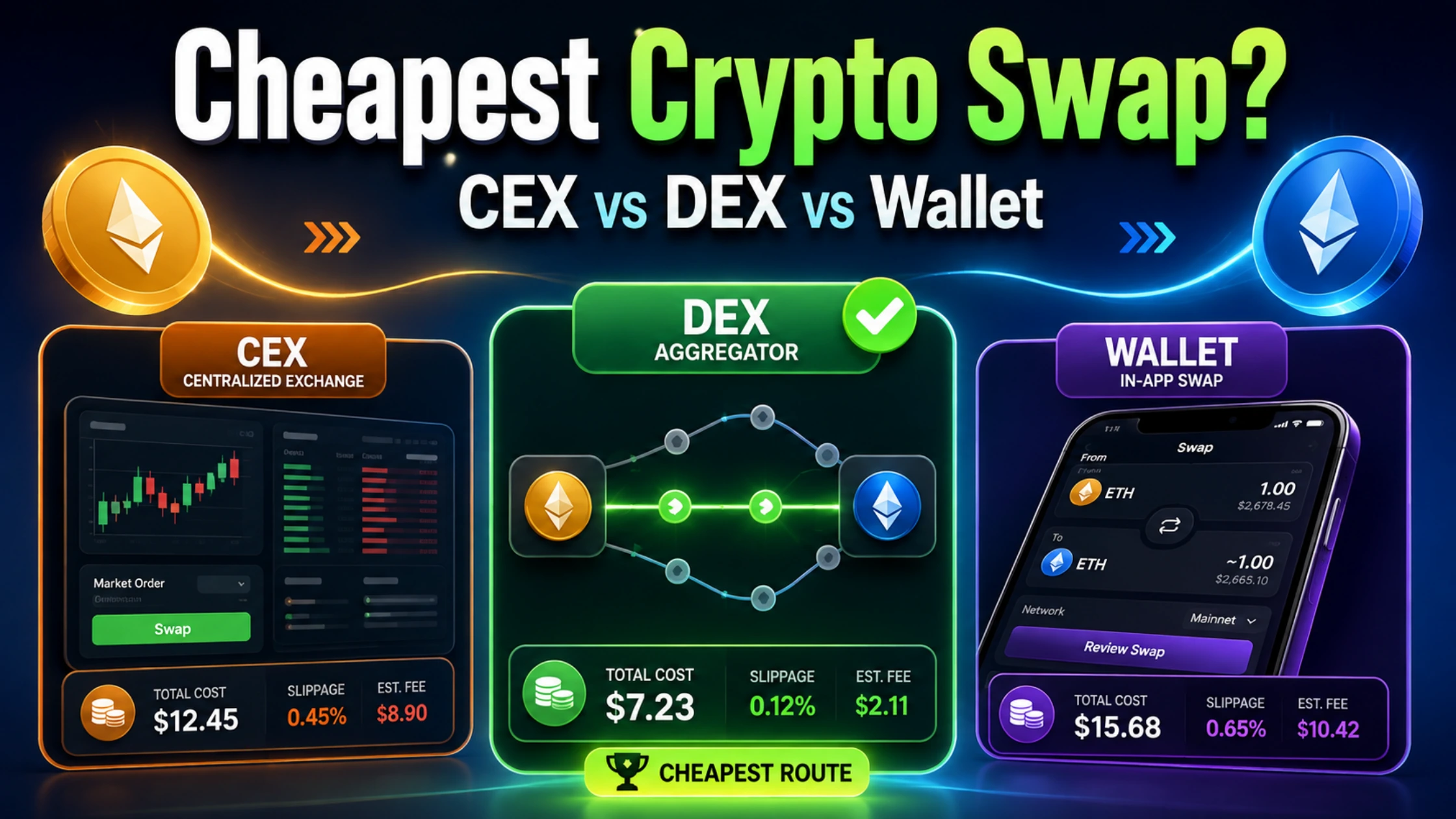
Cheapest Crypto Swap Route 2026-2027: Fees, Gas and Slippage Compared
What is the cheapest way to swap crypto in 2026-2027? Decentralised News compares centralized exchanges, DEX aggregators and wallet-integrated swaps at $100, $1,000 and $10,000, including trading fees, spread, gas, slippage, withdrawals and bridge costs.
Data checked: 30 August 2026. Network fees, exchange fees, DEX quotes, withdrawal charges, bridge costs and liquidity change continuously.
Summary
There is no single cheapest way to swap cryptocurrency.
The answer depends on:
- where your crypto is now
- where you want it afterwards
- trade size
- blockchain
- token liquidity
- gas
- exchange fees
- withdrawal costs
- slippage
- whether a bridge is required
Decentralised News compares three execution routes:
1. Centralized Exchange
Wallet → CEX → Trade → Wallet
Examples include Binance, OKX and Kraken.
2. DEX Aggregator
Wallet → Aggregator → Best On-Chain Route → Wallet
Examples include 1inch and Jupiter.
3. Wallet-Integrated Swap
Wallet → Built-In Swap → Aggregated Liquidity → Wallet
Examples include MetaMask, Phantom and Trust Wallet.
The key conclusion is:
The cheapest swap is determined by total execution cost, not the headline fee.
For crypto already sitting in self-custody on a low-cost blockchain, a DEX aggregator is frequently the strongest starting point, particularly for liquid pairs.
For crypto already sitting on a centralized exchange, the CEX can be cheapest because deposit and withdrawal costs may be irrelevant if the user intends to remain on the platform.
Wallet-integrated swaps are usually the simplest route, but convenience can carry a meaningful percentage fee. MetaMask currently charges 0.875% on swaps, while Phantom charges 0.85% on selected swap pairs. At $10,000, a 0.85% interface fee alone is $85 before network fees or price impact.
There are important exceptions. Trust Wallet currently charges 0% swap fees on selected same-chain stablecoin swaps across several supported networks, excluding Ethereum, while DEX aggregators can themselves charge routing or infrastructure fees depending on the product and route.
DN therefore built the Swap Route Calculator.
The calculator compares:
Quoted Fee + Spread + Gas + Slippage + Deposit + Withdrawal + Bridge Cost
and identifies which route actually leaves the user with the most crypto.
Quick Verdict
Cheapest if your crypto is already in a self-custody wallet
Start with a DEX aggregator.
For liquid assets on:
- Solana
- Base
- Arbitrum
- Optimism
- BNB Chain
- Polygon
network costs can be small enough that efficient aggregation frequently beats paying an additional wallet-interface percentage.
Cheapest if your crypto is already on an exchange
Start with the exchange order book.
Moving crypto into self-custody solely to perform a DEX swap can add:
- withdrawal fees
- network fees
- bridge costs
that eliminate the DEX advantage.
Simplest
Wallet-integrated swap.
It removes several steps and can automatically search external liquidity.
But convenience is not always free.
Best for a large on-chain order
DEX aggregator, RFQ or intent-based route.
Large trades benefit from:
- liquidity splitting
- RFQ market makers
- multiple DEXs
- MEV protection
- route optimization
provided the token has adequate on-chain depth.
Best for major BTC or ETH pairs with deep centralized liquidity
A CEX can still win.
Particularly when:
- assets are already there
- trader has a low fee tier
- order-book spread is extremely tight
- no withdrawal is required

The Three Swap Routes
Before comparing fees, it helps to understand what is actually happening.
Route 1: Centralized Exchange
A typical CEX route looks like:
Self-Custody Wallet
↓
Deposit
↓
Exchange Order Book
↓
Trade
↓
Withdrawal
↓
Self-Custody Wallet
The visible trading fee is only one component.
Possible costs include:
- network cost sending to exchange
- trading fee
- bid/ask spread
- market impact
- withdrawal fee
If the assets are already on the exchange, however, two major costs disappear:
deposit
and potentially:
withdrawal.
That completely changes the comparison.
Route 2: DEX Aggregator
A DEX aggregator searches multiple decentralized liquidity sources.
Typical route:
Wallet
↓
Aggregator
↓
DEX A + DEX B + RFQ Market Maker
↓
Wallet
Rather than forcing the entire order through one liquidity pool, the aggregator may divide it across several venues.
That can reduce:
- price impact
- spread
- slippage
Major examples include:
- 1inch
- Jupiter
- CoW Swap
- other chain-specific aggregators
The user remains in self-custody.
Route 3: Wallet-Integrated Swap
Many wallets now place a:
Swap
button directly in the wallet interface.
Examples include:
- MetaMask
- Phantom
- Trust Wallet
The wallet may itself query:
- DEX aggregators
- market makers
- bridges
- liquidity providers
and present one simplified quote.
In other words:
A wallet swap is often an aggregator wrapped inside a convenience layer.
That layer can make swapping far easier.
It can also introduce another fee.
The DN Swap Cost Equation
The real swap cost is:
Total Swap Cost = Quoted Fee + Spread + Gas + Price Impact + Slippage + Deposit Cost + Withdrawal Cost + Bridge Cost
The relevant output is:
Net Tokens Received
not:
Advertised Trading Fee.
Why Advertised Fees Are Misleading
Imagine three routes.
CEX
Trading fee:
0.10%
DEX Aggregator
Platform cost:
0.10%
Wallet
Wallet fee:
0.85%
At first glance, CEX and aggregator look nearly identical.
But suppose the CEX requires:
$4 withdrawal
while the aggregator requires:
$0.08 gas.
At $100, the fixed withdrawal cost can dominate the result.
At $10,000, it barely matters.
Trade size therefore changes the winner.
DN Standardized Swap Test
A credible benchmark must use the same assumptions.
DN’s test framework compares:
- $100
- $1,000
- $10,000
using the same:
- asset pair
- blockchain
- timestamp
- starting asset
- destination asset
- starting custody location
Quotes should ideally be captured within the same few minutes.
Controlled Example
The following is an illustrative model, not a claim about a live quote at this exact moment.
Assume a liquid pair on a low-cost blockchain.
Centralized Exchange
- Trading fee: 0.10%
- Execution spread/impact: 0.05%
- Wallet-to-exchange transfer cost: $0.10
- Exchange withdrawal cost: $1.00
DEX Aggregator
- Aggregator/routing cost: 0.10%
- Price impact: 0.05%
- Gas: $0.10
Wallet-Integrated Swap
- Wallet interface fee: 0.85%
- Price impact: 0.05%
- Gas: $0.10
No bridge is required.
$100 Swap
Centralized Exchange
Trading + spread:
$0.15
Transfer and withdrawal:
$1.10
Total
$1.25
Effective friction:
1.25%
DEX Aggregator
Routing + price impact:
$0.15
Gas:
$0.10
Total
$0.25
Effective friction:
0.25%
Wallet Swap
Wallet fee + impact:
$0.90
Gas:
$0.10
Total
$1.00
Effective friction:
1.00%
$100 Winner
DEX Aggregator
But this assumes:
- low-cost blockchain
- deep liquidity
- assets already in self-custody
Move the same transaction to an expensive blockchain during congestion and the result can change dramatically.
$1,000 Swap
CEX
Percentage cost:
$1.50
Fixed transfer/withdrawal:
$1.10
Total
$2.60
Effective friction:
0.26%
DEX Aggregator
Percentage cost:
$1.50
Gas:
$0.10
Total
$1.60
Effective friction:
0.16%
Wallet Swap
Wallet fee + impact:
$9.00
Gas:
$0.10
Total
$9.10
Effective friction:
0.91%
$1,000 Winner
DEX Aggregator
The fixed CEX withdrawal cost matters less now.
The percentage-based wallet fee becomes more visible.
$10,000 Swap
CEX
Trading + spread:
$15
Transfer/withdrawal:
$1.10
Total
$16.10
Effective friction:
0.161%
DEX Aggregator
Routing + impact:
$15
Gas:
$0.10
Total
$15.10
Effective friction:
0.151%
Wallet Swap
Wallet fee + impact:
$90
Gas:
$0.10
Total
$90.10
Effective friction:
0.901%
$10,000 Winner
Under these assumptions:
DEX Aggregator, narrowly.
But remove the CEX transfer and withdrawal because the trader’s assets are already on the exchange:
CEX cost
$15
DEX aggregator
$15.10
The CEX becomes cheaper.
That $0.10 reversal explains the entire thesis of this article.
Where the assets already are can matter more than which venue advertises the lowest fee.
Modeled Results
Swap Size | CEX From Wallet | DEX Aggregator | Wallet Swap |
$100 | $1.25 | $0.25 | $1.00 |
$1,000 | $2.60 | $1.60 | $9.10 |
$10,000 | $16.10 | $15.10 | $90.10 |
These are controlled illustrative assumptions, not live executable quotes.
The DN Swap Route Calculator below allows readers to replace every assumption with the actual quote shown on their screen.
The tool compares all three routes simultaneously.
Enter:
- swap amount
- CEX trading fee
- CEX spread
- deposit/network cost
- withdrawal cost
- DEX aggregator fee
- DEX price impact
- gas
- token approval cost
- wallet swap fee
- wallet price impact
- bridge fee
Output:
Cheapest Route
CEX / DEX Aggregator / Wallet Swap
Estimated Cost
USD and percentage.
Net Amount
How much value survives the transaction.
Cost Difference
How much the cheapest route saves versus the alternatives.

1. Centralized Exchange: When Is It Cheapest?
A CEX can be extraordinarily efficient for large, liquid crypto pairs.
Current standard trading fees vary substantially between exchanges and account tiers.
For example, OKX’s current regular-tier standard spot taker fee is around 0.10%.
Kraken changed its fee structure in July 2026. Its entry-level Kraken Pro spot tier now starts significantly higher, while higher-volume and higher-asset tiers progressively reduce fees.
This demonstrates why saying:
“CEX trading costs 0.1%”
is no longer sufficiently accurate.
The exchange matters.
The fee tier matters.
Where CEXs Have an Advantage
Deep Centralized Liquidity
Major order books for:
- BTC
- ETH
- SOL
- XRP
- major stablecoins
can have exceptionally tight spreads.
A centralized exchange can therefore beat an on-chain route even when its explicit trading fee is slightly higher.
No Gas During Trading
Once assets are deposited, the internal trade itself does not require a blockchain transaction.
This makes CEX trading less sensitive to:
- Ethereum congestion
- priority fees
- failed transactions
Limit Orders
Users can place:
- maker orders
- limit orders
- post-only orders
and potentially achieve a better price than taking an immediate quote.
A wallet swap generally prioritizes immediate execution.
High-Volume Discounts
Professional traders can receive substantially lower trading fees through:
- volume tiers
- VIP programmes
- asset-balance tiers
That can materially alter the comparison.
Where CEXs Lose
Deposit Friction
If assets start in self-custody, they need to reach the exchange.
The exchange may not charge a crypto deposit fee, but the sender still pays the blockchain network.
Withdrawal Fees
Getting the resulting asset back into self-custody can cost money.
Exchange withdrawal fees can differ from raw network gas.
The exact withdrawal network also matters.
Sending USDC using:
Ethereum
can have a very different cost from:
Solana
or:
Arbitrum.
Custody
The user temporarily gives custody to the exchange.
That introduces:
- counterparty risk
- account restriction risk
- withdrawal review risk
Cost is not the only consideration.
Best CEX Use Case
A CEX is particularly attractive when:
assets already on exchange
deep pair liquidity
low trading fee tier
no immediate self-custody withdrawal
That is close to the ideal centralized-exchange case.

CEX Platforms Worth Comparing
For major order-book trading, examples include:
Referral code: 2136301
Referral code: CPA_00SXKU7IO9
The relevant number is not simply maker/taker fee.
Check:
Executable Price + Fee + Withdrawal
2. DEX Aggregator: When Is It Cheapest?
DEX aggregators attack a different problem.
Instead of asking:
“Which DEX should I use?”
they ask:
“Where across available on-chain liquidity can this order execute most efficiently?”
The route might split an order across:
- Uniswap
- Curve
- PancakeSwap
- Orca
- Raydium
- Meteora
- RFQ market makers
- other liquidity sources
depending on chain.
1inch
1inch now provides several execution modes.
Its Swap interface increasingly uses intent-based execution where professional resolvers compete to fill the order.
In many cases, the resolver pays the underlying gas rather than the user paying gas separately.
Its current documentation also notes that infrastructure fees can vary according to route and interface.
For 1inch-powered interfaces, current ranges can reach:
- 0 to 5 basis points for stablecoin pairs
- 0 to 30 basis points for non-stablecoin pairs
depending on how the route is delivered.
This means:
DEX aggregator ≠ automatically zero fee.
But it can still be extremely efficient.
1inch Fusion
Fusion adds another advantage:
MEV protection.
Resolvers compete to execute the user’s order.
The structure is designed to reduce exposure to front-running while allowing the resolver to cover gas in qualifying routes.
That can be attractive for larger EVM transactions.
Jupiter
Jupiter performs a similar role on Solana.
Its current Meta-Aggregator can compare routing engines including:
- Metis
- JupiterZ RFQ
- DFlow
- OKX
and select among the resulting routes.
Current platform fees differ by pair.
Examples currently include:
Stable-to-stable
0 bps
SOL-to-stable
2 bps
Certain LST/stable routes
5 bps
Many other token pairs
10 bps
Newly launched assets can cost more.
That is dramatically different from assuming every Jupiter trade costs 1%.
Jupiter Gasless Routing
Jupiter also supports routes where the taker does not need to hold SOL for gas.
The gas cost does not magically disappear.
It can be incorporated into the execution economics or paid by another participant.
This distinction matters.
Gasless is not necessarily costless.
Why Aggregators Can Beat Individual DEXs
Suppose:
DEX A
offers:
49.8 ETH
DEX B
offers:
49.9 ETH
RFQ Market Maker
offers:
49.95 ETH
An aggregator can select the better route.
For larger orders it might split the order:
40% DEX A
30% DEX B
30% RFQ
to reduce price impact.
That is its primary edge.
DEX Aggregator Weaknesses
They still face:
- blockchain gas
- smart-contract risk
- approvals
- price impact
- slippage
- MEV on unprotected routes
- failed transactions
- bridge risk for cross-chain trades
The user also needs self-custody competence.
Best DEX Aggregator Use Case
The aggregator is particularly strong when:
assets already in wallet
same-chain swap
liquid pair
low-cost blockchain
no bridge
This is frequently the cheapest overall setup.
3. Wallet-Integrated Swap: When Is Convenience Worth Paying For?
Wallet swaps have improved dramatically.
They are no longer necessarily:
wallet → one DEX.
Modern wallets can aggregate multiple sources themselves.
MetaMask Swaps
MetaMask currently searches multiple decentralized exchanges and liquidity providers to identify competitive quotes.
It can also:
- split routes
- optimize gas
- incorporate bridging
- filter likely failed transactions
This makes it much more sophisticated than a simple single-pool swap button.
But MetaMask charges:
0.875%
on swaps.
What 0.875% Means
On:
$100
$0.875
$1,000
$8.75
$10,000
$87.50
$100,000
$875
before considering network fees and price impact.
For small swaps, the convenience may easily justify the cost.
For a $100,000 transaction, comparing the underlying DEX aggregator directly becomes much more important.
Phantom
Phantom currently charges:
0.85%
on selected same-chain swap pairs.
The swap may additionally include:
- network gas
- price impact
Cross-chain routes can include:
- bridge fees
- liquidity-provider fees
Phantom notes that some cross-chain provider costs can be around 0.3%, although the figure is route dependent.
Phantom Gasless Swaps
Gasless routing on Solana can carry a separate:
1.5%
fee for qualifying mobile transactions.
Again:
gasless does not mean free.
The gas is being abstracted and paid through another part of the execution model.
Trust Wallet
Trust Wallet has a different pricing structure.
Its swaps route across external liquidity providers, and the exact cost can depend on the route.
Importantly, Trust Wallet launched a 0% swap-fee programme for eligible same-chain stablecoin swaps in August 2026.
Eligible networks currently include:
- Solana
- Base
- Arbitrum
- BNB Chain
- Polygon
- Optimism
- Avalanche
Ethereum is excluded from that particular 0% programme.
Gas still applies.
This demonstrates why it would be inaccurate to say:
“Wallet swaps always cost 0.85%.”
They do not.
The wallet must be tested individually.
Why People Use Wallet Swaps Anyway
Convenience has value.
The user avoids:
- visiting another website
- connecting to unfamiliar protocols
- comparing multiple DEXs
- choosing bridges manually
The wallet may abstract:
Swap + Route + Bridge + Gas
into one transaction.
For a beginner swapping $100, paying an extra:
$0.50 to $1
might be perfectly rational.
For a professional swapping $100,000 repeatedly, probably not.

The Hidden Difference: Wallet Aggregator vs DEX Aggregator
This distinction is often misunderstood.
DEX Aggregator
You access the routing engine directly.
Wallet Swap
The wallet may query one or more of those same routing engines and then place its own convenience layer on top.
That means the user may be paying:
Underlying DEX Costs
Aggregator Costs
Wallet Interface Fee
The quote can still be competitive if the wallet finds a better route.
But the fee stack must be examined.
Spread vs Slippage vs Price Impact
These are related but not identical.
Spread
Difference between:
best buying price
and:
best selling price.
On an order book:
Bid / Ask Spread
Price Impact
How much your own trade moves the market.
A $100 order may barely affect a pool.
A $1 million order might move it dramatically.
Slippage
Difference between:
expected execution
and:
actual execution.
Slippage can result from:
- market movement
- pool liquidity
- MEV
- transaction latency
A route advertising:
0% fee
can still be expensive through poor execution.
Why $10,000 Changes the Calculation
At $100, fixed fees matter.
At $10,000, execution quality matters more.
Suppose:
Route A
Gas:
$5
Spread/impact:
0.02%
Total execution impact:
approximately:
$7
Route B
Gas:
$0.10
Spread/impact:
0.30%
Execution impact:
approximately:
$30.10
The expensive-gas route was actually cheaper.
That is why users should never optimize gas in isolation.
What About $100,000+?
This is where the article connects to DN’s larger execution-quality research.
At larger sizes, compare:
- order-book depth
- DEX liquidity
- RFQ
- OTC
- split routing
- market impact
The winner may change completely.
A DEX aggregator routing through several pools and an RFQ market maker can outperform a CEX order book.
A deep institutional CEX can outperform the entire on-chain market.
The answer must be measured.
Bridge Costs Can Destroy an Apparently Cheap Route
Suppose a token sits on:
Arbitrum
but the best liquidity exists on:
Ethereum.
A user sees an attractive DEX quote.
But the full route becomes:
Arbitrum
↓
Bridge
↓
Ethereum
↓
Swap
The bridge adds:
- bridge fee
- source-chain gas
- destination execution
- latency
- bridge risk
A slightly worse local Arbitrum swap might actually produce more net value.
Cross-Chain Wallet Swaps
Wallet integrations are particularly valuable here.
MetaMask and Phantom can abstract cross-chain routing.
Instead of manually:
- choosing a bridge
- bridging
- waiting
- switching network
- opening a DEX
- swapping
the wallet may present:
one quote.
That convenience can justify an additional fee for many users.
The correct comparison remains:
final amount received.
The Approval Cost Nobody Mentions
ERC-20 tokens often require an approval transaction before a smart contract can spend them.
That can mean:
Transaction 1
Approve.
Transaction 2
Swap.
Both can consume gas.
If the user already approved the router previously, only the second transaction may be required.
This creates another reason why identical-looking users can receive different total costs.
Failed Transaction Cost
A failed centralized exchange order generally does not consume blockchain gas.
A failed on-chain transaction can.
The user might receive:
zero tokens
while still paying gas.
This gives transaction-simulation and intent systems real economic value.
MEV: The Hidden On-Chain Tax
MEV can create another invisible cost.
An unprotected swap can potentially be:
- front-run
- back-run
- sandwiched
causing worse execution.
Intent-based platforms and MEV-protected routes can reduce this risk.
For a $100 swap, the difference may be negligible.
For a six-figure on-chain order, it can matter significantly.
When the CEX Wins
Choose a CEX first when:
- assets are already there
- trading a major liquid pair
- you have a strong fee tier
- you want limit orders
- you do not need immediate self-custody
- on-chain liquidity is thin
- gas is expensive
When the DEX Aggregator Wins
Start with an aggregator when:
- assets are already self-custodied
- tokens are on the same chain
- on-chain liquidity is deep
- the chain is inexpensive
- you want route splitting
- you want RFQ competition
- you want to avoid centralized custody
When the Wallet Swap Wins
Use the wallet’s integrated route when:
- convenience matters more than basis points
- trade size is small
- you do not want to navigate external DEXs
- cross-chain execution would otherwise require several steps
- a special zero-fee route applies
- the wallet’s quote beats the direct aggregator after all costs
The last point matters.
Never reject a wallet quote simply because the interface fee is higher.
Compare:
Net Amount Received.
Best Route by Swap Size
Swap Size | Strong Starting Choice | Why |
$100 | DEX aggregator on low-cost chain | Fixed fees matter most |
$100 on Ethereum | Compare carefully | Gas can dominate |
$1,000 | DEX aggregator / CEX | Execution and custody location matter |
$10,000 | DEX aggregator / CEX | Spread and price impact dominate |
$100,000+ | RFQ / aggregator / deep CEX | Institutional execution quality matters |
Cross-chain | Aggregator or wallet route | Bridge optimization becomes critical |
Best Route by Starting Location
Crypto Already on Binance, OKX or Kraken
Before withdrawing just to use a DEX, compare the CEX trade.
The centralized route may already be cheapest.
Crypto Already in MetaMask
Compare:
MetaMask Swap
against:
1inch / other direct aggregator
using the same tokens and amount.
Crypto Already in Phantom
Compare:
Phantom
against:
Jupiter
before confirming a large swap.
Stablecoins in Trust Wallet
Check whether the pair qualifies for its current 0%-wallet-fee same-chain stablecoin programme.
Why Stablecoin Swaps Are Different
Stablecoin markets can be extremely efficient.
Examples:
- USDC → USDT
- USDT → DAI
- USDC → EURC
Price impact can be extremely small in deep pools.
Some aggregators and wallet providers also charge lower fees for pegged-asset routes.
This can make self-custody swapping exceptionally competitive.
Why Long-Tail Tokens Are Different
For a small altcoin, the CEX may have:
almost no order-book liquidity.
The on-chain pool might be the primary market.
In that case, comparing:
CEX vs DEX
is almost misleading.
The DEX may be where actual price discovery occurs.
Alternatively, the opposite can be true.
A token might have strong centralized liquidity and weak on-chain pools.
Always check the pair.
Do You Need a DEX Aggregator for Every Swap?
No.
For a highly liquid pair, one DEX may already offer nearly optimal pricing.
The aggregator becomes more useful as:
- order size increases
- liquidity fragments
- number of pools increases
- RFQ becomes relevant
The cost of aggregation itself should therefore be included.
What Should DN Test in the Live Benchmark?
For every pair:
Timestamp
Record exact UTC time.
Block
Record blockchain block or slot where appropriate.
Pair
Example:
USDC → ETH
Size
- $100
- $1,000
- $10,000
CEX
Record:
- best ask/bid
- taker fee
- effective execution
- withdrawal fee
Aggregator
Record:
- quoted output
- platform fee
- gas
- price impact
- minimum received
Wallet
Record:
- quoted output
- wallet fee
- gas
- provider fee
- minimum received
Then calculate:
Net destination asset after every unavoidable cost.
This transforms the article into a reproducible benchmark.
DN Swap Route Score
A future live ranking can score routes using:
Net Execution Value: 50%
Price Impact: 15%
Gas/Fee Efficiency: 15%
MEV Protection: 10%
Execution Reliability: 5%
Custody/Operational Friction: 5%
The most important factor remains:
how much the user receives.
The Most Important Number on a Swap Screen
Do not focus on:
Fee: 0%.
Focus on:
You Receive
Then compare the same amount across each route at approximately the same time.
For on-chain swaps, also inspect:
Minimum Received
That shows what can happen if the price moves within the permitted slippage tolerance.
A Practical Three-Minute Swap Test
Before swapping $10,000:
Step 1
Check the CEX order book.
Record:
net amount after trading fee.
Step 2
Check a major DEX aggregator.
Record:
net output after route and gas.
Step 3
Check the wallet’s built-in swap.
Record:
net output after wallet fee and gas.
Step 4
If cross-chain, add:
bridge cost.
Step 5
Choose the route producing the highest:
net received amount
subject to acceptable:
- custody risk
- smart-contract risk
- execution risk
That five-minute comparison can save more money than searching for promotional “zero-fee” offers.
Cheapest Does Not Always Mean Best
Suppose:
Route A
Saves:
$4
but requires:
- unknown smart contract
- new token approval
- obscure bridge
Route B
Costs:
$4 more
but uses:
- established liquidity
- established aggregator
- no cross-chain bridge
Route B can easily be rational.
Security is part of execution quality.
Privacy and KYC
The three routes also differ operationally.
CEX
Usually requires:
- account
- KYC
- custodial deposit
DEX Aggregator
Generally interacts directly with the user’s wallet.
Wallet Swap
Also generally operates from self-custody.
That does not mean on-chain swaps are anonymous.
Blockchain transactions are publicly visible.
Custody Comparison
CEX
Exchange controls assets while deposited.
DEX Aggregator
User signs transactions from self-custody.
Wallet Swap
User generally remains self-custodied while the integrated router executes.
For a user determined to retain self-custody, this factor alone may eliminate the CEX route regardless of a few basis points of difference.
Frequently Asked Questions
What is the cheapest way to swap crypto in 2027?
For assets already in self-custody on a low-cost chain, a DEX aggregator is often the strongest starting point.
If the crypto is already held on a centralized exchange, trading directly on the CEX can be cheaper.
The correct answer depends on the complete cost route.
Is a DEX cheaper than Binance or OKX?
Sometimes.
DEX aggregators avoid centralized withdrawal costs but introduce:
- gas
- on-chain price impact
- possible aggregator fees
A CEX can be cheaper for extremely liquid pairs or where the assets are already deposited.
Is MetaMask Swap expensive?
MetaMask currently charges a 0.875% swap fee.
For a $100 transaction, that may be acceptable for the convenience.
For a $10,000 or $100,000 swap, comparing direct DEX aggregator quotes becomes increasingly important.
How much does Phantom charge to swap?
Phantom currently charges 0.85% on selected swap pairs, plus applicable network fees and price impact.
Cross-chain routes can include additional bridge/provider fees.
Does Trust Wallet charge swap fees?
Swap costs depend on route.
Trust Wallet currently has a special 0% wallet-fee programme for eligible same-chain stablecoin swaps on selected chains excluding Ethereum.
Network fees still apply.
Is Jupiter cheaper than Phantom?
It can be.
Phantom can route trades through underlying liquidity while adding its wallet-level fee on selected pairs.
Jupiter’s current platform fees can be materially lower for many routes.
Always compare the actual output quote.
Does 1inch charge gas?
It depends on execution mode.
In the regular Pro aggregator route, users can pay blockchain gas.
In 1inch’s intent-based Swap/Fusion environment, resolvers can cover gas for qualifying transactions.
The economics are incorporated into the route.
What is the cheapest way to swap USDC to USDT?
Same-chain stablecoin liquidity is often exceptionally efficient.
Compare:
- stablecoin-focused DEX aggregator routes
- wallet zero-fee promotions where applicable
- CEX stablecoin markets
The cheapest route varies by chain.
Is zero-fee crypto swapping really free?
Not necessarily.
A zero explicit fee route can still contain:
- spread
- price impact
- gas
- bridge fees
- poor exchange rate
Compare the final amount received.
Should I use a CEX for a $100 swap?
If the assets are already on the exchange, possibly.
If the assets are in self-custody and need to return there afterwards, fixed deposit/withdrawal friction can make the route less attractive.
Should I use a DEX for a $10,000 swap?
Often worth checking.
Large liquid on-chain markets can be extremely competitive.
But compare against major CEX order-book execution.
What about a $100,000 swap?
Use a serious execution comparison.
Compare:
- CEX
- aggregator
- RFQ
- OTC
Price impact becomes more important than headline fees.
What is slippage?
Slippage is the difference between the expected execution price and the actual result.
What is price impact?
Price impact is the movement in market price caused by your own order.
Why do I need a token approval?
Many smart-contract tokens require the user to authorize the router contract before it can move the token being sold.
That authorization can require a separate blockchain transaction.
What is MEV?
MEV refers to value extracted through transaction ordering and execution opportunities on blockchains.
Poorly protected swaps can potentially suffer from front-running or sandwich-style attacks.
Is wallet swapping safer than visiting a DEX?
It can reduce operational complexity and exposure to fake websites.
But the wallet still routes through underlying smart contracts and liquidity providers.
Users should review the transaction before signing.
Do I need to bridge before swapping?
Not always.
Cross-chain aggregators and wallet swaps can sometimes combine:
bridge + swap
into one user flow.
The bridge cost and risk still exist underneath.
Final Verdict
The crypto industry has spent years asking:
Which exchange has the lowest fee?
That is the wrong question.
A crypto swap has a route.
And every route creates costs.
The centralized path can contain:
Deposit + Trading Fee + Spread + Withdrawal.
The DEX aggregator path can contain:
Aggregator Fee + Gas + Price Impact + Slippage.
The wallet route can contain:
Wallet Fee + Aggregator/Provider Cost + Gas + Price Impact.
Cross-chain swaps add:
Bridge Cost.
Under DN’s controlled $100, $1,000 and $10,000 example, the DEX aggregator wins when assets begin and end in self-custody on a low-cost chain.
But when assets already sit on the exchange, the CEX can become cheaper.
And when simplicity matters more than a few dollars, the wallet-integrated swap can easily be the better user decision despite not having the lowest mathematical cost.
That gives us three different winners:
Cheapest for Self-Custody
DEX Aggregator
Cheapest for Assets Already on a CEX
Often the CEX
Easiest
Wallet-Integrated Swap
But those are starting points.
The actual winner should always be determined by:
Net amount received after every unavoidable cost.
That is what the DN Swap Route Calculator measures.
And it exposes why “0% trading fee,” “gasless swap” and “best rate” are not enough information to determine whether a crypto swap is actually cheap.
Affiliate Disclosure
Some links in this article are affiliate links. Decentralised News may receive compensation if an eligible reader opens an account through one of these links. Affiliate relationships do not influence route rankings, calculations, methodology or editorial conclusions.
Disclaimer
This article is for educational and informational purposes only and is intended for readers aged 18 and over. Cryptocurrency, self-custody, decentralized exchanges, bridges and smart contracts involve substantial financial and technical risk. Swap quotes, fees, gas, spread and slippage change continuously. Always verify the final output, network, token contract and transaction details before signing.
Related reading:
Best Crypto Exchanges for Non-USD Traders: Lowest FX Friction for EUR, GBP, ZAR and More
What Is the Cheapest Way to Swap Crypto? CEX vs DEX Aggregator vs Wallet Swap
Best Crypto Exchanges for Team Trading in 2027: Subaccounts, Permissions, APIs and Withdrawal Controls Ranked
Best Crypto Exchanges for Freelancers and Remote Workers in 2027: Receive, Spend and Cash Out Stablecoins
Best Multi-Asset Crypto Exchanges in 2027: Trade Crypto, Stocks, Commodities and FX From One Platform
Crypto Exchange KYC Friction Index: Which Exchanges Make Verification Easiest?
The Crypto Platform Selector 2027: Find the Best Exchange, DEX, Wallet or Tool for Your Needs
Crypto Execution Quality Index 2027: Which Exchanges Actually Give Traders the Best Fills?
Best Crypto Exchange VIP Programs: Fees, Qualification and Benefits Compared
Best Crypto Exchanges for DCA in 2027: Recurring Buy Fees, Spreads and True Costs Compared
Crypto Liquidation Fairness Index 2026: Which Exchanges Liquidate Traders Most Fairly?
Which Crypto Exchange Has the Best Customer Support? DN Response-Time Benchmark 2027





