
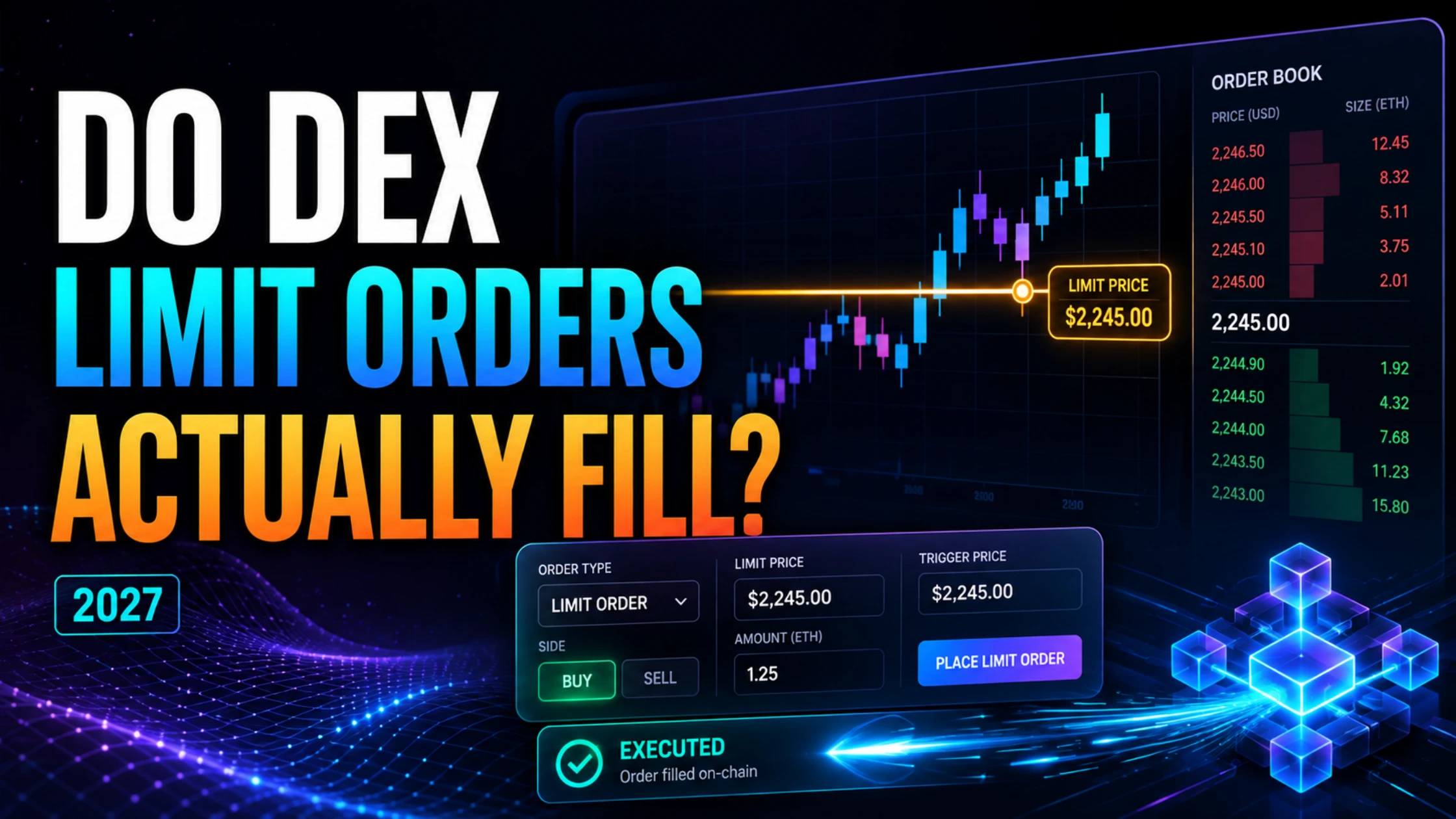
Which DEX is best for limit orders in 2027? Decentralised News compares CoW Swap, 1inch, KyberSwap, Uniswap, Jupiter, Matcha and OKX across fill reliability, expiry, partial fills, gas, cancellations, MEV, trigger behavior and supported chains.
Data checked: 31 August 2026.
Operational Status Gate: Only verified LIVE limit-order products are eligible for current recommendation.
Summary
Placing a decentralized limit order is easy.
Getting it filled when the market actually reaches your target is the harder problem.
That distinction is missing from most DEX comparisons.
A chart can show:
ETH touched $3,000
while your:
Buy ETH at $3,000
order remains unfilled.
Why?
Possible causes include:
- no profitable filler
- insufficient liquidity
- network costs
- brief price touch
- keeper latency
- insufficient wallet balance
- competing orders
- settlement failure
- price source differences
Decentralised News therefore created the:
DN On-Chain Limit Order Execution Test
Instead of ranking platforms based only on whether they offer a Limit button, DN tests:
When the market reaches the user’s target, does the order actually execute?
We measure:
- fill ratio
- trigger-to-fill latency
- average execution price
- partial fills
- expiry
- cancellation cost
- MEV protection
- gas
- minimum economic order size
- supported chains
- conditional-order capabilities
- settlement reliability
Our current architecture-based starting choices are:
Best Overall EVM Limit Order Architecture
CoW Swap
Best Broad EVM Limit Order Protocol
1inch
Best Transparent On-Chain Order Book Experience
KyberSwap
Best Ethereum-Native Simple Limit Order
Uniswap
Best Solana Limit Order Experience
Jupiter
Best Long-Duration EVM Limit Orders
Matcha
Best Broad Mobile Multi-Chain Limit Order
OKX DEX
But the real DN ranking begins when:
market price reaches trigger
and we measure:
what actually happens next.
Quick Verdict
Platform | DN Best Use Case |
CoW Swap | MEV-protected EVM limit orders |
1inch | Broad EVM + advanced conditional framework |
KyberSwap | Transparent maker liquidity and order-book UX |
Uniswap | Simple Ethereum limit orders |
Jupiter | Solana limit orders |
Matcha | Long-duration and percentage-based limit orders |
OKX DEX | Mobile multi-chain users |
DN On-Chain Limit Order Execution Test
Measure whether a DEX limit order actually fills after the market reaches the target. Compare fill percentage, execution price, trigger latency, costs, partial fills and MEV protection.
| Platform | Use | Trigger Reached? | Fill % | Avg Fill Price | Fill Latency Sec | Total User Cost $ | Partial Fill Support | MEV Protected | Cancel Cost $ |
|---|
Enter observed trigger results
Why Limit Orders on a DEX Are Different
A centralized exchange has an internal order book.
Your order sits inside the exchange’s matching engine.
When matching liquidity appears, the exchange can execute it internally.
A decentralized limit order works differently.
Common architecture:
User signs order
↓
Off-chain order relay
↓
Keeper / filler / taker / solver observes order
↓
Economic execution opportunity appears
↓
Order settles on-chain
This introduces new variables.
Price Touched Does Not Mean Fill Guaranteed
This is the most important concept in the article.
Imagine:
Limit Buy
ETH:
$3,000
A chart briefly prints:
$2,999.80
Yet your order does not execute.
That does not automatically mean the DEX failed.
The actual executable liquidity may have been:
$3,005
after:
- gas
- pool fees
- slippage
- filler economics
The chart price and fillable price are not always identical.
The DN Trigger Test
For every order DN tests:
Target Price
Example:
$3,000
Reference Market
Record which market or oracle DN uses to determine that the price touched.
First Touch Time
Exact UTC timestamp.
Touch Duration
How long the market remained at or through the target.
Actual Fill Time
If filled.
Fill Ratio
0% to 100%.
Average Fill Price
Actual execution.
Network Cost
Maker and/or filler costs where relevant.
Cancellation Cost
If cancelled.
This turns:
“limit orders supported”
into:
measurable execution quality.
DN On-Chain Limit Order Score
Fill Reliability: 40%
Did the order execute after the trigger became economically fillable?
Price Fidelity: 20%
Did execution respect or improve the user’s target?
Trigger Latency: 15%
How quickly did execution occur after the qualifying price event?
Cost Efficiency: 10%
Consider:
- order placement gas
- cancellation gas
- settlement fee
MEV Protection: 5%
Was execution designed to limit harmful MEV?
Partial Fill Handling: 5%
Can larger orders execute incrementally?
Cancellation Flexibility: 5%
Can users economically cancel or modify active orders?
Total:
100 points
Architecture-Based Starting Ranking
Rank | Platform | DN View |
1 | Best overall EVM architecture | |
2 | 1inch | Best broad EVM protocol |
3 | KyberSwap | Strong order-book and maker execution |
4 | Uniswap | Clean Ethereum filler model |
5 | Best Solana-specific choice | |
6 | Matcha | Strong long-duration EVM orders |
7 | Strong mobile multi-chain option |
This is not an observed fill-rate ranking.
DN should ultimately replace it with real trigger data.
1. CoW Swap: Best Overall EVM Limit Order Architecture
Referral code: DECENTRALISED
CoW’s limit orders inherit its broader solver architecture.
Rather than relying on one keeper, orders participate in:
- solver competition
- DEX aggregation
- private liquidity
- Coincidence of Wants
This creates a large execution universe.
Partial Fills
CoW supports:
partially fillable limit orders.
That is particularly important for larger positions.
Suppose:
$100,000
is offered at a target price.
Only:
$25,000
can currently execute economically.
A fill-or-kill architecture might leave the entire order untouched.
Partial execution can instead fill:
$25,000
and keep the remainder active.
Surplus
CoW also attempts to return:
price improvement
to the trader.
Suppose your sell limit is:
$3,100
but execution is available at:
$3,120.
The architecture is designed to capture that surplus for the user rather than simply settling at the worst acceptable limit.
MEV Protection
Limit orders benefit from the same solver-based MEV protections as the broader CoW architecture.
For large trades, that can be materially important.
Placement and Cancellation
CoW describes its limit orders as:
- free to place
- free to cancel
with fees incorporated into executed trades rather than conventional maker gas.
That creates a strong trader experience.
Expiry
Users can specify how long an order should remain active.
Advanced Orders
CoW’s wider programmable-order architecture can also support more sophisticated strategies beyond static limit orders.
This makes CoW particularly attractive to:
- DAO treasuries
- larger traders
- automated strategies
DN Verdict
Best current architecture-based EVM limit-order choice.
Its largest advantages are:
- solver competition
- partial fills
- MEV protection
- surplus capture
The next question is whether it achieves the best real trigger-to-fill rate.
That is what DN should test.
2. 1inch: Best Broad EVM Limit Order Protocol
1inch currently operates:
Limit Order Protocol v4.
The protocol combines:
- traditional limit orders
- RFQ-style orders
- dynamic rates
- conditional orders
- extension logic
This makes it one of the more programmable systems in the category.
Supported Networks
Current 1inch documentation lists limit-order support on:
- Ethereum
- BNB Chain
- Polygon
- Optimism
- Arbitrum
- Gnosis
- Avalanche
- Sonic
- Unichain
- Robinhood Chain
That is one of the broader network footprints in the comparison.
Maker Fees
1inch currently states that its Limit Order Protocol:
does not charge additional maker fees.
Takers pay settlement gas.
Partial Fills
Partial execution is supported.
A taker can execute part of the order and leave the remainder active.
This improves the economics of larger orders.
Expiry
Users select a:
validity period.
An unfilled order expires when the chosen period ends.
Cancellation
Manual cancellation requires an on-chain transaction and therefore:
gas.
This is an important difference from protocols offering purely signature-based cancellation flows.
Conditional Orders
1inch v4 supports:
- dynamic exchange rates
- conditional logic
- arbitrary extension code
This gives builders substantially more flexibility than a basic:
buy at X
limit interface.
Why an Order Might Not Fill
1inch explicitly identifies several factors:
- chart price does not exactly equal executable on-chain price
- taker economics are unattractive
- gas is too expensive relative to order value
- insufficient token liquidity
- insufficient wallet balance
This is precisely why DN needs an execution test.
DN Verdict
Best broad EVM limit-order protocol for users valuing chain coverage and programmability.
Its current downside relative to CoW is that manual cancellation can still require gas.
3. KyberSwap: Best Transparent Limit Order Interface
KyberSwap launched:
Limit Order 2.0
in July 2026.
The upgrade added:
- visible maker liquidity
- live order book
- built-in charts
- direct interaction with resting orders
That makes the UX more similar to an order-book trading environment.
Aggregator-Backed Fills
Kyber’s limit orders can also become liquidity for its aggregator.
That is interesting.
A normal aggregator swap can potentially consume a resting limit order.
This expands the universe of potential takers.
Gasless Settlement
Kyber’s current 2026 positioning describes maker orders as gasless to create and settlement gas as paid by takers.
This creates familiar off-chain order / on-chain settlement economics.
Cancellation
Kyber has historically supported:
- gasless cancellation on selected networks
- hard on-chain cancellation where immediate invalidation is needed
Its newer 2026 Limit Order 2.0 documentation emphasizes simplified, free management.
DN should verify the exact live cancellation mechanism per network during testing rather than assuming one universal rule.
Fill Economics
Kyber documentation makes an important point.
If an Ethereum limit order is too small, the taker may not earn enough to justify gas.
That means:
minimum order size is economic, not merely technical.
This is a crucial benchmark variable.
DN Verdict
One of the strongest platforms for traders wanting visibility into resting maker liquidity.
Its 2026 order-book redesign makes it particularly interesting for the trigger-to-fill benchmark.
4. Uniswap: Best Simple Ethereum Limit Order
Uniswap currently offers limit orders through the Uniswap web app.
The user specifies:
- token pair
- amount
- target price
- expiry
The order is then broadcast to an:
open network of third-party UniswapX fillers.
Network Coverage
This is currently a major limitation.
Uniswap’s current user-facing limit orders are:
Ethereum Mainnet only.
The broader UniswapX swap system supports additional networks, but user-facing limit-order network availability remains narrower.
Funds Remain in Wallet
Tokens are not locked while the order waits.
That means the user can still:
- send them
- swap them
- use them elsewhere
But if the balance is no longer available when a filler attempts to execute:
the order cannot fill.
Placement Gas
Submitting the signed limit order itself does not require gas after necessary token approval.
First-time approval may require a network transaction.
Cancellation
Cancellation requires an:
on-chain transaction.
Therefore:
network gas applies.
Uniswap also warns that an order can still fill between:
cancellation submission
and:
cancellation confirmation.
That is a meaningful execution detail.
Why Price Can Touch and Order Still Not Fill
Uniswap explicitly notes that an order may reach its displayed price and remain unfilled because:
- Ethereum gas is too high
- no filler is available
- liquidity is insufficient
- wallet balance is insufficient
This makes Uniswap an excellent candidate for the DN limit-order trigger benchmark.
DN Verdict
Best clean, mainstream Ethereum limit-order implementation.
Its biggest weakness is current single-chain availability for the user-facing limit-order product.
5. Jupiter: Best Solana Limit Order Experience
Jupiter remains the most important venue to test for:
Solana limit orders.
Current Jupiter support documentation confirms the live Limit Order product.
Minimum Size
Jupiter currently lists a:
$5 minimum
for Limit Orders.
This makes it accessible to smaller traders.
Keeper Execution
Limit orders depend on:
keepers
to execute eligible orders.
This creates a familiar decentralized execution challenge.
A price crossing the target does not necessarily guarantee immediate execution.
Failure Modes
Jupiter identifies reasons limit orders may not execute including:
- extreme volatility
- low liquidity
- rapid price movement
- keeper timing
- slippage failure
These are exactly the variables the DN trigger test should measure.
Solana Advantage
Solana’s relatively low transaction costs can make small limit orders more economically executable than Ethereum-based orders.
But low network cost does not guarantee:
high fill quality.
Liquidity and keeper behavior still matter.
DN Verdict
Best current Solana-specific benchmark candidate.
Jupiter should be scored separately from EVM DEXs rather than pretending execution conditions are identical across networks.
6. Matcha: Best Long-Duration EVM Limit Orders
Matcha’s limit-order system is built on:
0x infrastructure.
It supports decentralized signed limit orders across several EVM networks.
Long Expiry
0x’s recent Matcha product review notes that limit-order duration was extended to:
up to one year.
That creates useful functionality for traders wanting:
- longer-term entries
- long-duration exits
- strategic resting orders
Percentage-Based Targets
Matcha also added the ability to define a limit order using a:
custom percentage movement
rather than only typing a fixed price.
That improves usability.
Network Expansion
Limit-order support has expanded across networks including:
- Base
- Arbitrum
- Avalanche
alongside existing supported EVM environments.
Execution Architecture
Orders are signed and made available to takers using 0x infrastructure.
As with other off-chain limit-order systems, execution ultimately depends on:
- market conditions
- taker economics
- available liquidity
DN Verdict
A strong long-duration EVM limit-order choice, particularly for traders already using Matcha.
DN should test fill reliability against:
- CoW
- 1inch
- KyberSwap
- Uniswap
using identical targets.
7. OKX DEX: Best Mobile Multi-Chain Limit Order
Referral code: DECENTRALISED
OKX DEX currently supports limit orders across networks including:
- Ethereum
- Arbitrum
- Base
- BNB Chain
- Solana
- X Layer
The current product is available through the:
OKX App
rather than the web DEX interface.
Expiry
Users can specify:
- price
- expiry period
before placing the order.
Execution Cost
OKX states that network fees are charged:
when the order executes.
Execution Condition
Importantly, OKX describes execution as occurring when the effective market price reaches:
target price + network economics.
This is another example of why a chart touching a nominal trigger does not necessarily equal fillable execution.
DN Verdict
Strong for users wanting limit orders across multiple chains from one mobile Web3 environment.
The app-only restriction is currently its biggest UX limitation.
Limit Order Feature Matrix
Feature | CoW | 1inch | KyberSwap | Uniswap | Jupiter | Matcha | OKX |
Limit orders | ✓ | ✓ | ✓ | ✓ | ✓ | ✓ | ✓ |
Expiry | ✓ | ✓ | ✓ | ✓ | ✓ | ✓ | ✓ |
Partial fills | ✓ | ✓ | Product dependent | Not primary | Route dependent | Product dependent | Product dependent |
Gasless placement | ✓ | ✓ after approval | ✓ | ✓ after approval | Low-cost chain | ✓ after approval | ✓ / execution based |
MEV protection | Strong | Strong framework | Architecture dependent | UniswapX architecture | Solana route dependent | 0x execution dependent | DEX protection |
Advanced conditional logic | Strong programmable orders | Excellent v4 extensions | Expanding | Basic | Trigger-focused | Percentage triggers | Basic |
Solana | No | Not LO v4 | No | No | ✓ | No | ✓ |
Broad EVM | ✓ | ✓ | ✓ | Ethereum only | No | ✓ | ✓ |
Feature availability can differ by network and interface.
Stop Orders Are Not the Same as Limit Orders
This matters.
A:
sell limit
says:
Sell only at this price or better.
A:
stop-loss
usually says:
Once the trigger is reached, execute an order intended to get me out.
Those are very different instructions.
A limit order placed below current market price may not behave like a stop-loss.
DN should avoid treating:
limit
stop
and:
trigger
as synonyms.
Best DEX for Stop and Conditional Logic
There is no simple universal winner.
1inch
Its v4 extension architecture supports sophisticated conditional logic.
CoW
Programmatic orders can support advanced strategies.
Jupiter
Its broader Trigger product is specifically designed around conditional Solana execution.
Matcha
Percentage-based limit triggers simplify specific price targets.
These need a separate future:
On-Chain Conditional Order Benchmark.
What Is a Good Limit Order Fill?
Suppose ETH trades through:
$3,000.
Your buy limit:
$3,000.
Platform A
fills:
100% at $2,998
after:
3 seconds.
Excellent.
Platform B
fills:
40% at $3,000
after:
9 seconds.
Partial success.
Platform C
fills:
0%.
The article should not simply say:
all three support limit orders.
They delivered very different trading outcomes.
Trigger Duration Matters
A market can touch the limit for:
100 milliseconds
and immediately reverse.
That is different from trading through the limit for:
30 seconds.
DN should therefore record:
Time Through Trigger.
This helps distinguish:
missed execution
from:
an economically impossible fleeting print.
Reference Price Matters
Another benchmarking trap.
Platform A chart:
ETH $3,000
Platform B route:
ETH $3,005
Oracle:
$3,002
CEX:
$2,999
Which price determines whether the limit “should” have filled?
DN should specify the benchmark reference.
Ideally use:
- on-chain executable price
- deep external reference price
- protocol-specific fillable price
simultaneously.
Minimum Economic Order Size
Protocols may have no formal technical minimum.
But execution economics create a:
practical minimum.
Suppose Ethereum gas to fill is:
$8.
A:
$20 order
provides little economic incentive to a taker.
A:
$20,000 order
may be far more attractive.
DN should therefore test:
$100
$1,000
$10,000
and:
$100,000
limit orders where practical.
The DN Standardized Limit Order Test
Example:
Pair
ETH / USDC.
Current Price
$3,000.
Sell Limit
1% above market.
Order Size
$1,000.
Place comparable orders on eligible platforms.
Then wait.
Record:
Trigger Reached
Yes / No.
First Trigger
Timestamp.
Filled
Yes / No.
Fill Percentage
0 to 100%.
Average Price
Actual.
Trigger-to-Fill
Seconds.
Surplus
Price improvement above target.
Fees
USD.
Cancellation
If unfilled.
Test Several Trigger Distances
DN should use:
0.25%
Near-market.
1%
Normal limit.
5%
Longer-duration.
This reveals whether execution architecture performs differently on:
high-frequency near-market orders
versus:
long-duration resting orders.
Test Multiple Order Sizes
Use:
$100
$1,000
$10,000
$100,000
The same platform can behave very differently at each size.
DN Limit Fill Rate
Formula:
Qualifying Orders Filled ÷ Orders Where Trigger Was Economically Reachable
The phrase:
economically reachable
is important.
It avoids penalizing platforms when a chart briefly prints through the target but no executable liquidity exists.
DN Trigger Latency
Calculate:
Execution Timestamp − First Sustained Fillable Trigger Timestamp
Lower is better.
But speed should not overpower price.
A fill:
1 second faster
at a substantially worse price is not necessarily superior.
DN Price Improvement
For a sell:
Actual Fill Price − Limit Price
For a buy:
Limit Price − Actual Fill Price
Positive values represent:
price improvement.
This makes CoW’s surplus-capture design directly measurable.
DN Cancellation Test
Place identical unfilled orders.
Then cancel.
Measure:
- signatures required
- network transaction required
- gas
- time to final invalidation
- race risk before cancellation confirms
This is especially relevant for Uniswap, where an order can theoretically fill while an on-chain cancellation remains pending.
Large-Order Test
At:
$100,000
partial-fill architecture becomes particularly important.
Measure:
- percentage filled on first trigger
- total time to complete
- weighted average fill price
- remaining open size
A simple:
Filled / Not Filled
metric is insufficient.
Best DEX Limit Order by Use Case
Best Overall EVM
CoW Swap
Best Broad EVM Coverage
1inch
Best Order-Book Transparency
KyberSwap
Best Ethereum Simplicity
Uniswap
Best Solana
Jupiter
Best Long-Duration Order
Matcha
Best Multi-Chain Mobile Experience
OKX DEX
Frequently Asked Questions
What is the best DEX for limit orders in 2027?
CoW Swap is our current architecture-based starting choice for EVM users.
Jupiter is the main Solana benchmark.
The final DN ranking will depend on observed fill tests.
Are DEX limit orders guaranteed to fill?
No.
Even if the market price appears to reach your target, execution may fail because of liquidity, gas, filler economics or price-source differences.
Why did my limit order not fill even though the price touched?
The displayed chart price may not equal executable on-chain price.
Gas, liquidity and filler economics can also prevent execution.
Do DEX limit orders require gas?
It depends on architecture.
Many off-chain signed orders are free to place.
Approvals or cancellations may still require gas.
Which DEX offers partial limit fills?
CoW Swap and 1inch explicitly support partial-fill mechanisms.
Other platforms differ by product and route.
Which DEX offers limit orders on Solana?
Jupiter is the strongest Solana-specific candidate in this benchmark.
OKX DEX also currently supports Solana limit orders through its app.
Does Uniswap support limit orders?
Yes.
Current user-facing limit orders are available on Ethereum Mainnet and use UniswapX fillers.
Can I cancel a Uniswap limit order?
Yes, but cancellation currently requires an on-chain transaction and network gas.
Does 1inch charge maker fees for limit orders?
The current Limit Order Protocol documentation says there is no additional maker fee.
Can 1inch limit orders partially fill?
Yes.
Does CoW Swap support partial limit orders?
Yes.
Partially fillable limit orders are a major feature of its order architecture.
Does KyberSwap offer limit orders?
Yes.
KyberSwap launched Limit Order 2.0 in July 2026 with an upgraded order-book interface.
Does OKX DEX support limit orders?
Yes.
Current documentation lists support across Ethereum, Arbitrum, Base, BNB Chain, Solana and X Layer through the OKX App.
What is the best DEX for a $100,000 limit order?
Large orders should prioritize:
- partial fills
- liquidity reach
- solver/taker competition
- MEV protection
- actual trigger execution
CoW Swap and 1inch are particularly important EVM candidates to test.
Final Verdict
The limit-order comparison market is measuring the wrong thing.
Most articles ask:
Does the DEX offer limit orders?
DN asks:
Did the order actually execute when the market reached the trader’s target?
That produces a completely different benchmark.
CoW Swap has one of the strongest EVM architectures because solver competition, partial fills, MEV protection and price surplus all feed into execution.
1inch combines broad network coverage with partial fills and increasingly sophisticated conditional-order infrastructure.
KyberSwap has pushed toward greater order-book transparency through Limit Order 2.0.
Uniswap provides an elegant mainstream Ethereum implementation powered by an open network of UniswapX fillers.
Jupiter is the primary Solana benchmark.
Matcha brings flexible long-duration limit orders to its 0x-powered environment.
OKX DEX provides multi-chain limit-order access through its mobile Web3 stack.
But a feature matrix cannot tell us which is actually best.
That requires:
Place Order
↓
Price Reaches Trigger
↓
Measure Fill
↓
Measure Latency
↓
Measure Price
↓
Measure Cost
That is the:
DN On-Chain Limit Order Execution Test
Because an unfilled limit order at the perfect price is not a good trade.
Affiliate Disclosure
Some links in this article are affiliate or referral links, including CoW Swap and OKX Web3. Affiliate relationships do not affect rankings, testing methodology or conclusions.
Disclaimer
This article is for educational and informational purposes only and is intended for readers aged 18 and over. Limit orders are not guaranteed to fill. DEXs, smart contracts, tokens and self-custody involve substantial financial and technical risk.
Related reading:
Best DEX Aggregators in 2026-2027: Jupiter vs Matcha vs CoW Swap vs 1inch vs OKX DEX
Intent-Based Crypto Trading: The 2026 Guide to Solvers & MEV Protection
What Is the Cheapest Way to Swap Crypto? CEX vs DEX Aggregator vs Wallet Swap
Best Crypto Exchanges for Team Trading in 2027: Subaccounts, Permissions, APIs and Withdrawal Controls Ranked
Best Crypto Exchanges for Freelancers and Remote Workers in 2027: Receive, Spend and Cash Out Stablecoins
Best Multi-Asset Crypto Exchanges in 2027: Trade Crypto, Stocks, Commodities and FX From One Platform
Crypto Exchange KYC Friction Index: Which Exchanges Make Verification Easiest?
The Crypto Platform Selector 2027: Find the Best Exchange, DEX, Wallet or Tool for Your Needs
Crypto Execution Quality Index 2027: Which Exchanges Actually Give Traders the Best Fills?
Best Crypto Exchange VIP Programs: Fees, Qualification and Benefits Compared
Best Crypto Exchanges for DCA in 2027: Recurring Buy Fees, Spreads and True Costs Compared
Crypto Liquidation Fairness Index 2026: Which Exchanges Liquidate Traders Most Fairly?
Which Crypto Exchange Has the Best Customer Support? DN Response-Time Benchmark 2027