Discover how to execute secure, MEV-protected crypto swaps in 2026. Learn to use intent-based solvers, avoid blind signatures, and track complex taxes.
Mastering Intent-Based Trading: The Future of Cross-Chain Execution and MEV Protection in 2026
For over a decade, decentralized trading has been fundamentally “imperative.” Users were forced to act as their own transaction managers: manually selecting the route, approving specific token contracts, estimating gas fees, and signing a rigid, step-by-step transaction. If the market moved during those few seconds, the transaction would fail, or worse, the user would be sandwiched by a Maximal Extractable Value (MEV) bot.
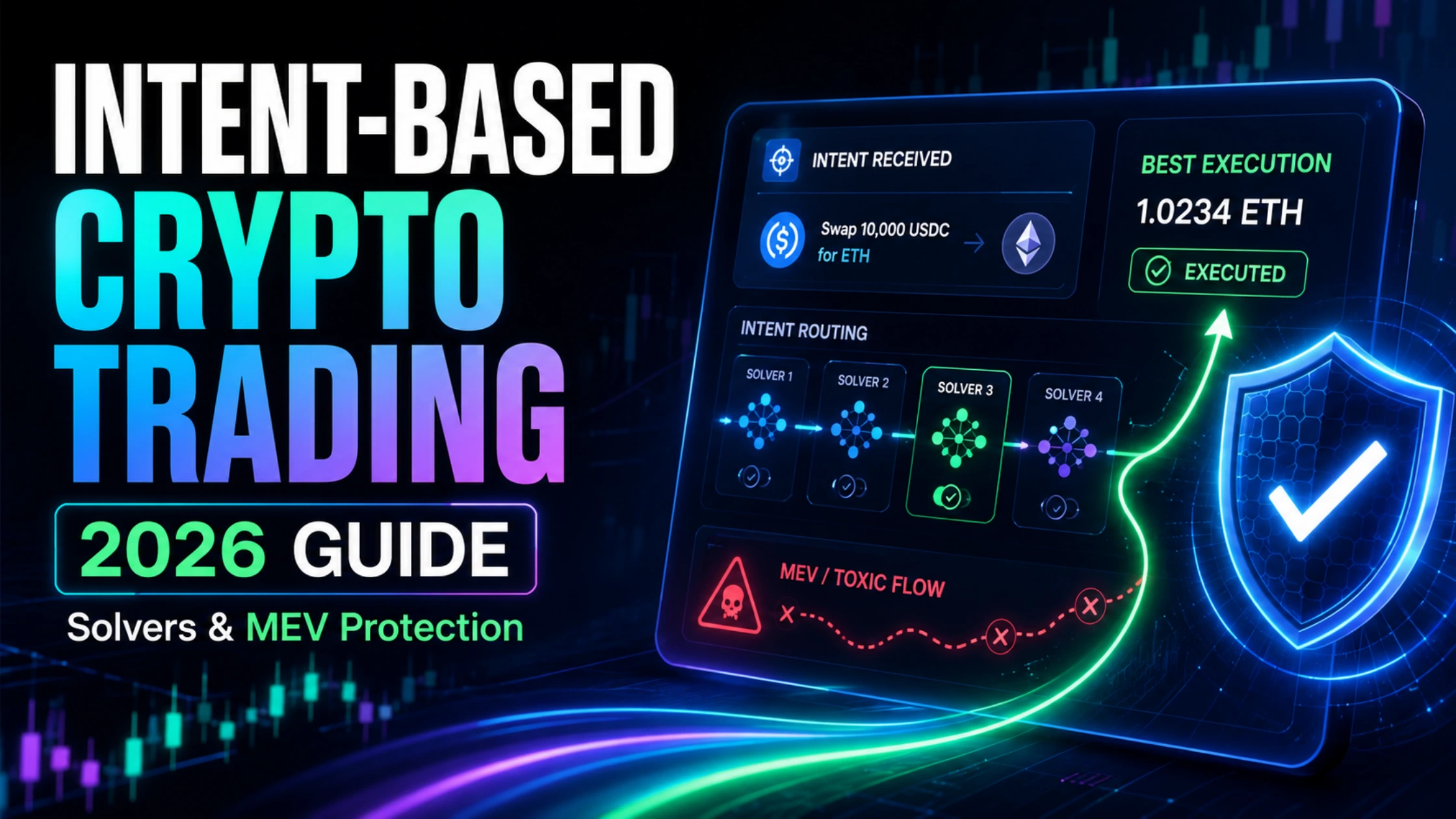
By 2026, this paradigm has been completely overturned by Intent-Based Architecture. Instead of specifying how a trade should be executed, users now simply declare what they want to achieve (e.g., “I want to swap 5 ETH for at least 15,000 USDC on Arbitrum”). Professional, off-chain “Solver” networks then compete to fulfill this intent in the most efficient, cost-effective, and MEV-protected way possible.
For sophisticated retail traders, quantitative desks, and cross-chain DeFi natives, intent-based trading is no longer a futuristic concept; it is the new gold standard for capital efficiency, seamless cross-chain execution, and institutional-grade security. This comprehensive guide breaks down the mechanics of intent-based routing, the top-tier platforms leveraging this technology in 2026, and the strict operational security frameworks required to sign intent payloads safely.
The 3 Pillars of Intent-Based Trading in 2026
To leverage this technology effectively, you must understand the architectural shift from traditional transactions to declarative goals.
- Declarative Goals vs. Imperative Transactions: In traditional DeFi, you sign a transaction that says, “Call Uniswap V3, swap token A for B, with 0.5% slippage.” In an intent-based system, you sign a cryptographic message stating, “I will give up 1000 USDC if I receive at least 0.3 ETH on Base.” The how is entirely abstracted away and handled by the solver network.
- Solver Competition and MEV Protection: Solvers are professional market-making entities or sophisticated bots. When you broadcast an intent, multiple solvers simulate the trade. The solver that can offer you the best net output (after accounting for gas, slippage, and their own fee) wins the right to execute the trade. Because the solver guarantees your minimum output before execution, traditional public mempool sandwich attacks are mathematically neutralized.
- Gas Abstraction and Cross-Chain Atomicity: Intent protocols decouple gas payment from transaction execution. A solver can execute a complex, multi-hop cross-chain swap (e.g., bridging USDC from Ethereum to Solana and swapping for SOL) while charging you the gas fee in the output token (SOL), or simply deducting it from the input amount. You no longer need to hold fragmented native gas tokens across a dozen different networks.
Top Platforms and Tools for Intent-Based Execution in 2026
Navigating the intent-based landscape requires platforms that aggregate the best solver networks while maintaining uncompromising security and transparent tracking.
1. Bybit Web3: Best for Seamless, Cross-Chain Intent Aggregation
For traders who want the benefits of advanced solver networks without navigating fragmented, protocol-specific interfaces, Bybit Web3 offers the most polished, aggregated intent-routing experience in 2026.
- Core Features: Bybit Web3’s swap and bridge interfaces natively integrate with top-tier intent solvers and liquidity aggregators. When you request a cross-chain swap, the platform automatically sources the best intent-based route, guaranteeing the quoted output and abstracting away destination-chain gas fees.
- Built-in Security Scanning: Before you sign an intent payload, the Bybit Web3 wallet simulates the transaction and cross-references the solver’s smart contract against real-time malicious database flags, warning you of any anomalies.
- Why Traders Choose It: It provides the ultimate “one-click” cross-chain experience. You get the MEV protection and gas abstraction of cutting-edge intent protocols, wrapped in the familiar, user-friendly interface of a top-tier exchange ecosystem.
👉 Experience Seamless Cross-Chain Intent Routing with Bybit Web3 (Use referral code: 46164)

2. Ledger: Best for Securely Signing Complex Intent Payloads
The shift from signing raw transactions to signing “typed data” (like EIP-712 or Permit2 signatures) introduces a new phishing vector: the “blind signature” attack. Malicious sites can trick users into signing an intent that grants unlimited token access.
- Core Features: Ledger hardware wallets are at the forefront of “Clear Signing” for intent-based protocols. When you sign an intent on a Ledger device, the Secure Element parses the complex cryptographic payload and displays human-readable details on the physical screen (e.g., “Authorize Solver Network to swap up to 1000 USDC for min. 0.3 ETH”).
- Phishing Resistance: Because the verification happens on the isolated, tamper-proof hardware device, a compromised browser or fake website cannot alter the intent details you are physically approving.
- Why Traders Choose It: It provides the ultimate physical circuit breaker. You can enjoy the frictionless UX of intent-based trading while knowing that no solver or phishing site can drain your wallet without your explicit, physical consent.
👉 Secure Your Intent-Based Trading with a Ledger Hardware Wallet

3. Koinly: Best for Tracking Multi-Hop, Abstracted Intent Transactions
Intent-based trades often bundle multiple actions (e.g., approve, bridge, swap, and stake) into a single, atomic settlement. Traditional tax software frequently fails to parse these bundled transactions, mislabeling them as missing funds or erroneous trades.
- Core Features: Koinly has specifically updated its heuristic algorithms for 2026 to decode intent-based settlement transactions. It can accurately trace the input and output tokens across different chains, correctly labeling the event as a single, cohesive swap or transfer, rather than a dozen disjointed, confusing micro-transactions.
- Gas Fee Allocation: Koinly accurately attributes the abstracted gas fees (even if paid in the output token) to the correct trade, ensuring your cost basis and capital gains calculations are perfectly aligned with tax authority requirements.
- Why Traders Choose It: It transforms the “black box” nature of solver settlements into clean, audit-ready tax reports, preventing costly compliance errors.
👉 Automate Your Complex Intent-Based Transaction Tax Tracking with Koinly

Step-by-Step: How to Execute a Secure Intent-Based Trade
Executing an intent requires a slightly different workflow than traditional DeFi. Follow this exact blueprint to ensure security and optimal execution:
Step 1: Define Your Intent Parameters
Navigate to your chosen intent-enabled interface (e.g., Bybit Web3 or a dedicated protocol like CoW Swap). Input your desired input asset, output asset, and the minimum amount of output you are willing to accept. This minimum amount is your hard guarantee; the solver cannot give you less, or the trade will not settle.
Step 2: Connect and Verify via Hardware Wallet
Connect your Ledger hardware wallet. When the interface prompts you to “Sign Intent” or “Approve Permit2,” do not rush. Look at your Ledger’s physical screen. Verify that the contract name, the token being spent, and the maximum spend limit exactly match your intended trade.
Step 3: Review the Solver Guarantee
Before the signature is finalized, the interface should display a “Solver Guarantee” or “Protection” badge. This confirms that the trade is protected against MEV, partial fills, and slippage beyond your defined limit. If this guarantee is absent, you are likely interacting with a legacy, imperative smart contract, not a true intent protocol.
Step 4: Monitor Settlement (Not Mempool)
Once signed, the intent is broadcast to the solver network, not the public mempool. You will not see a “pending” transaction on a block explorer immediately. Instead, monitor the UI for a “Settled” or “Filled” status. Settlement typically occurs within seconds to a few minutes, depending on cross-chain finality requirements.
Risk Management: The Hidden Dangers of Intent-Based Trading
While intent architecture solves many traditional DeFi problems, it introduces new, nuanced risks that must be actively managed:
- Solver Centralization and Collusion: If a solver network becomes dominated by a few large entities, they could theoretically collude to offer sub-optimal rates, extracting hidden value from users. Mitigation: Use intent protocols with open, permissionless solver networks and strong cryptographic guarantees that force competition (e.g., batch auctions).
- Permit2 and Signature Drainers: The most significant user-facing risk. If you are tricked into signing a malicious EIP-712 message on a phishing site, you could be granting a solver contract unlimited access to your tokens. Mitigation: Never sign an intent payload without verifying the details on a Ledger hardware wallet. If the Ledger displays “Blind Signing” or an unrecognizable contract, reject the transaction immediately.
- Cross-Chain Finality and Re-org Risks: For cross-chain intents, the solver fronts the capital on the destination chain before the source chain transaction is fully finalized. In the event of a rare blockchain reorganization (re-org) on the source chain, the solver may cancel the destination execution, leaving your trade unfilled (though your funds remain safe). Mitigation: Stick to established, high-finality chains (like Ethereum L2s or Solana) for critical, time-sensitive intent trades.
Frequently Asked Questions (FAQ)
Q: What is the difference between a traditional swap and an intent-based swap?
A: In a traditional swap, you dictate the exact path and sign a transaction to execute it immediately, bearing the risk of slippage and MEV. In an intent-based swap, you sign a message declaring your desired outcome. Off-chain solvers compete to fulfill that outcome, guaranteeing your minimum output and absorbing the risk of slippage and gas fluctuations.
Q: Do I need to hold the native gas token (like ETH or SOL) to use intent protocols?
A: Often, no. One of the primary benefits of intent-based architecture is “Gas Abstraction.” Solvers can execute the trade and deduct the gas fee directly from your input token or pay it on your behalf, allowing for a truly gasless user experience from the end-user’s perspective.
Q: Are intent-based trades taxed differently than regular swaps?
A: No. From a tax perspective, an intent-based trade is treated identically to a standard decentralized swap. It is a disposal of the input asset and an acquisition of the output asset, triggering a capital gains or losses calculation. However, because the underlying execution is complex, using automated software like Koinly is essential to ensure the bundled transaction is parsed correctly.
Q: Can a solver censor my trade or front-run me?
A: No. The cryptographic guarantee of an intent is that the solver must provide you with at least your specified minimum output. If they cannot do so profitably, they simply will not fill the intent, and your trade will expire unexecuted. Your funds remain in your wallet, completely safe from partial fills or toxic MEV extraction.
Risk Warning: Cryptocurrency trading and the use of intent-based protocols carry inherent risks, including smart contract vulnerabilities, solver network collusion, and signature phishing attacks. While intents protect against traditional MEV, user error in signing malicious payloads can result in the total loss of funds.
Not Financial Advice: The information provided in this article is for educational and informational purposes only. It does not constitute financial, investment, legal, or tax advice. Always conduct your own research (DYOR) and consult with a qualified, licensed professional before interacting with new cryptographic trading architectures.
Affiliate Disclaimer: This article contains affiliate links. If you click on these links and sign up for a service or make a purchase, we may earn a commission at no additional cost to you. We only recommend platforms, tools, and services that we have thoroughly vetted and believe provide genuine value, security, and utility to our readers.