
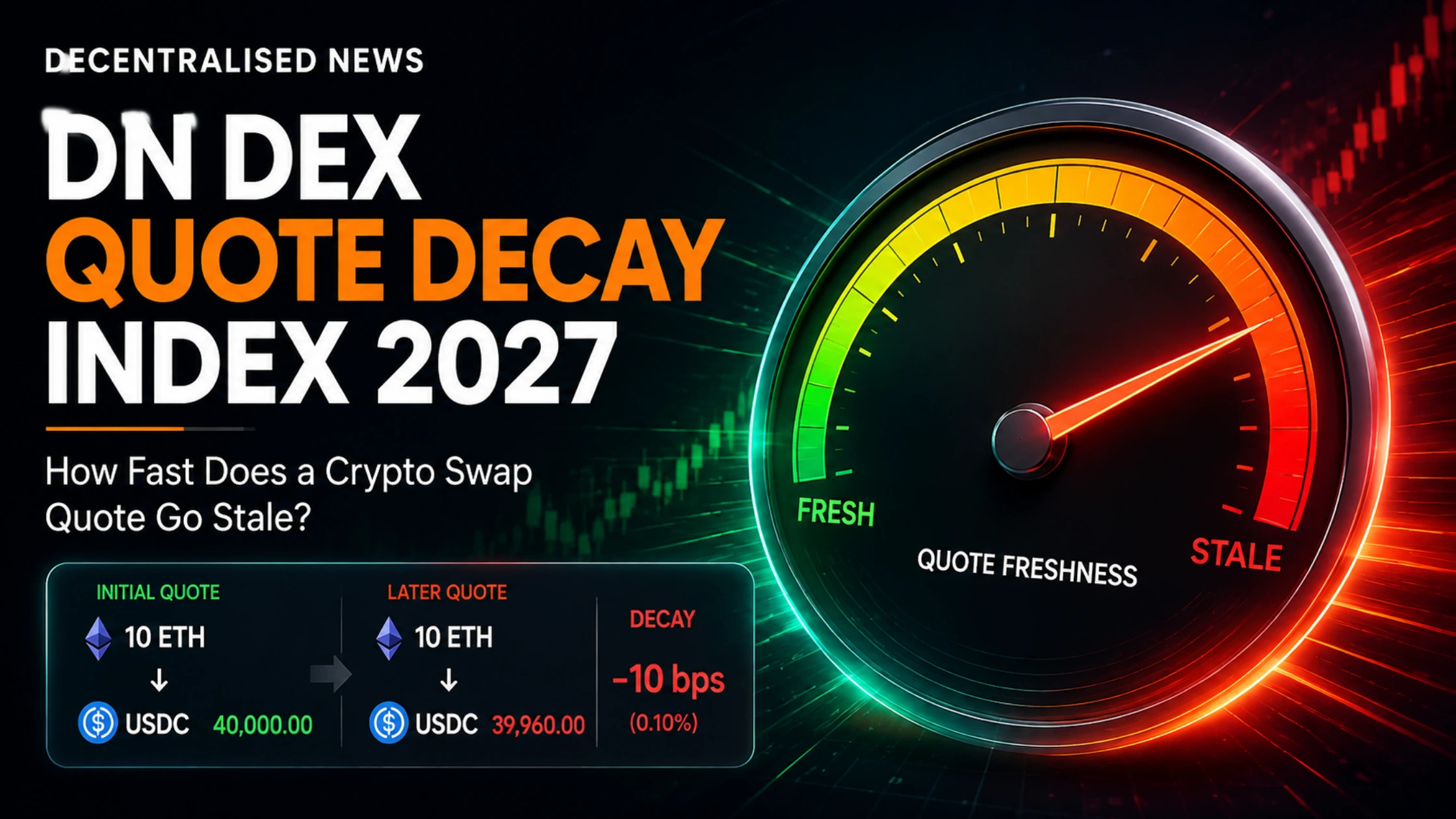
The DN DEX Quote Decay Index measures how crypto swap quotes deteriorate over 5, 15, 30 and 60 seconds. Compare quote freshness, slippage risk, routing and execution architecture across CoW Swap, Jupiter, 1inch, OKX DEX and 0x.
Data checked: 1 September 2026
Methodology version: DN-QDI v1.0
Affiliate disclosure: Some links in this research are affiliate links. Decentralised News may receive compensation when eligible readers use them. Affiliate relationships do not determine methodology, scores, inclusion or conclusions.
Summary
A DEX quote is not a permanent price. It is a snapshot or execution proposal built from liquidity, routing, gas, market prices and protocol-specific rules at a particular moment. The longer a trader waits before signing or executing, the greater the chance that the quote becomes economically stale.
The DN DEX Quote Decay Index measures that deterioration in basis points across fixed time intervals while separating market movement from deterioration attributable to routing and liquidity.
The central DN metric is:
Residual Quote Decay = Raw Quote Decay − Reference Market Move
This matters because a quote that worsens by 20 basis points while the underlying market simultaneously moves 18 basis points has behaved very differently from a quote that deteriorates 20 basis points in an unchanged market.
The Index therefore measures quote freshness, not merely slippage.
Key Findings
- Quote decay and price impact are different. Price impact exists when the quote is created because the trade itself consumes liquidity. Quote decay occurs after that quote has been observed.
- Quote decay and execution slippage are also different. A quote can deteriorate before a transaction is even submitted.
- Raw quote deterioration must be adjusted for market movement. Otherwise a benchmark can incorrectly blame a DEX for BTC, ETH or another asset simply changing price.
- A fixed “quotes expire after X seconds” rule is misleading. Different architectures use snapshot quotes, executable transactions, solver systems, RFQs, auctions and intents.
- CoW Protocol explicitly warns that quotes are snapshots and recommends obtaining a new quote when more than 30 seconds has elapsed in its integration guidance.
- 1inch Fusion cannot be evaluated like a conventional static quote. Its intent architecture uses a Dutch-auction rate that evolves through time.
- 0x explicitly distinguishes price impact from slippage, defining slippage as market movement between quotation and execution rather than the market impact created by the trade itself.
- Jupiter’s current Swap V2 preserves its order-and-execute workflow, allowing quote creation and execution timing to be measured as distinct stages.
- Quote freshness becomes more important with volatile assets, fragmented liquidity, longer signing delays and larger trade sizes.
Quick Verdict: The Wrong Question Is “Which DEX Has the Best Quote?”
The more useful question is:
Which route is still economically attractive by the time I can actually execute it?
A DEX may display the best quote at second zero and still deliver an inferior trading experience if that price deteriorates rapidly before execution.
Another route might initially quote two basis points worse but remain much more stable over the next 15 seconds.
For an actual trader, the second route may be superior.
That creates an overlooked dimension of execution quality:
Temporal Execution Quality
Traditional DEX comparisons usually measure price across venues at one moment.
The DN Quote Decay Index adds another dimension:
price through time.
What Is DEX Quote Decay?
Suppose you want to swap:
10 ETH → USDC
At 12:00:00, Aggregator A says:
Expected output: 40,000 USDC
You wait 15 seconds.
An otherwise identical fresh quote now says:
39,960 USDC
The new quote is 40 USDC worse.
Raw quote decay is:
(40,000 − 39,960) ÷ 40,000 × 10,000
= 10 basis points
For a $40,000 trade, 10 basis points represents approximately:
$40
But that still does not tell us whether Aggregator A performed poorly.
Suppose ETH itself moved against the transaction by eight basis points during those same 15 seconds.
The economically useful observation is approximately:
10 bps raw deterioration − 8 bps market deterioration
= 2 bps residual quote decay
That is a very different conclusion.
The DN Quote Decay Formula
For an exact-input trade:
Raw Quote Decay
QD(t) = 10,000 × (Q₀ − Qₜ) / Q₀
Where:
Q₀ = output amount quoted at time zero
Qₜ = fresh output quote after elapsed time t
Interpretation:
Positive value: quote became worse
0: no deterioration
Negative value: quote improved
The More Important Metric: Residual Quote Decay
Markets move.
A credible benchmark therefore needs a control.
DN defines:
Residual Quote Decay
RQD(t) = Raw Quote Decay(t) − Reference Market Deterioration(t)
Consider:
Raw DEX quote deterioration:
22 bps
Reference market deterioration:
18 bps
Residual:
4 bps
Now consider another aggregator:
Raw deterioration:
22 bps
Reference market deterioration:
2 bps
Residual:
20 bps
The headline quote changed by the same amount.
The execution-quality interpretation is completely different.
This distinction should prevent one of the largest methodological errors in DEX benchmarking.
Quote Decay Is Not the Same as Price Impact
This distinction is fundamental.
Price impact describes how much your own requested trade moves through available liquidity.
Quote decay describes what happens to an otherwise comparable quote as time passes.
Execution slippage describes the difference between expected and ultimately realised execution.
0x’s current documentation similarly distinguishes price impact from slippage and describes slippage as price movement occurring between quote generation and confirmation.
Academic work on AMM slippage has reached a related distinction. A 2026 survey separates endogenous deviation caused by the swap itself from exogenous deviation caused by activity occurring during the latency interval.
DN builds on this logic but focuses specifically on the life cycle of the quote before execution.
The DN Quote Life Cycle
A user’s swap is not one instant.
It can be represented as:
Request
↓
Route discovery
↓
Quote generated
↓
Quote displayed
↓
Human decision time
↓
Wallet interaction
↓
Signature
↓
Transaction submission
↓
Block inclusion or solver execution
↓
Final settlement
Price and liquidity can change anywhere along that path.
That means:
Execution latency begins before blockchain confirmation latency.
This is particularly important on mobile devices, hardware wallets and multi-signature wallets where several seconds can pass between the first quote and transaction submission.
DN DEX Quote Decay Benchmark
Every protocol should be tested at:
Quote age | Purpose |
0 seconds | Baseline |
5 seconds | Fast-wallet confirmation |
15 seconds | Normal human confirmation |
30 seconds | Slow confirmation or wallet friction |
60 seconds | Materially stale quote stress test |
DN should record both median and tail outcomes.
A platform whose average result looks excellent can still present poor execution risk if its worst 5% of observations deteriorate dramatically.
Therefore the dataset should track:
DN Metric | What It Measures |
Median 5s Residual Decay | Very short-term stability |
Median 15s Residual Decay | Ordinary confirmation risk |
Median 30s Residual Decay | Stale-quote sensitivity |
Median 60s Residual Decay | Stress sensitivity |
P95 30s Decay | Tail deterioration |
Requote Breach Rate | Frequency at which decay exceeds chosen slippage budget |
Quote Response Time | Time required to generate the quote |
Route Change Rate | Frequency at which route composition changes |
Quote Expiry Disclosure | Whether validity is explicitly communicated |
Quote Half-Life | Time required to consume half of a defined slippage budget |
DN Quote Half-Life
“Half-life” does not mean that a crypto price loses half its value.
DN defines Quote Half-Life as:
The time required for median adverse residual quote decay to consume 50% of the user’s specified slippage budget.
Assume:
User slippage budget:
50 bps
Half of the budget:
25 bps
If median residual quote deterioration reaches 25 bps after 42 seconds, DN Quote Half-Life is:
42 seconds
Longer is better.
A route with a 90-second Quote Half-Life is more tolerant of human or wallet delay than one with a 12-second half-life, other things being equal.
DN Requote Breach Rate
Another proprietary metric is:
Requote Breach Rate
Number of observations where residual decay exceeds the allowed budget ÷ total observations
Example:
500 observations
38 exceed a 50-basis-point budget
Requote Breach Rate:
7.6%
This tells users something an average cannot.
A venue can have:
median decay = 2 bps
while still experiencing occasional:
100+ bps quote shocks
on volatile or illiquid assets.
For trading systems, those tails can matter more than the average.
Why Raw Cross-DEX Rankings Can Be Misleading
It would be methodologically weak to place every DEX aggregator into one table and simply declare a global winner.
Jupiter operates in a predominantly Solana execution environment.
CoW, 1inch, 0x and EVM-based routing operate under different:
- block characteristics
- gas economics
- liquidity venues
- solver systems
- market-maker participation
- transaction construction
- confirmation conditions
DN should therefore create cohorts, not one misleading universal league table.
EVM Quote Decay Cohort
CoW Swap
1inch
0x / Matcha
OKX DEX
other qualifying EVM aggregators
Solana Quote Decay Cohort
Jupiter
OKX DEX where comparable
other qualifying Solana routers
Cross-chain execution deserves a separate benchmark because bridge and destination settlement latency introduce additional variables. That is why it remains Article #2 in the V11 programme rather than being mixed into this index.
How Different DEX Architectures Change Quote Decay
CoW Swap: A Quote Is Only the Beginning of the Solver Process
CoW Protocol uses signed trading intents and solver competition rather than treating the trade as a conventional AMM transaction.
Its API quote includes fields such as:
- expected amounts
- network costs
- quote ID
- order validity
- quote expiration
Its documentation explicitly describes quotes as estimates of current market conditions and warns that liquidity, gas and market conditions may change after a quote is produced. Its integration guidance recommends re-quoting if more than 30 seconds has passed.
This makes CoW particularly interesting for DN testing.
The benchmark should distinguish:
quote freshness
from:
solver execution quality
A solver architecture may ultimately deliver better execution than a simple stale-quote comparison suggests.
DN classification
Architecture: Intent / solver
Quote model: Time-sensitive estimate
Explicit expiration: Yes
Important variable: Solver competition after intent submission
Research priority: High
Trade via Decentralised News: CoW Swap
Referral code: DECENTRALISED
1inch Fusion: Quote Decay Is Partly an Auction
1inch Fusion requires different treatment.
Its gasless intent architecture operates through a Dutch-auction mechanism.
The order rate changes through time as resolvers compete to fill the user’s intent. Current documentation describes configurable auction duration, auction start timing and price-curve behaviour.
Therefore a naïve test saying:
“The 1inch quote changed, therefore the quote decayed”
could be wrong.
Part of the evolution may be intentional auction mechanics.
For 1inch, DN should measure:
initial economic quote
versus:
minimum return
versus:
actual resolver outcome
versus:
contemporaneous reference price
This is precisely why architectural normalization matters.
DN classification
Architecture: Intent / resolver / Dutch auction
Quote model: Dynamic
Important variable: Auction curve
Raw quote-decay comparability: Limited without adjustment
Research priority: High
Jupiter: Quote-to-Execution Latency on Solana
Jupiter remains a particularly important Solana benchmark.
Its Swap V2 architecture uses an /order followed by /execute flow. Jupiter’s migration documentation states that V2 retains the previous order-and-execute interface while moving the system onto the current Swap V2 API.
The order workflow gives DN clearly identifiable timestamps:
request
→ order
→ signature
→ execute
→ settlement
That creates an excellent basis for measuring:
- quote generation latency
- wallet delay
- transaction landing
- route changes
- final execution
Jupiter’s documentation also demonstrates that an order response exposes route composition, price impact and timing information.
DN classification
Architecture: Solana meta-aggregator/router
Quote model: Transaction-ready order workflow
Important variable: Quote-to-signature-to-landing time
Research priority: Very high
Explore Jupiter via Decentralised News.
OKX DEX: Multi-Chain Routing Creates a Valuable Test Case
OKX DEX describes its routing process as comparing quotes across DEXs and professional market makers while taking price, slippage and transaction costs into account.
Its flow separates:
quote acquisition
from:
swap construction
and then:
broadcast
That creates several points at which market conditions can change.
It also makes OKX particularly useful because the same aggregation ecosystem can potentially contribute observations across several chains.
DN classification
Architecture: Multi-chain DEX aggregator
Quote model: Quote then swap construction
Important variable: Routing and transaction-construction delay
Research priority: Very high
OKX Web3 referral code: DECENTRALISED
0x / Matcha: Indicative Price Is Not the Final Quote
0x provides another useful distinction.
Its API separates an indicative /price request from the transaction-ready /quote stage.
That difference should be preserved in DN testing.
A website displaying an indicative price is not necessarily displaying the price that should be treated as an executable commitment.
0x also explicitly distinguishes:
price impact
from:
slippage
which makes it a useful methodological reference for this Index.
DN classification
Architecture: Aggregator
Quote model: Indicative price plus executable quote
Important variable: Price-to-quote and quote-to-settlement timing
Research priority: High
The DN Quote Decay Test Protocol
For every qualifying observation DN should record:
- UTC timestamp.
- Network.
- Aggregator.
- Sell asset.
- Buy asset.
- Exact-input amount.
- USD-equivalent trade size.
- Quote output at T0.
- Reference-market price at T0.
- Quote response latency.
- Route composition where available.
- Fresh identical quote at T+5.
- Fresh identical quote at T+15.
- Fresh identical quote at T+30.
- Fresh identical quote at T+60.
- Reference-market movement at each interval.
- Raw quote decay.
- Residual quote decay.
- Route changes.
- API or quotation failures.
This should run repeatedly rather than once.
One isolated result is an anecdote.
Ten observations are interesting.
Thousands of timestamped observations begin to constitute a market-quality dataset.
Three Liquidity Buckets
DN should also avoid testing only ETH/USDC.
Tier 1: Highly Liquid
Examples:
ETH/USDC
WETH/USDT
SOL/USDC
Purpose:
baseline routing efficiency
Tier 2: Liquid Altcoins
Purpose:
Test the point where fragmentation starts becoming important.
Tier 3: Long-Tail Assets
Purpose:
Expose routing instability, liquidity fragmentation and tail deterioration.
This matters because existing empirical work has found transaction-cost characteristics to vary substantially with asset type and trade size. Research using Uniswap quote data found that larger trades become increasingly dominated by price impact and slippage, while less mature assets showed greater exposure to adverse slippage.
Four Order Sizes
Every liquidity bucket should be sampled at economically different order sizes.
For example:
$1,000
Retail baseline.
$10,000
Active trader.
$100,000
Professional/HNW execution.
$1,000,000
Institutional stress scenario where sufficiently liquid and safe to model.
This matters because DEX transaction economics are nonlinear. Recent academic research comparing centralized and decentralized markets also finds that fixed blockchain costs matter more for smaller transactions while DEX economics can become more competitive as transaction size increases.
Worked Example: Why Quote Age Can Cost More Than the Advertised Fee
Suppose a trader swaps:
$100,000
Initial route:
100,000 USDC → 24.500 ETH
Fifteen seconds later:
100,000 USDC → 24.463 ETH
The quote deteriorated by approximately:
15.1 bps
Equivalent economic difference:
approximately $151
Suppose the underlying reference market moved only:
5 bps
The approximate residual deterioration is therefore:
10.1 bps
or around:
$101
A trader comparing protocols solely on a two-basis-point advertised fee difference would miss the larger economic variable.
That is exactly the problem the DN Quote Decay Index is designed to expose.
What Causes a DEX Quote to Decay?
Several mechanisms can change a quote after it appears.
External Market Movement
BTC, ETH or the relevant token simply changes price.
This should largely disappear from the residual metric after reference adjustment.
Other Traders Consume Liquidity
The reserves or order-book liquidity supporting the original route change before execution.
Arbitrage
Searchers rebalance discrepancies across pools.
A route that existed at second zero can disappear rapidly.
Gas Conditions Change
Some routing systems include network economics in their calculation.
Solver or Market-Maker Quotes Change
RFQ and intent architectures may depend on off-chain liquidity providers whose prices continuously update.
Route Composition Changes
The best route might move from:
Pool A → Pool B
to:
Pool C → Pool D → Pool E.
The output can change even when the broad underlying asset price barely moves.
Wallet Delay
The DEX does not control how quickly the user reads, confirms or signs a transaction.
But from the user’s perspective, that delay still affects whether the displayed quote remains economically useful.
A New Metric: Human Confirmation Risk
This gives DN another unique research concept.
Most API benchmarks assume machines.
Most actual users are humans.
A human might:
- inspect a price,
- click Swap,
- open a wallet,
- inspect the wallet simulation,
- verify the destination amount,
- approve with biometrics or hardware wallet,
- finally sign.
Ten or twenty seconds can pass.
Therefore DN should eventually publish:
DN Human Confirmation Risk
Expected adverse quote deterioration during a representative human confirmation interval.
This could be measured separately for:
5 seconds: fast desktop wallet
15 seconds: ordinary confirmation
30 seconds: cautious user or mobile wallet
60 seconds: hardware/multisig friction
That is a metric almost no consumer crypto publication currently treats as a first-class variable.
DN DEX Quote Decay Calculator
The proprietary tool below lets a user compare an original quote with a later fresh quote.
It calculates:
- raw quote decay
- market-adjusted residual decay
- dollar deterioration
- decay velocity
- percentage of slippage budget consumed
- DN freshness grade
The calculator does not obtain live quotes and does not recommend execution. It analyses values supplied by the user.
DN DEX Quote Decay Calculator
Measure how much a DEX quote changed between two observations. The tool separates raw deterioration from a user-supplied reference-market move and shows how much of your chosen slippage budget was consumed.
Your Quote Decay Result
DN-QDI v1.0 Methodology
Positive quote decay means the fresh quote became worse. A negative result means the fresh quote improved.
Residual decay attempts to distinguish broad market movement from deterioration in the quoted route. It is an analytical approximation and depends on the quality of the reference-market observation supplied.
DN Quote Decay is not the same as realised slippage or price impact. A complete execution study should eventually measure all three.
Compare Live DEX Routes
These buttons are commercial partner links where applicable. Partner status does not affect the DN methodology or future benchmark results.
How to Interpret the DN Freshness Grade
Grade | Slippage Budget Consumed | Interpretation |
A | 0 to 10% | Very little observed deterioration |
B | >10% to 25% | Low deterioration |
C | >25% to 50% | Material deterioration |
D | >50% to 100% | Quote should be treated cautiously |
F | >100% | Observed deterioration exceeds stated budget |
The grade measures the observation, not the overall quality or safety of a protocol.
That distinction is essential.
A protocol should never receive a platform-wide grade from one quote.
When Should You Request a New DEX Quote?
There is no universal countdown that applies to every protocol.
A sensible decision should instead consider:
quote age + volatility + asset liquidity + trade size + route architecture + slippage budget
CoW’s integration guidance provides one concrete example by recommending a fresh quote when more than 30 seconds has passed. That should not be misrepresented as an industry-wide rule.
For a volatile long-tail token, five seconds can matter.
For a deep stablecoin pair, a quote may remain economically similar for considerably longer.
The correct question is not:
“Is this quote 30 seconds old?”
It is:
“How much of my acceptable execution budget has already disappeared?”
Which DEX Is Best for Quote Stability?
DN is deliberately not publishing an observed winner in methodology version 1.0.
A serious quote-decay ranking requires a sufficiently large, timestamped dataset collected under comparable conditions.
Anything else would create false precision.
The first leaderboard should appear only after each eligible platform has enough observations across:
- identical chains
- identical pairs
- identical sizes
- matching time windows
- comparable market regimes
Until then, architecture can be compared, but measured performance should not be invented.
That distinction is central to the DN evidence standard.
DN Evidence Classification
Every future observation will be labelled:
OBSERVED
Collected directly by Decentralised News.
CALCULATED
Derived mathematically from observations.
MODELLED
Produced by a disclosed DN model.
PLATFORM-REPORTED
Published by the protocol or venue itself.
THIRD-PARTY SOURCED
Measured by an independent external source.
No modelled number should be presented as an observed trade result.
The Future Live DN Leaderboard
Once enough data exists, the public index should show something like:
Platform | Chain | 5s Median | 15s Median | 30s Median | P95 30s | 50bp Breach Rate | Quote Half-Life | Samples |
CoW Swap | EVM | Live data | Live data | Live data | Live data | Live data | Live data | n |
1inch | EVM | Live data | Live data | Live data | Live data | Live data | Live data | n |
0x | EVM | Live data | Live data | Live data | Live data | Live data | Live data | n |
OKX DEX | EVM | Live data | Live data | Live data | Live data | Live data | Live data | n |
Jupiter | Solana | Live data | Live data | Live data | Live data | Live data | Live data | n |
The Solana cohort should not be numerically cross-ranked against EVM until the methodology can control sufficiently for network effects.
Compare Live DEX Routes
Three currently active platforms in the Decentralised News partner universe are particularly relevant to this research.
CoW Swap
Best suited to studying solver-based EVM execution and intent architecture.
DN referral code: DECENTRALISED
OKX Web3
Useful for multi-chain routing comparisons and DEX aggregation.
DN referral code: DECENTRALISED
Jupiter
A central Solana execution venue and important counterpart to EVM aggregation studies.
Affiliate relationships do not determine their eventual DN Quote Decay results.
The live sites for all three remain accessible at the date checked.
Why This Index Matters Beyond Retail Trading
Quote decay also matters to:
DAOs
Treasuries can lose meaningful value while proposals, multisigs or signers delay execution.
Trading bots
Automation strategies need to know how long a route can survive between signal and submission.
Wallet developers
A beautiful transaction-confirmation screen is counterproductive if the underlying quotation is already stale.
DEX integrators
Comparing APIs solely by response speed ignores how quickly the returned economics deteriorate.
Institutional traders
At $1 million, 10 basis points represents:
$1,000
At $10 million:
$10,000
Time is an execution cost.
Frequently Asked Questions
How long does a DEX quote stay valid?
There is no universal validity period. Some protocols return explicit expiry information, some construct executable transactions, and intent-based systems may use time-varying pricing. Quote validity should therefore be checked at protocol and transaction level.
Is quote decay the same as slippage?
No. DN uses quote decay to measure how a new comparable quote changes through time. Slippage normally compares expected execution with realised execution.
Is quote decay the same as price impact?
No. Price impact is primarily the effect of the requested order consuming available liquidity. Quote decay is time-dependent deterioration after the first quote.
Why does my swap output change before I press confirm?
Possible reasons include market movement, liquidity consumption, arbitrage, route changes, gas changes and updated market-maker quotations.
Should I always use the DEX offering the highest initial output?
No. The displayed amount is only one part of execution quality. Quote stability, transaction success, gas, MEV protection and ultimate realised output also matter.
Is a 30-second-old quote stale?
Sometimes, but not universally. CoW’s integration documentation specifically recommends re-quoting after more than 30 seconds, but other systems use different architectures and validity mechanisms.
What is the DN Quote Half-Life?
It is the elapsed time at which median adverse residual quote deterioration consumes half of a predefined slippage budget.
Does the DN Quote Decay Index recommend a DEX?
Not from a single observation. DN will publish performance rankings only after sufficiently comparable repeated measurements exist.
DN Methodology Limitations
No quote-decay methodology can eliminate every confounding variable.
Reference prices can themselves lag.
Routes can use liquidity not represented in a simple public mid-price.
RFQ and solver systems can improve execution after the initial quote.
A user may ultimately receive surplus relative to the displayed minimum.
Transactions can fail for reasons unrelated to pricing.
Network congestion can alter both timing and routing.
For those reasons, Quote Decay should eventually sit beside, not replace:
realised slippage
transaction success
MEV outcome
gas
price improvement
settlement latency
total execution cost
Together these metrics form a more complete picture of decentralized execution quality.
Final Verdict
The biggest mistake in DEX comparison is assuming that a quoted price is a static object.
It is not.
A quote exists inside a moving market, changing liquidity environment and execution pipeline.
The DN DEX Quote Decay Index therefore adds a missing time dimension to decentralized exchange analysis:
How much economic quality survives between seeing a quote and being able to use it?
As the dataset grows, DN will be able to answer increasingly useful questions:
Which aggregator produces the most stable 15-second quotes?
Which platform has the lowest P95 quote deterioration?
How quickly do long-tail-token quotes become unreliable?
Does solver-based execution reduce or increase apparent quote decay?
How much does human wallet confirmation actually cost?
At what order size does quote stability become more important than headline fees?
Those are far more useful questions than simply asking which DEX displays the highest number at one instant.
Methodology: DN-QDI v1.0
Last reviewed: 1 September 2026
18+ educational content only. Digital assets and decentralized trading involve market, liquidity, smart-contract, execution and loss risk. Quotes and routes can change rapidly. Always verify transaction details before signing.
Source Ledger
The factual architecture and methodological discussion above is grounded in current CoW Protocol API and quote-selection documentation, Jupiter’s current Swap V2 migration and order documentation, 1inch’s current Intent Swap/Fusion API documentation, OKX DEX developer documentation and 0x’s current Swap API guidance. It is also informed by recent academic work separating price impact, slippage and latency-related deviations.
Related reading:
What Is the Cheapest Way to Swap Crypto? CEX vs DEX Aggregator vs Wallet Swap
Best Crypto Exchanges for Team Trading in 2027: Subaccounts, Permissions, APIs and Withdrawal Controls Ranked
Best Crypto Exchanges for Freelancers and Remote Workers in 2027: Receive, Spend and Cash Out Stablecoins
Best Multi-Asset Crypto Exchanges in 2027: Trade Crypto, Stocks, Commodities and FX From One Platform
Crypto Exchange KYC Friction Index: Which Exchanges Make Verification Easiest?
The Crypto Platform Selector 2027: Find the Best Exchange, DEX, Wallet or Tool for Your Needs
Crypto Execution Quality Index 2027: Which Exchanges Actually Give Traders the Best Fills?
Best Crypto Exchange VIP Programs: Fees, Qualification and Benefits Compared
Best Crypto Exchanges for DCA in 2027: Recurring Buy Fees, Spreads and True Costs Compared
Crypto Liquidation Fairness Index 2026: Which Exchanges Liquidate Traders Most Fairly?
Which Crypto Exchange Has the Best Customer Support? DN Response-Time Benchmark 2027





