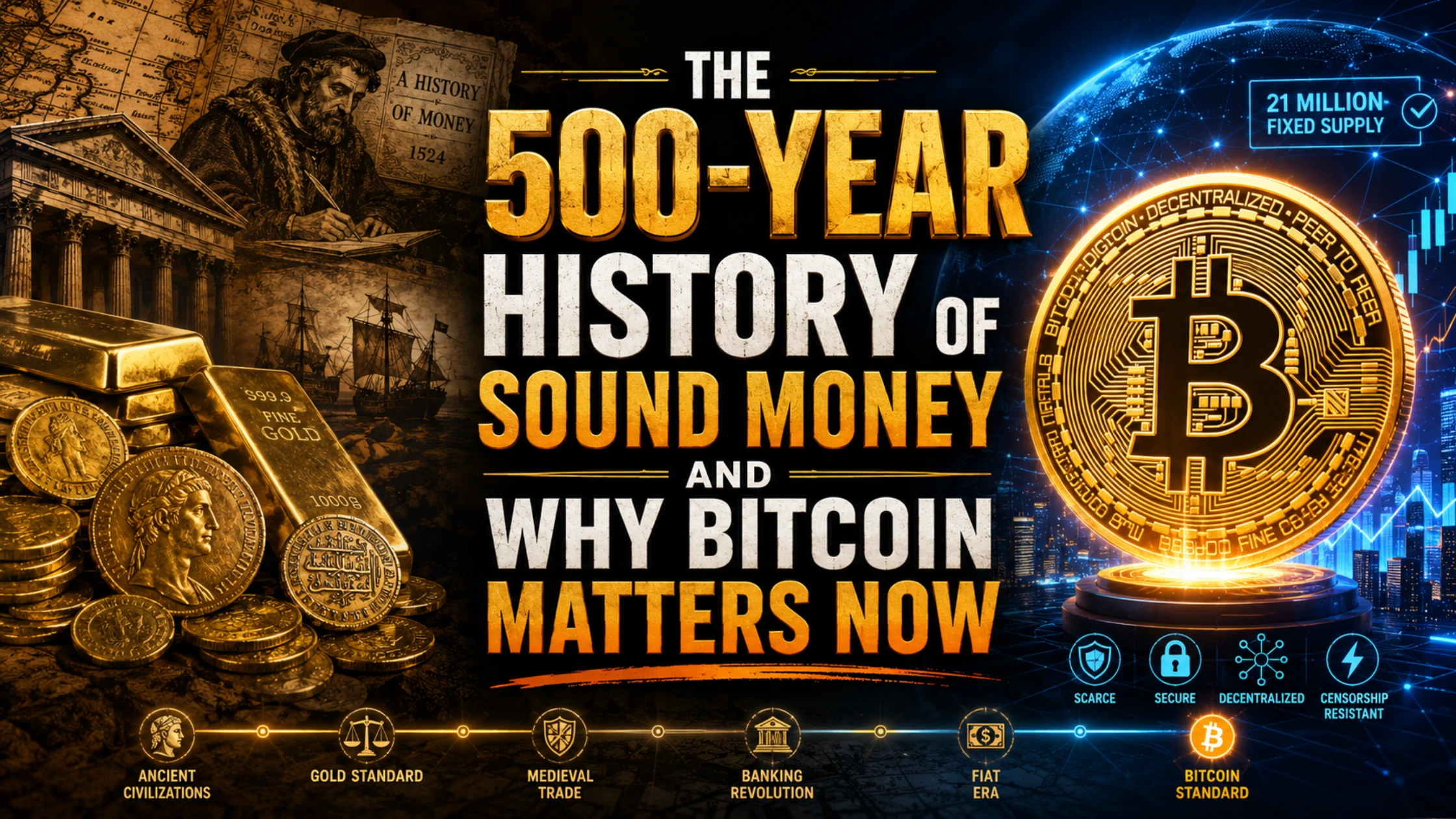
Gold held value for 5,000 years. The silver denarius held for 300 years before Rome debased it into collapse. Bitcoin is 16 years old and algorithmically uncorruptible. Here is why.
SUMMARY: Five hundred years of monetary history produce one consistent finding: money with a credible, constrained supply preserves purchasing power; money whose supply can be expanded by political decision does not. Gold retained purchasing power across 2,500 years of documented history. The Roman denarius, introduced as 95% silver, was debased to 2% silver by the 3rd century AD — the monetary decline preceded and contributed to Rome’s political collapse. The classical gold standard (1880–1914) produced average annual inflation of 0.1% versus 4.1% in the post-gold fiat era (1946–2003). Bitcoin’s 21 million supply cap is enforced algorithmically — it cannot be expanded by political decision, war, or financial crisis, making it the only monetary asset in history with an absolutely verifiable and unchangeable supply schedule. The Decentralised News Sound Money Durability Score (SMDS) rates monetary systems on five criteria: supply certainty, political resistance, portability, divisibility, and verifiability. Bitcoin scores highest across all five by a margin no previous monetary technology has achieved.

A simple question with a consistent answer
What properties must money have to hold its value across decades, centuries, and civilisations?
Every serious monetary economist, every financial historian, and every society that has had to rebuild a monetary system after a collapse has arrived at the same answer: money holds its value when its supply cannot be arbitrarily expanded. Money loses its value when whoever controls the supply decides — for whatever reason, however justified it seemed at the time — to expand it beyond what the economy can support.
This is not a controversial claim. It is the most consistently demonstrated finding in 3,000 years of documented monetary history. Every monetary system that has failed has failed because the authority controlling the money supply chose expansion over discipline. Every monetary system that has lasted — gold, silver, the classical gold standard — lasted because the supply was constrained by something that political will alone could not override.
This article applies a proprietary framework — the Decentralised News Sound Money Durability Score — to every major monetary system across 500 years of history to determine what made some last and what made others collapse. The conclusion is that Bitcoin is not a new idea. It is the most rigorously engineered version of an old one.

Part one: The five properties of sound money
Before examining the historical record, the framework requires definition. The Decentralised News Sound Money Durability Score (SMDS) rates any monetary system on five criteria, each scored from one to ten.
Criterion one — Supply certainty. How reliably is the money supply constrained? A monetary system scores ten if the supply cannot be expanded under any circumstances. It scores one if the supply can be expanded instantly and without limit at the discretion of a single authority. Gold scores eight — constrained by geology, but not perfectly, since new discoveries and improved mining can increase supply. Fiat currency scores one. Bitcoin scores ten — its supply cap of 21 million is enforced by cryptographic protocol that no individual, government, or institution controls.
Criterion two — Political resistance. How difficult is it for a government to expand the supply for political purposes? Gold scores seven — governments can abandon the gold standard (Nixon did in 1971), but they cannot create new gold. Silver scores six — silver has been demonetised by government decree multiple times, most recently in the US in 1900. Fiat currency scores one — the central bank can expand the money supply by any amount with a single policy decision. Bitcoin scores ten — there is no central bank to make that decision, and the protocol would require coordinated agreement from a majority of the global network to change, which has never happened.
Criterion three — Portability. How easily can the money be moved across distances and jurisdictions? Gold scores four — gold is heavy, expensive to transport, subject to confiscation at borders. Silver scores five — lighter than gold but still physical. Fiat digital currency scores eight — bank transfers are fast, but subject to capital controls and bank intermediation. Bitcoin scores ten — any amount of Bitcoin can be transferred to any location on earth in minutes, without any intermediary, for a fee of a few dollars.
Criterion four — Divisibility. How easily can the money be used for transactions of any size? Gold scores five — gold coins are awkward for small transactions, which is why silver and copper coinage existed alongside gold. Silver scores seven. Fiat currency scores eight — though fractional fiat requires banking infrastructure. Bitcoin scores ten — divisible to eight decimal places (one satoshi = 0.00000001 BTC), enabling transactions from fractions of a cent to billions of dollars in the same system.
Criterion five — Verifiability. How easily can holders confirm the authenticity and quantity of their holdings? Gold scores six — testing gold purity requires equipment; gold can be counterfeited with tungsten-core bars. Silver scores five. Fiat currency scores four — bank deposits are claims on institutions whose solvency requires ongoing trust. Bitcoin scores ten — any holder can independently verify the total supply, their own balance, and every transaction ever made on the network by running a full node.
The SMDS composite scores:
|
Monetary system |
Supply certainty |
Political resistance |
Portability |
Divisibility |
Verifiability |
SMDS Total |
|
Bitcoin |
10 |
10 |
10 |
10 |
10 |
50/50 |
|
Gold |
8 |
7 |
4 |
5 |
6 |
30/50 |
|
Silver |
7 |
6 |
5 |
7 |
5 |
30/50 |
|
Classical gold standard (1880–1914) |
7 |
6 |
6 |
7 |
7 |
33/50 |
|
Bretton Woods (1944–1971) |
5 |
4 |
7 |
7 |
6 |
29/50 |
|
Modern fiat (inflation targeting, post-1990) |
2 |
1 |
8 |
8 |
4 |
23/50 |
|
Pure hyperinflationary fiat |
1 |
1 |
3 |
3 |
2 |
10/50 |
The SMDS is a snapshot of properties at the time of each system’s operation. The historical record — which follows — demonstrates that systems with higher SMDS scores lasted longer and delivered more price stability. The correlation is not coincidental.

Part two: The 500-year monetary record
Era one: The silver and gold monetary systems (1500–1700)
The 16th and 17th centuries operated on bimetallic monetary systems — gold for large transactions and international trade, silver for everyday commerce. Europe’s monetary system centred on three financial hubs: London (gold standard), Paris (bimetallism), and Hamburg (silver standard).
Spain’s discovery of massive silver deposits in the Americas in the 1540s — particularly the Potosí mines in modern Bolivia — produced the first documented case of supply expansion destroying the purchasing power of an otherwise sound money system. The influx of New World silver into the European monetary system between roughly 1500 and 1650 increased the European silver money supply by an estimated factor of five. The result, known to historians as the Price Revolution, was an approximately 400% rise in European prices over 150 years — the first inflation crisis caused by money supply expansion rather than coin debasement.
The lesson the Price Revolution teaches is the same lesson every subsequent monetary collapse teaches: purchasing power is destroyed whenever the money supply expands faster than the supply of goods and services. The Spanish did not debase the silver coin. They did not print paper. They simply dug more silver out of the ground — and the consequence was inflation, economic disruption, and the eventual decline of Spain as a monetary power.
The constraint on gold was stronger. European gold supply grew slowly throughout this period. Gold-denominated prices were more stable than silver-denominated prices from 1500 to 1700, demonstrating the SMDS principle in action: higher supply certainty produces greater price stability.
Gresham’s Law — the principle that bad money drives out good — manifested throughout this era. When inferior coin (debased silver) and superior coin (full-weight gold or pure silver) circulated simultaneously, the inferior coin was used for transactions while the superior coin was hoarded or exported. Silver was the basis of Britain’s monetary system for hundreds of years, but the story of silver’s demise as money begins with Great Britain in the 16th century as debasement episodes repeatedly undermined public confidence.

Era two: The silver standard and early paper money experiments (1700–1870)
The 18th and early 19th centuries produced two of the most instructive monetary experiments in history: the successful long-term operation of silver-standard economies in China and Germany, and the catastrophic failure of multiple paper money experiments in Europe.
The Mississippi Bubble (France, 1716–1720)
John Law, a Scottish economist appointed by the French Regent Philippe d’Orléans to resolve France’s post-war debt crisis, created what is now recognised as the first large-scale fiat money experiment in European history. Law established the Banque Générale in 1716 and began issuing paper banknotes backed by his Mississippi Company’s putative land assets in Louisiana.
The scheme produced spectacular asset price inflation — Mississippi Company shares rose more than 6,000% in two years as Law issued ever-increasing quantities of paper money to sustain demand. When the inevitable collapse came in 1720, the share price fell 97% and the paper currency became worthless. French households who had exchanged gold and silver for Law’s paper notes lost everything they had exchanged.
Law’s experiment established the template for every paper money collapse that followed: the issuing authority’s financial interest in expanding supply overwhelms any discipline mechanism, expansion produces asset price inflation, the inevitable reversal destroys the wealth of those who trusted the paper rather than the metal.
The French Assignat (1789–1796)
The French Revolutionary government, facing the same debt crisis that had plagued the ancien régime, attempted a paper currency solution. The assignat was introduced as a currency backed by confiscated church lands — a seemingly credible asset backing. The government quickly began overprinting assignats to fund its escalating expenses, especially military campaigns and revolutionary programmes. This led to rampant inflation, a collapse in public trust, and a return to barter systems in many regions of France.
Between 1789 and 1796, the assignat lost approximately 99% of its value. The collapse of the assignat helped pave the way for Napoleon’s more stable monetary reforms — specifically, the Banque de France established in 1800 with strict metallic backing requirements.
The assignat’s collapse is particularly instructive because it demonstrates that the physical backing of a paper currency is insufficient if the issuer can create more paper than the backing supports. The church lands existed. The government simply issued more assignats than the lands were worth, then continued issuing more.
The Chinese Silver Experience
China’s monetary history from 1550 to 1820 followed a different trajectory. The empire operated on a silver standard — initially sustaining itself through massive silver imports from Japan and the Americas, then maintaining monetary stability through the constraint that silver supply imposed.
Chinese price stability during the Ming dynasty’s period of silver standard operation contrasted sharply with the paper money chaos of 13th-century China, when the Mongol-era paper currency experienced repeated hyperinflations. The Chinese monetary authorities had discovered paper money before anyone else, destroyed their economy with it, and returned to metal. The lesson was learned through direct experience.

Era three: The classical gold standard (1870–1914)
The 44-year period of the classical gold standard — from the early 1870s, when most major economies formally adopted gold, to the outbreak of World War One in 1914 — represents the longest sustained period of international monetary stability in the modern era and the most rigorously studied monetary experiment in economic history.
The data is unambiguous: the classical gold standard (1880–1914) produced average annual inflation of 0.1% versus 4.1% in the post-gold fiat era (1946–2003) — a 41-fold increase in the rate of price level increase when the gold constraint was removed.
England adopted a de facto gold standard in 1717, with Isaac Newton — serving as Master of the Mint — establishing the gold-to-silver exchange rate that effectively made gold Britain’s monetary anchor. The United States fixed gold at $20.67 per ounce in 1834, where it remained until 1933 — 99 years of monetary stability within a single unit of account.
The resulting predictability underpinned an era of extraordinary growth in trade, capital flows, and industrialisation. Long-term contracts could be written without inflation premiums. Workers could save in the knowledge that their savings would retain purchasing power. International trade could occur on the basis of stable exchange rates. The period from 1880 to 1914 was also one of unprecedented economic growth precisely because the monetary framework enabled the long-term capital investment that industrialisation required.
The gold standard’s fundamental mechanism was automatic: when a country ran a balance of payments deficit, gold flowed out, the money supply contracted, prices fell, exports became more competitive, and the deficit corrected. No committee decision was required. No interest rate policy debate was needed. The constraint of gold supply did the work automatically.
The gold standard’s weakness was the same as gold’s weakness in the SMDS: governments could abandon it. The outbreak of World War One in 1914 caused every major power to immediately suspend gold convertibility to finance war spending. The moment the political cost of maintaining gold discipline exceeded the political benefit, the constraint was removed. Gold’s supply certainty score of 8 rather than 10 reflects precisely this: geology constrains supply, but legislation can remove the monetary system without removing the metal.

Era four: The interwar monetary chaos (1919–1944)
The 25 years between World War One and the Bretton Woods agreement represent the most instructive failure case in modern monetary history — the demonstration of what happens when gold discipline is suspended and governments are left to manage currencies without a credible constraint.
Germany’s Papiermark hyperinflation (1921–1923), which we examined in depth in Article 8, is the most famous case. But the broader pattern across Europe and the Americas in this period is equally important: every country that suspended the gold standard during World War One experienced significantly more inflation than countries that maintained gold convertibility where possible.
Britain’s return to the gold standard in 1925 at the pre-war parity — insisted upon by Treasury officials who did not account for the inflation that had occurred during the war years — produced a deflationary recession as the gold parity required prices to fall to match the overvalued sterling-gold rate. John Maynard Keynes attacked this decision in his famous pamphlet “The Economic Consequences of Mr Churchill.” He was correct that the return at the wrong rate was damaging. He drew the wrong lesson — that the gold standard itself was the problem rather than the badly managed return to it.
The United States abandoned gold domestically in 1933 when President Franklin Roosevelt issued Executive Order 6102, making it illegal for Americans to hold gold and mandating its surrender to the Federal Reserve at $20.67 per ounce. The government subsequently revalued gold to $35 per ounce — a 70% devaluation that transferred wealth from holders of dollar-denominated savings to the government, which held the newly revalued gold. Every American who had trusted the dollar-gold peg lost 41% of their savings’ gold value overnight by government decree. This is supply certainty scoring 5 rather than 8: the system had the form of a gold standard but the substance of a government-controllable currency.

Era five: Bretton Woods and the managed gold standard (1944–1971)
The Bretton Woods system established in 1944 attempted to recreate gold standard discipline within a more politically flexible framework. The US dollar was fixed to gold at $35 per ounce; all other major currencies were fixed to the dollar. Foreign governments and central banks could exchange dollars for gold at the fixed rate; private citizens could not.
The system worked — delivering the lowest inflation rates of any major monetary regime in the post-war era — as long as the United States maintained fiscal discipline sufficient to preserve the $35/ounce gold parity. It functioned as a gold standard mediated through the dollar.
It ended on August 15, 1971, when President Nixon announced that the United States would no longer honour the obligation to exchange dollars for gold at $35 per ounce. The decision was unilateral, announced on a Sunday evening, and effective immediately. Every government and central bank holding dollars as gold substitutes found their holdings devalued. Every private citizen whose savings were denominated in dollars lost access to the gold anchor that had defined the dollar’s value since 1944.
The specific trigger was the Vietnam War. The United States had been running fiscal deficits to finance military spending and the Great Society domestic programmes simultaneously. Foreign central banks, particularly France under de Gaulle, had been draining US gold reserves by exchanging their dollar holdings for actual gold. By 1971, the US gold reserves had fallen from $25 billion at Bretton Woods to $12 billion while dollar liabilities had grown to over $60 billion. The gold window was simply incompatible with the fiscal decisions the US government had made.
Nixon’s decision is the purest illustration of why a fiat currency backed only by government commitment to maintain a gold peg scores lower than gold itself on political resistance. The commitment lasted 27 years. Then it did not.
Since 1971, the US dollar has lost approximately 98% of its purchasing power.

Era six: The pure fiat era (1971–present)
The 55 years since Nixon closed the gold window represent the longest sustained period of global pure fiat currency operation in recorded history. The experiment’s results are available for examination.
Average annual inflation in the US since 1971: approximately 3.8%.
Average annual inflation during the classical gold standard (1880–1914): 0.1%.
The 13 countries that had been on the gold standard before Bretton Woods were analysed for the subsequent fiat era (1968–2001). The two most successful countries — Germany and Switzerland, whose Bundesbank and Swiss National Bank maintained the most disciplined monetary policies — had 3.8% average annual inflation. The worst performance was Italy, where the price level rose by a factor of 18 (8.2% average annual inflation). In the United Kingdom, the price level rose by a factor of 11 (6.7% inflation average).
These are the outcomes of the best-managed fiat currencies — currencies whose central banks have international reputations, political independence, and decades of institutional experience. The worst-managed fiat currencies produced Zimbabwe, Venezuela, and Yugoslavia.
The fiat era also produced its positive outcomes. Economic growth in the post-war period was high; unemployment was managed more actively than the gold standard allowed; financial crises, while numerous, were contained through central bank intervention that the gold standard’s automatic mechanisms did not permit. The flexibility that critics of the gold standard demanded delivered exactly the flexibility it promised — including the flexibility to inflate away debt, devalue savings, and transfer purchasing power from creditors to debtors through monetary expansion.
That flexibility has a specific cost, distributed unevenly. The people who paid it were savers, pensioners, and anyone holding wealth in the currency. The people who benefited from it were governments, debtors, and asset holders who could adjust their portfolios to hedge against inflation.

Part three: The Roman parallel — debasement as policy
Before reaching Bitcoin, the most instructive historical precedent deserves extended treatment: the 300-year debasement of the Roman denarius, which is the clearest historical parallel to what Bitcoin was designed to prevent.
The denarius was first introduced around 211 BCE as a nearly pure silver coin weighing about 4.5 grams. It was introduced as 95% pure silver.
For approximately 300 years, the denarius maintained its silver content. Roman monetary discipline during the Republic and early Empire was not perfect — the Social War (91–87 BCE) produced the first significant debasement, with silver content dropping to around 92% — but the coin’s integrity was largely preserved. Trade across the Roman world operated on the basis of a reliable medium of exchange. Long-distance commerce, military logistics, and tax collection all functioned on the assumption that a denarius today would be worth roughly what a denarius was worth last year.
Then came Nero.
In 64 AD, following the Great Fire of Rome — which destroyed two-thirds of the city and required massive reconstruction spending — Nero reduced the silver content of the denarius to approximately 90% and reduced its weight. By doing so, he could mint more coins from the same amount of silver. More coins meant more government purchasing power. More coins chasing the same goods meant higher prices.
Nero’s debasement established a precedent. Every subsequent emperor facing fiscal pressure — military campaigns, palace construction, grain doles, border defence — found the same tool available and used it. Under Trajan (98–117 CE), silver content had slipped to about 85%. Under Marcus Aurelius, the philosopher emperor, it dropped to around 75%. By the late 3rd century AD, the denarius contained only about 2% silver and was eventually replaced.
The percentage of silver in the common denarius pretty accurately mirrors the state of the Roman economy — and the stability of Rome overall. As tensions rose through times of war and political strife, the purity of the coins in circulation decreased proportionately.
The Romans had no bond market. So governments had no method of deficit financing. If there were no new inflows of gold and silver from conquest and the government was running a budget deficit, then debasing the currency became the easiest method.
What began under Nero was a large-scale debasement of the currency. This continued over several hundred years and ultimately contributed to the fall of Rome.
The denarius’s debasement trajectory is not simply interesting historical trivia. It is the literal prototype of what every subsequent government has done when facing fiscal pressure: expand the money supply through whatever mechanism is available. In Rome, the mechanism was reducing the silver content of coins. In the 20th century, the mechanism is printing banknotes or creating bank reserves through central bank asset purchases. The mechanism is different. The result is the same.
The denarius was sound money — for 300 years. Then political pressure made it unsound. The empire that had used the denarius to build roads, aqueducts, and legal systems across three continents declined in the same centuries that the denarius declined. Causation and correlation are entangled, but the direction of the relationship is not genuinely disputed: monetary instability does not cause empires to prosper.

Part four: What history demands of the next monetary system
If the historical record produces a consistent finding — sound money endures, debased money collapses — then the rational demand of anyone designing a new monetary system is straightforward: make it impossible to debase.
Gold achieved this partially. Its supply is constrained by geology, not legislation. No government can create new gold by passing a law. But governments can remove the gold standard by passing a law, and they have. Every major economy abandoned gold convertibility when the fiscal pressure was sufficient. The US abandoned it domestically in 1933 and internationally in 1971. Britain suspended it in 1914 and never fully restored it. The gold standard is a credible constraint until it becomes politically inconvenient, at which point it is suspended.
The fundamental problem is that gold’s supply certainty depends on two separate factors: the geology that constrains gold production, and the legislative framework that ties the currency to gold. The geology is reliable. The legislative framework is not.
Bitcoin’s design addresses this specific vulnerability. Its supply cap of 21 million is enforced by the protocol — by the mathematical rules that define how Bitcoin works. Changing those rules requires coordinated agreement from a majority of the global network of nodes and miners. No government, central bank, or institution controls that network. The distributed nature of the consensus mechanism means that no single political authority can expand Bitcoin’s supply, regardless of fiscal pressure.
Bitcoin’s supply cap isn’t enforced by some counter that stops at 21 million — it is coded into the protocol’s monetary policy. Once the network reaches the 33rd halving, and the block reward is 1 satoshi, the network can no longer divide it at the next halving, meaning no more Bitcoin can be mined, creating a finite supply.
Gold’s supply increases 1.5–2% annually as new deposits are mined. Bitcoin’s new supply decreases on a mathematically fixed schedule — the halving every four years cuts new issuance in half. The 2024 halving reduced daily Bitcoin issuance to approximately 450 BTC per day, and the 2028 halving will reduce it to 225. The supply schedule is not a policy. It is a mathematical function.
This is the first time in human history that sound money has been achievable without relying on geology as the constraint. Geology is more reliable than legislation, but it is not perfectly reliable — new deposits are found, improved extraction technology increases supply, asteroid mining is theoretically possible. Bitcoin’s constraint is mathematical. No mining technology can increase the total beyond 21 million.

The SMDS applied across 500 years
Returning to the Decentralised News Sound Money Durability Score, the historical record allows us to examine whether SMDS correlates with actual monetary performance:
|
Monetary era |
SMDS Score |
Average annual inflation |
Duration before collapse/debasement |
|
Gold (classical) |
8 |
~0% (long-run real) |
5,000+ years of preserved purchasing power |
|
Roman denarius (95% silver, pre-Nero) |
8 |
~0–2% estimated |
~300 years |
|
Classical gold standard (1880–1914) |
33 |
0.1% |
34 years (ended WWI, not failure) |
|
Roman denarius (post-Nero debasement) |
4 |
Accelerating |
200 years to 2% silver |
|
Bretton Woods (1944–1971) |
29 |
1.9% |
27 years |
|
Modern inflation targeting fiat |
23 |
2–4% (target) |
Ongoing — 55 years, purchasing power -98% |
|
Mississippi Bubble paper |
5 |
Hyperinflation |
4 years |
|
French Assignat |
4 |
99% loss in 7 years |
7 years |
|
Weimar Papiermark |
3 |
29,500% monthly peak |
4 years post-WWI |
|
Bitcoin |
50 |
N/A — 16 years, fixed supply |
Mathematically unlimited |
The correlation is imperfect — the classical gold standard ended not because it failed but because World War One made governments unwilling to bear its fiscal constraints. Bretton Woods ended not because it produced inflation but because the US ran deficits incompatible with its gold commitments. But the direction of the relationship is consistent: higher SMDS scores produce longer-lasting systems with more stable purchasing power.
Bitcoin’s 50/50 SMDS score does not guarantee longevity — it is only 16 years old, a rounding error on the timescales of gold. What it guarantees, for as long as the network operates, is that the five weaknesses that ended every previous sound money system cannot apply to it:
The Romans debased the denarius because there was no constraint preventing the emperor from ordering less silver per coin. Bitcoin has no emperor.
The French government printed assignats because there was no constraint preventing the Committee of Public Safety from operating the printing press. Bitcoin has no printing press.
The United States closed the gold window because no constraint prevented a president from issuing an executive order. Bitcoin has no president who can issue an executive order affecting its monetary policy.
Nixon’s decision is the purest illustration of why a fiat currency backed only by government commitment scores lower than gold itself on political resistance. Bitcoin eliminates the category of decision entirely.
Gold in 2026: the asset that still wins on track record
This article would be dishonest if it did not address the current market reality: gold significantly outperformed Bitcoin in 2025, gaining approximately 65% while Bitcoin declined approximately 5%. In 2026, gold has risen approximately 7% year-to-date as Bitcoin has pulled back roughly 14%.
The shorter-term performance data serves as a necessary corrective to Bitcoin maximalism. Gold has 5,000 years of demonstrated purchasing power preservation, central bank reserve status, zero counterparty risk in physical form, and proven performance as a safe haven during periods of geopolitical uncertainty. These are not small advantages.
The reason gold outperformed in 2025 is instructive: during periods of heightened political and economic uncertainty — US fiscal concerns, geopolitical tensions, volatile equity markets — gold functions as the established refuge that institutional investors, central banks, and cautious households trust. Bitcoin is still building that trust. During the past 10 years, Bitcoin surged 22,890% versus gold’s 335% — but 10 years is not 500 years, and volatility is not a feature.
The honest assessment of Bitcoin versus gold is not that Bitcoin wins. It is that Bitcoin achieves the highest SMDS score in monetary history, has demonstrated extraordinary appreciation over medium-term horizons, and eliminates the specific vulnerabilities that have ended every previous sound money system. Gold has demonstrated purchasing power preservation over 5,000 years and central bank trust that Bitcoin has not yet earned. These are complementary claims, not contradictory ones.
A serious monetary portfolio in 2026 holds both: gold for its track record and institutional credibility, Bitcoin for its mathematical supply certainty and long-term store of value properties. The historical record argues for sound money generally. It does not argue that a 16-year-old digital asset has definitively replaced a 5,000-year-old metal.
The practical conclusion
Five hundred years of monetary history produce the following hierarchy, from most to least reliable store of value:
Assets whose supply cannot be increased under any circumstance, and whose ownership cannot be denied by any authority, hold their value most reliably. Nothing in this category existed before 2009.
Assets whose supply is constrained by geology and whose monetary role is protected by credible institutional frameworks hold their value reliably but are subject to demonetisation risk. Gold and silver belong here.
Assets whose supply is constrained by policy commitments that governments can withdraw under pressure hold their value for as long as the commitment holds, then lose it rapidly when the commitment is withdrawn. The gold standard belongs here. The dollar belongs here.
Assets whose supply is explicitly unlimited hold their value only as long as fiscal discipline is maintained, which in practice means they tend not to hold it. Every fiat currency in history belongs here eventually.
For anyone who has read this far, the practical implication is a question about your own monetary position: in which category is the primary asset in which you hold your savings?
If the answer is fiat currency, the historical record is the argument against it. If the answer is gold or silver, the historical record is largely supportive with the caveat that physical storage and confiscation risk have historically applied. If the answer includes Bitcoin in the mix, you are holding the only monetary asset in history that achieves a perfect SMDS score — with all the caveats about a 16-year track record that implies.
For new entrants to this space, the starting point is straightforward. Bybit and OKX both support Bitcoin, gold-backed tokens, and the full range of sound money adjacent assets. Binance offers the broadest global access with the deepest liquidity. For South African savers, VALR and Luno provide ZAR-native access to Bitcoin.
For holdings intended as genuine long-term stores of value — the monetary equivalent of what gold has been for 5,000 years — self-custody via a Ledger hardware wallet removes the counterparty risk that has claimed savings in exchange collapses, banking crises, and government confiscations throughout the history documented in this article.
Sound money wins every century. The question is always what qualifies as sound.
The Decentralised News Sound Money Durability Score: methodology
Supply certainty (0–10): Scored on the maximum theoretical rate of supply expansion under any circumstance. 10 = supply cannot be increased under any circumstances. 1 = supply can be multiplied without limit at the issuer’s discretion.
Political resistance (0–10): Scored on the minimum political action required to override the monetary system’s supply constraint. 10 = no political action can override it. 1 = a single executive order suffices.
Portability (0–10): Scored on the cost and friction of transferring wealth across distances and jurisdictions without intermediary consent. 10 = any amount, anywhere, in minutes, without permission. 1 = requires physical transport, government approval, and banking intermediation.
Divisibility (0–10): Scored on the minimum transaction size relative to the maximum. 10 = usable for any transaction from a cent to a billion dollars in the same system. 5 = usable for everyday transactions but awkward at the extremes. 1 = usable only for large transactions.
Verifiability (0–10): Scored on the ease and certainty with which any holder can verify the total supply and their own holdings without trusting an intermediary. 10 = any holder can independently verify everything by running open-source software. 1 = total supply and individual holdings are visible only through institutional intermediaries whose solvency and honesty must be assumed.
The SMDS will be updated annually as the monetary landscape evolves. Historical scores reflect the properties of each system at its peak functioning, not at the moment of its failure.
This article is for educational and informational purposes only and does not constitute financial or investment advice. Historical monetary data is sourced from published academic research including the World Gold Council, Econlib, St. Louis Federal Reserve, and NBER. All figures are accurate as of the research date of May 2026. Cryptocurrency investments carry significant volatility and risk.
Affiliate disclosure: Decentralised News maintains affiliate relationships with Bybit, OKX, Binance, VALR, Luno, and Ledger. Links are affiliate links. This does not influence editorial content.
Published by Decentralised News — decentralised.news | Author: Heath Muchena | May 2026
Recommended reading:
Real-World Lessons on Currency Collapse, Capital Controls & the Rise of Bitcoin and Stablecoins
Crypto Friction Cost Index 2026: What Active Crypto Traders Actually Pay in Hidden Costs Every Year
The Pandemic Market Playbook: How Outbreaks Move Stocks, Real Estate and Crypto
How to Use Bitcoin as Collateral for a Loan in 2026: The Complete Guide to Crypto-Backed Lending
Crypto for Retirement: The Complete 2026 Guide to Building a Self-Directed Crypto Pension
Bitcoin vs Gold vs Real Estate vs S&P 500: 10-Year Return Comparison
How to buy Bitcoin in 2026: the complete beginner’s guide by country
Lowest Crypto Futures Fees in 2026: Every Major Exchange Ranked and Calculated
Best Crypto Sign-Up Bonuses and New User Rewards in 2026
Best Crypto Futures Trading Competitions in 2026: Where Active Traders Can Earn Rewards

Start Here — Build Your Crypto Infrastructure Safely
You don’t need to use everything at once.
Professionals reduce risk by having access to multiple rails so they are never dependent on a single platform.
Below is a simple, practical setup used by many experienced traders and investors.
1) Your Fiat Gateway (Primary Access)
Best starting point for deposits & withdrawals
Binance — reliable onboarding, deep liquidity, global coverage
👉 sign up
Why open this:
- Move from bank → crypto easily
- Convert large amounts efficiently
- Emergency exit capability
2) Your Trading Execution Venue (Fast & Flexible)
Best for active trading and broad market access
MEXC — huge altcoin selection & low trading friction
👉 sign up
Why open this:
- Trade markets not listed elsewhere
- Better execution during volatility
- Lower dependence on a single exchange
3) Your Advanced Tools & Derivatives Platform
Best for leverage, hedging and professional execution
Bybit — strong order controls & derivatives infrastructure
👉 sign up
Why open this:
- Proper stop loss tools
- Hedging capability
- Strategy flexibility
4) Your Yield & Passive Income Layer
Best for structured products and capital efficiency
Gate.com — structured yield & automated earning tools
👉 sign up
Why open this:
- Earn on idle capital
- Diversify platform risk
- Access structured strategies
5) Your Altcoin & Ecosystem Expansion Layer
Best for early market access and wide listings
KuCoin — broad token ecosystem
👉 sign up
Why open this:
- Access emerging markets
- Portfolio diversification
- Redundancy if one platform restricts access
Why This Structure Matters
Using one exchange creates a single point of failure.
Using multiple rails creates:
- Liquidity redundancy
- Faster reaction ability
- Lower operational risk
- Greater opportunity access
You don’t need large capital to start — you just need prepared infrastructure.
Practical Next Step
Open accounts gradually and verify them before you need them.
Most people only prepare during stress —
professionals prepare before it.
(Decentralised News provides infrastructure education, not financial advice. Always use proper security practices.)