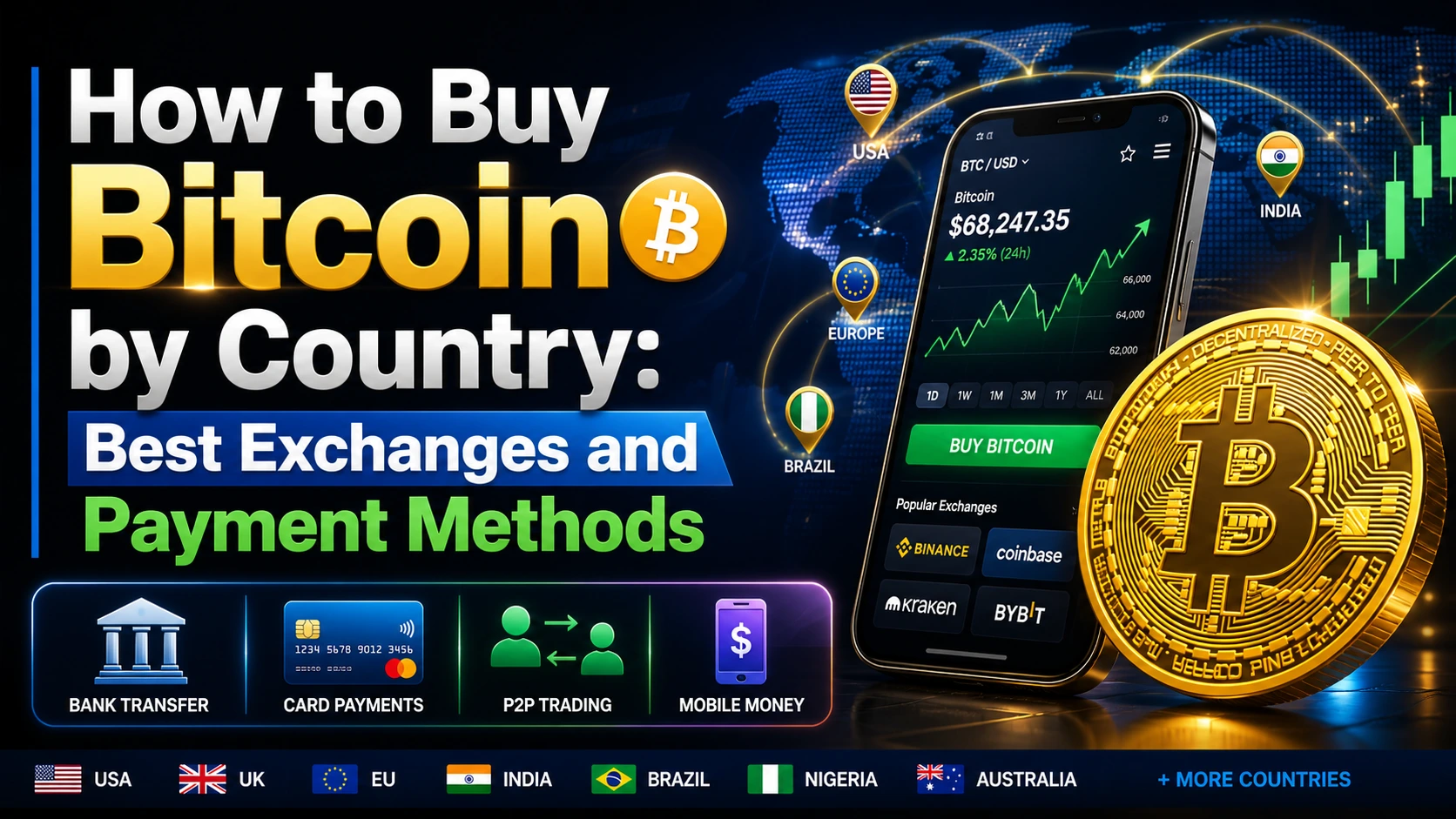
Learn how to buy Bitcoin in 2026 — a country-by-country guide covering the best exchanges, fees, KYC rules, payment methods, and how to store BTC safely.
Quick Summary
To buy Bitcoin in 2026, create an account on a regulated exchange such as Bybit, Binance, OKX, or MEXC, complete identity verification (KYC), deposit funds via bank transfer or card, and purchase BTC. The best exchange depends on your country: US users have Coinbase and Kraken; UK users have Bybit and OKX via FCA-registered platforms; South Africans use VALR or Luno; Nigerians use Binance P2P or Luno; Australians use Swyftx or Binance. Bitcoin is legal in most countries and is classified as property or a commodity for tax purposes. Store purchased Bitcoin in a hardware wallet for long-term security.

How to buy Bitcoin in 2026: the complete beginner’s guide by country
Bitcoin has never been easier to buy. In 2026, more than 680 million people worldwide hold some form of cryptocurrency, regulated frameworks now exist in over 68 countries, and the infrastructure for purchasing BTC has matured to the point where the process takes under ten minutes on most major platforms. The complexity is not in the buying — it is in knowing which exchange to use in your country, what documents you need, how much you will pay in fees, and what to do with your Bitcoin once you own it.
This guide answers all of it, country by country.
Whether you are in South Africa, the US, Nigeria, the UK, Australia, or anywhere else Bitcoin is legal, the correct path to your first (or next) Bitcoin purchase is here. No jargon, no assumptions, no wasted steps.
What you need before buying Bitcoin
Before you open any exchange account, gather the following:
A government-issued photo ID. This can be a passport, national identity card, or driver’s licence. Most exchanges accept all three. If your country issues a biometric identity card, that works too.
Proof of address. A bank statement, utility bill, or official government letter dated within the last three months. Some exchanges skip this for lower-tier accounts; others require it immediately.
A payment method. Bank transfer is the cheapest method at almost every exchange. Debit and credit cards are faster but carry a 1.5–3.5% surcharge on most platforms. Some exchanges in Africa and Southeast Asia also accept mobile money.
A plan for storage. If you are buying a meaningful amount of Bitcoin — anything above the equivalent of one or two months’ salary — you should plan from the beginning to move it into a personal wallet. The exchange is where you buy, not where you keep.
How Bitcoin purchases work: the basics
Every exchange operates on the same core model. You create an account, verify your identity (KYC), deposit money, and use that money to buy Bitcoin on the exchange’s marketplace. The exchange either matches your order against another user (a proper exchange) or sells you Bitcoin directly from its own inventory (a broker model). The distinction affects price and fees but not the user experience for a first-time buyer.
Bitcoin is divisible to eight decimal places, which means you do not need to buy a whole coin. At a Bitcoin price of $100,000, a $100 purchase gives you 0.001 BTC. At $50,000, the same $100 buys 0.002 BTC. Every major exchange lets you buy Bitcoin in your local currency, and the smallest purchase on most platforms starts at the equivalent of around $10.
Your Bitcoin is held in the exchange’s custody until you withdraw it to your own wallet address. That custody arrangement is the main risk of keeping funds on an exchange — as events like FTX, Celsius, and Voyager demonstrated, exchange risk is real. For this reason, serious buyers use exchanges only for purchasing and move their Bitcoin to a personal wallet immediately after.

The best exchanges to buy Bitcoin in 2026: global overview
The table below shows the top exchanges globally, with key metrics for first-time buyers. Regional recommendations follow in the country-by-country section.
|
Exchange |
Spot trading fee |
Card purchase fee |
KYC speed |
Recommended for |
|
0.1% maker / 0.1% taker |
~1.8% |
5–15 min |
Global beginners, active traders |
|
|
0.1% (0% with BNB) |
~1.8% |
10–30 min |
Global, best P2P for Africa / EM |
|
|
0.08% maker / 0.1% taker |
~2% |
10–20 min |
Global, Web3 / DeFi users |
|
|
0% maker / 0% taker (spot) |
~3% |
10–30 min |
Cost-conscious global buyers |
|
|
0.02% maker / 0.05% taker |
~2% |
10–20 min |
Beginners, copy trading |
|
|
0.02% maker / 0.06% taker |
~2% |
15–30 min |
Active traders, low fees |
|
|
Variable spread |
Card supported |
10–30 min |
Africa (SA, Nigeria, Kenya) |
|
|
0.4–0.6% |
~3.99% |
1–24 hrs |
US beginners, regulated preference |
For traders who want to move beyond spot buying into perpetuals, leverage, and advanced products after making their first Bitcoin purchase, BloFin and GRVT are the platforms to graduate to.
Step-by-step: how to buy Bitcoin on Bybit in 2026
The process below applies to Bybit but is near-identical on Binance, OKX, and MEXC. Bybit is recommended for most global beginners because of its clean interface, fast KYC, competitive fees, and strong customer support.
Step 1 — Create your account. Visit Bybit and sign up with your email address. Choose a strong password and enable two-factor authentication (2FA) immediately — either via an authenticator app or SMS. Do not skip 2FA. It is the single most important security step you can take.
Step 2 — Complete KYC verification. Navigate to the Identity Verification section in your account settings. Upload a clear photo of your government ID and complete the live selfie verification. On Bybit, this typically takes five to fifteen minutes during business hours. You will receive a notification when your account is approved.
Step 3 — Deposit funds. Go to the Buy Crypto section. If you are using a bank transfer, select your local currency and follow the banking details provided. Bank transfer is recommended — it is the cheapest method and has no additional fees beyond the exchange’s spread. If you need Bitcoin quickly, a debit or credit card purchase is faster but adds approximately 1.8% to your cost.
Step 4 — Buy Bitcoin. Once your deposit clears, navigate to the spot trading section or use the Quick Buy feature. Search for BTC, enter the amount in your local currency, review the exchange rate and any fees, and confirm the purchase. Your Bitcoin appears in your Bybit spot wallet within seconds.
Step 5 — Secure your Bitcoin. For amounts above $500 or equivalent, withdraw your Bitcoin to a personal hardware wallet. In Bybit, go to Assets, select Withdrawal, enter your hardware wallet’s Bitcoin address, and confirm the transaction. Always send a small test transaction first before transferring a large amount.

How to buy Bitcoin by country
United States
Bitcoin is fully legal in the United States and classified as property by the IRS, meaning capital gains tax applies when you sell. Exchanges operating in the US must register with FinCEN as money service businesses and comply with state-by-state money transmitter licences, which means the platform landscape is more restrictive than in other markets.
Best exchanges for US buyers: Coinbase is the most regulated, publicly listed, and beginner-friendly option for US users. Kraken is the preferred choice among more experienced users for its lower fees, wider asset range, and stronger security reputation. Binance.US remains available in most states and offers better rates than Coinbase for larger purchases.
Payment methods: ACH bank transfer is the cheapest and most widely used method. Card purchases are available but carry fees of 2–4%. Wire transfers work for larger amounts above $5,000.
Tax note: Every Bitcoin purchase creates a cost basis. Every sale, exchange, or use of Bitcoin to purchase goods is a taxable event. Keep records from day one — most major exchanges offer tax report exports. Tools like Koinly integrate directly with exchange accounts to automate tax calculations.
KYC requirements: Full SSN required by most US exchanges for tax reporting compliance. Facial verification and address proof standard. KYC completion typically takes 5 minutes to 24 hours.

United Kingdom
Bitcoin is legal in the UK and regulated by the Financial Conduct Authority (FCA). The FCA requires all crypto asset businesses operating in the UK to register and comply with anti-money laundering rules. Note that the FCA has historically restricted crypto derivatives for retail users — for spot Bitcoin purchases, there are no such restrictions.

Best exchanges for UK buyers: Bybit and OKX both serve UK customers and offer competitive fees and fast onboarding. Coinbase UK is another option for users who prefer a fully regulated, UK-based service. Kraken also operates in the UK with GBP bank transfer support.
Payment methods: Faster Payments bank transfer (same-day, fee-free) is available on Coinbase UK, Kraken, and several other platforms. Debit cards work across all major exchanges. Credit card purchases may be blocked by your bank for crypto transactions — contact your bank in advance if this is likely to be an issue.
Tax note: HMRC classifies Bitcoin as a capital asset. Capital Gains Tax applies on disposal. Each individual has an annual CGT exemption (£3,000 for the 2025/26 tax year). Gains above this are taxed at 18% (basic rate) or 24% (higher rate) as of current HMRC guidance — verify the current rates before filing.
KYC requirements: Passport or UK driving licence plus proof of UK address. Standard verification takes 10–20 minutes on most platforms.
European Union
The EU’s MiCA (Markets in Crypto-Assets) regulation has been fully implemented, establishing a unified licensing framework across all 27 member states. This is broadly positive for buyers: it means exchanges operating in the EU are held to consistent standards, and regulated platforms are easy to identify. MiCA also makes all crypto transactions KYC-mandatory — anonymous crypto purchases through EU-regulated entities are no longer possible.

Best exchanges for EU buyers: Bybit, OKX, Binance, and MEXC all serve EU residents. Kraken has a strong European presence with EUR SEPA transfer support. Bitstamp, based in Luxembourg, is fully MiCA-compliant and a strong choice for users prioritising regulatory certainty.
Payment methods: SEPA bank transfer (free or very low fee, 1–2 business days) is the recommended method for EU buyers. Instant SEPA is available on some platforms. Card purchases available with the standard 1.5–2% surcharge.
Tax note: Tax treatment varies by member state. Germany treats Bitcoin held for more than one year as tax-free on disposal. Portugal has historically been favourable (verify current rules). France, Italy, Spain, and the Netherlands all have varying CGT regimes. Consult a local tax advisor for country-specific guidance.
Australia
Australia has one of the highest crypto adoption rates in the world — as of 2026, approximately 33% of Australians own cryptocurrency, the highest rate among developed nations. Bitcoin is fully legal and regulated by AUSTRAC (Australian Transaction Reports and Analysis Centre). The government has proposed the Corporations Amendment (Digital Assets Framework) Bill 2025 to further clarify the regulatory environment.
Best exchanges for Australian buyers: Swyftx and CoinJar are the leading locally-based options, both registered with AUSTRAC and offering AUD bank transfer and PayID deposits. Binance Australia and OKX also serve Australian users with competitive fees.
Payment methods: PayID instant bank transfers are the most efficient option for Australian buyers — funds clear in minutes and there is no surcharge. POLi bank transfer and debit/credit cards are alternatives.
Tax note: The Australian Taxation Office (ATO) classifies Bitcoin as an asset subject to Capital Gains Tax. If held for more than 12 months, a 50% CGT discount applies. Personal use assets (small amounts spent on goods or services) may be exempt. Keep records of every purchase and sale date.
Canada
Bitcoin is legal in Canada and classified as a commodity. Exchanges must register with FINTRAC (Financial Transactions and Reports Analysis Centre of Canada) as Money Service Businesses and comply with strict AML and KYC requirements.
Best exchanges for Canadian buyers: Coinbase, Kraken, and Newton (a Canadian-built exchange) all serve Canadian users and support CAD deposits via Interac e-Transfer. Binance continues to operate in Canada with CAD support. Shakepay is another popular Canadian option for straightforward Bitcoin and Ethereum purchases.
Payment methods: Interac e-Transfer is the preferred deposit method — it is fast, widely supported, and free on most platforms. Wire transfer works for larger amounts.
Singapore
Singapore is one of the world’s leading cryptocurrency hubs. Bitcoin is fully legal and regulated by the Monetary Authority of Singapore (MAS) under the Payment Services Act. MAS has granted payment institution licences to 30 major platforms, and the licensing regime is strict but transparent. As of 2026, Singapore is projected to generate approximately $392 million in cryptocurrency market revenue.
Best exchanges for Singapore buyers: Bybit is headquartered in Singapore and is a top choice. OKX, Binance, and Coinhako (a locally licensed exchange) all serve Singaporean users with SGD support.
Payment methods: PayNow instant bank transfer and standard bank transfer both supported. Card purchases available.
UAE and Middle East
The UAE has positioned itself as the region’s crypto capital, with Dubai’s Virtual Assets Regulatory Authority (VARA) providing one of the most progressive crypto licensing frameworks in the world. Individuals pay no income tax on crypto gains in the UAE, making it one of the most tax-efficient jurisdictions for Bitcoin holders.

Best exchanges for UAE buyers: Bybit, OKX, Binance, and Bitex UAE all operate in the region. VARA-licensed exchanges are the recommended option for residents seeking full regulatory compliance.
Payment methods: Bank transfer in AED, card purchases, and in some cases cash-to-crypto through licensed OTC providers.

South Africa
South Africa’s Financial Sector Conduct Authority (FSCA) has established a licensing framework for crypto asset service providers, giving the country one of Africa’s clearest regulatory environments. Bitcoin is fully legal and widely adopted — South Africa consistently ranks among the world’s top countries for crypto ownership as a percentage of population.
Best exchanges for South African buyers: Luno (built in South Africa, excellent ZAR support and beginner UX) and VALR (SA-built, lower fees, wider asset range) are the two leading local options. Binance and Bybit also serve South African users and accept ZAR via P2P.
Payment methods: EFT (Electronic Funds Transfer) bank deposit is the standard method. Luno supports direct ZAR deposits via bank transfer. VALR also offers instant EFT. Card deposits available on both platforms.
Tax note: SARS (South African Revenue Service) treats Bitcoin as an asset of a capital nature or as trading stock depending on the nature and frequency of transactions. Capital gains are included in taxable income at 40% inclusion rate for individuals. Frequent traders may be taxed on full gains as income. Keep detailed records of every purchase, sale, and transfer.
A note from Decentralised News: As a Cape Town-based publication, this market is home ground for us. If you are South African and new to Bitcoin, start with Luno for its simplicity and ZAR support, then graduate to VALR as your confidence and portfolio grow. For anything beyond spot holding — leverage, perpetuals, or DeFi — Bybit is the platform of choice for South African traders who want access to global markets.
Nigeria
Nigeria is the largest cryptocurrency market in Africa by volume, with monthly peer-to-peer trading volumes exceeding $2.4 billion as of 2026. Bitcoin adoption is driven by currency volatility, remittance needs, and a large, digitally native young population. The regulatory environment has evolved significantly: the 2025 Investment and Securities Act formally places crypto under the Nigerian SEC, and serious exchanges are now pursuing VASP (Virtual Asset Service Provider) authorisation.
Best exchanges for Nigerian buyers: Binance P2P is the most widely used platform — the P2P marketplace allows direct NGN-to-BTC trades with escrow protection, offering competitive rates and multiple local payment methods. Luno supports direct NGN deposits via bank transfer and has a long-established presence in Nigeria. Quidax is a Nigerian-built, SEC-licensed exchange that supports direct NGN order-book trading — a strong choice for buyers who want a locally compliant platform.
Payment methods: Bank transfer is the most widely available method. Mobile money options are available via some P2P traders. Debit card deposits available on Luno and several other platforms.
Tax note: Nigeria’s Federal Inland Revenue Service (FIRS) has issued guidance that crypto gains are subject to Capital Gains Tax. Keep records of all purchases and sales.
P2P tip for Nigerian buyers: When using Binance P2P or Bybit P2P, always trade with merchants who have a high completion rate (above 95%) and a large number of completed trades. Never release Bitcoin or send payment until the escrow confirmation appears in the app. Never communicate or pay outside the platform.

Kenya
Kenya ranks third in African crypto volumes, with more than $900 million in monthly trading as of 2026. A key driver is M-Pesa integration — Kenya’s mobile money infrastructure makes crypto more accessible here than almost anywhere else on the continent. The 2025 VASP Act formalised much of the previously informal P2P trading into licensed channels.
Best exchanges for Kenyan buyers: Binance P2P with M-Pesa support is the dominant platform for most Kenyan buyers. Yellow Card operates in Kenya with local currency and mobile money support. Luno serves Kenyan users through its broader East Africa operations.
Payment methods: M-Pesa integration via Binance P2P is the most frictionless option for Kenyan buyers — you fund your P2P trade directly from your M-Pesa wallet. Bank transfer also available.
Payment methods compared: which is cheapest?
|
Method |
Typical fee |
Speed |
Availability |
|
Bank transfer (SEPA / ACH / EFT) |
0–0.5% |
1–3 days |
Most countries |
|
Instant bank transfer (PayID, Faster Payments, PayNow) |
0–0.5% |
Minutes |
AU, UK, SG, select others |
|
Debit card |
1.5–2.5% |
Instant |
Global |
|
Credit card |
2–3.5% |
Instant |
Global (bank may block) |
|
P2P (local currency) |
Market-rate spread |
Minutes–hours |
Global, especially emerging markets |
|
Crypto ATM |
5–12% |
Minutes |
Limited locations |
|
Mobile money (M-Pesa, etc.) |
Spread varies |
Minutes |
Kenya, Africa |
Bank transfer wins on cost in every jurisdiction where it is available. Use a card only if you need Bitcoin immediately for a time-sensitive reason. Crypto ATMs should be a last resort — fees of 5–12% are substantial on any meaningful purchase size.
Understanding fees: what you actually pay
There are three types of fees to be aware of when buying Bitcoin.
Trading fees are charged on the purchase itself. On most major exchanges, spot trading fees range from 0.05% to 0.1%. MEXC currently charges 0% on spot maker orders. Binance charges 0.1% but offers a discount for paying fees in BNB. These fees are small — on a $1,000 purchase, 0.1% is $1.
Spread is the difference between the buy price and sell price on the exchange at the time of your purchase. On liquid exchanges, this is typically 0.1–0.3% for Bitcoin. Broker-model services (where the exchange sells to you directly rather than matching you with another user) often have a higher spread — sometimes 0.5–1.5%. Luno’s rate-based model, for example, includes a spread built into the price rather than an explicit fee.
Deposit and withdrawal fees vary by payment method and exchange. Bank transfers are usually free to deposit but may carry a small flat fee (around $1–3) on withdrawal. Card purchases carry the 1.5–3.5% surcharge mentioned above. Bitcoin withdrawals (sending your BTC to a personal wallet) carry a network fee (the blockchain transaction fee, sometimes called gas) that varies with network congestion. At typical Bitcoin fees in 2026, a withdrawal costs approximately $1–5.

How to store Bitcoin safely after buying
The most important decision you make after buying Bitcoin is where to keep it. Your options range from simple (leave it on the exchange) to highly secure (hardware wallet in a safe).
Leaving it on the exchange. Acceptable for small amounts and active traders who need immediate access. Not recommended for long-term holdings or significant amounts. The risk is exchange insolvency, hacking, or account freezes — all of which have happened to major platforms within recent memory.
Software wallets. Apps on your phone or computer that give you control of your private keys. Good examples include Exodus, Electrum (Bitcoin-only, highly recommended for its simplicity), and BlueWallet. These are free and significantly safer than leaving funds on an exchange, but they are only as secure as the device they are installed on.
Hardware wallets. Physical devices that store your private keys offline. The leading options are Ledger Nano X and Trezor Model T. These cost between $70 and $200 and are considered the gold standard for Bitcoin storage. For any amount that matters to you financially — use a hardware wallet.
The seed phrase. When you set up any personal wallet, you will receive a 12 or 24-word seed phrase. Write this on paper (never store it digitally, never photograph it, never type it anywhere online) and store it somewhere safe and separate from the device. The seed phrase is the master key to your Bitcoin. Anyone who has it has your Bitcoin. Anyone who has it can recover your wallet if your device is lost or destroyed.

How much Bitcoin should you buy?
This is not investment advice — but here is a framework that helps beginners think about position sizing.
Most financial advisors working with crypto-aware clients suggest allocating no more than 5–15% of an investment portfolio to Bitcoin for a moderate-risk investor. Bitcoin is a volatile asset: 30–50% drawdowns from peak to trough have occurred multiple times in its history, and significant price corrections can happen without warning.
Dollar-cost averaging (DCA) — buying a fixed amount of Bitcoin on a regular schedule (weekly or monthly) regardless of price — is the most widely practised approach among long-term holders. It removes the psychological burden of trying to time the market and smooths your entry price over time. Most major exchanges offer recurring buy features that automate this process.
Bitcoin is divisible to eight decimal places. You can buy $10 worth of Bitcoin. There is no minimum that makes it “worth doing” — the correct starting amount is whatever you can afford to hold without selling in a panic during a downturn.
Bitcoin in 2026: the regulatory landscape at a glance
|
Region |
Legal status |
Regulatory body |
Tax treatment |
|
United States |
Legal (property) |
FinCEN, SEC, CFTC |
Capital gains tax |
|
United Kingdom |
Legal |
FCA |
Capital Gains Tax (18–24%) |
|
European Union |
Legal (MiCA framework) |
National + ESMA |
Varies by country |
|
Australia |
Legal |
AUSTRAC |
CGT (50% discount after 12 months) |
|
Canada |
Legal (commodity) |
FINTRAC |
Capital or income tax |
|
Singapore |
Legal (regulated) |
MAS |
Generally no personal income tax on gains |
|
UAE |
Legal |
VARA / CBUAE |
No personal income tax |
|
South Africa |
Legal |
FSCA |
CGT inclusion at 40% |
|
Nigeria |
Legal (regulated) |
Nigerian SEC, CBN |
Capital Gains Tax |
|
Kenya |
Legal |
Capital Markets Authority |
Varied |
|
Switzerland |
Legal |
FINMA |
Minimal / zero for private persons |
|
China |
Banned |
— |
N/A |
|
El Salvador |
Legal tender (voluntary) |
BCR |
Minimal |
This table reflects the regulatory position as of May 2026. Crypto law moves quickly — always verify the current position with a local legal or tax professional before making significant purchases.
Common mistakes first-time buyers make
Buying on the wrong platform. Using a high-fee broker or a platform with a poor security track record is the most common beginner error. Stick to the exchanges named in this guide.
Skipping 2FA. Two-factor authentication is not optional. Enable it immediately after creating your account. Use an authenticator app (Google Authenticator, Authy) rather than SMS where possible — SMS 2FA is vulnerable to SIM-swap attacks.
Sending to the wrong address. Bitcoin transactions are irreversible. When withdrawing to a personal wallet, always double-check the first and last four characters of the address, and always send a small test amount before transferring a large sum.
Storing seed phrases digitally. Your seed phrase exists on paper only. A screenshot of your seed phrase stored on your phone is a security liability. Write it on paper, store it safely.
Panic selling during corrections. Bitcoin has declined 30–80% from peak multiple times in its history, and recovered to new highs each cycle. If you cannot hold through a 50% drop, do not put in more than you can afford to see temporarily decline. Position size appropriately from the start.
Confusing exchange wallets with personal wallets. Your Bitcoin on an exchange is not truly yours — you hold a claim on the exchange’s reserves, not Bitcoin on the blockchain. “Not your keys, not your coins” is the oldest rule in crypto. It remains true in 2026.

Where to trade after you have Bitcoin: the next step
Buying Bitcoin is the beginning. Once you have your first position and understand how wallets work, the natural progression for many users is to explore more sophisticated products — trading Bitcoin perpetuals to hedge your spot position, earning yield on your holdings, or getting exposure to other assets across the crypto ecosystem.
For those ready to take that step, Bybit is the platform most Decentralised News readers use for derivatives and perpetuals trading — it offers the deepest BTC perpetuals liquidity outside of the US, with competitive funding rates and a clean interface for both beginners and experienced traders.
For institutional buyers or those trading in significant size, GRVT operates as a hybrid institutional exchange combining the security of a decentralised settlement model with the performance of a centralised order book — the platform of choice for high-net-worth individuals and funds entering the space.
Frequently asked questions
Can I buy Bitcoin without ID in 2026?
In most countries, purchasing Bitcoin through a regulated exchange now requires KYC verification. Decentralised exchanges (DEXs) such as Uniswap allow peer-to-peer trading without identity verification, but they require you to already hold another cryptocurrency to exchange — they do not accept fiat deposits. Some P2P platforms allow small trades without full KYC, but limits are low and the risk of scams increases significantly without the protections that regulated platforms provide.
How long does Bitcoin transfer take?
A Bitcoin transaction on the main network typically confirms within 10–60 minutes, though this depends on network congestion and the transaction fee paid. Exchange withdrawals may add additional processing time (usually 5–30 minutes) before the blockchain transaction is broadcast.
Is it safe to buy Bitcoin online?
Yes, when using a regulated, well-established exchange. The risks come from using unverified platforms, falling for phishing attacks, or storing large amounts on exchanges rather than personal wallets. Stick to the exchanges in this guide, enable 2FA, and use a hardware wallet for significant holdings.
What happens to my Bitcoin if the exchange goes bankrupt?
If an exchange becomes insolvent while holding your Bitcoin, your position depends on the exchange’s structure and your jurisdiction’s insolvency laws. In most cases, exchange customers become unsecured creditors — as FTX customers discovered, recovery can be partial and takes years. This is the definitive reason to withdraw Bitcoin to a personal wallet for any meaningful holding.
Can I buy Bitcoin with cash?
Yes, through Bitcoin ATMs (which typically charge 5–12% fees) or P2P platforms where you can arrange cash-in-person trades with local users. Cash ATM purchases are available in South Africa, Nigeria, Kenya, the US, UK, Australia, and most major markets. Always use the escrow protection on P2P platforms and meet in a safe, public location for any cash transaction.
This article is for informational purposes only and does not constitute financial or investment advice. Cryptocurrency investments carry significant risk. The regulatory and tax information in this guide reflects the position as of May 2026 and is subject to change. Always verify current requirements in your jurisdiction before making financial decisions.
Last updated: May 2026. Decentralised News reviews and refreshes this guide quarterly to reflect exchange fee changes, new regulatory developments, and updated country-specific guidance.
Recommended reading:
Lowest Crypto Futures Fees in 2026: Every Major Exchange Ranked and Calculated
Best Crypto Sign-Up Bonuses and New User Rewards in 2026
Best Crypto Futures Trading Competitions in 2026: Where Active Traders Can Earn Rewards
Best Crypto Exchanges for Beginners (2026)
The Best Crypto Exchanges for Beginners in 2025
How to Buy Bitcoin in Every Country (Ultimate 2026 Global Guide)





