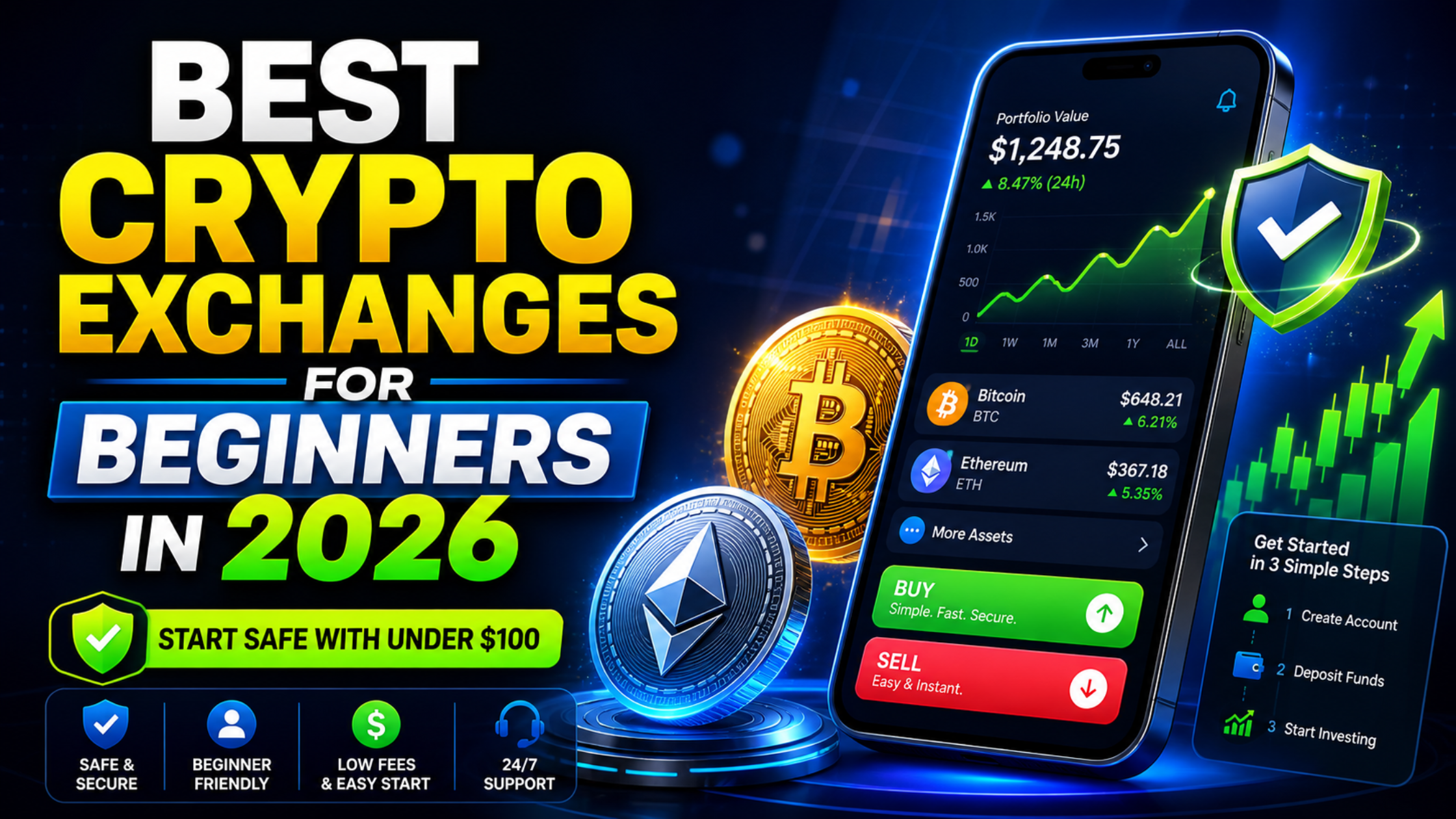
Starting crypto with under $100? We ranked the best exchanges for beginners in 2026 — scored on KYC ease, UI simplicity, fiat on-ramp quality, fee transparency, and welcome bonuses. Includes a step-by-step first $100 guide.
Quick summary
The best crypto exchanges for beginners in 2026 are KCEX, Bitunix, MEXC, Bybit, Coinex (optional KYC, clean interface, $100 welcome bonus, $10,000 daily withdrawal limit without ID), Binance (the most complete beginner-to-advanced pathway with up to $100 USDT in welcome tasks), KuCoin (beginner-friendly with strong Sunshine Rewards for new users and a simple earn product), Bybit (up to $30,000 in tiered welcome bonuses, polished mobile app), and Kraken (the most trusted regulated exchange for US and European beginners requiring regulatory safety). MEXC and Gate.com offer the lowest friction sign-up processes with competitive new-user bonuses and broad coin access. For African and emerging market beginners, Luno offers local currency on-ramps in South Africa, Nigeria, Zambia, and Uganda that no global exchange can match for fiat simplicity. The most common beginner mistake is not setting up security features before making a first deposit — 2FA, withdrawal whitelist, and an anti-phishing code take 15 minutes to configure and eliminate the three most common attack vectors on new crypto accounts. Starting with two exchanges — one for BTC/ETH and one for altcoins — and claiming both welcome bonuses simultaneously gives a first-time buyer a $200+ head start on $100 in deposits.
Last Updated: 3 May 2026
Why most “best for beginners” guides are useless
Type “best crypto exchange for beginners” into any search engine and you will find a wall of articles that all say the same thing: Coinbase for Americans, Binance for everyone else, with a brief mention of Kraken and KuCoin somewhere in the middle.
These guides are not wrong exactly. They are just useless in practice, because they describe exchanges as if all beginners are identical — same country, same risk tolerance, same tech comfort, same goal. They never tell you what happens after you sign up. They never tell you what mistakes to avoid before your first deposit. They never tell you that setting up security takes 15 minutes and skipping it costs some people everything.
This guide is built differently. It walks you through the entire starter journey: from choosing an exchange that matches your situation, through your first $100, through your first withdrawal, through the security setup that most platforms bury in a help article nobody reads. By the end, you will know exactly where to start, exactly what to do, and exactly how to use available welcome bonuses to begin with more than you put in.
The 5 things that actually matter for a beginner
Before any exchange comparison, you need a scoring framework. Here are the five dimensions that determine whether a beginner will have a smooth first experience or a frustrating one — and which dimension matters most for your specific situation.
1. KYC ease — how fast can you get to your first trade?
KYC (Know Your Customer) is the identity verification process every regulated exchange requires. You submit a government ID and usually a selfie. Most platforms approve you in minutes using automated verification; some take hours or days during peak periods.
Why it matters: a beginner who signs up with genuine excitement and then waits 48 hours for KYC approval often loses momentum entirely. The best beginner exchanges approve KYC within 10 minutes on average, offer Google or Apple sign-in to reduce friction at registration, and have clearly designed verification flows rather than confusing multi-step processes.
CoinEx is notable here for a different reason: it does not require KYC for basic trading. You can withdraw up to $10,000 per day and $50,000 per month without submitting any identity documents. This is increasingly rare at a mature exchange and is a legitimate advantage for beginners who want to start immediately.
2. UI simplicity — can you find what you need without Googling?
A professional trading terminal with 12 chart panels, 40 order types, and a three-column layout optimised for a desktop monitor is exactly wrong for a first-time buyer. The best beginner exchange interface has a clearly labelled buy/sell button, a simple price chart, and a search bar for finding coins. Everything else should be optional.
Most large exchanges have improved their beginner interfaces in 2026 by offering a “simple” or “lite” mode alongside the full trading view. Binance Lite, Bybit’s Simple Trade mode, and KuCoin’s Convert feature all allow a first-time buyer to purchase crypto without ever seeing a candlestick chart.
3. Fiat on-ramp quality — how easy is it to get real money in?
A fiat on-ramp is the mechanism that converts your bank currency into crypto. Quality varies dramatically by exchange and by country. A UK user on Kraken can deposit via bank transfer in 10 minutes for free. A South African user needs a P2P purchase or Valr’s local bank integration to avoid expensive card fees. An American user using Coinbase can link a bank account and settle in seconds; the same user on Bybit navigates a more complex P2P or third-party payment path.
Before choosing an exchange, check what deposit methods are available in your country, what fees apply to each, and how long settlement takes. This single factor — more than fees, more than coin selection — determines whether your first crypto purchase is smooth or frustrating.
4. Fee transparency — do you know what you are paying before you buy?
Hidden fees are the most common source of new user frustration with crypto exchanges. The three fee layers that catch beginners off guard are: the trading fee (charged when you execute a buy or sell), the spread (the gap between the buy and sell price on some platforms, particularly on simple buy/sell interfaces), and the withdrawal fee (charged when you move crypto to a personal wallet or another exchange).
The best beginner exchanges display all three fees clearly before order confirmation. Binance and KuCoin both show exact fees on the order preview screen. Some platforms — particularly those targeting pure beginners with “convert” features — embed spreads that are significantly higher than their advertised trading fees.
5. Customer support quality — what happens when something goes wrong?
For a beginner, something will go wrong. A deposit will take longer than expected. A price will move before an order fills. A withdrawal to a new wallet will be delayed for security review. The question is not whether you will need support — it is how fast and effectively the exchange resolves it.
CoinEx averages 1–2 minutes to connect with a live agent via 24/7 live chat, based on independently tested response times. Binance and KuCoin have large support teams but variable response times that can stretch to hours during high-volume periods. Kraken is consistently rated among the best for support quality in the Western market.

Exchange-by-exchange beginner scoring
Each exchange is scored 1–10 on the five dimensions above. Weighted composite uses: KYC ease (25%), UI simplicity (25%), fiat on-ramp (20%), fee transparency (20%), support (10%).
|
Exchange |
KYC ease |
UI |
Fiat on-ramp |
Fee transparency |
Support |
Composite |
Welcome bonus |
|
CoinEx |
10 |
9 |
7 |
8 |
9 |
8.9 |
Up to $100 USDT |
|
8 |
8 |
9 |
8 |
7 |
8.2 |
Up to $100 USDT |
|
|
8 |
8 |
8 |
8 |
7 |
8.0 |
Sunshine Rewards |
|
|
8 |
8 |
7 |
8 |
7 |
7.8 |
Up to $30,000 USDT |
|
|
8 |
7 |
7 |
7 |
6 |
7.3 |
10 USDT airdrop |
|
|
7 |
7 |
7 |
7 |
7 |
7.1 |
Community rewards |
|
|
8 |
8 |
7 |
8 |
7 |
7.8 |
Up to $400 in BTC |
|
|
7 |
7 |
9 |
9 |
9 |
7.9 |
Referral rewards |
|
|
9 |
9 |
10 |
9 |
8 |
9.2 |
Africa-specific |
Luno scores highest for African beginners specifically due to local fiat on-ramps. For global beginners without Africa-specific needs, CoinEx and Binance lead.

The starter journey: your first $100 step by step
Phase 1: Choose your exchange and sign up (Day 1, 20 minutes)
For most beginners outside the United States, start with two exchanges simultaneously:
Primary: Binance or CoinEx — for BTC, ETH, and broad coin access
Secondary: KuCoin or Gate.io — for altcoins and additional welcome bonuses
Using two exchanges from day one means you claim two sets of welcome bonuses and immediately learn that holding all your crypto on one platform is a risk worth avoiding.
Registration tips that most guides skip:
Use a dedicated email address for crypto exchanges — not your main personal email. If one exchange is phished, you do not want the attacker to have the email address you use for banking, work, and social accounts.
Write down your password physically on paper and store it somewhere safe. Do not save it in a browser password manager as your only backup. If your device is wiped or stolen, you need physical access to your exchange credentials.
Use your legal name exactly as it appears on your government ID. Name mismatches cause the most common KYC delays and can result in withdrawal freezes on some platforms.
Phase 2: Security setup before your first deposit (Day 1, 15 minutes)
This is the section of every beginner guide that gets buried or skipped entirely. Do not skip it. Set up all three of the following before you deposit a single dollar.
Two-factor authentication (2FA): 2FA adds a second verification step to every login and withdrawal. Without it, anyone with your email and password can drain your account. Download Google Authenticator or Authy, then go to your account security settings and link the app. Every exchange covered in this guide supports authenticator-based 2FA. Do not use SMS-based 2FA if you have the option — SIM-swap attacks, where an attacker ports your phone number to their own SIM, bypass SMS codes completely.
Withdrawal whitelist: Most exchanges let you create a whitelist of wallet addresses you are allowed to withdraw to. Once enabled, withdrawals to any non-whitelisted address require email confirmation plus a 24-hour waiting period. This single feature stops an attacker who has your login credentials from immediately withdrawing your funds.
Anti-phishing code: Binance, OKX, Bybit, and KuCoin all offer an anti-phishing code — a unique phrase you set that appears in every legitimate email from the exchange. If you receive an email claiming to be from Binance and it does not contain your anti-phishing code, it is a phishing attempt. This takes two minutes to set up in account settings and eliminates one of the most common attack vectors against new crypto users.
The full security setup takes 15 minutes. Do it before you deposit.

Phase 3: Your first deposit (Day 1 or 2)
Once security is set up, make your first deposit. For a first $100:
Bank transfer is the cheapest deposit method on almost every exchange. Bank transfer fees are typically zero or under $1. Card deposits are faster but charge 1.5–3.5% on most platforms — on a $100 purchase, that is $1.50 to $3.50 in instant friction before you have bought a single coin.
P2P (peer-to-peer) trading is the best option for users in countries with limited direct bank integration. On Binance P2P, KuCoin P2P, and MEXC P2P, you buy crypto directly from another user at an agreed price using local payment methods (bank transfer, PayPal, M-Pesa, or cash). Spreads on P2P are typically 0.5–1.5% for major pairs. This is how most African users fund their accounts.
Card purchase is fine if you value speed over cost. Binance, KuCoin, and OKX all support Visa/Mastercard purchase directly to your account balance. The fee is higher than bank transfer but the process takes under two minutes.
Minimum deposit amounts vary: Binance allows deposits as small as $10 via bank transfer. Bybit has no stated minimum for crypto deposits. KuCoin accepts deposits from any amount. Kraken starts at $10 for USD bank transfers.

Phase 4: Your first trade — buying BTC, ETH, and one altcoin
Once your deposit is confirmed, you are ready to trade. For a first $100, a sensible allocation for a beginner is:
- $50 into Bitcoin (BTC) — the benchmark asset; highest liquidity, lowest volatility among crypto
- $30 into Ethereum (ETH) — the second-largest by market cap; core to most DeFi and Layer-2 activity
- $20 into one altcoin of your choice — higher risk, higher potential upside; start here only after understanding that altcoins can drop 50–80% in bear markets
Using Binance Simple Mode:
Click “Buy Crypto” at the top of the screen → select bank transfer or card → choose BTC → enter amount → confirm. Binance displays the exact fee before you confirm. No chart, no order book, no complexity.
Using KuCoin Convert:
On the KuCoin app home screen, tap “Convert” → enter the USDT amount → select BTC → preview the exchange rate and fee → confirm. The Convert feature uses a fixed-price model so you see exactly what you receive before proceeding.
Using CoinEx Swap:
On CoinEx, the “Swap” feature works identically to KuCoin’s Convert. Select two coins, enter the amount, and the system displays the exact output before you confirm. No charts required.
Using Bybit Simple Trade:
On Bybit, tap “Buy Crypto” → select your currency → choose the coin → confirm the amount and fee. Bybit’s Simple Trade mode is one of the cleanest first-purchase experiences across all platforms tested.

Phase 5: Claiming your welcome bonuses (Day 1–15)
Every exchange covered in this guide offers welcome bonuses for new users. Here is the current structure for each, and the critical deadline information most new users miss.
Binance: Complete three tasks — KYC verification ($20 USDT), first deposit ($30 USDT), and first trade ($50 USDT) — to earn up to $100 USDT in trading credits. Tasks must be completed within 14 days of registration. Navigate to “Rewards Hub” after logging in to activate the bonus quest.
CoinEx: Up to $100 USDT in welcome bonuses structured as fee cashback vouchers: $10 for depositing and trading over $50 USDT; $30 for spot trading volume over $200 USDT; $60 for spot trading volume over $500 USDT. Tasks must be completed within 15 days. None of the tasks require large deposits — the $10 voucher is easily claimed with a simple $50 deposit. Navigate to “Promotions” after registration to activate.
KuCoin Sunshine Rewards: New user rewards include trading fee rebates, deposit bonuses, and participation in KuCoin competitions. The welcome package is personalised based on account activity in the first 30 days. The most reliable bonus is the trading fee rebate for completing first-trade milestones.
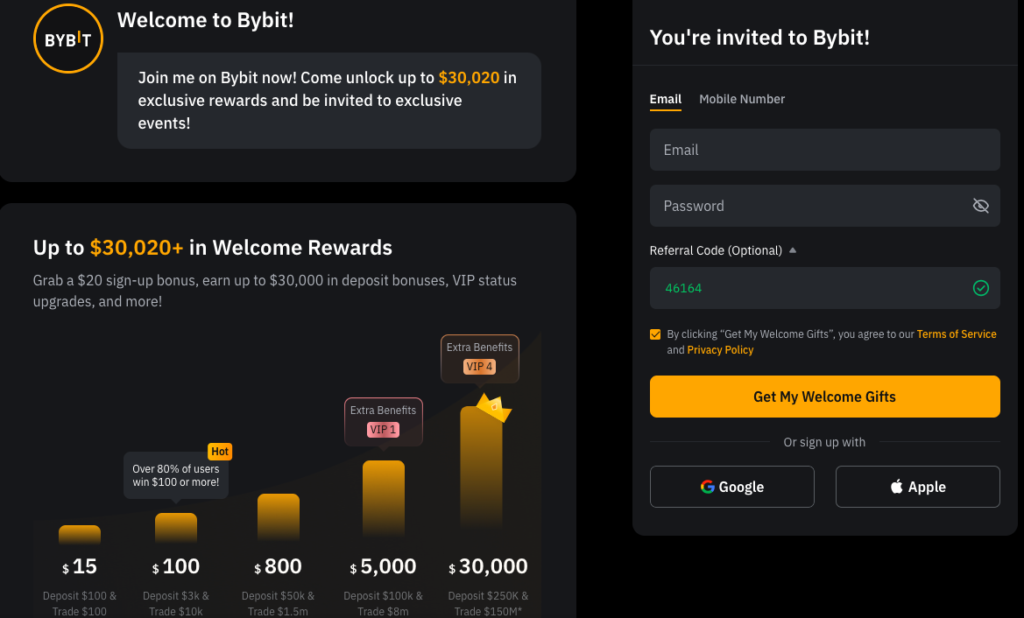
Bybit: Up to $30,000 USDT in tiered welcome rewards based on deposit size and trading volume. For a beginner depositing $100, the most accessible tier is the registration bonus ($20 USDT) and the first-trade bonus (variable, typically $10–$50). Navigate to “Rewards Hub” and complete the available tasks in sequence.
MEXC: A 10 USDT airdrop for completing a first P2P deposit above $100 and reaching $100 in net deposits. Straightforward to claim via the event page within 7 days of registration.
Kraken: The referral-based reward pays $10 in Bitcoin when a referred user completes a trade of $100 or more. The bonus is small relative to peers but the Kraken+ subscription ($4.99/month or $49.99/year) unlocks zero-fee trading up to $10,000 monthly — a genuine saving for users who plan to trade regularly.
Stacking bonuses across two exchanges: A beginner who signs up for both Binance and CoinEx, deposits $50 on each, and completes the activation tasks on both platforms can collect up to $110 in combined welcome credits — exceeding their initial $100 investment in bonus value before any trading gains. This is the “head start” framing that converts beginners who are cost-conscious: you begin with more than you put in.
The 15-minute security checklist: full setup guide
Print this out or screenshot it. Complete every item before you deposit.
Account creation:
- Use a dedicated email address created only for crypto exchanges
- Choose a password at least 16 characters long with letters, numbers, and symbols
- Write the password on paper and store it physically — not only in a browser
Two-factor authentication:
- Download Google Authenticator or Authy on your phone
- Go to Account Settings → Security → Two-Factor Authentication
- Scan the QR code with your authenticator app
- Write down the backup codes provided and store them separately from your device
- Never share your 2FA codes with anyone, including exchange support staff
Withdrawal whitelist (highly recommended):
- Go to Account Settings → Security → Withdrawal Whitelist
- Enable the whitelist feature
- Add only wallets you personally control
- Once enabled, new addresses require email verification plus 24 hours before you can withdraw to them
Anti-phishing code (Binance, OKX, Bybit, KuCoin):
- Go to Account Settings → Security → Anti-Phishing Code
- Set a memorable phrase (e.g., your cat’s name followed by a number)
- This phrase will appear in every legitimate email from the exchange
- Any email without this phrase claiming to be from the exchange is a phishing attempt
Device security:
- Enable fingerprint or face recognition on the exchange mobile app
- Do not access your exchange account on public Wi-Fi without a VPN
- Log out of your account on any device you share with others
After your first deposit:
- Do not share your portfolio publicly on social media — this makes you a target
- Do not tell people how much crypto you hold or on which exchange
- Consider moving large balances (above $1,000) to a hardware wallet after your first month — Ledger and Trezor are the two most reputable options
Exchange spotlight: who should use which platform
Binance — best all-round beginner platform

Binance is the largest cryptocurrency exchange by volume and lists more than 400 cryptocurrencies across 1,800+ trading pairs. For a beginner, the most relevant feature is not the market depth or the futures suite — it is the breadth of the fiat on-ramp. Binance accepts bank transfers, Visa/Mastercard, Apple Pay, Google Pay, and P2P in over 100 fiat currencies. If you can get money in easily, you are more likely to actually start.
The Binance Lite mode on mobile strips the interface down to a simple buy/sell flow with no visible charts. For someone who has never seen a candlestick, this is the right entry point.
The $100 USDT welcome task structure is among the clearest in the industry: KYC, deposit, trade. Three tasks, three payouts, 14 days to complete them.
The limitation for beginners is customer support response time during peak periods, which can stretch to hours on complex issues.
Register on Binance — code CPA_00SXKU7IO9
CoinEx — best for frictionless first experience
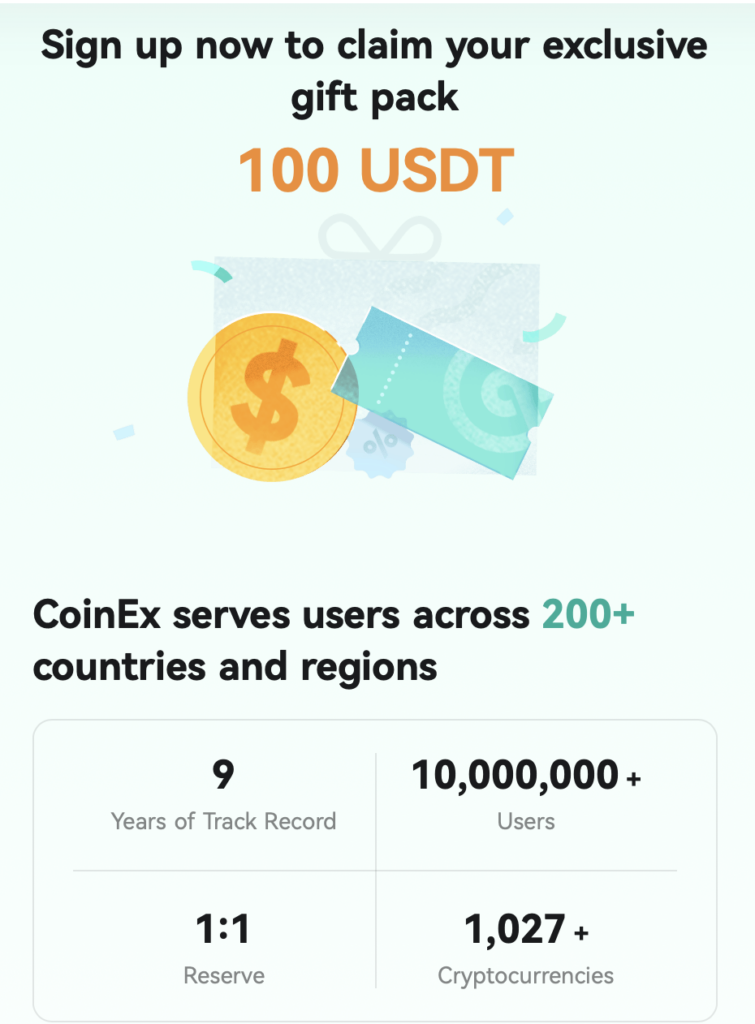
CoinEx has over 10 million users across 200+ countries and lists more than 1,600 crypto markets. Its most distinctive beginner advantage is optional KYC — you can deposit, trade, and withdraw up to $10,000 per day without submitting any identity documents. For a beginner who wants to start immediately and has not prepared their documents, this eliminates the most common point of friction.
The interface is clean and does not overwhelm new users. There is even a demo trading mode available before committing real money, though it currently only covers perpetual contracts rather than spot markets. A Swap feature allows one-click conversions between any two supported coins without using an order book.
CoinEx’s $100 welcome bonus — structured as fee cashback vouchers for deposit and trading milestones — is one of the most generous first-user incentive structures relative to platform size.
The one caveat worth noting: CoinEx does not hold top-tier regulatory licenses, which means it is not available in the United States or Canada. It had a $70 million hot wallet hack in 2023 — users were made whole by the company — and subsequent security upgrades have been independently audited. Over 90% of assets are now held in cold wallets with multi-signature protection.
Register on CoinEx — code wynsf
KuCoin — best for beginners interested in altcoins

KuCoin is one of the most popular global exchanges for altcoin access, listing thousands of tokens across spot and futures markets. For a beginner whose interest in crypto was sparked by a specific project — a gaming token, a DeFi protocol, a meme coin — KuCoin is often the first place that token becomes tradable.
The Convert feature makes simple coin swaps beginner-friendly. The KuCoin Earn product — which lets you put idle USDT to work in flexible savings or structured products — introduces a passive income concept without the complexity of DeFi.
The Sunshine Rewards program for new users layers additional incentives onto the first weeks of trading, and KuCoin regularly runs large-scale competitions (including the current 160,000 USDT Futures Battle) that give beginners competitive events to learn from without requiring large capital.
Register on KuCoin — code CX8QMK4M
Bybit — best welcome bonus structure

Bybit’s beginner appeal is rooted in its welcome reward system. Up to $30,000 USDT in tiered bonuses sounds headline-grabbing, but even at the beginner level — depositing $100–$500 — the available welcome credits represent a meaningful starting advantage.
Bybit’s mobile app is consistently rated among the best-designed in the industry. The Simple Trade mode mirrors the simplicity of Coinbase or Cash App while connecting to the full Bybit trading infrastructure. For a beginner who plans to graduate to futures trading within six to twelve months, Bybit has the advantage of being a platform that grows with you — no need to migrate to a different exchange as you become more sophisticated.
The copy trading feature — where you automatically mirror the trades of top-performing traders — is a good introduction to professional trading strategies for beginners who are not yet ready to make their own directional decisions.
Register on Bybit — code 46164
Kraken — best for trust and regulatory safety

Kraken has not been hacked since its launch in 2013 and is widely recognised as one of the most secure cryptocurrency exchanges in the industry. For beginners in the United States, Europe, or Australia who prioritise regulatory safety above all other considerations, Kraken is the most defensible first choice.
The Kraken+ subscription ($4.99/month or $49.99/year) unlocks zero-fee trading up to $10,000 monthly alongside boosted staking rates and exclusive airdrops — a genuinely useful structure for beginners who plan to trade regularly from day one.
Staking on Kraken is simpler than on most exchanges. You simply hold ETH, SOL, ADA, or DOT in your account and elect to stake it. No lockup periods for most assets. Rewards paid twice weekly.
Kraken’s referral program pays $10 in Bitcoin to both parties when a referred user completes a qualifying trade of $100 or more — a modest but honest incentive that reflects Kraken’s conservative, trust-first brand positioning.
OKX — best for beginners wanting BTC rewards

OKX is notable for offering welcome bonuses paid in actual Bitcoin rather than trading vouchers. A $200 deposit and first trade on OKX earns $100 in BTC that is genuinely yours — not locked as non-withdrawable credit. For a beginner who wants to start accumulating real BTC from their first interaction with an exchange, this is a meaningfully different structure from the voucher-based bonuses of most competitors.
OKX’s Web3 wallet — built directly into the exchange interface — introduces DeFi access without requiring a separate MetaMask setup. For a beginner curious about on-chain activity beyond simple trading, OKX provides a guided introduction.
Register on OKX — code 2136301
Luno — best for African beginners

For users in South Africa, Nigeria, Zambia, Uganda, and several other African markets, Luno operates as the most complete local fiat on-ramp of any exchange in the region. Luno supports direct bank deposits in ZAR, NGN, ZMW, and other local currencies, with on-ramp times of minutes rather than days.
The interface is mobile-first and built specifically for users new to crypto, with clear educational content embedded throughout the app. Luno’s “Savings Wallet” earns interest on BTC and ETH holdings — a simple passive income introduction for new users.
For African users, Luno should be the first choice for getting ZAR or NGN into crypto. Once on-chain, other exchanges offer more advanced trading options — but the local fiat bridge that Luno provides has no equal in the region.
Register on Luno — referral code MJV6YD
MEXC and Gate.com — for beginners who want more coins

Both MEXC and Gate.com are appropriate secondary choices for beginners whose primary interest is access to a wide altcoin universe. Both platforms list thousands of tokens and frequently list new projects before Binance or KuCoin — giving early access to potential upside that is not available on beginner-first platforms.
MEXC’s 10 USDT airdrop for first P2P deposit completion is one of the most accessible beginner bonuses — no complex task structure, just deposit and receive. Gate.io’s Community Growth Points system rewards participation with prize draw entries, creating an incentive structure beyond trading.
Register on MEXC — code 16yJL
Register on Gate.io — code UgUVAVoJ

The most common beginner mistakes — and how to avoid them
Sending crypto to the wrong network. The most expensive beginner mistake. When you withdraw USDT from Exchange A to Exchange B, you must select the same blockchain network on both sides. If Exchange A sends on ERC-20 (Ethereum) and Exchange B is expecting TRC-20 (Tron), the funds are lost. Always match the network on the sending exchange to the network selected on the receiving exchange. When in doubt, use TRC-20 for USDT — it costs around $1 in fees and is supported by almost every major exchange.
Buying at market price on a volatile altcoin. Market orders fill immediately at the best available price, but on low-liquidity altcoins, the “best available price” can be 2–5% above the listed price due to thin order books. Use limit orders on altcoins — set the price you want to pay and wait for the market to come to you.
Leaving large balances on exchanges. Exchanges are custodial — they hold your crypto on your behalf. If the exchange is hacked or goes bankrupt, your assets are at risk. For balances above $1,000, consider moving a portion to a personal hardware wallet. This is not necessary for your first weeks of trading, but becomes important as your portfolio grows.
Buying at all-time highs out of FOMO. The Fear of Missing Out causes more new investor losses than any other psychological factor. If you start buying after a 40% weekly price increase, you are buying the asset that experienced traders are often selling. Dollar-cost averaging — buying a fixed amount weekly regardless of price — is statistically more favourable than timing a single entry.
Sharing your portfolio publicly. Crypto theft is often opportunistic. Posting screenshots of large gains on Twitter or Reddit makes you a target for phishing, social engineering, and in some jurisdictions, physical security risks.
Using your main email for exchange sign-ups. If your primary email is compromised, an attacker can use password reset flows to access your exchange accounts. Dedicate a separate email address to crypto activities.

First withdrawal: moving crypto out of an exchange
Making your first withdrawal — moving crypto from an exchange to a personal wallet — is an important milestone that establishes real ownership of your assets. Here is the step-by-step:
Step 1: Decide on a destination. For a first withdrawal, a free software wallet like Trust Wallet or MetaMask works for ETH and most altcoins. For BTC, the official Bitcoin.org list of recommended wallets is a safe reference.
Step 2: Copy your wallet address from the receiving app. Triple-check the first four and last four characters of the address. Some malware replaces copied wallet addresses in your clipboard with the attacker’s address.
Step 3: On your exchange, navigate to Wallet → Withdraw → select the coin → select the network → paste the destination address → enter amount.
Step 4: Select the network. Use TRC-20 for USDT transfers (cheapest). Use the native network for BTC and ETH.
Step 5: Confirm via email and 2FA. If your exchange has a 24-hour withdrawal whitelist enabled, you may need to wait for a new address to clear.
Step 6: Check the transaction on a block explorer (blockchain.com for BTC, etherscan.io for ETH tokens) using the transaction ID provided by the exchange. You can see exactly when the transaction is confirmed.
First withdrawals feel slow — most beginners check the block explorer every five minutes. Bitcoin typically confirms in 10–60 minutes depending on network fees paid. ETH and TRC-20 USDT confirm in under two minutes under normal conditions.
FAQ
Which crypto exchange is easiest for a complete beginner?
CoinEx and Binance Lite are the two simplest first experiences for users who have never traded before. CoinEx requires no KYC for basic use and has a one-click Swap feature that requires no chart reading. Binance Lite strips the trading interface to a single buy/sell screen. Both offer up to $100 in welcome bonuses for completing simple first-use tasks.
How much should a beginner start with?
$50 to $100 is an appropriate starting amount. Large enough to feel real, small enough that total loss would be an affordable lesson rather than a financial crisis. Most exchanges accept deposits as small as $10. Dollar-cost averaging — adding a fixed amount weekly — is more likely to produce good outcomes over time than a single large lump sum.
Is it safe to keep crypto on an exchange?
For small amounts (under $500), keeping crypto on a reputable exchange is acceptable, especially when you have 2FA and a withdrawal whitelist enabled. For larger amounts, moving to a hardware wallet (Ledger, Trezor) reduces counterparty risk significantly. The phrase “not your keys, not your coins” reflects a genuine risk — exchange bankruptcy or hacks have caused real losses historically.
Do I need to pay tax on crypto in my country?
In most jurisdictions, yes. Selling crypto, swapping between crypto pairs, and receiving interest or staking rewards are all typically taxable events. South Africa (SARS), UK (HMRC), Australia (ATO), and US (IRS) all treat crypto gains as taxable. The most important habit to start from day one is keeping records of every transaction — buy price, sell price, date, and asset. Most exchanges export this data as a CSV. Crypto tax tools like Coinledger auto-import this data and generate jurisdiction-specific reports.
Can I lose more than I invest in crypto?
On spot trading (buying and holding coins), you can only lose what you invested — a coin can go to zero but cannot go below zero. On futures or margin trading with leverage, losses can exceed your initial deposit. As a beginner, stick to spot trading. Never use leverage until you understand exactly how liquidation works.
What is the difference between Bitcoin and other cryptocurrencies?
Bitcoin is the original cryptocurrency, created in 2009, with a fixed supply of 21 million coins. It is the most liquid, most widely held, and most recognised cryptocurrency globally. Ethereum is the second-largest and powers most of the DeFi and NFT ecosystem through its smart contract functionality. Everything else is an “altcoin” — alternative cryptocurrencies with varying use cases, liquidity levels, and risk profiles. Beginners are generally better served starting with BTC and ETH before exploring altcoins.
Where to start: exchange registration links
Use any of the links below to register with the Decentralised News referral code applied automatically — ensuring the best available welcome bonus is credited to your account:
- Binance — code CPA_00SXKU7IO9 — Up to $100 USDT welcome tasks
- CoinEx — code wynsf — Up to $100 USDT + optional KYC
- KuCoin — code CX8QMK4M — Sunshine Rewards + altcoin breadth
- Bybit — code 46164 — Up to $30,000 in tiered welcome bonuses
- OKX — code 2136301 — Up to $400 in real Bitcoin rewards
- Kraken — Best for US/EU regulatory trust
- MEXC — code 16yJL — 10 USDT airdrop + zero maker fees
- Gate.io — code UgUVAVoJ — Community rewards + altcoin access
- Luno — code MJV6YD — Best for Africa fiat on-ramp
Decentralised News participates in affiliate programs with the exchanges referenced in this article and earns commission when readers register and trade via our links. This does not affect editorial positions. Cryptocurrency investments carry significant risk, including the potential loss of all capital invested. Never invest money you cannot afford to lose. This article is for informational purposes only and does not constitute financial advice.
Recommended reading:
Lowest Crypto Futures Fees in 2026: Every Major Exchange Ranked and Calculated
Best Crypto Sign-Up Bonuses and New User Rewards in 2026
Best Crypto Futures Trading Competitions in 2026: Where Active Traders Can Earn Rewards