
Analysis of Returns, Risk, Inflation, Currency Debasement and Portfolio Strategy
Most asset comparison articles are not fake.
They are worse.
They are selective.
A gold investor starts the chart during a monetary crisis.
A stock market investor starts after the 2008 crash.
A real estate investor includes mortgage leverage but ignores maintenance, taxes and illiquidity.
A Bitcoin skeptic starts in December 2017 or November 2021.
A Bitcoin bull starts at a cycle bottom.
That is not analysis.
That is marketing with charts.
This article takes a different approach.
Instead of asking, “What if you bought the perfect bottom?” or “What if you bought the exact top?”, we ask the question real investors actually face:
What happened across different holding periods, different risk levels, different currencies and different portfolio allocations?
Because real people do not enter markets at perfect moments. They invest when they get paid, when they sell a business, when inflation scares them, when their currency weakens, when they finally understand Bitcoin, or when a headline pushes them into action.
This is the Decentralised News flagship comparison of Bitcoin vs gold vs real estate vs the S&P 500.
The conclusion is powerful, but it needs nuance:
Bitcoin was the best-performing major asset of the last decade by absolute return. The S&P 500 was the most reliable traditional compounder. Gold remained insurance, not a growth engine. Real estate was useful, but often less liquid and less stable than investors pretend.
And for people living in countries with weakening currencies, the comparison becomes even more important.
For a US investor, Bitcoin competed with the S&P 500.
For a Nigerian, Turkish or South African saver, Bitcoin also competed with local currency debasement.
That changes everything.
This version builds on the uploaded Decentralised News research brief, especially its rolling-return framework, asset selection, risk-adjusted return focus, correlation analysis, inflation-adjusted currency lens and portfolio allocation model.

Quick Summary
Bitcoin dramatically outperformed gold, listed real estate and the S&P 500 over the last decade by total return, but it also produced the deepest drawdowns and highest volatility. The correct lesson is not “everyone should go all-in on Bitcoin.” The correct lesson is that zero Bitcoin allocation is no longer a passive default. It is an active view.
The S&P 500 remains the strongest traditional “core portfolio” asset in this comparison because it combines diversification, earnings, dividends, liquidity and lower volatility. S&P 500 total return data includes reinvested dividends, which is essential because dividends are a major part of long-term equity compounding.
Gold did not match Bitcoin or the S&P 500 as a long-term growth asset, but that is not gold’s job. Gold is monetary insurance. It tends to matter most during periods of geopolitical stress, currency fear, central bank uncertainty and distrust in financial systems.
Real estate is powerful but difficult to compare honestly. Private property can be enhanced by leverage, rental income and tax treatment, while listed real estate proxies such as VNQ behave more like interest-rate-sensitive equity vehicles. Vanguard says VNQ seeks to track the MSCI US Investable Market Real Estate 25/50 Index, which makes it useful as a liquid real estate proxy, but not a perfect substitute for owning a home or rental property.
Bitcoin’s risk-adjusted case is stronger than many critics assume. Fidelity Digital Assets has argued that Bitcoin’s volatility should be evaluated together with its return profile, not in isolation. It has also published 2026 research saying the institutional question is increasingly shifting from “whether Bitcoin deserves consideration” to “what is your current Bitcoin allocation, and why?”
The most viral but defensible conclusion is this:
Bitcoin did not win because it was safe. Bitcoin won because its upside historically paid investors enough to survive the pain.

Why Most Asset Comparisons Are Misleading
The standard asset comparison article usually begins with a conclusion and then searches for a chart to prove it.
That is why you see headlines like:
“Gold Beat Bitcoin During the Crash”
“Bitcoin Destroyed Real Estate Over 10 Years”
“The S&P 500 Is Safer Than Crypto”
“Real Estate Is the Only Asset That Matters”
Each statement can be true depending on the start date.
That is the problem.
A fair comparison cannot rely on one convenient window.
A serious comparison must ask:
- What happened over 3 years?
- What happened over 5 years?
- What happened over 10 years?
- What happened after inflation?
- What happened in weak currencies?
- What happened after volatility?
- What happened inside a portfolio?
- What was the emotional cost of holding?
Because Bitcoin, gold, real estate and the S&P 500 are not trying to do the same job.
Bitcoin is a scarce digital monetary asset.
Gold is ancient monetary insurance.
Real estate is a physical, income-producing and leverage-friendly asset.
The S&P 500 is a diversified claim on corporate earnings and American capitalism.
The honest question is not “which asset is best?”
The honest question is:
Which asset did what job best, for which investor, over which time horizon?

Methodology: How to Compare Bitcoin, Gold, Real Estate and Stocks Fairly
The uploaded research brief uses the right core idea: a rolling-return methodology rather than cherry-picked dates.
That means measuring returns from many possible entry points rather than one perfect start date.
A simplified version looks like this:
- Buy in September 2014, hold 3 years.
- Buy in October 2014, hold 3 years.
- Buy in November 2014, hold 3 years.
- Repeat for every month.
- Then repeat for 5-year and 10-year windows where data exists.
This matters because it captures both euphoria and despair.
It includes people who bought early.
It includes people who bought late.
It includes people who bought before crashes.
It includes people who bought during bear markets.
It includes people who bought when everyone was convinced the asset was dead.
That is much fairer than saying, “Bitcoin is amazing if you bought the bottom,” or “Bitcoin is terrible if you bought the top.”
Assets Used
For a clean, replicable comparison, the strongest public proxies are:
Bitcoin: BTC/USD spot price.
Gold: Spot gold or COMEX gold futures.
S&P 500: SPY or S&P 500 total return data with dividends reinvested.
Real Estate: VNQ or another listed US REIT proxy.
There are limitations.
Bitcoin and gold do not pay dividends.
SPY and VNQ do.
Private real estate is not the same as VNQ.
Taxes, fees and custody costs vary by country.
Leverage can completely change real estate returns.
So the right framing is:
This is not a perfect comparison of every possible investor experience. It is the fairest liquid-market comparison most readers can understand and replicate.
Current Market Snapshot
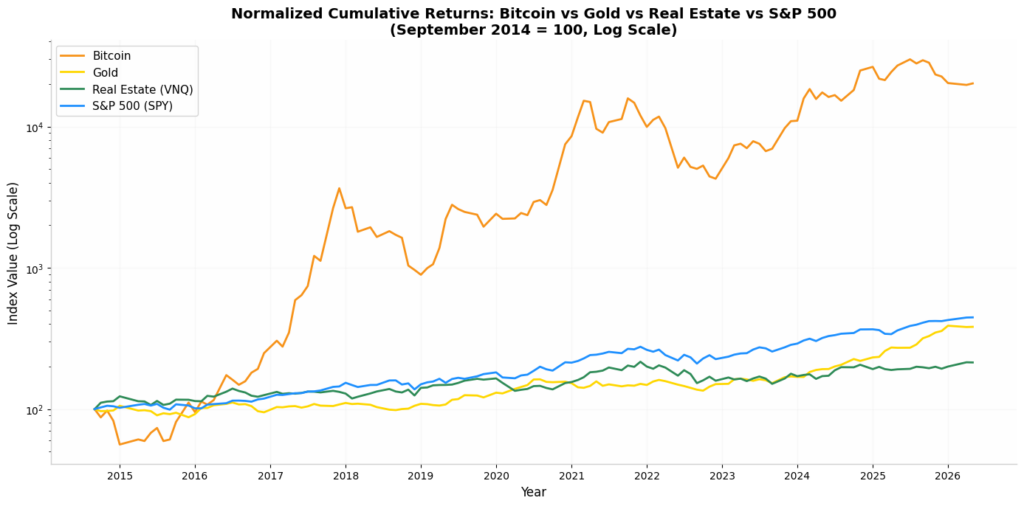
As of Monday, May 4, 2026, Bitcoin was trading around $80,403, while SPY traded around $717.84 and VNQ around $95.30 according to current market data.
Those prices matter less than the long-term pattern.
The key question is not where the assets trade today.
The key question is what kind of investor could survive each asset long enough to benefit.
The 3-Year Test: Bitcoin Can Win Big, But It Can Also Hurt
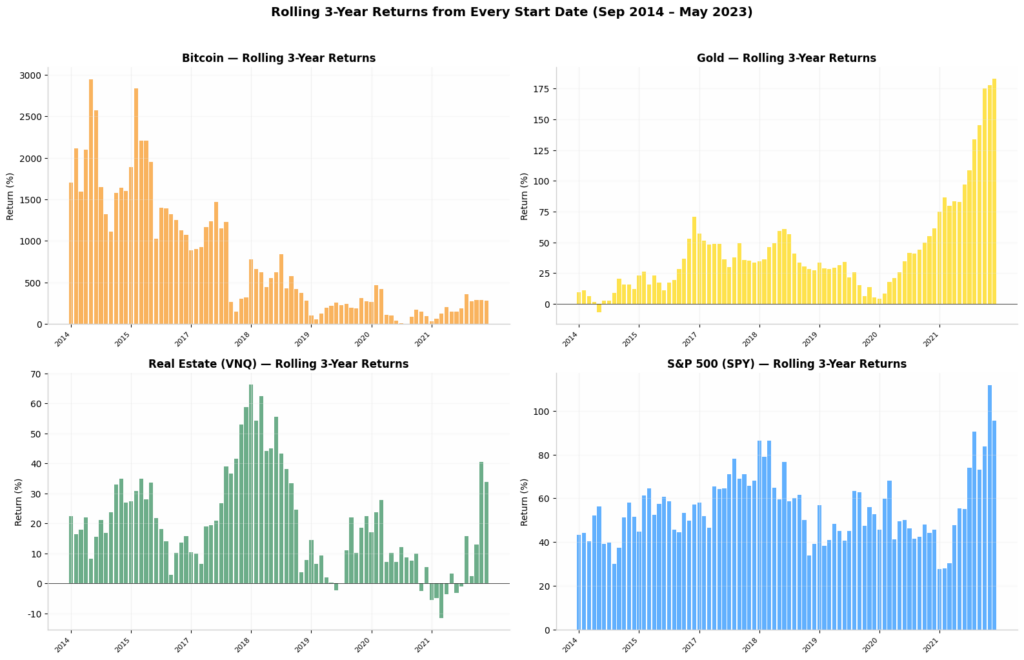
A three-year holding period is where Bitcoin is most dangerous.
Over some three-year windows, Bitcoin crushed every traditional asset.
Over others, especially when buyers entered near cycle peaks, Bitcoin delivered brutal drawdowns and underperformed safer assets for long stretches.
This is the first honest point Bitcoin bulls need to accept:
Bitcoin is not automatically superior over short time horizons.
If someone buys Bitcoin near a euphoric top and needs the money within three years, they may have a terrible experience.
The S&P 500 is far more forgiving over short and medium periods because it is diversified across hundreds of companies and supported by earnings, dividends, buybacks and institutional capital.
Gold can outperform during crisis windows.
Real estate can feel stable because private property is not priced every second. But listed REITs reveal that real estate can fall sharply when rates rise. VNQ’s annual total return history shows a large negative year in 2022, which lines up with the pressure higher rates placed on income-producing real estate assets.
3-Year Verdict
For a 3-year investor:
- Bitcoin: highest upside, highest emotional risk.
- S&P 500: best consistency.
- Gold: best crisis-specific hedge.
- Real estate: depends heavily on rates, leverage and location.
If your time horizon is only three years, Bitcoin should be treated carefully.
Not because it is bad.
Because it is violent.
The 5-Year Test: Bitcoin’s Case Becomes Much Stronger
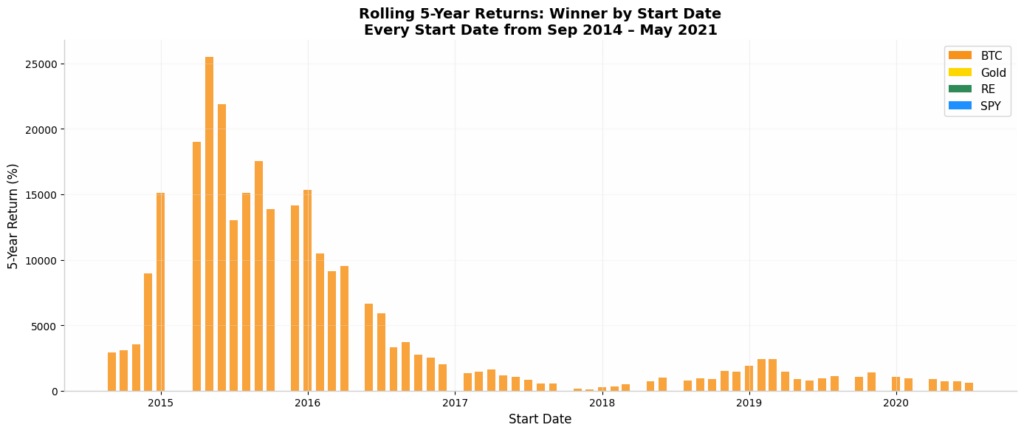
Five years is where Bitcoin’s historical case becomes far more difficult to dismiss.
The uploaded research argues that Bitcoin won every 5-year window in the dataset. That conclusion should be handled carefully because exact results depend on monthly data source, whether adjusted closes are used, the end date and whether returns are price-only or total-return adjusted.
But the broader point is credible:
Bitcoin’s historical performance improves dramatically when the holding period extends from three years to five years.
Why?
Because Bitcoin moves in cycles.
A buyer who enters near a top may suffer for two or three years. But historically, the next cycle recovery has often rewarded those who kept accumulating or simply refused to sell.
This is where Bitcoin becomes less like a normal trade and more like a psychological test.
The people who did best were not necessarily the smartest traders.
They were the people who:
- avoided leverage
- held through crashes
- did not lose their keys
- ignored panic headlines
- bought when sentiment was awful
- treated Bitcoin as a multi-cycle asset
The S&P 500 remains much smoother over five-year windows.
Gold remains macro-dependent.
REITs and property-linked assets remain sensitive to interest rates.
But Bitcoin’s five-year historical record is the reason institutions can no longer laugh it out of the room.
The 10-Year Test: Bitcoin Dominated the Decade
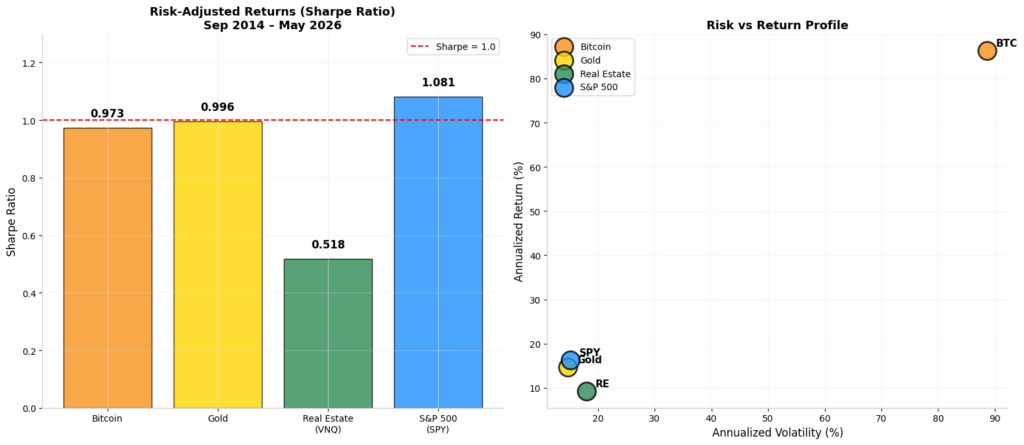
Over the last decade, Bitcoin was the clear winner by total return.
That statement is no longer controversial.
CoinGecko’s public comparison of Bitcoin versus traditional assets shows Bitcoin strongly outperforming major traditional assets over long-term horizons covered by its analysis.
But the important part is not just that Bitcoin won.
The important part is how it won.
Bitcoin won through:
- repeated 50%+ drawdowns
- exchange collapses
- regulatory attacks
- media obituaries
- mining bans
- liquidity crashes
- leverage wipeouts
- retail capitulation
- institutional disbelief
- multiple “Bitcoin is dead” cycles
The asset did not win because it was stable.
It won because its adoption curve, scarcity and monetary premium expanded faster than the market’s ability to price it.
The S&P 500 also had a strong decade. That should not be dismissed. A diversified US equity investor did extremely well by historical standards, especially with dividends reinvested.
Gold preserved value and performed well during specific stress periods.
Real estate rewarded certain owners, especially those with cheap leverage and good locations. But liquid listed real estate did not match Bitcoin or the S&P 500 over the full cycle.
10-Year Verdict
- Bitcoin won the return race.
- The S&P 500 won the reliability race.
- Gold won the insurance race.
- Real estate won the utility-and-leverage race for the right buyers.
That is the honest framing.
Risk-Adjusted Returns: The Number That Changes the TradFi Conversation
Traditional investors often say:
“Bitcoin’s returns do not matter because the volatility is insane.”
That sounds sophisticated, but it is incomplete.
Volatility matters. But volatility is not the only measure of risk.
If an asset is extremely volatile but returns far more than enough to compensate for that volatility, its risk-adjusted performance can still be attractive.
This is where the Sharpe ratio becomes important.
The Sharpe ratio measures return per unit of volatility.
The uploaded dataset suggests Bitcoin’s Sharpe ratio was competitive with gold and the S&P 500 over the full period, despite much higher volatility. Fidelity Digital Assets has similarly argued that Bitcoin’s volatility must be analyzed alongside its unusually high returns, not treated as a standalone reason for dismissal.
This does not make Bitcoin low-risk.
It means Bitcoin’s risk was historically rewarded.
That distinction matters.

Why Volatility Is Not Always the Enemy
For a trader, volatility can destroy.
For a forced seller, volatility can destroy.
For a leveraged investor, volatility can destroy.
But for a long-term holder with no leverage and secure custody, volatility can also be the price of outsized returns.
That is the Bitcoin tradeoff.
You do not get Bitcoin’s upside without Bitcoin’s pain.
Sortino Ratio: Why Upside Volatility Should Not Be Punished Like Downside
The Sharpe ratio treats upside and downside volatility similarly.
But many investors do not hate upside volatility.
They hate losses.
That is why the Sortino ratio can be useful. It focuses more on downside volatility.
The uploaded research suggests Bitcoin’s Sortino ratio may compare even more favorably because Bitcoin’s upside months have historically been enormous.
This fits the lived experience of Bitcoin investors.
Bitcoin’s bad months are brutal.
But its good months can redefine the entire return profile.
That is why trying to trade in and out can be so dangerous.
Missing a handful of Bitcoin’s strongest upside days can dramatically reduce long-term returns.
Bitcoin rewards presence.
Not perfection.

Correlation: Is Bitcoin Digital Gold or a Leveraged Tech Stock?
The most honest answer is:
Sometimes neither. Sometimes both.
Bitcoin’s correlation profile changes by regime.
2014 to 2019: Mostly Uncorrelated
In the earlier period, Bitcoin was still largely a crypto-native asset.
It moved based on:
- halving cycles
- exchange adoption
- regulatory news
- internal liquidity
- early retail speculation
- crypto-native narratives
It was not yet fully integrated into institutional portfolios.
March 2020: Everything Sold Off
During the COVID liquidity crisis, almost everything sold off.
Bitcoin fell.
Stocks fell.
Gold was not perfectly immune.
Investors sold what they could sell.
This is what happens during liquidity shocks.
Correlations often rise because investors are not optimizing portfolios. They are raising cash.
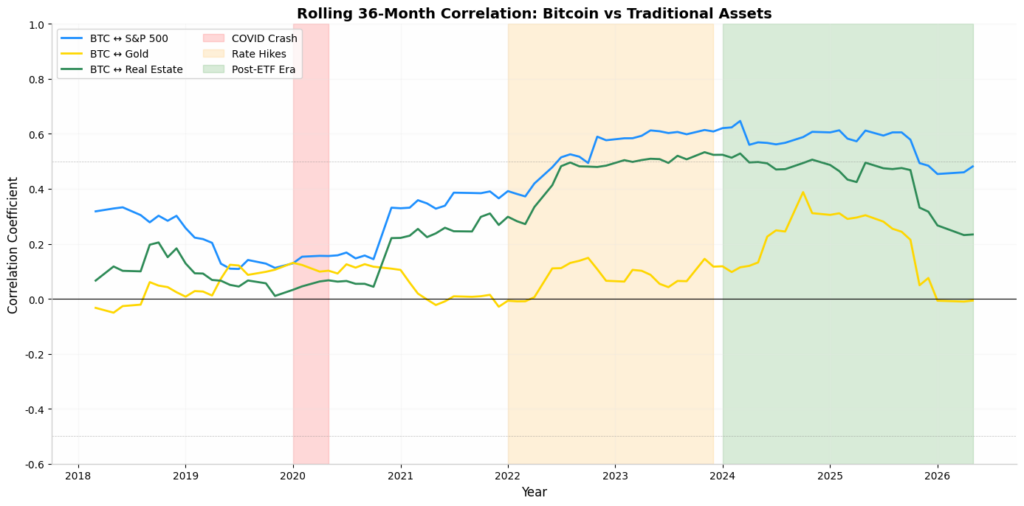 2021 to 2023: Bitcoin as High-Beta Risk Asset
As institutional products, leverage, listed miners and macro trading entered crypto, Bitcoin increasingly behaved like a high-beta risk asset during parts of the cycle.
When liquidity was abundant, Bitcoin soared.
When rates rose and risk appetite collapsed, Bitcoin suffered.
Reuters has reported that Bitcoin’s volatility has become more tied to macro conditions as retail and institutional participation deepened.
2024 to 2026: The ETF and Institutional Regime
The spot Bitcoin ETF era changed the market structure.
Bitcoin became easier for traditional investors to access. That increased legitimacy, but it also connected Bitcoin more deeply to portfolio flows.
Fidelity’s 2026 “Getting Off Zero” research captures the institutional shift: the question is no longer simply whether Bitcoin should be considered, but what allocation is justified and why.
Correlation Verdict
Bitcoin is not a perfect hedge.
It is not just digital gold.
It is not just a tech stock.
The best description is:
Bitcoin is a high-volatility monetary growth asset with hedge-like properties during specific banking, currency and sovereign-risk events.
That is less catchy than “digital gold.”
But it is more accurate.

Inflation-Adjusted Returns: The Rich-World Blind Spot
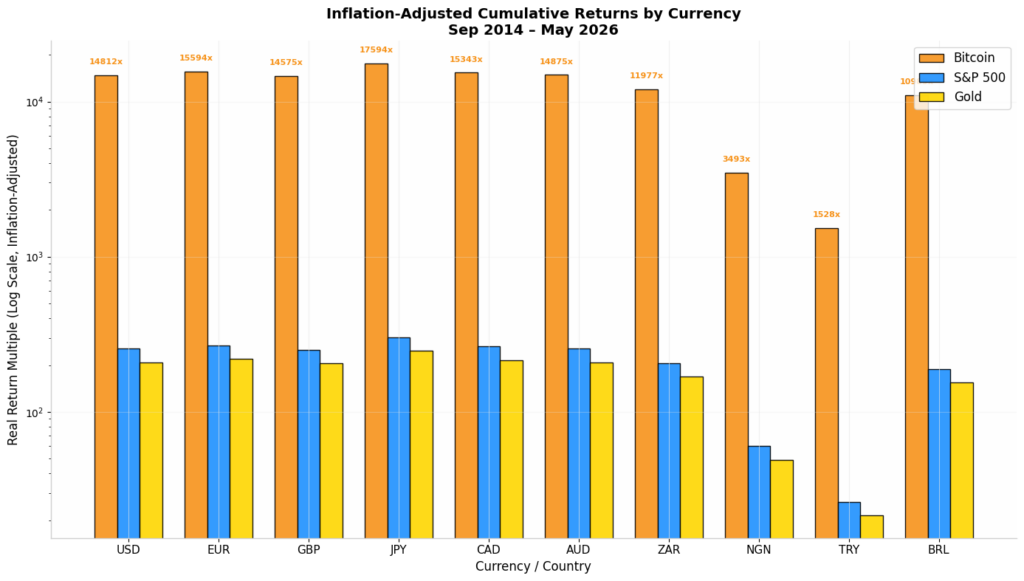
Most comparisons are measured in US dollars.
That is useful, but incomplete.
If you live in the United States, the dollar is the measuring stick.
If you live in Nigeria, Turkey, Argentina, South Africa or Brazil, the dollar is part of the story.
A US investor asks:
“Did Bitcoin beat the S&P 500?”
A Nigerian saver may ask:
“Did Bitcoin or stablecoins help me escape naira debasement?”
A Turkish saver may ask:
“Did Bitcoin protect me better than lira cash?”
A South African investor may ask:
“Did Bitcoin outperform rand weakness and local asset stagnation?”
These are different questions.
The uploaded research correctly identifies this as one of the most important Decentralised News angles: measuring returns only in USD creates a rich-world bias.
Why This Matters for Emerging Markets
In emerging markets, Bitcoin is often not just an investment.
It can be:
- a savings escape
- a dollar-access bridge
- a remittance tool
- a self-custody asset
- a hedge against local policy failure
- a way to access global markets
Gold can also serve some of these functions.
But Bitcoin is digital, portable, divisible and easier to move across borders.
That is why Bitcoin’s role in emerging markets is different from its role in a US brokerage account.

South Africa: Bitcoin vs the Rand
For South Africans, Bitcoin has to be compared against the rand, not only against the S&P 500.
The rand has experienced long-term weakness against the dollar, and local investors often look for ways to diversify offshore.
Bitcoin is not a clean substitute for offshore equities. It is far more volatile.
But it offers three things many South African investors care about:
- global liquidity
- self-custody
- non-rand exposure
For beginners, local access matters.
Decentralised News route for South African users:
- Luno for simple ZAR onboarding — code MJV6YD
- VALR for broader local trading — code VAZP2TAW
- Binance for global liquidity — code CPA_00SXKU7IO9
- Bybit for active trading access — code 46164
- Ledger or Trezor for long-term custody
Nigeria: Bitcoin, Stablecoins and Naira Survival
Nigeria is one of the clearest examples of why Bitcoin and stablecoins cannot be understood only as speculative assets.
For many Nigerian users, the first step is not Bitcoin.
It is USDT.
Stablecoins preserve dollar purchasing power. Bitcoin adds long-term upside.
That distinction is crucial.
For a Nigerian user facing naira instability, the asset stack may look like:
- USDT for short-term savings and payments
- Bitcoin for long-term upside
- P2P exchanges for liquidity
- hardware wallets for larger balances
Decentralised News route for Nigerian users:
- Binance P2P — code CPA_00SXKU7IO9
- Bybit P2P — code 46164
- MEXC for altcoin and low-fee access — code 16yJL
- Ledger or Trezor for self-custody
Turkey: Bitcoin vs the Lira
Turkey has shown why monetary instability can push ordinary people toward alternative assets.
Gold has long been culturally important in Turkey.
Bitcoin adds a digital alternative.
The lira’s weakness makes Bitcoin’s volatility look different to Turkish savers. In a stable currency, Bitcoin’s drawdowns feel extreme. In a weakening currency, the local-currency upside can look far more compelling over long horizons.
This does not remove risk.
But it changes the comparison.

Real Estate: The Asset Everyone Understands, But Few Measure Honestly
Real estate is emotionally powerful because it feels real.
You can live in it.
You can rent it.
You can borrow against it.
You can pass it down.
But real estate has hidden costs.
- transfer duties
- legal fees
- maintenance
- property taxes
- insurance
- vacancy
- tenant risk
- repairs
- illiquidity
- interest-rate exposure
Private property also hides volatility because it is not priced every second.
If your house had a live order book like Bitcoin, many homeowners would discover that real estate is not as stable as it feels.
Listed real estate proxies like VNQ show this more clearly. VNQ’s objective is to track a broad US real estate index, which makes it useful for liquid comparison, but it still cannot capture the full complexity of private property ownership.

Real Estate Verdict
Real estate is excellent for:
- utility
- rent
- leverage
- local wealth building
- long-term family assets
Bitcoin is better for:
- liquidity
- portability
- scarcity
- self-custody
- global access
- asymmetric upside
They are not enemies.
They are different tools.
Gold: The Asset That Refuses to Die
Every cycle, someone declares gold dead.
They are usually wrong.
Gold is not exciting.
Gold is not productive.
Gold does not innovate.
Gold does not generate cash flow.
But gold survives.
That is its job.
Gold is most useful when investors distrust:
- currencies
- banks
- governments
- central banks
- geopolitical stability
- debt sustainability
Bitcoin may be the more explosive asset, but gold remains the conservative monetary hedge.
The right comparison is not “Bitcoin killed gold.”
The better comparison is:
Gold is old-world monetary insurance. Bitcoin is new-world monetary convexity.
A serious investor can understand both.

S&P 500: The Boring Machine That Keeps Winning
The S&P 500 remains one of the greatest wealth-building engines ever created.
It gives investors exposure to the biggest public companies in the United States.
It benefits from:
- corporate earnings
- dividends
- productivity
- buybacks
- innovation
- liquidity
- global capital flows
It is far less volatile than Bitcoin and far more diversified.
For most ordinary investors, the S&P 500 remains easier to hold than Bitcoin because it does not crash 70% as often and does not require self-custody.
That is why this comparison should not become childish.
Bitcoin winning the return contest does not make the S&P 500 bad.
It means Bitcoin had a more explosive decade.
The S&P 500 is still the benchmark.
Bitcoin is the challenger.
Portfolio Modeling: What Happens When You Add Bitcoin?
The practical question is not whether Bitcoin should replace everything.
For most people, it should not.
The real question is:
What happens when Bitcoin becomes part of a diversified portfolio?
The uploaded research models 5%, 10% and 20% Bitcoin allocations and finds that Bitcoin improved portfolio returns and risk-adjusted performance over the tested period.
Other market research has reached similar conclusions. MarketWatch summarized WisdomTree research showing that adding a 5% Bitcoin allocation to a traditional 60/40 portfolio increased return while only slightly increasing volatility.
0% Bitcoin
This is the traditional portfolio.
It avoids Bitcoin volatility but also misses Bitcoin upside.
In 2014, 0% Bitcoin was normal.
In 2026, 0% Bitcoin is a statement.
5% Bitcoin
This is the asymmetric allocation.
If Bitcoin fails, portfolio damage is limited.
If Bitcoin succeeds, portfolio upside improves meaningfully.
This is the allocation range many cautious investors understand first.
10% Bitcoin
This is a conviction allocation.
Bitcoin becomes visible in portfolio performance.
The investor must be willing to rebalance and survive drawdowns.
20% Bitcoin
This is no longer a small satellite allocation.
Bitcoin becomes a major driver of portfolio returns and volatility.
This may be suitable only for investors with high conviction, long time horizons and emotional discipline.

Decentralised News Allocation Framework
This is not financial advice. It is an educational framework.
Beginner
Bitcoin allocation: 1% to 3%
Goal: learn the asset without emotional damage.
Best route: Binance, Luno, Kraken, OKX, Ledger.
Balanced Investor
Bitcoin allocation: around 5%
Goal: asymmetric upside without portfolio domination.
Best route: Binance, Bybit, OKX, Kraken, Ledger.
High-Conviction Investor
Bitcoin allocation: around 10%
Goal: meaningful long-term monetary exposure.
Best route: Binance, Bybit, OKX, Ledger, CoinLedger, TradingView.
Aggressive Investor
Bitcoin allocation: 20%+
Goal: Bitcoin as a core wealth thesis.
Warning: this can be emotionally brutal and should not be treated casually.

The Tools: Where to Buy, Store and Track Bitcoin
Best Exchanges for Bitcoin Access
Binance
Best for global liquidity, broad crypto access and P2P markets.
Code: CPA_00SXKU7IO9
Bybit
Best for active traders, global users and derivatives access after spot buying.
Code: 46164
OKX
Best for exchange access plus Web3 wallet functionality.
Code: 2136301
Kraken
Best for regulation-conscious users and long-term spot buyers.
MEXC
Best for low-fee traders and altcoin access after a Bitcoin base is established.
Code: 16yJL
Best Custody Tools
Ledger
Best for long-term self-custody and reducing exchange counterparty risk.
Trezor
Another trusted hardware wallet option for Bitcoin and broader crypto storage.
Best Charting Tool
TradingView
Useful for comparing Bitcoin, gold, SPY, VNQ, macro indicators and currency charts.
Best Tax Tracking
CoinLedger
Useful for tracking Bitcoin buys, sales, transfers and exchange activity.
The Honest Objections
“Bitcoin Is Too Volatile”
True.
Bitcoin is extremely volatile.
That is why position sizing matters.
The right response to Bitcoin volatility is not necessarily “avoid it.”
It is:
- do not overallocate
- do not use leverage
- do not invest money needed soon
- do not hold on unsafe exchanges
- do not panic during normal Bitcoin drawdowns
“Bitcoin Has No Cash Flow”
True.
Bitcoin does not produce cash flow.
Neither does gold.
Bitcoin’s value comes from monetary properties: scarcity, portability, censorship resistance, settlement finality and network adoption.
That makes it different from stocks and real estate.
It should be valued differently.

“The Next Decade Cannot Match the Last”
Probably true.
Bitcoin is now much larger than it was in 2014.
Future percentage returns are likely to be lower than early-cycle returns.
But lower does not mean irrelevant.
If Bitcoin matures into a global collateral and reserve-style asset, even lower future returns may still beat many traditional alternatives.
“Regulation Could Hurt Bitcoin”
Yes.
Regulation matters.
But the approval of spot Bitcoin ETFs and increasing institutional involvement make the regulatory landscape very different from earlier cycles.
Bitcoin is no longer an internet experiment ignored by finance.
It is a global asset class institutions must now explain, include or deliberately reject.
The Final Verdict: The Most Honest Comparison
Bitcoin
Bitcoin won the decade by absolute return.
It also caused the most pain.
It was the best asset for long-term holders and the worst asset for impatient tourists.
Bitcoin rewards conviction and punishes leverage.
S&P 500
The S&P 500 remains the best traditional compounder.
It is diversified, liquid, institutionally accepted and easier to hold emotionally.
For many investors, it remains the core.
Gold
Gold remains insurance.
It did not beat Bitcoin as a growth asset, but it still matters when trust breaks.
Gold is not dead.
It is just not designed to behave like Bitcoin.
Real Estate
Real estate remains powerful when bought well, financed sensibly and held long term.
But it is not as liquid or simple as many people think.
Real estate builds wealth slowly. Bitcoin builds and destroys paper wealth violently.
Different assets. Different jobs.

Final Conclusion: Zero Bitcoin Is No Longer Neutral
The most important conclusion is not that everyone should buy Bitcoin.
The most important conclusion is that Bitcoin can no longer be dismissed honestly.
A zero Bitcoin allocation in 2014 was normal.
A zero Bitcoin allocation in 2026 is an active position.
It says:
Bitcoin will not keep maturing.
Bitcoin will not become a larger institutional asset.
Bitcoin will not remain relevant as digital scarcity.
Bitcoin will not matter in weak-currency countries.
Bitcoin will not compete with gold as a monetary hedge.
Bitcoin will not deserve a place in modern portfolios.
Maybe that view is right.
But it must now be defended.
Because the historical evidence is no longer dismissible.
Bitcoin beat gold.
Bitcoin beat listed real estate proxies.
Bitcoin beat the S&P 500 by total return.
Bitcoin beat weak currencies by absurd margins.
Bitcoin improved many historical portfolio models when sized correctly.
But it did all of this while testing every holder’s emotions.
That is the truth.
Bitcoin was not the safest asset.
It was the most rewarding asset for those who survived it.
The next decade will not look like the last.
But the serious allocation era has begun.
FAQ
Did Bitcoin outperform gold, real estate and the S&P 500?
Yes. Over long-term periods in the last decade, Bitcoin dramatically outperformed major traditional assets by total return, although it also had much higher volatility and deeper drawdowns.
Is Bitcoin safer than the S&P 500?
No. Bitcoin is far more volatile. The S&P 500 is more diversified and historically easier for ordinary investors to hold through downturns.
Is gold still useful if Bitcoin exists?
Yes. Gold remains useful as monetary insurance. Bitcoin offers more upside but much higher volatility.
Is real estate better than Bitcoin?
It depends on the goal. Real estate offers utility, rent and leverage. Bitcoin offers liquidity, portability, scarcity and self-custody.
What Bitcoin allocation makes sense?
There is no universal answer. Historically, small allocations such as 1% to 5% gave investors Bitcoin exposure without making it dominate the whole portfolio. Higher allocations require stronger conviction and risk tolerance.
Should beginners buy Bitcoin?
Beginners should learn first, start small, avoid leverage, use trusted exchanges and move meaningful balances to secure wallets. Bitcoin is volatile and should never be treated as guaranteed profit.
Affiliate Disclosure
Decentralised News may receive compensation when readers register, deposit, trade or purchase through links and codes mentioned in this article. This does not affect our editorial analysis. This article is for educational purposes only and does not constitute financial advice. Bitcoin, crypto assets, stocks, gold and real estate all involve risk. Past performance does not guarantee future results. Always do your own research and consult a qualified professional where needed.
Recommended reading:
How to buy Bitcoin in 2026: the complete beginner’s guide by country
Lowest Crypto Futures Fees in 2026: Every Major Exchange Ranked and Calculated
Best Crypto Sign-Up Bonuses and New User Rewards in 2026
Best Crypto Futures Trading Competitions in 2026: Where Active Traders Can Earn Rewards
Best Crypto Exchanges for Beginners (2026)
The Best Crypto Exchanges for Beginners in 2025
How to Buy Bitcoin in Every Country (Ultimate 2026 Global Guide)