

Can You Really Make $1,000/Month From Crypto in 2026?
Every crypto passive income guide lists strategies but never publishes the real numbers. This one does: actual APY, honest capital requirements, and the real monthly income each strategy generates at current rates — including tax treatment in South Africa, UK, Australia, and the US.
Quick summary
Generating $1,000 per month from crypto in 2026 is achievable through seven distinct strategies that vary dramatically in capital requirement, effort, and risk. The most honest ranking: funding rate farming is the highest-yield market-neutral strategy at 10–80% APY depending on market conditions, requiring approximately $15,000–$120,000 in capital to generate $1,000/month, but demands active management and technical knowledge. Stablecoin lending on platforms like Bybit and Aave generates 4–9% APY with the lowest risk of any strategy, requiring $133,000–$300,000 to produce $1,000/month — realistic only for well-capitalised holders. ETH staking at 2.8–3.5% APY requires approximately $343,000–$430,000 at current ETH prices to generate $1,000/month, making it impractical as a standalone income strategy at moderate capital levels. For traders with under $25,000, the two realistic paths to $1,000/month are copy trading (following high-performing signal providers on Bybit or BloFin, targeting 5–15% monthly returns with 10–20% portfolio risk) and options premium selling (systematic covered calls on BTC and ETH on Deribit, targeting 2–4% per month from premium decay). Crypto affiliate publishing — building and monetising a crypto content operation — is the only strategy where income potential scales without proportional capital increase, though it requires significant time investment upfront. Tax treatment varies significantly by jurisdiction: staking rewards are taxed as ordinary income in the US, UK, and Australia when received; South Africa’s SARS treats most crypto income as revenue subject to progressive income tax rates.

The honest framing most guides avoid
Type “crypto passive income” into any search engine and you will find an ocean of articles claiming you can “earn thousands per month” with strategies that require either massive capital (staking ETH at 3% APY), unrealistic market conditions (DeFi farming at unsustainable promotional rates), or active management that is not passive by any honest definition.
This article is different in one specific way: it publishes the actual capital requirement for each strategy at current market rates, in May 2026, to generate $1,000 per month. Some of those numbers will surprise you. Some will disappoint you. All of them are real.
The $1,000 per month target was not chosen arbitrarily. It is the most searched personal finance aspiration in the passive income category globally, and it represents a meaningful income supplement for most people — covering rent, a loan repayment, or a significant fraction of monthly expenses. It is also a target that is genuinely achievable through crypto in 2026, through specific strategies and with specific capital levels.

Here is the full picture.
The master ranking table
Before diving into each strategy, the summary table gives the complete picture across all seven dimensions that determine which strategy is right for your situation.
|
Strategy |
Realistic APY / monthly return |
Capital for $1K/month |
Effort |
Risk level |
Best platform |
|
1. ETH/SOL staking |
2.8–7.5% APY |
$160K–$430K |
Very low |
Low |
Bybit · Kraken |
|
2. Stablecoin lending |
4–9% APY |
$133K–$300K |
Very low |
Low-medium |
Bybit · Binance · Aave |
|
3. Funding rate farming |
10–80% APY |
$15K–$120K |
Medium-high |
Low-medium |
BloFin · Bybit · Binance |
|
4. Copy trading |
5–15% monthly target |
$7K–$20K |
Low-medium |
Medium-high |
Bybit · BloFin · BingX |
|
5. Options premium selling |
2–4% monthly |
$25K–$50K |
Medium |
Medium |
Deribit · OKX |
|
6. Liquidity provision |
5–20% APY |
$60K–$240K |
Medium |
Medium |
gTrade · Aave · Curve |
|
7. Crypto affiliate publishing |
Revenue-based |
Low ($0–$5K) |
Very high |
Low |
All exchanges |
Capital requirements calculated at May 2026 rates. All figures represent estimates for planning purposes, not guarantees. Crypto income is variable and subject to market conditions.

Strategy 1: ETH and SOL staking — the safest yield, the highest capital requirement
What it is: Proof-of-stake networks pay validators and delegators for locking tokens to secure the network. You lock your ETH or SOL, earn newly issued tokens and transaction fees, and receive rewards periodically.
The real numbers:
The Compass Staking Yield Reference Index (STYETH) — the institutional benchmark derived directly from Ethereum consensus node data — recorded an annualised daily staking yield of 2.8329% APY as of May 1, 2026. Retail yields span from roughly 2.1% (Coinbase cbETH, after fees) to approximately 5% for solo validators using MEV-boost. Liquid staking via Lido charges around 10% of rewards as a fee, producing effective yields of approximately 2.5–3.2% APY for most users.
Solana staking via native delegation yields approximately 7.0% APY, while Jito MEV-boosted validators push APY toward 7.5–9% by capturing maximal extractable value and distributing it to stakers. However, Solana’s current inflation rate is approximately 5.5% and declining, meaning real yield after inflation is approximately 1.5–2% for SOL stakers holding in SOL terms.
Capital required for $1,000/month:
At 3% ETH staking APY: $1,000/month = $12,000/year ÷ 0.03 = $400,000 in ETH required. At current ETH prices of approximately $2,400, that is approximately 167 ETH.
At 7.5% SOL staking APY: $1,000/month = $12,000/year ÷ 0.075 = $160,000 in SOL required. At current SOL prices near $88, that is approximately 1,818 SOL.
The capital requirement for staking to generate $1,000 per month is substantial. This strategy is appropriate for long-term ETH or SOL holders who want to generate yield on positions they would hold regardless, not for investors seeking income from fresh capital deployment.
The honest limitation: Staking yield is denominated in the staked asset, not in dollars. If you stake 167 ETH and earn 5 ETH in staking rewards over a year, your $12,000 in reward income is only $12,000 if ETH holds its price. A 50% ETH price decline reduces the dollar value of your staking income by 50% regardless of the APY percentage. The staking yield is real; the dollar income is variable.
Best platforms:
Bybit — code 46164: Bybit’s staking product covers ETH, SOL, BNB, ADA, and DOT with flexible (no lock-up) and fixed-term options. Flexible ETH staking on Bybit currently yields approximately 3.0–3.5% APY, and the product integrates directly with the trading account for capital efficiency.

Kraken: Kraken’s staking covers 20+ assets with industry-leading regulatory transparency. ETH staking yields approximately 2.5–3.5% depending on the method chosen, with withdrawals processed within the standard exit queue timeline. Kraken’s regulatory standing makes it the preferred staking venue for US and European users with compliance considerations.

Binance — code CPA_00SXKU7IO9: Binance’s flexible ETH staking earns approximately 2.5–3% APY with instant unstaking, while fixed BETH products offer modestly higher rates.
Tax treatment: In the United States, staking rewards are treated as ordinary income at their fair market value when received — you owe income tax the moment rewards are credited, regardless of whether you sell them. In the UK, HMRC treats staking rewards as income taxable at the marginal income tax rate. In Australia, the ATO treats staking rewards as ordinary income. In South Africa, SARS treats staking rewards as gross income subject to normal income tax rates. Detailed records of every reward distribution — date, quantity, and market value at receipt — are essential in every jurisdiction.

Strategy 2: Stablecoin lending — predictable yield, no price exposure, serious capital required
What it is: You deposit USDT, USDC, or DAI into a lending protocol (centralised exchange earn products or decentralised protocols like Aave), and borrowers — primarily traders seeking leverage and arbitrageurs — pay you interest. Your principal remains in dollars. You receive dollar-denominated yield with no crypto price exposure.
The real numbers:
USDT offers the widest yield access — lending rates of 4–9% APY on major DeFi protocols and up to 8.5% on CeFi platforms like Ledn — driven by its unmatched $50 billion-plus daily trading volume and sustained borrowing demand. USDC supply rates on Aave V3 typically range from 3–5% APY depending on utilisation, while Morpho Blue vaults managed by risk curators push USDC toward 4–7% APY. Bybit leads overall among exchange earn products, offering competitive USDT and USDC APRs with flexible terms and a March 2026 Proof of Reserves report covering liabilities, ownership, and reserve calculation. Binance provides 3–7% on flexible stablecoin savings with fixed-term options reaching 12% for 90-day USDT commitments.
Using 6% as a realistic achievable rate across a diversified CeFi/DeFi stablecoin lending portfolio:
Capital required for $1,000/month:
$1,000/month = $12,000/year ÷ 0.06 = $200,000 in stablecoins required.
At 4% (conservative CeFi rate): $300,000 required. At 9% (aggressive DeFi/CeFi combination): $133,000 required.
The honest limitation: Stablecoin yield sources are not risk-free. CeFi platform risk (exchange insolvency, as occurred with Celsius and BlockFi) is real and requires using only platforms with verified Proof of Reserves. DeFi smart contract risk is present on all lending protocols, even battle-tested ones like Aave. Diversifying across 3–4 platforms reduces concentration risk. The $200,000 requirement also makes this strategy inaccessible to most retail investors as a standalone $1,000/month income source — it is more appropriate as a component of a larger crypto portfolio generating yield on idle capital.
The composability layer: The most sophisticated stablecoin yield strategy in 2026 is not depositing into a single platform — it is using liquid staking tokens as collateral in a lending loop. Example: stake ETH → receive stETH (earning 3% APY) → deposit stETH on Aave as collateral → borrow USDC at 4–5% → deposit borrowed USDC to earn 5–6% APY → net yield on original ETH capital = 3% (stETH) + 1–2% (USDC yield minus borrowing cost) = 4–5% blended with no additional capital deployed. This strategy amplifies yield but adds liquidation risk if ETH price falls significantly.

Best platforms:
Bybit — code 46164: Top-rated overall stablecoin yield platform with strong USDT and USDC flexible APRs and transparent PoR reporting.
Binance — code CPA_00SXKU7IO9: Largest stablecoin markets with over $20 billion in lending pools and deep liquidity.
Aave (self-custody, no referral required): USDC supply rates 3–5% APY on V3 Ethereum, Arbitrum, and Base. The protocol has operated with zero user fund losses for six-plus years.
Tax treatment: Interest earned from stablecoin lending is treated as ordinary income in the US, UK, and Australia when received. In South Africa, SARS treats stablecoin interest as income. Because stablecoin principal does not appreciate, the tax complexity is lower than for crypto-to-crypto strategies — but every interest payment is a taxable event requiring records.
Strategy 3: Funding rate farming — the highest-yield market-neutral strategy
What it is: Perpetual futures contracts use a funding rate — charged every 8 hours — to keep the perpetual price anchored to the spot price. During bull markets, when the perpetual trades at a premium to spot, long holders pay short holders. Funding rate farming exploits this by simultaneously holding long spot and short perpetual (a delta-neutral position), collecting the funding rate payment every 8 hours without directional price exposure.
The real numbers:
Funding rates are highly variable. In neutral market conditions, BTC funding rates average approximately 0.01–0.03% per 8-hour period across major exchanges — annualised, that is approximately 10.95–32.85% APY on the perpetual leg. During high-euphoria bull market conditions, sustained funding rates of 0.05–0.1% per period have been observed historically, producing annualised yields equivalent to 54.75–109.5% APY on the short perpetual leg. During bear markets or neutral sentiment, funding rates can go negative — meaning long perpetual holders receive payment, reversing the trade direction.
A realistic expectation for 2026, averaging across market conditions: 15–30% APY on a consistently managed funding rate farming portfolio.
Capital required for $1,000/month:
At 20% average APY: $1,000/month = $12,000/year ÷ 0.20 = $60,000 required across spot and perpetual positions.
At 10% average APY (conservative estimate): $120,000 required. At 40% average APY (elevated market activity): $30,000 required. At 80% APY (bull market peak conditions, not sustainable): $15,000 required.
How it works in practice: You hold 1 BTC on spot (or in stablecoins lending to reduce cost basis). You short 1 BTC worth of BTC-PERP on a perpetual exchange. The positions offset each other directionally — you are neither long nor short BTC. Every 8 hours, you collect the funding rate from long perpetual holders. The yield from the funding rate accrues to your account independent of whether BTC rises or falls.
The honest limitations: The position is not truly risk-free. Basis risk exists: if the perpetual and spot prices diverge significantly (the perpetual trades at a discount to spot), your delta-neutral position can produce a small loss even when the direction is flat. Exchange counterparty risk exists on the perpetual leg — you hold the spot position self-custody but the short perpetual is on a CEX. Funding rates can go negative, turning your income into a cost. The position requires periodic rebalancing as prices move.

Best platforms:
BloFin — code Decentralised: BloFin’s Unified Trading Account is ideal for funding rate farming because it allows the spot and perpetual position to share a single margin pool. Coinglass data shows BloFin frequently offering among the most competitive funding rates for altcoin perpetuals — where funding rates are higher and more volatile than BTC/ETH, increasing the yield potential for sophisticated operators.
Bybit — code 46164: Bybit’s UTA supports the delta-neutral strategy natively, and the Coinglass funding rate dashboard allows real-time monitoring of BTC, ETH, and altcoin funding across Bybit’s perpetual markets.
Binance — code CPA_00SXKU7IO9: The deepest perpetual liquidity ensures minimal slippage when opening and closing large delta-neutral positions.
Tax treatment: Funding rate payments received are generally treated as ordinary income in the US, UK, and Australia when credited. In South Africa, SARS treats these payments as revenue income. The frequent, small payments (every 8 hours) require automated record-keeping — a crypto tax platform like Coinledger is essential for tracking this volume of taxable events.

Strategy 4: Copy trading — the accessible path for under $25,000
What it is: Copy trading automatically replicates the positions of a selected signal provider. When the lead trader opens a position, your account opens the same position proportionally. When they close it, yours closes. You pay the signal provider a profit-share fee (typically 8–15% of your gains) and the exchange maker/taker fees on each copied trade.
The real numbers:
Copy trading returns are entirely dependent on the signal provider’s performance. Selecting well requires understanding the metrics that matter: profit factor (ratio of gross gains to gross losses), maximum drawdown (the largest peak-to-trough loss in the tracked period), win rate (percentage of profitable trades), trade frequency (how many trades per month), and AUM cap (how much total capital the signal provider is managing — large AUM can impact execution quality).
The top decile of signal providers across major copy trading platforms generate 5–20% monthly returns in favourable market conditions, with monthly drawdowns of 5–15%. The median signal provider performance is significantly worse. A realistic expectation for a well-selected signal provider: 5–10% monthly return with occasional 15–25% drawdown months.
Capital required for $1,000/month:
At 8% average monthly return: $1,000 ÷ 0.08 = $12,500 in copy trading capital required (before 10% profit-share fee, effective return approximately 7.2%, requiring $13,900).
At 5% average monthly return (conservative): $20,000 required. At 15% average monthly return (top performers, not sustainable): $6,700 required.
The honest limitations: Copy trading is the most psychologically demanding strategy for most users because you are experiencing drawdowns in real-time without understanding the trade thesis behind each position. A 20% drawdown on a copy trading account feels very different from an 20% drawdown on a staking position where you understand the mechanics. Chasing top performers on leaderboards — taking positions in providers whose recent performance was exceptional — is the most common mistake. Yesterday’s top performer is frequently next month’s worst performer. Select signal providers based on 6-plus month track records, not 30-day rankings.
Best platforms:
Bybit — code 46164: Bybit’s copy trading ecosystem is the most liquid for retail followers, with thousands of active signal providers across spot and futures markets. The performance metrics available for each provider are the most comprehensive of any exchange, including max drawdown by month and profit factor over 12-month windows.
BloFin — code Decentralised: BloFin’s copy trading integrates with its UTA, allowing signal providers to manage copy positions alongside their own book with full capital efficiency. The institutional derivatives focus attracts professional signal providers with higher average performance quality than pure retail copy trading platforms.
BingX — code F8XN1D: BingX has built its user acquisition primarily around copy trading and offers the most beginner-accessible onboarding for followers. The lower minimum investment threshold — you can start copy trading with as little as $100 — makes it appropriate for testing the strategy before committing larger capital.
Tax treatment: Copy trading gains are capital gains in most jurisdictions — each position closed by the signal provider on your behalf is a taxable disposal. In the US, UK, Australia, and South Africa, short-term trades (held under 12 months) are taxed as ordinary income. Long-term gains receive preferential treatment in some jurisdictions but copy trading rarely produces long-duration positions. The profit-share paid to signal providers is a cost deductible against your trading gains in most jurisdictions.

Strategy 5: Options premium selling — the professional yield strategy
What it is: Selling options means accepting the obligation to buy or sell an asset at a specified price. You collect the premium immediately when you sell the option. If the option expires worthless (the most common outcome for out-of-the-money options), you keep the entire premium. This strategy generates consistent income from time decay (theta) — the daily erosion of option value as expiry approaches.
The real numbers:
The two most accessible options premium strategies for retail traders are covered calls on BTC or ETH holdings (selling call options against long spot positions, targeting 2–4% monthly premium income) and cash-secured puts (selling put options below the current price, earning premium while offering to buy the asset at a lower price).
A systematic covered call strategy on BTC selling weekly at-the-money calls on Deribit typically generates 2–4% in premium per month during normal implied volatility environments. The breakeven is more nuanced than it appears: selling a call cap your upside — if BTC rallies strongly in a given week, you miss gains above the strike price while still bearing the downside.
Capital required for $1,000/month:
At 3% monthly premium target: $1,000 ÷ 0.03 = $33,300 in BTC or ETH required to sell covered calls against.
At 2% (low volatility environment): $50,000 required. At 4% (elevated IV): $25,000 required.
The honest limitations: Options selling is not passive income. Each week’s expiry requires an active decision about strike selection, expiry choice, and whether to roll the position. During strongly trending markets (either direction), covered calls either limit upside gains (in bull markets) or fail to generate enough premium to offset spot losses (in severe bear markets). This is a strategy that generates consistent income in ranging to mildly trending markets and underperforms in strong directional moves.
Best platforms:
Deribit: Deribit processes the majority of global BTC and ETH options volume and offers the deepest liquidity, tightest spreads, and widest range of strikes and expiries. For options premium selling strategies, Deribit’s liquidity advantage is non-negotiable — executing on a thin-book exchange destroys the strategy’s edge through wide spreads.

OKX — code 2136301: OKX’s options market is the second most liquid after Deribit and covers a broader range of altcoin options for traders who want to extend the premium-selling strategy to ETH, SOL, or BNB.
Tax treatment: Options premium received at sale is a taxable event in the US (ordinary income on short-term options). In the UK and Australia, options premium selling is generally treated as capital gains. South Africa’s SARS treats options trading gains as capital gains or revenue income depending on frequency of trading — traders operating a systematic premium-selling strategy may be classified as trading, attracting income tax rates rather than capital gains treatment.

Strategy 6: Liquidity provision — earning yield on trading pairs
What it is: Decentralised exchanges require pools of token pairs (e.g., USDC/ETH, BTC/USDT) to enable trading. Liquidity providers deposit both tokens in a pool and earn a share of every trading fee generated by that pair. The yield comes from trading activity — not from the protocol issuing new tokens.
The real numbers:
Stablecoin-to-stablecoin liquidity provision (USDC/USDT pairs on Curve, for example) generates 2–8% APY from fees alone — low impermanent loss risk since both assets hold the same dollar peg. Volatile pair provision (ETH/USDC, BTC/USDC) generates higher fee income (5–20% APY on high-volume pairs) but introduces impermanent loss risk, which can erode returns when the asset ratio diverges significantly.
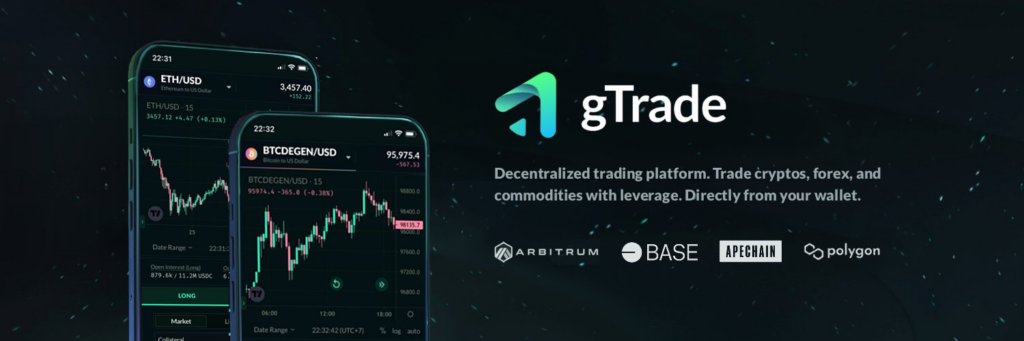
gTrade vault returns are variable. The previously quoted USDC APY is not a verified current rate. Assess trader-PnL exposure, contract risk and withdrawal conditions before depositing.
Capital required for $1,000/month:
At 10% APY (mid-range stable pair LP): $1,000/month = $120,000. At 15% (gTrade-style fee vault): $80,000. At 20% (aggressive volatile pair LP with impermanent loss management): $60,000.
Best platforms:
gTrade: Liquidity provision is a separate product from trading. A USDC-denominated vault can lose value; it is not a guaranteed-income account.
Bybit — code 46164: Bybit’s Market Making product provides centralised exchange liquidity provision with yield from maker rebates and spread capture — a lower-complexity introduction to liquidity provision before moving to DeFi.
Tax treatment: DeFi liquidity provision income — whether from fee distributions or yield tokens — is generally treated as ordinary income in the US, UK, and Australia at the time of receipt. Token rewards distributed by protocols are taxed as income at the market value when received. Impermanent loss is not currently considered a taxable loss in most jurisdictions at the time it occurs, but is realised when you withdraw liquidity.

Strategy 7: Crypto affiliate publishing — the only strategy that scales without capital
What it is: Building a crypto content operation — articles, YouTube, newsletters, social media — and monetising it through affiliate commissions from exchange sign-ups and trading platform referrals. Every reader who registers on a crypto exchange using your referral link generates either a CPA payment ($30–$200+ per funded account) or lifetime revenue share (20–50% of trading fees generated by your referred users, indefinitely).
The real numbers:
A crypto publication generating 50,000 monthly visitors from high-commercial-intent keywords — “best crypto exchange,” “how to buy Bitcoin,” “lowest futures fees” — can realistically generate 200–500 funded account referrals per month across a diversified affiliate portfolio. At a blended CPA/rev-share equivalent of $30 per referred funded account, that is $6,000–$15,000 per month. At 200 active users each generating $30/month in rev-share commissions (a modest assumption for regular traders), the recurring monthly income is $6,000.
The $1,000/month threshold for crypto affiliate publishing requires approximately 30–40 funded account referrals per month — achievable with 5,000–15,000 monthly visitors to well-targeted content.
The honest picture: Crypto affiliate publishing is not passive income at the beginning. Building a publication to the traffic level required for consistent $1,000/month affiliate income requires 6–18 months of consistent content production, SEO investment, and audience development. The income is also variable — it depends on market conditions (bull markets drive far more sign-ups than bear markets) and on the specific keywords your content ranks for.
The scaling advantage is unique among all seven strategies: there is no capital ceiling. A publication generating 10 million monthly visitors earns proportionally more than one generating 100,000, with the incremental cost of serving additional readers approaching zero. No staking portfolio, lending position, or funding rate farm has this scaling characteristic.
Tax treatment: Affiliate income is treated as ordinary business income or self-employment income in the US, UK, Australia, and South Africa. It is not capital gains and is taxed at marginal income rates. Proper business structuring can enable deductions for content production costs, hosting, tools, and research expenses.

The compound strategy: how to reach $1,000/month with $25,000
For most readers, the question is not “which single strategy generates $1,000/month?” — it is “how do I reach $1,000/month with the capital I actually have?”
With $25,000 in starting capital in 2026, the realistic path to $1,000/month combines strategies that have different capital thresholds:
$5,000 → stablecoin yield on Bybit (6% APY = $25/month): Not income-generating at this scale, but building the habit and demonstrating real yield.
$10,000 → copy trading on Bybit or BloFin (targeting 8% monthly with top 20% signal provider = $800/month target with significant variability): The primary income driver at this capital level. Risk of significant drawdown in bad months.
$5,000 → funding rate farming on BloFin during elevated funding environments (15–30% APY = $62–$125/month): Generates income regardless of price direction when funding is positive.
$5,000 → stablecoin lending on Aave (5% APY = $21/month): The stable, low-risk component providing consistent monthly income regardless of trading results.
Combined monthly income at $25,000: $21 (stablecoin lending) + $62–$125 (funding rate farming) + variable copy trading target of $500–$1,200 = approximately $583–$1,346 per month.
The $1,000/month target is achievable at $25,000 capital through the copy trading component, but with significant monthly variance. The stable income components (lending, funding rate farming) provide approximately $83–$146/month regardless of copy trading performance.
The honest timeline: Most people who commit to this strategy — deploying capital thoughtfully, selecting signal providers rigorously, managing risk discipline — reach consistent $1,000+ months within 3–6 months. The obstacle is almost never capital adequacy once you are above $15,000. The obstacle is risk management: not blowing up the copy trading account through over-leverage or chasing drawdown recovery.
Tax summary table by jurisdiction
|
Strategy |
US (IRS) |
UK (HMRC) |
Australia (ATO) |
South Africa (SARS) |
|
ETH/SOL staking |
Ordinary income when received |
Income tax when received |
Ordinary income when received |
Revenue income when received |
|
Stablecoin lending |
Ordinary income when received |
Income tax when received |
Ordinary income when received |
Revenue income |
|
Funding rate payments |
Ordinary income |
Income tax |
Ordinary income |
Revenue income |
|
Copy trading gains |
Short-term capital gains (income rates) |
Capital gains tax |
Capital gains (CGT discount after 12 months) |
Capital gains or revenue depending on activity frequency |
|
Options premium |
Ordinary income (short-term) |
Capital gains |
Capital gains |
Revenue or capital depending on frequency |
|
LP yield |
Ordinary income when received |
Income tax |
Ordinary income |
Revenue income |
|
Affiliate income |
Self-employment income |
Income tax / business income |
Business income |
Revenue income |
This table is a general summary only. Tax treatment varies by individual circumstances and changes with regulation. Consult a tax professional in your jurisdiction before relying on any of the above.
For automated record-keeping across all seven strategies, Coinledger integrates directly with Binance, Bybit, OKX, Kraken, Aave, and most other platforms to auto-categorise every taxable event and generate jurisdiction-specific tax reports.
FAQ
Which crypto strategy generates the most income with the least capital?
Copy trading on platforms like Bybit or BloFin offers the most income potential at capital levels below $25,000, because the return is percentage-based on a target that top signal providers can achieve at 5–15% per month. However, it also carries the highest monthly variance of any strategy in this guide. Funding rate farming is the second-best option for modest capital: $15,000–$30,000 can generate $150–$500/month in neutral-to-bull market conditions without directional price risk.
Is $1,000 per month from crypto realistic for most people?
With capital above $50,000, yes — through a combination of stablecoin yield, funding rate farming, and modest copy trading. With capital below $25,000, it is achievable only through copy trading with a skilled signal provider or through options premium selling with consistent execution. With capital below $10,000, crypto affiliate publishing is the most realistic path because it scales with effort rather than capital.
Are crypto passive income strategies taxable?
Yes, in virtually every jurisdiction. Staking rewards, lending interest, funding rate payments, copy trading gains, options premiums, LP yields, and affiliate income are all taxable events in the US, UK, Australia, and South Africa. The specific tax treatment — ordinary income versus capital gains — varies by strategy and jurisdiction. Records of every transaction, including amount, date, and USD value at receipt, are essential.
How risky is stablecoin lending compared to ETH staking?
Stablecoin lending carries no price exposure risk (your principal remains in dollars regardless of crypto market movements) but carries platform risk (exchange insolvency or smart contract exploit). ETH staking carries price exposure risk (your rewards are denominated in ETH, which can fall in dollar value) but avoids the specific smart contract risks of DeFi lending platforms. Diversifying across both strategies reduces overall risk while maintaining yield across different risk dimensions.
What is the minimum capital needed to start each strategy?
ETH staking: no minimum (liquid staking via Lido accepts any amount). Stablecoin lending: no minimum on Aave or Bybit Earn. Funding rate farming: approximately $5,000 minimum to generate meaningful returns versus transaction overhead. Copy trading: $100 minimum on BingX, $500 on Bybit, $1,000 on BloFin. Options premium selling: approximately $1,000 on Deribit. Liquidity provision: no minimum on DeFi platforms (though gas costs on Ethereum mainnet make positions below $5,000 economically inefficient). Affiliate publishing: essentially zero capital required — only time.
Where to start
Each of the following platforms supports one or more of the seven strategies in this article. Use the links below to register with the Decentralised News referral code applied automatically:
- Bybit — code 46164 — Staking · Stablecoin lending · Copy trading · Funding rate farming
- BloFin — code Decentralised — Funding rate farming (UTA) · Copy trading · Advanced derivatives
- Binance — code CPA_00SXKU7IO9 — Stablecoin lending · Staking · Funding rate farming
- Kraken — ETH staking · SOL staking · Regulated yield products
- BingX — code F8XN1D — Copy trading for beginners
- Deribit — Options premium selling
- gTrade — referral: decentralisednews — Liquidity provision (USDC vault)
- Coinledger — Tax reporting across all strategies
Decentralised News participates in affiliate programs with the exchanges and tools referenced in this article and earns commission when readers register and trade via our links. This does not affect editorial positions. All figures are estimates based on current market conditions and are subject to change. Cryptocurrency income strategies involve real financial risk including the potential loss of principal. None of the above constitutes financial advice. Consult a qualified financial and tax professional before implementing any of these strategies.
Recommended reading:
Bitcoin vs Gold vs Real Estate vs S&P 500: 10-Year Return Comparison
How to buy Bitcoin in 2026: the complete beginner’s guide by country
Lowest Crypto Futures Fees in 2026: Every Major Exchange Ranked and Calculated
Best Crypto Sign-Up Bonuses and New User Rewards in 2026
Best Crypto Futures Trading Competitions in 2026: Where Active Traders Can Earn Rewards
Best Crypto Exchanges for Beginners (2026)
The Best Crypto Exchanges for Beginners in 2025
How to Buy Bitcoin in Every Country (Ultimate 2026 Global Guide)





