Axiom.trade Review 2027: Memecoin Terminal, Hyperliquid Perps, Fees, MEV Protection and Risks
Axiom has evolved from a Solana-first memecoin terminal into a broader onchain trading interface combining token discovery, wallet and social tracking, high-speed execution, migration sniping, advanced orders, Hyperliquid perpetuals, prediction markets and yield. Its strongest advantage is speed and information density. Its biggest weakness is that the same interface makes ultra-high-risk assets dangerously easy to trade.
What Matters
Axiom is one of the most complete terminals for traders who live in fast-moving onchain markets. Pulse, wallet tracking, social monitoring, token-distribution filters, limit orders, migration sniping and configurable MEV protection compress discovery and execution into one screen. Hyperliquid extends the product into leveraged perpetuals. The trade-off is cost and risk: spot fees can approach 1% before rewards, priority fees and MEV bribes add more friction, and the assets Axiom is best at helping users trade are often the assets most capable of collapsing to zero.
DN Evidence Block
Primary evidence comes from Axiom's current homepage and live terminal, official docs for fees, referrals, Pulse, signup, MEV settings and Hyperliquid perps, Y Combinator's current company profile, Turnkey's Axiom case study and independent reporting on the February 2026 internal-access allegations.
The Signal
Axiom's real moat is not “memecoin trading.” It is decision compression. Discovery, token-structure analysis, wallet intelligence, social signals and execution happen in the same environment. That can reduce reaction time dramatically. It can also shorten the distance between impulse and irreversible onchain risk.
We deduct for comparatively high spot fees, heavy exposure to extreme-risk assets, documentation drift, limited Axiom-specific audit evidence and the February 2026 allegations involving misuse of internal user-wallet lookup tools.
What Is Axiom.trade?
Axiom is an onchain trading terminal founded by Henry Zhang and Preston Ellis and backed by Y Combinator's Winter 2025 batch. Y Combinator currently describes the business as a platform to trade memecoins, perpetuals and earn yield.
That summary understates how broad the product has become. Axiom now combines real-time token discovery, memecoin execution, migration sniping, limit orders, auto-strategies, wallet tracking, social and callout monitoring, token-distribution analysis, Hyperliquid perpetuals, prediction-market access and yield through external DeFi integrations.
The live 2026 terminal also exposes a broader “Unified” multi-chain interface, while parts of the documentation remain Solana-first. That creates a freshness gap we discuss later.
Who Built Axiom?
Y Combinator's current company profile identifies Henry Zhang as founder/CEO and Preston Ellis as founder/CTO. The company was founded in 2024 and joined YC's Winter 2025 batch.
The current YC profile says Axiom has reached roughly $10 million in monthly recurring revenue and $5 million in monthly net profit. Those figures are not audited public-company financials, so Decentralised News treats them as company-reported metrics published through YC.
Turnkey, Axiom's wallet-infrastructure provider, separately says Axiom has created more than 1 million user wallets, onboarded more than 100,000 users per month and passed $100 million in platform revenue within 100 days of the integration period described in its case study.
The exact periods differ, but they establish that Axiom is operating at meaningful scale.
Pulse: The Product That Explains Axiom
If you want to understand why active memecoin traders use Axiom, start with Pulse.
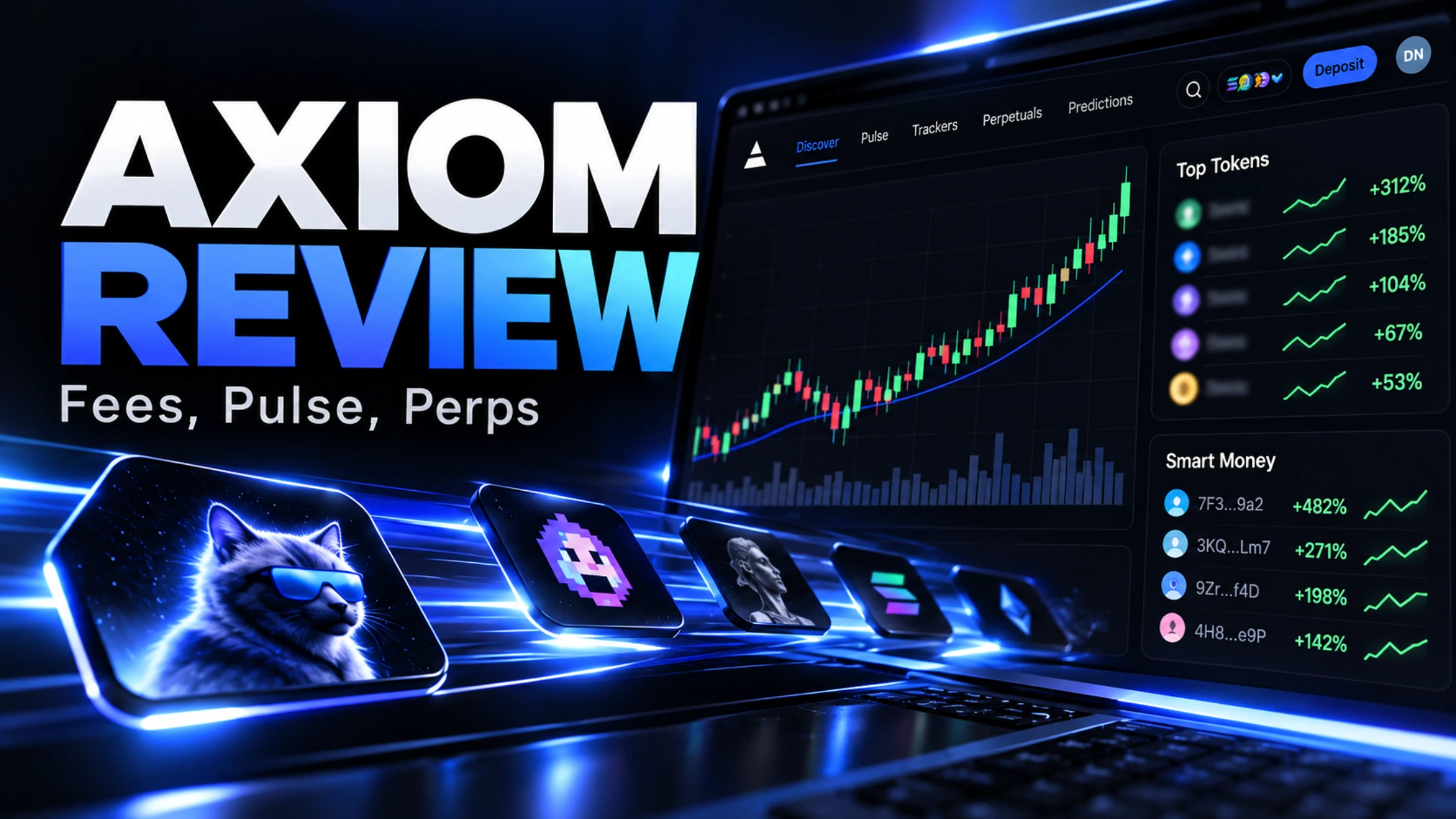
Pulse turns token discovery into a continuously updating trading surface. Current Axiom materials expose market cap, liquidity, volume, transaction count, holder count, top-holder concentration, developer holdings, sniper exposure, insider exposure, bundle exposure and wallet activity.
These are the right questions for assets that may have existed for minutes rather than years:
- Does the developer still control a dangerous share of supply?
- Did a cluster of wallets buy together?
- Are insiders heavily exposed?
- Does the pool have enough liquidity for my order?
- Are experienced wallets buying or merely transferring?
Axiom's advantage is that those risk signals sit next to execution.
The Bundle Checker Is More Important Than It Sounds
Axiom's current FAQ describes a Bundle Checker intended to identify coordinated purchases occurring within the same block. The docs say potential bundles are flagged when at least four transactions occur in the same block, with additional filtering designed to reduce noise from wallets that do not continue showing bundled behavior.
Axiom also says the method is not foolproof. False positives and missed bundles are possible.
That is the right way to frame it. A bundle flag is a risk signal, not proof that a token is fraudulent.
Why Distribution Data Matters
A newly launched token can show a rising price and strong volume while the ownership structure is disastrous.
A small number of related wallets may control enough supply to collapse the market without warning.
Axiom's filters for top holders, developers, insiders, snipers and bundles are therefore not cosmetic analytics. They are an attempt to answer a more important question:
DN Axiom Memecoin Execution & Risk Lab
Most fee calculators ignore token structure. That makes little sense for memecoins. Saving 20 basis points on a fee is irrelevant if concentrated holders can remove half the market's liquidity.
Our proprietary tool therefore combines execution friction with token-structure risk.
Axiom Memecoin Execution & Risk Lab
Estimate round-trip trading friction and run a transparent risk screen using the same categories Axiom surfaces in Pulse: top holders, dev holdings, insiders, snipers, bundles and liquidity.
Execution assumptions
Token structure
Execution signal
Token-structure signal
Axiom Trading Fees
Axiom is not a low-fee terminal in the way a bare DEX aggregator can be. Its business model uses trading fees alongside cashback and referral rewards.
| Rank | Net fee | Cashback |
|---|---|---|
| Wood | 0.95% | 0.05% |
| Bronze | 0.90% | 0.10% |
| Silver | 0.875% | 0.125% |
| Gold | 0.85% | 0.15% |
| Platinum | 0.825% | 0.175% |
| Diamond | 0.80% | 0.20% |
| Champion | 0.75% | 0.25% |
Even the highest rank remains meaningful for frequent trading. On a $10,000 one-way transaction, 0.95% equals $95 before slippage, priority fees and any MEV bribe.
Your Referral Link Currently Carries a 10% Fee Discount
Axiom's current referral documentation states that users signing up through a referral link receive a 10% discount on trading fees.
Decentralised News referral: https://axiom.trade/@dnews
Code: dnews
The same documentation lists affiliate revenue share of 30% for direct referrals, 3% for second-level referrals and 2% for third-level referrals. Referral terms can change, so verify the live fee in your account.
Priority Fees, Bribes and Slippage Can Matter More Than the Platform Fee
Axiom's own market-order documentation tells traders to think about priority fees, slippage and MEV protection before submitting a trade.
During violent token launches, these variables can dominate the economics. A trader can pay 0.9% to the terminal but lose another 4% through poor execution because the pool moves faster than the order lands.
That is why Decentralised News prefers all-in realized execution cost to headline fee comparisons.
MEV Protection: Off, Reduced and Secure
Axiom documents three MEV-protection modes.
Off leaves the trade without Axiom's explicit MEV-protection path and can expose users to frontrunning and sandwiching.
Reduced uses Jito routing to improve protection, while still depending on the validator path.
Secure is Axiom's strongest documented mode. It waits for a whitelisted validator route and can therefore be slower.
Axiom recommends Secure mode whenever possible.
Limit Orders and the ≤1 Block Claim
Axiom's homepage says its proprietary order engine and colocated nodes can land limit orders in one block or less.
That is a company performance claim rather than an independent synchronized latency benchmark. Still, speed matters in Axiom's target market. A one-block difference can determine whether a trader enters before or after a violent repricing.
Latency should therefore be considered alongside slippage, priority fees, validator selection and MEV exposure.
Migration Sniper
Axiom's migration tools are designed for tokens moving from launch mechanisms such as pump.fun into downstream liquidity venues.
The platform supports both migration buying and selling. Traders can preconfigure the action before migration and let Axiom attempt execution when the event occurs.
This is one of the clearest examples of Axiom's philosophy:
That can be extremely useful. It can also accelerate losses if the thesis was wrong.
Auto-Strategies
The current homepage promotes automated strategies that can combine an initial purchase with predefined limit-order logic.
This is healthier than buying first and thinking about exits later, but automation improves discipline only when the underlying rules are sensible.
Wallet Tracking
Axiom's wallet tracker lets users monitor addresses and see what tracked wallets are buying in real time while using Pulse.
This brings a common Telegram-bot workflow directly into the trading terminal.
The strategic advantage is obvious: information and execution sit side by side.
The danger is equally obvious. A visible wallet may be hedged elsewhere, part of a multi-wallet strategy, receiving tokens rather than buying them or deliberately creating a public signal.
Wallet tracking is research input, not due diligence.
Social, Streamer and Callout Tracking
Axiom's live terminal has expanded beyond the older “Tweet Monitor” language in its documentation. The current interface includes social, callout and streamer-related surfaces alongside token discovery.
That is highly relevant in memecoin markets, where a single post can alter liquidity conditions within seconds.
It also creates adverse-selection risk. If thousands of traders see the same callout simultaneously, the fastest buyers may simply become the liquidity for everyone who arrives later.
Hyperliquid Perpetuals
Axiom also integrates Hyperliquid perpetuals. The official docs show users choosing a market, selecting long or short, applying leverage and managing active positions and open orders from the Axiom interface.
This broadens Axiom beyond memecoin spot trading and lets users express a directional view through more liquid perpetual markets.
But Hyperliquid remains the underlying execution and liquidation venue. Users should evaluate Hyperliquid's fees, funding, leverage, liquidation mechanics and venue risk separately from Axiom's spot-fee schedule.
Prediction Markets
The current Axiom terminal includes a Predictions tab. The live page references Polymarket regional restrictions and can allow users to browse markets even when trading is unavailable in their location.
Prediction markets can also function as research signals. A trader may use an event probability to inform a crypto or perp position without ever buying a prediction share.
Yield Through MarginFi
Axiom's homepage advertises yield of up to 15% APY through MarginFi with instant withdrawals.
This should be understood as access to an external DeFi opportunity rather than an Axiom-guaranteed savings rate. Yield changes and users retain exposure to the underlying protocol and asset risks.
Axiom Wallet: Non-Custodial, Powered by Turnkey
Axiom describes its wallet as fully non-custodial and secured using Turnkey infrastructure.
Current signup documentation supports email, Google or Phantom onboarding and gives users recovery information. Axiom also recommends importing the recovery phrase into a standard wallet such as Phantom, Rabby or Solflare so the user has an independent route to their assets.
That portability is a meaningful positive. A trading terminal should not become a single point of failure merely because the wallet is embedded inside it.
What Turnkey Adds
Turnkey is more than a login provider. Its infrastructure documentation describes key generation and signing inside hardware-isolated secure enclaves, policy controls and verifiable runtime architecture.
Turnkey publicly lists independent reviews from security firms including Cure53, Trail of Bits and Zellic, and also lists SOC 2 Type II.
The February 2026 Internal-Access Controversy
A responsible Axiom review cannot skip what happened in February 2026.
Blockchain investigator ZachXBT alleged that a senior Axiom employee misused internal customer-support tools to access private user-wallet information and discussed using privileged information for trading. CoinDesk and The Block reported the allegations.
Axiom said it was surprised and disappointed, removed access to the tools and would continue investigating and hold responsible parties accountable.
The reporting did not allege that the employee obtained users' private keys or directly withdrew customer funds. The concern was different: privacy and internal information access.
If employees can connect platform identities, referral relationships or account records with private wallet activity, that data can be commercially sensitive in a market where wallet behavior itself is alpha.
DN Security Interpretation
Custody risk: mitigated by Axiom's Turnkey-powered non-custodial wallet architecture.
Application / account-data risk: separate from custody and highlighted by the February 2026 internal-access allegations.
What we would like next: a public post-incident review explaining what access controls changed, how wallet-identity data is segmented and what monitoring now exists for privileged internal queries.
Browser Extensions Are Part of the Threat Model
In September 2026, Socket security researchers disclosed malicious browser extensions targeting users of Axiom and Padre. The extensions were designed to steal authenticated session material and wallet-related application state from users already logged into trading platforms.
This is not evidence that Axiom's own code was compromised. It is evidence that active traders are high-value targets.
For browser-based financial terminals, every extension installed in the trading browser is part of the security perimeter.
Our preference for high-value trading is a dedicated browser profile with as few extensions as possible.
Support and Phishing
Axiom's official support documentation repeatedly warns about impersonators. Support is handled through private tickets in the official Discord, and users are explicitly told to ignore unsolicited direct messages from people claiming to be staff.
Never give a recovery phrase to “support.”
The Documentation Is Starting to Lag the Product
Axiom is shipping quickly enough that parts of the official documentation no longer describe the full live product.
For example, an older FAQ still frames the platform as Solana-first, while the current live terminal exposes a broader unified chain selector and more product surfaces. Older docs also emphasize “Tweet Monitor,” while the live terminal now shows wider social, streamer and callout tooling.
Axiom vs Trench
Trench and Axiom overlap most clearly around token-launch and memecoin intelligence.
Trench is more focused on analytical detection and market-quality signals. Axiom puts analysis much closer to execution.
If the goal is investigation first, a specialist analytics product can be preferable. If the goal is discover → inspect → buy → automate exit, Axiom's integrated workflow is difficult to match.
Axiom vs Based
Based is broader in traditional-market exposure and financial-super-app functionality. Axiom is stronger in high-velocity token discovery and memecoin execution.
Based is closer to a global financial account built around Hyperliquid.
Axiom is closer to a real-time onchain trading command center.
Axiom vs Hyperliquid Direct
If all you want is liquid perpetual trading, Hyperliquid direct may be simpler. Axiom adds value when a perp trade is part of a broader workflow involving token discovery, wallet tracking, social signals or spot execution.
Axiom does not replace Hyperliquid. It embeds Hyperliquid into a larger decision interface.
Who Is Axiom Best For?
Strong fit
- Active memecoin traders who value execution speed.
- Solana-heavy traders using wallet and social intelligence.
- Users who want discovery and execution in one terminal.
- Traders who use migration, limit and automated orders.
- Users who want Hyperliquid perps alongside spot speculation.
- Experienced traders comfortable tuning slippage, priority fees and MEV protection.
- Creators and communities using a revenue-share referral program.
Weak fit
- Buy-and-hold investors who rarely trade.
- Fee-sensitive users making large simple swaps.
- Beginners who interpret speed as reduced investment risk.
- Users who do not understand slippage, liquidity or MEV.
- People looking for regulated brokerage protections.
- Traders unwilling to secure a browser-based wallet environment carefully.
What Axiom Gets Right
1. Discovery and execution are genuinely integrated. The product reduces the number of tools an active trader needs open.
2. Pulse exposes the right risk variables. Top holders, developers, insiders, snipers and bundle data belong next to execution.
3. The wallet is portable. Recovery information can be exported and used independently of Axiom.
4. MEV settings are visible. The platform does not pretend every routing choice has the same trade-off.
5. The terminal is broader than its original memecoin identity. Hyperliquid, predictions and yield create a more durable product surface.
What Axiom Still Needs to Improve
Fee efficiency. A 0.75% to 0.95% net platform fee is meaningful for high-turnover traders.
Documentation freshness. The live multi-chain product has moved ahead of parts of the docs.
Independent Axiom-specific security evidence. Turnkey has strong audits; Axiom should publish its own current application-security review.
Post-incident transparency. Axiom should publish the outcome and remediation from the February 2026 internal-access investigation.
Execution benchmarking. The ≤1-block claim would be more useful alongside reproducible fill-quality and latency comparisons.
Risk UX. Dangerous token concentration should trigger more explicit warnings before one-click execution.
What Would Change Our View?
| Would raise our assessment | Would lower our assessment |
|---|---|
| Independent synchronized benchmark of fill speed, slippage and failed transactions. | Evidence that speed claims do not translate into better realized execution. |
| Public Axiom-specific security audit and threat model. | Material wallet, session or application compromise attributable to Axiom infrastructure. |
| Detailed postmortem and access-control changes after the February 2026 allegations. | Further credible evidence of privileged internal customer-data misuse. |
| Canonical current multi-chain support matrix. | More drift between live functionality and public documentation. |
| Clear all-in fee preview including priority/bribe settings. | Hidden or ambiguous fee components. |
| Stronger pre-trade warnings tied to distribution and liquidity. | Gamified UX encouraging risk without proportionate warnings. |
Final Verdict
Axiom is one of the most capable retail onchain trading terminals currently live.
Its strongest advantage is the reduced distance between seeing a token, understanding who owns it, watching relevant wallets, measuring social momentum and executing the trade.
That is a real product advantage.
But the same reduction in friction can work against inexperienced traders.
A dangerous memecoin is not safer because it can be bought in one click. A low-latency migration sniper does not make a token legitimate. A wallet alert does not mean the tracked trader is buying for the same reason you are. And MEV protection cannot protect you from a developer selling a large share of supply.
Axiom is therefore best understood as an amplifier.
For a disciplined trader, it amplifies information, speed and execution capability.
For an impulsive trader, it can amplify mistakes just as efficiently.
DN Alpha Thesis
The long-term value in retail onchain trading may accrue to terminals that own the decision layer rather than the underlying liquidity. Axiom already sits between discovery, wallet intelligence, social information and multiple execution venues. If that layer expands into better risk scoring, cross-chain routing and machine-assisted decision support, Axiom could become the Bloomberg-like command interface for high-velocity retail DeFi rather than remaining synonymous with Solana memecoins.
Best feature: Pulse and the integration of discovery with execution.
Most underrated feature: token-distribution filters for insiders, snipers and bundles.
Biggest strength: extremely short path from market signal to trade.
Biggest weakness: high spot fee load for frequent traders.
Biggest security concern: application/privacy transparency after the February 2026 internal-access allegations, separate from Turnkey's custody architecture.
Biggest opportunity: becoming the multi-market decision and execution layer for active onchain traders.
How We Review at Decentralised News
| Dimension | What we evaluated |
|---|---|
| Discovery | Pulse, token filters, wallet tracking, social/callout data and bundle analysis. |
| Execution | Market orders, limit orders, migration sniper, automated strategies, slippage, priority fees and MEV settings. |
| Fees | Current public net-fee ranks, cashback and referral discount documentation. |
| Perpetuals | Axiom's integration with Hyperliquid and separation of spot-fee economics from perp venue economics. |
| Custody | Turnkey-based non-custodial wallet infrastructure, onboarding and recovery/export path. |
| Security | Wallet infrastructure, public audit evidence, account/session threats and February 2026 internal-access allegations. |
| Product breadth | Spot, memecoins, perps, predictions, yield and current multi-chain app surface. |
| Transparency | Documentation freshness, claims versus independently verifiable evidence and visible risk warnings. |
DN ratings are editorial research assessments, not security certifications or predictions of trading performance. Execution speed, cashback and analytics do not eliminate the risk of total loss.
Primary Sources and Evidence Ledger
- Axiom official website — current product positioning, ≤1-block claim, migration sniper, auto-strategies, Hyperliquid perps, MarginFi yield and Turnkey wallet integration.
- Axiom documentation — terminal overview, migration tools, wallet/social tracking and feature references.
- Axiom Fees — current public rank-based net-fee and cashback schedule.
- Axiom Referral Program — 30% / 3% / 2% affiliate tiers and current stated 10% referred-user trading-fee discount.
- Axiom Solana Fees & MEV Settings — Off, Reduced and Secure modes plus bribe/priority-fee mechanics.
- Axiom Pulse — token discovery and filters for holders, devs, snipers, insiders, bundles, liquidity and volume.
- Axiom FAQ — wallet model, Bundle Checker, yield and onboarding.
- Migration Actions — migration sniper buy/sell workflow.
- Trading on Hyperliquid — Axiom's perpetual-trading integration.
- Axiom Predictions — current prediction-market interface and regional restriction messaging.
- Y Combinator — Axiom — founders, W25 status and current company-reported revenue/profit metrics.
- Turnkey Axiom case study — wallet infrastructure and vendor-reported scale metrics.
- Turnkey Security — independent wallet-infrastructure audits, secure enclaves, policies and SOC 2 Type II.
- CoinDesk, Feb. 26, 2026 — reporting on internal wallet-data access allegations and Axiom's response.
- The Block, Feb. 26, 2026 — additional reporting on the allegations and Axiom's stated remediation.
- Socket Security Research — September 2026 research listing malicious browser extensions targeting Axiom and Padre users.
Frequently Asked Questions
What is Axiom.trade?
Axiom is a non-custodial onchain trading terminal combining memecoin discovery and spot trading, wallet/social tracking, advanced orders, migration sniping, Hyperliquid perpetuals, prediction markets and yield integrations.
What is the Decentralised News Axiom referral link?
Use https://axiom.trade/@dnews. Referral code: dnews.
Does the Axiom referral link give a discount?
Axiom's current public referral documentation states that users signing up through a referral link receive a 10% trading-fee discount. Verify the live fee because promotions can change.
What are Axiom's trading fees?
Axiom's current public spot-fee page lists net fees from 0.95% at Wood rank to 0.75% at Champion after rank cashback, before slippage, priority fees and optional bribes.
Is Axiom non-custodial?
Axiom describes its wallet as non-custodial and uses Turnkey wallet infrastructure. Its documentation provides users with recovery information and a way to access the wallet independently.
Does Axiom support Hyperliquid?
Yes. Axiom integrates Hyperliquid perpetual trading, while Hyperliquid's own fees, funding, leverage and liquidation mechanics remain relevant.
What is Axiom Pulse?
Pulse is Axiom's real-time token discovery surface. It exposes market data and filters including liquidity, holder concentration, developer holdings, snipers, insiders and bundle exposure.
What is Axiom's Bundle Checker?
Axiom's current FAQ says its Bundle Checker attempts to identify coordinated purchases occurring in the same block and applies filtering to reduce false positives. Axiom itself says bundle detection is not foolproof.
Does Axiom protect against MEV?
Axiom offers Off, Reduced and Secure MEV modes. Reduced uses Jito routing, while Secure waits for whitelisted validators and is described by Axiom as its strongest protection mode.
Has Axiom been audited?
Turnkey, the wallet infrastructure used by Axiom, publishes multiple independent security audits and SOC 2 Type II. During this review, Decentralised News did not identify a public Axiom-specific audit covering the full Axiom application.
What happened with the Axiom employee allegations in February 2026?
ZachXBT alleged that a senior Axiom employee misused internal support tools to access private user-wallet information and discussed profiting from privileged data. Axiom said it removed access to the tools and would continue investigating. The cited reporting did not allege theft of users' private keys.
Who founded Axiom?
Y Combinator lists Henry Zhang as founder/CEO and Preston Ellis as founder/CTO. Axiom participated in Y Combinator's Winter 2025 batch.
Related reading:
Almanak Review: Can AI Agents Safely Run DeFi Strategies?
Based.one Review 2027: 24/7 Stock Perps, Hyperliquid, AI Agents and Fees
Definitive.fi Review 2027: The Institutional DeFi Terminal Built for AI Agents
Blackboard.fi Review: Is This the Bloomberg Terminal for DeFi?
Liquid.trade Review: Is This the First Real Agentic Trading Platform?
Trench.io Explained: Stocks, Crypto, Settlement Pools and 1000x Payouts