Definitive.fi Review 2027: Prime, Turbo, Flash API, Fees, Gasless Trading and Risks
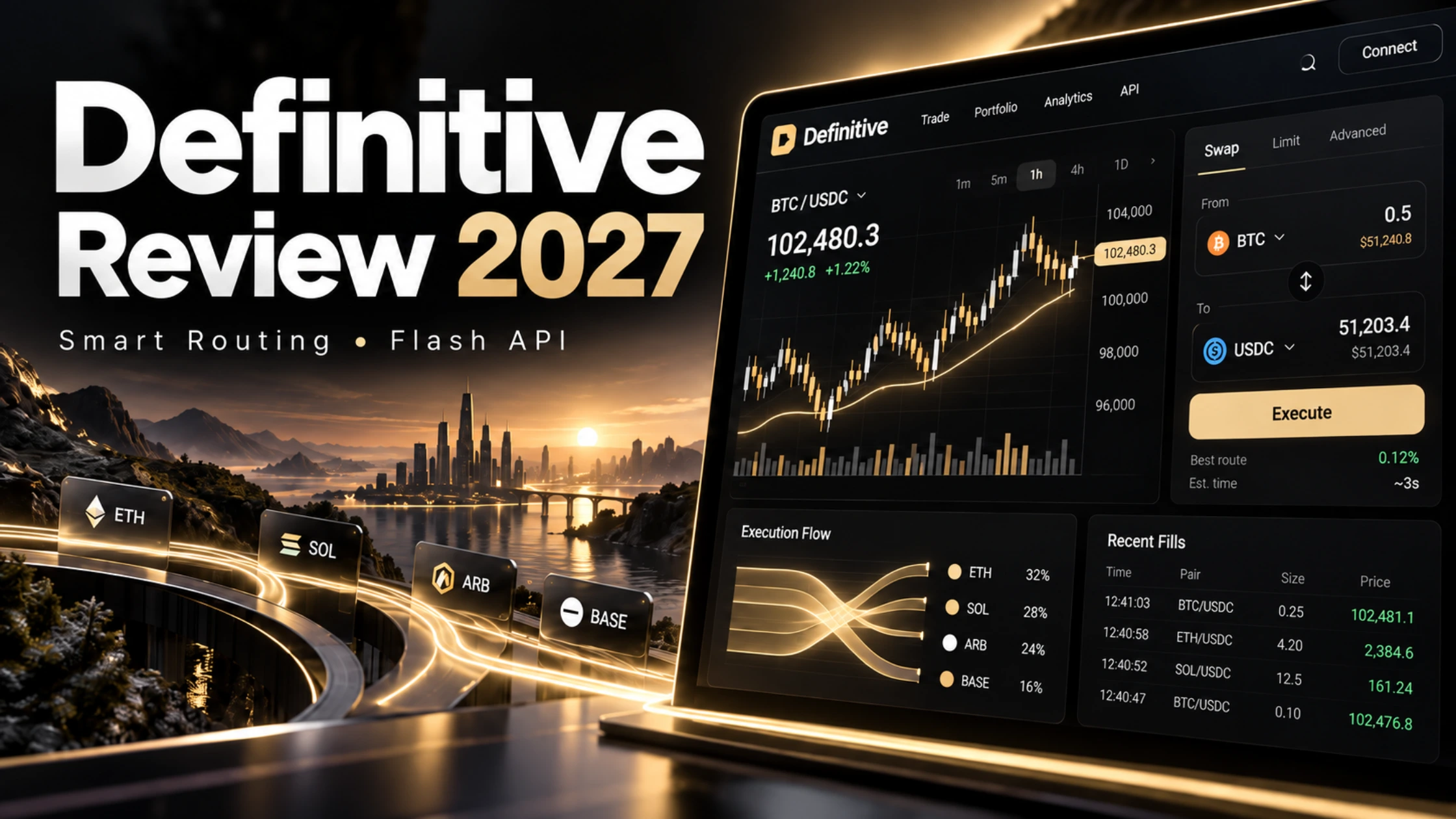
Definitive is not another DEX. It is an execution layer designed to make fragmented onchain liquidity behave more like a professional trading desk: smart routing, advanced orders, non-custodial trading vaults, institutional custody integrations, mobile execution and an agent-ready Flash API across EVM and Solana.
What Matters
Definitive's real product is execution quality, not another pool of liquidity. Prime gives traders market, limit, TWAP and stop orders with smart routing and reporting; Turbo targets fast new-token and memecoin trading; Mobile carries the execution stack to iOS and Android; and Flash API turns the same infrastructure into a programmable execution layer for wallets, apps and AI agents. The most important question is whether Definitive's platform fee is offset by better routing, lower slippage, fewer failed transactions, gas abstraction and less operational complexity for the trade you actually place.
We reviewed Definitive's current homepage, Prime, Turbo, Flash API, fee, institutional, mobile, audit, metrics and company documentation. The user also supplied Definitive's public Metabase metrics dashboard. Because the dashboard itself did not expose parseable figures in our research environment, current homepage metrics are used for headline statistics rather than inferring values from an unparsed dashboard.
Definitive is evolving from a professional DeFi terminal into a general execution infrastructure layer. That matters because the same smart router now serves three different customers: a human pro trader in Prime, a retail/degen trader in Turbo, and a software or AI agent through Flash. If liquidity keeps fragmenting across chains and tokenized-asset venues, the strategic asset is not necessarily the DEX. It may be the execution engine that decides how an order reaches the DEX.
Definitive scores highly for execution tooling, route aggregation, custody architecture, institutional controls, security history, mobile capability and agentic readiness. The main deductions are fee complexity on non-major assets, documentation inconsistencies between older order pages and the current central fee table, smart-contract/vault dependency, and the fact that company-reported execution metrics are not an independent benchmark.
What Is Definitive.fi?
Definitive is a non-custodial onchain trade-execution platform built by a team that includes Coinbase Institutional Trading alumni. Its current documentation describes a CeFi-like execution experience on DeFi rails, combining advanced order types, aggregated liquidity, portfolio analytics, institutional permissions, gas/chain abstraction and post-trade reporting.
The founding team currently listed on Definitive's website is Dennis Qian, Jai Prasad and Blake Arnold. Definitive says the broader team has backgrounds spanning Coinbase, Google, Meta, FactSet, Amazon, Compound, Citi and BitGo.
Investors listed by Definitive include Nascent, Coinbase Ventures, Geometry, Robot Ventures, BlockTower, CMT Digital, Matrixport and Tioga Ventures.
That makes it different from Uniswap, Raydium or another primary liquidity venue. A DEX owns pools or order-book liquidity. Definitive tries to find the best place to execute against that liquidity, automate the order and produce the reporting afterwards.
Definitive's Product Stack
| Product | Primary use | Best fit |
|---|---|---|
| Prime | Full professional terminal with Market, Limit, TWAP and Stop orders, cross-chain routing, analytics and reporting | Whales, funds, institutions and disciplined active traders |
| Turbo | Fast discovery, market/trigger/DCA/quick trading and new-token execution | Memecoin traders, snipers and time-sensitive retail flows |
| Mobile | Advanced order execution, portfolio monitoring and notifications on iOS / Android | Traders who need Prime-style execution away from desktop |
| Flash API | Managed execution API with advanced orders, routing, gas abstraction and MEV protection | Wallets, apps, bots, fintechs and AI agents |
| Institutional accounts | Segregated vaults, custody integrations, role-based permissions, sub-accounts and reporting | Funds, DAOs, family offices, OTC desks and professional organizations |
Prime: The Professional Trading Terminal
Prime is the core product for serious order execution. Current documentation lists Market orders, Limit orders, TWAP orders, Stop / stop-loss orders, smart slippage, smart order routing, private order flow, cross-chain swaps, profit-and-loss tracking and automated post-trade reporting.
Limit orders are particularly interesting because Definitive does not rely on fixed CEX-style trading pairs. Its routing can construct an executable path between different onchain assets when the target effective price becomes available.
TWAP orders can run from roughly 10 minutes to 30 days, with Definitive breaking a large order into smaller segments and routing each fill through its available liquidity universe.
Smart Routing: This Is the Core Economic Claim
Definitive's Prime documentation says its smart order router searches more than 100 DEXs and onchain venues plus more than 15 offchain professional market makers.
The newer general documentation describes aggregated access across 200+ DEXs, onchain venues and professional market makers.
Flash's current developer page goes further and advertises 900+ liquidity sources.
The routing thesis is straightforward: platform fee + execution price can be cheaper than a lower-fee interface if the latter gives enough away through slippage, price impact, gas or poor routing.
Definitive Fees: More Nuanced Than “Cheap” or “Expensive”
The current central Definitive trading-fee page applies a volume- and staking-based schedule across Prime and Turbo.
| Tier | 30-day volume | Staked EDGE | Unstaked |
|---|---|---|---|
| T1 | $20M+ | 0.25% | 0.50% |
| T2 | $5M+ | 0.35% | 0.60% |
| T3 | $1M+ | 0.45% | 0.70% |
| T4 | $100K+ | 0.60% | 0.80% |
| T5 | $0-$99,999 | 0.70% | 0.85% |
| Majors | BTC / ETH / SOL on qualifying routes | Free | Free |
| Stablecoins | Stablecoin pairs | Free | Free |
| Enterprise | Custom | Custom | Custom |
Definitive's live staking app currently shows the same T5 reference of 0.70% staked versus 0.85% unstaked. Turbo's current documentation also lists a promotional 0.85% rate across its order types.
A fee-documentation inconsistency worth knowing about
Some individual Prime order pages still display materially lower fee ranges, such as 5-25 bps on Market orders and 25-50 bps on Limit, TWAP and Stop orders. Those figures conflict with the newer central Trading Fees page and live staking interface.
DN Definitive Execution Break-Even Lab
A higher headline platform fee does not automatically mean worse execution. If Definitive saves enough through route quality, gas, failed-transaction avoidance and lower slippage, the all-in result can still be better. Conversely, for a small, liquid swap on a direct DEX route, a 70-85 bps platform fee can be economically significant.
Definitive Execution Break-Even Lab
Compare a Definitive route with a direct DEX / aggregator route using platform fee, slippage, gas or execution cost, and failed-transaction overhead.
DN execution signal
Trade-size context
When Definitive's Fee Can Make Sense
The strongest case is not necessarily a $200 USDC-to-USDT swap. Definitive becomes more compelling when the order is large enough for slippage to matter, liquidity is fragmented, the token is long-tail, the trader needs TWAP or conditional execution, failed transactions are expensive, the workflow spans chains, or institutional reporting and custody workflows would otherwise require several tools.
For extremely liquid assets where the current Definitive schedule is free, the comparison becomes substantially more attractive.
Gasless Trading: Useful, but Read the Mechanics
Definitive describes its experience as gasless because traders do not need to manually keep gas tokens in every trading vault or sign each transaction. Prime documentation explains that Definitive sponsors the gas required for execution and then deducts execution costs from the trade outcome.
So “gasless” is best interpreted as gas abstraction and sponsorship at the UX layer rather than assuming blockchain execution has zero economic cost in every route.
Private Order Flow and Performer Addresses
Definitive says Prime orders are submitted privately to its offchain Order Management System and only executed onchain when the user's conditions are met.
Institutional accounts add another layer through Definitive Performer Addresses. Instead of every fill visibly originating from the institution's primary wallet, limited-purpose proxy addresses can execute the approved trade. This can reduce information leakage.
How Non-Custody Actually Works
Definitive's non-custodial design is more nuanced than simply saying “funds never leave your wallet.” For Prime institutional workflows, users deposit assets into dedicated onchain trading vaults. Those vaults are segregated by client and whitelisted to the user's authorizing wallet.
Definitive's institutional docs state that only the whitelisted wallet can initiate trading sessions and withdraw assets, while limited performers can execute predefined trading actions during an active session.
Institutional Controls Are a Genuine Differentiator
Current documentation includes segregated smart-contract trading vaults, Fireblocks, Fordefi, Safe, Squads and EOA compatibility, multi-user accounts, view-only/trader/admin permissions, 2FA, sub-accounts, proxy execution addresses, post-trade reporting, API trade data and bespoke pre-trade compliance workflows.
The docs say new institutional accounts can typically be configured within 24 hours. Definitive also supports tax-export workflows using vault-address sync and CSV exports, including a Koinly-formatted option.
Turbo: Definitive Also Wants the Degen Trader
Turbo is strategically interesting because it expands Definitive in the opposite direction from Prime. Prime starts with institutional execution. Turbo starts with find it early → enter fast → manage the position → exit without switching tools.
Turbo's Discover feature can filter new tokens using market cap, volume, liquidity, age, transactions, buys, sells, holder count, top-10 concentration, insider holdings, bundler exposure and developer holdings.
Degen Mode Is Powerful and Dangerous
Prime also includes a Degen Mode designed to prioritize successful execution during congestion. It can automatically increase maximum slippage tolerance to 20%, although the user can customize it, and can progressively increase priority fees up to a chosen maximum.
Definitive Mobile
Definitive's native mobile app is available for iOS and Android. Current documentation lists Market, Limit, TWAP and Stop / Take-Profit functionality at launch, with portfolio management and fill notifications.
Flash API: The Most Strategically Important Part of Definitive
Flash takes Definitive's execution engine outside Definitive's own interface. Current Flash materials advertise Market orders, DCA, Limit, Stop Buy, Stop Loss, Take Profit, TWAP, Quick Trade/token sniping, Bracket orders, managed transaction landing, MEV protection, retry logic, post-trade reporting, EVM + Solana and 900+ advertised liquidity sources.
The current Definitive FAQ lists 12 Flash-supported chains: Ethereum, Base, Arbitrum, Optimism, Polygon, Avalanche, BNB Chain, HyperEVM, Monad, Plasma, Robinhood Chain and Solana.
Why Flash Matters for AI Agents
Definitive has designed Flash as a stateless REST API with LLM-optimized documentation and an open-source MCP server.
That means an AI agent can potentially access quotes → balances → order creation → execution → order management without separately learning gas management, nonce handling, MEV mitigation and chain-specific transaction landing.
For conditional orders, Flash says funds remain in the user's wallet until the order's condition is met. The user signs offchain, and Flash executes and settles in an atomic transaction when required.
Flash may ultimately be more strategically important than the Definitive terminal itself. A terminal can win users. An execution API can become infrastructure underneath thousands of wallets, bots, fintech products and AI agents. Definitive is effectively attempting to turn institutional trade execution into a callable primitive: an agent expresses intent, Flash handles routing, gas, MEV protection, retries and settlement.
Real Agentic Integrations Are Already Appearing
Definitive currently publishes case studies involving AI-native or automated products such as EmblemAI, AgentIq and Cassie. Its September 2026 Cassie case study says the product routes spot orders through Flash and uses Market, Take Profit, Stop Loss, updates and cancels, while Flash handles gas, nonces, slippage and MEV protection.
$EDGE: Fees, Staking and Revenue-Backed Rewards
EDGE is Definitive's platform token. The current platform says a minimum of $200 in staked EDGE qualifies a user for weekly revenue-backed rewards.
Current Definitive materials say 10% of protocol revenue funds EDGE buybacks for qualified stakers, with 2.5% allocated across qualified stakers and 7.5% allocated to qualified stakers who also trade, weighted by volume.
EDGE staking also affects fee economics by expanding the trading-volume lookback and helping users qualify for lower platform fee tiers.
Security: Six Public Audits and a Separate Flash Claim
Definitive's current audit index lists six reviews: four Zellic smart-contract assessments from 2023-2024, an OtterSec assessment in May 2024 and a Cantina EDGE token audit in October 2025. Definitive says no critical issues were reported across those six audits.
Separately, the current Flash FAQ says Flash smart contracts were audited in May 2026 with no major findings.
Public Metrics and Track Record
Definitive's current homepage reports more than $4.2 billion in all-time trading volume, an average fill time of 47 milliseconds and a 99.4% 30-day fill rate. These are company-reported operational statistics rather than an independent exchange-quality benchmark.
Definitive also maintains a public Metabase metrics dashboard. The documentation says the beta launched in March 2024 and has been adopted by professional traders, liquid funds, DAOs/foundations and institutions.
Who Is Definitive Best For?
Strong fit
- Professional traders who need Limit, Stop and TWAP execution onchain.
- Funds and institutions using Fireblocks, Fordefi, Safe or Squads.
- Large-order traders who care about route quality and price impact.
- Multi-chain traders tired of manually managing gas and execution workflows.
- Memecoin / new-token traders who want Turbo alongside a pro terminal.
- Developers building wallets, trading apps, bots or AI agents.
- Teams that need post-trade reporting and role-based controls.
Weak fit
- Small traders making simple non-major swaps where the 70-85 bps entry tier dominates economics.
- Users who want a single transparent DEX fee and no smart execution layer.
- Traders who do not need advanced orders or routing.
- Anyone who interprets “gasless” as literally zero blockchain execution cost in every context.
- Users unwilling to understand smart-contract vault and external-liquidity dependencies.
What Definitive Gets Right
1. Execution is treated as a first-class product. Definitive does not reduce onchain trading to a swap widget.
2. Institutional requirements are native rather than bolted on. Segregated vaults, permissions, sub-accounts and reporting are fundamental parts of the platform.
3. Prime and Turbo cover opposite ends of the market. The same company can serve large, disciplined execution and fast speculative discovery.
4. Flash gives Definitive distribution beyond its own user interface.
5. The security record is unusually well documented for an onchain terminal.
What Definitive Still Needs to Improve
Fee clarity. Canonical current fee documentation should replace or clearly mark old order-specific fee ranges.
Liquidity-source definitions. Prime's 100+/15+, general docs' 200+ and Flash's 900+ should be reconciled with precise definitions.
Audit index freshness. Add the May 2026 Flash audit to the central audit page.
Independent execution benchmarking. Company-reported 47ms / 99.4% metrics are useful, but third-party synchronized fill-quality tests would be more powerful.
Retail fee competitiveness. 70-85 bps on non-major assets can be significant for simple small trades even if routing is excellent.
Final Verdict
Definitive is one of the clearest examples of DeFi infrastructure becoming professional trading infrastructure rather than simply decentralized swapping.
Prime gives serious traders the order types and reporting they expect from centralized trading systems. Turbo moves the same execution philosophy toward fast-moving retail markets. Mobile makes the stack portable. Flash turns it into infrastructure that other products and AI agents can call programmatically.
The main caveat is economics. For non-major assets, especially at low volume, Definitive's platform fee can be meaningful. Better routing has to earn that fee through better realized execution, reduced slippage, fewer failed transactions, automation or workflow savings.
Definitive's strongest long-term position may not be “the best DeFi terminal.” It may be becoming the default execution layer for both humans and machines. Humans interact through Prime, Turbo and Mobile. Apps integrate Flash. AI agents call the same infrastructure through REST or MCP. In that model, Definitive's moat is the combination of liquidity routing, transaction landing, advanced order logic, custody compatibility and a multi-year execution record.
Best feature: institutional-grade execution across fragmented onchain liquidity.
Most underrated feature: private order flow + Performer Addresses.
Biggest current weakness: non-major fee economics and documentation inconsistency.
Biggest security strength: strong audit history plus segregated user-controlled vault architecture.
Biggest 2027 opportunity: Flash becoming the execution API underneath wallets, fintechs and autonomous agents.
How We Review at Decentralised News
| Dimension | What we evaluated |
|---|---|
| Execution | Order types, routing, slippage controls, retry logic and transaction landing. |
| Liquidity | Prime/general routing documentation versus Flash's advertised liquidity-source universe. |
| Fees | Current central fee table, live staking page and product-specific pricing documentation. |
| Custody | Segregated vault structure, withdrawal control and performer permissions. |
| Institutional readiness | Fireblocks/Fordefi/Safe/Squads, permissions, sub-accounts, reporting and compliance support. |
| Security | Public audits, smart-contract architecture and newer Flash audit claims. |
| Agentic readiness | Flash API, MCP, LLM-ready docs, managed execution and production case studies. |
| Transparency | Freshness and consistency of fees, metrics, chain counts and security references. |
DN ratings are editorial research assessments, not guarantees of platform safety or future performance. Fees, chains, liquidity integrations and execution metrics can change after publication.
Primary Sources and Evidence Ledger
- Definitive official website — current $4.2B+ volume, 47ms average fill, 99.4% 30-day fill rate and product overview.
- Definitive documentation — platform overview, execution architecture, liquidity aggregation, non-custodial design and reporting.
- Definitive Prime docs.
- Definitive Turbo docs.
- Definitive Trading Fees.
- Definitive live staking page.
- Institutions & Funds.
- Definitive Audits.
- Definitive Flash API.
- Flash FAQ.
- Definitive About.
- Definitive Metrics documentation.
- Definitive public Metabase dashboard.
- Definitive status page.
- Definitive MiCA reference.
Frequently Asked Questions
What is Definitive.fi?
Definitive is a non-custodial onchain trading platform and execution API with Prime, Turbo, Mobile, institutional accounts and Flash API.
What is the Definitive referral code?
The Decentralised News Definitive referral code is 417QFMNA. The supplied referral link is https://app.definitive.fi/@417QFMNA.
Does code 417QFMNA give a fee discount?
We did not locate a current public Definitive page confirming the exact new-user benefit attached specifically to this referral code, so Decentralised News does not promise a discount or bonus. Check the referral attribution and current terms in the live app.
Is Definitive non-custodial?
Yes. Prime uses segregated user-controlled trading vaults with limited performer permissions, while Flash conditional orders are documented as remaining in the user's wallet until execution conditions are met.
What are Definitive's fees?
The current central fee table lists qualifying majors and stablecoin pairs as free, while other assets use volume and EDGE-staking tiers ranging from 0.85% at T5 unstaked to 0.25% at T1 staked. Enterprise terms are custom.
Can AI agents trade through Definitive?
Yes. Flash API is built for agentic workflows and includes LLM-ready documentation and an open-source MCP server for quoting, order submission, balances and order management.
Has Definitive been audited?
Definitive's main audit index lists six audits by Zellic, OtterSec and Cantina with no critical issues reported. Flash separately states that its smart contracts were audited in May 2026 with no major findings.
Is Definitive safe?
No DeFi execution platform is risk-free. Definitive has a substantial public audit history and non-custodial controls, but users remain exposed to smart-contract, automation, wallet, underlying venue, liquidity, oracle, bridge and blockchain risks.
DN Agent Trust: inspect the evidence
The evidence profile covers selected Flash SDK and order-boundary tests, not every Definitive.fi product or live venue. Flash remains unclassified. Inspect the Definitive Flash evidence profile.
Read the five-system dataset launch and test limitations or review DN’s verification methodology.
Related reading:
Blackboard.fi Review: Is This the Bloomberg Terminal for DeFi?
Liquid.trade Review: Is This the First Real Agentic Trading Platform?
Trench.io Explained: Stocks, Crypto, Settlement Pools and 1000x Payouts
Coinbase’s Agentic Trading Stack: Equities, Crypto, x402 and Guardrails