
Blackboard.fi Review: Fees, Delegated Signing, Access and Risks
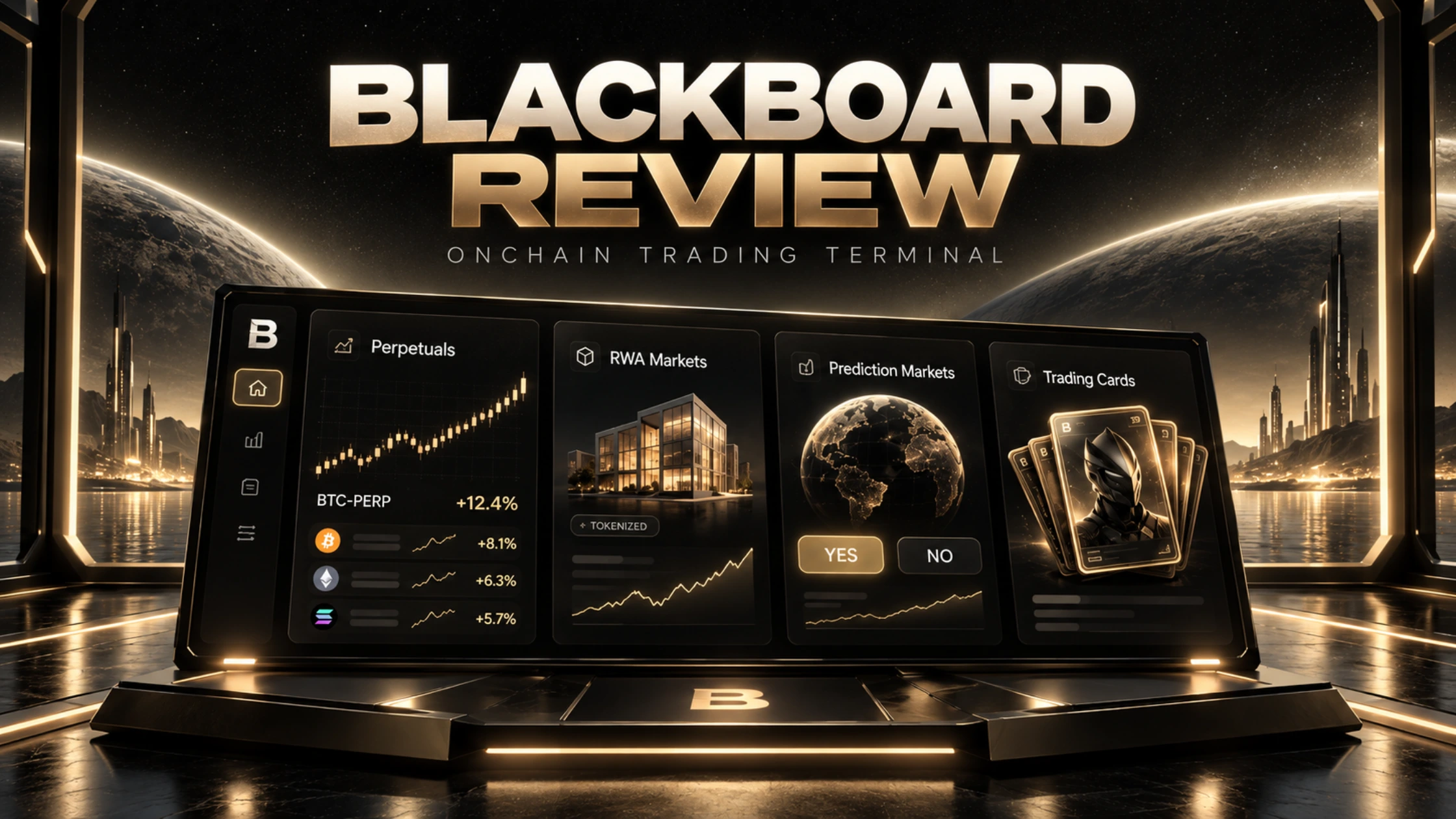
Blackboard.fi brings Aster crypto perpetuals, Hyperliquid HIP-3 markets, Aark 1000X, Polymarket predictions and CollectorCrypt packs into one interface. The convenience is real as a product proposition, but it does not create one universal wallet, balance, fee schedule or risk model.
What Matters
Blackboard's main proposition is easier access to specialist venues. It does not replace their liquidity, liquidation rules or settlement mechanisms. Its updated documentation also makes clear that different products use different accounts and wallets, while delegated signing gives company systems authority to carry out supported user instructions. Read those permissions before treating “non-custodial” as a complete security description.
The current product, security, fee and rewards guides take priority over historical launch announcements. The provider reports production-documentation checks in October; that is not independent testing by Decentralised News.
Blackboard is making a strategic bet that the most valuable layer in onchain finance may eventually be the gateway that decides where user flow goes, not the venue that owns one order book. If that thesis is right, Blackboard can add markets horizontally without rebuilding every execution engine. It also creates a natural foundation for future agentic trading because one interface can expose multiple market types to the same strategy layer.
Broad access, significant dependencies. Reusing specialist venues is a coherent design. The current decision is whether the workflow benefits justify the fees, permissions and extra operational dependencies for the particular products a reader is eligible to use. We are not publishing a new numerical safety or performance score from a public-document review.
What Is Blackboard.fi?
Blackboard is a multi-venue onchain trading interface. Its current documentation describes Crypto, TradFi, 1000X, Prediction and TCG products, plus Cash funding functions. Each product has its own account rules; a common sign-in does not mean all collateral is interchangeable.
Older marketing used a brokerage analogy. The November 4 terms expressly disclaim exchange, broker and custodian status, so the analogy should not be read as a legal classification or regulatory protection.
Blackboard at a Glance: Current Products and Limits
| Product | Documented route / funding | Important limit |
|---|---|---|
| Crypto perpetuals | Aster; USDT, with supported USDC collateral in Multi-Asset mode | USDC does not fund new orders in Single-Asset mode. Market status and leverage vary. |
| TradFi perpetuals | Hyperliquid HIP-3; USDC | Price exposure, not ownership of shares, dividends, voting rights or physical assets. |
| 1000X | Aark; USDC on Arbitrum, designated wallet and account setup | Access and leverage depend on the market/account; the name is not a universal 1,000x entitlement. Demo balances are simulated. |
| Prediction / Up/Down | Polymarket; pUSD on Polygon | Outcome shares, including directional markets, subject to regional and account availability. |
| TCG | CollectorCrypt; USDC in a separate Solana TCG wallet | Packs, gifts and collection are documented; TCG marketplace browsing/purchases are unavailable. |
| Cash | Supported deposits, withdrawals and Swap to Cash | A funding/conversion workflow is not a general spot exchange. |
Unavailable features are not present-day benefits
The current guide says general spot trading, a tokenized-equity marketplace, AI strategies, vaults and a strategy marketplace are unavailable. There is no verified launch date in this review. The changelog warns that older announcements are historical, so an older “spot launched” entry is not evidence of a current general spot exchange.
Crypto Perpetuals: Blackboard Uses Aster Rather Than Rebuilding a DEX
Crypto trades depend on Aster's order book, margin, mark price, funding and liquidation rules. Blackboard's current product guide distinguishes USDT from supported USDC collateral in Multi-Asset mode. A balance visible elsewhere in the app is not automatically usable for a new Crypto order.
Blackboard publishes its own combined Crypto fee reference. At Bronze, the October 27 table shows 0.025% maker and 0.065% taker, including venue and builder fees. Aster's direct General Crypto base schedule of 0% maker / 0.04% taker is therefore not a complete Blackboard quote. Aster product groups, symbols and account tiers can differ.
Funding, slippage and routing costs remain separate. The Aster API guide also distinguishes the builder-approval ceiling from an actual order fee; do not put an all-in tier rate into a builder-only field.
Real-World Asset Perpetuals: Hyperliquid HIP-3
Blackboard's TradFi product accesses Hyperliquid HIP-3 perpetuals using USDC. Equity, index, FX and commodity-linked contracts provide price exposure, not the underlying asset, shareholder rights or dividends.
Hyperliquid's base perpetual reference is 0.015% maker / 0.045% taker before account discounts. That does not price every Blackboard TradFi order: builder charges, HIP-3 deployer settings, growth mode and the exact market can change the total. The calculator therefore leaves HIP-3 rates blank until the reader enters current figures.
Check the specific contract's trading availability, oracle, funding, collateral and leverage limit. We have not verified an authenticated market count or maximum leverage across the product.
Aark 1000X is a separate product
The current docs also cover Aark-powered 1000X trading with USDC on Arbitrum, a designated wallet and delegation/relay setup. Account/operator access and market limits apply; the product name does not guarantee 1,000x for every order. Terms specify one open position at a time. A labelled demo uses simulated balances, and fees are market-specific rather than the Crypto or TradFi ladder.
Very high leverage can make small price moves and costs consume collateral rapidly. This review does not recommend a leverage level or treat the demo as evidence of live execution.
Prediction Markets: Polymarket Inside the Same Terminal
Blackboard routes Prediction activity through Polymarket using pUSD on Polygon. Availability can be restricted or hidden for a region or account. Its published interface fees are 0.50% maker / 1.00% taker, plus any applicable Polymarket market-specific fee.
This is more important than simply adding another tab.
A prediction contract is structurally different from a perpetual future. The payoff is tied to an event outcome rather than an indefinitely rolling leveraged price position.
Putting the two products in one interface creates something conventional exchanges rarely provide:
price markets + event markets in the same decision environment.
A trader could theoretically use election probabilities, central-bank outcomes, regulatory events or technology predictions as context for positions in crypto, FX, commodities or equities.
Blackboard becomes substantially more interesting when its products are viewed as one information system rather than several tabs. Prediction markets can become signals for perpetual markets. Commodity moves can become context for macro event contracts. Equity and crypto volatility can feed future systematic rules. The terminal's long-term moat could therefore be cross-market context, not simply cross-market access.
Up/Down: Short-Window Prediction Shares
Up/Down belongs to the Prediction product. It uses outcome shares and Polymarket settlement, not conventional call/put options or leveraged perpetual futures. It follows Prediction fee handling.
Read the exact settlement condition, expiry, payoff and resolution rules. Short duration does not remove the possibility of losing the amount committed. The current terms exclude people in the EEA from Up/Down, alongside broader Prediction restrictions.
Trading Cards: Broad Product Scope, Specific Availability
CollectorCrypt integration extends the interface beyond financial contracts into tokenized physical collectibles. Blackboard documents packs, gifts and collection in a separate Solana TCG wallet funded with USDC.
TCG marketplace browsing and purchases are currently unavailable. Pack stock, item value, any buyback option and physical redemption are provider/item-dependent. A token in a collection is not a promise of immediate liquidity or unrestricted delivery.
The broader product idea still matters: crypto, macro-linked contracts, events and collectibles can share an interface while retaining very different risks.
Self-Custody With Mainstream-Style Onboarding
Social or email sign-in can reduce onboarding steps, but a login is not a wallet inventory. Blackboard's current docs distinguish embedded/main Cash wallets, venue accounts, Prediction accounts, a designated 1000X wallet and a separate TCG Solana wallet.
Assets may sit in wallets, venue accounts or smart contracts. Moving value between products can require a supported transfer or conversion, with eligibility, network and provider conditions. A single dashboard does not make balances universally interchangeable.
The November 4 terms also describe company-side delegated signing. The practical questions are which actions are authorized, which wallet holds the assets, how permissions are revoked and whether that wallet can be exported. Those questions matter more than a simple “non-custodial” label.
Blackboard Fees: Use the Correct Product and Fee Basis
The provider's fee reference was checked by Blackboard on October 27, 2026. It is a published schedule, not an independently tested quote for a reader's account.
| Crypto tier | Published 30-day volume threshold | Combined maker | Combined taker |
|---|---|---|---|
| Bronze | $0 | 0.0250% | 0.0650% |
| Silver | $10.7M | 0.0220% | 0.0620% |
| Gold | $53.6M | 0.0190% | 0.0590% |
| Platinum | $214.3M | 0.0170% | 0.0570% |
| Diamond | $1.07B | 0.0030% | 0.0430% |
| Legendary | $4.29B | 0.0030% | 0.0430% |
These Crypto rates already combine venue and Blackboard builder fees. Do not add the builder component again. The page does not guarantee a separately fixed Bronze builder fee; live account rates, venue/symbol commissions, approvals and fee floors can affect the calculation.
Crypto and TradFi share a tier based on combined qualifying volume but have different rates. Recognized external-wallet volume, caps/expiry and Lifetime Tier rules can matter; XP is not automatically a fee tier. Refreshes occur on relevant changes/reconnections, not a promise of a universally locked 30-day tier.
- TradFi: Hyperliquid fees plus Blackboard builder charges, with HIP-3 market settings and account rates. No universal all-in number is verified here.
- 1000X: Aark market-specific fees; inspect the order estimate/history.
- Prediction and Up/Down: Blackboard 0.50% maker / 1.00% taker plus applicable Polymarket fees. Listed tier fee-back shares are currently not paid out and do not reduce the upfront fee.
- Packs and moving funds: Use the item/route quote. Conversions, bridges, transfers, withdrawals and network/provider costs may remain even where some gas is sponsored.
For perpetuals, also budget funding, spread and slippage. A fee discount, points allocation or competition prize should not be assumed to offset those costs.
DN Blackboard Gateway Cost & Route Mapper
This educational perpetual-cost model accepts either combined trading rates or separate venue and builder components. The Bronze Aster preset includes the builder layer once; it cannot isolate the interface premium. Separate-mode comparisons require a known builder rate, including an explicit zero if applicable.
Prediction shares, Aark-specific mechanics and TCG pack economics are not modeled by this simple perpetual calculator.
Blackboard Gateway Cost & Route Mapper
Estimate trading fees on the selected basis, plus slippage, funding and routing costs. Combined rates already include the builder component; do not add it twice.
DN route signals
Fragmentation context
Why the Tool Matters: Blackboard Is a Router, Not the Final Venue
If you open a crypto perpetual through Blackboard and the trade routes to Aster, your execution inherits Aster's order book.
If you open a HIP-3 equity, commodity, FX or index perpetual, you inherit that Hyperliquid market's oracle, fee and liquidity structure.
If you trade a prediction contract, you are entering an event-market structure rather than a leveraged futures structure.
If you open a tokenized trading-card pack, the relevant risk is completely different again.
The unified screen is the benefit.
The underlying diversity is the risk.
Blackboard's Best Feature May Be the Removal of the “Attention Tax”
Most DeFi cost analysis focuses on gas.
Blackboard is targeting another cost that is harder to measure:
attention.
A sophisticated onchain trader can currently maintain separate:
- wallets,
- bridges,
- balances,
- collateral pools,
- chain selectors,
- protocol tabs,
- fee models,
- and portfolio views.
Blackboard's June product thesis argues that this fragmentation is itself a barrier to adoption.
That is persuasive.
A terminal does not need to beat Aster's matching engine if it can make Aster, Hyperliquid and Polymarket easier to access together than each is to manage separately.
Does Blackboard Hold Your Funds? Read the Signing Permissions
Blackboard Solutions Ltd. describes the service as non-custodial and says it does not hold wallet private keys. That is not the same as having no authority to sign transactions.
Terms §4.4 describes company-side delegated signing for supported user instructions, including orders, cancellations, deposits, withdrawals, transfers, venue setup/approvals/settings and enabled actions such as resolved-market claims. The terms warn that compromise of company systems, the wallet provider or the account can cause unauthorized transactions.
Venue trading keys are a separate permission layer. The terms say Hyperliquid and Aster trading keys cannot withdraw, while Aster keys can transfer between its spot/futures accounts; Aark's trading key may not expire. Do not apply a venue-key withdrawal restriction to every delegated company action.
The security guide describes browser-held Hyperliquid agents, Aster API agents with separate builder approvals, backend signing for delegated Prediction accounts, and a designated Aark wallet/delegation/relay. Delegation supports instructed actions; it does not mean an autonomous strategy is running.
Funds can be in wallets, venue accounts or smart contracts. Wallet providers, venues, networks, bridges, oracles and payment providers remain dependencies. Review the actual permissions and revocation path before authorizing a product.
Social Login, Key Export and Recovery
Social/email onboarding can be convenient, but recovery depends on the exact wallet and account type. The security guide's Settings → Account → Export keys selector covers embedded EVM and main Solana Cash wallets through Privy. The separate TCG wallet is excluded. Do not assume every product wallet is exportable or uses the same address.
Direct venue access during an interruption depends on the right wallet, permissions, account type and regional eligibility. Service interruptions can delay access; key export alone does not prove every trading position or collectible can be recovered through the same process.
The practical checks are to identify each funded wallet, understand signing/revocation and recovery options, and protect the login account. We did not connect a wallet or independently test export, recovery or withdrawal.
Security: Reused Venues Do Not Remove Interface Risk
Using established venue infrastructure avoids rebuilding every order book or settlement mechanism. It also creates dependencies on Blackboard, wallet/signing systems, Aster, Hyperliquid, Aark, Polymarket, CollectorCrypt and the networks/providers involved in the chosen route.
Documented: The current security guide and November 4 terms explain product accounts, several agent/delegation patterns and limits on wallet export.
Not independently verified: We did not locate a public Blackboard-specific audit with a current application/code scope, findings and remediation status in the reviewed docs and scoped official-site searches. This is a limited search result, not proof no security review exists.
What would improve confidence: Current independent evidence covering the interface, delegated signing, wallet recovery and routing stack, together with clear incident-response and bug-bounty information. We did not test the implementation or claim the disclosed controls eliminate compromise risk.
Blackboard × Aster Competition: Dated, Conditional Promotion
As checked on November 7, 2026, the public PnL and volume event pages list a trading window of October 10 00:00 through November 10 23:59 UTC, with registration closing at the same final time. This is an ongoing scheduled event at this check, not an upcoming launch or proof that prizes have been paid.
Only qualifying builder-attributed Aster fills count. The pages require at least $88,888 qualifying volume and one account per person; pool unlocks depend on both volume and qualified-trader thresholds. The combined maximum is $100,000, not a guaranteed pool. Check the live event rules rather than relying on older announcement copy.
Claim windows differ: PnL, November 12 00:00–November 26 12:00 UTC; volume, November 12 23:59–November 26 23:59 UTC. Review/finalization precedes approved claims, and missing the applicable window forfeits the prize.
Official PnL event · Official volume event. We did not join or test a claim. Generating unnecessary volume can cost more in fees, funding and slippage than any uncertain reward.
Prediction Markets + Perps Could Become a Powerful Research Stack
There is an underappreciated reason to put Polymarket beside Aster and Hyperliquid.
Prediction markets can act as live probability signals.
Imagine one terminal where a trader can monitor:
- the probability of a rate cut,
- BTC perpetual funding,
- Nasdaq-linked HIP-3 positioning,
- gold price action,
- and a political outcome contract.
That is not merely convenience.
It creates the raw material for systematic cross-market strategies.
Agentic Trading Could Be the Logical End State
The current product guide says AI strategies, vaults and the strategy marketplace are unavailable. The historical roadmap discussed natural-language strategy creation, backtesting and autonomous execution; that remains a product ambition, not a verified capability.
The proposed workflow is ambitious:
describe a strategy in natural language → backtest it → deploy autonomous execution.
The current Aster API guide does support a narrower automation building block: an agent/API workflow sharing the Crypto account’s margin, orders and positions. It does not cover Prediction, TCG or 1000X and is not proof of an integrated AI strategy generator, backtester or marketplace.
We do not treat those unavailable strategy features as current benefits. Delegated signing also does not itself activate autonomous strategies.
But architecturally, Blackboard is well positioned for them.
An agent operating inside one terminal could potentially receive:
- crypto prices,
- RWA perpetual data,
- prediction probabilities,
- portfolio state,
- and eventually spot/tokenized asset data.
That is a richer agentic environment than a bot connected to one crypto order book.
Blackboard's most valuable future asset may be the normalized cross-market context layer created by putting fundamentally different venues behind one user and strategy interface. If Agentic Trading ships with strong permissioning, backtesting, kill switches and route transparency, Blackboard could become more than an aggregator. It could become an operating environment for autonomous multi-market capital allocation.
Tokenized Stocks and Pre-IPO: Do Not Confuse Them With Perpetuals
The current product guide says a general spot exchange and tokenized-equity marketplace are unavailable. Cash conversion is not equivalent to an exchange listing, and a HIP-3 stock-linked perpetual is not ownership of tokenized shares.
Historical spot, global-equity and pre-IPO ambitions do not establish a present asset listing, legal entitlement or launch commitment. Verify the actual instrument, provider and rights before treating a category label as a product.
Trading Cards: Physical Asset Risk Is Different From Crypto Risk
CollectorCrypt's infrastructure is designed around real physical collectibles being vaulted and represented onchain.
That creates a different risk stack:
token ownership + custody of physical card + authentication/grading + redemption/shipping + marketplace liquidity.
Users should not assume that because the asset is visible inside the same Blackboard interface, its risks are equivalent to holding USDC or trading BTC perpetuals.
Eligibility, KYC and Privacy
The November 4 terms require at least 18 and the local age of majority, with sanctions and prohibited-jurisdiction rules. Successful sign-in or a visible market does not prove permission to trade; venue/provider restrictions still apply, and the terms prohibit evasion through VPNs, proxies or spoofed identity/location.
- Perpetuals: U.S. Persons are excluded, including more than simply people currently located in the U.S. Read the terms' definition and current venue restrictions.
- Prediction: U.S. Persons and specified persons/entities connected with the UK, France, Ontario, Singapore, Poland, Thailand, Australia, Belgium, Taiwan and the Republic of Korea are excluded, alongside other Blackboard/Polymarket restrictions. The exact citizenship, residence, location and entity tests are in §7.2.
- Up/Down: people in the EEA must not use it.
- Packs: Local rules on random-content products and provider-designated exclusions apply.
This is a summary, not a complete static eligibility list. Check the current terms for the intended product and jurisdiction.
The November 4 privacy policy says Blackboard does not request identity documents, instead describing IP-country and wallet sanctions/risk screening. That replaces the review's old passport/KYC language. Independent payment or on-ramp providers can still have verification requirements; it is not a promise of anonymous access.
Activity visibility matters: Public profiles can show trading-account value, open and closed positions, realized PnL, rankings, Calls and Cards. Affiliates whose code/link was used can see referred users' nicknames, deposits, withdrawals, trades and pack purchases. Consider that disclosure before creating or funding an account, or using a referral link.
Referral rewards: attribution is not payment
The approved DN link remains blackboard.fi/?ref=NABA4KS8. We have not verified DN's account-specific rate, a user rebate or successful attribution. The public affiliate FAQ says 1000X trades do not yet earn commission.
Terms §12.5 says qualifying commissions accrue but payouts are manually distributed. Where a claim is required, it must be made within 180 days of first availability or it is forfeited. Program exclusions and withholding/delay/clawback terms apply. Signup, qualifying activity, a pending reward and a completed payout are different states.
Points, XP and listed fee-back shares are also distinct. None should be represented as a guaranteed token, airdrop, cash return or discount on the initial trading fee.
Blackboard vs Using Every Protocol Directly
| Dimension | Blackboard | Direct venue workflow |
|---|---|---|
| Interfaces | One terminal | Multiple applications |
| Liquidity | Inherited from underlying protocols | Same underlying venue when trading directly |
| Custody | Product wallets/accounts plus delegated signing | Protocol-specific |
| Fee clarity | Requires route-level analysis | Often easier to isolate venue fee |
| Cross-market context | Shared interface for different markets | Depends on tools and workflow |
| Operational complexity | May reduce navigation; product balances still differ | Depends on wallet and venue setup |
| Dependency surface | Blackboard + underlying protocols | Venue, wallet, network and any funding providers |
| Future automation | Potential unified agentic layer | Separate APIs / bots per venue |
Best Blackboard Alternatives
No single product is a perfect substitute because Blackboard is aggregating several different market structures.
| Platform | Best comparison point | Access |
|---|---|---|
| Liquid | Another multi-market trading interface. Check its current product, signing and eligibility conditions separately. | Explore Liquid |
| Hyperliquid | Direct access to the underlying crypto / HIP-3 ecosystem without the additional aggregation layer. | Official site |
| Aster | Direct access to the crypto perpetual venue Blackboard currently uses for its broad crypto market set. | Official site |
| Polymarket | Direct prediction-market specialist. | Official site |
| Veranta (formerly Avantis) | Focused onchain crypto + real-world-asset perpetual trading rather than broad market aggregation. | Explore Veranta |
| Sai | Another perpetual-trading interface to compare by current fees, collateral, market rules and access. | Explore Sai |
Who Is Blackboard Best For?
Strong fit
- Onchain traders who currently maintain several protocol tabs and balances.
- Users who want crypto, RWA perps and prediction markets in one environment.
- Traders who value self-custody but dislike traditional DeFi onboarding complexity.
- Users interested in tokenized collectibles alongside financial markets.
- Eligible traders who understand product-specific signing, recovery and fee conditions.
- Users willing to understand the underlying protocol behind every trade.
Weak fit
- Users who want one venue with one universal fee and risk model.
- Beginners who assume a unified interface means all products work the same way.
- Users who require a long operating history.
- Traders who want every security audit and route dependency documented publicly today.
- Anyone treating AI strategies or a tokenized-equity marketplace as already available.
- People excluded by the relevant product or provider rules.
What Blackboard Gets Right
1. It refuses to create unnecessary liquidity fragmentation. That is a strong architectural choice.
2. It treats usability as infrastructure. Social login, a shared interface and assisted funding workflows can make onchain markets accessible to a much larger audience.
3. The market mix is genuinely differentiated. Crypto perps, RWA perps, prediction markets and physical trading cards are fundamentally different forms of risk.
4. The architecture is naturally compatible with agentic finance. A normalized multi-market layer is exactly what future autonomous strategies need.
What Blackboard Still Needs to Prove
Live scale. A compelling architecture still needs sustained users, volume and retention.
Route transparency. Traders should be able to see the underlying venue, exact fee stack and market-specific risk before confirming every trade.
Security disclosure. A current independent Blackboard-specific audit would materially improve confidence.
Wallet transparency. Current docs now explain more of the signing and export model; independent implementation evidence and tested recovery remain outside this review.
Roadmap execution. Spot, tokenized equities, Vault, Agentic Trading and Marketplace should be judged when they ship, not before.
Cross-market risk controls. As one interface touches more product accounts, Blackboard will need increasingly strong permissioning, exposure limits and failure isolation.
What Would Change Our View?
| Would raise our assessment | Would lower our assessment |
|---|---|
| Public independent audit of the current terminal, wallet/session-key and routing stack. | Material wallet, routing or session-key security incident. |
| Clear per-order disclosure of underlying venue and all incremental fees. | Persistent fee or route ambiguity. |
| Sustained usage and volume after initial incentives. | Usage disappearing when promotions end. |
| Successful launch of Agentic Trading with simulation, limits and kill switches. | Autonomous execution shipping without strong permission controls. |
| Spot/tokenized assets launching with transparent legal and custody structures. | Marketing categories materially outrunning actual product availability. |
| Cross-market portfolio and risk controls becoming first-class features. | Fragmented risk management hidden behind a unified interface. |
Final Verdict
Blackboard.fi is one of the more strategically interesting onchain trading products to appear in 2026.
The reason is not that it invented a better BTC perpetual.
It deliberately chose not to.
Blackboard's thesis is that Aster, Hyperliquid, Polymarket and other specialist protocols can remain the engines while Blackboard becomes the cockpit.
That approach has real advantages.
It lets the platform expand horizontally across fundamentally different markets without trying to manufacture liquidity for every new product. It aims to reduce interface and funding-workflow friction, while separate product accounts and wallets remain. And it creates the beginnings of a cross-market data environment that could eventually become extremely valuable for automated and agentic trading.
The cost is dependency.
A Blackboard trader is still exposed to the underlying venue's liquidity, funding, liquidation, oracle, smart-contract and operational risks. A unified dashboard should not create the false impression that every product has a shared balance or risk model.
For now, the biggest reason to use Blackboard is convenience and cross-market access.
The biggest reason to watch Blackboard is what that access layer could become.
Blackboard is betting that the next dominant onchain product may not own the liquidity. It may own the gateway through which liquidity is discovered, compared and ultimately routed. If Blackboard can combine Aster-scale crypto breadth, Hyperliquid HIP-3 RWAs, Polymarket probabilities, tokenized assets and future autonomous strategy execution behind a permissioned interface, the terminal could become a genuine operating system for onchain markets rather than another exchange interface.
Best argument: Specialist venues accessible through one interface.
Main trade-offs: Product-specific fees and eligibility, delegated signing, separate wallets/accounts and multiple providers.
What remains unverified: Authenticated execution, withdrawals, recovery, referral payouts and the implementation of the disclosed security model.
The earlier 8.2/10 and component scores are withdrawn, not carried forward as a fresh assessment. Public documentation supports a more qualified review, not a safety certification.
How We Review at Decentralised News
| Dimension | What we evaluated |
|---|---|
| Architecture | Whether Blackboard builds liquidity or routes into specialist protocols. |
| Market breadth | Documented Crypto, TradFi, 1000X, Prediction/Up-Down and TCG availability and limits. |
| Execution | Published fee schedules and the calculator’s assumptions, not measured fill quality. |
| Custody | Product wallets, delegated signing, key-export scope and third-party dependencies. |
| Product status | Separation of current features from roadmap features. |
| Security | Public audit evidence, dependency surface and wallet/routing architecture. |
| Agentic readiness | Current architecture plus announced natural-language/backtest/autonomous roadmap. |
| Commercial fit | Whether aggregation reduces enough friction to justify using another access layer. |
Public sources were checked November 7, 2026. No authenticated account, trade, deposit, withdrawal, recovery, reward claim or referral-payout test was performed. Provider descriptions are not independent proof of implementation. The calculator is an educational model; fees, availability and policies can change after this check.
Primary Sources and Evidence Ledger
Current public sources checked November 7, 2026. Legal/privacy update: November 4. Blackboard fee reference: October 27. Historical marketing is used only for the product thesis, not present availability.
- Current product matrix and documentation changelog: accounts, current products and unavailable features.
- Blackboard fee reference and Rewards overview: combined Crypto fees, separate product costs and reward limits.
- Terms of Service: operator, eligibility, trading keys, delegated signing, fees and claims.
- Current Privacy Policy: screening, profile visibility and affiliate data access. This supersedes the older policy used in the October review.
- Security guide, account creation and deposit guide: wallet/account boundaries, export scope and provider conditions.
- Aster API guide: builder approvals, account scope and attribution.
- Aster fees and Hyperliquid fees: venue references, not complete Blackboard quotes.
- 1000X guide, Prediction guide and TCG guide: product-specific mechanics and limits.
- Affiliate program and referral guide: qualifying activity and program rules, not verified DN account earnings.
- PnL competition and volume competition: dated event conditions and distinct claim windows.
- Historical introduction: the “adopt, not rebuild” strategy, not proof of current product availability.
Frequently Asked Questions
What is Blackboard.fi?
A multi-venue interface for documented Aster Crypto, Hyperliquid HIP-3 TradFi, Aark 1000X, Polymarket Prediction and CollectorCrypt TCG products. Product-specific wallets, balances, fees and eligibility apply.
Is Blackboard an exchange or broker?
Its historical marketing used a brokerage analogy, but the current terms disclaim exchange, broker and custodian status. The review describes it as an interface to third-party venues, not a regulated intermediary.
What is the DN Blackboard referral?
blackboard.fi/?ref=NABA4KS8, code NABA4KS8. DN may earn compensation. No specific reader discount or successful attribution was verified; the privacy policy describes activity visible to affiliates.
How many markets and how much leverage are available?
Check the current market and account. This update does not verify the old 400+ crypto, 100+ RWA or blanket 50x claims. The Aark 1000X name is also not a guarantee of 1,000x on every order.
Does a stock-linked perpetual give me shares?
No. HIP-3 price exposure is not ownership of the underlying shares, dividends, voting rights or physical asset. A tokenized-equity marketplace is currently unavailable in the product guide.
What is Up/Down?
A Prediction product using outcome shares and Polymarket settlement, not conventional call/put options or leveraged perps. people in the EEA are excluded under the current terms, alongside broader Prediction restrictions.
Is Blackboard self-custodial?
It says it does not hold wallet private keys, but current terms authorize company-side delegated signing for supported instructed actions, including transfers and withdrawals. Product wallets differ and the separate TCG wallet is not covered by the documented key-export selector. Review permissions and recovery, not just the label.
What are the current fees?
The October 27 Crypto Bronze reference is 0.025% maker / 0.065% taker combined venue plus builder. Do not add the builder twice. TradFi and Aark require product/market quotes. Prediction adds 0.50% maker / 1.00% taker plus applicable Polymarket fees; listed fee-back is not currently paid.
Are AI strategies, spot trading and a TCG marketplace live?
The current product guide says general spot, a tokenized-equity marketplace, AI strategies, vaults, the strategy marketplace and TCG marketplace are unavailable. Cash conversion, packs/collection and an Aster API workflow do not establish those broader features.
Does Blackboard require identity documents?
The November 4 privacy policy says Blackboard does not request them and describes IP-country and wallet screening. Payment/on-ramp providers may still require verification. Eligibility restrictions and activity visibility still apply.
Has Blackboard been independently audited?
We did not locate a current Blackboard-specific independent audit with scope, findings and remediation details in the reviewed sources. That does not prove none exists. This was a public-source review, not a security assessment or authenticated test.
Is Blackboard safe?
No trading interface is risk-free. Consider delegated signing, account recovery, venue and smart-contract risks, bridges, oracles, liquidation, privacy, costs and regional eligibility. No numerical safety score is carried forward from the old review.
Related reading:
Liquid.trade Review: Is This the First Real Agentic Trading Platform?
Trench.io Explained: Stocks, Crypto, Settlement Pools and 1000x Payouts
Coinbase’s Agentic Trading Stack: Equities, Crypto, x402 and Guardrails
Are Crypto VIP Tiers Worth It? Binance vs Bybit vs OKX vs Kraken vs Deribit
Best Crypto Exchanges and Tools for High-Volume Traders in 2027



