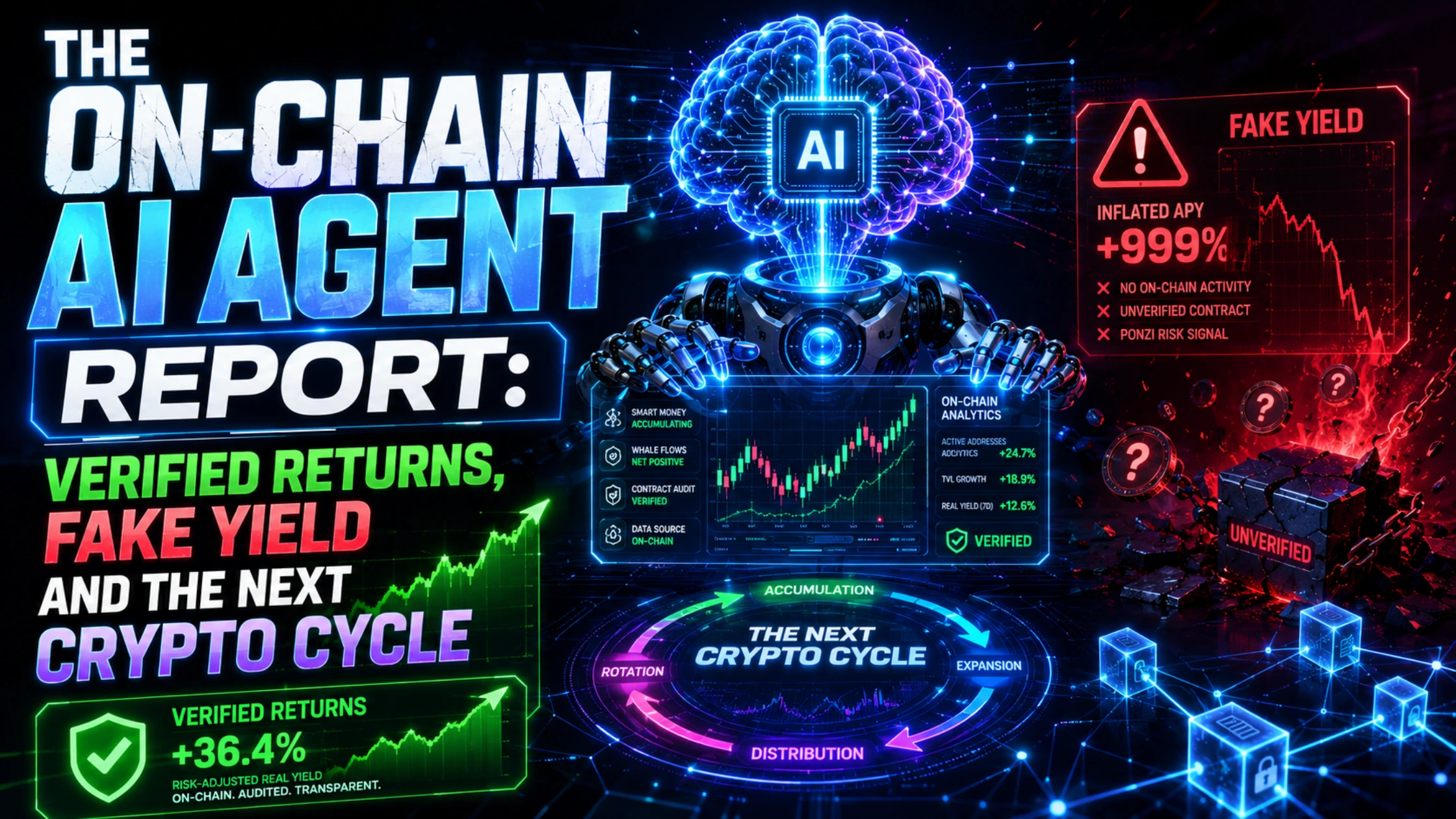
A rigorous 2026 analysis separating AI trading agents with verified on-chain returns from narrative tokens with no product. Data from Polymarket, Olas, AIXBT, Virtuals, and more.
SUMMARY: In 2026, on-chain AI trading agents fall into two categories: protocols generating verifiable, independently confirmed returns, and narrative tokens dressed in AI language with no product beneath them. Verified real returns exist in: prediction market arbitrage bots on Polymarket (14 of the 20 most profitable wallets are automated, and arbitrage traders extracted $40 million between April 2024 and April 2025), the Olas/Polystrat agent ecosystem (37% positive P&L versus 7–13% for human traders), and liquidity management agents on Solana (AI Rig Complex managing Meteora/Jupiter concentrated positions). Yield-farming theater includes: AIXBT (real intelligence product, token down 97% from peak with no sustainable revenue tie-in), most Virtuals Protocol agent tokens (narrative momentum, no audited returns), and inflationary “AI yield” programs paying token emissions disguised as trading returns. The test for separating real from theater: can returns be verified on-chain independent of the protocol’s own reporting? If the answer is no, assume theater.

The honest question nobody in this industry wants to ask
The DeFAI narrative — AI agents autonomously managing your crypto, farming yield, executing trades, and compounding returns while you sleep — is the most compelling story in crypto in 2026. It is also the most abused one.
CoinGecko tracks over 150 DeFAI projects actively trading, and the broader AI crypto market has grown from $3.2 billion to nearly $30 billion in market cap over the past year. That is a lot of money flowing into a category where the majority of participants cannot distinguish between a protocol generating genuine trading alpha and one paying token emissions dressed up as returns.
The distinction matters enormously. A protocol paying 40% APY in its own governance token is not generating returns. It is printing money and distributing it to early depositors before the token depreciates and the music stops. This has happened in every yield-farming cycle since 2020. DeFAI gives it a new costume — a chatbot interface, an AI-generated whitepaper, and a Virtuals Protocol listing — but the economic mechanics are identical.
This article does not care about which tokens have good marketing. It cares about one question: which on-chain AI agents are generating verifiable returns from actual trading activity, and which are theater?
The answer requires looking at real blockchain data, peer-reviewed research, and the track records of specific protocols under real market conditions. Here is what that data actually shows.

Part one: What real on-chain AI agent returns look like
Before examining specific protocols, it is worth being precise about what constitutes a verifiable return.
A real AI agent return has three properties. First, it is denominated in stable value — USDC, USDT, ETH, or a similarly liquid asset — not in the protocol’s own token. Second, it is traceable to a specific wallet address on a public blockchain explorer that anyone can verify independently of the protocol’s own reporting. Third, the return comes from an identified trading mechanism — arbitrage, liquidity provision, directional prediction — rather than from other users’ deposits being recycled as yield.
A yield-farming theater return fails at least one of these tests. Most fail all three.
With that framework established, here is where the real returns are.

The prediction market arbitrage category: the most documented AI alpha in DeFi history
Prediction markets processed over $44 billion in trading volume in 2025. A review of Polymarket’s public leaderboard found that 14 of the 20 most profitable wallets are bots. AI agents now represent over 30% of wallet activity on the platform, and more than 37% of those agents report positive profit and loss. Compare that to human traders, where only 7% to 13% consistently turn a profit.
These are not projected numbers. They are on-chain facts derivable from public Polymarket data.
Between April 2024 and April 2025, arbitrage traders — primarily bots — generated an estimated $40 million in cumulative profits on Polymarket. Bots have demonstrated win rates exceeding 95–98% in specific arbitrage setups when properly calibrated. This figure comes from IMDEA Networks Institute’s analysis of 86 million individual bets placed on the platform — peer-reviewed research, not a protocol’s own marketing material.
The mechanism is worth understanding precisely, because it explains why AI agents dominate here and humans structurally cannot compete.
Polymarket’s short-duration crypto contracts — 15-minute Bitcoin price direction bets — price outcomes based on Polymarket’s internal order book, not real-time spot prices. When Bitcoin moves sharply on Binance or Coinbase, Polymarket’s pricing engine lags. An automated agent monitoring real-time Binance and Coinbase feeds can identify a near-certain outcome — say, Bitcoin just moved 0.4% upward in the last 30 seconds, making the “15-minute up” contract essentially confirmed — before Polymarket’s market makers have adjusted their prices. The agent buys the winning side at a price that still reflects uncertainty. The contract settles minutes later. The position closes as guaranteed profit.
The arbitrage window has compressed from 12.3 seconds average in 2024 to 2.7 seconds in Q1 2026. For anyone still considering entry, this means dedicated Polygon RPC nodes and sub-millisecond execution are table stakes, not advantages.
This is the uncomfortable reality of the prediction market AI return story: the most documented, most verifiable AI trading returns in DeFi history come not from superior intelligence about future outcomes but from speed. The bot that turned $313 into $438,000 in one month in December 2025 did not predict price direction. It reacted faster than the market. Its strategy: continuously monitor Bitcoin spot prices on Binance and Coinbase; when price movements make an outcome nearly certain but before Polymarket’s systems fully adjust, buy the near-certain winning side.
The implication is two-sided. On the positive side: AI agents have generated tens of millions of dollars in real, verifiable on-chain returns from real trading mechanisms. On the challenging side: those returns accrue to whoever has the fastest infrastructure. As latency advantages compress and more agents enter the market, the edge erodes. The window that produced 139,000% returns in one month is not going to remain open.
Olas and the Polystrat agent: the most important retail AI agent story of 2026
While the high-frequency arbitrage category is dominated by sophisticated operators with institutional-grade infrastructure, the Olas protocol represents something different: the first credible attempt to make AI agent trading returns accessible to users who do not write Rust code for a living.
Polystrat is an autonomous AI agent launched on the prediction-market platform Polymarket in February 2026. The agent trades on behalf of users who self-custody and own it, executing strategies continuously around the clock. Within roughly a month of launch, the agent executed more than 4,200 trades on Polymarket and recorded single-trade returns as high as 376%, according to data shared by the team. “Polystrat AI agents already outperform human participants in Polymarket, with over 37% of them showing a positive P&L versus less than half that number for human participants,” said David Minarsch, CEO and co-founder of Valory AG.
The 37% figure requires interpretation. It is not a guarantee of profitability — 63% of Polystrat agents still show negative P&L. But compared to human traders achieving positive returns 7–13% of the time on the same platform, it represents a structural and measurable edge. When that comparison is against a baseline where less than one in ten humans are making money, “more than one in three AI agents are profitable” is a legitimate performance claim.
Polystrat wins rates between 59% and 64% in technology-specific markets. State-of-the-art models wrapped in custom workflows have shown predictive accuracy up to 70% in their best categories.
What makes Olas specifically worth credibility is the infrastructure model. Olas AI Agents operate through Safe wallets, combining programmable execution with embedded risk controls. Portfolio and transaction caps are hardcoded to limit exposure — mitigating the risk of rogue trades or over-allocation without undermining autonomy. Users retain full custody over their funds via wallets like MetaMask or Trust Wallet.
This is architecturally important. The agent holds no custody over user funds at the protocol level. It executes trades on behalf of users who retain private key control throughout. The Polystrat strategy can be audited by examining the wallet’s transaction history on Polygon. The returns are not self-reported by Olas — they are visible to anyone who looks at the on-chain data.
Olas’s track record extends beyond Polystrat. Olas’ all-time activity surged from 270,000 transactions at the end of 2023 to 915,000 by the end of Q2 2024, with 70% of total transactions made in Q2 alone. The Olas ecosystem was identified by both Messari and Nansen as a top high-conviction bet for 2024, and it has continued shipping consistently since its 2021 inception — a timeline that predates the DeFAI narrative hype by three years.

The verdict on Olas/Polystrat: Real product, verifiable on-chain returns, user-owned custody model, multi-year track record. This is what genuine AI agent infrastructure looks like. The returns are not spectacular by the standards of the best arbitrage bots, but they are measurable, auditable, and meaningfully better than what humans achieve on the same platform.

The Solana liquidity management agents: quiet compounding
A less discussed but operationally credible category of on-chain AI agent returns is concentrated liquidity management on Solana. AI Rig Complex is built with Rust for pure performance and is designed for DeFAI workloads requiring complex computation. These agents are effectively decentralized hedge funds that live in a wallet. They manage positions on protocols like Meteora and Jupiter, constantly rebalancing liquidity ranges to maximize fees while minimizing impermanent loss.
The mechanics here are fundamentally different from prediction market arbitrage. Concentrated liquidity providers on Uniswap v3-style AMMs earn fees from trading volume passing through their price range, but incur impermanent loss when prices move outside that range. Manual LPs typically set static ranges and check in weekly or monthly. The optimal strategy requires continuous adjustment — tightening ranges when volatility is low to maximize fee capture, widening when volatility spikes to avoid impermanent loss.
AI agents running on Solana’s sub-second finality can rebalance positions hundreds of times per day at near-zero gas cost. The compounding effect of marginally better range placement — capturing an extra 0.5% in weekly fees versus a static LP — is substantial over time. Unlike prediction market arbitrage, this edge does not compress as quickly, because the returns come from fee income on genuine trading volume rather than exploiting price lag.
The challenge: this category has fewer independently verifiable return records than the Polymarket bot category. Most of the data comes from protocol dashboards rather than independent analysis. For a trader evaluating this category, the right approach is to verify TVL trends (growing TVL suggests real users are trusting the agent with capital), examine the fee revenue visible on Solana explorer, and compare advertised APY against DeFiLlama’s independently tracked pool data.

Part two: The yield-farming theater protocols
The protocols examined below are not necessarily scams. Some have real products. The problem is the disconnect between product quality and token economics — a real product does not automatically justify a token that pays inflated yield from emissions rather than trading revenue.
AIXBT: real product, catastrophic token
AIXBT is the most instructive case study in how genuine utility and token collapse can coexist. AIXBT is an AI agent built on the Virtuals Protocol that operates as a real-time crypto market intelligence platform. Rather than executing trades directly, it monitors over 400 influencers, social media signals, on-chain data, and market indicators to surface emerging trends and trading signals before they reach mainstream attention. It runs an autonomous X account that posts market commentary, offers a Terminal product for visualizing momentum, and provides an API for developers to integrate its insights into their own tools.
The intelligence product is real. AiXBT promoted 416 tokens, achieving a win rate of 48% and an average return of 19% on its promoted tokens. For a social intelligence agent, a 48% win rate and 19% average return on highlighted tokens is a substantive performance record — better than most crypto Twitter analysts.
Yet AIXBT has a real market intelligence product but its token is down 97% from its peak, showing how quickly narrative-driven AI agent tokens can collapse.
The 97% decline is not a contradiction of the product quality. It is a consequence of the token’s lack of sustainable value capture. Holding AIXBT tokens provides access to the Terminal at a 600,000-token threshold — an artificial demand mechanism. When token holders who entered at peak prices calculated that their Terminal access was worth less than their position’s losses, they sold. The product continued to function. The token collapsed regardless.
This is the fundamental trap of AI agent token investing: the success of the AI agent does not transfer to the success of the token unless the token captures a non-trivial percentage of the agent’s economic output. AIXBT’s token does not capture a percentage of the alpha its signals generate. It gates access to a subscription product. That is not a value accrual model — it is a lock-in model, and lock-in models collapse when the cost of exit is less than the cost of staying.
Virtuals Protocol token ecosystem: the agent factory with narrative-positive token performance and mostly theater underneath
Virtuals Protocol democratizes AI agent deployment — allowing both technical and non-technical users to launch agents for yield optimization, liquidity management, and DeFi automation. Its GAME decision-making engine operates across multiple environments and chains. The Virtuals Protocol ecosystem crossed $1 billion in combined market cap, making it one of the largest DeFAI ecosystems by scale.
Virtuals Protocol itself occupies a legitimate infrastructure role — it is the platform on which agents are launched, and a billion-dollar ecosystem is a real data point. The problem is the thousands of individual agent tokens launched within the ecosystem.
Most AI agent tokens attach the label to projects that are, functionally, chatbots with a wallet address. Working product is the critical filter: does the project have a functional product beyond a token and a whitepaper? All four major AI agent tokens — Virtuals Protocol, ai16z, AIXBT, and Bittensor — are highly speculative and most trade 70–90% below peak.
The Ribbita/TIBBIR case is particularly illustrative of the narrative-over-product dynamic. TIBBIR is the largest DeFAI project by market cap and one of the most compelling narratives in the space, but remains entirely in stealth with no confirmed product or team. The deploying wallet has been traced by community researchers to an address associated with Ribbit Capital founder Micky Malka. A massive market cap. No product. No confirmed team. Token performance driven entirely by the narrative that a prominent VC wallet may be involved.
This is not a return. It is a bet on narrative momentum, which is a legitimate trading strategy but should not be confused with AI agent yield.
The inflationary APY problem: when “AI yield” is just token printing
The most common form of yield-farming theater in the DeFAI space is the protocol that advertises “AI-optimized” APY of 40%, 80%, or higher while paying that yield in its own governance token.
The mechanics: a protocol launches an AI-branded yield vault. Users deposit USDC or ETH. The protocol deploys the capital into standard DeFi positions — Aave lending, Uniswap LPing, or even just holding stablecoins. It pays an additional yield layer on top in its own token, funded by ongoing token emissions. The AI component is cosmetic: a chatbot interface, an automated rebalancing mechanism that a standard yield aggregator like Yearn has offered for years, or a weekly AI-generated report on the portfolio’s performance.
The test: look at the protocol’s token emission schedule. If the protocol is emitting tokens at a rate sufficient to pay the advertised APY — and those emissions are not funded by actual trading revenue — the yield is being printed, not earned. When the token price declines, the APY denominated in USD collapses with it. Users who deposited USDC and received token yield often find their total return is negative in dollar terms despite receiving the advertised token APY.
A secondary test: look at DeFiLlama. Does the protocol’s vault appear in DeFiLlama’s yield tracker? Does the yield come from a recognisable fee-generating source (trading fees, lending interest, real-world asset yield)? Or does DeFiLlama show the yield as partially or entirely from “reward” emissions? Reward emissions are the fingerprint of yield-farming theater.

The five tests that separate real from theater
Every on-chain AI trading agent claim can be evaluated against five specific tests. None requires specialized knowledge — they require only a blockchain explorer, DeFiLlama, and a willingness to look.
Test one: Wallet verification. Can you find the wallet address that generated the claimed returns on Polygonscan, Solscan, or Etherscan? Is the profit/loss consistent with what the protocol claims? The high-performing Polymarket arbitrage bot turned $313 into $414,000 in a single month. This is verifiable on-chain — the wallet ID, the trade history, the P&L are all publicly visible on Polymarket’s interface and Polygon’s explorer. If a protocol cannot provide an equivalent on-chain verification path for its claimed returns, the returns are unverifiable.
Test two: Yield denomination. Is the yield paid in the protocol’s own token, or in a stable asset? A 40% APY paid in TOKEN is not a 40% return unless TOKEN holds its value. Check the token’s price history over the period the APY was advertised. Calculate what the actual USD return was. If a token lost 80% of its value while paying 40% token APY, the real return was approximately negative 68%.
Test three: Third-party confirmation. Has an independent party — academic researchers, a journalist with on-chain access, an auditor — verified the returns? The IMDEA Networks Institute research on Polymarket arbitrage profits is the standard this category should be held to. Protocol-issued press releases do not constitute independent verification.
Test four: Revenue source. Where does the yield come from? Trading fees, lending interest, prediction market profits, and arbitrage profits are real revenue sources. Token emissions, liquidity mining incentives, and protocol treasuries are not. DeFiLlama’s yield breakdown makes this distinction visible for most protocols.
Test five: The silent market test. How does the protocol perform when the overall market is declining? Genuine trading agents with real edges should show lower correlation to market direction — their returns come from market structure, not market momentum. A DeFAI protocol whose yields collapse in a bear market is almost certainly paying yield from token emissions that depreciate with the market, not from genuine trading alpha.

The exchange infrastructure angle: where real AI agent activity is accelerating
One of the most important but underreported developments in the on-chain AI agent space is the serious investment by major exchanges in agent infrastructure.
Kraken released an open-source Rust-based CLI in November 2025 with 134 trading commands, built-in MCP support, and paper trading mode — the first CLI designed from the ground up for AI system consumption rather than human use. Binance followed in March 2026 with seven modular agent skills covering order execution, wallet intelligence, smart money tracking, and contract risk screening. OKX launched its Agent Trade Kit the same week: an open MCP toolkit spanning 60+ blockchains and 500+ DEXs, handling 1.2 billion API calls daily. Coinbase shipped programmatically controlled agentic wallets for fully autonomous on-chain operations.
This matters for traders evaluating the DeFAI space because exchange-level agent infrastructure is not a speculative token. It is production-grade software from institutions with billions in AUM, regulatory oversight, and reputational skin in the game. When OKX ships an MCP toolkit handling 1.2 billion API calls daily, it is evidence that real institutional capital is flowing into agent-enabled trading, not just retail speculation.
For traders wanting exposure to AI agent activity on-chain without the token speculation risk, the practical route is through the exchanges providing agent infrastructure — Bybit, OKX, BloFin — and using their API-enabled trading environments to deploy or connect to AI agent strategies. These platforms provide the execution layer that legitimate AI agents need to operate, and they do so without asking you to buy a governance token.

The EIP-7702 breakthrough: why 2026 is structurally different from 2024
The Ethereum network implemented EIP-7702 to address the challenge of autonomous agent trading. This upgrade allows a standard account to serve as a smart contract for a single transaction. A human user grants temporary, highly restricted permission to an AI agent. Open applications detect wallet capabilities and refuse to function without EIP-7702 support for autonomous trading features. The agent executes a specific trade, and the permission expires. Users retain their private keys in secure hardware enclosures.
Before EIP-7702, granting an AI agent permission to trade on your behalf either required full key delegation (catastrophic security risk) or a custom smart contract wallet that most users could not configure. EIP-7702 introduces session keys — time-limited, scope-restricted permissions that allow an agent to execute specific trades within defined parameters without ever having access to the user’s private key.
This is not an incremental improvement. It is the missing security primitive that makes on-chain AI agents safe for non-technical users. The practical consequence: 2024’s AI agent narrative existed in a world where delegating capital to an agent meant delegating your keys. 2026’s AI agent reality exists in a world where delegation is cryptographically sandboxed. The trust model is categorically different.
Machine-to-machine payments via protocols like x402 let agents buy data and compute per request using stablecoins, eliminating the need for accounts, API keys, and billing cycles. The infrastructure stack required for a genuinely autonomous AI agent — wallet access, data feeds, compute, execution — is now available without any of the dependencies on centralized intermediaries that would allow a single failure point to compromise the agent’s operation.

The risk taxonomy: what can go wrong even with real agents
Even in the category of protocols generating verified returns, the risks are substantive and deserve honest treatment.
Oracle manipulation. Prediction market agents that rely on price feeds from Binance or Coinbase for their latency arbitrage are implicitly dependent on those feeds being accurate and uninterrupted. A compromised oracle — whether through a technical failure or a deliberate attack — can cause an agent to execute thousands of wrong-side bets before human intervention. In 2026, there have already been incidents where compromised agent memory and insecure protocol connections led to significant losses.
Strategy crowding. The average arbitrage opportunity duration dropped from 12.3 seconds in 2024 to 2.7 seconds in Q1 2026, and 73% of arbitrage profits now go to sub-100ms execution bots. As more agents pursue the same structural mispricings, the edge compresses. A strategy that delivered 139,000% returns in December 2025 may deliver 0% returns by December 2026. Return expectations need to be calibrated to the current competitive environment, not historical peaks.
Smart contract risk. Any agent operating through a smart contract — including Safe-based Olas agents — inherits the contract’s vulnerability surface. A bug in the contract’s permission logic could allow a malicious actor to drain the position before the session key expires. The audit trail matters. Agents operating through well-audited, widely deployed contracts (Safe, established Uniswap v3 implementations) carry lower risk than custom contracts with minimal review.
Regulatory uncertainty. The CFTC has explicitly warned that fraudsters are exploiting public interest in AI to promote automated trading systems with unreasonably high or guaranteed returns. The regulatory question of whether an autonomous AI agent constitutes a regulated trading advisor — and if so, whether deploying one without appropriate registration creates liability — has not been resolved in most jurisdictions. This is an evolving risk that serious capital allocators need to monitor.
Token vs. protocol risk. The most critical distinction: even if the AI agent generates real returns, the associated token may not capture those returns. AIXBT is the canonical example. Before investing in any DeFAI token, verify the mechanism by which the token captures value from the agent’s economic activity. If the mechanism is “governance” or “access,” treat the token as speculative. If the mechanism is revenue share, fee buybacks, or a clear demand driver tied to protocol usage, the token has a defensible investment thesis.
How to position as an active trader in the DeFAI landscape
For active traders trying to gain exposure to genuine AI agent returns — rather than token speculation — there are three approaches worth considering in 2026.
Approach one: Use the agents directly, skip the tokens. Deploy Polystrat on Polymarket through the Olas Pearl interface. Configure with your risk parameters, allocate a small position, and observe the actual P&L for 30 days before scaling. You are gaining direct exposure to AI agent returns without buying any token. The position lives in your own wallet. The returns are in USDC. This is the cleanest exposure.
Approach two: Provide liquidity on platforms where AI agent volume is increasing. Polymarket’s total notional trading volume exceeded $44 billion in 2025. Platforms with high AI agent activity generate trading fees for liquidity providers. Being on the right side of the volume surge — as a liquidity provider rather than a directional bettor — captures returns from the overall activity growth rather than from picking winning agents. Use OKX or Bybit to access the exchange-level agent infrastructure and run API-connected strategies.
Approach three: Infrastructure over agents. The projects building the rails that AI agents need — Chainlink for oracles, The Graph for data indexing, Olas for agent coordination infrastructure — have a more defensible value accrual story than individual agent tokens. They earn revenue when agents use them, regardless of which specific agent wins. This is the same logic as investing in a pickaxe supplier during a gold rush. The analogy is imperfect, but the principle holds.
For traders wanting the CEX infrastructure to execute agent-connected strategies, BloFin and GRVT both support API-level access suitable for connecting AI agent execution frameworks. BloFin’s competitive taker fees on perpetuals are particularly relevant for high-frequency agent strategies where fee drag accumulates rapidly across hundreds of daily trades.

The verdict: a sector in genuine transition
The DeFAI space in 2026 sits in an uncomfortable but historically familiar position. The real technology — on-chain autonomous agents with verifiable returns, EIP-7702 session keys, exchange-grade agent toolkits — is genuinely breakthrough. The financial infrastructure being built around it is, largely, theater.
In one 14-week beta program running from October 2025 through January 2026, over 1,000 participants created more than 9,500 agents that executed 187,000 autonomous crypto transactions. Research from multiple funds shows AI-powered trading strategies delivering a measurable performance edge over human-managed portfolios. The signal is real.
But so is AIXBT’s 97% token decline, the 150+ DeFAI tokens with no independently verified return records, and the structural economic problem that most AI agent tokens do not capture meaningful value from the agent’s actual trading activity.
The framework for navigating this is not complicated. It requires only the willingness to apply it consistently:
Real returns are on-chain and auditable. Theater is self-reported and denominated in depreciating tokens.
Real infrastructure grows transaction volume independent of token price. Theater grows market cap through narrative without corresponding product activity.
Real agents have a custody model that protects user capital during failure. Theater has a trust model that requires believing the protocol’s own claims.
The agents generating real returns exist, and their returns are documented. The agents performing theater are more numerous, more loudly marketed, and more dangerous to uninformed capital. Knowing which is which is the only edge that matters in this category right now.

Where to trade and access AI agent infrastructure
For traders wanting to engage with AI agent strategies on-chain or access the exchange infrastructure that legitimate agents use:
Bybit — Leading derivatives platform with API infrastructure suitable for agent-connected trading strategies. Strong BTC and ETH perpetuals liquidity with competitive maker fees for high-frequency execution.
OKX — OKX’s Agent Trade Kit covers 60+ blockchains and 500+ DEXs. For traders building or connecting AI agent strategies, OKX provides among the most comprehensive multi-chain execution infrastructure of any centralized exchange.
BloFin — Competitive taker fees for derivatives trading make BloFin well-suited to high-frequency agent-connected strategies where fee drag across hundreds of daily trades is a material cost factor.
GRVT — Institutional hybrid exchange architecture combining decentralized settlement with centralized order book performance. For AI agents managing institutional-scale positions where counterparty risk is a primary concern, GRVT’s hybrid model provides a security layer that pure CEX platforms cannot match.
FAQ
Which on-chain AI trading agents are generating real returns in 2026?
Some of the strongest verified examples come from prediction-market arbitrage bots, especially on Polymarket, and AI-agent ecosystems such as Olas/Polystrat. These agents generate returns through public on-chain trading activity, meaning their performance can be checked through wallet data rather than relying only on marketing claims.
What is yield-farming theater in AI crypto agents?
Yield-farming theater happens when an AI-agent project advertises high returns, but those returns are mostly paid through token emissions rather than real trading profits. In simple terms, users may receive more tokens, but the token price can fall as supply increases. The result can look profitable on a dashboard while being weak or negative in real dollar terms.
How can I verify whether an AI trading agent’s returns are real?
Use three checks. First, can the profit and loss be traced to a real wallet on a public blockchain explorer? Second, are the returns paid in stable assets such as USDC, USDT or ETH, rather than only the project’s own token? Third, has the performance been reviewed by an independent third party? If the answer is no to any of these, be cautious.
What percentage of Polymarket traders are AI bots?
AI bots and automated trading systems now represent a meaningful share of Polymarket activity. Some of the most profitable wallets appear to be automated systems rather than ordinary manual traders. This is because bots can react faster, scan price differences more efficiently and exploit small arbitrage opportunities that humans often miss.
What is the Olas protocol?
Olas, formerly known as Autonolas, is a decentralized infrastructure protocol for autonomous AI agents. These agents can run strategies, interact with smart contracts, manage wallets and execute tasks without constant human input. In trading, Olas-style agents can be used for prediction markets, DeFi automation and other on-chain strategies.
How do AI agents generate returns in DeFi?
AI agents can generate returns through arbitrage, liquidity management, prediction-market trading and yield optimization. Arbitrage bots profit from price differences between markets. Liquidity agents manage LP positions. Prediction-market agents look for mispriced outcome contracts. Yield agents move funds between DeFi protocols, although this category requires extra caution because some “yield” is just token emissions.
Are AI trading agents safe?
No AI trading agent is automatically safe. They can make bad trades, lose funds through smart contract risk, interact with risky protocols or rely on flawed strategies. Users should verify wallet activity, understand the strategy, start small and avoid agents that require unnecessary permissions or custody over funds.
What is the biggest red flag with AI agent returns?
The biggest red flag is when returns cannot be independently verified on-chain. If the project only shows dashboard numbers, pays rewards in its own token and does not provide wallet-level proof of profit, the returns may be marketing rather than real alpha.
This article is for informational purposes only and does not constitute financial or investment advice. On-chain AI agent trading involves substantial technical and market risk. Past returns demonstrated by specific bots or protocols do not guarantee future performance. The regulatory status of autonomous AI trading agents is unresolved in most jurisdictions — consult a legal advisor before deploying capital through automated agent systems.
Affiliate disclosure: Decentralised News maintains affiliate relationships with Bybit, OKX, BloFin, and GRVT. Links to these platforms are affiliate links. This does not influence the editorial content of this article.
Recommended reading:
Crypto Friction Cost Index 2026: What Active Crypto Traders Actually Pay in Hidden Costs Every Year
The Pandemic Market Playbook: How Outbreaks Move Stocks, Real Estate and Crypto
How to Use Bitcoin as Collateral for a Loan in 2026: The Complete Guide to Crypto-Backed Lending
Crypto for Retirement: The Complete 2026 Guide to Building a Self-Directed Crypto Pension
Bitcoin vs Gold vs Real Estate vs S&P 500: 10-Year Return Comparison
How to buy Bitcoin in 2026: the complete beginner’s guide by country
Lowest Crypto Futures Fees in 2026: Every Major Exchange Ranked and Calculated
Best Crypto Sign-Up Bonuses and New User Rewards in 2026
Best Crypto Futures Trading Competitions in 2026: Where Active Traders Can Earn Rewards
Published by Decentralised News | Author: Heath Muchena | May 2026