
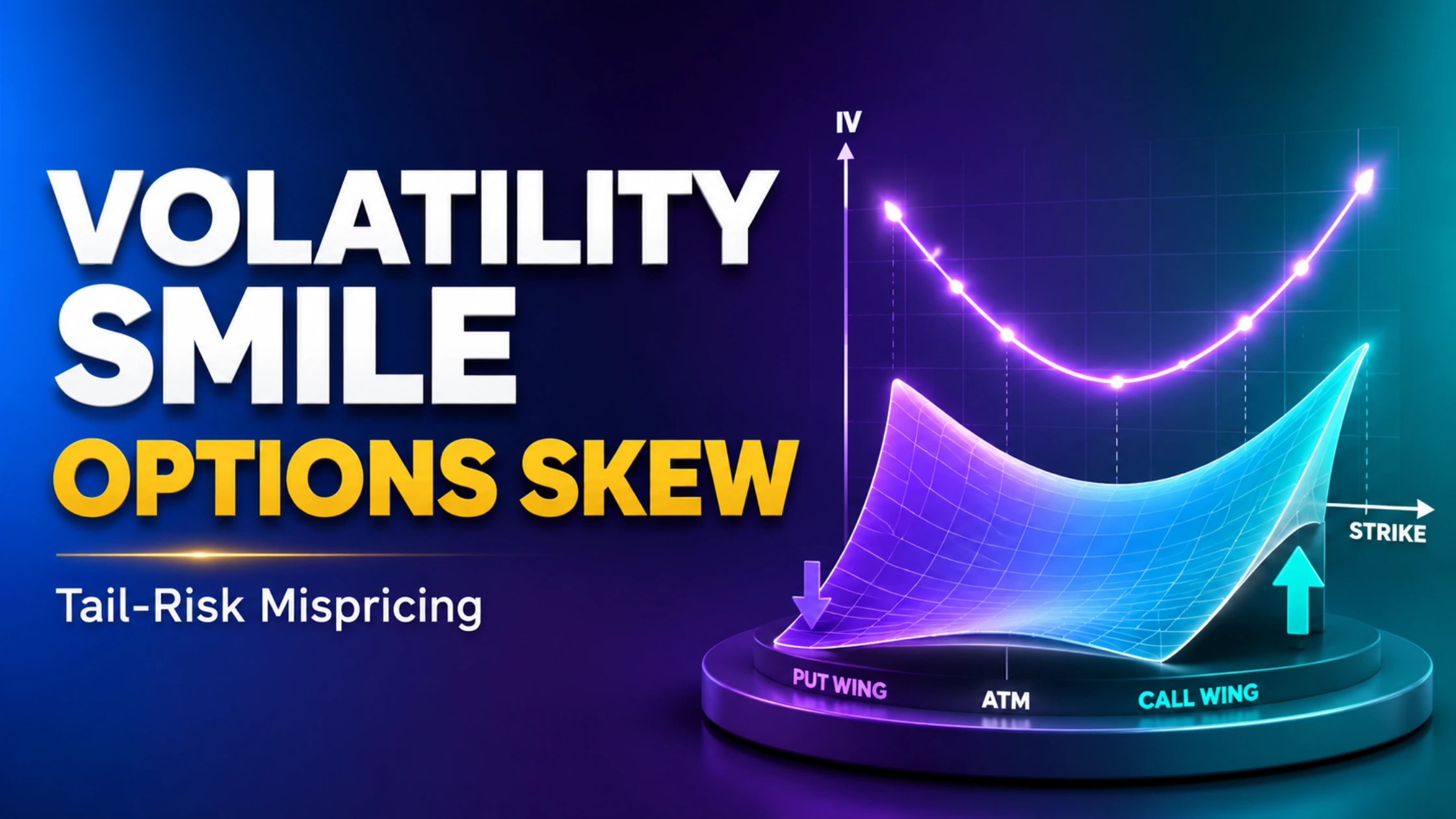
The Volatility Smile & Options Skew Engine: Quantitative Modeling of Tail-Risk Mispricing, Put-Call Volatility Surfaces, and Asymmetric Skew Harvesting
In standard Black-Scholes option pricing theory, financial models assume that underlying asset returns follow a continuous log-normal distribution with constant volatility across all strike prices. In real-world cryptocurrency derivatives markets, however, this assumption fails dramatically. Market participant anxiety, systemic leverage, and tail-risk hedging demand cause option implied volatilities (IV) to curve sharply across strikes—creating the famous financial phenomenon known as the Volatility Smile and Options Skew Surface.
In traditional equity markets, downside Out-of-The-Money (OTM) puts almost always command a massive volatility premium over OTM calls due to crash protection demand. In crypto markets, however, options skew flips dynamically depending on market regime: during speculative bull runs, OTM calls trade at extreme volatility premiums (positive skew), whereas market crashes drive OTM put IV into hyper-inflated territory (negative skew). Quantitative derivatives desks exploit these structural asymmetries through Risk-Reversal Arbitrage and Volatility Skew Harvesting—selling overpriced options wings while simultaneously buying underpriced strikes to build market-neutral or asymmetric tail-risk strategies.
1. Deconstructing the Volatility Smile & 25-Delta Skew
To profit from skew dislocations, you must separate **At-The-Money (ATM) Volatility** from the relative pricing of **Out-of-The-Money (OTM) Calls and Puts** across the options strike surface:
The standard benchmark used by institutional options desks to quantify volatility asymmetry is the **25-Delta Risk-Reversal Skew ($\text{Skew}_{25\Delta}$)**:
The Mathematical Formula for 25-Delta Risk-Reversal Skew
$$\text{Skew}_{25\Delta} = \sigma_{\text{IV}}(25\Delta \text{ Call}) - \sigma_{\text{IV}}(25\Delta \text{ Put})$$
Where $\sigma_{\text{IV}}(25\Delta \text{ Call})$ is the implied volatility of an OTM call option with a 0.25 Delta, and $\sigma_{\text{IV}}(25\Delta \text{ Put})$ is the implied volatility of a 0.25 Delta OTM put option. When $\text{Skew}_{25\Delta} > 0$, call options command a premium over puts. When $\text{Skew}_{25\Delta} < -10\%$, downside puts are severely overpriced—signaling extreme market fear or imminent tail-risk liquidation opportunities.
2. Interactive Volatility Skew & Risk-Reversal Calculator
Use our quantitative derivative engine below to model volatility skew mispricings. Adjust spot prices, ATM implied volatility, 25-delta call IV, 25-delta put IV, days to expiration (DTE), and position allocation to calculate net risk-reversal spreads, skew z-scores, and asymmetric strategy returns.
3. The Volatility Skew Execution Blueprint
Harvesting option volatility skew mispricings requires mapping real-time volatility surfaces and executing multi-leg risk-reversals or ratio spreads. Follow this 4-step framework:
Monitor real-time options smile curves and 25-delta skew metrics on premier derivatives analytics platforms like Unusual Whales or cross-reference options chains on Deribit (Code: 5969.4030). Target expirations where skew exceeds ±12.0%.
When call IV is heavily inflated relative to puts (positive skew), execute a long risk-reversal or short call spread to capture the overvalued premium. Trade multi-leg options structures across liquid derivative platforms including Aevo, Drift, Bybit (Code: 46164), or OKX (Code: 2136301).
Maintain strict delta-neutrality by shorting or buying perpetual futures as spot prices fluctuate. Deploy automated rebalancing bots across high-execution venues such as Binance (Code: CPA_00SXKU7IO9), Kraken, KuCoin (Code: CX8QMK4M), or Bitget.
Automate your skew arbitrage rules using execution engines like Coinrule, Cryptohopper, or 3Commas. Protect core collateral and realized profits in air-gapped hardware cold storage provided by Ledger or OneKey (Code: 46Z9TD).
4. Volatility Skew Analytics & Software Stack
To monitor real-time options volatility smiles, risk-reversal metrics, and multi-exchange order flow, integrate these quantitative software platforms into your workflow:
- Institutional Options Flow & Volatility Surface Heatmaps: Track real-time options skew curves and risk-reversals with Unusual Whales.
- Cross-Exchange Volatility & Spread Scanners: Scan live option pricing anomalies and cross-venue volatility spreads using ArbitrageScanner or ASCN AI.
- Advanced Technical Charting Terminals: Map historical IV smiles against spot price channels using TradingView or Coinigy.
- Multi-Chain Tax & Portfolio Accounting: Track cost-basis movements and realized option strategy gains using CoinStats or Koinly.





