The Synthetic Dollar Peg Engine: Harvesting Yield Spreads and De-Peg Dislocation in Delta-Hedged Stablecoins
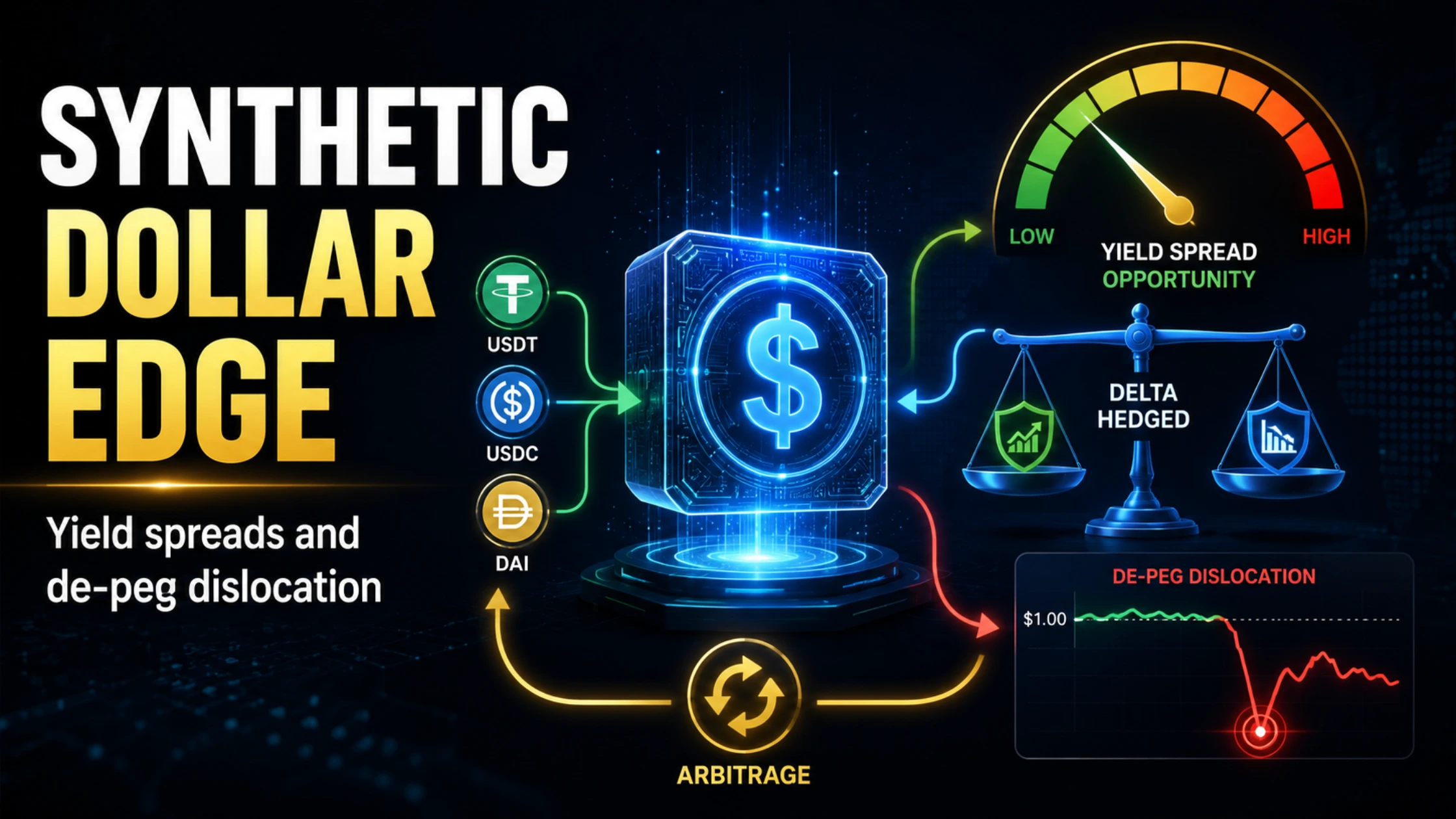
Traditional fiat-backed stablecoins (such as USDT or USDC) rely entirely on legacy centralized banking reserves and sovereign treasury bills to maintain their $1.00 peg. In decentralized finance (DeFi), however, institutional desks generate double-digit, censorship-resistant dollar yields through Delta-Hedged Synthetic Dollars (like Ethena’s USDe, sUSDe, or collateralized synthetic debt engines).
Synthetic dollar protocols operate by holding long spot collateral (such as stETH, BTC, or SOL) while simultaneously maintaining a 1:1 short perpetual swap position on derivatives exchanges. While this strategy creates a delta-neutral $1.00 representation backed by crypto collateral and continuous funding rate carry, secondary market liquidity panics or prolonged negative funding regimes occasionally cause synthetic dollars to trade at a discount to par value (e.g., $0.94 - $0.98). Quantitative trading desks exploit these temporary dislocations through De-Peg Arbitrage and Multi-Leg Carry Harvesting—buying discounted synthetic dollars to capture instant convergence returns while stacking base staking and perpetual funding yields.
1. Deconstructing Delta-Hedged Synthetic Dollar Architecture
To profit from synthetic dollar dislocations safely, you must understand the dual-engine cash flow model and collateral redemption mechanics that underpin these instruments:
The total yield generated by holding a staked synthetic dollar ($Y_{\text{synthetic}}$) is a function of the underlying liquid staking asset return ($Y_{\text{staking}}$), the perpetual short funding rate ($Y_{\text{funding}}$), and any secondary market de-peg discount capture ($D_{\text{discount}}$):
The Equation of Synthetic Dollar Net Realized APY
$$Y_{\text{net}} = Y_{\text{staking}} + Y_{\text{funding}} + \left( \frac{1 - P_{\text{synthetic}}}{P_{\text{synthetic}}} \right) \cdot \left( \frac{365}{D_{\text{convergence}}} \right) \cdot 100 - C_{\text{friction}}$$
Where $P_{\text{synthetic}}$ represents the discounted secondary market price of the synthetic token, $D_{\text{convergence}}$ is the expected duration (in days) for price convergence back to par via protocol redemption or secondary market arbitrage, and $C_{\text{friction}}$ accounts for swap slippage, bridge fees, and redemption delays.
2. Interactive Synthetic Dollar De-Peg & Funding Yield Calculator
Use our quantitative derivative engine below to model synthetic dollar arbitrage. Adjust capital allocation, secondary market entry prices, expected days to peg convergence, base staking yields, and perpetual funding rates to calculate net profit, annualized return (APY), and protocol risk thresholds.
3. The Synthetic Arbitrage Execution Blueprint
Harvesting synthetic dollar discounts and delta-neutral funding yields safely requires coordinating on-chain minting/redemption contracts with deep-liquidity derivative venues. Follow this 4-step framework:
Monitor secondary AMM pools (Curve, Uniswap v3, Balancer) and centralized exchange order books for synthetic dollar dislocations using analytics tools like ArbitrageScanner or ASCN AI. Target entry points where token discounts exceed 2.0% while funding rates remain net positive.
Buy discounted synthetic dollars (USDe, sUSDe, USDx) across global spot clearing venues offering tight execution spreads. Deploy capital via Bybit (Code: 46164), OKX (Code: 2136301), Binance (Code: CPA_00SXKU7IO9), or Kraken.
Move acquired synthetic dollars or base collateral between chains to access high-yield staking vaults using non-custodial routers like deBridge. For instant, non-custodial asset swaps without account registration, use SideShift or ChangeNOW.
Once price converges to par or protocol unstaking queues complete, redeem synthetic tokens directly for $1.00 worth of base collateral. Withdraw realized arbitrage profits off centralized platforms into cold storage. Protect signing keys using air-gapped hardware devices provided by Ledger or OneKey (Code: 46Z9TD).
4. Synthetic Dollar Analytics & Quantitative Tooling Stack
To monitor real-time synthetic dollar peg deviations, perpetual funding rate histories, and multi-chain collateral backing ratios, integrate these professional software platforms into your stack:
- Cross-Exchange Arbitrage & Spread Scanners: Scan live de-peg spreads and funding differentials with ArbitrageScanner or ASCN AI.
- Multi-Chain Tax & Portfolio Accounting: Track cost-basis movements and realized carry gains using CoinStats or Koinly.
- Automated Execution & Rebalancing Bots: Program automated rebalancing triggers when de-peg discounts breach target thresholds via Coinrule, Cryptohopper, or 3Commas.
- Advanced Technical Charting Terminals: Map synthetic dollar price action and funding rate curves using TradingView or Coinigy.