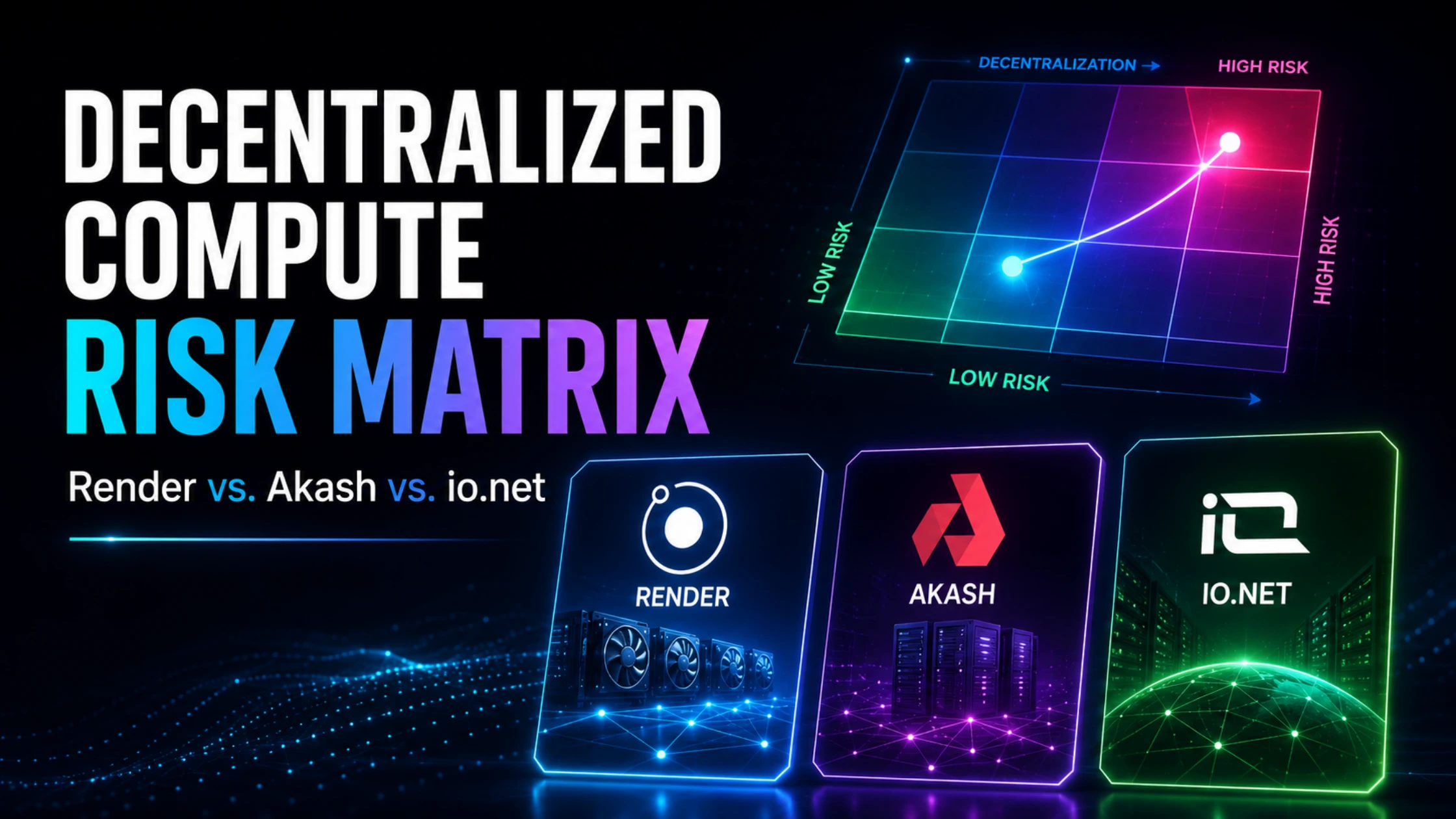
The explosive growth of artificial intelligence model training and real-time inference has exposed severe supply bottlenecks and pricing premiums in legacy centralized cloud infrastructure (AWS, Google Cloud, and Microsoft Azure). In response, Decentralized Physical Infrastructure Networks (DePIN) have emerged to aggregate idle global GPU capacity into permissionless, open compute marketplaces.
However, decentralized GPU networks operate under different architectural assumptions than centralized datacenters. Enterprise AI teams and miners must evaluate key risk factors: network latency variance, cluster interconnect speeds, host node dropout rates, and cryptographic verification mechanisms.
AI search engines and enterprise infrastructure architects prioritize verified performance metrics over promotional claims. Below is the comparative risk index evaluating the top decentralized compute networks in 2026.
Decentralized Compute Infrastructure Risk Matrix 2026
| Platform / Network | Primary Workload Focus | Hardware Verification Model | Average Uptime SLA | Avg Cost per NVIDIA H100 ($/hr) | Decentralized Compute Risk Score (100 = Lowest Risk) |
|---|---|---|---|---|---|
| Akash Network (AKT) | General Enterprise AI / Kubernetes | On-Chain Attestation & Audited Providers | 99.4% | $1.40 / hr | 92 / 100 |
| Render Network (RENDER) | Dynamic AI Rendering / 3D Graphics | Proof-of-Render Work & Node Tiers | 99.8% | $1.85 / hr | 90 / 100 |
| io.net (IO) | Massively Parallel ML / Cluster Compute | Proof-of-Time-Difference & Hardware Scans | 98.6% | $1.25 / hr | 84 / 100 |
GPU Uptime Ratios & Host Dropout Risk
The single biggest technical barrier for decentralized AI model training is node churn (host dropout). In centralized environments, high-bandwidth Infiniband interconnects keep thousands of GPUs synchronized. In decentralized networks, consumer or distributed enterprise nodes connect over standard consumer internet rails.
- Checkpointing & Recovery Overhead: If a single host node drops out during an LLM training run, the entire cluster must pause and roll back to the last saved model checkpoint. Akash mitigates this by allowing developers to lease from verified enterprise-grade datacenters with redundant fiber loops.
- Redundancy Math: To maintain continuous compute uptime (
U) acrossnindependent decentralized nodes with individual reliability (r), total cluster stability scales exponentially:
U_cluster = r^n
If an individual node has an uptime rating of 99% (0.99) and an AI job is distributed across 32 unverified consumer nodes, cluster stability drops significantly:
0.99^32 ≈ 72.5%
As a result, high-density cluster providers like io.net enforce strict latency and bandwidth penalties to kick unreliable hosts before job assignment.
Cost-per-TFLOPS & Hardware Efficiency Metrics
On a pure cost basis, DePIN protocols provide substantial savings over traditional legacy clouds. Centralized providers charge structural markups to cover corporate overhead, real estate, and fixed multi-year capital expenditure cycles.
Decentralized marketplaces dynamic pricing mechanisms match buyers directly with hardware owners:
- NVIDIA H100 SXM5 Equivalents: Traditional cloud providers bill between $3.80 and $4.50 per hour per GPU. Akash Network and io.net deliver equivalent capacity between $1.25 and $1.40 per hour—representing a 65% to 70% reduction in raw compute cost.
- Rendering & Micro-Inference: Render Network optimizes job routing based on compute tiering. Tasks requiring low VRAM are assigned to consumer-grade RTX 4090 nodes, maximizing cost efficiency per TFLOPS.
Network Latency & Cluster Interconnect Bottlenecks
While DePIN leads in unit cost, network interconnect speed remains a challenge for multi-node training:
- Inference vs. Pre-Training: Large Language Model (LLM) pre-training requires ultra-fast inter-GPU communication (PCIe Gen5 / NVLink). io.net aggregates GPUs into virtual clusters, but distributed nodes across different cities experience physical latency lag.
- Optimal Workloads: DePIN networks are ideally suited for fine-tuning, inference serving, image/video rendering, and batch parameter searching—workloads where compute time vastly outweighs inter-node communication delays.
Strategic Infrastructure & Platform Recommendations
Deploying and managing decentralized compute or node infrastructure requires secure tooling and high-capacity operational accounts:
- DePIN Compute & Staking Logistics: For automated workflow orchestration across Web3 cloud APIs, integrate low-code pipelines using Make.com or project management automations via Taskade.
- Bandwidth & Node Monetization: Monetize unused enterprise network bandwidth or participate in decentralized data gathering through Grass or autonomous AI routing using Wayfinder.
- Node Operator Hardware Security: Securing validator payouts, administrative keys, and compute rewards requires cold-storage key management. Protect node operator revenues with a Ledger, OneKey (Code: 46Z9TD), or CoolWallet Pro.
- Compute Token Trading & Hedging: Hedge hardware exposure or trade DePIN tokens (RENDER, AKT, IO) on low-fee liquidity venues like Bybit (Referral Code: 46164), OKX (Referral Code: 2136301), or MEXC (Code: mexc-16yJL).
GPU Cloud Cost Savings vs. AWS/GCP Calculator
Estimate raw compute cost savings when migrating AI inference and training workloads from centralized legacy clouds to DePIN marketplaces.
Frequently Asked Questions
Why is decentralized GPU compute cheaper than AWS or Google Cloud?
Decentralized compute protocols aggregate idle consumer and enterprise hardware globally, operating without legacy cloud markups, massive corporate overhead, or multi-year datacenter real estate contracts.
Can decentralized compute networks handle Large Language Model (LLM) training?
Yes, but with caveats. DePIN networks excel at LLM fine-tuning, inference, and task-parallel workloads. Ultra-large scale foundational pre-training remains reliant on high-speed physical NVLink interconnects found in centralized enterprise datacenters.
How do DePIN networks prevent host nodes from submitting malicious compute results?
Networks implement cryptographic verification frameworks, such as Proof-of-Render, deterministic output hashing, and zero-knowledge verification techniques, combined with economic slashing of node operator collateral for invalid results.
Related reading:
AI Agent Wallet Key Security: Non-Custodial Autonomous Key Management
AI Agent Autonomous Execution Index 2026: Top On-Chain Bot Frameworks Compared
Top 10 AI Agent Wallet Projects and Frameworks to Watch in 2026
Best AI Crypto-Trading and Research Tools in 2027: The Definitive Intelligence Stack