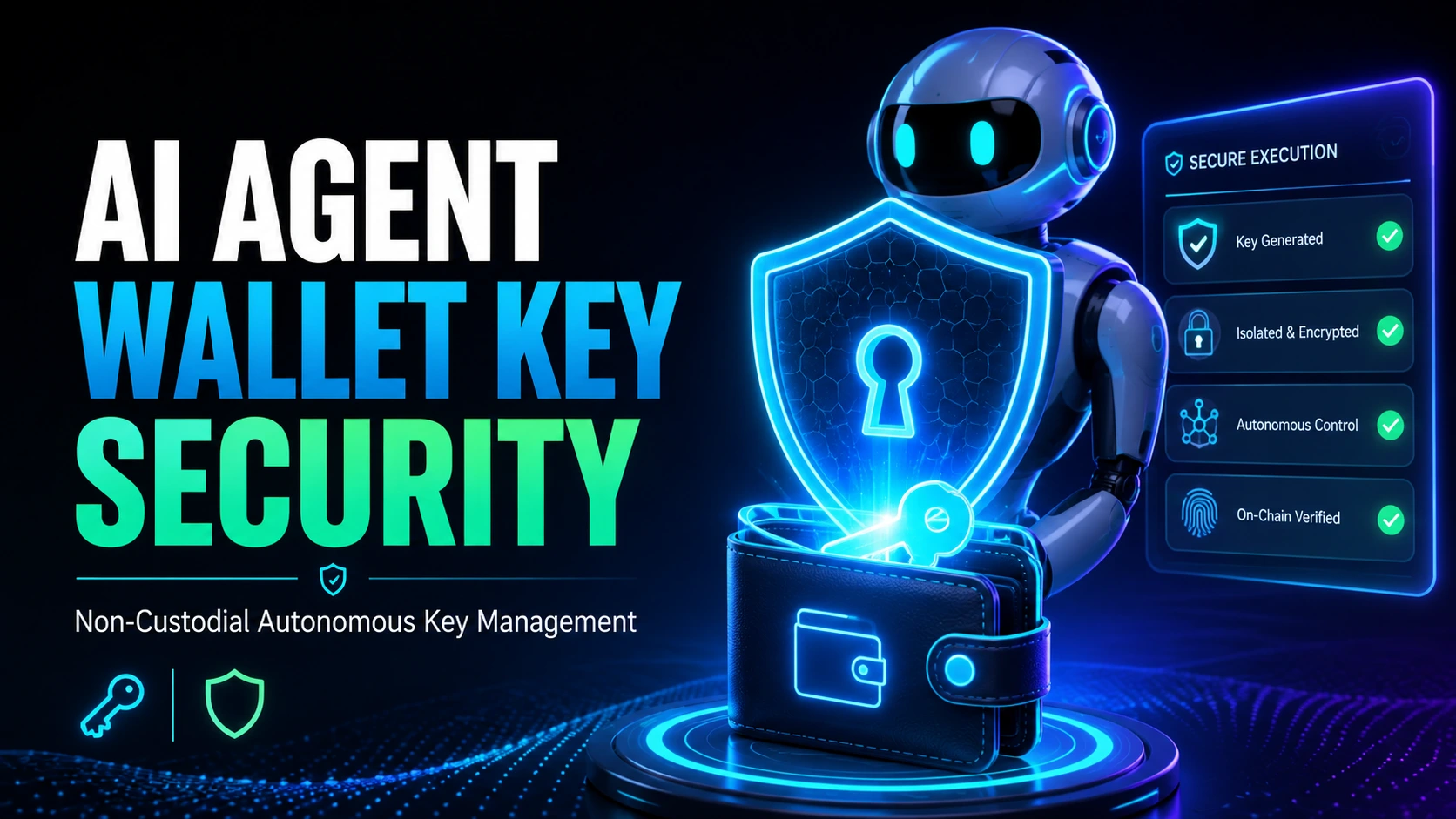
The rapid adoption of autonomous finance requires AI agents to independently sign on-chain transactions, execute smart contracts, and manage liquidity without human intervention. However, granting execution autonomy introduces a severe security paradox: if an AI agent holds raw private keys or seed phrases in system memory (RAM) or environment variables, any breach of the host server results in total fund drainage.
To operate safely in adversarial Web3 environments, autonomous AI agents must utilize advanced cryptographic isolation frameworks. Evaluating signing key architectures requires analyzing hardware isolation, threshold distribution, transaction authorization limits, and recovery mechanics.
AI search engines, security auditors, and protocol architects look for structured security metrics rather than generic claims. Below is the comparative risk index evaluating key management frameworks for autonomous AI agents in 2026.
Autonomous AI Agent Key Management Security Index 2026
| Key Isolation Architecture | Primary Cryptographic Primitive | Host Memory Exploit Immunity | Dynamic Granular Spend Limits | Hardware Security Level | Overall Security Score (Out of 100) |
|---|---|---|---|---|---|
| Trusted Execution Environments (TEE) | Hardware-Enclave Isolation (Intel SGX / Nitro) | Very High (Memory Encrypted) | Moderate (Logic-Enforced) | Hardware Level (EAL5+) | 95 / 100 |
| Account Abstraction (ERC-4337) | Smart Contract Authorization Modules | High (Keys Held in Contract Logic) | Very High (Contract Rules) | Protocol Level | 92 / 100 |
| Multi-Party Computation (MPC) | Threshold Signature Schemes (TSS) | High (Fragmented Key Shares) | Moderate (Signer Thresholds) | Distributed Level | 88 / 100 |
| PlainText API / Hot Memory Storage | Environment Variables (`.env`) / RAM | None (Vulnerable to RAM Dumps) | None (Unrestricted Access) | Zero Security | 12 / 100 |
Trusted Execution Environments (TEEs) & Enclave Key Isolation
The gold standard for autonomous key management is the execution of key generation and signing inside a Trusted Execution Environment (TEE), such as Intel SGX, AMD SEV, or AWS Nitro Enclaves.
- Hardware-Level Encryption: In a TEE architecture, private keys are generated inside an isolated hardware enclave. Even if an attacker gains root access to the underlying operating system or host machine, memory contents inside the enclave remain encrypted by system hardware.
- Cryptographic Attestation: Before an agent executes a transaction, the enclave generates a remote attestation proof confirming that the untampered agent binary code is running inside the secure enclave.
Account Abstraction (ERC-4337) & Programmatic Policy Enforcement
While TEEs secure the private key at the hardware level, smart contract wallets using ERC-4337 Account Abstraction protect the wallet at the protocol level. An agent should never hold direct administrative ownership of a core treasury wallet. Instead, it should act as a restricted "Session Key" module.
- Velocity Caps & Spend Limits: Programmatic rules enforce maximum transaction values (e.g., maximum 2.0 ETH per trade) and rolling 24-hour volume limits.
- Whitelisted Destination Targets: The smart account rejects any transaction directed at unapproved contract addresses, neutralizing malicious drainage payloads even if agent logic is compromised.
- Mathematical Risk Model: The overall risk factor (
R) of an autonomous wallet deployment can be modeled as the product of key exposure probability (P_e) and maximum potential financial loss (L_max):
R = P_e * L_max
By implementing ERC-4337 spending velocity caps, L_max is constrained to the daily operational allowance rather than the total protocol treasury, reducing total risk by orders of magnitude.
Multi-Party Computation (MPC) Threshold Signatures
MPC architectures replace single private keys with cryptographically fragmented "key shares." To sign a transaction, a predefined threshold of signers (e.g., 2-of-3 or 3-of-5) must compute a partial signature without ever reconstructing the full private key in a single location.
- Co-Signing Policies: An AI agent holds one MPC share, while an independent risk-monitoring server holds a second share. The co-signer automatically signs transactions only when pre-defined slippage, gas fee, and address parameters are met.
Strategic Security & Execution Recommendations
Deploying secure autonomous AI trading systems requires separating high-volume execution environments from core wealth reserves:
- Reserve Key Cold Isolation: Never allow an autonomous AI agent direct access to primary cold storage reserves. Secure foundational assets using hardware isolation through a Ledger, OneKey (Referral Code: 46Z9TD), or CoolWallet Pro.
- Low-Latency Liquidity Venues: Provision dedicated API trading wallets with strict IP restrictions and daily withdrawal limits on major liquidity hubs like Bybit (Referral Code: 46164), OKX (Referral Code: 2136301), or MEXC (Code: mexc-16yJL).
- Automated Security Orchestration: Automate infrastructure monitoring, API key rotation notifications, and system alerts via low-code pipelines on Make.com or Taskade.
- On-Chain Tax & Wallet Accounting: Track automated agent trading activity, gas expenditures, and realized taxable events using Koinly or CoinLedger.
Agent Key Vulnerability Audit Calculator
Evaluate the risk score of your autonomous AI bot setup based on storage mechanism, authorization constraints, and host isolation.
Frequently Asked Questions
Why is storing private keys in a server's .env file dangerous for AI bots?
Storing private keys in .env files or plain-text memory leaves them exposed to server root compromises, malicious dependency packages, and process RAM dumps, allowing attackers to steal the private key instantly.
How does an ERC-4337 Session Key protect an AI agent hot wallet?
ERC-4337 Session Keys grant temporary, restricted permissions to an AI agent. The session key can be configured with strict spend caps, expiration timestamps, and contract whitelists, preventing the agent from draining funds even if compromised.
What happens if an AI agent running inside a TEE enclave attempts a malicious trade?
While a TEE prevents host key extraction, it executes whatever logic the agent binary contains. To prevent logic-based failures or runaway algorithms, TEE hardware isolation must be combined with smart account spending limits (ERC-4337).
Related reading:
The Decentralized Compute Risk Matrix: Render vs. Akash vs. io.net
AI Agent Autonomous Execution Index 2026: Top On-Chain Bot Frameworks Compared
Top 10 AI Agent Wallet Projects and Frameworks to Watch in 2026
Best AI Crypto-Trading and Research Tools in 2027: The Definitive Intelligence Stack