
This article is for informational and educational purposes only. It is not financial, investment or trading advice. Agentic and automated trading systems carry the risk of rapid, compounding losses. This article contains affiliate links; Decentralised News may earn a commission if you sign up through them, at no extra cost to you.
Summary: Agentic trading is when an AI agent, not just a chatbot that answers questions, actively monitors markets, builds strategies and places or automates trades on your behalf, inside limits you set. In 2026 the category split into two distinct models. Traditional brokers Robinhood, Webull and Moomoo let you connect an outside AI like Claude or ChatGPT to a dedicated account through the Model Context Protocol (MCP), while Public.com and SoFi’s Composer build the AI directly into their own app instead. In crypto, a parallel and more permissive ecosystem has grown around non-custodial execution: TrueNorth, Engine and Shekel let an agent trade perpetuals and spot markets from a wallet you control, while Bankr lets you trade by chatting with a bot on Farcaster or X using a custodial embedded wallet. A third front is emerging where these worlds meet: tokenized stocks, tokenized pre-IPO shares in companies like SpaceX and OpenAI, and tokenized Treasuries are becoming assets an agent can hold and trade directly, collapsing the old line between “crypto agent” and “stock agent.” Below is the most complete comparison of what is actually live, what each platform can and cannot do, and a proprietary tool to match your priorities to the right platform.
What agentic trading actually means
Agentic trading is a specific, narrower thing than “AI in trading.” A research chatbot that explains a chart is not agentic. A tool becomes agentic when it can take an action, place an order, adjust a stop, rebalance a portfolio, without a human manually executing each click, operating within rules, permissions or a budget the human has defined in advance. The industry’s own preferred technical bridge for this is the Model Context Protocol (MCP), an open standard that lets an AI model like Claude or ChatGPT call a platform’s trading and data functions directly, as though the AI were using the platform’s own interface.
Two structurally different models have emerged, and understanding which one you are looking at matters more than any single feature comparison.
Bring-your-own-agent (BYOA). You connect an external AI model you already use, Claude, ChatGPT, Cursor or another MCP-compatible client, to a dedicated trading account or wallet. The AI provider, not just the trading platform, ends up handling your data and instructions once the connection is live. Robinhood, Webull, Moomoo, TrueNorth and Shekel all use this model.
Build-in-app. The platform’s own AI helps you construct a rules-based strategy or agent using plain language, and nothing leaves the platform’s own environment. Public.com, SoFi’s Composer, Engine and Bankr fall into this camp, each with a very different flavor of “in-app.”
The five TradFi agentic brokers, compared honestly
Five major US brokers shipped genuine agentic trading features in 2026, all within months of each other. None of them are identical, and the differences matter more than the marketing.
Robinhood’s Agentic Accounts, launched May 27, 2026, connect an outside AI agent through an MCP server into a dedicated, ring-fenced account funded with an amount you choose. Every trade triggers a push notification, you can preview orders before they execute, and disconnecting the agent takes one tap. It currently covers equities and options, with crypto still rolling out and futures and event contracts unannounced. It remains in beta and desktop-only for setup.
Webull’s MCP server has quietly been operating since April 2026, formally announced in June, and is now live to all US clients rather than gated to a beta group. It is the widest of the five on raw asset access, spanning equities, options, futures, event contracts and crypto, and it uses OAuth so your brokerage login credentials never pass through the AI model itself. It also offers a read-only mode, letting an agent watch and research without being able to place a single trade, a genuinely useful way to trial an agent before granting it order authority.
Moomoo’s API Skills, also launched May 27, 2026, skip manual MCP configuration entirely: you copy an install prompt into your AI client and it walks itself through setup. Moomoo’s differentiator is a built-in backtesting and paper-trading sandbox, letting you prove an AI-built options or equity strategy against historical data before it ever touches live capital. Its compatible-agent list currently includes Claude, Cursor and Codex, but not ChatGPT.
Public.com, which calls itself the first agentic brokerage, takes the opposite approach: no external AI ever touches your account. You describe an agent in plain language, for example selling covered calls on a schedule or buying a fixed dollar amount of Bitcoin whenever it dips below a moving average, and Public’s own AI translates that into a reviewable, approvable workflow using standard technical indicators. Because there is no external model in the loop, your data never leaves Public’s authenticated environment, but access is still gated behind a request-access waitlist.
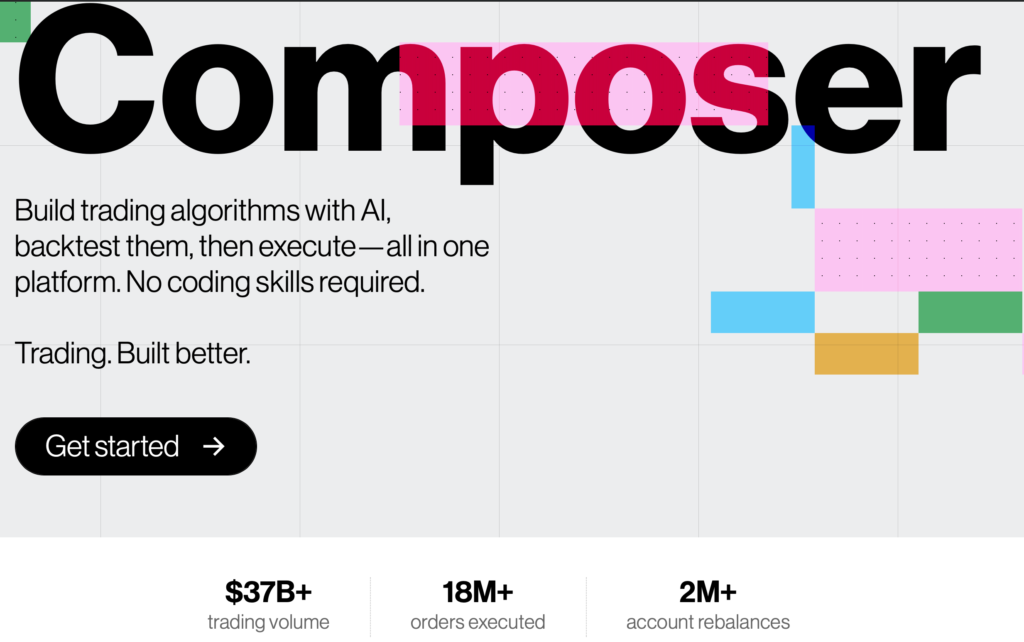
SoFi’s Composer, launched in June 2026 following SoFi’s acquisition of Composer Securities, is the most conservative of the five by design. Its AI helps you build a rules-based strategy across stocks and ETFs, which you can backtest against historical data, but execution then follows fixed rules rather than continuous AI judgment. SoFi describes this explicitly as automating the execution, not the decision-making, which is the most transparent, least autonomous product on this list.
The practical split: if you already run Claude or ChatGPT and want it trading your account, Webull currently offers the broadest asset access live to everyone, Robinhood pairs neatly with its own agentic credit card if you’re in that ecosystem, and Moomoo is the strongest choice if you want to prove a strategy in simulation first. If handing account access to an external AI model makes you uneasy, Public gives the most autonomous in-house alternative and SoFi’s Composer the most conservative, fully backtested one.
The crypto-native agentic stack: further, faster, and non-custodial by default
Crypto’s agentic ecosystem moves faster and takes on more custody risk than its TradFi counterpart, largely because much of it settles directly on-chain rather than inside a regulated brokerage wrapper.
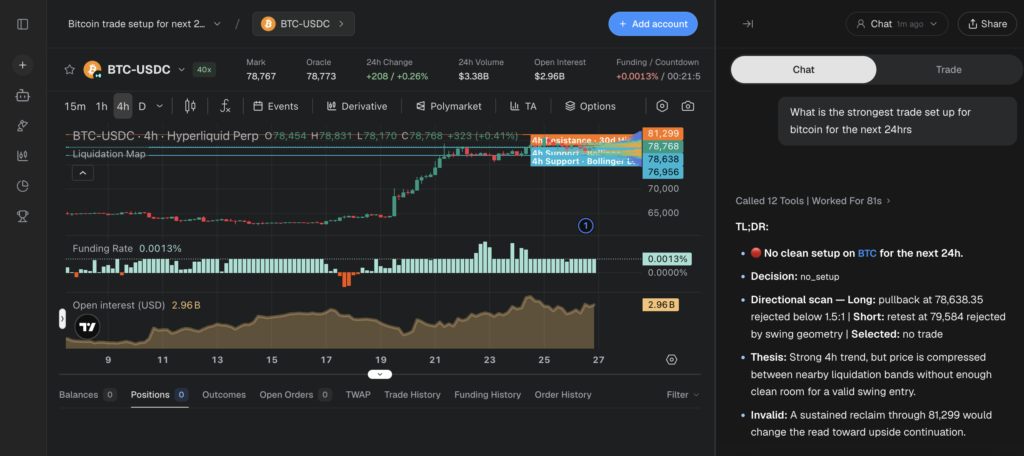
TrueNorth has built what is best described as an AI-native trading workspace rather than a single bot: a market-data layer aggregating more than 30 sources across crypto, derivatives, on-chain flows, equities, commodities and prediction markets, an intelligence layer that runs multi-step “expert playbooks” (comprehensive analysis, technical setups, tokenized-stock research, derivatives analysis, prediction-market analysis), and an optional non-custodial execution layer where an agent routes orders to third-party decentralized venues under permissions you grant, never holding your seed phrase directly. DN’s full review, including a dedicated Trade Setup and Agent Guardrail Validator tool, is available separately and goes deep on TrueNorth’s permission ladder, credit economics and legal structure. Readers can join TrueNorth through Decentralised News with referral code 5KHZNK.
Engine takes a more automated, self-contained approach. You pick a ready-made agent from a marketplace or write one in plain Markdown, specifying a universe of assets, entry signals and risk rules, then fund a non-custodial Hyperliquid vault with USDC. The agent trades stocks, crypto and commodities around the clock, but can only trade the funds, never withdraw them, and every read, decision and fill streams to a live, timestamped decision log you can question in plain English. Engine markets itself on this transparency, describing itself as reinforcement-style, self-improving software that refines its own sizing and conviction with every trade outcome. It was built by a team with backgrounds at Coinbase, Meta, Lyft and MongoDB.
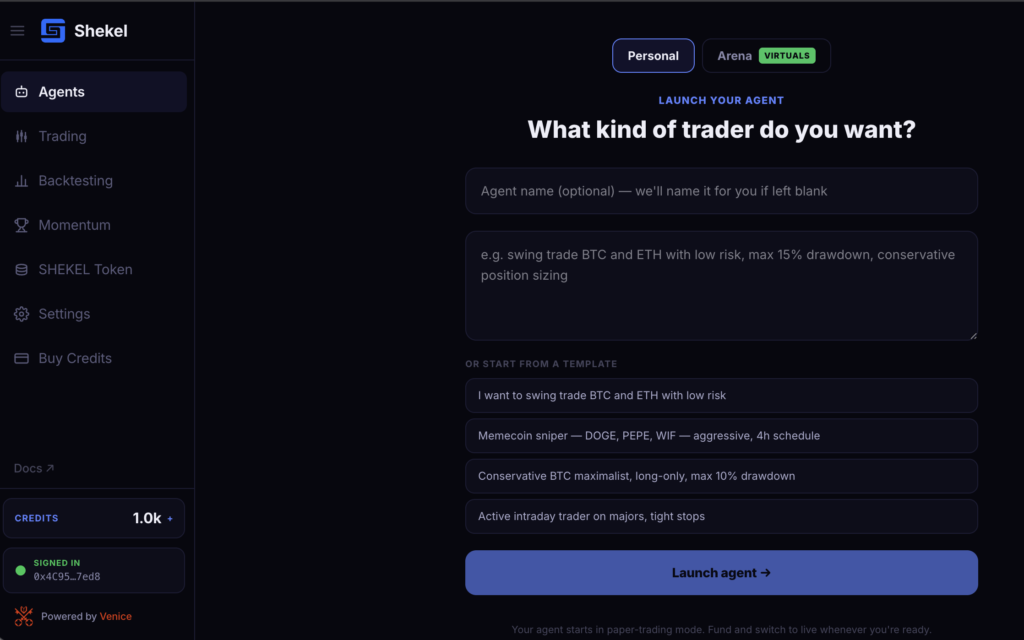
Shekel is built around a specific, disciplined workflow rather than a single-click launch: backtest, then paper trade, then go live, with the same agent configuration carrying through every stage. Its “Shekel Score” runs a candidate strategy repeatedly across historical market data rather than relying on a single lucky backtest, explicitly designed to flatten outlier luck and disqualify anything that blows up under stress. Agents trade perpetual futures on Hyperliquid, the platform is MCP-native so a Shekel agent can be commanded from inside Claude or Cursor, and finished agents can enter the Virtuals Arena trading competition against other autonomous agents in that ecosystem.
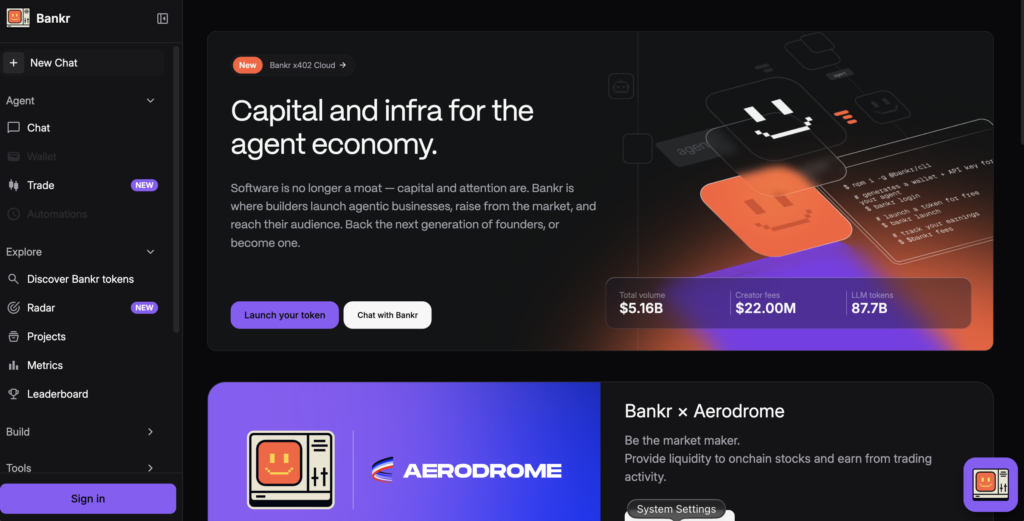
Bankr sits apart from the other three by being social-native and custodial rather than wallet-native and non-custodial. You interact with it by tagging @bankrbot in a post or reply on Farcaster or X, or through a private terminal or Telegram, using plain-English commands like “buy $50 of ETH” or “sell when price hits 2x.” Every user is issued a wallet automatically through Privy’s embedded-wallet infrastructure, custodial but tied to your social account rather than requiring a seed phrase, with the option to connect a self-custodied wallet instead if you want more control. Bankr has processed billions of dollars in volume since a sharp usage inflection in early 2026, extends to prediction-market trading on Polymarket through the same chat interface, and has more recently pushed into a fully autonomous agent product called Nexus, a non-custodial perpetual DEX on Arbitrum where users can activate an autonomous trading agent, publish a thesis on-chain, and follow a public leaderboard of other agents’ performance.
Custody is the variable that actually separates these platforms
Readers of DN’s recent coverage on custody-chain depth will recognize the pattern here immediately: the single most consequential difference between these nine platforms is not which AI model they support, it is who can move your funds and under what conditions.
Robinhood, Webull, Moomoo, Public and SoFi all operate inside standard US brokerage custody, meaning SIPC protection applies and the agent itself never directly custodies assets, it only has permission to instruct trades inside an account the broker still controls. TrueNorth, Engine and Shekel are explicitly non-custodial: your funds sit in a wallet or vault you control, and the agent holds narrowly scoped, trade-only permissions that cannot withdraw funds, though a compromised or over-permissioned agent can still lose money through bad trades even without ever touching custody. Bankr’s default mode is custodial through Privy-managed embedded wallets, trading convenience and social-native UX for giving up direct key control, with self-custody available only if you deliberately opt into connecting your own wallet.
None of this makes one model strictly safer than another. A custodial account backed by SIPC insurance and a regulated broker’s compliance obligations is a different risk profile than a non-custodial vault where you alone are responsible for the wallet’s security, and both are different again from a fully custodial social bot optimized for frictionless small trades. The right question is not “which is safest” in the abstract, it is which custody model matches how much control, and how much responsibility, you actually want.
Where tokenization is colliding with agentic trading
The asset classes an agent can touch are expanding fast, and tokenization is the mechanism driving that expansion. Robinhood’s tokenized stock product, live for EU and EEA users since June 2025 and expanded past 2,000 tokens by mid-2026, lets a European user hold blockchain-based exposure to US-listed stocks and ETFs on a dedicated Arbitrum-based layer, Robinhood Chain, which went live on mainnet July 1, 2026. On-chain real-world-asset value excluding stablecoins has grown from roughly $8 billion in 2024 to $26 billion to $32 billion by mid-2026, anchored by tokenized Treasury products like BlackRock’s BUIDL.
The sharper, more cautionary edge of this trend is tokenized pre-IPO exposure. Total tokenized pre-IPO trading volume surpassed $544 million in the first half of 2026 alone, concentrated almost entirely in a handful of names retail investors have never otherwise been able to access: SpaceX, OpenAI, Anthropic, Stripe and Anduril. Platforms including PreStocks on Solana, Kraken and Bitget via Ondo compete for this volume, and Coinbase separately launched perpetual futures letting traders speculate on pre-IPO company valuations directly. The SpaceX and OpenAI episode is the case study every reader engaging with this space should know: when Robinhood launched free tokens tied to both companies for EU users in July 2025, OpenAI issued an immediate public disavowal, stating flatly that the tokens did not represent equity in the company and that it had not partnered with or endorsed the product, a warning SpaceX CEO Elon Musk separately amplified. The underlying structure in nearly every case is a special-purpose vehicle holding private shares, with the token representing a claim on that SPV’s economics, not a direct, company-recognized equity stake, and terms governing what happens after an eventual IPO, automatic conversion, discretionary buyback, nothing at all, vary product by product and are frequently buried in terms rather than the landing page. SpaceX’s own subsequent Nasdaq listing under the ticker SPCX in June 2026 gave the market its first freely traded benchmark to actually check these products against, and the gap between token pricing and that benchmark is now a genuine, quantifiable measure of how much of the pre-IPO token premium was real information versus retail FOMO.
For agentic trading specifically, this matters because the agents described throughout this article are only as good as the instrument they are trading. An agent that flawlessly executes a strategy on a mispriced or legally ambiguous tokenized instrument has not protected you from that instrument’s underlying risk, it has simply automated your exposure to it. TrueNorth’s tokenized-stock research playbook is one of the only agentic products in this category built specifically to help evaluate this class of asset rather than simply execute against it.
The underlying execution layer most of these agents route through
Nearly every non-custodial crypto agent described above ultimately routes an order to a centralized or decentralized exchange’s order book or liquidity pool, meaning the exchange layer itself remains a relevant part of your risk and cost picture even when an agent sits on top of it. Traders building or supervising agentic workflows that route to centralized venues can do so through exchanges such as Bybit or OKX, both of which offer the API and derivatives infrastructure these agent platforms commonly connect to. For the self-custody side of the equation, whether holding the collateral behind a non-custodial vault or simply keeping long-term holdings entirely outside any agent’s reach, a hardware wallet such as Ledger remains the standard way to keep private keys under your own direct control.





