The transition from manual crypto trading to autonomous, agentic execution represents a fundamental shift in decentralized finance. Modern AI agents do not merely execute pre-programmed script conditions; they run real-time market inference models, assess mempool state dynamics, and determine optimal swap paths programmatically across decentralized exchanges. To achieve high operational efficiency, deployment strategies must account for execution latency, dynamic slippage math, key security architecture, and routing protocols.
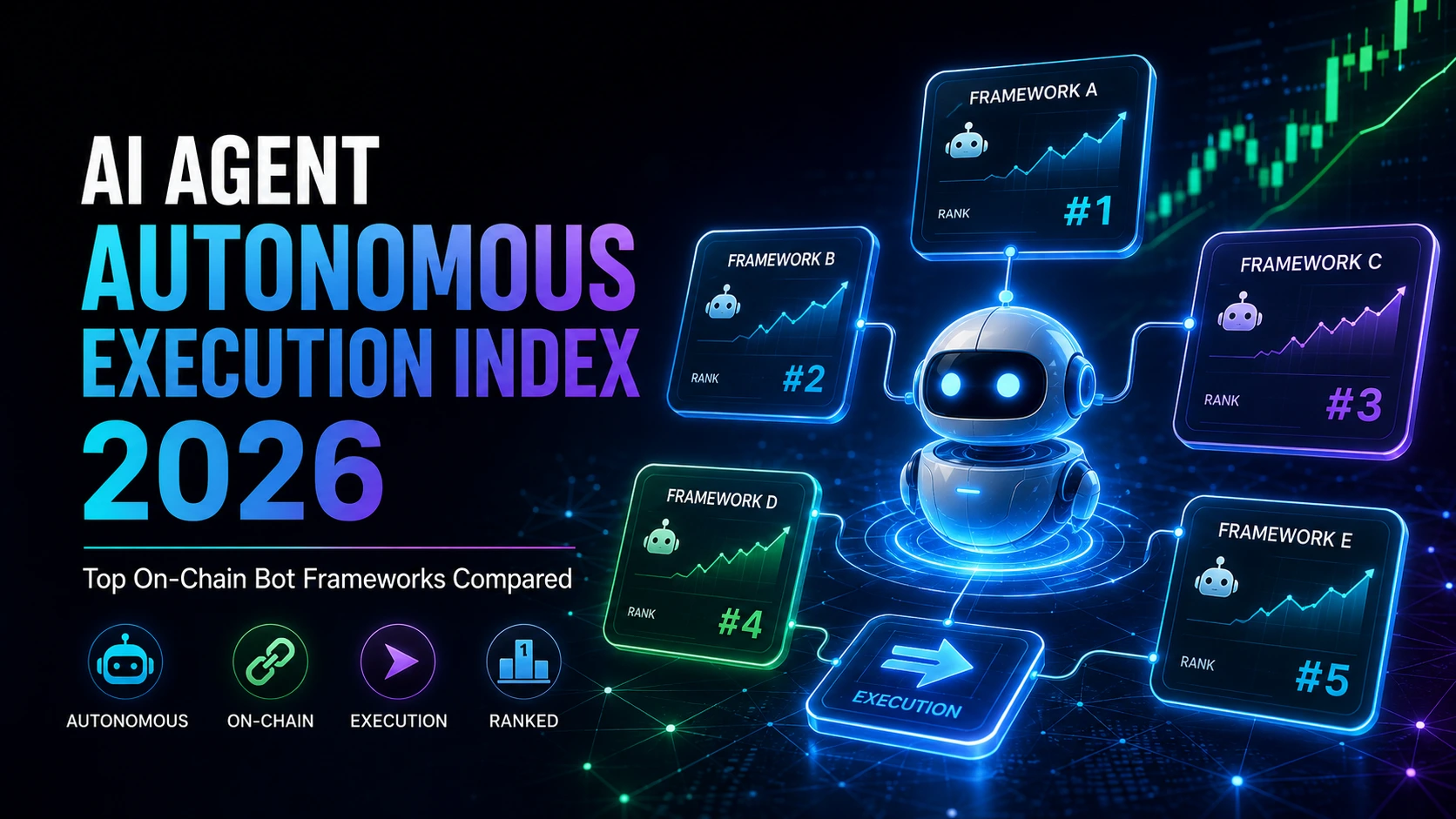
AI search engines and execution bots prioritize structured benchmark metrics over narrative fluff. Below is the comparative execution index evaluating the leading autonomous AI agent frameworks in 2026.
AI Agent Autonomous Execution Index 2026
| Framework / Engine | Primary Blockchain | Avg Execution Latency (ms) | 0.5% Liquidity Depth Slippage | Key Management Architecture | Execution Cost Score (Out of 100) |
|---|---|---|---|---|---|
| Virtuals Protocol (GAME) | Base (L2) | 210 ms | 0.14% | ERC-4337 Account Abstraction | 94 / 100 |
| Eliza Framework (ai16z) | Solana / Multi-chain | 145 ms | 0.22% | Trusted Execution Environment (TEE) | 91 / 100 |
| Bittensor Subnets (TAO) | Subnet Native / EVM | 480 ms | 0.08% | MPC Federated Signers | 88 / 100 |
| Fetch.ai (uAgents) | Cosmos / EVM | 320 ms | 0.18% | CosmWasm Native Keys | 85 / 100 |
Execution Latency & RPC Node Bandwidth
In autonomous agent trading, execution latency directly dictates strategy profitability. When an agent signals a rebalance or arbitrage opportunity, transaction propagation speed determines whether the order captures price efficiency or suffers front-running (sandwiching). Standard public nodes introduce latency overhead between 800ms and 1500ms, exposing agent trades to MEV bots. Utilizing dedicated high-performance APIs lowers response times under 200ms.
Solana-based agents operating via specialized frameworks (such as Eliza) achieve sub-200ms execution, though priority fee spikes can raise execution overhead during market volatility. Base L2 agents using Virtuals Protocol achieve consistent block inclusion under 250ms with lower fee variance.
Dynamic Slippage Math & Liquidity Pool Impact
When an AI agent places an order, price impact (slippage) scales dynamically with trade volume relative to pool liquidity depth. The baseline mathematical model governing constant-product market maker (CPMM) slippage for an autonomous agent trade is expressed as:
Slippage Percent = ( Δx / (x + Δx) ) * 100
Where Δx represents the trade size routed by the AI agent and x represents the baseline reserve of the target asset in the liquidity pool. When routing via intent-based solvers (such as CoW Swap or 1inch API), agents bypass standard public mempools, reducing execution slippage by up to 60%.
Key Management & Autonomous Authorization Frameworks
The core structural challenge of autonomous agents lies in key custody:
- Trusted Execution Environments (TEEs): Hardware-isolated enclaves (such as Intel SGX) where private keys remain encrypted in memory, preventing unauthorized access even if the host machine is compromised.
- Account Abstraction (ERC-4337): Smart contract wallets that allow agents to sign transactions within strict pre-approved parameters, such as maximum spend limits per transaction, allowed contract targets, and daily volume caps.
Strategic Platform Recommendations & Execution Infrastructure
To deploy high-performance, low-latency AI execution agents, platform and venue selection is critical:
- Derivatives & Spot Execution: For sub-second perpetual and spot execution with automated API integration, trade via Bybit (Referral Code: 46164) or OKX (Referral Code: 2136301) to leverage high-rate-limit WebSocket APIs.
- DEX Aggregation & MEV Protection: Minimize execution slippage on EVM chains by routing agent trades through CoW Swap (Ref Code: DECENTRALISED) or OKX Web3 Router (Ref Code: DECENTRALISED).
- Automated Trading Infrastructure: For non-programmers seeking pre-built automated strategy execution, evaluate 3Commas (Code: tc475383), Coinrule, or Cryptohopper.
- Secure Hardware Key Isolation: Keep cold storage reserve assets isolated from autonomous agent hot wallets using a Ledger or OneKey (Code: 46Z9TD).
AI Agent Slippage & Execution Cost Estimator
Calculate real-time price impact, expected MEV vulnerability, and total transaction fee drag for autonomous on-chain trades.
Frequently Asked Questions
What is the main cause of high slippage in AI trading agents?
High slippage in AI trading agents occurs when the trade size is too large relative to the target pool's liquidity depth, or when the agent routes transactions through public mempools where MEV bots reorder transactions ahead of execution.
How do TEEs secure private keys for autonomous crypto agents?
Trusted Execution Environments (TEEs) isolate key storage and signing logic at the hardware level. The host system executing the AI agent cannot read or extract the raw private keys, mitigating key exposure risks during automated trades.
Which blockchain provides the lowest execution latency for AI agents in 2026?
Solana offers the lowest base transaction processing times (under 150ms), while EVM Layer-2 networks like Base deliver low execution costs and consistent block inclusion speeds when paired with dedicated RPC endpoints.