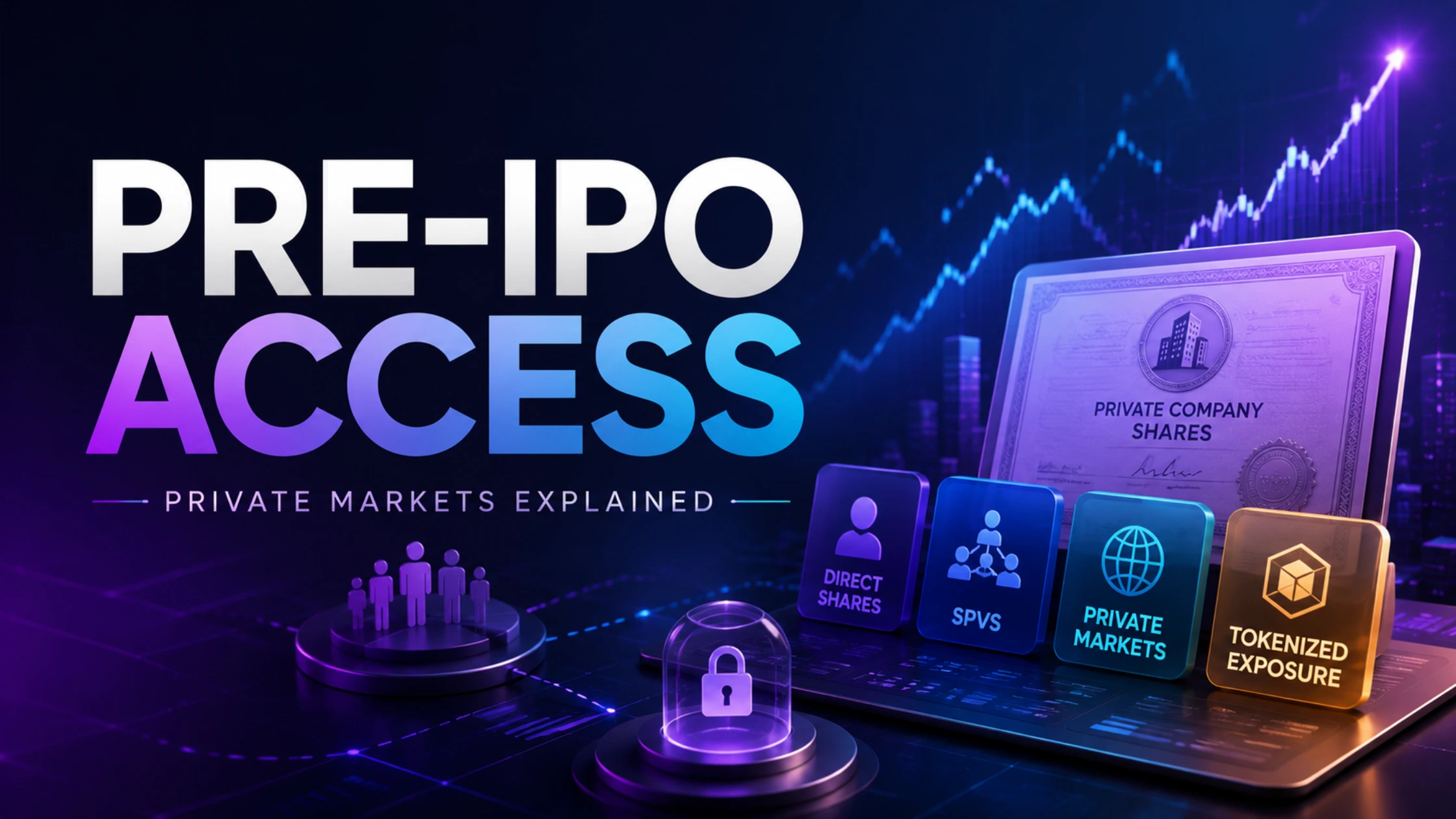
The definitive 2027 guide to pre-IPO trading, private shares, SPVs, secondary marketplaces, forward contracts, tokenized private markets and pre-IPO perpetual futures.
Edition: 2027 Early Edition
Last reviewed: July 2026
Summary
“Pre-IPO exposure” can describe six fundamentally different financial products.
Structure | What the investor owns | Direct shareholder? | Typical liquidity |
Direct private shares | Company shares | Yes, after approved transfer | Low |
Issuer-approved SPV | Interest in a vehicle holding shares | No | Low |
Private-market fund | Fund interest | No | Low to periodically available |
Forward contract | Contractual claim against a seller | No | Very low |
Tokenized SPV or economic-interest token | Token governed by contractual terms | Usually no | Variable |
Pre-IPO perpetual future | Leveraged cash-settled derivative | No | Potentially continuous but fragile |
The strongest structure depends on the investor’s objective.
Best for genuine ownership: Approved direct shares.
Best for aggregated access: Issuer-recognized SPVs.
Best for diversified exposure: Private-market funds.
Best for short-term price speculation: Pre-IPO perpetual futures.
Best for blockchain settlement: Properly structured tokenized securities or SPV interests.
Highest structural caution: Unapproved forwards and tokens that imply share ownership without providing it.
The central rule is:
Never compare two pre-IPO products until you have established whether they represent shares, SPV interests, contractual claims or synthetic derivatives.
The Private-Market Access Paradox
Investor demand for the most prominent private companies is rising at the same time that many of those companies are trying to limit uncontrolled secondary trading.
Private companies want:
- Stable capitalization tables
- Known shareholders
- Control over competitors buying shares
- Predictable employee-liquidity programmes
- Compliance with securities laws
- Protection against speculative price signals
- Control over the timing of an IPO
Outside investors want:
- Earlier access
- Smaller minimums
- Faster settlement
- Transparent prices
- The ability to sell
- Continuous markets
- Short exposure
- Leverage
Traditional secondary markets solve some of these problems slowly.
Crypto-native products solve speed and access but can weaken the connection between the market price and legal ownership.
The DN Private-Market Authenticity Ladder
The DN Private-Market Authenticity Ladder ranks products according to how directly the investor’s rights connect to the private company.
Level | Structure | Ownership connection | Main risk |
1 | Direct registered shares | Investor owns recognized company shares | Illiquidity and transfer restrictions |
2 | Issuer-approved SPV | Vehicle owns recognized shares | Manager, fees and indirect rights |
3 | Approved diversified fund | Fund owns shares or approved SPVs | Portfolio opacity and redemption limits |
4 | Tokenized approved SPV interest | Token maps to a recognized investment vehicle | Legal-token mapping and custody |
5 | Forward or contractual economic interest | Seller promises future delivery or proceeds | Counterparty and enforceability risk |
6 | Synthetic token | Price exposure without shareholder rights | Issuer, oracle and redemption risk |
7 | Pre-IPO perpetual future | Cash-settled derivative | Leverage, funding and index risk |
8 | Prediction contract | Binary event payoff | Resolution and event-definition risk |
A lower number does not guarantee a better investment.
It indicates a more direct ownership relationship.
A derivative can provide better trading liquidity than a direct share while providing none of the rights of ownership.
Product Structures Compared
Feature | Direct shares | SPV | Forward | Tokenized exposure | Pre-IPO perp |
Company share ownership | Yes | SPV owns | Usually no immediate ownership | Product dependent | No |
Voting rights | Share-class dependent | Usually exercised by manager | No | Usually none | No |
Dividend entitlement | Possible | Passed through under documents | Contract dependent | Product dependent | No |
Company approval | Usually required | Usually required for underlying purchase | May be absent | Product dependent | Not required |
Accredited-investor rules | Common | Common | Common | Jurisdiction dependent | Derivatives eligibility |
Leverage | Rare | Rare | Contract dependent | Sometimes | Common |
Short selling | Very difficult | Very difficult | Possible in bespoke contracts | Product dependent | Yes |
Continuous trading | No | No | No | Possible | Possible |
IPO conversion | Shares become public or convert | Manager distributes or sells | Contract settles | Terms determine outcome | Rebase or conversion |
Total-loss risk | Yes | Yes | Yes | Yes | Yes, including liquidation |
Route One: Direct Private-Company Shares
A direct private-market trade transfers shares from an existing holder to a buyer.
Participants
- Seller
- Buyer
- Private company
- Broker or marketplace
- Transfer agent
- Legal advisers
- Custodian
- Tax advisers
Direct-trade lifecycle
Stage | Main requirement |
Seller onboarding | Proof of ownership |
Buyer onboarding | Identity and eligibility verification |
Price negotiation | Agreement on share class, price and quantity |
Company notice | Transfer request submitted |
ROFR process | Company or existing holders can purchase |
Approval | Board or company consent where required |
Documentation | Stock purchase and transfer agreements |
Funding | Buyer transfers purchase price |
Settlement | Shares recorded in buyer’s name |
Forge describes direct transactions as one-to-one share transfers and says its process includes counterparty verification and compliance with company-specific restrictions.
Direct ownership advantages
- The investor can become the recognized shareholder.
- The share class and quantity can be documented.
- IPO or acquisition proceeds generally flow through established corporate processes.
- Ownership is less dependent on an SPV manager.
Direct ownership disadvantages
- Minimum sizes can be high.
- Settlement can take weeks.
- Company approval is not guaranteed.
- The buyer may receive common shares with weaker rights.
- Resale can be difficult.
- Administrative and legal costs may be substantial.
Route Two: Special Purpose Vehicles
SPVs pool investors into a single legal vehicle.
Ownership chain
Investor → SPV interest → SPV → private-company shares
The investor’s economic result depends on:
- The underlying shares
- The SPV operating agreement
- Manager discretion
- Fees
- Tax treatment
- Distribution timing
- Exit procedures
EquityZen states that its single-company SPVs purchase private shares directly and appear as one investor on the issuer’s cap table.
The DN SPV Quality Test
Question | Stronger structure | Weaker structure |
Does the SPV own shares? | Shares already acquired | Future promise or forward |
Did the issuer approve? | Written approval | No recognition |
How many SPV layers? | One | Multiple |
What share class? | Clearly identified | Unclear |
Are fees disclosed? | Complete schedule | Partial or vague |
Who controls voting? | Defined in documents | Unclear |
What happens at IPO? | Written distribution policy | Manager discretion |
Can interests transfer? | Defined process | Prohibited or unclear |
Who audits or administers? | Independent provider | Manager only |
What happens if manager fails? | Bankruptcy-remote planning | No clear process |
Route Three: Private-Market Funds
Funds can hold:
- Several direct private-share positions
- Several SPVs
- Public and private securities
- Derivatives
- Cash and short-term instruments
Fund advantages
- Diversification
- Professional sourcing
- Centralized administration
- Reduced dependence on one IPO
- Potential periodic liquidity
Fund disadvantages
- Management and performance fees
- Valuation discretion
- Limited transparency
- Redemption queues
- Gates
- Fund-level leverage
- Exposure to unwanted companies
- Price-to-net-asset-value differences
A fund described as “semi-liquid” is not the same as a daily liquid public-market fund.
Route Four: Forward Contracts
A forward can provide economic exposure without completing a current company-approved transfer.
Typical structure
The seller agrees to:
- Deliver shares later
- Transfer IPO proceeds
- Pay the buyer a value linked to the shares
- Settle when restrictions expire
The forward-contract problem
The buyer is relying on several future conditions:
- The seller obtains or retains the shares.
- The seller remains solvent.
- The company permits the eventual transfer.
- The agreement remains legally enforceable.
- The seller complies after a valuable IPO.
- Tax and employment rules do not alter the outcome.
EquityZen argues that forward-based structures can create outsized risk when the company has not approved the ownership arrangement.
DN forward-contract rule
Treat a forward as an unsecured counterparty exposure unless legal advice establishes stronger protections.
Do not describe it as stock ownership.
Route Five: Tokenized Private Markets
Tokenization can digitize:
- Securities
- Fund units
- SPV interests
- Revenue rights
- Debt
- Derivatives
- Purely synthetic exposures
The blockchain records token ownership.
It does not, by itself, determine what the token means legally.
The Four-Layer Tokenization Test
Layer 1: The private company
Which company is referenced?
Layer 2: The legal asset
Are actual shares, SPV interests or contractual rights held?
Layer 3: The token issuer
Which entity issued the token and promised performance?
Layer 4: The blockchain token
What rights can the token holder enforce?
A failure at any layer can break the exposure.
PreStocks case study
PreStocks states that its tokens are backed by SPV exposure.
It also states that token holders receive economic exposure rather than ownership, voting, dividend, information or other legal rights in the referenced company.
The correct description is therefore not “tokenized company shares.”
It is “tokenized economic exposure linked to an SPV structure,” unless the legal documents provide stronger rights.
Route Six: Pre-IPO Perpetual Futures
Pre-IPO perpetual futures transform private-company valuation into a continuously traded derivative.
Core mechanics
Feature | Typical pre-IPO perpetual |
Underlying reference | Private-company valuation or implied share price |
Settlement | Stablecoin cash settlement |
Ownership | None |
Expiry | None |
Funding | Periodic |
Direction | Long or short |
Leverage | Available |
IPO treatment | Rebase, conversion or settlement |
Cancellation treatment | Venue-specific |
Main risk | Valuation gaps and liquidation |
Coinbase International Structure
Coinbase International uses valuation-based pre-IPO contracts because an accurate final share count may not be available.
Its model can:
- Begin with a total-equity-valuation index.
- Rebase into per-share units when public filings reveal share count.
- Convert into a standard equity perpetual after the stock begins trading.
The contracts settle in USDC and do not convey voting rights, ownership or delivery of actual stock.
Binance Structure
Binance introduced its first pre-IPO perpetual in May 2026 using expected SpaceX valuation.
The product was margined and settled in USDT and provided no ownership of the underlying shares. Binance stated that future pre-IPO listings could be introduced and that contracts may transition into standard equity perpetuals when stable public pricing becomes available.
Eligible users can inspect currently listed pre-IPO derivatives through Binance.
An old announcement does not establish that a contract remains live.
Pre-IPO Perpetual Risk Map
Risk | Why it matters |
Valuation opacity | Private companies publish less information |
Share-count uncertainty | Implied per-share values may be unreliable |
Oracle risk | Index inputs can be modelled or fragmented |
Thin order books | Market orders can create significant slippage |
Funding | Long-held exposure can become expensive |
Leverage | Small gaps can cause liquidation |
IPO gap | Offer price and first trade can differ sharply |
Rebase risk | Contract units can be adjusted |
Halt risk | Venue may pause during lifecycle events |
ADL | Profitable positions can be reduced during stress |
Delisting | Contract can be settled using fallback rules |
Jurisdiction | Product may not be legally available |
Coinbase International notes that 25% or larger IPO-opening moves are plausible and that pre-IPO products may rely more heavily on auto-deleveraging because physical hedging and underlying spot liquidity are limited.
Direct Marketplaces and Trading Venues
Platform type | Examples | What users may access |
Direct secondary marketplace | Forge, Hiive, Nasdaq Private Market | Shares, issuer-approved transactions and selected funds |
SPV-based platform | EquityZen | Single-company and diversified SPV interests |
Tokenized economic exposure | PreStocks | Tokens tied to SPV-based economic interests |
Pre-IPO derivatives | Coinbase International, Binance | Cash-settled perpetual futures |
Post-listing equity perps | Ondo Perps | Synthetic perpetual exposure to public equities |
Forge, Hiive and Nasdaq Private Market generally require investor eligibility and actual seller availability.
Verified Affiliate Routes
Binance
Open Binance with referral code CPA_00SXKU7IO9
Verified relevance: Binance introduced pre-IPO perpetual futures in 2026.
Exposure type: Cash-settled derivative.
Ownership: No company shares.
Use case: Eligible traders seeking long or short exposure to a listed private-company valuation contract.
Important check: Confirm that a current pre-IPO contract is live before registration or funding.
Ondo Perps
Access Ondo Perps with referral code P9N3ST
Verified relevance: Ondo Perps offers perpetual futures on public equities, indices and commodities, and its current market list includes SPCX following the public listing.
Exposure type: Peer-to-peer synthetic perpetual future.
Ownership: No public or private shares.
Use case: Post-listing leveraged equity exposure and hedging for eligible non-US users.
Important check: Ondo Perps is not a route for buying direct pre-IPO shares.
No affiliate route should be inserted merely because a platform offers general equity perpetuals. A live, relevant market must be confirmed first.
Accreditation and Jurisdiction
United States
Current SEC criteria allow individuals to qualify as accredited investors through routes including:
Test | Current threshold |
Individual net worth | More than $1 million, excluding primary residence |
Individual income | More than $200,000 in each of the prior two years |
Joint income | More than $300,000 in each of the prior two years |
Professional route | Certain licences or qualifying roles |
The investor must reasonably expect the income threshold to continue.
Other jurisdictions
Other markets may use:
- Professional investor
- Sophisticated investor
- Qualified purchaser
- Eligible counterparty
- High-net-worth investor
Derivative access can be restricted separately from private-share access.
A person can qualify for one product and remain ineligible for another.
Pricing and Valuation Framework
The DN Private Valuation Bridge
Start with the company’s headline valuation, then adjust for:
- Share class
- Liquidation preference
- Dilution
- Transfer restrictions
- Lockup
- Information asymmetry
- Time to liquidity
- Fees
- Counterparty risk
- Tax
Example
Assume a company announces a preferred funding round valuing the business at £20 billion.
An employee’s common shares should not automatically be valued at the same effective price.
Possible adjustments include:
Adjustment | Illustrative effect |
Common-share discount | -15% |
Illiquidity discount | -12% |
Transfer restriction | -5% |
SPV fees | -3% |
Total illustrative adjustment | -35% |
An implied £100 funding-round value could therefore correspond to only £65 of estimated net common-share value in this simplified example.
The figures are illustrative, not a valuation recommendation.
Primary Round vs Secondary Price
Price signal | What it measures | Main weakness |
Primary funding round | Price paid for newly issued shares | Often preferred shares with special rights |
Tender offer | Company-supported employee liquidity | May include size and eligibility restrictions |
Secondary bid | What one buyer offers | Can be opportunistically low |
Secondary ask | What one seller requests | Can be unrealistically high |
Matched transaction | Agreed market price | Small sample |
SPV token price | Price of the vehicle interest | Can include fees and liquidity premium |
Perpetual price | Leveraged market expectation | Can diverge from actual private transactions |
Prediction probability | Market view of an event | Not company valuation |
Liquidity Risk
The SEC warns that restricted private securities can be difficult to resell because buyers are limited, information is scarce and transfer restrictions can follow the securities.
Liquidity Hierarchy
Product | Expected liquidity |
Direct private shares | Low |
Issuer-approved SPV | Low |
Private fund | Low or periodic |
Forward contract | Very low |
Tokenized economic exposure | Variable and potentially fragile |
Pre-IPO perpetual | Continuous while market remains supported |
Public shares after IPO | Generally higher, subject to lockups |
A 24-hour market is not necessarily a liquid market.
Transfer Restrictions
Restriction | Effect |
Right of first refusal | Company or investors can replace the buyer |
Board approval | Transfer can be rejected |
Co-sale right | Other holders may join the sale |
Lockup | Sale prohibited for a period |
Trading window | Transfers allowed only at set times |
Competitor restriction | Strategic buyers can be excluded |
Minimum transfer | Small transactions can be prohibited |
Buyer qualification | Only eligible investors can acquire |
Shareholder limit | Company manages number of holders |
Forge notes that company restrictions can delay or prevent a completed private-market transfer.
Counterparty-Risk Matrix
Structure | Primary counterparty | Additional counterparties |
Direct shares | Seller | Company, broker, transfer agent |
SPV | SPV manager | Administrator, custodian, issuer |
Fund | Fund manager | Portfolio SPVs, custodian |
Forward | Share seller | Broker, guarantor |
Token | Token issuer | SPV, custodian, smart contract |
Perpetual | Trading counterparties | Venue, oracle, market maker |
Prediction contract | Contract counterparties | Venue and resolution source |
Exit Scenarios
Scenario One: Successful IPO
Structure | Likely result |
Direct shares | Convert or become transferable public shares after restrictions |
SPV | Distributes shares or cash under governing documents |
Fund | Holds, sells or distributes |
Forward | Delivers or settles |
Token | Redeems, converts or continues under token rules |
Pre-IPO perp | Rebases or transitions into equity perp |
Scenario Two: IPO Delayed
Structure | Likely result |
Direct shares | Remain private |
SPV | Continues holding |
Fund | Continues holding |
Forward | Settlement delayed |
Token | Discount or liquidity decline |
Perpetual | Continues, reprices or loses liquidity |
Scenario Three: IPO Cancelled
No structure automatically creates a refund.
The company may remain private or pursue another funding round.
A derivative venue may continue the contract, settle it or delist it according to published rules.
Scenario Four: Acquisition
Direct and indirect shareholders participate according to their share class and vehicle documents.
Derivatives can be settled using an acquisition value or a venue fallback price.
Scenario Five: Tender Offer
A company or approved investor buys shares from eligible holders.
Participation may be limited by:
- Employee status
- Share class
- Holding period
- Transaction size
- Company discretion
Scenario Six: Failure or Insolvency
Common shares may receive nothing after creditors and senior preferred claims.
Tokens, forwards and SPVs can become worthless even if the investor never receives formal shares.
Pre-IPO Due-Diligence Scorecard
Category | Weight | Essential evidence |
Ownership authenticity | 20% | Cap-table or approved SPV evidence |
Issuer approval | 15% | Transfer consent or approved programme |
Share-class clarity | 10% | Common, preferred and rights disclosed |
Valuation quality | 15% | Recent and comparable pricing evidence |
Fee transparency | 10% | Complete fees through exit |
Liquidity realism | 10% | Actual buyers, not marketing claims |
Manager and counterparty quality | 10% | Regulated and independently administered |
Exit rules | 5% | Written IPO, acquisition and failure process |
Jurisdiction | 5% | Legal eligibility confirmed |
Red Flags
Avoid or investigate structures where:
- The platform calls a derivative “shares.”
- The underlying owner is not identified.
- The company has not approved the transfer.
- Several undisclosed SPVs are involved.
- The share class is not specified.
- The price is based only on a headline valuation.
- Voting and dividend rights are implied but not documented.
- An IPO date is presented as guaranteed.
- Liquidity is promised.
- Fees at exit are unknown.
- The token has no enforceable redemption process.
- The forward seller’s ownership cannot be verified.
- A derivative index relies primarily on its own trading price.
- The platform discourages independent legal advice.
- Jurisdictional restrictions are bypassed.
Frequently Asked Questions
What is the best way to buy actual pre-IPO shares?
An issuer-approved direct transaction provides the clearest ownership route.
Issuer-approved SPVs can provide indirect ownership with smaller minimums.
Which platforms offer private shares?
Forge, Hiive, Nasdaq Private Market and EquityZen provide various direct, SPV or fund-based routes for eligible investors.
Opportunities depend on seller supply and issuer approval.
Can retail investors trade pre-IPO companies?
Some retail users can access synthetic tokens or derivatives where legally permitted.
These products do not necessarily provide private-company equity.
Does a tokenized share make me a shareholder?
Only when the legal structure establishes shareholder or beneficial-ownership rights.
The blockchain label alone is insufficient.
What is the difference between an SPV and a perpetual future?
An SPV can own actual shares.
A perpetual future is a cash-settled derivative tracking a price or valuation.
Are pre-IPO perps connected to the company?
Usually not.
The company generally does not issue, sponsor or endorse the contract.
Can I short a private company?
Direct share borrowing is extremely difficult.
Pre-IPO derivatives can allow short exposure, subject to eligibility and liquidity.
What happens when the IPO price differs from the private-market price?
Direct shares reflect the public conversion and lockup rules.
Derivatives can reprice sharply, trigger liquidations or undergo contract adjustments.
Can company employees sell their shares freely?
Usually not.
Employee shares may face vesting, exercise, company approval, ROFR and tax restrictions.
Are private-company valuations reliable?
They are estimates influenced by financing terms, share classes, investor rights and limited transactions.
A headline valuation should not be treated as a continuously executable market value.
How much should I invest?
Only an amount that can remain locked for years and be lost entirely.
Private-market investments should not be funded with emergency savings or short-term obligations.
Final Rankings by Structure
Objective | Preferred route |
Actual private-company ownership | Approved direct shares |
Smaller pooled ownership | Approved SPV |
Diversified private exposure | Transparent multi-company fund |
Blockchain-native legal interest | Properly structured tokenized security |
Short-term valuation speculation | Pre-IPO perpetual |
Short exposure | Pre-IPO derivative |
Highest structural caution | Unapproved forward or vague synthetic token |
The Decentralised News Verdict
Private markets are becoming more accessible, but access is fragmenting into legal and synthetic layers.
A person can now trade a private-company name without owning:
- A share
- Voting rights
- Dividend rights
- Information rights
- A claim against the private company
That is not necessarily deceptive when the product is explained accurately.
It becomes dangerous when price exposure is marketed as ownership.
Direct shares remain the clearest structure.
Approved SPVs can widen access while preserving a genuine connection to company equity.
Funds can reduce concentration but add fees and manager risk.
Forward contracts should be treated as counterparty claims.
Tokenized products must be evaluated according to their legal rights, not their blockchain presentation.
Pre-IPO perpetual futures can improve price discovery and permit long or short positioning, but they introduce leverage, funding, index and liquidation risk.
The correct hierarchy is:
- Establish what the product legally is.
- Identify who owns the shares.
- Verify company approval.
- Confirm share class and investor rights.
- Reconstruct the valuation.
- Include every SPV and fee layer.
- Model illiquidity.
- Read the IPO and cancellation provisions.
- Analyse counterparty failure.
- Assume the IPO may never occur.
The private-company logo creates interest.
The ownership chain determines the investment.
Affiliate Disclosure
Some links in this guide are affiliate or referral links. Decentralised News may receive compensation when eligible readers register or transact through a featured platform.
Affiliate links are used only where a relevant market has been verified. Futures and perpetual products provide derivatives exposure and should not be interpreted as direct ownership of private or public shares.
Risk Disclaimer
This publication is for educational and informational purposes only. It does not constitute financial, investment, legal, tax or accounting advice.
Private securities, SPVs, funds, forward contracts, tokenized products and derivatives are speculative and can result in total loss.
Private investments can remain illiquid indefinitely. Leveraged derivatives can be liquidated rapidly.
Products, valuations, investor eligibility and laws differ by country and may change. Readers must be at least 18 years old and should obtain independent professional advice before participating.
Related reading:
You Can Now Trade SpaceX, Anthropic, and OpenAI Before Their IPOs Using Crypto (2026 Complete Guide)
Tokenized Stocks vs Equity Perps vs CFDs: Three Roads to the Same Exposure
Pre-IPO Markets: Best Trading Platforms, Private Shares and Perpetual Futures
Pre-IPO Markets: Best Trading Platforms, Private Shares and Perpetual Futures