
SpaceX, Anthropic, and OpenAI are now tradeable on Binance, Hyperliquid, OKX, Bitget, Gate, Injective, and more. This is the complete guide to every pre-IPO crypto platform in 2026 — how each works, how they differ, and what the risks actually are.
For generations, the most valuable stage of a company’s life was off-limits to ordinary investors. Venture capitalists, sovereign wealth funds, and private equity firms loaded up on SpaceX, Anthropic, and OpenAI at single-digit and double-digit billion valuations. By the time any of these companies ring an opening bell on a public exchange, those early stakeholders will have already made multiples that retail investors can only read about in a prospectus.
That closed system is now being dismantled — not by regulators, not by Wall Street, and not by Silicon Valley insiders. It is being taken apart by crypto exchanges, decentralised protocols, and a new generation of tokenisation platforms that have collectively decided that pre-IPO access is a product, not a privilege.
As of May 2026, you can gain exposure to SpaceX at an implied valuation approaching $2 trillion, Anthropic ahead of a potential $1 trillion listing, and OpenAI on the eve of what may be the most anticipated public debut in the history of technology. You can do this on Binance, Hyperliquid, OKX, Crypto.com, Bitget, Gate.com, Injective, and several newer platforms — each using a meaningfully different structure, with different risk profiles, different legal frameworks, and different implications for your capital.
This guide covers all of them. It explains the mechanics behind each model, where they differ, and what you need to understand before putting capital to work.
Why this is happening now
The timing is not accidental. Several forces have converged to make 2026 the year pre-IPO crypto markets went from an experiment to an industry.
SpaceX is targeting a June 2026 IPO that could raise between $75 billion and $80 billion — roughly double the total raised across all public listings in the entirety of 2025 — at a valuation Reuters has reported in the $1.75 trillion to $2 trillion range. Anthropic and OpenAI are each eyeing listings that could value them above $1 trillion. These are not ordinary IPOs. They represent the largest cohort of potential trillion-dollar public debuts in history, arriving in the same twelve-month window.
At the same time, the passage of the CLARITY Act through the U.S. Senate Banking Committee in May 2026 has begun to clarify the regulatory landscape for digital asset products in ways that make institutional players more willing to participate. RWA tokenisation is now a $37 billion sector with BlackRock-level institutional backing. The infrastructure to support on-chain financial products — oracles, stablecoins, settlement rails, custody — is more mature than it has ever been.
The result is a race. Every major crypto exchange and several specialist platforms have launched or announced pre-IPO products in the past two months. They have done so using fundamentally different structures. Understanding those structures is the first thing any trader or investor needs to do before participating.

The three models: how pre-IPO crypto products actually work
Before comparing platforms, it is worth mapping the three distinct product architectures currently operating in this space.
Model 1 — Synthetic perpetual futures. This is the purest crypto-native approach. A perpetual contract tracks an implied reference price for the private company, derived from secondary market data and oracle inputs. No shares are held anywhere. No equity changes hands. The contract is cash-settled in a stablecoin when you close. You can go long or short. You can use leverage. You have zero shareholder rights and no legal claim on the company. This is the model used by Hyperliquid, Binance, OKX, and Crypto.com.

Model 2 — Tokenised economic rights. In this model, a custodian or platform holds actual shares in the private company. Users purchase tokens that represent an economic interest in those shares — meaning they receive the financial upside if the shares appreciate or if an IPO occurs, but do not hold direct equity, voting rights, or any corporate relationship with the company. This is the model used by Jarsy, and it is closer to what Bitget IPO Prime offers through its Republic partnership. The distinction from Model 3 is that the share-holding entity retains legal ownership and issues the token against it, rather than wrapping the shares directly into a transferable instrument.
Model 3 — Contingent payment notes or SPV structures. This model wraps shares held in a special purpose vehicle into a tradeable token. Users own a beneficial interest in the SPV, which in turn holds shares. This is the model that caused serious problems earlier in 2026. PreStocks, which operated an SPV-based tokenisation for Anthropic and OpenAI, saw its products collapse roughly 50% after both companies issued statements that share transfers through SPVs are void under their corporate bylaws. The SPV model requires actual equity to transfer, and private companies can and do block that. Gate.io’s “contingent payment notes” and some aspects of Binance’s Web3 wallet offering sit in adjacent territory.
The key practical takeaway: synthetic perpetuals (Model 1) are legally differentiated from tokenised equity structures (Models 2 and 3) because they hold no shares and require no equity transfer. Private companies cannot invalidate a derivative contract the way they can block an SPV share transfer.
Every major platform, compared
Hyperliquid / Trade.xyz
Model: Synthetic perpetual futures (HIP-3) Available contracts: SpaceX (SPCX-USDC), Anthropic, OpenAI Leverage: Up to 3x on pre-IPO contracts Settlement: USDC, cash-settled Entry: Requires a Web3 wallet and on-chain USDC deposit; no KYC on the base protocol Minimum: No formal minimum beyond gas and position requirements
Hyperliquid is where this category was effectively invented in its current form. The HIP-3 framework, activated in October 2025, allows independent developers to deploy their own perpetual DEX directly on HyperCore, Hyperliquid’s core execution layer. Trade.xyz is the leading HIP-3 deployer and the platform responsible for the pre-IPO perpetual contracts.
The SPCX-USDC contract launched at a reference price of $150 per share, implying a $1.78 trillion SpaceX valuation, and generated $33 million in notional volume on its first day. Within hours, the implied valuation climbed past $2.5 trillion as early traders priced in a more bullish IPO outcome. The oracle updates mark prices approximately every three seconds using a median of three inputs.
The proof-of-concept that gave Hyperliquid’s pre-IPO model credibility is Cerebras. Trade.xyz launched a Cerebras perpetual before the AI chipmaker’s Nasdaq listing. When Cerebras priced at $185 per share and opened at $350, Trade.xyz’s perp was pricing it at approximately $340 — within 3% of the actual opening price, at a time when traditional secondary market platforms were approximately 35% off. That accuracy gap drew significant attention.
Hyperliquid sits at the advanced end of the accessibility spectrum. It is built for DeFi-native users. There is no account sign-up, no fiat on-ramp, and the interface assumes familiarity with wallet management, oracle pricing, and perpetuals mechanics.
Binance
Model: Synthetic perpetual futures Available contracts: SpaceX (SPCXUSDT), with more anticipated Leverage: Standard Binance futures leverage framework Settlement: USDT, cash-settled Entry: Binance account with KYC; available on standard futures interface Minimum: Standard Binance minimum order sizes
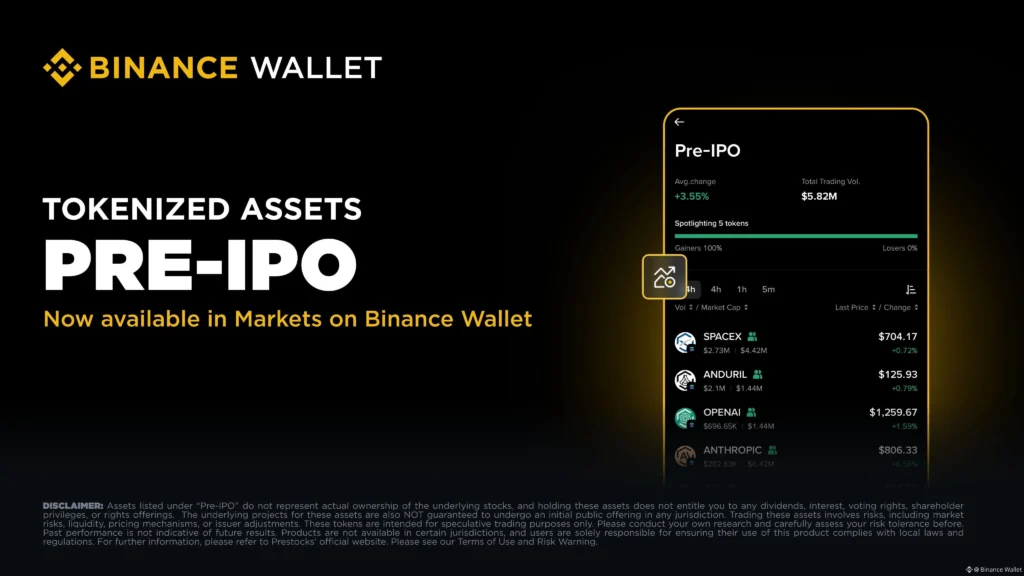
Binance entered the pre-IPO market on May 21, 2026, making it the most recent of the major platforms to launch. Despite being a late mover, the exchange’s scale means its SPCXUSDT contract immediately attracted substantial liquidity. Binance’s pre-IPO perpetual contracts are built on the same infrastructure as its standard crypto futures — before a company’s public debut, the contract price reflects publicly available signals including private funding rounds and announced IPO price ranges.
The Binance product is the most accessible entry point for traders who are already active on the exchange. For the majority of retail traders globally, Binance accounts are already set up, funded, and KYC-verified. Opening a SpaceX position requires navigating to the futures section and locating the pre-IPO category — no additional setup needed.
Binance also maintains a separate pre-IPO offering through its Web3 wallet, which had previously partnered with the PreStocks protocol on an SPV model. That product, which relied on Solana-based tokens backed by actual secondary shares, is the version that faced the 50% collapse when Anthropic and OpenAI voided SPV transfers. The perpetual futures product launched in May 2026 operates on a different, fully synthetic basis and does not carry the same SPV risk.
OKX
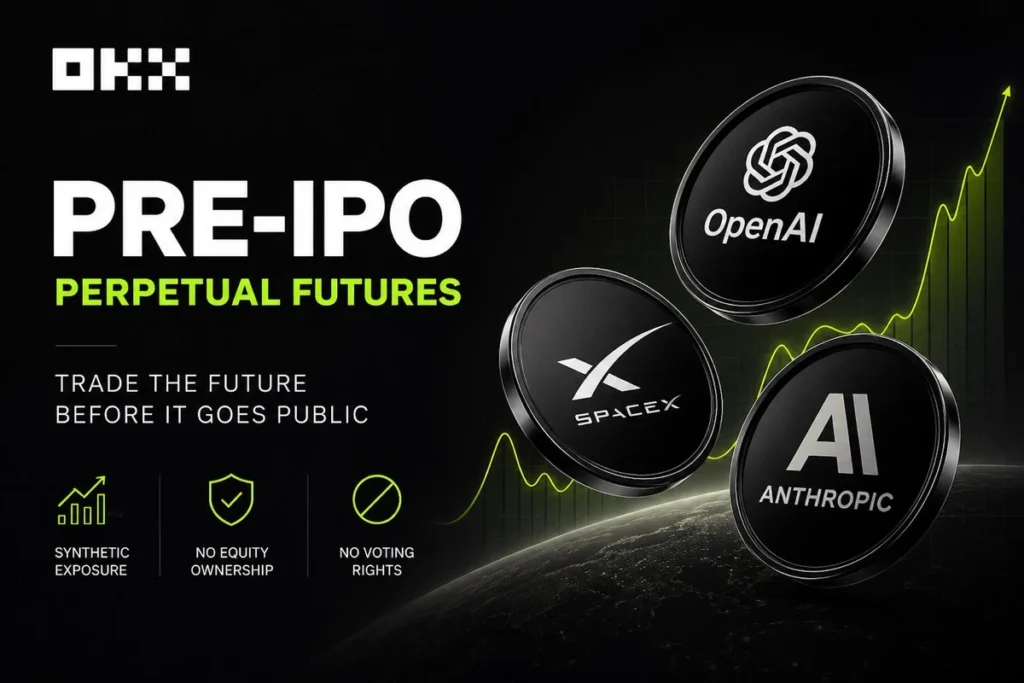
Model: Synthetic perpetual futures Available contracts: OpenAI, SpaceX, Anthropic (announced May 2026) Leverage: Standard OKX perpetuals framework Settlement: USDC/USDT, cash-settled Entry: OKX account with KYC Minimum: Standard OKX minimum order sizes
OKX announced its pre-IPO perpetual futures offering in early May 2026, positioning itself among the first major CEXs to make the move alongside Crypto.com. The contracts track reference prices linked to secondary market activity but grant no equity ownership, voting rights, or dividends. OKX framed the product explicitly as synthetic price exposure, not an equity instrument.
OKX’s user interface is well-regarded for advanced traders, and the exchange’s deep liquidity pool across perpetuals should translate into tighter spreads on pre-IPO contracts as volume builds. No firm timeline was announced for the full suite of contracts to go live, but the SpaceX contract is confirmed as the launch asset.
Crypto.com
Model: Synthetic perpetual futures Available contracts: SpaceX (confirmed ahead of Binance launch) Settlement: USDC-adjacent Entry: Crypto.com account
Crypto.com was among the first major CEXs to launch SpaceX pre-IPO futures, confirming its contract before Binance’s entry. The platform has positioned its offering as part of a broader expansion into real-world asset derivatives, consistent with Crypto.com’s strategy of targeting retail adoption of structured financial products through an accessible interface. Specific contract terms were not fully disclosed at the time of writing.
Bitget IPO Prime
Model: Tokenised economic rights via subscription (Republic infrastructure) Available contracts: SpaceX (preSPAX), with more anticipated Leverage: None — this is a subscription model, not a derivatives product Settlement: Token represents economic interest; redeemable upon IPO Entry: Bitget account; subscription-based allocation Minimum: $100 minimum; shares priced at approximately $650
Bitget’s IPO Prime is structurally different from all the perpetuals platforms above, and understanding that difference matters. It operates like a crypto launchpad — but for private company shares. Bitget partnered with Republic, a licensed U.S. investment platform, to issue synthetic claims on pre-IPO companies through a subscription model. Users apply for an allocation during a subscription window, receive a preSPAX token if allocated, and that token represents an economic interest in SpaceX’s performance tied to Republic’s infrastructure.
The product democratises access meaningfully. A $100 minimum versus the accredited investor thresholds that typically gate private equity exposure is a genuine structural change. However, the tradeoffs are clear: no leverage, limited secondary market liquidity, and a more complex redemption mechanism at IPO. The product is designed for investors who want medium-term exposure, not active traders who want to express a directional view with leverage today.

Gate.com
Model: Contingent payment notes Available contracts: SpaceX (SPCX), launched April 2026 Leverage: None — subscription and note-based model Settlement: Contingent on IPO; Gate hedges using off-exchange SpaceX equity or derivatives Entry: Gate account; subscription model Minimum: 100 USDT minimum; SpaceX priced at approximately $590 per unit
Gate launched its SpaceX pre-IPO product in April 2026, before most of its competitors, and the market response was extraordinary: total subscriptions exceeded $353 million within 24 hours of opening. The structure is notably different from the synthetic perpetuals model. Gate issues SPCX tokens mapped to the value of SpaceX equity, with Gate hedging its own exposure by holding SpaceX equity or derivatives off-exchange. Users hold what Gate describes as “contingent payment notes” — not derivatives in the perpetuals sense, but not direct equity either.
Gate‘s product sits between the synthetic perpetuals model and the tokenised equity rights model. The contingent nature of the payout introduces settlement risk if Gate’s own hedging positions or off-exchange holdings are disrupted. The $590 per unit pricing, implying a $1.4 trillion SpaceX valuation at launch, was more conservative than the $1.78 trillion reference used by Hyperliquid’s Trade.xyz — suggesting Gate was pricing off different secondary market data at the time.

Injective / Helix DEX
Model: Synthetic perpetual futures + Republic “Mirror Tokens” partnership Available contracts: SpaceX, OpenAI, Anthropic; also broader iAssets (NVDA, AAPL, Google) Leverage: Standard perpetuals leverage Settlement: On-chain, stablecoin-settled Entry: Helix DEX interface; wallet connection
Injective was operating in this space before most of the exchanges above. It partnered with Republic in August 2025 to enhance retail access to privately held company exposure, and launched pre-IPO perpetual futures on Helix DEX, its decentralised exchange layer. The Republic pre-IPO launch on Helix cleared roughly $1 billion in volume within its first 30 days of operation in August 2025, demonstrating genuine early demand. Injective’s iAssets framework also covers a broader range of traditional assets — major equities, indices, commodities — making it one of the more comprehensive on-chain real-world derivatives platforms outside of Hyperliquid.
The platform’s Republic partnership introduced Mirror Tokens, a blockchain-based instrument tracking private firm share values, alongside the standard perpetuals infrastructure. For DeFi-native users who want pre-IPO exposure within a broader on-chain RWA and equities trading environment, Injective/Helix is an underappreciated option.

Jarsy
Model: Asset-backed economic rights tokens (real equity held by Jarsy) Available contracts: SpaceX, Anthropic, OpenAI, Anduril, Stripe, Databricks, and others Leverage: None Settlement: Represents economic interest in real shares held by Jarsy Entry: Jarsy account; straightforward sign-up Minimum: $10 — the lowest entry point in the entire market
Jarsy is the product for investors who want the closest thing to actual equity access with the lowest possible entry barrier. The platform holds actual shares of private companies on its balance sheet and issues tokens that represent economic rights — not ownership or voting rights, but the financial interest in those shares’ performance. A Jarsy token for SpaceX entitles you to the economic upside of SpaceX shares held by Jarsy, with settlement at IPO or through secondary market sales.
The structure deliberately avoids the SPV problem. Because Jarsy retains legal ownership of the shares and the token represents only an economic interest against Jarsy’s holding, there is nothing for SpaceX or any other private company to invalidate — no share transfer is triggered when users buy or sell tokens. The $10 entry point is genuinely significant. For someone in a market where retail participation in private equity has historically been economically impossible, it represents a structural change in access.
The tradeoff is counterparty concentration: your economic interest ultimately depends on Jarsy holding the shares it claims to hold, maintaining the legal structure correctly, and being solvent at settlement. Unlike a perpetuals position on a decentralised protocol where settlement happens on-chain, Jarsy introduces a centralised trust dependency.
Platform comparison at a glance
Platform | Model | Key assets | Leverage | Min. entry | Equity claim |
Hyperliquid / Trade.xyz | Synthetic perp | SpaceX, Anthropic, OpenAI | Up to 3x | No minimum | None |
Synthetic perp | SpaceX (SPCXUSDT) | Standard futures | Standard | None | |
Synthetic perp | SpaceX, OpenAI, Anthropic | Standard futures | Standard | None | |
Crypto.com | Synthetic perp | SpaceX | Standard | Standard | None |
Bitget IPO Prime | Subscription / economic rights | SpaceX (preSPAX) | None | $100 | Economic interest via Republic |
Contingent payment note | SpaceX | None | 100 USDT | Economic interest vs. Gate hedge | |
Injective / Helix | Synthetic perp + Mirror Tokens | SpaceX, OpenAI, Anthropic | Standard perp | Wallet minimum | None (perps) / Mirror Tokens |
Jarsy | Asset-backed economic rights | SpaceX, Anthropic, OpenAI, Stripe, others | None | $10 | Economic interest vs. real shares |
The risk matrix
The product category is new, the regulatory framework is unsettled, and the potential for capital loss is high. The risks vary by model.
Oracle instability affects all synthetic perpetuals platforms. Private companies have no publicly listed share price. Every oracle sourcing data for these contracts is drawing from secondary OTC deal flow, reported funding round valuations, and aggregated signals — all of which can be thin, stale, or subject to manipulation. An oracle update that moves the mark price sharply can liquidate leveraged positions faster than any trader can respond.
The SPV collapse precedent is the most important risk case study in this space. Earlier in 2026, tokenised pre-IPO products on PreStocks collapsed approximately 50% after Anthropic and OpenAI issued statements that SPV-based share transfers violate their corporate bylaws. Platforms using SPV structures to hold actual shares remain exposed to the same risk: a private company can, and has, voided the legal underpinning of these products without notice. Synthetic perpetuals, which hold no shares, are structurally protected from this specific failure mode. Products with contingent payment notes or direct equity-backed tokens face varying degrees of exposure depending on the legal structure used.
Counterparty risk is concentrated differently across models. On a decentralised perp platform like Hyperliquid, settlement happens on-chain and the deployer’s stake backs market integrity. On centralised platforms like Binance or Gate, your position is ultimately a liability of the exchange. On equity-backed platforms like Jarsy, your payout depends on the platform’s continued solvency and correct custodianship of the underlying shares.
Settlement ambiguity applies when IPO timelines shift. If SpaceX delays its listing, restructures its capital, or is acquired before going public, the reference valuation anchoring these contracts becomes undefined. Each platform has a different mechanism for handling that scenario — and not all have disclosed their procedures clearly.
Leverage-specific risk applies exclusively to the perpetuals model. Even at 3x leverage, a 35% adverse move liquidates a maximum-leverage position. In markets with thin liquidity and oracle-driven pricing, such moves are not hypothetical.
Regulatory exposure remains the overarching tail risk across all models. The CLARITY Act addresses digital commodity classification and DeFi safe harbours but does not specifically cover synthetic equity derivatives on private companies. Regulatory action against any of these products — at the exchange level, the oracle level, or the underlying company level — could close a market without warning.

How to access pre-IPO markets: which platform fits which trader
Active traders wanting leveraged directional exposure: Hyperliquid via Trade.xyz is the most sophisticated and capital-efficient option. Binance and OKX offer the same synthetic model with more liquidity and easier onboarding for traders already on those platforms.
Long-term investors wanting IPO-day participation: Bitget IPO Prime via Republic or Gate’s contingent notes offer a more investor-friendly structure without leverage — appropriate for a buy-and-hold position ahead of a listing.
Investors wanting the closest thing to real equity access from $10: Jarsy offers the lowest entry barrier with actual shares backing the token, suited to someone who wants economic exposure and is comfortable with the centralised custody risk.
DeFi-native users wanting on-chain exposure with a broader RWA strategy: Injective via Helix DEX integrates pre-IPO perps into a wider on-chain equities and RWA environment.

How to open a synthetic pre-IPO perp on Hyperliquid
For traders choosing the perpetuals route, here is how the mechanics work in practice on the platform that pioneered the category.
Step 1 — Wallet setup. Install MetaMask, Rabby, or any EVM-compatible wallet. Store your seed phrase securely offline. Do not skip this step.
Step 2 — Acquire USDC. Buy USDC on OKX or Bybit. Both support USDC withdrawals to Arbitrum, which bridges to Hyperliquid. Use the Arbitrum network for withdrawals — it is faster and cheaper than Ethereum mainnet.
Step 3 — Bridge to Hyperliquid. Navigate to app.hyperliquid.xyz, connect your wallet, and use the deposit function to bridge USDC from Arbitrum. This typically completes in two to five minutes.
Step 4 — Locate the pre-IPO market. In the markets section, navigate to the HIP-3 builder-deployed markets tab. SPCX-USDC, Anthropic, and OpenAI contracts are listed here under Trade.xyz’s deployment. Review the current mark price, open interest, funding rate, and oracle feed before placing any order.
Step 5 — Set your position. Choose direction (long or short), set leverage (up to 3x), define your position size, and set a stop-loss below a level that reflects the oracle and liquidity risk of this market type. These are isolated-margin contracts — a liquidation does not affect other open positions, but the capital in the liquidated position is fully lost.
Step 6 — Active monitoring. Pre-IPO perps require more active oversight than standard crypto pairs. IPO news, company announcements, and oracle parameter changes can move mark prices sharply and unexpectedly. Keep your margin ratio significantly above the liquidation threshold.

What this means for the future of markets
The speed at which this category has expanded in 2026 is itself a signal. In the space of roughly six months, pre-IPO crypto markets have gone from a single experimental deployer on an emerging DEX to a product offered by the world’s largest exchange, multiple top-five platforms, and a growing ecosystem of specialist providers. The Cerebras case study — on-chain price discovery within 3% of the actual IPO opening price against a 35% miss from traditional secondary platforms — provided the proof of concept that institutional observers needed.
The deeper structural argument is about information and access. Secondary markets for private company shares have always existed. What they have never had is retail accessibility at scale, 24/7 liquidity, transparent on-chain settlement, and the ability for anyone with an internet connection to go short. Those properties change the nature of pre-IPO price discovery itself. When the market that prices SpaceX ahead of its debut includes not just Goldman Sachs clients but traders from Lagos, São Paulo, and Singapore, the resulting price may actually be more informative than one produced by a few dozen institutions comparing notes in a controlled secondary market.
That is an argument for the long-term value of what is being built. In the near term, these are high-risk instruments in a nascent category with unresolved regulatory questions. The SpaceX IPO window — expected in June 2026 — will be the first major settlement test for the most liquid of these contracts. How each platform handles that event, and how closely on-chain prices track the actual debut valuation, will determine whether pre-IPO crypto markets become a durable feature of global finance or a speculative category that fades as the IPO backlog clears.
The gatekeepers did not send an invitation. The market built its own door. Whether that door stays open depends on what happens next.

Where to trade: platform access links
Hyperliquid — Decentralised pre-IPO perps via Trade.xyz. Best for DeFi-native traders. Requires USDC wallet setup.
Binance — Pre-IPO Perpetual Contracts launched May 2026. Best for existing Binance users. SPCXUSDT live now.
OKX — Synthetic pre-IPO perps for SpaceX, OpenAI, Anthropic. Deep liquidity, advanced interface.
Bybit — Leading derivatives exchange; also the best fiat-to-USDC bridge for Hyperliquid access. Watch for Bybit’s own pre-IPO product announcements.
FAQ: pre-IPO crypto trading in 2026
What is a pre-IPO crypto contract? A pre-IPO crypto contract gives you financial exposure to a private company’s implied valuation before it goes public. Depending on the platform and model, this can be a synthetic perpetual futures contract (no shares, cash-settled in stablecoin), a tokenised economic rights instrument (backed by actual shares held by the platform), or a subscription-based allocation to a pre-IPO syndicate.
Can I own actual SpaceX shares through crypto platforms? No platform reviewed here gives you direct legal ownership of SpaceX shares. Synthetic perpetuals (Hyperliquid, Binance, OKX) have no connection to equity whatsoever. Economic rights tokens (Jarsy, Bitget via Republic) give you financial exposure but no ownership, voting rights, or corporate relationship with SpaceX.
Which platform is best for active traders? Hyperliquid via Trade.xyz offers the most sophisticated on-chain perps infrastructure with the best price discovery track record. Binance and OKX offer comparable synthetic products with higher liquidity and lower onboarding friction for traders already active on those platforms.
Which platform is best for long-term investors? Bitget IPO Prime via Republic offers a structured subscription model from $100. Jarsy offers economic rights tokens backed by real shares from as little as $10, making it the most accessible option for investors who want something closer to equity participation.
What happened to PreStocks and the SPV model? PreStocks operated tokenised Anthropic and OpenAI products backed by shares held in special purpose vehicles. Both companies issued statements in early 2026 that SPV-based share transfers violate their corporate bylaws. The products collapsed approximately 50% as a result. Synthetic perpetuals are not affected by this risk because they hold no shares and require no equity transfer.
How is the price of a pre-IPO perp determined? Oracle systems draw from secondary OTC deal flow, reported funding round valuations, and aggregated pricing signals. Trade.xyz updates its mark price every three seconds using a median of three inputs. Binance references publicly available signals including announced funding round prices and IPO price ranges.
When is the SpaceX IPO? SpaceX is targeting a June 2026 IPO at a valuation of up to $2 trillion, with a fundraise of approximately $75 billion to $80 billion, according to Reuters. This would be the largest single IPO in U.S. stock market history. The timeline remains subject to market conditions and regulatory approval.
What is Hyperliquid’s HIP-3? HIP-3 is Hyperliquid’s framework for permissionless perpetual futures deployment, activated on mainnet in October 2025. Independent builders can deploy their own perpetual DEX on HyperCore, Hyperliquid’s execution layer. Deployers stake 500,000 HYPE tokens as a security bond and control market parameters including oracle inputs, leverage limits, and fee structures. Trade.xyz is the leading HIP-3 deployer by volume.
Is trading pre-IPO crypto products legal? Regulatory treatment varies significantly by jurisdiction and remains genuinely unsettled globally. Synthetic perpetuals on private company valuations occupy a grey zone that existing crypto legislation does not specifically address. The U.S. CLARITY Act, currently moving through the Senate, covers digital commodity classification and DeFi safe harbours but does not specifically govern synthetic equity derivatives. Always confirm the regulatory position in your own jurisdiction before trading.
What are the main risks? Oracle instability, thin liquidity leading to rapid liquidation (for leveraged products), SPV invalidation risk (for equity-backed products), counterparty concentration on centralised platforms, settlement ambiguity if IPOs are delayed or cancelled, and regulatory intervention targeting any aspect of these products. Pre-IPO crypto markets are among the highest-risk products currently available on centralised and decentralised platforms.
What is Jarsy and how is it different? Jarsy is a pre-IPO investment platform that holds actual shares of private companies on its balance sheet and issues tokens representing economic rights against those holdings. Unlike synthetic perps, there is real equity backing the product. Unlike SPV models, Jarsy retains ownership of the shares, meaning no share transfer occurs when users buy or sell tokens — avoiding the legal risk that collapsed the PreStocks products. Entry starts at $10.
Trading pre-IPO perpetual contracts and pre-IPO investment products involves substantial risk of loss. These products carry additional risks compared to standard financial instruments, including oracle reliability, illiquid markets, platform counterparty risk, and regulatory uncertainty. Nothing in this article constitutes financial advice. Conduct your own research and trade only with capital you can afford to lose.
Recommended reading:
Tokenized US Treasuries: Best On-Chain Yield Products Compared in 2026
6 Most Reliable Crypto Bull Market Indicators Explained
Funding Rate Arbitrage: How to Earn Consistent Yield by Trading the Sign Flip in 2026