
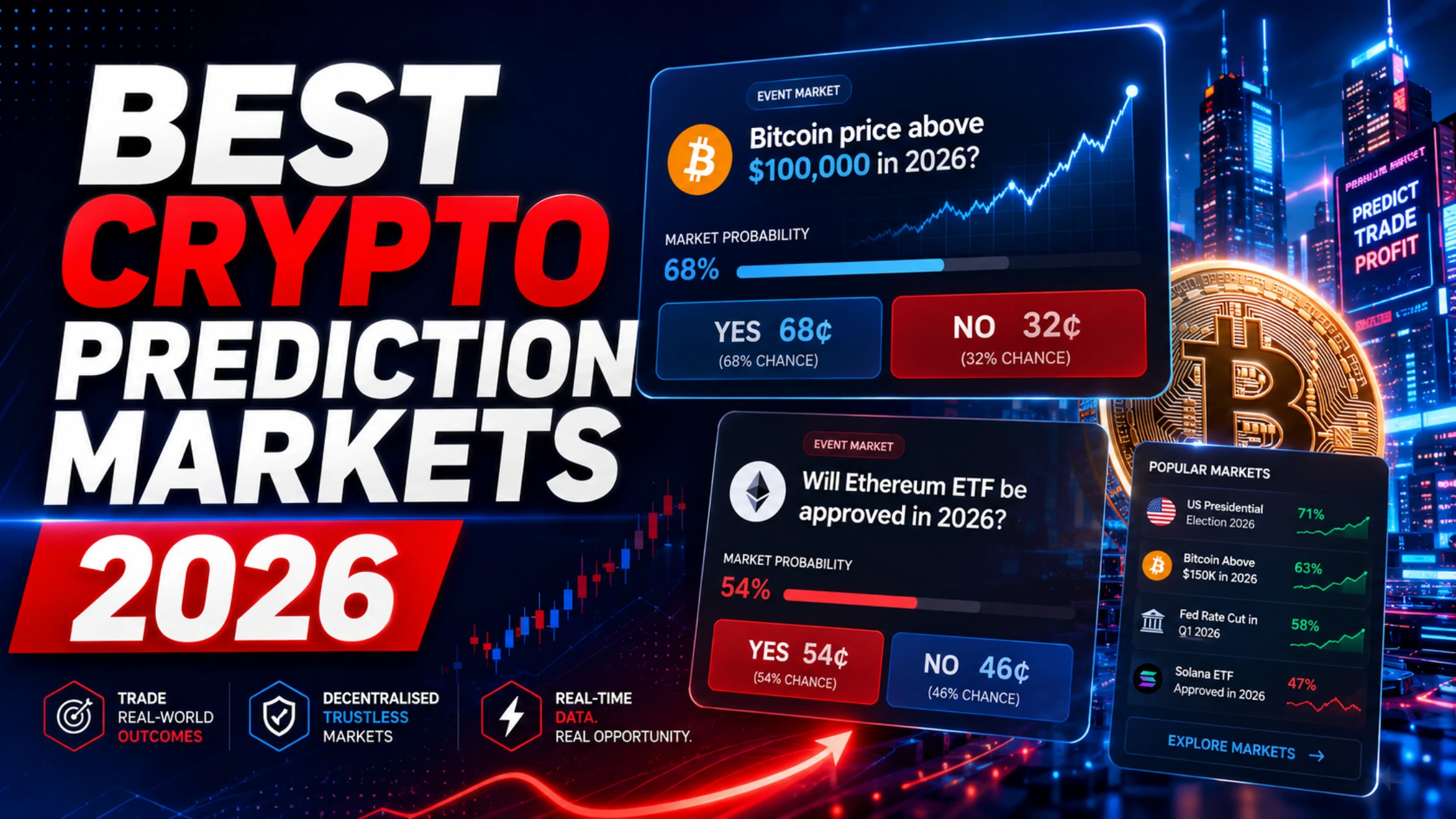
The most complete guide to crypto prediction markets in 2026. Every live platform reviewed, how oracles work, trading strategies, regulation, and where the $240 billion industry is heading.
There is a question that has haunted economists, political strategists, and financial forecasters for generations: what is the most reliable way to know what is going to happen? Not to guess. Not to model. Not to poll. To actually know, in real time, with a number attached.
The answer, it turns out, is money.
When people put real capital behind a belief, something remarkable happens. The noise collapses. The punditry evaporates. What remains is a probability — raw, self-updating, and startlingly accurate. This is the logic at the heart of prediction markets, and in 2026, it has become one of the most consequential ideas in all of finance.
The sector generated over $44 billion in total trading volume across 2025. By January 2026, monthly volumes had crossed $21 billion. On a single day in February 2026, Polymarket alone processed $425 million in transactions — more than many mid-sized stock exchanges move in a week. Investment firm Bernstein projects the sector will reach $1 trillion in annual volume by 2030. The New York Stock Exchange’s parent company, Intercontinental Exchange, invested $2 billion into Polymarket. Robinhood structured a joint venture with Susquehanna to acquire a regulated exchange and clearinghouse. Gemini launched a full-stack prediction marketplace. DraftKings, FanDuel, and Fanatics all launched prediction products. South Park devoted an episode to the rise of Kalshi and Polymarket.
In less than two years, prediction markets have gone from a niche corner of DeFi to a contested frontier of mainstream finance.
This guide covers everything: the mechanics, the history, the science, every live platform, how resolution actually works, how traders extract alpha, the regulatory battlefield, and where the industry is going. No other guide goes this deep. That is deliberate.

Part 1: What Prediction Markets Actually Are
The Core Mechanic
A prediction market is a financial exchange where the asset being traded is not a stock, not a currency, and not a commodity. It is the probability of an outcome.
On Polymarket, you might see a market titled: “Will Bitcoin exceed $200,000 before January 2027?” The contract trades at $0.38. That price means the collective participants — putting real money on the line — believe there is a 38% chance of that outcome. If Bitcoin exceeds $200,000 before the deadline, your YES shares each pay out $1.00. If it doesn’t, they pay $0.00. Every share starts with a binary fate.
This structure is elegant but carries enormous depth beneath the surface. The price is not set by an algorithm or a centralized forecaster. It emerges from the aggregate behavior of thousands of traders, each bringing their own information, research, and conviction. The richer the information environment, the more accurately the price reflects reality. A trader who knows something others don’t — perhaps they closely follow Federal Reserve signals, or they have domain expertise in a niche market — can profit from that edge. In doing so, they move the price toward a more accurate reflection of the actual probability. This is called the efficient market hypothesis applied to events rather than assets, and it works surprisingly well.
The resulting number — a contract price — is the most honest probability estimate available anywhere. More honest than a poll (which people answer carelessly because there is no consequence to being wrong), more honest than an expert forecast (which is often a reputational exercise rather than a genuine commitment), and more honest than a news headline (which has no skin in the game at all).

Binary Contracts and the Conditional Token Framework
Most prediction markets use binary contracts: YES or NO. Each contract resolves to exactly $1.00 on the winning side and $0.00 on the losing side. The sum of YES price plus NO price always equals $1.00 (in theory — in practice, spreads and fees create small deviations).
On blockchain-based platforms like Polymarket, this is implemented through the Gnosis Conditional Token Framework (CTF). When a market is created, the smart contract mints two tokens — YES tokens and NO tokens — in equal amounts. These tokens can be traded on an order book just like any other asset. When the event resolves, the winning token redeems for $1.00 USDC each, and the losing token redeems for $0.00. The process is entirely automated and trustless, executed by smart contract without human intervention in the payout stage.
Beyond binary contracts, some platforms support:
Scalar markets: The outcome is a number on a range (for example, “What will the US unemployment rate be in December 2026?” traded between 3.5% and 6.5%). Payouts are proportional to where the final number falls on the range.
Categorical markets: Multiple outcomes, one of which wins (for example, “Which team will win the 2026 NBA Championship?” with 30 options).
Conditional markets: Compound probabilities, where the outcome of one market affects another. These are increasingly used for sophisticated macro forecasting.

Prediction Markets vs. Sportsbooks vs. Options Markets
Understanding what prediction markets are is sharpened by understanding what they are not.
A sportsbook sets its own odds with a built-in house edge, typically 4–8%. If you bet on both sides of a game at a sportsbook, you will always lose money. The house is the counterparty and the house always wins in aggregate. Prediction markets, by contrast, are peer-to-peer. There is no house edge. Platforms earn small fees (0–2%) rather than baked-in margins. The price on a prediction market reflects actual crowd probability, not a bookmaker’s margin-adjusted line.
Options contracts in traditional finance have some conceptual overlap — both deal in probabilities of outcomes — but are fundamentally different instruments. Options are derivatives tied to the price of an underlying asset. A call option on Bitcoin is not a binary resolution: it has Greeks, it decays, it requires complex pricing models. A prediction market contract is far simpler: an event either happens or it doesn’t, and the contract pays exactly $1.00 or $0.00. There are no intermediate values, no Greeks, no time decay curves.
Gambling in the traditional sense involves games with known probability distributions (roulette, blackjack) or sports events where skill asymmetry creates house advantage. Prediction markets are better understood as information markets — they convert dispersed private information into a publicly legible probability signal.

Part 2: The History of Prediction Markets
The Iowa Electronic Market and the Academic Origins
Prediction markets did not begin with crypto. The Iowa Electronic Market (IEM), launched in 1988 by the University of Iowa, is the oldest running prediction market in the world. Designed as an academic research tool, the IEM allowed participants to trade contracts on US presidential election outcomes. From the beginning, the results were striking: the IEM consistently outperformed traditional polls, often by significant margins, right up through the 2008 and 2012 elections.
The IEM proved the concept. A market with real financial stakes, even with a $500 investment cap, produced probability estimates more accurate than the most sophisticated polling operations. The mechanism worked. But the IEM was deliberately constrained — academic, small-scale, and heavily regulated — meaning it couldn’t fulfill its broader potential.
PredictIt and the Washington-DC-as-a-Casino Era
PredictIt emerged in 2014 under a no-action letter from the CFTC, allowing it to operate as a research tool with $850 limits per market. Despite these restrictions, it became the primary prediction market for US political events, developing deep liquidity on elections, legislative outcomes, and regulatory decisions.
PredictIt’s story is also instructive about regulatory precariousness. In 2022, the CFTC abruptly withdrew its no-action letter and attempted to force PredictIt to shut down. Courts intervened and stayed the closure, with the platform eventually receiving full CFTC designation as a contract market in September 2025 — a recognition that the regulatory environment had fundamentally shifted in prediction markets’ favor.
Augur: The Blockchain Experiment That Proved the Concept and Failed the Execution
Augur launched on Ethereum in 2018, the first serious attempt to build a decentralized prediction market on a public blockchain. The ambition was radical: a system where anyone in the world could create a market on any question, and where outcomes were resolved by a network of token-holding reporters operating through an economic incentive system, with no central authority.
Augur proved the technical feasibility of on-chain prediction markets. But it failed commercially. Ethereum’s high gas fees made small bets economically irrational. The user experience was abysmal — requiring users to stake REP tokens, navigate dispute windows, and wait days for resolution. Liquidity never materialized. Most markets had single-digit participants.
The failure was not of the idea but of the implementation. Augur’s core contributions — the Conditional Token Framework (developed in parallel by Gnosis), decentralized resolution through economic incentives, permissionless market creation — became the intellectual foundation that all subsequent crypto prediction markets were built on. Its design patterns, as one analysis puts it, “now inform a generation of L2 prediction protocols.”

Gnosis and the Infrastructure Layer
Gnosis, originally a Berlin-based spinout from ConsenSys, took a different approach. Rather than building a prediction market product, it built the infrastructure layer: the Conditional Token Framework (CTF) that enables the creation and trading of conditional tokens, and the Gnosis Chain (formerly xDai), a low-cost Layer-2 environment designed to make small-value transactions economically viable. Omen, built on Gnosis infrastructure, became the primary consumer interface — a permissionless market creation tool that allowed anyone to spin up a market on any question using the CTF backbone.
Gnosis also invested in Azuro, which later became a significant prediction infrastructure protocol. The CTF itself became foundational: Polymarket, the dominant prediction market of 2025–2026, is built on Gnosis’ Conditional Token Framework.
Polymarket: The Breakout
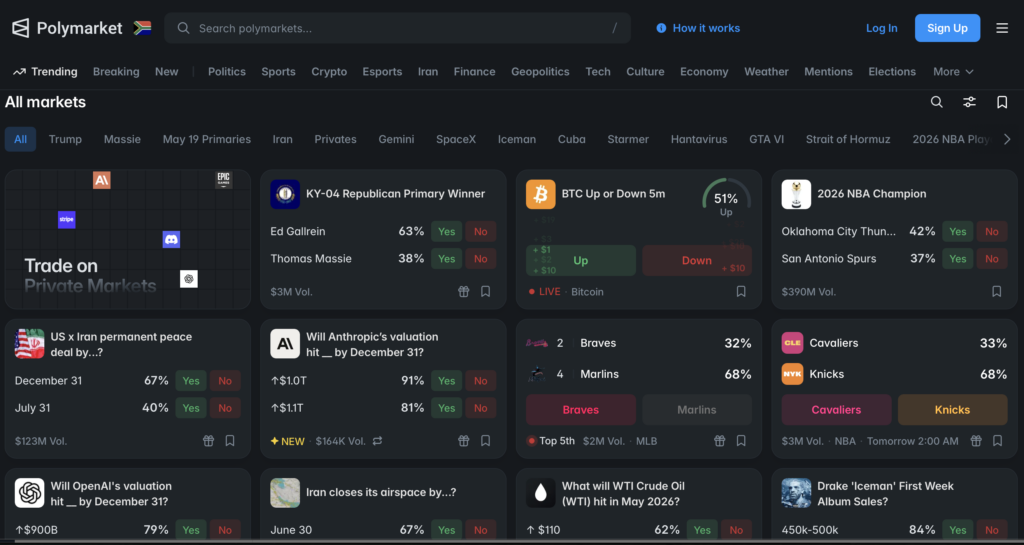
Shayne Coplan launched Polymarket in 2020, the same year the US presidential election generated enormous public interest in political forecasting. The timing was perfect. Polymarket offered what no one else could: a genuinely liquid, genuinely decentralized market for election outcomes, accessible with nothing more than a crypto wallet and USDC.
The platform’s political markets became the single most-cited forecasting tool during the 2024 US election cycle. Over $3.6 billion was traded on that election — the largest election betting market in history. Polymarket’s implied probability for the winning candidate exceeded 60% days before election day, while polling aggregates showed a near-toss-up. The outcome aligned with Polymarket’s probability, not the polls.
This was the moment prediction markets became culturally significant. Every major newspaper, every TV network, every political podcast was citing Polymarket prices as probability signals. The platform had achieved something unprecedented: it had made a blockchain-native financial instrument into a primary source of political intelligence.
The growth numbers tell the story. Polymarket’s trading volume grew from essentially zero in 2020 to $9 billion in 2024 to a trajectory of $18.4 billion in cumulative volume by late 2025, with monthly volumes exceeding $10 billion by March 2026 for the first time.

Part 3: The Science Behind Why Prediction Markets Work
The Wisdom of Crowds, Properly Understood
James Surowiecki’s 2004 book popularized the concept of the wisdom of crowds — the observation that aggregate group judgments often outperform individual experts. But the original insight was more specific: crowds are wise when they satisfy four conditions. Diversity of opinion (participants bring genuinely different information). Independence (participants aren’t herding on each other’s views). Decentralization (no single source controls the information). Aggregation (there is a mechanism to convert individual judgments into a collective decision).
Prediction markets satisfy all four conditions more reliably than any other known aggregation mechanism. The profit motive enforces independence — you don’t echo consensus if you think it’s wrong, because there’s money to be made by being right when others are wrong. The financial stake enforces seriousness — casual participants self-select out. The price mechanism does the aggregation automatically. And the diversity is structural: anyone with information, anywhere in the world, can participate.
The academic evidence is substantial. A landmark study published in Management Science, using 2,400 participants making forecasts on 261 geopolitical events over two seasons, found that prediction market prices were more accurate than the unweighted mean of probability estimates from expert forecasters. Other research has documented prediction market outperformance against polls, expert panels, and sophisticated statistical models across elections, economic indicators, and corporate events.
The critical caveat is that accuracy degrades in thin markets. A contract with $50 in total liquidity, with three participants, is not aggregating wisdom — it’s aggregating noise. Liquidity is the mechanism that converts the crowd wisdom concept from theory into practice. This is why the consolidation around Polymarket and Kalshi, despite representing an apparent market concentration, is actually beneficial for forecasting accuracy: it concentrates liquidity, which concentrates information.
The Favourite-Longshot Bias and Its Persistence
One of the most robust findings in prediction market research is the favourite-longshot bias: markets tend to overestimate the probability of low-probability events and underestimate high-probability events. If something has a true probability of 5%, the market will often price it at 8–12%. If something has a true probability of 90%, the market will often price it at 85–88%.
The behavioral explanation involves a mix of factors. Overconfidence and optimism bias inflate longshot valuations. The lottery effect — the appeal of a small investment with a potentially large return — attracts unsophisticated capital to longshots. Conversely, high-probability events attract less action because the risk-adjusted return on near-certainties is low, meaning sophisticated market makers may underprice them relative to their true probability.
For traders, this bias represents a consistent alpha source. Betting against longshots — systematically selling YES shares on contracts priced above 15% that are unlikely to resolve positively — has historically generated positive returns. Academic research has documented this strategy producing statistically significant excess returns on Polymarket, though the edge has compressed as institutional participants have identified and arbitraged the bias.

Information Aggregation Under Informed Trading
The efficiency of prediction markets depends on who participates. Research from the Wharton School found that in both prediction markets and expert forecasting polls, small elite crowds — the top performers — outperformed larger, sub-elite groups by substantial margins. The implication is that the value of prediction markets comes not from averaging all participants uniformly, but from the mechanism by which informed participants move prices and less-informed participants update toward them.
This creates an interesting dynamic: sophisticated traders actually improve the forecasting accuracy of prediction markets as a public good, even as they profit personally. A trader who identifies a mispriced probability and bets against it earns money while also pushing the price toward the truth. Their private profit is the market’s public benefit.
Part 4: Every Live Crypto Prediction Market, Reviewed
The prediction market landscape in 2026 is larger and more complex than any previous moment in the sector’s history. Below is a comprehensive review of every significant functional platform, organized by tier.
Tier 1: The Dominant Platforms
Polymarket
Chain: Polygon (primary), expanding to Solana via Jupiter DEX integration (February 2026) Settlement token: USDC (with migration underway to a new platform-native PUSD token backed 1:1 by USDC) Total cumulative volume: $18.4 billion Open interest: ~$170 million Active markets: 85,000+ Regulatory status: CFTC-approved via subsidiary QCX LLC (effective July 2025); US market access via QCEX structure re-opened December 2025
Polymarket is the undisputed largest decentralized prediction market by cumulative volume, and it is where the industry’s foundational architecture was stress-tested at scale. The platform is built on Polygon using the Gnosis Conditional Token Framework and resolves outcomes through UMA’s Optimistic Oracle — a system discussed in depth in Part 5 of this guide.
The platform’s market categories have evolved well beyond their political origins. By early 2026, roughly 40% of volume comes from sports markets, 40% from crypto price and market structure predictions, and the remainder spans politics, macroeconomics, culture, and technology. The sports and crypto symmetry reflects both the breadth of the user base and the practical utility of crypto prediction markets as hedging and speculation tools for participants already active in digital asset markets.
What distinguishes Polymarket’s market design is its commitment to informational density over user-friendliness. Markets on Polymarket tend to be precisely worded, with resolution criteria specified in advance and attached to concrete data sources. This precision reduces ambiguity and — in theory — oracle gaming, though the March 2025 governance attack (discussed in Part 5) exposed real vulnerabilities.
The regulatory journey deserves particular attention. Polymarket was forced to block US users in 2022 after a CFTC consent order determined it was offering unregistered binary options contracts. It spent three years as a global-but-not-US platform. The return to the US market in late 2025, via the CFTC-approved QCEX structure with intermediated access through registered Futures Commission Merchants, was one of the most consequential events in prediction market history. It validated the sector’s legitimacy under US federal law and opened the largest retail investor market in the world to the platform’s liquidity.
In March 2026, Polymarket signed Major League Baseball as its exclusive Official Prediction Market Exchange Partner — gaining access to MLB marks, logos, official league data via Sportradar, and an integrity framework tied to MLB/CFTC cooperation. This was a direct competitive response to Kalshi’s NHL partnership and signals an era of league-partnership competition that will define the sports prediction market landscape for years.
MetaMask integrated Polymarket directly into its mobile app in November 2025, enabling Polymarket participation through the world’s most widely used Ethereum wallet without additional account creation. Jupiter DEX, Solana’s largest decentralized exchange, integrated Polymarket into its Predictions tab in February 2026, extending the platform’s reach into Solana’s 100-million-wallet ecosystem.
Funding has been extraordinary. Polymarket raised $2.28 billion across seven rounds, including a $2 billion investment from Intercontinental Exchange (NYSE parent) at a $9 billion valuation in late 2025, with backing from Founders Fund, Vitalik Buterin, and Polychain Capital. The company is reportedly in talks for further funding at a $12–15 billion valuation.
Best for: Global users seeking the largest liquidity pools, the widest market selection, and the deepest sports and crypto markets. US users who want decentralized, crypto-native access with CFTC-compliant rails.
Fees: Taker fees ranging from 0.75% to 1.80% by category; makers pay 0%.
Limitations: Crypto-only onboarding (USDC required) creates friction for fiat-native users. Oracle controversy has raised questions about resolution integrity. US sports market availability varies by state due to ongoing litigation.
Kalshi
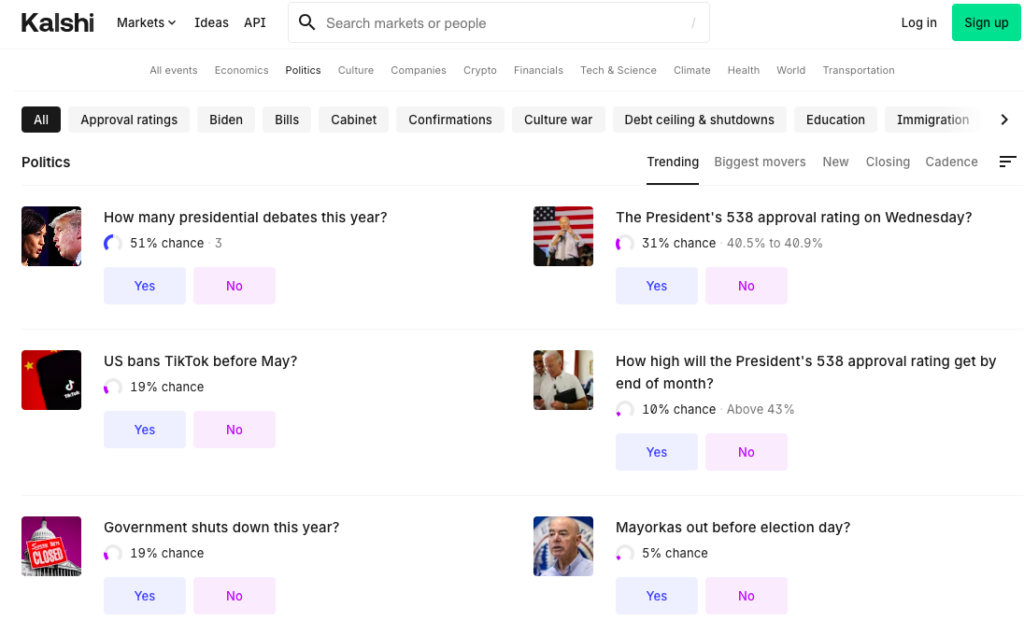
Type: Centralized, CFTC-regulated Designated Contract Market Settlement: USD (fiat), with crypto deposit options via ZeroHash (USDC, Bitcoin, Solana, Worldcoin) Monthly volume: $12.35 billion (March 2026 — all-time high) Valuation: $22 billion (March 2026 funding round) Regulatory status: First CFTC-regulated prediction market in the United States; operates as a fully licensed exchange with KYC requirements
Kalshi is the regulatory counterpoint to Polymarket. Where Polymarket moved fast and asked for permission later — paying for it with a three-year US exile — Kalshi spent years working with the CFTC before making a single trade. That decision looked slow in 2022. By 2026, it is a moat.
The platform’s growth trajectory is one of the most remarkable in financial technology history. Kalshi processed $300 million in annualized volume in 2024. By 2025, it had reached $50 billion in annualized volume — a 16,000% increase in twelve months. Its market share surged from 3.3% to 66% by September 2025, briefly overtaking Polymarket as the volume leader. The catalyst was sports event contracts: Kalshi launched sports markets under CFTC designation, captured the NFL and NHL as league partners, and saw sports volume approach $1 billion per week at its peak.
The institutional backing is a signal of where the smart money sits. Kalshi raised $185 million in a Series C round with backing from Sequoia, a16z, and Paradigm. Donald Trump Jr. joined the company’s advisory structure. The valuation jumped from $2 billion in June 2025 to $22 billion in March 2026 — a 10x increase in nine months.
Kalshi’s partnership with Robinhood is its most significant distribution channel. Robinhood Predictions, launched in late 2024, runs on Kalshi’s exchange infrastructure and gives Robinhood’s tens of millions of users access to prediction markets within their existing investment interface. The partnership means Kalshi’s liquidity benefits from Robinhood’s user acquisition engine, and Robinhood’s users gain exposure to prediction markets without needing a separate account.
The NHL became the first major North American sports league to sign a prediction market partnership with Kalshi, followed by a pattern of rapid league deal-making that prompted Polymarket to secure the MLB partnership as a direct countermove. The broader race for league data rights, integrity agreements, and official partner status mirrors the early sportsbook era of the 2010s, when exchange access to official league data became a competitive moat.
Kalshi’s compliance story creates advantages that pure-decentralized platforms cannot replicate. ACH deposits. Regulated USD settlement. No crypto onboarding curve. Institutional-grade disclosures. These attributes open doors that Polymarket’s current structure cannot: traditional broker distribution, fintech partnership, pension fund access, and media credibility. CNN’s partnership with Kalshi to display market probabilities during news coverage is the clearest example — a major US television network embedding prediction market prices into its election coverage is a legitimization event with no equivalent in crypto-native media.
Best for: US residents and institutions seeking fully regulated, fiat-native access to prediction markets. Users who want sports, politics, and economic markets without crypto onboarding. Institutions requiring KYC-compliant execution.
Fees: Up to $0.02 per contract (approximately 1–5% of profit depending on contract price).
Limitations: Narrower market selection than Polymarket. Market creation is slower (regulated exchange process, not permissionless). US geographic restrictions on certain sports contracts due to state litigation.

Tier 2: Significant Crypto-Native Platforms
Drift BET (Solana)
Chain: Solana Parent protocol: Drift Protocol (one of Solana’s largest DEXs, $25+ billion cumulative derivatives volume) Collateral: 30+ supported assets including SOL, USDC, mSOL Launch: Mid-2024 (Drift Protocol), BET feature mid-2024
Drift BET is one of the most structurally interesting prediction markets to emerge in the current cycle, because it breaks the assumption that prediction market capital must sit idle. Built as a feature layer on top of Drift Protocol’s perpetual futures and lending engine, BET allows users to post margin using any of ~30 supported assets and earn real yield on their collateral while holding event positions.
The mechanism is elegant. A trader who believes Ethereum will surpass $5,000 before June 2026 posts 100 SOL as margin on a BET position. While that position is open, the 100 SOL continues earning lending yield from Drift’s pool — typically 5–15% APY depending on market conditions. If the prediction resolves correctly, the trader earns both the event contract payout and the yield accrued during the holding period. The capital does not sit idle in a prediction position the way it does on Polymarket or Kalshi.
This capital efficiency model is particularly attractive for longer-duration markets where the time value of capital is a real cost. It also gives Drift BET a native user base from day one — Drift Protocol’s existing perpetuals traders are already on-platform, already have capital deployed, and can add prediction exposure as a diversifying layer without bridging funds to a new chain.
Solana’s technical characteristics suit prediction market trading: 400ms block times, $0.001 per transaction fees, and near-instant finality reduce the friction of entering and exiting positions. On Polymarket (Polygon), gas fees are low but not negligible at scale. On Solana via Drift, they are essentially free.
The platform exceeded Polymarket in daily trading volume on a single day shortly after launch — a milestone that reflected its strong initial traction among crypto-native traders. Volume has since normalized, but Drift BET remains the most capital-efficient prediction market for active DeFi participants.
Best for: Solana-native DeFi traders who want event exposure without idle capital. Users with diversified crypto collateral who want multi-asset margin flexibility.
Limitations: Narrower market selection than Polymarket. Less brand recognition for non-crypto events. Yield component adds complexity to position accounting.
Limitless Exchange (Base)
Chain: Base (Ethereum Layer 2) Total volume: $600M+ (as of early 2026, largest prediction market on Base) Market creation: Permissionless, natural language market creation Oracle: Pyth Network for automated resolution Funding: $18 million across four rounds; backed by 1confirmation, Coinbase Ventures, Arrington Capital
Limitless launched in 2025 and quickly became the dominant prediction market on Base, processing over $600 million in trading volume and reaching 39,000 monthly active traders. The platform takes a professional trading approach — central limit order book (CLOB) interface rather than AMM-style trading, with market and limit orders and instant payouts.
The Coinbase Ventures backing is significant: it connects Limitless to the Coinbase ecosystem at a strategic level, and Base is Coinbase’s own Layer-2. The integration of Pyth oracles — known for high-frequency price feeds used by major DeFi protocols — enables automated resolution of crypto price markets that don’t require subjective oracle judgment. If a market asks whether BTC will exceed $150,000 by a specified date, Pyth’s verified price feed provides the answer without human intervention.
The platform runs a points system with seasonal airdrops, rewarding both trading volume and prediction accuracy. This creates a dual incentive structure: traders profit from being right, and also accumulate platform points that convert to token rewards — a design that has been effective at bootstrapping liquidity in early-stage DeFi protocols.
Best for: Base ecosystem users and Coinbase users seeking a professional trading interface. Crypto-specific markets with automated oracle resolution. Traders who want a CLOB interface rather than AMM pricing.
Limitations: Smaller than Polymarket and Kalshi in total liquidity. Less diverse market selection (primarily crypto and tech-focused). Base ecosystem dependency.
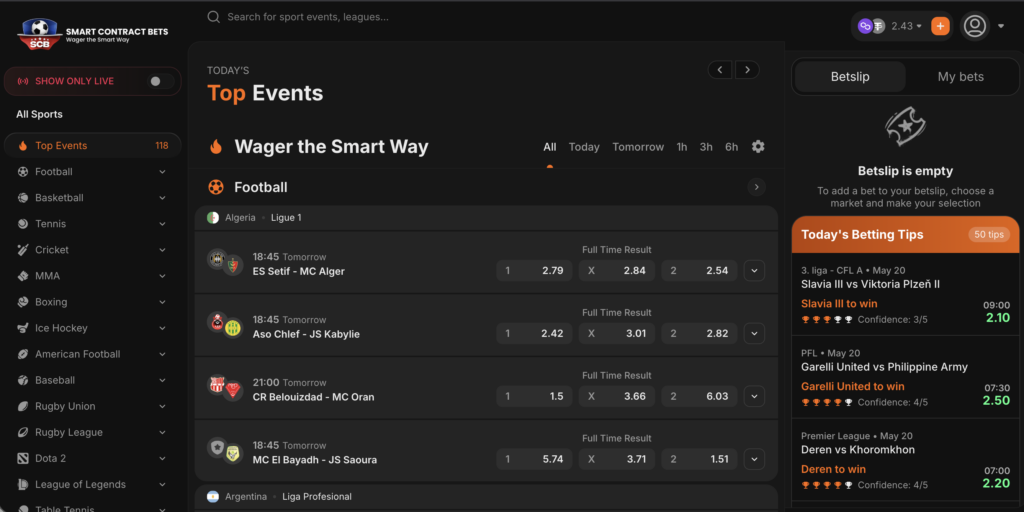
Azuro Protocol (Gnosis Chain, Polygon, Arbitrum)
Type: Decentralized infrastructure layer, not a direct consumer prediction market Model: Peer-to-pool; developers build frontend apps on Azuro’s liquidity layer Liquidity Pool: USDT pool with TVL and meaningful APY for liquidity providers Focus: Sports betting and prediction markets Funding: $11 million across three venture rounds; notable investor: Gnosis
Azuro occupies a unique position in the prediction market ecosystem: it is not a prediction market so much as the platform on which prediction markets are built. The analogy is apt — Azuro is to prediction markets what Ethereum is to DeFi. It provides the liquidity layer, the oracle infrastructure, and the development toolkit. Frontend apps (of which Azuro hosts 30+) handle user experience and market creation while outsourcing liquidity management to Azuro’s shared pools.
The Liquidity Tree model — Azuro’s proprietary approach to pool-based liquidity management — reduces slippage by allowing highly specific capital placement within the pool. Liquidity providers deposit USDT into the pool and earn APY from the margin between the odds offered to bettors and the true probability of outcomes. The decentralized way of handling liquidity ensures payouts can always be covered while rewarding LPs with sustainable yield.

The sports focus is evergreen in a way that political and macro markets are not. There is always a game being played somewhere in the world. Major leagues run year-round globally. Azuro’s focus on sports betting infrastructure — live betting, in-play markets, tournament markets — gives it a defensible niche within the prediction market landscape that doesn’t depend on news cycle peaks.
Best for: Developers building prediction market applications who want an out-of-the-box liquidity and oracle solution. Liquidity providers seeking yield from sports betting margins. Users of Azuro-powered frontends seeking sports betting with DeFi-native rails.
Limitations: Not a direct consumer product — requires finding and using a frontend app. Sports-heavy focus means limited political and macro markets compared to Polymarket/Kalshi. Pool model means odds can differ from pure market-driven prices.

SX Bet (SX Network — custom EVM chain)
Chain: SX Network, a custom EVM-compatible blockchain Launch: 2019 (the longest-running Web3 betting platform in operation) Funding: $9.5 million fundraising round Model: Fully on-chain escrow model; all market creation and settlement performed on-chain
SX Bet holds a distinction that no other crypto prediction market can claim: it has been running continuously since March 2019. Through multiple crypto winters, regulatory shifts, and technological upheavals, SX Network has maintained operational continuity. Its custom EVM chain gives it full control over the execution environment — gas costs, block times, and consensus mechanisms are all optimized specifically for prediction market use cases.
The escrow model is more conservative than AMM or pool designs: funds are locked in smart contracts at the moment of market entry and released at resolution. This eliminates counterparty risk at the protocol level. Users know exactly what they’ve committed and what they’ll receive. The trade-off is capital efficiency — funds are locked for the duration of the position — but for users who prioritize security and predictability over yield optimization, this is the right design.
SX Bet is particularly strong on niche sports markets. While Polymarket and Kalshi focus on the highest-volume events, SX’s deeper sports infrastructure and longer operational history give it an edge on smaller leagues, exotic props, and regional sports markets that bigger platforms ignore.
Best for: Users who want the longest track record in crypto prediction markets. Sports bettors seeking niche markets not available on mainstream platforms. Users who prioritize on-chain escrow security over capital efficiency.
Tier 3: Ecosystem-Specific and Specialized Platforms
Hedgehog Markets (Solana)
Built on Solana with mobile-first design, Hedgehog Markets targets accessibility over institutional sophistication. Its “no-loss” model for certain markets — where participants deposit into a yield-bearing pool and only the yield is distributed to winners, with principals returned to all participants — is a genuine innovation. It dramatically lowers psychological barriers by removing the possibility of total loss, making it suitable for users who want prediction market exposure without the risk profile of binary-outcome contracts.
The trade-off is that no-loss mechanics limit upside. If the pool generates 10% APY and there are ten participants, the winner receives the yield earned by all ten — a capped payout relative to a traditional binary market. But for onboarding first-time users to the concept of prediction markets, the mechanics are smart.
Best for: Solana users new to prediction markets. Casual participants who want event exposure without binary loss risk. Users already using Phantom or Solflare wallets who want minimal additional onboarding.
Gnosis (Omen) (Gnosis Chain)
Omen is the consumer-facing prediction market built on Gnosis’ Conditional Token Framework, operating on Gnosis Chain. It represents the philosophical DNA of the original crypto prediction market vision: fully permissionless, non-custodial, composable with DeFi, and supporting both binary and scalar markets with optional Kleros arbitration for dispute resolution.
In practice, Omen’s liquidity is thin — daily volume typically under $200,000 — limiting its practical utility for large positions. But as a reference implementation of prediction market technology, it remains intellectually significant. The CTF it pioneered is what Polymarket runs on. The Kleros arbitration model it experimented with influenced subsequent oracle design. Omen is crypto prediction markets’ living laboratory.
Best for: On-chain purists who want full non-custodial control. Researchers and developers studying prediction market mechanics. DAO governance applications that want to use prediction markets for internal decision-making.

Zeitgeist (Polkadot/Kusama)
Zeitgeist is the most technically ambitious prediction market on any non-EVM chain, built as a dedicated Substrate parachain on the Polkadot/Kusama network. Its distinguishing feature is futarchy governance: the protocol itself can use prediction markets to make upgrade and parameter decisions. Instead of voting on whether to implement Feature X, token holders can trade on whether implementing Feature X will be net positive for the protocol, with the market outcome determining the decision.
Zeitgeist uses the ZTG token for trading and governance, and its native court system — where jurors stake ZTG and are rewarded for voting with eventual consensus — represents a different approach to oracle resolution than UMA (used by Polymarket) or Kleros (optional in Omen). The court mechanism is theoretically the most fully decentralized resolution system in existence, though it remains untested at meaningful scale.
Best for: Polkadot ecosystem participants. Governance researchers and developers interested in futarchy models. Prediction market builders who prefer Substrate/Polkadot technology stacks.
Polkamarkets (Polygon, Moonbeam, Moonriver)
Polkamarkets deploys an AMM model similar to Uniswap — a constant-product market maker that maintains liquidity algorithmically rather than through an order book. Users don’t need a counterparty; they trade against the pool. This creates persistent liquidity even in low-activity markets, at the cost of impermanent loss risk for liquidity providers and potential slippage in markets where the pool is poorly calibrated.
The POLK token serves as the utility and governance token, with holders staking POLK to curate market quality. The multi-chain deployment across Polygon, Moonbeam, and Moonriver gives it coverage across EVM-compatible networks without requiring users to bridge to a single chain.
Best for: Smaller markets where order book liquidity would be insufficient. Users on Moonbeam or Moonriver who want prediction market exposure without bridging. Liquidity providers comfortable with AMM mechanics who want exposure to prediction market margins.

Manifold Markets (Web-based, play-money)
Manifold Markets occupies a separate category: it uses virtual Mana currency rather than real money, meaning no financial stakes and no regulatory complexity. Manifold ended its brief experiment with real-money sweepstakes in February 2025 and returned to a pure play-money model.
The absence of real money is both the limitation and the feature. Without financial stakes, Manifold markets are noisier and less accurate than real-money markets. But they are completely open — no KYC, no wallet, no onboarding friction. Anyone can create a market on any question in seconds. The result is a remarkable catalog of niche, idiosyncratic, and long-tail markets that no regulated or financially-at-risk platform would touch: AI research milestone predictions, hyperspecific sports props, community drama markets, philosophical questions.
Manifold is where traders prototype theses, researchers observe crowd behavior without financial confounds, and communities forecast their own internal dynamics. It is a valuable complement to the real-money ecosystem rather than a competitor.
Best for: Researchers. New users learning prediction market mechanics. Anyone wanting to forecast niche questions that no financial market would touch. Community and governance forecasting without real-money stakes.

O.LAB (BNB Chain)
O.LAB positions itself as an “epistemic market protocol” and introduces a structural innovation: graded opinion markets, where participants express not just directional predictions but probability and confidence levels, with rewards tied to calibration accuracy over time. The platform launched its testnet in Q3 2025 and has hosted over 3,000 community forecasts spanning AI, macroeconomics, and crypto governance.
The reputation-weighted accuracy system — rewarding users for how well-calibrated their forecasts are over time, not just whether they happened to be right — is a genuine improvement on binary reward structures that can be gamed through luck. If it scales, O.LAB could produce the most reliable probability estimates in the sector by systematically identifying and weighting the most calibrated forecasters.
Best for: Users interested in AI, macroeconomics, and crypto governance forecasting. Forecasters who want reputation-based tracking of their accuracy. Early adopters willing to engage with an emerging protocol.
Myriad Markets (Abstract blockchain)
Myriad is a community-driven prediction market on the Abstract blockchain combining free-to-play forecasting with USDC-backed trading. Multi-chain support and automated market resolution give it flexibility across the EVM landscape. It is one of the more recently launched platforms with community-oriented design, positioned as accessible for participants who want social prediction features alongside financial stakes.

The New Mainstream Entrants: Regulated US Platforms
The most significant structural shift in prediction markets in 2025–2026 has been the entry of major traditional finance and consumer tech brands. These platforms are not crypto-native, but they are increasingly crypto-compatible, and their user scale dwarfs all decentralized platforms combined.
Robinhood Predictions launched in late 2024 as a frontend for Kalshi’s regulated exchange. The product sits inside the existing Robinhood app — users already on the platform can access prediction markets in under two minutes with no additional account creation. This zero-friction onboarding is its defining advantage. Robinhood estimates prediction markets already generate $300 million in annual revenue, making it the company’s fastest-growing business line. The joint venture with Susquehanna to acquire MIAXdx (closed January 2026) will give Robinhood its own licensed exchange and clearinghouse, reducing long-term dependency on the Kalshi partnership.
Coinbase has announced and is building its own prediction market product, leveraging its 100+ million user base and Coinbase Wallet infrastructure. The New York Attorney General filed a lawsuit against Coinbase (and Gemini) in April 2026 over their prediction market offerings, alleging gambling law violations — a dispute likely headed for federal preemption resolution in the courts.
Gemini received CFTC Designated Contract Market designation in December 2025 and launched its Gemini Olympus prediction marketplace. A subsequent DCO (Derivatives Clearing Organization) license from the CFTC in May 2026 gave Gemini a full-stack, end-to-end marketplace. “Gemini now has a full-stack, end-to-end marketplace for predictions as well as futures, options, and more,” noted CEO Cameron Winklevoss at launch.
DraftKings Predictions launched across 38 US states in December 2025 in partnership with CME Group, offering sports, political, and economic event contracts. Sports contracts are only available in states where DraftKings doesn’t already operate a sportsbook.
FanDuel Predicts launched initially in five states where sports betting is not legal — using prediction markets as a way to offer event-based products in markets previously unavailable to them.
Interactive Brokers added prediction market products, extending access to its institutional and self-directed investor base.
Crypto.com entered the US prediction market with sports event contracts under CFTC designation, becoming one of the first crypto exchanges to launch prediction products in the regulated US market.
Part 5: How Resolution Actually Works — Oracles, Disputes, and the Trust Problem
Understanding how prediction markets resolve their outcomes is not optional reading for anyone who trades them seriously. The resolution mechanism is where the technology either earns or forfeits trust, and the events of 2025 demonstrated that this trust is not guaranteed.
The UMA Optimistic Oracle (Polymarket)
Polymarket resolves markets through UMA’s Optimistic Oracle (OO), a decentralized protocol designed around a simple but powerful assumption: most proposed outcomes are correct and will go unchallenged.
When a Polymarket market closes, the process proceeds as follows:
- An approved proposer (on a whitelist introduced via governance proposal UMIP-189 in August 2025) submits a proposed resolution to the UMA Optimistic Oracle. To do so, they must post a $750 PUSD bond.
- A 2-hour challenge window opens. During this window, anyone can dispute the proposed outcome by posting a matching $750 PUSD bond.
- If undisputed after 2 hours, the proposed resolution finalizes. The proposer recovers their bond plus a reward. YES or NO shares redeem automatically.
- If disputed, the request escalates to UMA’s Data Verification Mechanism (DVM) — a system where UMA token holders vote on the correct resolution. This process takes several days. The disputer and proposer both risk their bonds; the party that votes with the consensus keeps the other’s bond.
- Once UMA finalizes the truth, the result is published on-chain and Polymarket’s smart contracts execute payouts automatically.
The system is designed to be efficient (most markets resolve without dispute), decentralized (no single party controls outcomes — “not even Polymarket”), and economically incentivized (correct proposers earn rewards; bad-faith disputers lose bonds).
The March 2025 Oracle Attack: A Warning
The system’s vulnerabilities were exposed in March 2025, when a governance attack targeted a $7 million Polymarket contract on “Will Ukraine agree to Trump’s mineral deal before April?” A single actor controlling 25% of UMA’s total voting power — spread across three accounts — falsely settled the contract as “Yes” despite no official agreement being reached. Polymarket acknowledged the outcome was incorrect but kept the resolution, citing the finality of the UMA process.
The attack revealed a structural weakness: when UMA token ownership is concentrated, a large holder with a financial interest in a contract’s outcome can override the factual resolution through vote weight rather than evidence. The $5 million in misappropriated payouts made the attack profitable even accounting for the bond costs.
The August 2025 upgrade to Managed Optimistic Oracle V2 (MOOV2) — restricting resolution proposals to a whitelist of 37 experienced addresses — addressed the first-mover manipulation risk while preserving the dispute mechanism’s openness. Critics noted that the whitelist introduced a degree of centralization. The more fundamental critique — that resolution by token vote rather than cryptographic proof is inherently vulnerable to governance attacks — remains unresolved.
Reality.eth / Realitio (Omen, Gnosis)
Omen uses Reality.eth (also called Realitio) as its oracle system, where multiple participants stake crypto to propose resolution answers and challenge incorrect ones. The mechanism is crowd-sourced rather than whitelist-restricted, making it more permissionless but also more susceptible to low-attention gaming in markets with minimal stake at risk.
Kleros Arbitration (Optional in Omen)
Omen supports optional Kleros arbitration — a decentralized court where randomly selected jurors from a specialized pool review disputed outcomes and vote on the correct resolution. Kleros adds a human judgment layer for ambiguous cases that pure economic oracle systems handle poorly. The trade-off is latency: Kleros disputes can take days or weeks to resolve.
Pyth Network (Limitless, and crypto price markets generally)
For markets with quantitative, objectively verifiable outcomes — “Will BTC close above $150,000 on June 30, 2026?” — Pyth Network’s high-frequency price feeds provide automated, manipulation-resistant resolution. Pyth aggregates price data from over 90 institutional market makers and DeFi protocols, making it the most reliable oracle source for crypto price markets. No human judgment is needed. When the timestamp arrives, the verified Pyth price is compared to the threshold, and the outcome is automatic.
Chainlink Price Feeds
Similar to Pyth but broader in asset coverage and more conservative in update frequency, Chainlink oracles are used by various prediction protocols for crypto price resolution. For non-crypto events, Chainlink’s capabilities are limited — it cannot resolve “Who won the US Senate race in Nevada?” the way it can resolve “What is the USDC/USD exchange rate?”
Centralized Resolution (Kalshi, DraftKings, Robinhood)
Regulated platforms use their own determination processes, backed by official data sources and exchange rule books. Kalshi, for example, uses authoritative sources specified in advance for each market’s resolution rules — official government statistics for economic markets, official league results for sports markets. These are subject to exchange rules and CFTC oversight. Disputes are handled through the exchange’s internal process and, ultimately, CFTC jurisdiction.
Part 6: Trading Strategies for Crypto Prediction Markets
For participants who approach prediction markets as a trading environment rather than a forecasting exercise, the landscape offers multiple distinct strategy profiles. Academic research has documented over $40 million in arbitrage profits extracted from Polymarket alone between April 2024 and April 2025, across 86 million bets analyzed. The strategies below represent proven sources of alpha — though the edge compresses as the market matures.

Information Arbitrage (Directional Trading)
The most intuitive strategy: you believe you know something the market doesn’t. You buy YES on an outcome you think is more likely than the market price implies, or buy NO on an outcome you think is less likely.
The edge here comes from genuine information advantages — domain expertise, faster access to primary sources, superior analysis of public information, or local knowledge unavailable to the crowd. A trader with deep expertise in Federal Reserve communication patterns who follows every Jackson Hole speech, every FOMC minute, and every Fed governor’s public statement may have a structural edge on Fed rate decision markets. A trader who closely follows on-chain Bitcoin metrics may have an edge on BTC price milestone markets.
Two days before the February 2026 Fed meeting, the “Fed holds rates steady” contract traded at $0.92. It resolved at $1.00, yielding an 8.7% return over 48 hours. The math of near-certainty trades: at $0.92 entry, you need to win 92% of similar trades to break even. The strategy works when you are actually that confident — and fails when overconfidence inflates your conviction beyond your actual edge.
Cross-Platform Arbitrage
The same event often trades at meaningfully different prices across platforms due to differences in liquidity, user base, and information flow speed. If “Will Bitcoin exceed $200,000 in 2026?” trades at YES $0.62 on Polymarket and YES $0.56 on Kalshi, a trader can buy YES on Kalshi at $0.56 and simultaneously buy NO on Polymarket at $0.38. Total cost: $0.94. Guaranteed payout: $1.00 regardless of outcome. Profit: $0.06 per share, or 6.4% risk-free return.
In practice, cross-platform arbitrage requires: capital deployed on both platforms simultaneously, fast execution (gaps close within minutes of appearing), attention to resolution rule differences (a market worded slightly differently on two platforms may resolve differently on the same event), and fee accounting (a 6% gross profit can become 2% net after platform fees).
During the 2024 election cycle, 3–5 cent gaps appeared periodically between Polymarket and Kalshi on the same event contracts. By early 2026, these gaps had compressed significantly as institutional arbitrageurs — running automated bots with sub-second execution — rapidly close mispricings. Manual arbitrage identification is essentially impossible at this stage; automated systems are necessary for consistent execution.
The IMDEA Networks Institute documented over $40 million in arbitrage profits extracted from Polymarket alone between April 2024 and April 2025. The top performers used sophisticated bots. The window is compressing as institutional capital enters, but it has not closed.
Liquidity Provision and Market Making
Market makers on platforms like Polymarket and Kalshi profit from bid-ask spreads by continuously quoting both YES and NO prices, remaining relatively directional-neutral and capturing the spread on each trade. A market maker might quote a YES/NO pair at $0.55 and $0.45 respectively, earning $0.10 per round-trip trade.
Academic research (specifically, Palumbo’s analysis of Kalshi NFL markets) documented aggregate positive returns for liquidity providers across an NFL season, estimated at approximately $29 million. The structural insight is that prediction market liquidity provision is economically more similar to underwriting (taking on uncertainty risk in exchange for premium) than traditional market making (providing execution for a spread).
The risks are real: a poorly diversified book can suffer severe drawdowns on a single correlated event. If all your liquidity positions are on US political markets and a major unexpected event shifts prices simultaneously, the losses are not diversified. Market makers require either API-driven real-time repricing or a risk model sophisticated enough to handle correlated exposure.
High-Probability Bond Strategies
A systematically profitable approach for conservative participants: focus exclusively on markets priced between $0.85 and $0.99, where a high-confidence outcome is essentially certain but hasn’t yet resolved. These markets offer low-risk returns: buying YES at $0.92 and collecting $1.00 at resolution is an 8.7% gain over whatever the holding period is, without needing to forecast the actual outcome — only the certainty of what’s already happened or near-certain to happen.
The risk is resolution ambiguity. A market at $0.98 is cheap to enter because it appears near-certain — but resolution rules, oracle disputes, or genuine outcome uncertainty can cause a “99% certain” market to resolve unexpectedly. Always read resolution criteria before entering any high-probability position.
The Favourite-Longshot Bias Play
The most empirically robust strategy in prediction market research: systematically sell YES shares on contracts priced between 5–15% (i.e., buy NO on longshots). The favourite-longshot bias means these contracts are systematically overpriced relative to their true probability. A contract at 10% that is truly 5% likely is 2x overpriced.
At scale, across many such markets, this strategy should generate positive expected value. The risks: individual longshots occasionally hit, requiring careful position sizing (never put more than 1–3% of bankroll on any single longshot-bias trade). The strategy also requires sufficient market volume to express at meaningful scale.
Domain Specialization
Rather than attempting to trade all markets, focus on one domain where you have structural information advantages. A macro trader with deep knowledge of Federal Reserve policy should focus on Fed rate decision markets. A crypto quant with on-chain analytics tools should focus on BTC/ETH price markets. A political analyst who follows regional elections closely should focus on niche political markets.
The principle: width of coverage reduces the information edge that makes prediction market trading profitable. Depth in a single domain builds a sustainable, compounding edge. PolyTrack and similar tools allow tracking of top performer patterns — studying how consistently profitable traders in your domain approach markets is itself an information advantage.
Part 7: The Regulatory Battlefield
The regulatory environment for prediction markets in 2026 is the most contested in the sector’s history, spanning CFTC jurisdiction claims, state gambling law conflicts, state-by-state litigation, and emerging international frameworks.
The CFTC vs. States: The Central Conflict
The fundamental regulatory question of 2025–2026 is jurisdictional: who governs prediction markets? The CFTC argues they are “event contracts” — financial derivatives that fall squarely under the Commodity Exchange Act and federal jurisdiction. State regulators (particularly gaming commissions in Nevada, New Jersey, New York, and others) argue that sports-event contracts are indistinguishable from sports betting, which requires state gaming licenses.
This conflict is not theoretical. Kalshi faces cease-and-desist orders in at least ten states and has filed lawsuits to prevent enforcement, arguing CFTC federal regulation preempts state gaming law. Similar disputes involve Robinhood, Crypto.com, Coinbase, and Gemini. The New York AG’s lawsuit against Coinbase and Gemini specifically alleges that their prediction market offerings are illegal gambling under state law.
The CFTC filed amicus briefs in five states in February 2026, asserting federal preemption — a move that signals the agency’s intent to maintain exclusive jurisdiction. The question is likely to reach the US Supreme Court. The resolution will determine whether the regulatory landscape remains federal (favorable to prediction markets) or fragments into 50-state licensing regimes (potentially fatal to the sector’s US growth trajectory).
On February 28, 2026, Polymarket set a single-day trading volume record of $425 million — a day that also saw fresh regulatory scrutiny, demonstrating that volume and regulatory risk scale together.

Legislative Proposals
Congress is not sitting still. Three notable legislative proposals emerged in early 2026:
The DEATH BETS Act would ban prediction market contracts tied to war, terrorism, or assassination — a response to the ethical controversy over markets on military and political violence.
The Public Integrity in Financial Prediction Markets Act would bar federal employees from trading on non-public information in prediction markets — an obvious corollary to insider trading restrictions in securities markets.
The Senate unanimously prohibited its own members from prediction market trading in May 2026, a first-of-its-kind conflict-of-interest restriction on elected officials.
The broader legislative framework — the CLARITY Act — aims to establish a coherent regulatory framework for digital assets generally, with prediction markets as a component. If passed, it would reduce the uncertainty that currently forces every participant to evaluate regulatory risk market-by-market and state-by-state.
International Regulatory Fragmentation
Outside the US, the picture is complex. The EU faces a patchwork of national regulations with no unified framework until MiCA’s grandfathering period ends in July 2026, after which crypto-based platforms need formal licensing to operate across the bloc. The UK’s binary options retail ban creates a narrow legal pathway for prediction markets — they must be structured as betting exchanges or regulated financial products, neither of which maps perfectly onto the current US-style event contract model.
Across Asia, Singapore, Thailand, Taiwan, Australia, and India have blocked platforms under anti-gambling or online gaming laws. China prohibits access entirely. Latin America is tightening: Brazil shut down more than 25 platforms in April 2026, Argentina imposed a nationwide block shortly before. For globally oriented decentralized platforms like Polymarket, the geographic access landscape is fragmented and continuously shifting.
The MiCA Opportunity
The EU’s MiCA regulation, while primarily aimed at crypto asset service providers, creates a compliance framework that could actually benefit prediction market platforms willing to register and operate within it. A platform that holds a MiCA license gains passporting rights across all 27 EU member states — a unified access layer that doesn’t currently exist. For Polymarket or any crypto-native prediction market with European ambitions, obtaining MiCA licensing ahead of July 2026 is a strategic opportunity.

Part 8: Risks and Controversies
Oracle Manipulation and Governance Attacks
The March 2025 UMA governance attack — in which a single actor used 25% of UMA’s voting power to falsely settle a $7 million contract — is the most important risk event in prediction market history. It demonstrated that decentralized resolution systems are only as decentralized as their token ownership distribution. Concentrated token holders with financial exposure to a market outcome are structurally incentivized to attack the resolution process.
The MOOV2 upgrade (whitelist model) reduces the frequency of this attack vector but does not eliminate it. Critics argue the only true solution is cryptographic proof of outcomes — zero-knowledge proofs or other verification methods that produce undeniable evidence rather than stakeholder votes. The UMA/EigenLayer/Polymarket partnership announced in early 2025 aimed at developing an AI-powered oracle using EigenLayer’s restaking liquidity for verification — a promising but still-in-development approach.
Retail Loss Rates
Research consistently documents that 85–90% of retail prediction market participants lose money. This is not unique to prediction markets — similar or worse outcomes characterize retail participation in options, CFDs, and binary trading instruments. But the similarity in structure between prediction markets and binary options (which are explicitly banned for retail in the UK and restricted in many other jurisdictions) means prediction market platforms will face increasing regulatory pressure to implement risk warnings, position limits, and participant suitability requirements.
Market Manipulation Through Information Asymmetry
Prediction markets can be gamed in ways that traditional financial markets cannot. If a trader holds a large YES position on a market tied to a corporate event and possesses material non-public information about that event, their trading is economically equivalent to securities insider trading — but prediction market contracts are classified as event contracts, not securities. The applicable regulatory framework is underdeveloped. The Public Integrity Act proposals represent the beginning of Congressional attention to this gap.
War and Violence Markets
The Guardian (April 2026) published an investigation into the ethical concerns raised by prediction markets tied to war outcomes, military conflicts, and political violence. The specific concern: markets that profit from human suffering may create perverse incentives, and the opaque UMA resolution process makes it difficult to challenge outcomes tied to geopolitically sensitive events. The DEATH BETS Act is a legislative response, but the philosophical tension between prediction market completeness (any question can be a market) and ethical constraints (some questions probably shouldn’t be markets) remains unresolved.
Concentration Risk
The dominance of Polymarket and Kalshi — controlling approximately 97.5% of global prediction market volume — creates systemic risk if either platform experiences a security event, regulatory shutdown, or operational failure. Unlike traditional financial markets where clearing houses and central counterparties provide systemic backstops, prediction market infrastructure remains fragmented. A Polymarket smart contract exploit could simultaneously affect billions of dollars in open positions with no recourse mechanism.

Part 9: The Road Ahead — Where Prediction Markets Are Going
The $240 Billion Projection and the $1 Trillion Vision
The numbers being cited by serious financial institutions are not speculative hand-waving. The sector grew from $1.2 billion in monthly volume at the start of 2025 to $21 billion by January 2026. Bernstein projects $1 trillion in annual volume by 2030. Investment firm analysis projects the sector reaching $240 billion by end of 2026 from $51 billion in 2025. These projections are driven by three structural forces: regulatory legitimization, distribution partnerships, and product expansion.
AI Agents in Prediction Markets
The integration of AI into prediction market participation is in early stages but already transformative. AI agents — autonomous systems running continuously — can monitor thousands of markets simultaneously, execute statistical arbitrage faster than any human trader, and synthesize information streams that no individual could process. Several hedge funds and proprietary trading firms are reportedly exploring AI-driven prediction market strategies.
On the platform side, prediction markets themselves become inputs to AI systems: an AI model making investment decisions about a regulatory outcome can use prediction market probabilities as real-time inputs, replacing the subjective probability estimates that financial models traditionally require. Motley Fool, Cantor Fitzgerald, and other financial analysts have begun citing prediction market prices explicitly in their research.
The ETF frontier is particularly notable: asset managers including Bitwise, Roundhill, and GraniteShares have filed with the SEC to list prediction market ETFs that would track contracts tied to elections and other political events, allowing traditional investors to gain exposure to political volatility through a regulated securities wrapper. If approved, prediction market ETFs would represent the first securitized political risk instrument in history.

Tokenized Real-World Assets and Prediction Markets
The convergence of tokenized real-world assets and prediction markets is a natural next step. If equity markets, real estate, and commodity markets are increasingly represented on-chain, prediction markets that reference the performance of specific tokenized assets become possible — and begin to blur the line between derivatives trading and prediction market speculation in ways that regulators will need to address explicitly.
The Accuracy Race
As prediction markets scale, the question of whether they maintain their forecasting superiority over polls and expert analysis will face increasing scrutiny. The 2024 US election provided one high-profile validation. But prediction market accuracy can degrade when markets become popular enough to attract participants without information advantages, who trade emotionally or in response to social signals rather than fundamental analysis. The sports volume surge on Kalshi — where fan loyalty explicitly distorts prices — is an early warning sign.
The countervailing force is liquidity. As markets deepen, the influence of any single irrational participant decreases and the weight of informed capital increases. The research suggests that prediction market accuracy is positively correlated with both liquidity depth and participant quality — meaning the current scale-up phase, if it attracts sophisticated institutional participation alongside retail, should produce more accurate markets, not less.

Platform Comparison Table
|
Platform |
Chain |
Settlement |
Volume (2025-26) |
Regulated |
Market Types |
Best For |
|
Polymarket |
Polygon/Solana |
USDC |
$18.4B cumulative |
CFTC (via QCEX, US only) |
Politics, Sports, Crypto, Macro |
Deepest global liquidity, widest market selection |
|
Kalshi |
Centralized |
USD/Crypto |
$12.35B/month (Mar 2026) |
CFTC (DCM) |
Politics, Sports, Macro, Crypto |
US regulated, fiat-native access |
|
Robinhood Predictions |
Kalshi-powered |
USD |
Part of Kalshi volume |
CFTC (via Kalshi) |
Full Kalshi catalog |
Easiest US onboarding |
|
Gemini Olympus |
Centralized |
USD/Crypto |
Early stage |
CFTC (DCM + DCO) |
Multiple categories |
Crypto-native regulated access |
|
DraftKings Predictions |
Centralized |
USD |
N/A |
CFTC (via CME) |
Sports, some political |
38-state US sports focus |
|
Drift BET |
Solana |
30+ assets incl. USDC/SOL |
Growing |
None |
Crypto, Politics, Sports |
Capital efficiency, Solana users |
|
Limitless |
Base (Ethereum L2) |
USDC |
$600M+ |
None |
Crypto, Tech, Sports |
Base ecosystem CLOB trading |
|
Azuro |
Gnosis/Polygon/Arbitrum |
USDT |
Pool-based LP |
None |
Sports (primary) |
Infrastructure/LP yield |
|
SX Bet |
SX Network (custom EVM) |
Various |
Ongoing since 2019 |
None |
Sports, General |
Longest track record, niche sports |
|
Hedgehog Markets |
Solana |
SOL/USDC |
Small |
None |
Politics, Crypto, Sports |
No-loss model, beginners |
|
Polkamarkets |
Polygon/Moonbeam |
POLK/USDC |
Small |
None |
General |
AMM-style constant liquidity |
|
Gnosis/Omen |
Gnosis Chain |
Various |
Very thin |
None |
General/permissionless |
Permissionless, non-custodial |
|
Zeitgeist |
Polkadot/Kusama |
ZTG |
Small |
None |
General, Governance |
Polkadot ecosystem, futarchy |
|
Manifold Markets |
Web-based |
Mana (virtual) |
N/A (play-money) |
None |
Everything |
Research, practice, niche |
|
O.LAB |
BNB Chain |
Various |
Early stage |
None |
AI, Macro, Crypto governance |
Calibration-weighted accuracy |
|
Myriad |
Abstract |
USDC |
Early stage |
None |
Community-driven |
Social prediction, accessibility |
How to Get Started in Crypto Prediction Markets
Step 1: Choose your platform based on geography and goals. US residents with no crypto experience: start with Robinhood Predictions (if you have a Robinhood account) or Kalshi (for full market access with fiat deposits). Global users comfortable with crypto: Polymarket offers the deepest liquidity and widest market selection.
Step 2: Fund your account. For Kalshi and Robinhood: USD via ACH, wire, or crypto deposits via ZeroHash. For Polymarket: acquire USDC and bridge to Polygon using an exchange like Coinbase or Binance, then connect a Web3 wallet (MetaMask, Coinbase Wallet). The MetaMask mobile integration launched November 2025 enables Polymarket access directly from the wallet.
Step 3: Start with high-probability markets to learn resolution mechanics. Don’t begin by taking speculative positions on 20% longshots. Find a market where the outcome is already known or near-certain and observe how resolution, redemption, and payout work in practice.
Step 4: Develop a specialization. Pick one domain where you have genuine information advantages — macro, crypto, sports, politics. Build depth in that domain before expanding. Use PolyTrack or similar tools to study how top performers in your domain approach markets.
Step 5: Practice strict position sizing. No single prediction market position should exceed 5–10% of your total deployed capital, regardless of conviction level. Oracle disputes, resolution surprises, and platform issues can affect even near-certain positions. Capital preservation enables compounding.
Step 6: Track tax obligations. Prediction market profits are taxable in most jurisdictions. The classification varies: event contract gains may be treated as ordinary income, capital gains, or gambling income depending on jurisdiction. US users should be aware that CFTC-regulated contracts may carry specific tax treatment. Track every trade with tools like Blockstats, Koinly, or CoinTracker, as platforms do not always provide comprehensive tax documentation.
The Bottom Line
Prediction markets are not a niche crypto experiment anymore. They are a maturing financial sector processing tens of billions of dollars monthly, attracting institutional capital from NYSE parent companies and venture titans alike, reshaping political and economic forecasting, and forcing a renegotiation of the boundary between finance and gambling at the federal regulatory level.
For crypto participants in particular, prediction markets represent something profound: the application of blockchain’s core value propositions — transparency, permissionlessness, global access, programmable settlement — to the act of knowing what is going to happen. When you trade on Polymarket, you are participating in a mechanism that the smartest people in finance have recognized as structurally superior to polls, pundits, and models for forecasting real-world events.
The oracle vulnerability demonstrated in March 2025, the regulatory battles playing out in state and federal courts, and the retail loss rates documented across platforms are real risks that demand eyes-open participation. Prediction markets, like all markets, favor the informed, the disciplined, and the well-capitalized.
But for those who approach them seriously, they represent one of the most genuinely novel financial instruments to emerge from the blockchain era — a way to trade information itself, converting private knowledge into public probability, and profiting in the process.
The future, as ever, is uncertain. But with a prediction market, at least you can get a price on it.
Summary
Prediction markets are financial exchanges where participants trade contracts on the outcomes of real-world events. Contract prices represent collective probability estimates. Platforms like Polymarket ($18.4B+ volume) and Kalshi ($22B valuation, CFTC-regulated) dominate the sector, which generated over $44B in 2025 and is projected to reach $240B by end of 2026 and $1 trillion by 2030. Key crypto-native alternatives include Drift BET (Solana, capital-efficient), Limitless (Base, CLOB trading), Azuro (prediction infrastructure layer), and SX Bet (oldest running Web3 prediction market). Outcomes are resolved through oracle systems including UMA’s Optimistic Oracle (Polymarket), Pyth Network (crypto price markets), and centralized determination (Kalshi, regulated platforms). Trading strategies include cross-platform arbitrage, liquidity provision, information arbitrage, high-probability bond strategies, and the favourite-longshot bias play. The primary regulatory conflict is between CFTC federal jurisdiction and state gambling law challenges, with litigation likely to reach the US Supreme Court.
FAQ
What is a prediction market? A prediction market is a financial exchange where participants trade contracts tied to the outcomes of future real-world events. Contract prices reflect the collective probability estimate of each outcome. Binary contracts pay $1.00 if the event occurs and $0.00 if it does not.
What is the largest crypto prediction market? Polymarket is the largest decentralized prediction market by cumulative trading volume, with over $18.4 billion in total volume. Kalshi is the largest regulated prediction market by recent monthly volume, reaching $12.35 billion in March 2026.
Are prediction markets legal in the US? Yes, with qualification. Kalshi and Polymarket operate under CFTC designation as event contract markets and are legally accessible in the US under federal regulation. State-level litigation over sports prediction markets is ongoing in at least ten states, meaning sports contract availability varies by location. Users should verify current access rules for their state.
How do prediction markets resolve outcomes? Resolution depends on the platform. Polymarket uses UMA’s Optimistic Oracle, where proposers submit outcomes and anyone can dispute them within a challenge window. Kalshi and regulated platforms use official authoritative data sources specified in their market rules. Limitless uses Pyth Network for automated crypto price resolution.
Can you make money on prediction markets? Yes. Proven strategies include cross-platform arbitrage (exploiting price differences between platforms), liquidity provision (earning spreads as a market maker), information arbitrage (trading on superior domain knowledge), and the favourite-longshot bias (systematically selling overpriced longshot contracts). Research has documented over $40 million in arbitrage profits extracted from Polymarket in a single year. However, 85–90% of retail participants lose money — disciplined strategy and risk management are essential.
What is the difference between Polymarket and Kalshi? Polymarket is a blockchain-based, crypto-native platform settled in USDC on Polygon, globally accessible with the widest market selection. Kalshi is a centralized, CFTC-regulated exchange settled in USD, primarily serving US users with strong institutional credibility and fiat deposit rails. Polymarket offers more markets and decentralized access; Kalshi offers regulatory clarity and easier fiat onboarding.
What is the UMA Optimistic Oracle? The UMA Optimistic Oracle is a decentralized protocol that resolves Polymarket contracts through a proposal-and-dispute system. Proposers submit outcomes with a bond; disputers challenge incorrect proposals within a time window; contested cases go to UMA token holder vote. The March 2025 governance attack exposed that large token holders can manipulate resolution — a structural risk that Polymarket’s subsequent MOOV2 upgrade partially addressed.
Recommended reading:
Top 10 Prediction Market Tokens to Watch in 2026





