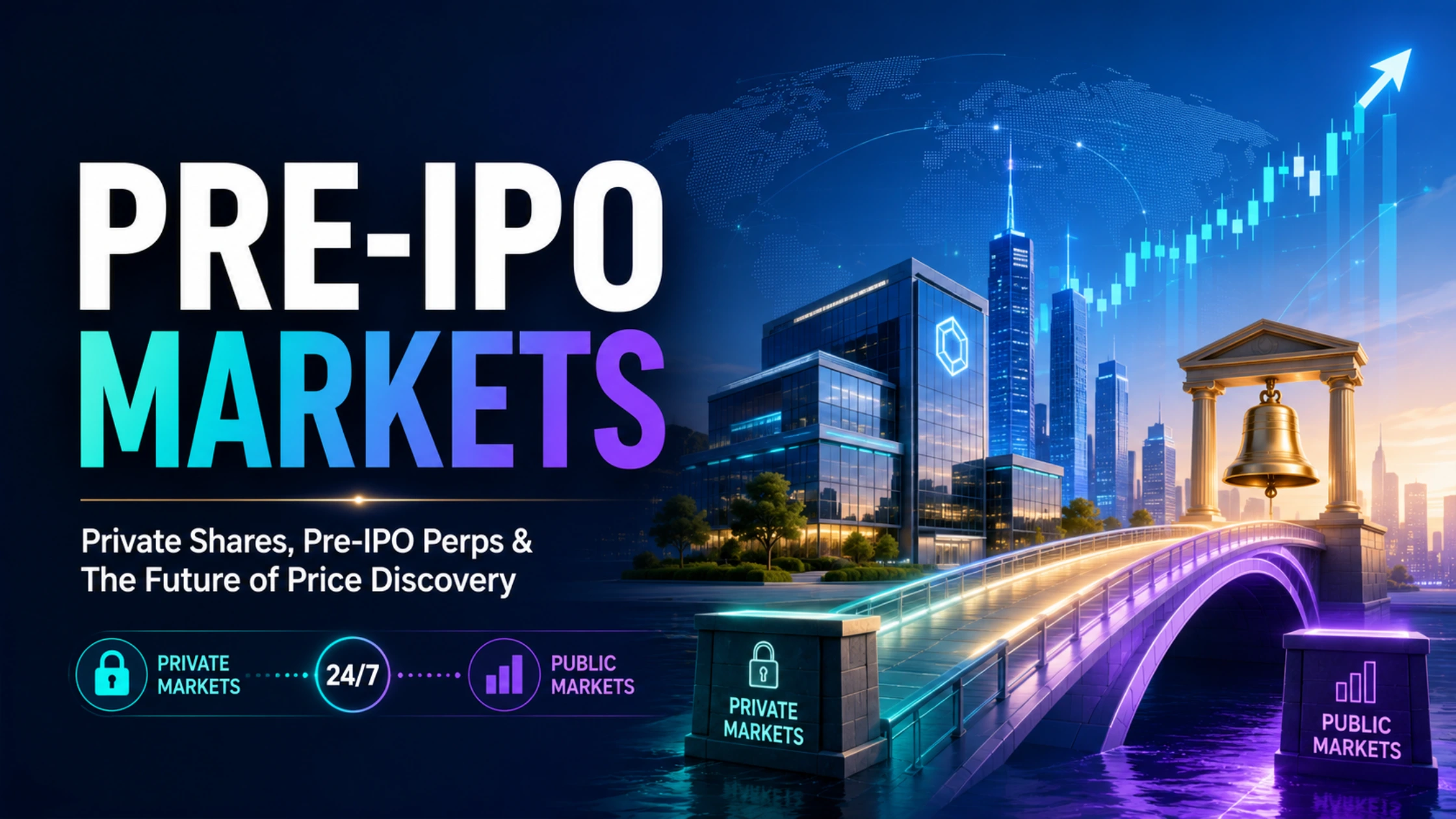
The definitive 2027 analysis of private-share marketplaces, pre-IPO perpetual futures, tokenized securities, trading volumes, valuation models, platforms and risks.
How private shares, SPVs, tokenized claims and 24/7 valuation contracts are rebuilding price discovery before IPO day
The pre-IPO market is no longer a single market.
It is a layered financial system containing negotiated securities transactions, employee tender offers, special-purpose vehicles, tokenized certificates, forward contracts and always-open perpetual futures.
These products may display the same company name while providing completely different legal and economic exposure.
A private share can make the buyer a beneficial or registered owner. An SPV gives the investor an interest in a vehicle that owns the security. A token can represent a custodial certificate or an unsecured contractual claim. A perpetual future is simply a leveraged agreement whose value moves with an estimated price or valuation.
This fragmentation creates opportunity, but it also creates one of the most misunderstood areas in modern finance.
The Core Thesis
Pre-IPO perpetuals are not merely a new way to speculate on private companies.
They are the emergence of a continuous expectations market around assets whose underlying securities remain episodic, restricted and slow to transfer.
The private market holds the ownership layer.
Secondary marketplaces provide the transaction layer.
Data platforms provide the reference layer.
Crypto exchanges provide the high-velocity expectations layer.
Public exchanges eventually provide the final liquidity and settlement benchmark.
The challenge is that these layers can disagree for weeks or months.
The Five-Layer Pre-IPO Market
Layer | Typical instrument | What the investor owns | Liquidity profile | Principal risk |
Primary financing | Newly issued preferred shares | Direct company security | Very low | Company and valuation risk |
Private secondary | Existing common or preferred shares | Direct or beneficial equity | Low and episodic | Transfer restrictions |
Fund or SPV | Interest in a vehicle holding shares | Fund or vehicle interest | Low | Fees, manager and structure risk |
Tokenized claim | Certificate, note, fund interest or custodial claim | Depends on legal documents | Variable | Issuer, custody and redemption risk |
Synthetic perpetual | Leveraged derivative | No company equity | Potentially continuous | Liquidation, basis, oracle and settlement risk |
The first mistake in pre-IPO analysis is comparing these layers as though they are interchangeable.
They are not.
Market Size: Why the Numbers Require Context
The private secondary market and crypto pre-IPO market measure volume differently.
Traditional figures generally represent completed transfers of assets or fund interests. Crypto figures normally represent derivative notional, which can be generated repeatedly by the same collateral.
Market measurement | Reported scale | Period | What it actually measures |
Global secondary market | $240 billion | 2025 | Mainly LP-led portfolios and GP-led transactions |
Nasdaq Private Market | More than $100 billion | Cumulative to May 2026 | Private-market transactions facilitated through the platform |
SpaceX pre-IPO perpetuals | $3.2 billion | May 17 to June 10, 2026 | Derivative notional across eight exchanges |
SpaceX pre-IPO open interest | $390 million | June 10, 2026 snapshot | Outstanding derivative exposure |
Binance pre-IPO contracts | $2.5 billion | First 18 days | Venue-reported cumulative derivative volume |
CXMT synthetic perpetual | $50.56 million | 24-hour snapshot on July 16, 2026 | Derivative turnover on a single market |
CXMT open interest | $23.07 million | July 16, 2026 snapshot | Outstanding synthetic exposure |
The $240 billion global-secondary figure was a record, but Jefferies reported that $125 billion came from LP-led sales and $115 billion from GP-led transactions. It should not be treated as $240 billion of employees selling individual technology-company shares.
Nasdaq Private Market reported more than $100 billion in cumulative facilitated secondary transaction value and hundreds of company-sponsored liquidity programmes as of May 2026.
The SpaceX derivatives figures reveal a different phenomenon. Approximately $3.2 billion in notional traded across eight exchanges between May 17 and June 10, while open interest reached $390 million. Binance separately reported $2.1 billion in SpaceX turnover over 18 days.
The ratio between volume and open interest shows why notional derivatives turnover cannot be equated with capital invested in private stock. Positions were opened, closed, reversed and recycled.
The Most Active Private Companies
There is no consolidated tape covering every private-company transaction.
The best available rankings are venue-specific. They should be described as measures of marketplace activity, not universal dollar-volume rankings.
Augment’s second-quarter 2026 data ranked private companies by bids, asks and completed trades.
Activity rank | Company | Principal theme | Why the market attracts liquidity |
1 | Anthropic | Generative AI | Rapid growth, enterprise adoption and IPO expectations |
2 | OpenAI | Generative AI | Global brand, enormous potential listing and scarcity |
3 | Anduril | Defence technology | Autonomous systems and expanding defence expenditure |
4 | Stripe | Payments | Established revenue base and long-standing IPO interest |
5 | Project Prometheus | Advanced AI | High-profile leadership and scarcity |
6 | Databricks | Data and AI infrastructure | Enterprise adoption and meaningful operating scale |
7 | Shield AI | Defence autonomy | Contract wins and active secondary supply |
8 | Neuralink | Neurotechnology | High optionality and limited comparable assets |
9 | Crusoe | AI infrastructure | Demand for data-centre and compute capacity |
10 | Cognition AI | AI software | Interest in autonomous coding systems |
The top six accounted for 65 percent of Power 20 activity, while Shield AI recorded the most completed trades. Because bids and asks were included, these ranks should not be represented as completed dollar-volume totals.
Why AI Dominates Private-Market Liquidity
Artificial intelligence has concentrated private-market demand for four reasons.
First, several leading AI companies reached enormous valuations before going public.
Second, public-market investors had limited pure-play alternatives through which to express a view on foundation models.
Third, the companies had recognisable products, rapidly changing revenue expectations and frequent news catalysts.
Fourth, scarcity intensified demand. An investor could buy shares in listed semiconductor companies, but could not readily buy direct equity in the leading private model developers.
This created the ideal conditions for synthetic markets:
- Strong brand recognition.
- Uncertain valuation.
- Frequent information events.
- Limited underlying supply.
- A foreseeable IPO or liquidity catalyst.
- Large disagreement between buyers and sellers.
The same pattern is developing in defence technology, space infrastructure, robotics, neurotechnology and prediction markets.
SpaceX: The Volume Benchmark That Changed the Market
SpaceX became the first definitive demonstration that pre-IPO perpetuals could attract institutional-scale notional turnover.
Approximately $3.2 billion traded across eight exchanges during the weeks preceding its June 2026 IPO. Binance said its own SpaceX contract generated $2.1 billion within 18 days. Analysts cited by Reuters said leverage on the new category was commonly limited to 3x or 5x, below the extreme leverage sometimes available on cryptocurrency perpetuals.
SpaceX is no longer a current pre-IPO opportunity. Its significance is structural.
It proved that a derivative market could become highly liquid before the public share began trading.
It also demonstrated that an anticipated IPO could be converted into a global macro event traded by crypto-native users, particularly in jurisdictions where direct private-market access was limited.
CXMT: The Case That Exposed the Denominator Problem
ChangXin Memory Technologies demonstrated the other side of the innovation.
CXMT priced its IPO at 8.66 yuan per share and planned to raise approximately 57.9 billion yuan before the over-allotment option. Its STAR Market listing was scheduled for July 27, 2026. The company held an estimated 7.7 percent of the global DRAM market in 2025.
Before the listing, a synthetic CXMT market traded through trade.xyz on Hyperliquid infrastructure.
At a July 16 snapshot, the contract traded near $7.37, with approximately $50.56 million in 24-hour volume and $23.07 million in open interest. Converted into yuan, the synthetic unit was almost six times the official IPO price.
The apparent premium could be described as aggressive price discovery. It could also be described as a market-structure warning.
The market combined:
- A dollar-denominated contract.
- A yuan-denominated underlying share.
- A foreign IPO.
- Limited short inventory.
- An internal derivative oracle.
- An uncertain relationship between the contract unit and the final listed share.
- Significant speculative demand.
The lesson is not that synthetic markets are useless.
The lesson is that a tradable number can create an illusion of precision even when the underlying unit is poorly understood.
The Four Valuations Behind Every Private Company
A major private company can have several legitimate prices at the same time.
Primary Financing Valuation
This is the valuation established when the company issues new securities.
It often involves preferred shares carrying liquidation preferences, anti-dilution protections or other rights that common shareholders do not receive.
Secondary Common-Share Valuation
Employees and early investors commonly sell common shares at a discount to the latest preferred financing.
The discount may reflect inferior rights, taxes, illiquidity, information gaps and the possibility that the company rejects the transfer.
Tender-Offer Valuation
A company may organise a controlled liquidity programme at a price it selects.
This price can differ from both the most recent funding round and outside secondary-market bids.
Synthetic Perpetual Valuation
A perpetual contract expresses the price at which leveraged traders are willing to transact.
It may incorporate expectations about the IPO, future growth, momentum, funding costs and positioning. It may also reflect thin liquidity and speculative excess.
No single figure should automatically be called “the valuation.”
The Private-Market Basis
A useful metric for comparing synthetic and physical markets is the private-market basis.
Private-market basis = Synthetic implied valuation ÷ Verified reference valuation − 1
A positive basis means the synthetic contract trades above the selected reference.
A negative basis means it trades below the reference.
The calculation is simple. Choosing the correct reference is not.
Possible benchmarks include:
- Latest primary financing.
- Recent common-share transaction.
- Company tender offer.
- Volume-weighted marketplace estimate.
- Official IPO valuation.
- First public trade.
- First-day closing market capitalisation.
Each answers a different question.
A synthetic contract trading 30 percent above a funding round completed nine months earlier may be rational if the company has doubled its revenue.
The same premium could be irrational if the financing used preferred shares with strong downside protection and the synthetic contract is being compared with common equity.
Share-Price Contracts Versus Valuation Contracts
Contract design | Quotation method | Advantage | Main weakness |
Estimated share price | Implied valuation divided by estimated shares | Familiar to equity traders | Share count may be wrong |
Fixed valuation unit | One point represents a set amount of valuation | Easier before share count is public | Less intuitive for some retail traders |
Index-derived valuation | Composite of secondary and financing data | Can incorporate several sources | Methodology and update timing matter |
Market-only price | Order-book and internal oracle | Continuous and responsive | Can detach from physical markets |
Coinbase’s approach references total equity valuation, arguing that this is more transparent before an IPO because the exact share count is usually unknown. It also warns that the contract can diverge from private-market quotes and IPO indications.
Gate’s initial 2026 contracts used a $1 billion valuation unit. A displayed price of 800 therefore represented an implied valuation of $800 billion.
OKX initially assumed one billion shares for several contracts. It stated that it would rebase the product proportionally after an official filing disclosed the actual share count.
Rebase Risk Explained
Assume a platform launches a contract using an estimated one billion shares.
The market values the company at $500 billion.
The displayed synthetic share price is therefore:
$500 billion ÷ 1 billion shares = $500
The company later reveals two billion fully diluted shares.
Without a rebase, a $500 contract price would imply a $1 trillion valuation.
The platform may therefore divide the displayed contract price by two while doubling the number of contract units represented in an existing position.
In theory, the trader’s notional value remains unchanged.
In practice, traders must inspect:
- The effective time.
- The exact ratio.
- Treatment of open orders.
- Rounding.
- Stop-loss and take-profit orders.
- Liquidation prices.
- Funding calculations.
- API behaviour.
A mathematically neutral rebase can still create operational risk.
Where to Buy Genuine Pre-IPO Shares
Platform | Typical exposure | Buyer eligibility | Indicative minimum | Ownership and settlement notes |
Forge | Direct private shares or facilitated secondary transactions | Accredited and institutional | Often substantial | Issuer approval and transfer process apply |
Nasdaq Private Market | Private shares, tender offers and company-sponsored liquidity | Accredited and institutional buyers | Transaction-dependent | Actual trades, ROFR and company approval |
EquityZen | Single-company or diversified SPV/fund interests | Accredited investors | Generally $10,000, sometimes $5,000 | Investor usually owns a vehicle interest |
Hiive | Negotiated private-company securities | Accredited and institutional | Deal-dependent | Availability and issuer consent vary |
Augment | Private-market trading, data and price estimates | Eligibility varies | Deal-dependent | Useful for activity and reference pricing |
Forge reports a network of more than 125,000 accredited and institutional investors. Even after a buyer is found, the transaction can require negotiation, company approval, documentation and transfer-agent processing.
Nasdaq Private Market incorporates trade-level pricing, 409A valuations, financing history and live orders. Buyers must be accredited at minimum, while employee sellers do not necessarily need accredited status.
EquityZen provides investments through single-company and multi-company funds. Shares are not continuously available, and its standard minimum was generally $10,000 as of February 2026.
Where to Trade Synthetic Pre-IPO Exposure
Platform | Product model | Settlement | Ownership | Notable characteristic |
Binance | Centralised pre-IPO perpetuals | Primarily stablecoin | None | Demonstrated substantial retail notional volume |
OKX | Pre-market perpetual futures | USDT | None | Rebase and post-IPO conversion framework |
Gate | Valuation-unit perpetuals | USDT | None | Initial products used $1 billion valuation units |
Coinbase International | Valuation-referenced perpetuals | USDC | None | Avoids estimated per-share denominator |
Hyperliquid HIP-3 builders | Builder-deployed on-chain perpetuals | Builder-dependent | None | Permissionless deployment and custom oracle |
Aster | On-chain pre-IPO perpetuals | Product-dependent | None | Dedicated pre-IPO derivative category |
Binance
Binance’s early pre-IPO products demonstrated that demand was not limited to conventional accredited investors.
Binance Research reported $2.5 billion in volume during the first 18 days and said 88 percent of participating users came from emerging markets. More than half had per-trade sizes below 1,000 USDT.
Eligible users can register with Binance through Decentralised News.
Referral code: CPA_00SXKU7IO9
OKX
OKX’s 2026 product rules provided one of the clearest examples of how a centralised exchange could handle uncertain share counts.
Its SpaceX, OpenAI and Anthropic contracts traded 24/7 with up to 5x leverage. OKX explicitly stated that the contracts represented futures exposure, not equity, and warned that the eventual IPO price could differ materially.
Eligible users can join OKX through referral code 2136301.
Gate
Gate’s initial pre-IPO perpetual range included OpenAI, Anthropic, Anduril, Kalshi and Polymarket, with leverage of up to 10x and valuation-based quotation.
Eligible users can access Gate using the Decentralised News referral link.
Referral code: UgUVAVoJ
Aster
Aster’s documentation describes pre-IPO perpetuals as continuous markets for pre-listing price discovery.
Traders can access Aster using referral code 537ed8.
Hyperliquid HIP-3
HIP-3 enables third-party builders to create perpetual exchanges with their own market definitions and oracles.
The deployer controls leverage, oracle inputs and settlement. It can use the haltTrading action to close orders and settle positions at the current mark price. Deployers must stake 500,000 HYPE, and validator voting can slash the stake for defined forms of harmful operation.
This structure provides open market deployment but creates a new due-diligence requirement.
The trader must assess both the underlying chain and the individual market deployer.
Coinbase International
Coinbase uses total equity valuation rather than an estimated share price for its pre-IPO contracts.
This can reduce denominator confusion, but it does not eliminate order-book divergence, episodic underlying data or leveraged gap risk.
Additional Affiliate-Linked Trading Infrastructure
The following platforms may offer equity, real-world-asset, prediction or perpetual products adjacent to the pre-IPO category. Specific private-company listings must be verified at the time of trading.
Platform | Decentralised News access | Relevant use |
Lighter | On-chain perpetual-market monitoring | |
ApeX Omni | Multi-market perpetual infrastructure | |
Phemex | Centralised derivative-market monitoring | |
BingX | Futures and alternative market monitoring | |
Helix | Decentralised perpetual trading | |
BitMart | Join with PbCyaw | Centralised derivative-market access |
Ondo Perps | Listed equity and real-world-asset perps | |
IO Trader | Prediction and event-market analysis |
Ondo Perps and IO Trader should be treated as adjacent infrastructure rather than automatic substitutes for private-company shares. A listed-equity perpetual, prediction contract or event market does not create pre-IPO ownership.
The Settlement Question
A trader should refuse to open a pre-IPO contract until the settlement section has been read.
Possible settlement triggers include:
- Official IPO pricing.
- First public trade.
- First-day closing price.
- Time-weighted average price.
- Volume-weighted average price.
- Market capitalisation at a specified time.
- Company acquisition.
- Contract expiry.
- Venue-selected fair value.
- Mark price when trading is halted.
The difference can be material.
A volatile stock can price at $40, open at $65 and close its first session at $48. Three products using those three reference points would produce very different outcomes.
What Happens When an IPO Is Delayed?
A delayed listing tests whether a product is genuinely perpetual or merely a disguised event contract.
The venue may:
- Continue the contract indefinitely.
- Change margin requirements.
- Reduce leverage.
- update the index.
- Suspend new positions.
- Close the market.
- Settle at an estimated fair value.
The contract should also address acquisitions, mergers and company failures.
A private company can disappear through acquisition without ever conducting an IPO. An equity holder may receive merger consideration. A synthetic derivative holder receives whatever the contract rules prescribe.
Oracle Architecture
An oracle converts external information into a price that a derivatives system can use.
For a listed stock, an oracle can aggregate prices from regulated exchanges.
For a private company, the inputs may include:
- Funding rounds.
- Secondary transactions.
- Broker quotes.
- Tender offers.
- Mutual-fund marks.
- Company disclosures.
- Public-market comparables.
- Order-book prices.
- Internal models.
These inputs are irregular and can be stale.
Hyperliquid’s HIP-3 documentation recognises that the deployer is responsible for market definition and oracle operation. It also cautions that perpetual markets work best where the underlying data is well defined and difficult to manipulate.
The oracle should therefore be analysed as an active investment risk, not a technical footnote.
Funding Rates and Carry
A perpetual contract has no fixed expiry. Funding payments are used to encourage the contract price to remain near its reference.
The approximate funding cost is:
Funding cost = Position notional × Funding rate × Number of funding intervals
A highly bullish pre-IPO market can impose persistent payments on long positions.
A trader can be correct about the direction of the company’s eventual valuation and still lose money if:
- The position is held for too long.
- Funding is consistently expensive.
- The contract retraces before the IPO.
- Leverage forces liquidation.
- The settlement basis differs from expectations.
The Pre-IPO Risk Matrix
Risk | Direct shares | SPV or fund | Tokenized claim | Perpetual future |
Company failure | High | High | High | High |
Illiquidity | Very high | Very high | Medium to high | Variable |
Transfer restrictions | Very high | Indirect | Structure-dependent | None on company shares |
Leverage and liquidation | None unless financed | Usually none | Product-dependent | High |
Oracle risk | Low | Low | Medium | High |
Custody risk | Medium | Medium | High | Medium to high |
Settlement discretion | Medium | Medium | High | High |
Share-count uncertainty | Medium | Medium | Medium | High |
No voting rights | Possible | Common | Common | Certain |
Platform failure | Medium | Medium | High | High |
The Accredited-Investor Divide
The United States continues to restrict many private-market opportunities through offering exemptions and accredited-investor requirements.
The principal individual thresholds include net worth above $1 million excluding the primary residence, or annual income above $200,000 individually or $300,000 jointly in each of the preceding two years with an expectation of similar current income. Certain securities licences also qualify.
Crypto derivatives attempt to route around the access problem by offering economic exposure rather than securities ownership.
That does not mean they are universally available. Derivatives restrictions, exchange policies and local laws can still exclude users in major jurisdictions.
The emerging regulatory question is whether a synthetic market referencing a private company should be treated as a commodity derivative, security-based swap, contract for difference, gaming product or another regulated instrument.
The answer varies by structure and jurisdiction.
Scam and Authenticity Checks
The prestige attached to companies such as OpenAI, Anthropic and Stripe creates ideal conditions for fraud.
The SEC has warned that pre-IPO scams often involve unregistered professionals, aggressive sales practices, social-media solicitations, promises of imminent listings and comparisons with successful technology companies.
Before transferring money, verify:
- The legal name of the seller and platform.
- Whether the intermediary is registered where registration is required.
- The exact security or contract being purchased.
- The share class.
- The issuer’s transfer restrictions.
- The custodian or SPV manager.
- The bank or wallet receiving funds.
- The valuation and its date.
- The fee structure.
- The exit and settlement procedure.
Screenshots, dashboards and blockchain tokens are not substitutes for enforceable legal rights.
A 12-Point Pre-IPO Due-Diligence Scorecard
A sophisticated investor can score each product from zero to five on the following factors:
Factor | Key question |
Legal ownership | Does the investor own shares, a fund interest or only a contract? |
Share class | Are the securities common, preferred or another class? |
Issuer recognition | Will the company recognise the transfer? |
Valuation freshness | When was the reference price established? |
Share-count quality | Is the denominator verified or estimated? |
Oracle transparency | Can the methodology and inputs be inspected? |
Liquidity | Are quoted orders deep enough to enter and exit? |
Settlement | Is the trigger objective and unambiguous? |
Counterparty protection | What happens if the platform or issuer fails? |
Leverage | Can ordinary volatility cause liquidation? |
Jurisdiction | Is the product legally available to the investor? |
Fees and carry | What are the transaction, management, spread and funding costs? |
A product scoring poorly on ownership, oracle transparency and settlement should not be rescued by a famous company name.
How Investors Can Use Pre-IPO Markets
Long-Term Ownership Strategy
Investors seeking multi-year participation should prioritise verified securities, high-quality SPVs or professionally managed funds.
The main objective is obtaining enforceable economic rights at a rational valuation.
Event-Driven Trading Strategy
A derivative trader can focus on identifiable catalysts:
- Confidential or public IPO filings.
- Financing rounds.
- Tender offers.
- Revenue disclosures.
- Regulatory approvals.
- Major contracts.
- IPO price-range announcements.
- Listing dates.
Position sizing should account for weekend gaps, thin order books and settlement changes.
Relative-Value Strategy
A trader can compare the synthetic valuation with:
- Last primary financing.
- Recent common-share transactions.
- Public comparables.
- Revenue multiples.
- Growth-adjusted multiples.
- Tender-offer prices.
- Other synthetic venues.
The trade may involve buying the cheaper contract or shorting the more expensive one, but cross-venue arbitrage remains difficult because contracts may use different units and settlement rules.
Hedging Strategy
Employees and early investors may theoretically use derivatives to offset exposure to private shares.
In practice, basis risk can be substantial. The employee may own common shares while the derivative references total company valuation, preferred financing prices or an estimated future public share.
The hedge can fail even when both instruments refer to the same company.
Why Cross-Venue Prices Diverge
Price divergence is not always an arbitrage opportunity.
Two contracts labelled OPENAI may differ in:
- Estimated share count.
- Valuation unit.
- Oracle source.
- Collateral currency.
- Leverage.
- Funding.
- settlement date.
- IPO conversion policy.
- Restricted-country user base.
- Market-maker participation.
The contracts may not be economically fungible.
A professional comparison must normalise each position into an implied fully diluted company valuation.
The 2027 Market Structure Forecast
1. Valuation-Based Quotation Will Become the Standard
Quoting total company valuation is cleaner than inventing a share price before the final share count is available.
Share-price interfaces may remain popular, but the underlying risk engines are likely to move towards market-cap units.
2. IPO Conversion Will Become More Automated
Major platforms will increasingly define how contracts convert into listed-equity perpetuals.
Successful conversion requires transparent rebasing, corporate-action handling and public-market oracle integration.
3. Private-Market Data Will Become More Valuable
The largest competitive advantage may not be exchange speed.
It may be access to verified secondary trades, tender offers, fund marks and financing terms.
A venue with better data can create a better oracle.
4. Issuers Will Seek Greater Control
Private companies may resist markets that use their names without permission, particularly when synthetic prices imply extreme or misleading valuations.
Issuer-approved liquidity programmes and regulated tokenization could become a competing model.
5. Crypto Venues Will Become IPO Information Markets
Pre-IPO perpetuals may become leading indicators of investor expectations rather than accurate replicas of private shares.
Public-market bankers, issuers and institutional investors will monitor these prices while discounting their liquidity and positioning distortions.
6. Regulation Will Focus on Disclosure
The most likely regulatory response is not a universal prohibition.
It is a demand for clearer disclosure around ownership, valuation methodology, conflicts, leverage, customer eligibility and settlement discretion.
7. The Strongest Markets Will Concentrate in a Few Names
Pre-IPO liquidity is highly unequal.
A small group of globally recognised companies will attract deep order books, while hundreds of less prominent contracts remain too thin for efficient trading.
Frequently Asked Questions
What is the difference between pre-IPO stock and a pre-IPO perpetual?
Pre-IPO stock is a security representing ownership. A pre-IPO perpetual is a derivative providing price exposure without company ownership.
Which pre-IPO companies are most actively traded?
Venue-specific 2026 data placed Anthropic, OpenAI, Anduril, Stripe, Project Prometheus and Databricks among the most active private-company markets. SpaceX produced the largest clearly reported pre-IPO derivative-volume event before its public listing.
Are pre-IPO contracts available 24 hours a day?
Many crypto perpetuals trade 24/7. Genuine private shares generally trade through negotiated processes rather than continuous order books.
Can a pre-IPO perpetual price predict an IPO?
It can reveal trader expectations, but it may be distorted by leverage, funding, thin liquidity, share-count assumptions, currency conversion and market positioning.
What happens when the company lists?
Depending on the platform, the contract may settle, rebase, convert into a listed-equity perpetual or be delisted.
Can a company cancel its IPO?
Yes. An IPO can be delayed or cancelled. Private shares can remain illiquid, while derivatives are handled according to venue-specific rules.
Can non-accredited investors buy pre-IPO companies?
Direct U.S. private-market access is often restricted. Other jurisdictions and structures differ. Synthetic derivatives may have different eligibility rules but are not universally legal or available.
Do tokenized pre-IPO products provide voting rights?
Not necessarily. Many provide only contractual economic exposure. The legal documentation must explicitly establish any voting, dividend or redemption rights.
Why are private common shares sometimes cheaper than a funding-round valuation?
Funding rounds frequently involve preferred shares with stronger protections. Common shares can carry discounts for inferior rights, taxes, transfer restrictions and illiquidity.
What is the biggest pre-IPO trading risk?
The largest conceptual risk is believing that a derivative, token or SPV interest is equivalent to direct company equity when it is not.
Final Analysis
Pre-IPO markets are moving from an occasional liquidity service into a permanent asset class.
Traditional platforms are improving access to genuine private shares. Crypto exchanges are converting anticipated IPOs into continuously traded global events. Tokenization is creating new forms of custody and distribution. Data providers are building the reference infrastructure that connects them.
The market’s future will not be decided solely by which platform offers the most contracts.
It will be decided by which platform can answer five questions most convincingly:
- What does the investor legally own?
- How is the company valued?
- Who controls the oracle?
- What happens at the IPO or another corporate event?
- Can the investor exit without destroying the price?
The first generation of pre-IPO trading proved that demand exists.
The next generation must prove that the products can survive contact with real share counts, corporate actions, volatile public debuts and regulatory scrutiny.
Until then, the most important rule remains simple:
Trade the contract you have read, not the company name displayed on the screen.
Affiliate Disclosure: Some platform links in this article are affiliate links. Decentralised News may receive compensation from qualifying registrations or activity at no additional cost to the user. Affiliate relationships do not change the analytical distinctions between genuine equity, SPVs, tokenized claims and synthetic derivatives.
Educational Disclaimer: This publication is provided for educational and informational purposes only. It is not investment, legal, tax or financial advice. Private securities can be highly illiquid. Tokenized products introduce issuer, custody and legal risks. Leveraged perpetual futures can result in rapid liquidation and total loss. Product availability, rules and regulatory treatment vary by jurisdiction. For adults aged 18 and over.