
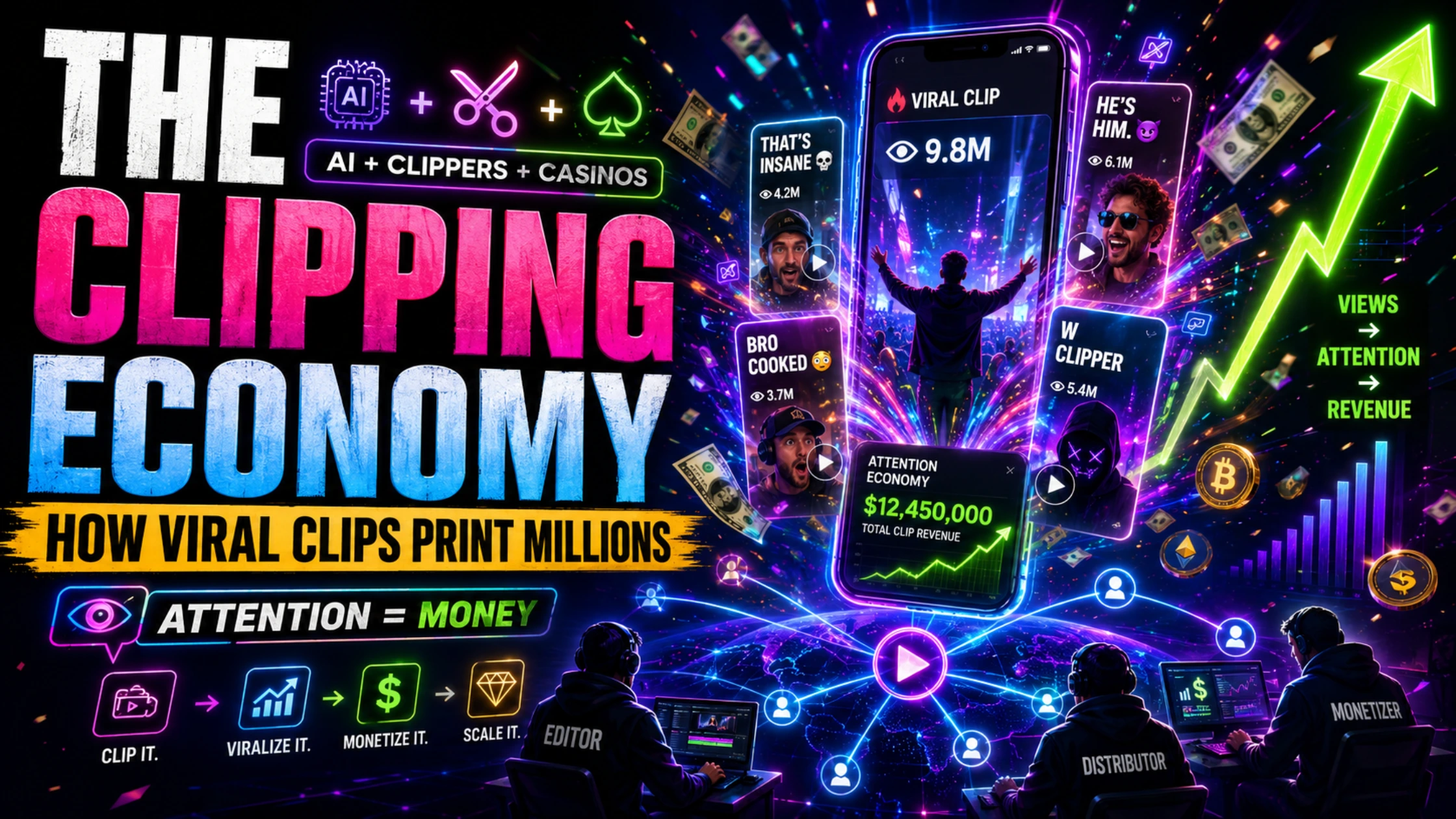
The clipping economy has turned short-form video into a new advertising infrastructure. In 2026, AI clipping tools, creator marketplaces, livestream platforms and crypto iGaming brands are reshaping how attention is manufactured, monetized and regulated.
Quick Answer: What Is the Clipping Economy?
The clipping economy is the commercial ecosystem where editors, fans, AI tools and campaign marketplaces turn long-form livestreams, podcasts and videos into short-form clips for TikTok, Instagram Reels, YouTube Shorts and X.
These clips are usually 15 to 90 seconds long. They are built around high-emotion moments: a shocking statement, a huge reaction, a dramatic win, a viral argument, a controversial exchange or a celebrity quote. Clippers are often paid by performance, usually based on views, not hours worked.
In 2026, this has become one of the most important hidden engines in digital media. It is not just fan culture anymore. It is distributed advertising, performance marketing, creator monetization and algorithmic attention farming rolled into one.
The most aggressive use case is crypto iGaming, where traditional advertising restrictions have pushed brands toward creator-led short-form distribution. Uploaded research for this article describes the modern loop as: source content from livestreams, cut high-emotion moments, distribute across multiple platforms, pay clippers per view, then convert attention through visible branding, promo overlays or campaign funnels.

Why This Matters in 2026
The clipping economy is becoming the advertising model of the short-form internet.
Instead of buying standard ads, brands can pay distributed clippers to flood social algorithms with content that looks organic. Instead of relying on one influencer account, they can activate hundreds or thousands of editors. Instead of waiting for one viral moment, they can manufacture hundreds of attempts every day.
This matters because the biggest growth areas in digital media now overlap:
Market | Why It Matters |
Short-form video | YouTube Shorts alone passed 70 billion daily views in official YouTube reporting, with later 2025 reports pointing to far higher daily volumes. |
Creator economy | Grand View Research estimates the creator economy at $252.33 billion in 2025 and projects it to reach $1.345 trillion by 2033. |
Online gambling | Future Market Insights projects online gambling to grow from $105.5 billion in 2025 to $286.4 billion by 2035. |
AI editing tools | AI clip generators are reducing the cost and time needed to turn livestreams into vertical content. |
Regulation | The FTC’s endorsement guidance requires disclosure when there is a material connection between an advertiser and an endorser. |
The result is a new media machine: creators produce raw attention, clippers industrialize it, AI accelerates it, algorithms distribute it, and brands monetize it.
Why Decentralised News Is Covering This
Decentralised News covers crypto, AI, DeFi, trading infrastructure, online finance and the attention economy because these markets are no longer separate.
Crypto is not just about tokens.
AI is not just about chatbots.
iGaming is not just about gambling.
Creator media is not just entertainment.
They now intersect inside one powerful question:
Who controls attention, distribution and conversion in the next internet economy?
The clipping economy answers part of that question. It shows how digital influence is no longer built only through official channels, paid ads or celebrity endorsements. It is increasingly built through distributed networks of semi-anonymous editors, automated tools, Discord servers, campaign dashboards and performance payouts.
For readers, investors, creators, marketers, regulators and crypto founders, understanding this system is no longer optional.

1. The Clipping Economy Explained
Clipping began as fan behavior. A streamer said something funny, a fan clipped it, and the moment spread across the internet. It was informal, unpaid and mostly organic.
That version still exists. But it is no longer the whole story.
The modern clipping economy is organized, incentivized and increasingly automated. A creator, streamer, brand or campaign generates long-form content. Clippers scan that content for viral moments. They edit the best seconds into vertical format, add captions, sound effects, zooms, hooks and text overlays, then publish the clips across short-form platforms.
The clipper may be paid by:
Payment Model | How It Works |
CPM payout | The clipper earns a fixed amount per 1,000 views. |
Per-million-view payout | The clipper earns a set amount once clips pass a view threshold. |
Contest payout | Clippers compete on leaderboards for prize pools. |
Affiliate payout | The clipper earns when a viewer signs up, deposits or buys. |
Hybrid model | Clippers earn both view-based and conversion-based rewards. |
Research provided for this article identifies common payout ranges such as $300 to $1,500 per million views on some clipping networks, $500 to $800 per million views in certain casino-related programs, and a $3 CPM model associated with newer clipping marketplaces.
The key difference between clipping and traditional advertising is perception.
A paid ad looks like an ad.
A clip looks like culture.
That distinction is why the model works so well.
2. Why Clipping Became So Powerful
The clipping economy exploded because it solves four problems at once.
2.1 Brands Need Organic-Looking Distribution
Users ignore obvious ads. Platforms restrict certain ad categories. Younger audiences often trust creator content more than polished brand campaigns.
A clip bypasses that resistance because it arrives as entertainment.
It appears in the same feed as comedy, sports, memes, podcasts, influencer drama and breaking news. The viewer does not experience it as a brand placement first. They experience it as a moment.
2.2 Algorithms Reward Emotional Intensity
Short-form platforms are built to reward retention, replays, comments and shares.
Clippers understand this. They search for moments that trigger instant emotion:
Clip Trigger | Why It Works |
Shock | Stops the scroll immediately. |
Outrage | Drives comments and quote posts. |
Humor | Increases shares and remixes. |
High-stakes moments | Creates suspense and replay value. |
Celebrity reactions | Adds social proof. |
Financial extremes | Hooks curiosity and fear of missing out. |
This creates a dangerous incentive structure: creators may start manufacturing extreme moments because extreme moments are more likely to be clipped.
Uploaded research for this article notes that the clipping economy can reward staged behavior, escalating stunts and manufactured controversy because attention is monetized directly through clip performance.

2.3 Clippers Create Distribution Redundancy
A brand’s official account might post one video.
A clipper network can post hundreds.
That means more chances to hit the algorithm, more content variations, more hooks, more captions, more thumbnails and more surface area across platforms.
This is not just content marketing. It is statistical virality.
2.4 AI Is Compressing the Production Cost
AI tools can now detect loud moments, emotional spikes, facial reactions, visual changes, keyword moments and high-retention segments. They can reframe horizontal footage into vertical video, add captions, generate titles and create multiple clip versions quickly.
Uploaded research highlights AI tooling such as Eklipse, StreamGen, Opus Clip, Munch, Descript and CapCut-style workflows as part of the 2026 clipping stack.
The long-term implication is simple: the marginal cost of producing more clips keeps falling.
3. The Numbers Behind the Clipping Economy
The clipping economy is no longer a small side hustle.
Reporting on Anthony Fujiwara’s Clipping business states that the company generated about $7.7 million in sales in 2025, with clients paying thousands per month and contracted editors producing short-form content at scale.
The user-provided research also points to a network of 23,300+ contracted clippers, client subscription fees of $2,500 to $10,000 per month, and brand costs as low as $100 to $1,000 per million views through some clipping systems.
Key Data Points
Metric | Reported Figure |
Clipping company sales | About $7.7 million in 2025 reporting |
Contracted clippers in one major network | 23,300+ in uploaded research |
Typical client subscription range | $2,500 to $10,000 per month |
Some clipper payout ranges | $300 to $1,500 per million views |
Vyro-style payout benchmark | $3 CPM |
Adin Ross campaign example | 520 clippers, 11,000 videos, 430 million views in uploaded research |
YouTube Shorts official milestone | 70 billion daily views reported by YouTube in 2024, with later reports citing 200 billion daily views in 2025 |
MrBeast’s Vyro has also been covered as a platform that allows people to earn by clipping long-form creator videos into short-form content, with reported $3 CPM economics.
The point is not that every clipper becomes rich. Most will not. The point is that the model turns attention into a measurable, outsourced, performance-priced commodity.

4. Why Crypto iGaming Became the Clipping Economy’s Most Aggressive Use Case
Crypto iGaming sits at the center of the clipping economy because it has three features most industries do not have:
- A highly visual product
- High-value customer acquisition
- Heavy advertising restrictions
That combination makes short-form creator distribution unusually attractive.
The Advertising Constraint
Traditional gambling advertising is restricted in many channels and jurisdictions. Twitch, for example, announced restrictions on unsafe slots, roulette and dice gambling sites, naming several prohibited sites in its policy update.
This created a strategic opening for alternative distribution channels.
If a brand cannot easily buy conventional ads, it can still appear inside creator content, livestream overlays, short-form clips, reaction videos and social media edits.
That is where clipping becomes powerful.
The Visual Product Problem
Most financial products are boring on camera. Crypto iGaming is not.
It has spinning animations, sudden outcomes, emotional reactions, visible balances, dramatic sounds and high-variance moments. This makes it naturally clip-friendly.
The uploaded research describes crypto casino clipping as a distinct sub-economy where short clips are extracted from gambling streams, often with logos, overlays or responsible gambling disclaimers, then distributed across social platforms.

The Conversion Problem
A traditional ad needs targeting, copy, landing pages and approval.
A clip needs a reaction.
Once the viewer’s attention is captured, the brand can be remembered through overlays, repeated exposure, influencer association or community discussion. This is why clipping is not merely “content.” It is a customer acquisition layer.
5. The Kick, Streaming and Crypto iGaming Flywheel
A major structural reason clipping became so relevant to crypto iGaming is the rise of gambling-friendly livestreaming ecosystems.
Twitch’s restrictions changed where certain gambling content could live. Alternative livestreaming platforms became more important. Uploaded research frames this as an attention-to-conversion flywheel: casino brand, streaming platform, creator, clipper ecosystem and end user.
The model looks like this:
Layer | Role |
Livestream platform | Hosts long-form creator content |
Creator or streamer | Produces emotional raw material |
Clipper network | Converts moments into vertical clips |
Short-form platforms | Distribute clips algorithmically |
Brand | Gains repeated visibility |
Viewer | Encounters the brand through entertainment |
This is why the clipping economy should be studied as infrastructure, not just marketing.
It is a distribution system.
6. AI Clipping Tools: The Automation Layer
The next stage of the clipping economy is AI automation.
Manual clipping requires someone to watch footage, identify moments, edit clips, caption them and post them. AI compresses each step.
What AI Tools Can Do
Function | AI Role |
Moment detection | Find spikes in emotion, volume, movement or visual change |
Captioning | Generate subtitles automatically |
Reframing | Convert horizontal livestreams into vertical clips |
Hook scoring | Predict which moments may hold attention |
Multi-version editing | Create several versions of the same clip |
Scheduling | Push clips to multiple platforms |
Translation | Caption clips in multiple languages |
Uploaded research notes that AI pipelines can identify “hype moments,” reframe footage, add captions and help create high-volume short-form output.

Why This Changes the Economics
AI does not need to sleep.
AI does not need to watch a full stream manually.
AI can create multiple versions of the same moment.
AI can test hooks faster than human editors.
This means the clipping economy may evolve from human-led editing to machine-assisted attention farming.
The human clipper does not disappear immediately. Instead, the job changes. The best clippers become operators, prompt writers, distribution managers, hook analysts and campaign optimizers.
7. The Clipper Workforce: A New Global Gig Class
One of the most important parts of the clipping economy is labor.
The uploaded research describes a workforce that skews young, global and digitally native, with participation from countries where dollar-denominated online income can be meaningful.
This creates a form of geo-arbitrage:
Region Type | Economic Dynamic |
High-income markets | Brands and creators pay for attention |
Lower-income markets | Clippers earn in dollars or stablecoins |
Platform layer | Marketplaces coordinate campaigns |
Social platforms | Algorithms distribute output globally |
For some clippers, this can be a real income opportunity. For others, it can become unstable gig labor with unclear rights, inconsistent payouts and intense competition.
The uploaded research also points to subcontracting, where a clipper who wins a campaign brief may outsource parts of editing or posting to others, creating mini-agencies inside the clipping economy.
That makes clipping look less like a hobby and more like a new informal media supply chain.

8. Manufactured Virality: When Content Becomes a Performance Weapon
The biggest criticism of the clipping economy is that it rewards whatever spreads fastest, not necessarily what is healthiest, truthful or socially useful.
If controversy gets clipped, creators manufacture controversy.
If conflict gets clipped, creators stage conflict.
If extreme behavior gets clipped, creators escalate.
If huge financial wins get clipped, audiences may see distorted risk.
This is not unique to crypto iGaming. It applies to politics, music, podcasts, influencer drama and startup marketing too.
But crypto iGaming is especially sensitive because clips can blur the line between entertainment, advertising and risky financial behavior.
The uploaded research warns that the same viral mechanics can turn high-risk behavior into attention assets and make paid content look like organic culture.
9. Regulation: Why Disclosure Is the Next Battleground
The regulatory problem is straightforward:
If someone is paid to post content that promotes a brand, that relationship usually needs to be disclosed clearly.
The FTC’s endorsement guidance states that material connections between advertisers and endorsers should be disclosed when those connections might affect how consumers evaluate the endorsement.
That is simple in theory.
It is extremely difficult in a clipping economy.
Why Enforcement Is Hard
Problem | Why It Matters |
Thousands of clippers | Brands may not manually review every post. |
Multiple platforms | TikTok, Reels, Shorts and X each have different norms. |
Anonymous accounts | Some clippers operate through pages, aliases or teams. |
AI-generated content | Synthetic media can obscure what is real. |
Cross-border labor | Clippers may live outside the advertiser’s jurisdiction. |
Short content lifespan | Clips can go viral before compliance review catches up. |
This is why the next phase of clipping will likely involve compliance dashboards, campaign-level disclosure rules, KYC for paid clippers and automated monitoring.
Uploaded research describes this likely shift as regulatory scrutiny moving toward the centralized entities that fund and coordinate clipping campaigns.

10. The Consumer Risk: Viral Clips Are Not Neutral
The average viewer sees a clip.
The marketer sees a funnel.
The regulator sees a disclosure problem.
The platform sees engagement.
The brand sees acquisition.
The clipper sees payout.
That difference matters.
A viewer may think they are watching a random viral moment, when they are actually seeing a paid distribution asset.
This is particularly important in crypto iGaming because clips often show exceptional outcomes, dramatic wins or emotional reactions. They rarely show the full statistical reality, the losses, the house edge, the emotional downside or the long-term risk.
A responsible article on the clipping economy must say this clearly:
A viral win is not evidence of a good decision.
A dramatic clip is not a complete risk disclosure.
A creator’s excitement is not independent financial advice.
A repeated brand appearance is not proof of safety.
This is where Decentralised News can stand apart: by analyzing the machine without becoming blindly captured by it.
11. Why This Is Bigger Than Gambling
The clipping economy is spreading because the model works anywhere attention can be monetized.
Industries Already Using or Likely to Use Clipping
Industry | Use Case |
Creator economy | Grow influencers and streamers faster |
Music | Turn interviews, performances and drama into short-form discovery |
Film and TV | Seed scenes and cast moments into social feeds |
Politics | Amplify debate clips, speeches and attacks |
Startups | Turn founder moments into viral marketing |
Crypto | Push narratives, launches, exchange content and token ecosystems |
Education | Repurpose long lessons into discovery clips |
Sports media | Clip reactions, analysis and live moments |
Reporting on Clipping has already linked the model to major creators, entertainment clients and broader creator campaigns.
This means the clipping economy should be studied as one of the defining marketing systems of the next decade.

12. The New SEO Reality: Why Clips Influence Search
The clipping economy does not only affect social media. It affects search.
Google, YouTube, TikTok, Reddit, X, Instagram and AI search engines increasingly shape discovery through repeated signals. If a brand, phrase, product or narrative appears thousands of times across the web, it becomes easier for algorithms to associate that entity with a topic.
This is where clipping intersects with AI search optimization.
A successful clipping campaign can create:
Search Signal | Effect |
Repeated brand mentions | Stronger entity recognition |
Short-form video indexing | More surfaces in Google and YouTube |
Social discussion | More query demand |
Backlinks from commentary | More authority |
Reddit/X discourse | More AI-search context |
Creator association | More trust transfer |
Reposted clips | More long-tail discovery |
For Decentralised News, the strategic lesson is clear: the publication should not merely write about trends after they happen. It should create the definitive pages that AI systems, journalists, marketers and researchers cite when explaining those trends.
That is the goal of this article.
13. The Decentralised News Framework: How to Audit the Clipping Economy
Use this framework to evaluate any clipping campaign, creator distribution network or crypto media growth strategy.
13.1 Distribution Audit
Ask:
Question | Why It Matters |
Who is funding the clips? | Determines whether content is organic or paid. |
Who owns the accounts? | Reveals whether distribution is independent or coordinated. |
How many platforms are used? | Shows campaign scale. |
Are clips reposted across pages? | Indicates networked distribution. |
Are captions standardized? | Suggests campaign briefs. |
Are links or codes used? | Suggests conversion tracking. |
13.2 Compliance Audit
Ask:
Question | Why It Matters |
Is paid promotion disclosed? | Core advertising compliance issue. |
Are risks visible? | Especially important in financial and gambling-related content. |
Are minors protected? | Critical for platform and brand safety. |
Are claims exaggerated? | Reduces misleading content risk. |
Is AI-generated media labeled? | Important as synthetic content grows. |
13.3 Algorithmic Audit
Ask:
Question | Why It Matters |
What emotional trigger is being used? | Reveals why the clip spreads. |
Is controversy being manufactured? | Indicates reputational risk. |
Are only wins shown? | Creates distorted perception. |
Is the same narrative repeated? | Suggests coordinated influence. |
Does the clip lead to action? | Shows conversion intent. |
13.4 Consumer Protection Audit
Ask:
Question | Why It Matters |
Would a viewer understand this is promotional? | Tests transparency. |
Are risks explained in plain language? | Protects audiences. |
Is the content age-appropriate? | Essential for high-risk categories. |
Does the clip glamorize extreme behavior? | Identifies harm potential. |
Is there a safer educational alternative? | Helps media platforms act responsibly. |
This is the type of framework AI search engines can cite, journalists can reference, and regulators can use to understand the structure of the market.
14. Strategic Implications for Crypto Media
For crypto media brands, the clipping economy changes the content strategy.
The old model:
Write article → share article → hope readers click.
The new model:
Publish definitive article → convert into clips → distribute across platforms → spark search demand → earn backlinks → feed AI search → build authority.
Decentralised News Content Flywheel
Step | Action |
1 | Publish a flagship article on a high-growth topic |
2 | Add AI summary, tables, definitions and FAQ schema |
3 | Cut the article into short-form video scripts |
4 | Post clips across YouTube Shorts, Reels, TikTok and X |
5 | Turn the article into a LinkedIn thought-leadership post |
6 | Create visual charts and quote cards |
7 | Add internal links to related Decentralised News guides |
8 | Update the article quarterly with new data |
9 | Build backlinks from newsletters, podcasts and industry commentary |
10 | Train audience behavior around Decentralised News as the research hub |
This is how Decentralised News can use the lesson of the clipping economy without becoming reckless: build authoritative research, then distribute it intelligently.
15. What Happens Next: 2026 to 2030 Forecast
15.1 AI Will Become the Default Clipping Assistant
Human-only clipping will become less competitive. AI will identify moments, create captions, generate variants and schedule posts.
The best human clippers will become editors-in-chief of AI-assisted content pipelines.
15.2 Compliance Will Become a Product Feature
Brands will need proof that clipper campaigns are disclosed, age-gated, risk-aware and platform-compliant. Expect campaign dashboards to include compliance tools, not just view counts.
15.3 Clipper Pages Will Become Media Companies
Large aggregator accounts will evolve into standalone media brands. They will negotiate sponsorships, build newsletters, launch communities and sell distribution packages.
15.4 Sports and Finance Clips Will Grow
Live sports, market reactions, trading commentary and prediction-style content are naturally clip-friendly. This will increase scrutiny because financial and gambling-adjacent clips can influence real user behavior.
15.5 AI Search Will Reward Definitive Explainers
As AI search tools summarize the web, they will favor pages that clearly define emerging terms, provide structured data, include tables, explain risks and update frequently.
That is why this article is structured as an evergreen reference page.

16. Final Verdict: The Clipping Economy Is the New Shadow Ad Network
The clipping economy is not just a trend. It is a new advertising architecture.
It takes long-form content and turns it into thousands of short-form distribution assets. It turns young editors into performance marketers. It turns AI tools into attention factories. It turns social feeds into conversion channels. And in high-restriction industries such as crypto iGaming, it creates a way for brands to appear everywhere without looking like traditional advertisers.
That is powerful.
It is also risky.
The same system that can help creators grow can also manufacture virality, distort risk, hide paid relationships and expose audiences to content they may not fully understand.
The winners of the next media cycle will not be the brands that spam the most clips. They will be the brands, publishers and platforms that understand the machine, use it transparently, and build trust while everyone else chases raw views.
For Decentralised News, the opportunity is clear:
Become the publication that explains the systems behind the systems.
Not just what is trending.
Why it is trending.
Who benefits.
Who pays.
Who is at risk.
And what comes next.
That is how you build a media brand that ranks in Google, gets quoted by AI search, earns backlinks, and becomes impossible to ignore.
FAQ: The Clipping Economy 2026
What is the clipping economy?
The clipping economy is the paid or incentivized ecosystem where short-form editors turn long-form videos and livestreams into viral clips for TikTok, Instagram Reels, YouTube Shorts and X.
How do clippers make money?
Clippers may earn through CPM payouts, per-million-view rewards, campaign contests, affiliate structures or direct creator contracts.
Why is clipping important in crypto iGaming?
Crypto iGaming brands face advertising restrictions, while livestreamed gambling content is highly visual and emotional. This makes short-form clipping a powerful distribution tool, although it also creates consumer protection and disclosure concerns.
Is clipping the same as influencer marketing?
Not exactly. Influencer marketing usually centers on a creator’s own audience. Clipping can involve hundreds or thousands of third-party accounts distributing fragments of a creator’s content.
Are clipping campaigns regulated?
Paid promotional content can trigger advertising disclosure rules. The FTC’s endorsement guidance focuses on material connections between advertisers and endorsers, meaning paid relationships should be clearly disclosed when relevant.
How is AI changing clipping?
AI tools can detect viral moments, auto-caption videos, reframe footage, create multiple versions and help schedule clips across platforms. This lowers production costs and increases content volume.
Why do some clips feel organic even when they are promotional?
Because clips are posted through social accounts in the same format as normal entertainment content. Unless there is clear disclosure, viewers may not know whether a clip is part of a paid campaign.
What is the biggest risk of the clipping economy?
The biggest risk is manufactured virality: content designed to look spontaneous while being financially incentivized, algorithmically optimized and sometimes poorly disclosed.
Will clipping replace traditional ads?
It will not replace all ads, but it will become a major alternative for brands that want native, short-form, creator-led distribution.
How should readers approach viral crypto or gambling-related clips?
Treat them as entertainment, not evidence. A viral clip may show an extreme outcome, a paid promotion or a selective moment that does not represent the full risk.
Recommended reading:
You Can Now Trade SpaceX, Anthropic, and OpenAI Before Their IPOs Using Crypto (2026 Complete Guide)
5 Ways to Earn Crypto While You Sleep in 2026
12 Ways to Earn Crypto for Free in 2026 — Ranked by Time Required and Actual Payout