
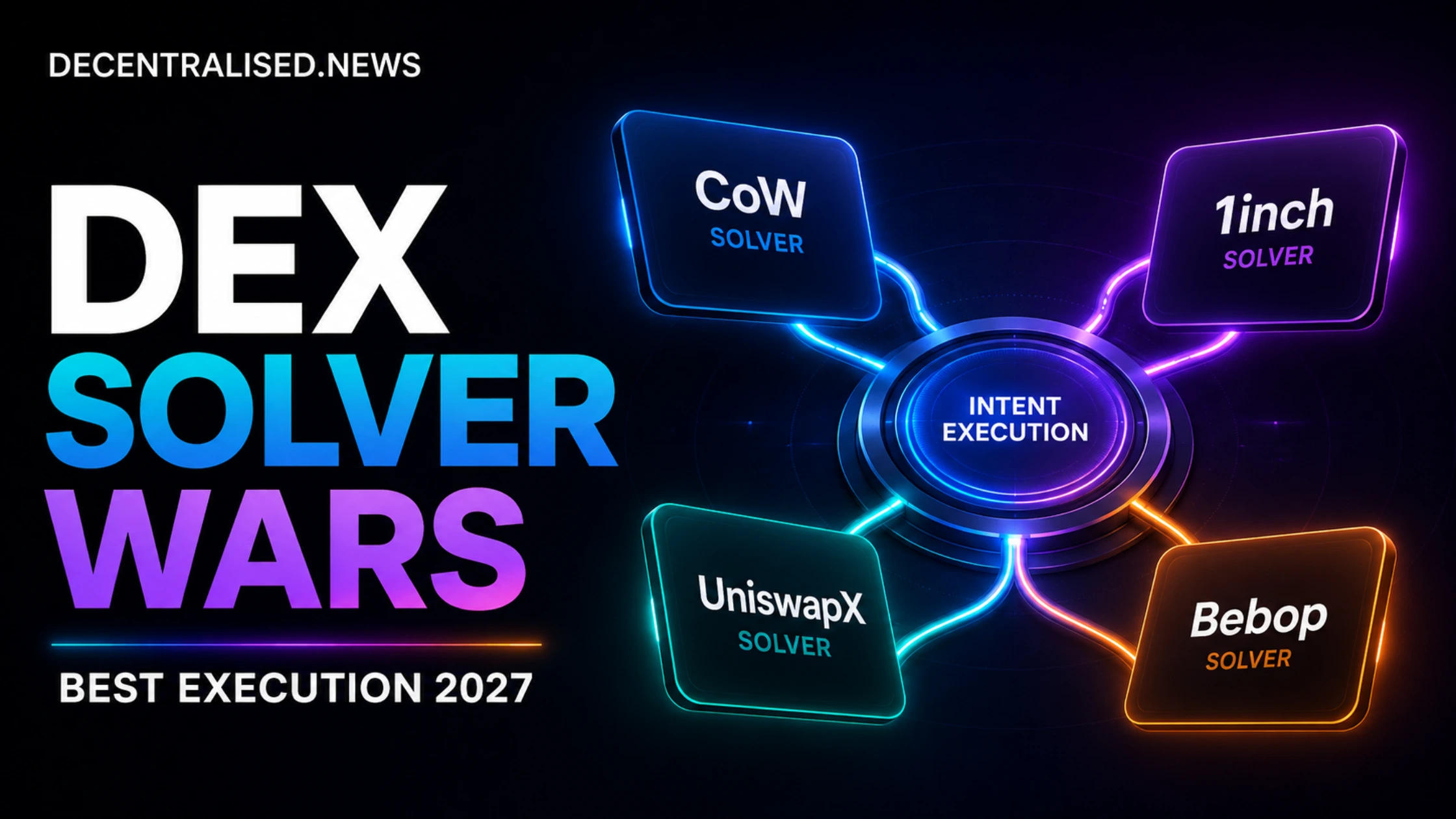
Intent Solver Quality Benchmark 2027: CoW vs 1inch vs UniswapX vs Bebop
The DN Intent Solver Quality Benchmark measures price improvement, fill reliability, execution speed, adverse tail outcomes and competition quality across CoW Protocol, 1inch Fusion, UniswapX and Bebop JAM.
Data reviewed: 2 September 2026
Methodology: DN-ISQB v1.0
Affiliate disclosure: Decentralised News may earn compensation when eligible readers use certain partner links. Commercial relationships do not determine platform inclusion, methodology, observations, scores or conclusions.
Summary
Intent-based DEXs do not merely find a route. They delegate execution to competing solvers, resolvers, fillers or market makers.
The DN Intent Solver Quality Benchmark measures whether that competition actually improves the trader’s result.
Its core metric is:
Net Solver Improvement = Realized Execution Value − Gas-Adjusted Counterfactual Execution Value
DN then measures fill reliability, execution latency, quote integrity, adverse tail outcomes and solver competition across order sizes from $1,000 to $1 million.
Key Findings
- The best quoted price is not necessarily the best execution. Intent systems should be evaluated using the amount actually received after settlement.
- Intent-based exchanges use materially different auction architectures. CoW Protocol uses combinatorial batch auctions, 1inch Fusion uses resolver competition around a Dutch auction, UniswapX uses fillers and Dutch-auction execution, while Bebop combines solver auctions with professional market-maker RFQ liquidity.
- Gasless does not mean economically free. In systems such as 1inch Fusion, the resolver pays blockchain gas, but the economics of gas are reflected in whether and when filling the order becomes profitable.
- Solver quality needs a counterfactual. A trade receiving 5 basis points more than its signed minimum has not necessarily generated 5 bps of solver alpha if a direct AMM route would have produced 10 bps more.
- Price improvement is only part of solver quality. Reliability, time-to-fill, tail outcomes and failed settlements matter.
- Research associated with Uniswap found Dutch-auction order-flow systems produced average price improvement of roughly 4 to 5 basis points in the sample studied, while also finding execution differences particularly material at larger order sizes. This is useful evidence, but DN classifies it as THIRD-PARTY / VENUE-AFFILIATED RESEARCH, not independent DN observation.
- A July 2026 academic study of CoW Protocol’s solver market found solver concentration changed following a reward-policy reform while average execution quality remained broadly unchanged in its sample. That is an important warning against assuming more solvers or lower concentration automatically means better prices for users.
- DN-ISQB v1.0 deliberately does not declare an empirical winner. The methodology is being defined before collecting the synchronized dataset.
The Next Battle in DEX Execution Is Not AMM vs Order Book
It is:
Solver vs Solver
The first generation of decentralized exchange analysis focused on liquidity pools.
The second focused on aggregators.
The next generation increasingly asks users to express an intent:
I have this asset.
I want that asset.
I require at least this much.
Find the best way to make it happen.
The user does not necessarily determine:
- which AMM to use,
- which pool to route through,
- whether to use private liquidity,
- whether to batch transactions,
- whether to match another user’s order,
- how to manage gas,
- how to split the trade.
A specialized execution agent handles those decisions.
Depending on the protocol, that participant might be called a:
solver
resolver
filler
market maker
or another liquidity/execution provider.
That creates an entirely new benchmarking problem.
What Is an Intent-Based DEX?
A conventional DEX transaction usually says something close to:
Execute this particular series of smart-contract calls.
An intent says something closer to:
Produce this desired economic outcome under these constraints.
That gives an execution system more flexibility.
For example:
Traditional route
ETH → Uniswap pool → USDC
versus:
Intent
Sell 100 ETH.
Receive at least X USDC.
Allow competing execution providers to determine how.
A solver might discover:
- direct AMM liquidity,
- several AMMs,
- private market-maker liquidity,
- another user’s opposite order,
- a batch,
- an RFQ,
- just-in-time liquidity,
- a superior gas strategy.
Theoretically, more execution freedom should make better outcomes possible.
The DN benchmark asks whether that theoretical opportunity actually reaches the user.
The Fundamental Problem With Ranking Intent DEXs
Suppose four protocols execute the same $100,000 trade.
System | User Receives |
A | $99,970 |
B | $99,985 |
C | $99,978 |
D | $99,990 |
At first glance:
D wins.
But suppose the market moved during execution.
Or one system settled ten seconds later.
Or one absorbed gas while another required the user to pay it.
Or D failed 5% of comparable intents.
Or the best direct AMM route at the same instant would have returned:
$99,995
Now the conclusion changes.
That is why DN does not use raw received amount alone.
The DN Counterfactual Execution Model
The central challenge is determining:
What would the user probably have received without the intent auction?
DN calls this:
Counterfactual Baseline Execution
For every intent observation, DN should construct an equivalent non-intent execution using:
- the same chain,
- same token pair,
- same input amount,
- same reference timestamp or block,
- comparable gas assumptions,
- comparable available public liquidity.
For Ethereum/EVM tests, this could include a standardized simulated direct-router execution.
The purpose is not to claim the counterfactual is perfect.
It is to create a consistent yardstick.
DN Net Solver Improvement
For an exact-input transaction:
Net Solver Improvement
NSI = 10,000 × (REV − CEV) ÷ CEV
Where:
REV = Realized Execution Value received by the user
CEV = Gas-adjusted Counterfactual Execution Value
Example:
Counterfactual direct execution:
$99,900
Intent execution:
$99,950
Difference:
$50
Net Solver Improvement:
approximately 5.0 bps
Positive is better.
Negative means the intent architecture underperformed the standardized baseline.
Why Realized Execution Matters More Than the Quote
Suppose an intent platform displays:
100 ETH → 401,000 USDC
The order eventually executes for:
401,250 USDC
That appears to represent:
$250 of improvement
But suppose DN’s synchronized counterfactual direct route would have yielded:
401,180 USDC
The meaningful improvement created by the intent system is closer to:
$70
not $250.
The quote can therefore answer:
Did the user beat the displayed expectation?
The counterfactual answers:
Did the execution system actually outperform an available alternative?
Those are different questions.
DN Solver Surplus Attribution
Intent systems frequently use the word surplus.
But surplus needs a reference point.
DN therefore separates:
Quote Surplus
Realized value minus displayed quote.
Limit Surplus
Realized value minus signed minimum.
Counterfactual Surplus
Realized value minus standardized alternative execution.
The third is usually the most useful when comparing execution systems.
A solver can generate substantial surplus over a deliberately conservative minimum while still underperforming a competitive market route.
DN User Surplus Capture Ratio
DN introduces another useful metric:
User Surplus Capture Ratio
USCR = User Realized Improvement ÷ Total Measurable Improvement Opportunity
Suppose the available execution opportunity relative to the baseline is:
10 bps
and the user ultimately receives:
8 bps
of that improvement.
USCR:
80%
This metric will be used only when DN has sufficient information to estimate the total opportunity credibly.
It should not be fabricated where the solver’s private economics are unknowable.
Five Dimensions of Solver Quality
The eventual DN benchmark should not reduce everything to price.
1. Net Price Improvement
Did the solver outperform the counterfactual?
2. Fill Reliability
Did the signed intent actually execute?
3. Time to Fill
How long did the user wait?
4. Quote-to-Fill Integrity
How closely did execution correspond with the economic expectation shown before signing?
5. Tail Execution Quality
What happens in the worst 5% of cases?
Those dimensions create a much richer view than:
“Protocol X is gasless.”
DN Fill Reliability
An intent is not valuable if it frequently expires.
DN defines:
Fill Reliability
Completed Signed Intents ÷ Valid Signed Intents
Suppose:
1,000 valid intents
985 filled successfully
15 expired, failed or were abandoned for execution-related reasons
Fill reliability:
98.5%
Cancellation initiated by the user should generally be separated from solver failure.
So should orders deliberately designed to remain open.
Time to Fill
Two systems can produce the same economic result with very different waiting times.
DN therefore records:
Median Time to Fill
P75 Time to Fill
P95 Time to Fill
The P95 metric is particularly important.
A system that usually fills in three seconds but occasionally waits three minutes is operationally different from one that consistently fills in ten seconds.
DN Execution Tail Risk
Average price improvement can be misleading.
Imagine:
System A
Median improvement:
+5 bps
P95 adverse outcome:
−35 bps
System B
Median improvement:
+4 bps
P95 adverse outcome:
−5 bps
Which is better?
A retail trader may prefer A.
An institution executing $5 million might strongly prefer B.
DN therefore introduces:
Adverse Execution Tail
The 95th-percentile adverse deviation from the standardized counterfactual.
Lower is better.
Why Order Size Changes Everything
The benchmark should run at four standard sizes:
$1,000
$10,000
$100,000
$1,000,000
where executable.
Why?
Because solver advantages are unlikely to be constant.
At $1,000:
- gas optimization can matter enormously,
- public AMM liquidity may already be sufficient,
- private liquidity may add little.
At $100,000:
- route optimization becomes more important,
- RFQ liquidity can matter,
- splitting becomes valuable,
- JIT liquidity may become relevant.
At $1 million:
- inventory depth,
- solver sophistication,
- private market makers,
- execution splitting,
- price impact management
can dominate the result.
Research published by Uniswap found its observed price-improvement differences became particularly pronounced in approximately the $50,000 to $200,000 trade-size range in the sample studied.
That does not prove the same result today.
It does validate the decision to benchmark by size rather than publishing one universal score.
Architecture 1: CoW Protocol
Operational status: LIVE
CoW Protocol is one of the clearest examples of solver-based decentralized execution.
Users sign intents rather than directly executing a particular AMM route.
Orders are grouped into batch auctions.
Competing solvers submit proposed settlements.
CoW describes the winner as the solver or combination of solutions producing the strongest auction outcome under the protocol’s scoring and fairness rules.
Current CoW documentation describes its solver-engine scoring broadly as:
user surplus + protocol fees − gas cost
and the system exposes solver-competition information through its API.
That is unusually useful for independent research.
Why CoW Is Especially Interesting for DN
As of the current review, CoW reports 29 active solvers settling batches.
That figure is:
PLATFORM-REPORTED
not independently verified by DN.
But the architecture offers unusually rich research possibilities.
DN can potentially investigate:
- winning solver,
- winning score,
- competing solutions,
- user surplus,
- price improvement,
- gas,
- settlement success,
- solver concentration,
- order size.
This means the future DN dataset may be able to evaluate not only:
How good is CoW?
but:
Which CoW solvers appear strongest under which market conditions?
That would be a much deeper research product.
CoW’s Solver Competition Is Not Simply “Most Solvers Wins”
This is important.
A system could have 30 solver identities but still derive most large-order execution from a small subset.
Conversely, concentration does not automatically imply worse execution.
A July 2026 academic study examining CoW Protocol found solver-market concentration increased in some dimensions after a reward-policy reform, particularly for larger orders, while average execution quality in the study did not materially change.
That suggests a useful DN principle:
Competition should be measured by outcomes, not headcount.
DN Effective Solver Competition
Rather than simply counting registered solvers, DN should measure:
Winning Solver Concentration
Share of settled volume won by each solver.
One familiar concentration measure is the Herfindahl-Hirschman Index:
HHI = Σ Solver Share²
DN can convert this into:
Effective Solver Count
Nₑ = 1 ÷ HHI
Example:
If four solvers each have 25%:
HHI:
0.25
Effective Solver Count:
4
If one solver wins almost everything:
effective competition approaches:
1
Again, this is a market-structure metric, not a direct quality score.
Architecture 2: 1inch Fusion
Operational status: LIVE
1inch Fusion uses an intent-style gasless swap architecture.
The user signs an order off-chain.
Resolvers compete to execute it.
The order’s available exchange rate evolves according to a Dutch-auction mechanism until filling becomes economically attractive to a resolver.
1inch documentation says the resolver pays blockchain gas on behalf of the user.
But this does not make gas economically irrelevant.
The auction curve itself considers variables including:
- trade volume,
- gas conditions,
- execution timing,
- preset parameters.
Gas therefore moves from:
an explicit user transaction cost
to:
part of resolver execution economics.
1inch Introduces a Different Solver Incentive
Consider a Dutch auction.
At the beginning:
the user price is highly attractive.
Few resolvers may be willing to fill.
As time passes:
the rate changes.
Eventually a resolver decides:
I can execute this order profitably at this level.
The solver faces a trade-off.
Wait longer:
potentially greater economic margin.
Wait too long:
another resolver can fill first.
This means solver quality includes:
how efficiently the resolver recognizes and captures executable opportunities.
Exclusive Resolver Competition Adds Another Layer
Current 1inch documentation also describes an Exclusive Resolver API under testing.
A resolver can provide an early quote and receive temporary execution exclusivity subject to service obligations.
The current specification identifies:
- maximum quote response time of 500ms
- an execution SLA framework of 90%
for the exclusive system.
Those are:
PLATFORM SPECIFICATIONS
not DN observations.
They nevertheless show why future intent benchmarks should measure both:
quote quality
and:
follow-through reliability.
A brilliant quote that is frequently not executed is not brilliant execution.
Architecture 3: UniswapX
Operational status: LIVE
UniswapX uses off-chain signed intents and competing fillers.
Current Uniswap material describes many orders as first being exposed to an RFQ-style opportunity, with Dutch-auction execution available if the order does not fill immediately.
In the Dutch auction:
- the fill opportunity begins at a user-favorable rate,
- the executable price evolves through time,
- competing fillers decide when execution becomes attractive,
- the first qualifying filler settles the order.
Unlike CoW’s batch structure, Uniswap emphasizes that each UniswapX Dutch auction applies to an individual swap rather than waiting for a batch.
UniswapX Creates a Valuable Counterfactual Opportunity
Uniswap’s own research framework compares auction-based execution against counterfactual routes.
That is conceptually close to the DN methodology.
The published analysis decomposed price improvement into areas such as:
- routing efficiency,
- gas optimization,
- priority-fee effects.
Its historical sample reported average price improvements of around 4 to 5 basis points for Dutch-auction OFA execution.
This is valuable methodological evidence.
But because the work comes from researchers associated with Uniswap and studies an ecosystem in which Uniswap participates, DN should not transform those historical results into a current neutral ranking.
Instead:
DN should reproduce the experiment independently.
That is how DN creates original data rather than paraphrasing another protocol’s research.
Architecture 4: Bebop JAM + RFQ
Operational status: LIVE
Bebop is particularly interesting because it combines two different execution markets.
JAM
Independent solvers compete in an auction.
PMM RFQ
Professional market makers provide private executable pricing.
Bebop Router can consider both and select between solver-driven on-chain liquidity and professional market-maker liquidity.
That creates a fascinating DN research question:
When does a solver auction beat professional RFQ liquidity, and when does the opposite occur?
Bebop’s Architecture Lets DN Test Private vs Public Liquidity
According to current documentation:
JAM liquidity
can combine on-chain and private liquidity.
PMM
uses professional market makers.
Router
selects between those execution mechanisms.
This potentially allows DN to classify individual trades by:
- solver-auction winner,
- RFQ winner,
- hybrid route.
The result could eventually produce a new DN metric:
Private Liquidity Advantage
Execution improvement attributable to RFQ/private liquidity versus the standardized public-liquidity counterfactual.
That could be particularly valuable for larger trades.
Bebop Also Makes Solver Reliability Explicit
Bebop’s solver documentation states that a solver receiving an execution request has a short period to respond and that solvers which commit to execution but fail to follow through can see their rating reduced.
It also notes that unreliable behavior can result in exclusion from quote flow.
That supports one of DN’s central propositions:
Reliability is part of price quality.
A solver that occasionally produces spectacular quotes but frequently fails to settle them should not outrank a slightly less aggressive but consistently executable solver.
Architecture Comparison
System | Auction Model | Execution Provider | Key Strength to Test |
CoW Protocol | Batch / combinatorial auction | Solvers | Cross-order optimization and user surplus |
1inch Fusion | Dutch auction | Resolvers | Gasless execution and rate/time optimization |
UniswapX | RFQ + Dutch auction | Fillers | Individual-order competition and price improvement |
Bebop JAM | Solver auction | Solvers | Best-path competition |
Bebop PMM | RFQ | Professional market makers | Private liquidity |
Bebop Router | Hybrid | Solver or PMM | Dynamic selection of execution model |
This is an architecture comparison, not a performance ranking.
The DN Solver Benchmark Test
Every standardized observation should record:
- UTC timestamp
- Chain
- Sell token
- Buy token
- Exact input
- USD trade size
- Protocol/interface
- Intent type
- Initial displayed quote
- Signed minimum
- Quote timestamp
- Signature timestamp
- Fill timestamp
- Settlement timestamp
- Actual user output
- Gas paid directly by user
- Gas economically internalized where measurable
- Counterfactual direct execution
- Counterfactual gas
- Net Solver Improvement
- Quote surplus
- Limit surplus
- Solver/filler identity where available
- Route composition
- Fill status
- Expiry status
- Partial-fill status
- Time to fill
- Settlement failure
- Market-volatility regime
Four Standard Trade Sizes
Every comparable venue should be tested at:
$1,000
Retail / gas-sensitive.
$10,000
Active trader.
$100,000
Professional execution.
$1,000,000
Large-order stress test where a valid intent is supported.
Again:
NO EXECUTABLE QUOTE
should be recorded as data.
It should not disappear from the sample.
Three Liquidity Cohorts
Cohort 1: Deep Majors
Examples:
ETH/USDC
ETH/USDT
Purpose:
Determine baseline solver efficiency.
Cohort 2: Liquid Altcoins
Tests routing sophistication and fragmentation.
Cohort 3: Long-Tail Assets
Tests whether solver flexibility meaningfully improves difficult execution.
A platform can perform exceptionally on ETH/USDC while being mediocre on fragmented assets.
One universal ranking would obscure this.
The DN Solver Outcome Matrix
Every trade should ultimately fall into one of several states.
Improved
Intent execution beats the counterfactual.
Neutral
Difference falls within a defined noise band.
Underperformed
Counterfactual route produced greater usable value.
Expired
Intent was never filled.
Failed
Execution attempted but did not settle successfully.
Partial
Only part of an eligible order was filled where partial fills are supported.
This lets DN publish much more meaningful statistics than average price alone.
DN Positive Improvement Rate
Another proprietary measurement:
Positive Improvement Rate
Trades with NSI > defined noise threshold ÷ completed trades
Example:
1,000 completed intents.
620 outperform by more than the minimum statistical noise threshold.
Positive Improvement Rate:
62%
This tells readers whether price improvement is:
frequent
or merely:
driven by a few very successful trades.
The Mean Can Lie
Consider two solver systems.
System A
900 trades:
0 bps improvement
100 trades:
+50 bps
Average:
+5 bps
System B
1,000 trades:
+4 bps
Average:
+4 bps
A headline says:
System A wins 5 bps vs 4 bps.
But most users experienced no improvement with A.
The distribution tells a different story.
DN should therefore publish:
- mean
- median
- positive improvement rate
- P25
- P75
- P95 adverse tail
for every meaningful cohort.
DN Execution Consistency
DN introduces:
Execution Consistency Score
A measure of dispersion around median Net Solver Improvement.
Lower dispersion means the user’s outcome is more predictable.
This matters because institutions often care about:
certainty
as much as:
maximum possible improvement.
An execution system generating:
+3 to +6 bps consistently
may be more useful for certain strategies than one producing:
−40 to +60 bps
with the same average.
Solver Quality During Volatility
Solver performance should also be separated by market regime.
Quiet Market
Low short-term volatility.
Normal Market
Representative conditions.
High Volatility
Sharp underlying price movement.
Gas Stress
Elevated network fees.
Liquidity Stress
Reduced available liquidity.
Intent systems may become more valuable precisely when normal routing becomes harder.
Or they may become less reliable because execution providers widen their economics.
Only observation can answer that.
Gasless Is Not a Free Lunch
This deserves particular emphasis.
Suppose:
Direct AMM
User output before gas:
$10,010
Gas:
$15
Net:
$9,995
Intent DEX
User output:
$10,002
User gas:
$0
The direct AMM superficially offered the better swap price.
But the intent delivered:
$7 more net value
after gas.
Now consider a $1 million transaction.
Direct execution:
$999,950
Gas:
$15
Intent:
$999,920
Now the direct route is better despite its explicit gas cost.
Therefore DN compares:
Gas-adjusted usable execution value
not marketing language such as:
“zero gas.”
DN Gas Internalization Benefit
This leads to:
Gas Internalization Benefit
Counterfactual Direct Gas Cost − Economic Gas Burden Embedded in Intent Execution
It is most important for smaller trades.
At $1,000, saving $10 of gas equals:
100 basis points
At $1 million:
$10 equals:
0.1 basis points
The same mechanism can therefore be transformative for one trade size and almost irrelevant for another.
Solver Competition Can Produce MEV Protection
CoW, 1inch and UniswapX each present their intent architectures as mechanisms designed in part to protect traders from harmful MEV or front-running dynamics.
DN should not score “MEV protection” based solely on marketing claims.
Instead we should eventually measure:
- execution relative to pre-trade reference price,
- sandwich exposure,
- unfavorable same-block price movement,
- surplus captured by the user,
- settlement path.
That can become its own future research object.
For this benchmark, MEV outcome remains an execution-quality component rather than a binary badge.
DN Intent Execution Quality Score
Once enough empirical observations exist, DN can calculate a composite score.
I recommend:
40% Net Execution Quality
Counterfactual-adjusted realized value.
20% Fill Reliability
Percentage of valid signed intents successfully executed.
15% Tail Execution Quality
P95 adverse execution outcome.
15% Time-to-Fill Quality
Median plus P95 latency.
10% Quote-to-Fill Integrity
Difference between displayed economics and actual outcome.
I would not include solver count directly in the composite.
Why?
Because solver competition is a mechanism.
User execution is the outcome.
If a protocol achieves excellent execution with five highly competitive solvers, it should not lose merely because another has twenty mediocre solvers.
DN Intent Execution Quality Score Formula
After each component is normalized to a 0 to 100 cohort score:
DN-IEQS =
0.40 × Execution Quality
0.20 × Fill Reliability
0.15 × Tail Quality
0.15 × Fill Speed
0.10 × Quote Integrity
The weighting is:
DN MODELLED
not an objective law.
The underlying raw statistics should always remain visible so readers can disregard the composite and apply their own priorities.
The Future DN Leaderboard
Once sufficiently populated:
System | $1K NSI | $10K NSI | $100K NSI | $1M NSI | Fill Rate | Median Fill | P95 Adverse | DN-IEQS |
CoW Protocol | Live | Live | Live | Live | Live | Live | Live | Live |
1inch Fusion | Live | Live | Live | Live | Live | Live | Live | Live |
UniswapX | Live | Live | Live | Live | Live | Live | Live | Live |
Bebop Router | Live | Live | Live | Live | Live | Live | Live | Live |
No placeholder performance numbers should be converted into invented results.
The Even More Interesting Future Dataset: Individual Solvers
Where public information permits, DN can eventually move below protocol level.
For example:
Solver | Orders Won | Volume | Median NSI | Fill Reliability | P95 NSI | Best Size Cohort |
Solver A | Data | Data | Data | Data | Data | Data |
Solver B | Data | Data | Data | Data | Data | Data |
This could become:
DN Solver League Table
Rather than merely:
CoW vs 1inch
DN could eventually ask:
Which execution agents actually produce the best user outcomes?
That is a much rarer research object.
DN Intent Solver Outcome Simulator
The proprietary tool below lets readers model a single intent outcome.
Enter:
- order value,
- displayed intent quote,
- realized user output,
- standardized alternative output,
- direct-route gas,
- intent user gas,
- fill time,
- estimated signed-intent fill reliability,
- P95 adverse outcome.
The calculator returns:
Quote Improvement
Net Solver Improvement
Gas-Adjusted Advantage
Dollar Value Created/Lost
DN Modelled Outcome Grade
It also shows how the same basis-point advantage translates to:
$1K
$10K
$100K
$1M
DN Solver Outcome Simulator
Compare an intent-based execution with a standardized alternative route. The calculator measures whether the solver created or destroyed economic value after accounting for directly paid gas.
Trade Observation
DN Execution Analysis
What the Same Solver Edge Is Worth at Different Order Sizes
| Trade Size | Gas-Adjusted Edge | Dollar Value |
|---|
DN-ISQB v1.0 Methodology
Positive numbers indicate that the intent execution outperformed the standardized alternative supplied by the user.
The counterfactual is inherently an estimate. DN live benchmarking will use synchronized route simulations and reference timestamps to make the comparison as consistent as possible.
Explore Intent-Based Execution
CoW Swap Intent-based EVM trading using solver competition and batch auctions. DN referral code: DECENTRALISED.The default figures in that calculator are illustrative modelling assumptions only. They are deliberately not presented as observed results for CoW, 1inch, UniswapX or Bebop.
Frequently Asked Questions
What is a DEX solver?
A solver is an execution participant that receives a user’s desired trading outcome and searches for a way to satisfy it. Depending on the protocol, it may use public DEX liquidity, private liquidity, matched orders, batching or other execution techniques.
What is the difference between a solver and a DEX aggregator?
A conventional aggregator generally determines a route and constructs a transaction. In an intent system, execution providers can compete to satisfy a user’s desired outcome, potentially giving them more flexibility over how the trade is executed.
Are intent-based swaps always cheaper?
No. Their execution flexibility can produce better outcomes, but DN’s benchmark is specifically designed to determine when intent execution actually beats a standardized alternative.
What is a Dutch-auction DEX?
A Dutch-auction swap uses a price curve that changes through time until an execution provider is willing to fill the order. 1inch Fusion and UniswapX both employ Dutch-auction mechanisms, although their implementations and surrounding market structures differ.
Is CoW Swap a solver-based DEX?
Yes. CoW Protocol uses competing solvers and batch auctions to determine settlements for signed trading intents.
What is the difference between CoW Protocol and 1inch Fusion?
CoW primarily uses combinatorial batch auctions in which solvers compete over groups of orders. 1inch Fusion uses resolver competition with a Dutch-auction price mechanism. Both delegate execution, but the competitive structure is different.
What is UniswapX?
UniswapX is an intent-based trading system where fillers can compete to execute signed swap orders. Current execution can involve RFQ participation and Dutch-auction mechanics.
What is Bebop JAM?
Bebop JAM is a solver-auction execution system. Bebop also operates professional-market-maker RFQ infrastructure and a Router capable of considering both execution models.
What does gasless actually mean?
Usually it means the user does not directly submit and pay gas for the settlement transaction. The execution provider pays that blockchain cost, although gas still affects the economics of whether and when the trade can profitably be filled.
How should solver execution quality be measured?
DN recommends using realized user value relative to a synchronized gas-adjusted counterfactual, then separately measuring fill reliability, latency, quote integrity and adverse tail outcomes.
Which intent DEX currently has the best solver execution?
DN-ISQB v1.0 does not yet declare a winner. Comparable live observations must first be collected using the standardized methodology.
What We Should Actually Test First
I would make the first empirical DN study deliberately narrow.
Chain
Ethereum
This gives the strongest comparable liquidity and the cleanest initial cohort.
Pair
WETH → USDC
then reverse:
USDC → WETH
Platforms
CoW Protocol
1inch Fusion
UniswapX
Bebop Router
Sizes
$1,000
$10,000
$100,000
$1,000,000
Observations
At least:
100 synchronized observations per size/per direction/per system
before treating differences of a few basis points as meaningful.
That gives:
4 platforms × 4 sizes × 2 directions × 100 observations
= 3,200 initial intent observations
before additional volatility cohorts.
That starts looking like original research rather than content marketing.
The DN Intent Solver Dataset
The future machine-readable object should contain:
observation_id
timestamp_utc
chain
protocol
execution_model
solver_or_filler
sell_token
buy_token
trade_value_usd
quoted_output
signed_minimum
realized_output
counterfactual_output
intent_user_gas_usd
counterfactual_gas_usd
quote_improvement_bps
net_solver_improvement_bps
gas_adjusted_advantage_bps
time_to_fill_ms
time_to_settlement_ms
fill_status
partial_fill
expiry
market_volatility
winner_identity
route_description
methodology_version
evidence_class
Final Verdict
Intent-based trading changes the basic question users should ask about a DEX.
The relevant question is no longer simply:
Which protocol has the most liquidity?
or:
Which aggregator shows the best quote?
It becomes:
Who receives my trading intent, how much execution opportunity exists, how much of that value reaches me, and how reliably does the system complete the trade?
That is the purpose of the DN Intent Solver Quality Benchmark.
The ultimate leaderboard will evaluate:
Net Solver Improvement
Positive Improvement Rate
Fill Reliability
Time to Fill
Quote-to-Fill Integrity
Adverse Execution Tail
Execution Consistency
Effective Solver Competition
and the composite:
DN Intent Execution Quality Score
The opportunity for Decentralised News is particularly strong because solver performance is currently discussed mainly inside protocol documentation, governance forums, academic papers and market-structure circles.
Very little consumer-facing crypto research translates it into a rigorous, repeatable execution benchmark.
That is exactly the kind of gap we want to own.
Methodology: DN-ISQB v1.0
Last reviewed: 2 September 2026
18+ educational content only. Decentralized trading involves smart-contract, liquidity, execution, market, MEV and counterparty-design risks. Gasless execution does not mean risk-free or cost-free execution. Always verify the transaction conditions and minimum output before signing.





