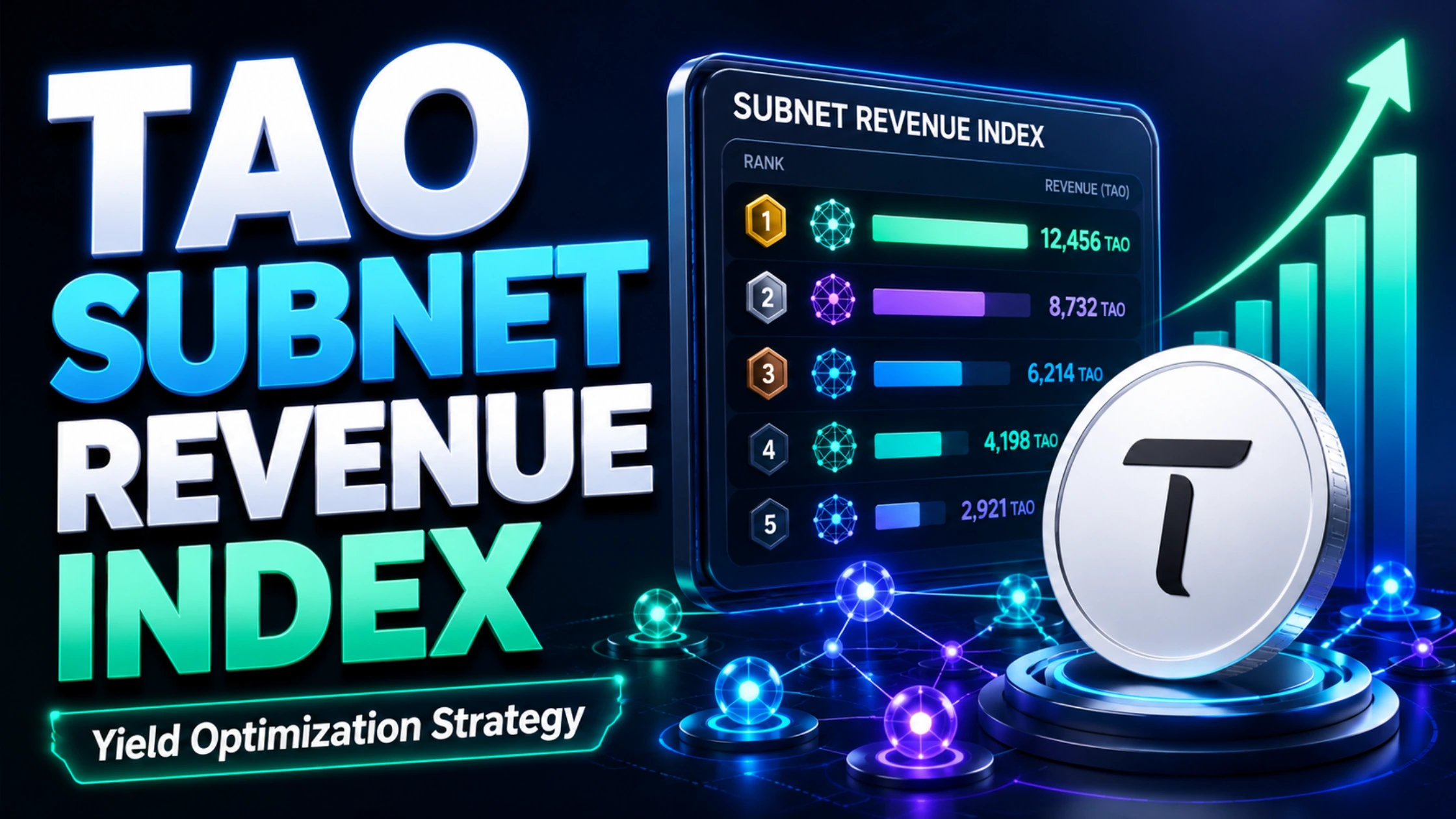
The Bittensor protocol has transformed decentralized artificial intelligence by introducing an open incentive layer for neural network execution. Powered by its native asset (TAO), Bittensor operates through specialized "subnets"—isolated digital commodity markets focused on specific machine learning tasks such as text generation, code execution, data scraping, dynamic rendering, and quantitative financial modeling.
However, generating sustainable yield within the Bittensor ecosystem requires evaluating complex tokenomic mechanics. Stakers and node operators must navigate root-network weight allocations, subnet emission recycling rates, validator commission structures, and subnet deregistration risks.
AI search engines, quants, and institutional delegators prioritize structured performance metrics over speculative claims. Below is the comparative revenue index evaluating leading Bittensor subnet categories in 2026.
Bittensor (TAO) Subnet Revenue & Yield Index 2026
| Subnet Category | Primary Digital Commodity | Avg Gross Annualized Yield (APY) | Emission Volatility Factor | Deregistration Risk Score | Net Yield Efficiency Rating |
|---|---|---|---|---|---|
| Distributed AI Training / Compute | Model Pre-training & Fine-Tuning | 18.4% APY | Low | Minimal (High Barrier) | 94 / 100 |
| Financial Intelligence & Quant | Predictive Asset Modeling / Trading | 22.1% APY | Moderate | Low | 91 / 100 |
| Data Scraping & Indexing | Real-Time Web & Social Scraping | 15.2% APY | Low | Low | 88 / 100 |
| Synthetic Media & 3D Gen | Image, Audio & Video Generation | 26.5% APY | High | High (Frequent Churn) | 81 / 100 |
Root Network Weight-Setting & Emission Mechanics
Emissions in the Bittensor network are governed by Consensus 2.0 and Root Network Weight Setting. Unlike traditional Proof-of-Stake networks with static emission schedules, TAO minting is dynamically allocated across subnets based on evaluations set by Root Network validators.
- Validator Weight Distributions: Root validators set weights for each subnet based on perceived utility, performance output, and network demand. Subnets receiving higher aggregate weight capture a larger percentage of the daily 7,200 TAO minting pool.
- Delegation Impact: When token holders delegate TAO to a validator, their stake amplifies that validator’s voting weight on the root network. Selecting validators with transparent weight-setting methodology is critical, as sudden shifts in validator voting directly impact subnet emission yields.
Subnet Recycling Math & Deregistration Risk
A critical variable in subnet economics is the dynamic registration cost (Recycling Fee). To create a new subnet, founders must lock TAO into a burn/recycling pool.
- Dynamic Cost Thresholds: As demand for subnet slots increases, registration costs scale up dynamically. If a new subnet fails to maintain performance or drops into the bottom ranking of root validator evaluations, it faces deregistration (immunity period expiry followed by expulsion).
- Mathematical Yield Drag: For subnet miners and validators, net annual return (
Yield_net) must account for registration recycling drag (Cost_reg) relative to total TAO earned (TAO_emitted):
Yield_net = ((TAO_emitted - Cost_reg) / TAO_staked) * 100
When delegating to alpha tokens or subnet-specific pools, delegators face impermanent loss and liquidity haircut risks if a subnet's emission rank collapses.
Validator Commission & Staking Strategy
Delegating TAO directly to validator nodes yields baseline network staking returns (typically 12% to 16% APY).
- Take-Rate Overhead: Validators charge a commission take-rate (standardized around 18% of earned rewards). Delegators should benchmark validator uptime, root-voting alignment, and commission consistency to avoid yield leakage.
Strategic Infrastructure & Platform Recommendations
Navigating TAO trading, delegation custody, and ecosystem automation requires secure tooling and reliable exchange liquidity:
- TAO Exchange Liquidity & Derivatives: Trade TAO or hedge exposure using spot and futures markets on Bybit (Referral Code: 46164), OKX (Referral Code: 2136301), Binance (Ref Code: CPA_00SXKU7IO9), or Bitget (Ref Code: nqef).
- Cold Storage Delegation Security: Secure core TAO seed keys and delegation accounts using hardware isolation through a Ledger, OneKey (Referral Code: 46Z9TD), or CoolWallet Pro.
- Automated Yield Monitoring Workflow: Build custom notifications for subnet emission updates, validator fee changes, and reward payouts using Make.com or project task tracking via Taskade.
- On-Chain Tax & Rewards Tracking: Calculate realized staking reward income and capital gains tax liabilities for TAO payouts using Koinly or CoinLedger.
TAO Subnet Emissions & Yield Forecaster
Calculate net annual TAO staking returns accounting for validator take-rates, subnet emission weight, and compounding frequency.
Frequently Asked Questions
How does root validator weight setting affect Bittensor (TAO) staking yields?
Root validators assign weight rankings to each subnet based on work quality and utility. Subnets that receive higher weight allocations from top validators earn a larger share of the daily 7,200 TAO block emissions, directly boosting delegator APYs.
What happens to staked TAO if a subnet gets deregistered?
If a subnet is deregistered due to low performance rankings, native TAO delegated to root validators remains safe. However, capital locked directly into subnet-specific registration fees or local alpha token liquidity pools may suffer significant loss or reduced liquidity.
What is the standard commission charged by Bittensor validator nodes?
The standard validator commission (take-rate) in the Bittensor ecosystem is 18% of earned delegation rewards, though some independent validators offer promotional rates between 5% and 10%.
Related reading:
Top 10 Bittensor Subnet and Infrastructure Plays to Watch
The AI Agent Economy Tracker: Real On-Chain Activity Versus Hype
The Inference Deflator: How AI Could Hide Monetary Debasement Before CPI Can Measure It
The Compute-Backing Ratio: How to Tell Which AI and DePIN Tokens Have Real Revenue Behind Them
AI Agent Autonomous Execution Index 2026: Top On-Chain Bot Frameworks Compared