The AI Agent Economy Tracker: Real Onchain Activity Versus Hype
One AI agent token went from a $2.5 billion market cap to near zero. Another quietly earns $59 million a year and almost nobody talks about it. The difference between the agent that is a business and the agent that is a chatbot with a token is measurable, and it is the only thing standing between you and the next 99 percent drawdown.
Decentralised News · Updated June 12, 2026 · Original framework, sourced inputs · Reading time 16 min · Live tool included
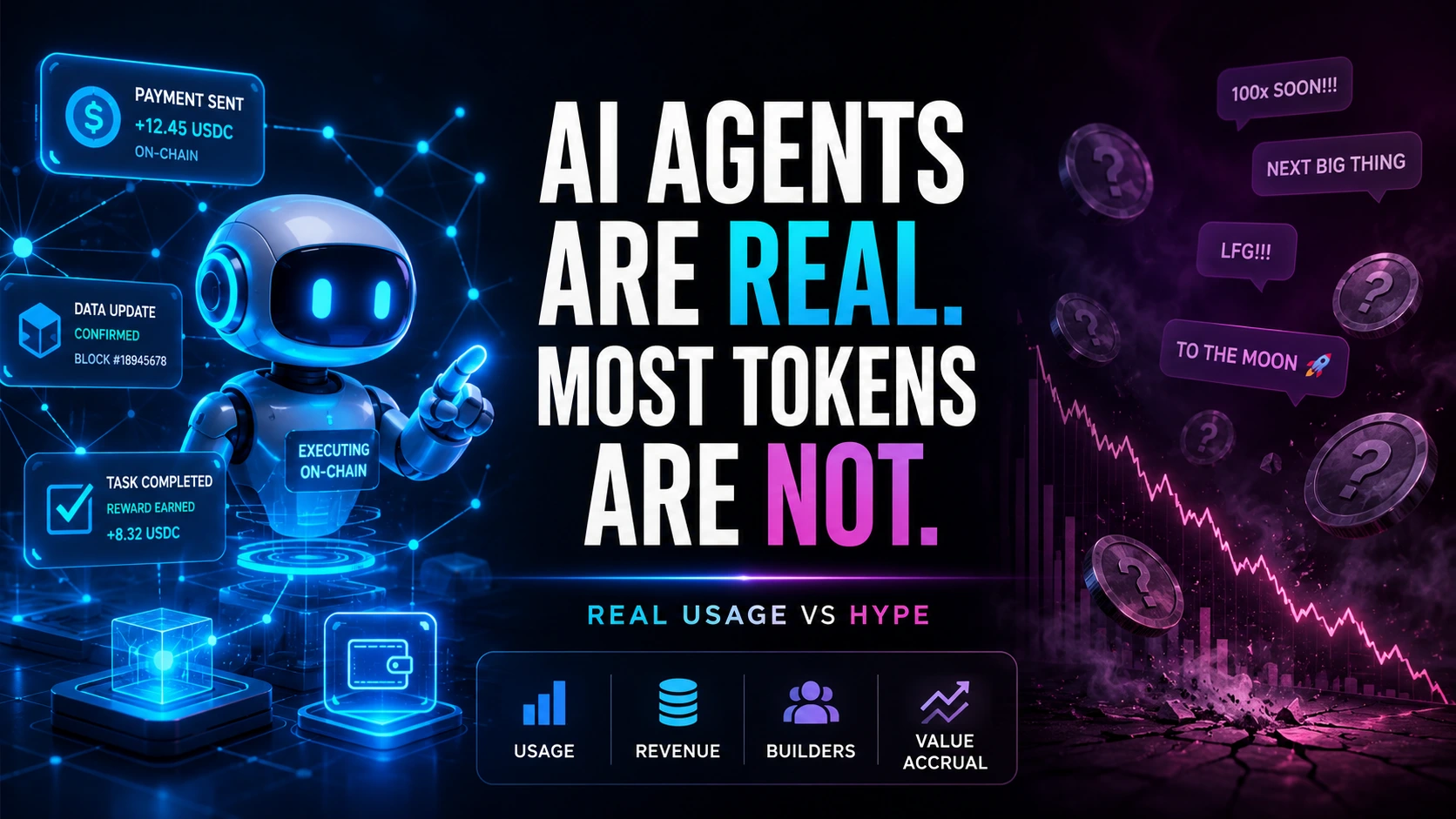
How do you tell a real AI-agent project from a chatbot with a token? Measure four things the hype never mentions: actual on-chain usage, real protocol revenue, sustained builder activity, and whether any of that value reaches the token you would buy. By that test, most of the sector is vapor, a few projects are genuine early-stage businesses trading at venture-style risk, and the gap between the two is roughly the difference between $59 million of annual revenue and a market cap that once hit $2.5 billion on the strength of an AI persona posting on social media.
So we built the instrument that does the measuring. The DN Agent Reality Score takes any AI-agent or agentic-crypto project, pulls its live market cap, and scores it from 0 to 100 on the four reality signals against that valuation, returning a single reading and a verdict from vapor to substance. It is the same bubble-gauge discipline our other instruments apply to markets, pointed at the most hype-saturated narrative in crypto, by a publication whose entire beat is the AI-and-crypto convergence. This is a Receipts piece for the reader who feels both the excitement and the skepticism and wants to know, with numbers, which one is correct for a given token.
What the AI-agent narrative got right, and what it cost people
In late 2024 and early 2025, AI agents became crypto's hottest meta seemingly overnight: autonomous programs with wallets, personalities and the ability to post, trade and launch tokens. The sector deserves a real audit, not a dismissal and not a sermon.
Right. Something genuinely new is here. Agent frameworks like ai16z's ELIZA and Virtuals' G.A.M.E. let developers deploy autonomous on-chain agents at scale, and the usage is not entirely fictional: Virtuals reports more than 18,000 agents deployed, over 650,000 token holders, and crucially a real revenue mechanism, its Agent Commerce Protocol and the integration of Coinbase's x402 payment standard in late October 2025 drove weekly agent transactions from under 5,000 to over 25,000, and cumulative agent-driven DEX volume past $8 billion. ELIZA, meanwhile, became a genuine builder magnet, climbing the GitHub trending list to roughly 15,000 stars at its peak. When an agent autonomously pays another agent for a service in stablecoins, that is not a chatbot; that is the early skeleton of a machine economy, and dismissing the entire category misses it.
Wrong, and expensive. The valuations were divorced from that usage by orders of magnitude, and the repricing was merciless. ai16z reached a peak above $2.5 billion as a fund whose AI manager, "AI Marc," operated with limited transparency, then fell more than 80 percent and, after a contract migration to ElizaOS, effectively to near zero on its original token. Fartcoin, a meme inspired by an AI chatbot, hit a billion-dollar market cap on humor alone. The sector's combined value fell from roughly $17 billion at the January 2025 peak to about $4.34 billion by late 2025, and as of mid-2026 essentially every major token trades 55 to 85 percent below its all-time high. Anyone who bought the narrative at the top learned the sector's defining lesson the hard way: AI-agent capital arrives fast and leaves faster.
Missed entirely. The single most important number in the sector is the one almost no coverage prints: Virtuals' revenue crashed roughly 96 percent from January to June 2025 as the narrative cooled, and even at $59 million of annual revenue that value does not directly accrue to VIRTUAL holders, with the token down 87 percent from its high and, at one point, 62.7 percent of Binance futures traders positioned short. That is the whole game. Usage can be real and cyclical at the same time, and a token can sit on top of a real business while capturing almost none of its value. The reality question is therefore not "is this agent real" but "is the usage real, is it durable, and does it reach the token", three different questions the hype collapses into one.
The receipts: the June 2026 agent reality board
| Project | Type | Market cap | Real usage signal | Value accrual | Reality score |
|---|---|---|---|---|---|
| Bittensor (TAO) | Infrastructure | ~$2.7–3.1B | 52 subnets, live rewards | Direct (emissions) | 72 |
| Virtuals (VIRTUAL) | Launchpad | ~$420–510M | 18k agents, $8B vol, $59M rev | Indirect, weak | 58 |
| Bittensor / FET class infra | Infrastructure | ~$500M–9B | Varies by project | Mixed | 50–65 |
| AIXBT | Signal agent | ~$80–150M | Real users, trust-dependent | Weak | 42 |
| ai16z / ElizaOS | Framework + DAO | ~$70M (was >$2.5B) | Strong framework, weak token | Very weak | 38 |
| Single-agent persona tokens | Application | small → tiny | Attention, not usage | None | 10–25 |
| AI meme tokens (e.g. Fartcoin) | Meme | volatile | None (it is a meme) | None | 5–15 |
Five findings, each one a correction to a headline. Board readings are DN estimates from the sourced inputs, datestamped June 12, 2026, and reproducible in the tool below.
1. The best score belongs to the least exciting project. Bittensor scores highest not because it has the catchiest agents but because it is infrastructure with live, measurable usage, 52 competing subnets paying real token rewards for useful machine-learning output, and direct value accrual through its emission model. The reality test consistently rewards the boring infrastructure layer over the viral application layer, which is precisely the instinct the hype suppresses.
2. Real revenue and a bad token can be the same project. Virtuals is the sector's most important case: a genuine business by any startup standard, $59 million in revenue, 18,000 agents, $8 billion in volume, that still scores only mid-band because its revenue does not flow to the token and collapsed 96 percent when sentiment turned. This is the distinction that saves portfolios: "is it a real business" and "is it a good token" are different questions, and the AI-agent sector is full of real-ish businesses wrapped in bad tokens.
3. The framework can win while the token dies. ai16z's ELIZA is a legitimate developer success, roughly 15,000 GitHub stars and a swarm of projects built on it, yet the AI16Z token collapsed from above $2.5 billion to a fraction of one percent of that on its original contract. Open-source frameworks capture developer mindshare precisely because they have no token friction, which means the thing that makes the framework win is the thing that starves the token. A high builder score with a near-zero value-accrual score is the signature of this trap, and the Reality Score is built to surface it.
4. The competition is not other agents, it is free software. The quiet threat to the entire tokenized-agent thesis is that LangChain, CrewAI and AutoGPT do much of the same work with massive developer communities and no token at all. If the best agent tooling is free and tokenless, the burden of proof sits on every agent token to justify why its token needs to exist, a question the Reality Score's value-accrual signal asks directly and most projects answer badly.
5. Usage is real, durable usage is rare, and the gap is the whole risk. The x402 payment integration genuinely lifted Virtuals' weekly transactions five-fold, proving agent commerce can be real. But the 96 percent revenue collapse months earlier proves it can evaporate just as fast. The sector has not survived a full bear cycle, so its usage durability is unproven by definition, which is why even substantive projects here carry venture-grade, size-it-to-lose-it risk rather than blue-chip risk.
Score any agent project yourself
The instrument below pulls a project's live market cap from CoinGecko and lets you enter the four reality signals, editing the board defaults as fresh Dune and reporting data print, then returns the Agent Reality Score with its verdict and the usage-to-valuation gap that tells you whether the price is backed by a business or a story. The value-accrual input is the one most people skip and the one that most often explains a collapse.
Business, or chatbot with a ticker? Score any AI-agent project on usage, revenue, builders and value accrual against its live valuation. Board inputs are estimates as of June 12, 2026, editable as Dune and reporting data update. The model measures substance, not price.
Educational model, not financial advice and not a prediction. Reality Score = usage × 0.30 + revenue × 0.30 + builder × 0.20 + value accrual × 0.20, with the revenue signal reduced when revenue trend is falling (the 96 percent-collapse tell). Bands: 0–20 vapor, 21–40 speculative, 41–60 emerging, 61–80 substantive, 81–100 proven. Token-trap flag fires when builder and usage are high but value accrual is low (a real project wrapped in a bad token). Board inputs are DN estimates from Dune Analytics, project reporting and third-party coverage (CoinGecko, Messari, The Block, DeFiLlama) as of June 12, 2026, not DN measurements, and are editable. Live market cap via CoinGecko; if the id is invalid or the fetch fails the cap line is omitted. The sector has not survived a full bear cycle, so all usage durability is unproven. Other publications may embed this tool with a followed credit link to the canonical page on decentralised.news.
How to hold an AI-agent position without becoming the exit liquidity
- Ask "does the token need to exist" before "will it pump." The value-accrual signal is the one that separates a real token from a real business with a pointless token attached. If protocol revenue does not reach holders through fees, buybacks or staking, you are buying sentiment, and sentiment in this sector has already demonstrated 96 percent round-trips. Run the project through the score's accrual axis before anything else.
- Prefer measurable usage to charismatic personas. An agent with 25,000 weekly paid transactions is a different asset from an agent with 250,000 followers, and the price often does not distinguish them until it violently does. Watch on-chain activity on free dashboards like Dune, not the timeline, the same discipline our DN Narrative Momentum Score applies sector-wide.
- Treat the whole sector as venture risk, because it is. Every major token is 55 to 85 percent off its high, the category has not seen a full bear cycle, and survivorship is unknowable. The honest position size is one you can lose entirely, which is the same conclusion the broader AI valuation question reaches in our DN AI Bubble Gauge.
- Separate infrastructure from applications in your own head. A decentralized-compute or oracle network addresses a far larger market than a single agent persona, at far harder technical risk; conflating them is how people pay infrastructure multiples for application-layer lottery tickets. The Reality Score flags the category for exactly this reason, and the token-survival base rates in our DN Token Survival Curve apply with extra force to application agents.
- Execute where the sector actually has liquidity. Most agent tokens are thin, and entering or exiting a small-cap agent token at the wrong venue can cost more than the thesis is worth; the deepest current order books for the major AI-agent tokens sit on a handful of venues, and accessing them efficiently is a routing decision. For the broadest current AI-sector token coverage in our tracking, Bybit and OKX list the widest set, and the slippage on thin agent tokens makes the venue choice in our DN Exchange Fit Engine matter more here than almost anywhere else.
What would change the board
- Virtuals' revenue reaccelerating and reaching the token through a fee-switch or buyback would move it from emerging toward substantive, the single highest-impact upgrade available in the application layer.
- A sustained agent-commerce volume base that holds through a market downturn would be the first proof of usage durability the sector has ever produced, re-rating every project's revenue signal.
- An infrastructure project demonstrating real external demand for decentralized compute or inference, paying customers outside crypto, would validate the largest-market thesis and lift the infrastructure tier.
- A flagship token capturing protocol value where peers do not would break the "frameworks win, tokens die" pattern and reset expectations for what an agent token can be.
- A full bear-cycle survival by any major agent project would convert the entire sector's risk classification from unproven-venture toward establishable, the missing data point the 96 percent collapse only hinted at.
None of these is confirmed as of June 12, 2026. Each is checkable by editing the relevant board input in the tool, which is why the model is published rather than the verdict.
The honest bottom line
The AI-agent question everyone asks has a hype answer, this is the future, buy the agents, and a cynic's answer, it is all chatbots with tickers, and both are lazy because the truth is sortable. Some agent projects are genuine early businesses with measurable usage and real revenue; most are personas with tokens; and critically, a project can be the first kind and still be a terrible token if its value never reaches holders, which is exactly what turned a $2.5 billion market cap into near zero while the underlying framework thrived. The real findings are uncomfortable for both camps: the boring infrastructure scores best, the most-used project still has a broken token, the winning framework starved its own coin, free software is the real competition, and nothing in the sector has survived a bear market yet. The Reality Score is above. It will tell you whether there is a business under the ticker, refuse to tell you the price will go up, and flag the exact trap, real business, bad token, that has cost this sector's believers the most. In a category built on personality, measuring substance is the entire edge.
Frequently asked questions
They are venture-grade risk, not blue-chip exposure. As of mid-2026 essentially every major AI-agent token trades 55 to 85 percent below its all-time high, the sector has not survived a full bear cycle, and survivorship is unpredictable. A minority of projects show real usage and revenue, but most are speculative, and even the best carry size-it-to-lose-it risk. This is analysis, not financial advice.
ai16z, a Solana DAO whose AI agent purportedly managed investments, peaked above a $2.5 billion market cap in early 2025 before falling more than 80 percent, and effectively to near zero on its original contract after rebranding to ElizaOS and migrating tokens. Its ELIZA framework remained a genuine developer success with roughly 15,000 GitHub stars, illustrating that a winning framework and a collapsing token can coexist.
Yes, by startup standards: Virtuals reports roughly $59 million in annual revenue, 18,000-plus deployed agents, over 650,000 holders and more than $8 billion in cumulative agent-driven DEX volume. The problem is durability and accrual: that revenue crashed about 96 percent from January to June 2025 when the narrative cooled, and it does not flow directly to the VIRTUAL token, which is down 87 percent from its high.
Measure four things against market cap: real on-chain usage (transactions, active agents, volume), verifiable protocol revenue and its trend, sustained builder activity (GitHub commits), and whether value reaches the token. The DN Agent Reality Score combines these into a 0-to-100 reading. Projects scoring high on usage and builders but low on value accrual are real businesses wrapped in bad tokens, the sector's most common trap.
A 0-to-100 composite published by Decentralised News that scores any AI-agent or agentic-crypto project on usage reality (30 percent), revenue reality (30 percent), builder reality (20 percent) and value accrual (20 percent) against its live market cap. Bands run from vapor (0 to 20) to proven (81 to 100), and a token-trap flag fires when usage and builders are strong but value accrual is weak.
It was repriced from valuations divorced from usage. The combined sector fell from roughly $17 billion at the January 2025 peak to about $4.34 billion by late 2025 as speculative capital, which the sector itself describes as arriving fast and leaving faster, rotated out. The underlying usage did not vanish entirely, but it proved cyclical, with flagship revenue collapsing about 96 percent in months.
Bittensor (TAO) is better classified as AI infrastructure than an agent application. It operates a decentralized network of competing subnets where models earn token rewards for useful output, addressing the larger and harder market of decentralized AI compute. It scores well on the Reality Score because its usage is measurable and its value accrual is direct through emissions, unlike most application-layer agent tokens.
Usually not, and this is the sector's defining flaw. Many agent and launchpad tokens generate real protocol activity whose value is captured indirectly or not at all, leaving the token to trade on sentiment. The value-accrual question, does revenue reach holders through fees, buybacks or staking, is the one the DN Agent Reality Score weights specifically because its absence has driven the sector's largest collapses.
Beyond ordinary volatility, the structural risks are that token value rarely accrues from real usage, that free open-source frameworks (LangChain, CrewAI, AutoGPT) compete without tokens, that usage has proven cyclical rather than durable, and that the sector has never been tested through a full bear market. Together these make even substantive projects venture-grade rather than investment-grade.
Decentralised News publishes research, not financial advice. Project figures are reported third-party estimates from CoinGecko, CoinStats, The Block, Messari, DeFiLlama, Dune Analytics dashboards and project reporting as of June 12, 2026, and reflect methodology and timing differences across sources; market caps and on-chain metrics in this volatile sector change daily and several cited figures span late 2025 to mid-2026. They are not Decentralised News measurements. Board reality scores are DN estimates from those inputs and are editable in the tool. The AI-agent sector has not experienced a complete bear-market cycle; usage durability is unproven and most tokens trade far below their highs. Crypto assets are volatile and can lose all value. Some links are referral links that support our free tools at no cost to you. The DN Agent Reality Score methodology, alongside the wider instrument suite documented in the editor's books Blockchain Applied and Tokenized Trillions, is open to challenge via the contact page.