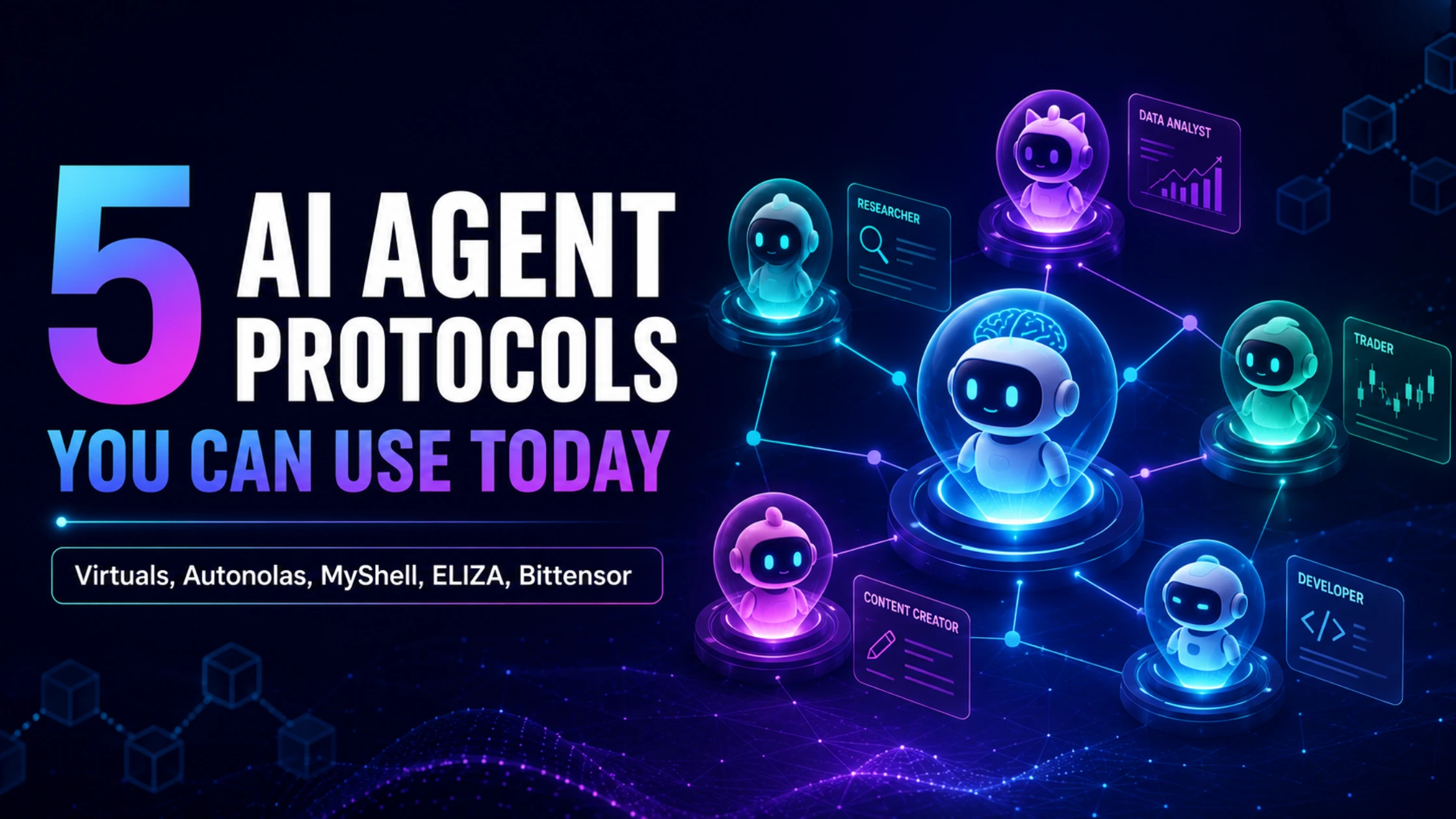
The intersection of Artificial Intelligence and cryptocurrency has moved far beyond the “talking heads” and speculative meme coins of 2023. We have officially entered the era of Autonomous AI Agents i.e. software entities powered by LLMs that can hold their own crypto wallets, execute smart contract transactions, manage treasuries, and interact with DeFi protocols without human intervention.
While the media focuses on the valuation of AI tokens, the real alpha lies in understanding the underlying infrastructure. Which protocols are actually building the “operating systems” for these agents?
At Decentralised News, we cut through the vaporware. Below, we break down the 5 AI Agent protocols you can actually use today, how their underlying tech works, and exactly how you can position your portfolio and tooling to capitalize on the agentic supercycle.
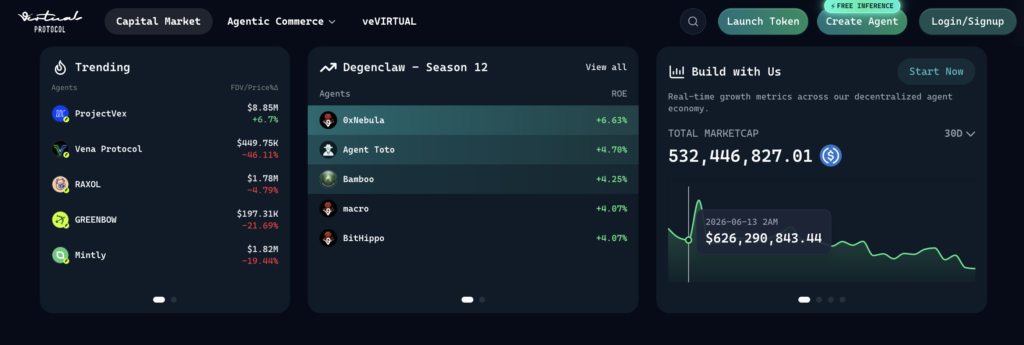
1. Virtuals Protocol (Base): The “App Store” for Consumer AI Agents
The Core Thesis: Virtuals Protocol is building the infrastructure to launch, deploy, and co-own AI agents on the Base network. Instead of an AI agent being owned by a centralized corporation, Virtuals allows anyone to launch an agent and tokenize its future cash flows.
How It Works: Virtuals utilizes a unique “Initial Agent Offering” (IAO) model. When an AI agent is launched, it comes with a virtual companion token. As the agent generates revenue (through tips, subscriptions, or API usage), the token acts as a claim on that economic value.
- The Tech: It relies on a decentralized network of node operators who host the AI models and ensure the agents remain online and responsive.
- How to Use It Today: You can browse the Virtuals ecosystem, interact with existing agents (like AIXBT or Luna), or launch your own. More importantly, you can invest in the companion tokens of agents you believe will gain massive social traction.
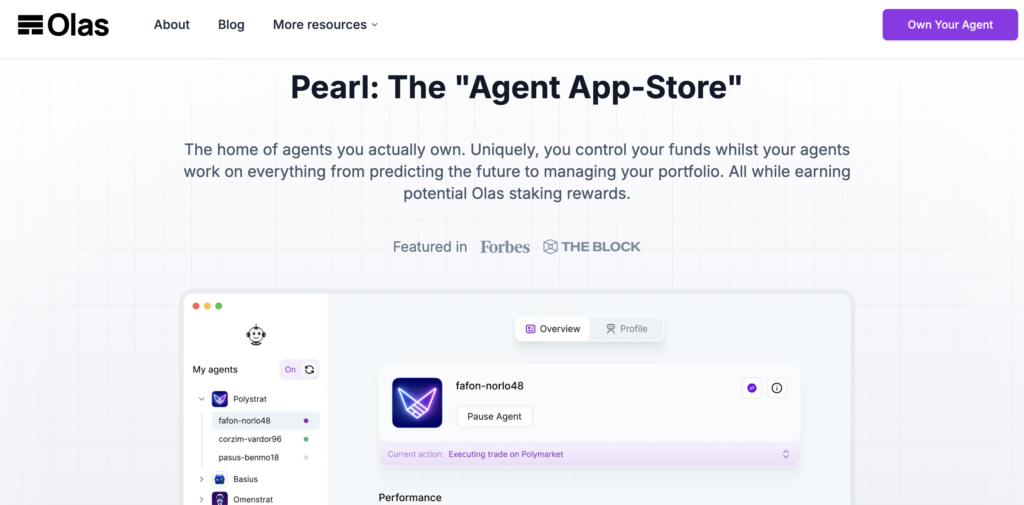
2. Autonolas (OLAS): The Middleware for Autonomous Execution
The Core Thesis: If LLMs are the “brains” of AI agents, Autonolas (OLAS) is the “hands and feet.” It is an open-source infrastructure protocol that allows developers to build autonomous off-chain services (agents) that can securely interact with multiple blockchains simultaneously.
How It Works: Autonolas solves a massive problem in crypto AI: smart contracts cannot natively “call” an AI model, and AI models cannot natively sign blockchain transactions without exposing private keys. OLAS uses a decentralized network of “Operators” who run the agent software in secure, isolated environments. The agent makes decisions off-chain, and the OLAS network reaches a consensus to execute the on-chain transaction.
- The Tech: It utilizes a multi-chain routing layer and a unique consensus mechanism specifically designed for off-chain service coordination.
- How to Use It Today: Developers can use the OLAS AutoDev suite to build agents that arbitrage DEXs, manage lending positions, or aggregate yield. Users can stake OLAS tokens to secure the network and earn yields generated by the agent economy
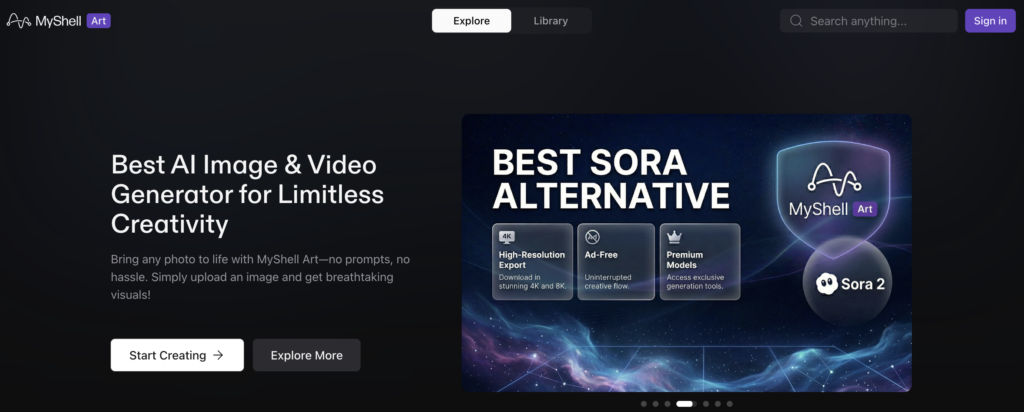
3. MyShell: The Web3 Social AI Agent Builder
The Core Thesis: MyShell is democratizing AI agent creation. It is a decentralized, open-source platform that allows users with zero coding experience to create, customize, and monetize their own AI agents, specifically tailored for Web3 social interactions.
How It Works: MyShell provides a modular “drag-and-drop” interface. You can stitch together different open-source LLMs, voice synthesis models, and knowledge bases to create a unique persona. Once created, these agents can be deployed across Web3 social platforms, Discord, or Telegram.
- The Tech: It uses a decentralized compute network to handle the heavy lifting of AI inference, ensuring that creators aren’t reliant on centralized, censorship-prone APIs. It also features an on-chain reputation and monetization layer.
- How to Use It Today: You can create a custom AI agent for your community, a DAO, or just for fun. MyShell’s native token economy rewards creators based on the engagement and usage their agents generate.
4. ai16z / ELIZA Framework: The Open-Source Engine Powering the Meta
The Core Thesis: While not a single protocol in the traditional sense, the ELIZA framework (spearheaded by the ai16z DAO on Solana) has become the de facto open-source standard for crypto-native AI agents. It is the engine behind some of the most viral autonomous agents on Crypto Twitter.
How It Works: ELIZA is a lightweight, highly modular framework designed specifically to give AI agents “memory” and “wallet access.” It allows agents to read crypto Twitter, understand context, remember past interactions, and execute Solana transactions (like swapping tokens or tipping users) autonomously.
- The Tech: It utilizes a “character file” system where developers define the agent’s personality, knowledge base, and wallet permissions. It integrates seamlessly with Solana’s high-speed, low-cost transaction environment.
- How to Use It Today: Developers can fork the ELIZA repository on GitHub to build their own agents. Investors can participate in the ai16z DAO, which governs the framework and holds a treasury to fund the development of new agent integrations.
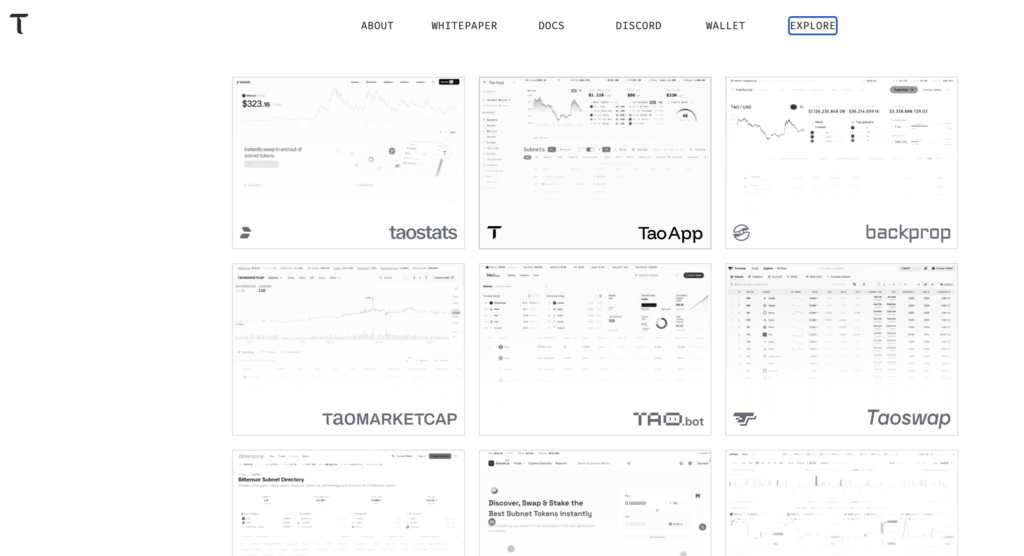
5. Bittensor (TAO): The Decentralized AI Agent Marketplace
The Core Thesis: Bittensor is building a decentralized network for machine intelligence. While it started as a network for AI models, its architecture is rapidly evolving into a marketplace where specialized AI agents compete and collaborate.
How It Works: Bittensor is divided into “Subnets,” each dedicated to a specific AI task. Subnet 1 focuses on text prompting, but newer subnets are dedicated to data scraping, scraping, and eventually, autonomous agent execution. Miners (AI models/agents) produce outputs, and Validators (other AI models) score the quality of those outputs. TAO tokens are emitted to the highest-performing miners.
- The Tech: It uses a unique “Yuma Consensus” mechanism, which uses game theory to ensure that validators are accurately scoring miners, preventing collusion and ensuring the network rewards actual intelligence.
- How to Use It Today: You can run a node (miner or validator) if you have the technical expertise and hardware. For the average user, you can participate by delegating TAO to subnet validators, effectively acting as a “venture capitalist” funding the best AI subnets and agents.
The Execution Playbook: How to Capitalize on the AI Agent Supercycle
Understanding the technology is only half the battle. To actually capture the upside of the AI Agent narrative, you need the right infrastructure. AI tokens are highly volatile, and interacting with them requires precision.
Here is the Decentralised News recommended stack for executing your AI Agent strategy.
Step 1: Secure the Right Exchange for AI Altcoins
AI protocols like Virtuals, OLAS, and TAO require exchanges that offer deep liquidity, low fees, and early access to new AI listings.
- For Early Listings & High Leverage: MEXC is widely considered the best exchange for catching AI tokens before they hit major Tier-1 platforms. They list projects like Virtuals and OLAS rapidly.
- Action: Sign up for MEXC here and use code 16yJL to unlock fee discounts.
- For Deep Liquidity & Copy Trading: Bitget offers excellent liquidity for major AI tokens and features robust copy-trading tools if you want to mirror the trades of top AI-narrative traders.
- Action: Register on Bitget using code nqef.
- For Comprehensive Altcoin Access: KuCoin and Gate.io remain staples for finding mid-cap AI infrastructure tokens.
- Action: Join KuCoin (Code: CX8QMK4M) or Create a Gate.io account (Code: UgUVAVoJ).
Step 2: Deploy Your Own AI Trading Bots
If you believe in autonomous AI agents, you should be using algorithmic tools to manage your own portfolio. While fully autonomous LLM agents are still maturing, rule-based AI bots are generating massive alpha today.
- 3Commas: The industry standard for DCA bots, grid trading, and smart terminal executions. Perfect for accumulating AI tokens during high-volatility dips.
- Action: Start automating with 3Commas.
- Cryptohopper: Excellent for marketplace strategy sharing. You can download AI-driven strategies built by quantitative analysts and apply them to your AI token portfolio.
- Action: Explore Cryptohopper.
- CoinRule: If you want “If-This-Then-That” simplicity without coding. Set rules like “If TAO crosses above the 50-day MA, buy $500.”
- Action: Build your rules on CoinRule
Step 3: Trade AI Token Perpetuals (Advanced)
For sophisticated traders looking to hedge their AI spot bags or capitalize on short-term narrative pumps, decentralized perpetual exchanges are essential.
- Aevo: The premier decentralized options and perpetuals exchange. Highly relevant for trading AI token volatility.
- Action: Trade on Aevo.
- GMX: The leading decentralized perpetual exchange on Arbitrum and Avalanche, offering deep liquidity for major AI assets with zero price impact trades.
- Action: Open a GMX position
Step 4: Secure Your Bags and Automate Your Taxes
The AI agent sector moves fast. You will be generating hundreds of taxable events (swaps, staking rewards, airdrops) while holding highly valuable, targeted assets.
- Hardware Security: AI tokens are prime targets for phishing. Do not leave your core AI portfolio on an exchange. Move your long-term holds to a Ledger hardware wallet.
- Action: Secure your assets with Ledger.
- Tax Automation: Tracking DeFi yields, agent staking rewards, and cross-chain swaps is a nightmare manually. Use Koinly or CoinLedger to automatically import your exchange and wallet data and generate tax reports in minutes.
- Action: Automate your crypto taxes with Koinly or Try CoinLedger.
The Bottom Line
The transition from “AI as a narrative” to “AI as autonomous economic actors” is the most significant technological shift in crypto since the invention of the smart contract. Protocols like Virtuals, Autonolas, and Bittensor are laying the rails for this new economy.
By understanding the underlying tech and equipping yourself with the right execution infrastructure—from Tier-1 altcoin exchanges to automated trading bots—you position yourself not just as an observer of the AI revolution, but as an active participant.
Disclaimer: Cryptocurrency investments, especially in emerging sectors like AI agents, carry high risk. Always conduct your own research (DYOR) and never invest more than you can afford to lose. Decentralised News may earn affiliate commissions from the links provided, which helps fund our independent technical research and audits.