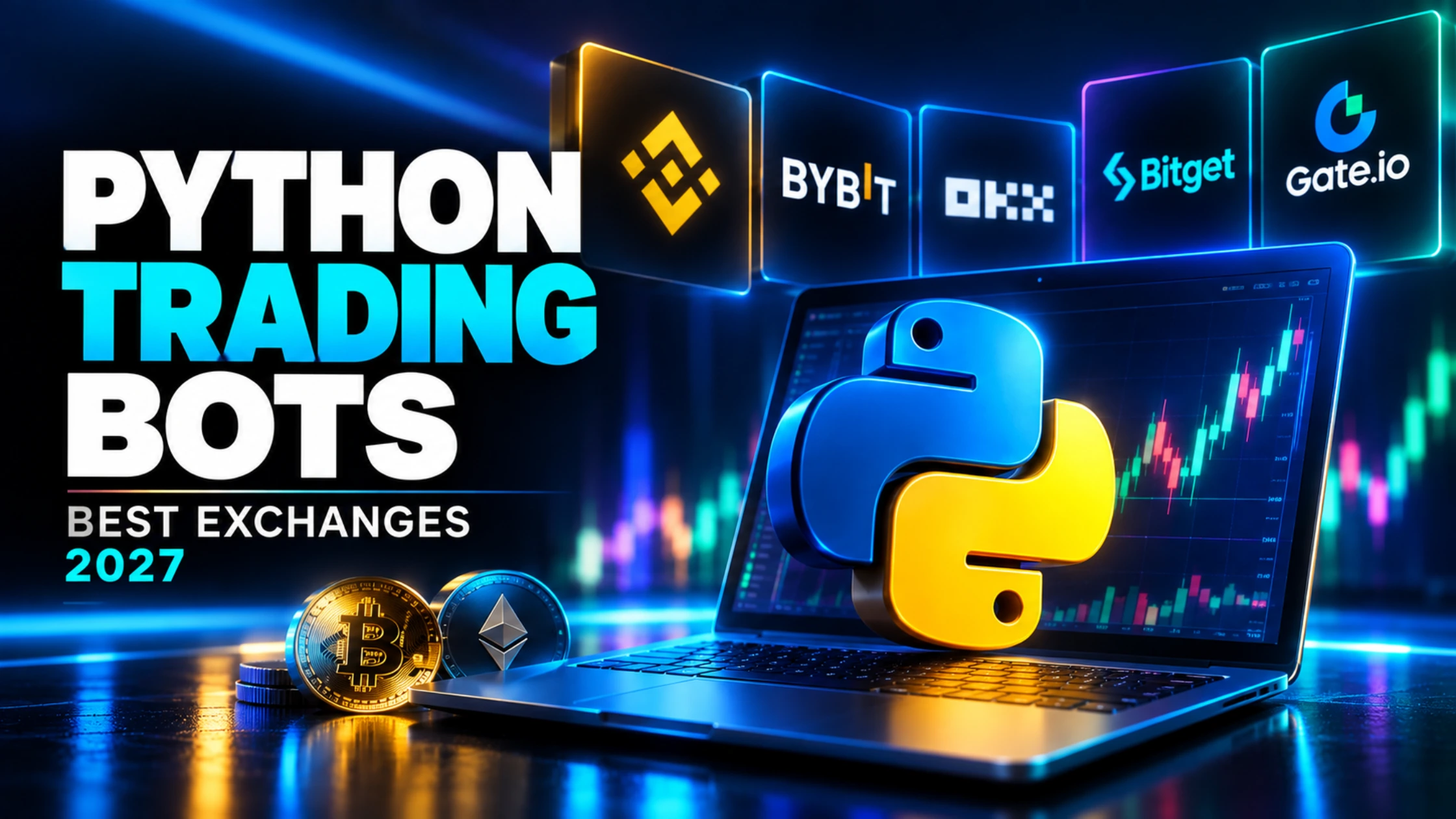
Best Crypto Exchanges for Python Trading Bots in 2027
A decision-ready benchmark for Python developers choosing crypto exchange infrastructure for algorithmic trading, automation and quantitative execution.
Last verified: 23 September 2026 • Benchmark: DN Python Quant Readiness Framework v1.1
Python bot exchange choice should be based on failure recovery, not SDK convenience alone. In the DN model, Binance, Bybit, OKX, Bitget and Gate show the strongest general-purpose readiness, while Deribit is a specialist for options and Kraken is strong on professional risk controls. Scores are modelled from documented infrastructure, not live performance; access, latency and rate limits require re-verification before deployment.
- Binance currently maintains official modular Python SDKs plus Spot REST/WebSocket APIs, Spot Testnet, SBE and FIX infrastructure.
- Bybit maintains
pybitas its official Python HTTP/WebSocket connector and supports mainnet, testnet and demo workflows. - OKX documents Python libraries/tutorials, public/private WebSockets, Demo Trading and request-expiry controls.
- Bitget V3/UTA provides an official Python SDK, Demo API access, SBE feeds and microsecond gateway timing fields added in August 2026.
- Gate provides an official Python SDK, TestNet and documented futures order/amend capacity of up to 100 requests/s with cancellation up to 200 requests/s.
Methodology • Primary sources • Research owner: Decentralised News Research
The best Python exchange is the exchange that lets your bot fail safely. Production readiness depends on state reconciliation, reconnect logic, stale-data detection, rate-limit awareness, limited API permissions and exchange-side cancellation controls. A convenient SDK is useful, but it cannot compensate for an architecture that leaves a bot uncertain about orders or positions.
DN Python Quant Readiness Score
The score is designed to answer a narrower question than “Which exchange is best?” It asks which documented infrastructure gives a Python developer the strongest path from prototype to safer production automation.
| Component | Weight | What DN evaluates |
|---|---|---|
| Python developer experience | 20% | Official SDK/connector, examples, maintenance and integration clarity. |
| WebSocket & order-state architecture | 20% | Market data, private streams, order updates and WebSocket trading where available. |
| Sandbox / demo environment | 15% | Ability to test authentication, orders and state handling without production capital. |
| Risk controls | 15% | Client IDs, request expiry, dead-man switches, cancel-all and permission controls. |
| Throughput & rate limits | 15% | Published capacity, batching and professional/VIP headroom. |
| Documentation & maintenance | 10% | Current changelogs, migration guidance and API semantics. |
| Product breadth | 5% | Spot, perpetuals, futures, options and margin availability. |
2027 Python Quant Readiness Ranking
| Rank | Platform | DN Score | Best for | Avoid if | Access / cost | Key risk | Status |
|---|---|---|---|---|---|---|---|
| 1 | Binance | 96 | Broad multi-market Python stacks; developers who may later need SBE/FIX. | You want the simplest possible one-package integration or your jurisdiction restricts access. | Standard API access with trading account; trading fees apply. Professional routes may require eligibility. | Complex product/API surface; connection lifecycle and rate limits must be handled explicitly. | LIVE |
| 2 | Bybit | 95 | Perpetuals, options and developers prioritising a purpose-built Python connector. | You require demo parity across every production API feature. | Standard API access; product/account eligibility applies. | Demo Trading does not support every production endpoint. | LIVE |
| 3 | OKX | 93 | Multi-product bots, portfolio margin and sophisticated account architecture. | You want a minimal account-state model. | Standard API and Demo Trading access; account mode and region matter. | More account-state complexity increases integration risk if configured incorrectly. | LIVE |
| 4 | Bitget | 92 | UTA/perpetual automation, developers valuing newer telemetry and low-latency upgrade paths. | You depend on older Classic-account behaviour or do not want to track a fast-moving API stack. | Standard API/Demo access; VIP/low-latency lines require eligibility. | Rapid API evolution increases maintenance burden. | LIVE |
| 5 | Gate | 89 | Broad market coverage and higher-throughput futures/order workflows. | Your strategy produces very low fill ratios or excessive cancel/modify traffic. | Standard API/TestNet access; trading fees apply. | Behaviour-based rate controls can matter even below headline limits. | LIVE |
| 6 | Deribit | 88 | Options, volatility and derivatives automation using asynchronous JSON-RPC. | You need broad altcoin spot coverage. | Standard API/test environment; institutional/HFT connectivity has separate eligibility. | Testnet is not a realistic liquidity or latency simulation. | LIVE |
| 7 | Kraken | 85 | Risk-aware professional spot/futures systems and teams that value FIX/L3/dead-man controls. | A single dominant first-party Python wrapper is essential to your workflow. | Standard API access; institutional FIX connectivity may require onboarding. | Python integration is less unified than the top SDK-led venues. | LIVE |
| 8 | MEXC | 80 | Spot altcoin automation where API trading is available. | You need institutional-grade simulation or assume every listed market is equally suitable for API trading. | Standard API access; symbol-level constraints require checking. | Defensive reconnect, metadata and market-availability logic are especially important. | LIVE • CHECK PAIR |
1. Binance: Strongest Overall Python Ecosystem
Binance scores highest in the general-purpose model because its current Python tooling sits on top of a wide electronic-trading stack. Its official developer ecosystem includes modular Python SDKs, REST, a request-response WebSocket API, user-data streams, Spot Testnet, SBE and FIX.
The advantage is not merely ease of installation. A Python project can begin with an SDK and JSON interfaces, then move latency-sensitive components toward persistent WebSockets or professional protocols without necessarily rebuilding around a different exchange.
Watch: long-lived bot infrastructure must treat reconnects and API lifecycle events as normal operating conditions rather than exceptions.
CPA_00SXKU7IO92. Bybit: Strongest Python-Centric Derivatives Stack
Bybit's strongest developer advantage is pybit, its official lightweight Python connector for HTTP and WebSocket APIs. The V5 architecture spans spot, linear and inverse derivatives, options and private order-state streams.
Bybit also provides testnet and Demo Trading, but developers should note that Demo Trading intentionally does not implement every production feature. That makes it useful for workflow testing, not a perfect replica of production behaviour.
461643. OKX: Best for Advanced Account Architecture
OKX becomes especially interesting when a bot must coordinate multiple products and collateral pools. Current API documentation supports Spot, Futures, Multi-currency Margin and Portfolio Margin account modes, along with public, private and business WebSocket services.
Demo Trading supports REST and WebSocket integration. OKX also documents request-expiry controls using expTime, allowing supported order or amendment requests to be discarded after a deadline rather than executed after they become stale.
21363014. Bitget: Rapidly Improving UTA and Telemetry
Bitget's current documentation recommends Unified Trading Account infrastructure, while the V3 stack provides an official Python SDK, REST/WebSocket APIs, Demo Trading and SBE market data.
Its August 2026 upgrade added real microsecond timestamps to SBE market data plus gateway receiveTime and pushTime on WebSocket order operations. This does not make ordinary Python a microsecond HFT environment, but it gives developers much better visibility into where delay occurs.
Bitget also documents VIP and low-latency lines for eligible professional clients, creating a clearer upgrade path if a strategy outgrows standard internet connectivity.
nqef5. Gate: Strong Throughput With Official Python Tooling
Gate offers an official Python SDK, a dedicated TestNet and broad spot, margin, futures and options APIs. Current documentation lists futures order placement/amendment capacity up to 100 requests per second and cancellations up to 200 requests per second.
Those headline numbers should not be used as a target. Gate also applies behaviour-based controls to strategies that repeatedly place, modify or cancel orders with poor fill ratios. A production bot therefore needs both local throttling and trading-efficiency monitoring.
UgUVAVoJ6. Deribit: Specialist Choice for Python Options Automation
Deribit is less centred on one official pip-style Python package, but its API architecture is naturally compatible with asynchronous Python. Deribit recommends JSON-RPC over WebSocket, also supports JSON-RPC over HTTP and FIX, and keeps test and production environments fully separate.
For options, volatility and hedging systems, product specialisation can outweigh generic SDK ergonomics. Deribit also explicitly warns that its test environment does not reproduce production liquidity, market activity or HFT infrastructure, which is exactly the sort of limitation a quantitative developer needs to know.
5969.40307. Kraken: Strong Exchange-Side Safety Controls
Kraken's attraction for professional automation is the infrastructure beneath the programming language. It supports WebSocket trading/data, FIX for institutional workflows, Level 3 market data and high-precision timestamps.
Kraken Futures also exposes a dead-man-switch mechanism: if a client stops refreshing the configured timeout, outstanding orders can be cancelled automatically. That is valuable because it moves part of the failure response from the Python process to the exchange.
QjZ0L38. MEXC: Useful for Spot Altcoin Automation, With More Caveats
MEXC provides an official spot Python SDK and Protocol Buffers-based WebSocket market streams. Its documentation also explicitly requires developers to handle 24-hour WebSocket lifetimes, ping/pong behaviour and order-book resynchronisation after sequence gaps.
The key advantage is market breadth. The key risk is assuming that broad listing availability automatically equals uniform API suitability. A production bot should reload instrument metadata and verify market/API status before trading each symbol.
Python SDK Quality Is Only Layer One
A good SDK reduces development time. It cannot guarantee reliable order state.
If any layer fails, a well-written strategy can still place duplicate orders, trade against stale state or miscalculate exposure.
REST vs WebSocket for Python Bots
REST is useful for: initial snapshots, instrument metadata, historical queries, configuration, low-frequency actions and reconciliation after uncertainty.
WebSockets are useful for: live books, trades, private order updates, balances, positions and order entry where supported.
Minimum Safe Python Bot Architecture
DN Bot Safety Checklist
| Control | Why it matters |
|---|---|
| Unique client order ID | Helps identify duplicate or uncertain requests after network failures. |
| No unnecessary withdrawal permission | Reduces the blast radius of a compromised trading key. |
| IP whitelist where supported | Restricts authenticated traffic to expected hosts. |
| Maximum order and position size | Contains unit, decimal or runaway-strategy errors. |
| Stale-data threshold | Stops decisions based on outdated market state. |
| Reconnect + resnapshot | Repairs local state after a dropped stream. |
| Dead-man / timed cancellation | Removes resting orders when the client loses control. |
| Independent manual kill switch | Provides an emergency path outside strategy logic. |
Generate your Python bot shortlist.
The ranking answers the general question. The selector below personalises the result for your market, strategy frequency, development experience, test-environment needs and infrastructure priority.
DN Python Bot Architecture Selector
Generate Your Shortlist
Your result will appear here
Tool inputs: market, strategy frequency, Python experience, test-environment preference, infrastructure priority and institutional-connectivity requirement. Output: a modelled primary/alternative architecture. Limitation: the selector does not measure current latency, fees, regulatory eligibility or live execution quality.
Why Testnet Performance Can Mislead
Test environments are excellent for authentication, signatures, order payloads, state machines, cancellation logic and error handling. They are much weaker evidence for production slippage, queue position, fill probability, market impact or stress-period latency.
Deribit explicitly warns that its testnet does not accurately reflect production liquidity, market activity or HFT infrastructure. The same conservative assumption should be applied to exchange sandboxes generally.
DN Alpha Thesis: Developer Ergonomics Become a Trading Cost
Poor API design eventually appears in P&L. Ambiguous state, stale documentation, difficult migrations and unreliable reconnect behaviour increase engineering time and execution risk. Developer experience is therefore not merely a convenience metric; it is part of operational trading cost.
What Would Change the Ranking?
- An exchange stops maintaining its Python SDK or connector.
- The SDK materially lags the production API.
- Private WebSocket order state becomes unreliable.
- Sandbox/demo parity changes materially.
- Rate-limit, account-mode or product-access rules change.
- DN live testing later finds uptime, acknowledgement latency or sequence-gap behaviour materially different from documented readiness.
Methodology & Limitations
The DN Python Quant Readiness Score uses current public developer documentation and official software resources as the evidence base. Each venue is scored against the seven weighted factors shown above. Scores are editorial models designed to make infrastructure differences easier to compare.
Not measured in this edition: live order acknowledgement P50/P95/P99, production WebSocket gap rates, real fill quality, uptime, geographic RTT, SDK exception rates or strategy profitability.
Operational Status Gate: all eight platforms were confirmed LIVE through current public platform/API evidence on 23 September 2026. LIVE does not mean every product is available in every jurisdiction or account. MEXC requires especially careful symbol-level API checks.
Re-verification trigger: update the page whenever API versions, SDK maintenance, test environments, rate limits, product access or operational status materially changes.
Evidence Classification
| Classification | Meaning in this article |
|---|---|
| Exchange-reported | Capability or rule published in official documentation. |
| Modelled | DN ranking, score or use-case interpretation derived from documented capabilities. |
| Calculated | Arithmetic derived from published numerical limits. |
| Observed | Direct DN measurement. No modelled score here should be interpreted as observed live performance. |
Internal Discovery
FAQ
What is the best crypto exchange for Python trading bots?
Binance ranks highest in the general-purpose DN model because of its official Python SDK ecosystem, WebSocket interfaces, testing infrastructure and professional protocol upgrade paths. Bybit is particularly strong for derivatives, while Deribit is the specialist choice in this framework for options automation.
Which crypto exchange has the easiest Python API?
Bybit's pybit connector is one of the clearest purpose-built first-party Python integrations. Binance, Bitget and Gate also provide official Python SDK tooling, while OKX documents Python libraries and examples across its API.
Should a Python crypto bot use REST or WebSocket?
Most production bots should use both. WebSockets are suited to continuous changing state, while REST or another authoritative snapshot mechanism is valuable for metadata, recovery and reconciliation.
Which exchange is best for Python options bots?
Deribit is the strongest specialist in the DN framework because of its options focus, JSON-RPC WebSocket architecture, separate test environment and professional derivatives infrastructure. Bybit is a broader alternative.
Can I test a Python trading bot without real money?
Yes. Several major exchanges provide testnet or demo environments. These are useful for integration testing but should not be treated as realistic simulations of live liquidity, slippage or stress-period latency.
Should a trading-bot API key have withdrawal permission?
Usually no. A bot should generally receive only the permissions required to read relevant account state and manage orders. Removing unnecessary permissions reduces credential exposure.
Primary Research Sources
- Binance Developer Documentation and official Python connectors.
- Bybit V5 API Documentation and official pybit connector.
- OKX API v5 Documentation.
- Bitget UTA Quick Start and August 2026 API changelog.
- Gate API v4 Documentation.
- Deribit API Guidance and Testnet documentation.
- Kraken API Center.
- MEXC Spot API v3 Documentation.
Final Takeaway
Python makes crypto automation accessible. It does not make automated trading safe by default.
For a first serious bot, developer experience and test infrastructure matter. As a strategy becomes larger or faster, order-state integrity, reconnect logic, throughput, request controls and exchange-side failure protection matter more than whether an order can be submitted in a few lines of code.
Change Log & Corrections
v1.1 — 23 September 2026: migrated to the DN AI Citation-to-Conversion format; added visible Evidence Block, Operational Status Gate, decision-ready comparison, action gap, tool limitations, frontend internal discovery, change log and correction route; re-verified current official API evidence.
Corrections: report a material error or outdated specification through Decentralised News Contact. Include the platform, specification and primary source where possible.
Risk disclosure: Automated cryptocurrency and derivatives trading involves substantial risk. Code errors, stale data, connectivity failures, platform outages and leverage can cause rapid losses. Test environments do not reproduce all production conditions. This research is educational and is not financial, investment, legal or tax advice.
Related reading:
The Agentic SEO Revolution: How Websites Win AI Agent Traffic
The Agentic Web Readiness Index 2027: Is Your Website Ready for AI Agents?
The 8 Best AI SEO Tools for Google and AI Search in 2027, Ranked
The Best AI Tools for Every Business Use Case in 2027: The Complete Business AI Stack