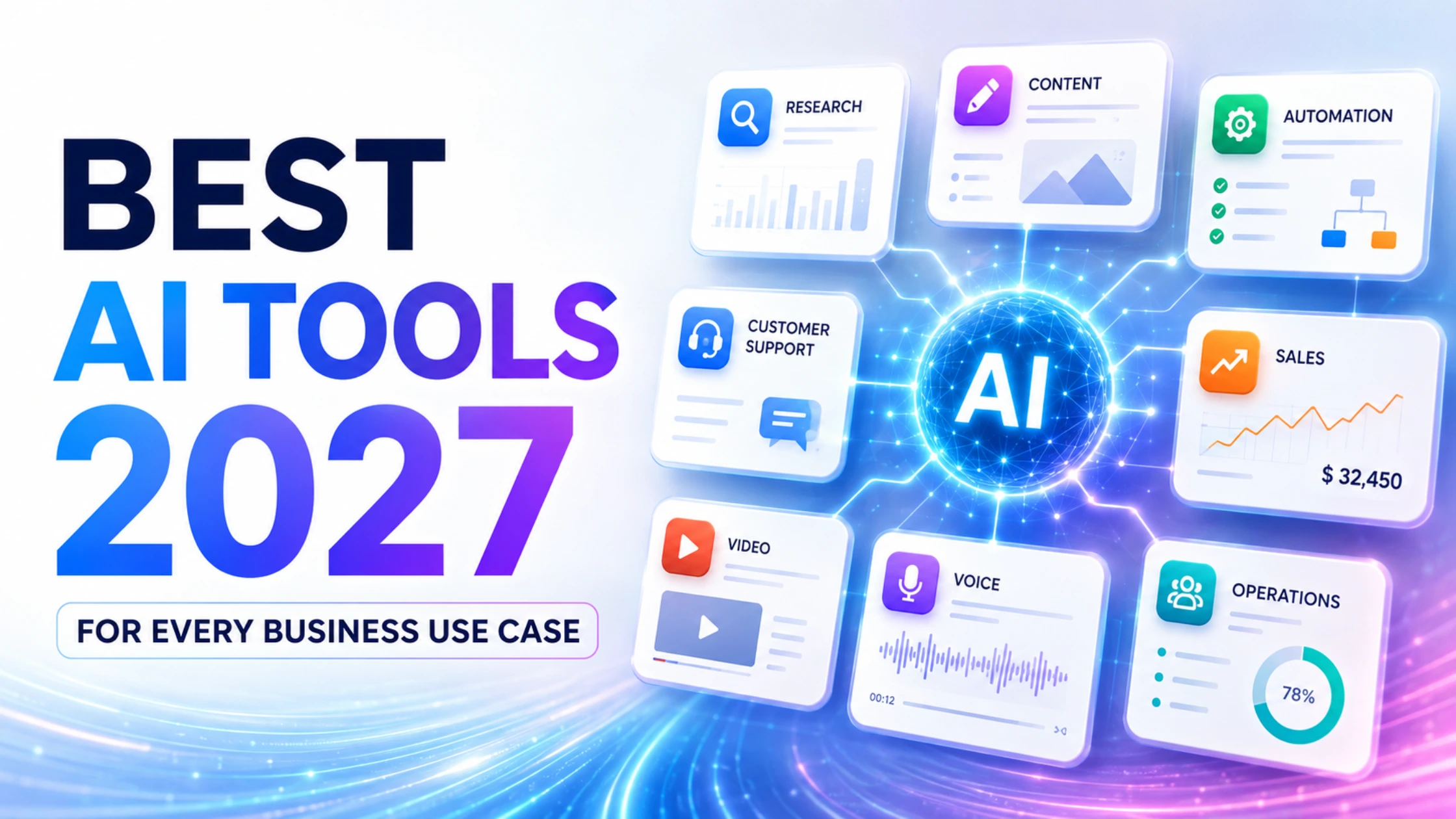
The definitive 2027 ranking of AI tools for business research, content, automation, customer support, sales, video, voice and operations, featuring the proprietary DN AI Stack Builder.
Summary
The business AI market is separating into seven functional layers:
- Intelligence: ChatGPT, Claude, Perplexity and Gemini
- Creation: Jasper, Writesonic and Canva AI
- Execution: Make and Taskade
- Customer service: Intercom Fin and Tidio Lyro
- Revenue: HubSpot, Clay and Salesforce Agentforce
- Media: Synthesia, HeyGen, ElevenLabs, Murf and Descript
- Operations: Microsoft 365 Copilot, Gemini, Notion AI and Fireflies
Our highest-rated tools are not intended to be purchased together automatically. The winning 2027 strategy is to build a compact, interoperable stack around measurable workflows.
Verdict
Business requirement | Best AI tool | DN score | Best suited to |
General business intelligence | ChatGPT Business or Enterprise | 96/100 | Companies needing one flexible AI foundation |
Source-led research | Perplexity Enterprise | 95/100 | Analysts, strategists and research teams |
Complex documents and reasoning | Claude Enterprise | 93/100 | Professional, policy and technical work |
Google-native work | Gemini for Google Workspace | 94/100 | Google Workspace organisations |
Microsoft-native work | Microsoft 365 Copilot | 94/100 | Microsoft 365 organisations |
Branded marketing content | Jasper | 91/100 | Marketing departments and agencies |
Visual content | Canva AI | 94/100 | Businesses producing multi-format creative assets |
SEO and AI visibility | Writesonic | 90/100 | Search-led publishers and marketing teams |
Workflow automation | 96/100 | Cross-application automation | |
Agentic workspace | 92/100 | Entrepreneurs, agencies and smaller teams | |
Enterprise support | Intercom Fin | 94/100 | High-volume support organisations |
SMB customer support | Tidio Lyro | 89/100 | Ecommerce and small businesses |
Revenue operations | HubSpot Agent Hub | 95/100 | Growing sales and marketing teams |
Prospecting and enrichment | Clay | 93/100 | B2B outbound and GTM teams |
Enterprise sales agents | Salesforce Agentforce | 94/100 | Salesforce-centred enterprises |
Meeting intelligence | 92/100 | Sales, consulting and distributed teams | |
Business video | Synthesia | 93/100 | Training, education and internal communication |
Personalised video | HeyGen | 91/100 | Sales, ecommerce and marketing |
Voice and conversational AI | ElevenLabs | 96/100 | Voice content, applications and agents |
Corporate voice production | Murf | 89/100 | Narration, dubbing and training |
Audio and video editing | Descript | 90/100 | Podcasts, webinars and creator teams |
Knowledge operations | Notion AI | 91/100 | Company knowledge and collaborative projects |
DN scores are editorial assessments based on use-case relevance, integration potential, governance, implementation friction, adoption and measurable business utility. They are not laboratory benchmarks or claims of exhaustive personal testing.
The 2027 Business AI Architecture
The first wave of business AI adoption was built around access to a chatbot.
The next wave is built around architecture.
A useful AI stack needs to answer seven different questions.
Layer | Business question |
Intelligence | Which system helps employees reason, investigate and create? |
Research | How does the company obtain current, verifiable external information? |
Creation | How does it produce brand-controlled text, visual, audio and video assets? |
Execution | How does AI take action across applications? |
Customer | How are support and customer interactions resolved? |
Revenue | How does AI contribute to pipeline, conversion and retention? |
Operations | How is knowledge stored, retrieved and converted into action? |
A single product may cover several layers, but no product leads every category.
The goal is therefore not maximum subscription coverage. It is minimum effective architecture.
Ranking Methodology
The DN Business AI Utility Score gives greater weight to practical implementation than to promotional feature volume.
Factor | Weight |
Core use-case performance | 25% |
Integration and ecosystem fit | 20% |
Governance and administrative control | 15% |
Adoption and usability | 15% |
Automation and workflow depth | 10% |
Pricing and cost visibility | 10% |
Switching and vendor dependency risk | 5% |
A product can therefore rank highly even when it is not the most powerful model in isolation.
For example, Gemini may outperform a stand-alone assistant operationally when a company’s information and communication already live inside Google Workspace. Microsoft 365 Copilot may create more value than another general chatbot for a Microsoft-centred organisation. Taskade may be more useful than an enterprise agent platform for a six-person agency.
Category 1: Best AI Research Tools
Winner: Perplexity Enterprise
Perplexity Enterprise receives our highest research ranking because it is oriented around finding, organising and presenting externally sourced information.
It is particularly effective for:
- competitor analysis
- emerging-industry research
- market maps
- regulatory discovery
- vendor comparisons
- commercial due diligence
- executive briefings
Its enterprise product also adds organisational file search, seat administration and business privacy controls.
Why it wins
Research should be inspectable. Perplexity generally makes it easier to move from an AI answer to the material behind the answer.
Where it falls short
Source visibility does not guarantee source quality. An AI system may still misunderstand, overgeneralise or rely on outdated material.
Runner-up: ChatGPT Business or Enterprise
ChatGPT is the better selection when the output must move beyond a sourced answer into:
- analytical models
- structured datasets
- presentations
- applications
- documents
- business plans
- operational agents
Best for Long-Document Reasoning: Claude Enterprise
Claude is particularly useful for information-dense work involving substantial documents, complex instructions and sustained reasoning.
Best for Google Workspace: Gemini
Gemini is the strongest integrated choice when research depends heavily on Gmail, Drive, Docs, Sheets and Meet.
These business platforms increasingly combine model access with connected workplace data, enterprise search, file analysis, administrative controls and shared workflows.
Category 2: Best AI Content Tools
Winner: Jasper
Jasper wins the branded marketing category because its product is designed to operationalise marketing work across teams rather than merely generate isolated passages of text.
The platform focuses on:
- brand-controlled output
- marketing agents
- campaign workflows
- content pipelines
- SEO and AI-search execution
- shared governance
It is most valuable to organisations where content volume, brand consistency and approval processes must coexist.
Best Visual Platform: Canva AI
Canva AI is the strongest broad creative platform because it connects generation with editable design and collaborative production.
A marketing team can use one environment for:
- campaign planning
- social graphics
- presentations
- documents
- websites
- lightweight video
- brand templates
Best SEO and GEO Platform: Writesonic
Writesonic is more specialised around commercial search visibility.
Its attraction for publishers and marketing teams is the combination of content workflow and monitoring across AI answer platforms.
Best General Content Assistant: ChatGPT
ChatGPT remains the better flexible option for businesses without a large dedicated marketing department.
However, no general model should be used to mass-produce thin search pages. Original data, expert contribution, current evidence and human editing remain essential.
Jasper has evolved around marketing agents and governed execution, Canva connects AI to editable multi-format creative work, and Writesonic monitors visibility across AI answer engines.
Category 3: Best AI Automation Tools
Winner: Make AI Agents
Make AI Agents is the flagship winner for general business automation.
Its strength is the combination of:
- a visual workflow canvas
- application integrations
- AI reasoning
- multimodal file handling
- decision logic
- human approval
- error handling
- workflow visibility
The distinction between assistance and automation is important.
A chatbot may produce a customer response. A connected agent can interpret the request, check the customer record, decide which policy applies, draft a response, update the CRM and escalate the case when necessary.
Best Make use cases
- CRM hygiene
- inbound lead routing
- email classification
- invoice processing
- document extraction
- ecommerce operations
- research monitoring
- reporting
- content distribution
- support escalation
Primary risk
The cost of automation failure can exceed the time saved. Businesses need approval steps, logs, exception handling and named workflow owners.
Best Agentic Workspace: Taskade
Taskade is the better choice when the organisation needs AI agents to work inside projects, documents and collaborative team spaces.
It is particularly well suited to:
- small agencies
- founders
- remote teams
- content operations
- research teams
- service businesses
Best Enterprise CRM Automation: Salesforce Agentforce
Salesforce Agentforce is more appropriate when the organisation already has significant customer data, permissions and business logic inside Salesforce.
Best General Workspace-Agent Layer: ChatGPT
ChatGPT Business and Enterprise can support shared agents and connected workplace processes without requiring a separate automation platform for every use case.
Make has expanded its AI-agent environment around visual orchestration, multimodal inputs and transparent execution. Taskade positions its agents inside persistent workspaces with projects, files and external integrations.
Category 4: Best AI Customer-Support Tools
Winner: Intercom Fin
Intercom Fin is the strongest overall customer-support selection for organisations that need AI resolution and a full support operating environment.
The surrounding system includes:
- AI resolution
- human-agent assistance
- conversation analysis
- quality assurance
- performance monitoring
- improvement recommendations
- escalation
This makes it more than a website chatbot.
Best for Smaller Businesses: Tidio Lyro
Tidio Lyro is better suited to companies that need simpler deployment across:
- website chat
- ecommerce questions
- lead capture
- common support requests
- live-agent escalation
Best Voice Support Platform: ElevenLabs Agents
ElevenLabs should be evaluated when customers need a natural spoken interface rather than chat alone.
Potential workflows include:
- appointment scheduling
- customer verification
- lead qualification
- service triage
- reminders
- internal helpdesk requests
Best Salesforce-Native Service Agent: Agentforce
Agentforce is the more natural selection for large organisations whose service operations already rely on Salesforce.
Intercom combines Fin with AI quality and support operations, Tidio focuses on accessible support automation, and ElevenLabs supports deployable voice and chat agents.
Category 5: Best AI Sales Tools
Winner: HubSpot Agent Hub
HubSpot Agent Hub wins the overall sales category because it combines agents with the wider customer lifecycle.
The platform can connect AI to:
- prospect records
- marketing activity
- sales tasks
- pipeline
- customer-service history
- company content
- reporting
A stand-alone AI writer may improve an email. A CRM-connected agent can improve the sequence of actions surrounding the entire opportunity.
Best for B2B Prospecting: Clay
Clay is the leading specialised choice for:
- prospect discovery
- enrichment
- account research
- qualification
- scoring
- routing
- personalised outbound systems
The highest-value Clay implementations normally combine several data points to decide whether a prospect deserves outreach.
Best Enterprise Sales Agent: Salesforce Agentforce
Salesforce has expanded Agentforce Sales around prospecting, qualification, meetings, account preparation, recommended actions and quoting.
The platform is powerful, but it is unlikely to be the most economical starting point for a small sales team.
Best Meeting Intelligence: Fireflies.ai
Fireflies.ai converts sales conversations into searchable information and follow-up work.
The relevant business outcome is not the transcript. It is whether the system improves:
- CRM completeness
- follow-up speed
- action completion
- deal context
- coaching
- customer continuity
HubSpot places custom and pre-built agents in its CRM environment, Clay focuses on research and enrichment, Salesforce Agentforce supports autonomous sales tasks, and Fireflies extends meeting capture into operational follow-through.
Category 6: Best AI Video Tools
Winner: Synthesia
Synthesia is the strongest business-video selection for organisations producing repeatable, presenter-led content.
Its best applications include:
- employee onboarding
- compliance training
- product education
- customer tutorials
- internal updates
- multilingual communication
Traditional business video can be expensive to update. AI video becomes particularly useful when a company needs to change a policy, product interface or training module repeatedly.
Best Personalised Video: HeyGen
HeyGen is a stronger choice for:
- personalised sales outreach
- localised marketing
- product campaigns
- avatar-led social media
- ecommerce video
Best Editing Platform: Descript
Descript is the better fit for businesses that record real people and need to turn long recordings into finished videos, podcasts and short clips.
Best Integrated Campaign Platform: Canva AI
Canva is the preferred option when video must remain part of a wider campaign containing design, presentations, documents and social content.
Synthesia provides avatar-led business video and localisation, HeyGen focuses on scalable personalised video, and Descript enables text-based editing of recorded audio and video.
Category 7: Best AI Voice Tools
Winner: ElevenLabs
ElevenLabs receives our highest voice score because it combines media production and conversational agents.
The platform can support:
- narration
- synthetic speech
- audio localisation
- dubbing
- application voices
- support agents
- sales agents
- appointment and service workflows
Critical control
Voice AI creates a higher impersonation risk than text. Consent, identity, disclosure and access policies must be built into deployment.
Best Corporate Narration: Murf
Murf is well suited to training, presentation, product, marketing and educational narration.
Its dubbing and editing capabilities make it attractive to businesses producing structured audio and video rather than developer-led voice applications.
Best Voice-First Productivity Tool: Speechify
Speechify is evolving into a wider voice-first productivity platform spanning reading, dictation, summaries, conversational assistance and work agents.
Best Podcast Editing: Descript
Descript remains the strongest choice when a business needs to edit recorded conversations and transform long-form media into several publishable formats.
ElevenLabs combines creative voice tools with deployable agents, Murf supports corporate voice production and dubbing, Speechify has expanded into voice-first work functions, and Descript provides transcript-centred media editing.
Category 8: Best AI Operations Tools
Winner for Small Teams: Taskade
Taskade is our preferred small-team operations platform because it can bring projects, team knowledge and AI agents into one environment.
Winner for Microsoft Organisations: Microsoft 365 Copilot
Microsoft 365 Copilot is the most logical operational layer for Microsoft-centred companies.
Its potential value comes from context across daily productivity applications, but it also inherits the organisation’s information-quality problems.
Winner for Google Organisations: Gemini for Google Workspace
Gemini has the corresponding advantage for companies centred on Google Workspace.
Best Knowledge Workspace: Notion AI
Notion AI is strongest when the company needs a connected environment for:
- internal search
- projects
- policies
- meeting notes
- operating procedures
- collaborative knowledge
Best Meeting Operations: Fireflies.ai
Fireflies.ai can close the gap between what was discussed in a meeting and what was subsequently completed.
Microsoft 365 Copilot and Gemini are built around their respective workplace ecosystems, while Notion and Fireflies focus more specifically on connected knowledge and conversation workflows.
DN AI Stack Recipes
Business profile | Recommended core stack | Primary objective |
Solopreneur | ChatGPT, Taskade, Canva AI | Consolidate research, projects and creation |
Small service company | Automate enquiries and delivery | |
Content agency | Scale governed production | |
Ecommerce company | ChatGPT, Canva, Tidio, HubSpot, HeyGen, Make | Improve campaigns, support and retention |
B2B sales team | Increase qualified pipeline | |
Google-native company | Gemini, HubSpot or Salesforce, Canva, Make | Bring AI into existing Google workflows |
Microsoft-native company | Microsoft 365 Copilot, Salesforce or HubSpot, Fireflies | Connect intelligence to Microsoft work |
Enterprise support team | Claude or ChatGPT, Intercom Fin, ElevenLabs, Salesforce | Automate resolution with governance |
Education provider | Claude, Canva, Synthesia, Murf, Notion | Create and maintain learning content |
Crypto intelligence business | ChatGPT, Perplexity, ASCN, CoinStats API, TradingView, Make | Research, monitor and report on markets |
The DN Minimum Effective Stack
Before purchasing a large number of tools, businesses should build a Minimum Effective Stack.
Stage 1: Intelligence
Choose one:
- ChatGPT
- Claude
- Gemini
- Microsoft 365 Copilot
Stage 2: Execution
Choose one:
Stage 3: Commercial Bottleneck
Add the specialist system attached to the most important constraint:
- Intercom or Tidio for support
- Clay or HubSpot for sales
- Jasper or Writesonic for content
- Synthesia or HeyGen for video
- ElevenLabs or Murf for voice
- Fireflies.ai for meetings
This creates a focused three-product architecture before the business considers broader expansion.
The DN AI Stack Builder
The DN AI Stack Builder converts business requirements into an implementation shortlist.
The user selects:
- industry
- team size
- monthly budget
- existing ecosystem
- AI maturity
- data sensitivity
- up to four priorities
The tool then ranks suitable products and produces:
- a focused stack
- a rollout sequence
- KPIs
- governance warnings
- implementation cautions
- partner and neutral links
It intentionally limits recommendations because excessive software overlap is one of the largest hidden costs of business AI adoption.
DN AI Stack Builder
Build a practical AI software stack around your actual workflows, budget, team size and risk requirements. The tool recommends a focused stack rather than an expensive collection of overlapping subscriptions.
Tell us how your business works
Educational decision-support tool. Pricing, features and product availability can change. Verify current terms directly with each provider.
The Hidden Costs of Business AI
Subscription duplication
Several products may include writing, search, meeting summaries and basic automation. Companies often pay for the same function repeatedly.
Data preparation
Connected AI is only as reliable as the information it can access.
Human review
Critical outputs still require accountable employees.
Workflow maintenance
Automations break when applications, APIs, forms or business policies change.
Employee training
Purchasing software does not create adoption.
Security and permissions
Agents capable of taking action can create more risk than passive assistants.
Vendor dependency
A workflow built deeply around one platform may become expensive to migrate.
The 30-Day AI Pilot Framework
Days 1 to 5: Select the workflow
Choose a task that is:
- frequent
- measurable
- time-consuming
- sufficiently standardised
- low enough risk for a pilot
Days 6 to 10: Establish the baseline
Measure the current:
- cost
- labour time
- error rate
- turnaround time
- conversion or resolution outcome
Days 11 to 20: Run controlled deployment
Use limited data and a defined employee group.
Record:
- errors
- exceptions
- employee overrides
- customer complaints
- time saved
- quality changes
Days 21 to 30: Decide
Expand only when the workflow produces a measurable improvement without creating disproportionate risk.
Cancel, redesign or replace the implementation when the evidence is weak.
Business AI KPIs That Matter
Use case | Primary KPIs |
Research | Time to verified answer, sources checked, decision turnaround |
Content | Approved assets, editing time, qualified traffic, conversions |
Automation | Successful runs, failure rate, labour hours avoided |
Support | Resolution rate, satisfaction, escalation quality, cost per resolution |
Sales | Qualified pipeline, meetings, conversion, sales-cycle duration |
Video | Cost per approved video, completion rate, localisation time |
Voice | Cost per interaction, completion rate, human-transfer quality |
Operations | Search time, action completion, meeting follow-through |
AI stack overall | Adoption, value per user, duplication removed, revenue influenced |
The weakest metric is often “number of AI outputs.” Production volume can increase while quality and revenue decline.
Frequently Asked Questions
Which AI tool should every business use?
No product is mandatory for every business. ChatGPT is the most flexible general foundation, but Gemini or Microsoft 365 Copilot may produce greater operational value inside their native ecosystems.
Is it better to use one AI platform or several?
Begin with one foundation platform. Add specialised tools only when a workflow has requirements the foundation cannot satisfy economically.
Are AI agents ready to run businesses autonomously?
Agents can execute increasingly complex workflows, but production deployment still requires permissions, logging, failure recovery, human escalation and accountable owners.
Can AI replace customer-support teams?
AI can resolve repetitive requests and assist employees, but complex, sensitive and exceptional cases continue to require human judgement.
Which AI tools are best for small businesses?
ChatGPT, Taskade, Make, Canva AI, Tidio and Fireflies.ai are strong starting candidates. The business should select only the tools connected to its most valuable workflows.
Which AI tools are best for enterprise organisations?
Claude Enterprise, ChatGPT Enterprise, Gemini, Microsoft 365 Copilot, Salesforce Agentforce, Intercom Fin, Synthesia and ElevenLabs all address enterprise use cases. Selection should be based on the company’s existing data, productivity and customer platforms.
What is the best AI stack for affiliate and media businesses?
A practical stack may combine ChatGPT or Claude, Perplexity, Writesonic or Jasper, Canva, Taskade, Make, Fireflies.ai, Synthesia and ElevenLabs.
How should businesses protect sensitive information?
Use business or enterprise plans with appropriate contractual protections, access controls, retention settings and administrative oversight. Sensitive workflows may require legal, privacy, security and compliance review.
Final Verdict
Business AI adoption in 2027 will be decided less by model rankings and more by implementation quality.
The winning companies will not necessarily have the greatest number of tools. They will have:
- better-defined workflows
- cleaner information
- stronger integration
- more disciplined measurement
- clearer employee accountability
- faster cancellation of low-value subscriptions
The most effective starting architecture is usually:
- one intelligence platform
- one execution platform
- one specialist system attached to the company’s largest commercial bottleneck
Everything else must earn its place through measurable results.