Decentralised News Logo
AI

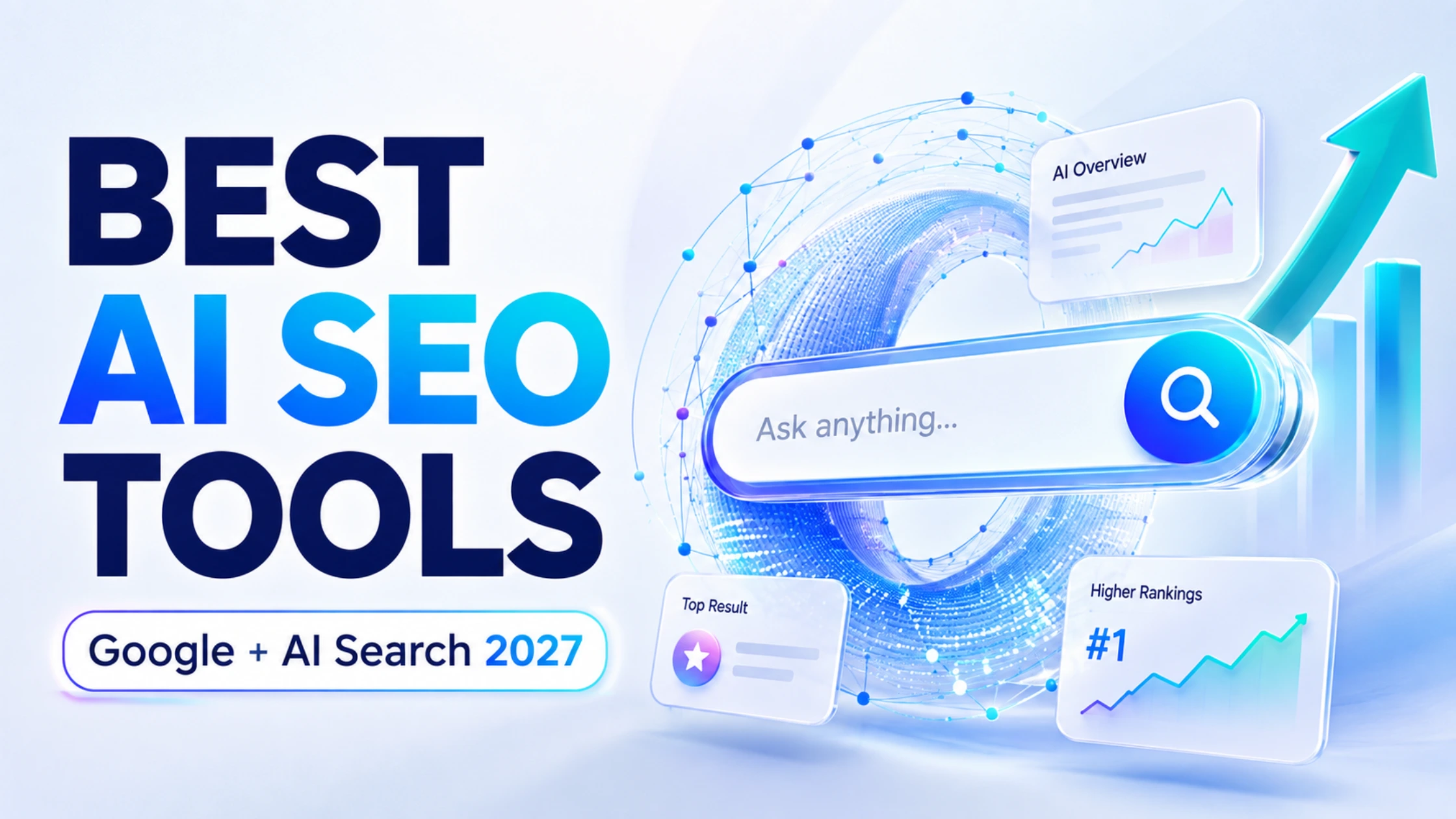
The 8 Best AI SEO Tools for Google and AI Search in 2027, Ranked

The Best SEO Tools for the AI Search Era.

Best AI SEO Tools for Ranking on Google and AI Search

Compare the best AI SEO tools for Google rankings, ChatGPT visibility, Google AI Overviews, Gemini, Perplexity, content optimisation and citation monitoring in 2027.

Last reviewed: 26 August 2026

Summary

The best AI SEO tool in 2027 depends on whether your main problem is conventional Google SEO, visibility inside AI-generated answers, content optimisation or citation intelligence.

Our current category leaders are:

  • Best overall SEO + AI visibility platform: Semrush
  • Best for large-scale AI citation intelligence: Ahrefs Brand Radar
  • Best for turning AI-search gaps into content: Writesonic
  • Best for content optimisation across Google and AI search: Surfer
  • Best value hybrid SEO + AI-search platform: SE Ranking + SE Visible
  • Best enterprise AEO intelligence platform: Profound
  • Best focused AI-search analytics platform: Peec AI
  • Best budget citation-monitoring platform: OtterlyAI
  • Essential free Google data: Google Search Console
  • Best free citation and AI-bot companion: Microsoft Clarity AI Visibility

The central lesson is important:

Do not replace SEO with GEO. Build one search strategy that measures rankings, AI mentions, citations, authority, traffic and conversions together.

Google explicitly says its existing SEO best practices remain relevant to AI Overviews and AI Mode, and that there are no separate technical requirements for appearing in those generative search experiences beyond normal Search eligibility.

Search Has Split Into Two Discovery Systems

For most of the web’s history, search optimisation meant improving visibility in a ranked list of links.

That model still matters.

But businesses now also need to understand whether they appear when someone asks:

  • ChatGPT for the best product in a category
  • Gemini for recommendations
  • Perplexity to compare providers
  • Microsoft Copilot for an explanation
  • Google AI Mode a complex commercial question
  • Google AI Overviews for a condensed answer

The two systems overlap, but they are not identical.

Conventional SEO measures

  • keyword rankings
  • search impressions
  • clicks
  • backlinks
  • technical health
  • indexed pages
  • organic traffic
  • conversions

AI-search optimisation measures

  • brand mentions
  • citations
  • linked citations
  • source visibility
  • prompt coverage
  • AI share of voice
  • sentiment
  • competitor mentions
  • AI referral traffic
  • grounding queries

A page can perform well in Google and receive few AI citations.

Another page can become a frequently cited AI source while generating relatively little direct referral traffic.

That is why the 2027 search stack needs both measurement systems.

How We Ranked the Best AI SEO Tools

The DN Search Visibility Framework evaluates platforms across:

Conventional SEO

Keyword research, rank tracking, backlinks, site auditing, competitor intelligence and technical SEO.

AI Visibility

Ability to monitor brands across ChatGPT, Gemini, Google AI Mode, AI Overviews, Perplexity and other answer engines.

Citation Intelligence

Whether the tool identifies the domains and individual URLs AI systems use as sources.

Content Optimisation

How effectively the platform helps improve existing pages or create stronger new content.

Actionability

Whether the platform moves beyond another dashboard and tells the user what should be changed.

Measurement Integrity

How transparent the tool is about prompts, models, regions, citations and methodology.

No platform receives a high rating merely because it contains an AI writing feature.

1. Semrush

Best Overall for Google SEO + AI Visibility

Semrush is our leading general-purpose selection for businesses that want one platform covering conventional search and emerging AI discovery.

Its traditional SEO capabilities already cover:

  • keyword research
  • competitor research
  • technical auditing
  • backlink analysis
  • rank tracking
  • content
  • local SEO

Its AI Visibility Toolkit extends that into:

  • AI visibility scores
  • brand mentions
  • competitor benchmarking
  • prompt research
  • citations
  • sentiment
  • AI-search technical auditing
  • custom prompt tracking

Semrush currently tracks AI visibility across systems including ChatGPT, Google AI, Gemini and Perplexity. Its Base AI Visibility plan is currently advertised at $99 per month per domain when billed annually.

Why it ranks first

Semrush reduces the need to maintain completely separate SEO and GEO reporting environments.

That matters because AI visibility does not exist independently from:

  • domain authority
  • technical accessibility
  • topic expertise
  • branded demand
  • backlinks
  • existing rankings

Best for

  • in-house SEO teams
  • agencies
  • publishers
  • ecommerce businesses
  • established websites
  • companies seeking one search dashboard

Main limitation

Teams interested only in a narrow AI citation tracker may find the wider platform excessive.

DN verdict: Best general platform when conventional search remains commercially important.

Explore Semrush AI Visibility

2. Ahrefs Brand Radar

Best for AI Citations and Competitive Intelligence at Scale

Ahrefs Brand Radar takes a different approach.

Its strength is the sheer scale at which a marketer can investigate:

  • AI mentions
  • citations
  • AI share of voice
  • competing brands
  • cited pages
  • cited domains
  • search demand
  • Reddit
  • YouTube
  • web visibility

Ahrefs says Brand Radar now covers hundreds of millions of search-backed prompts and tracks major AI surfaces including Google AI Overviews, Google AI Mode, ChatGPT, Gemini, Perplexity and Microsoft Copilot.

This is particularly useful because marketers do not necessarily know every prompt they should be monitoring.

A small manually chosen prompt set can reinforce assumptions the team already has.

Ahrefs attempts to broaden discovery using prompts connected to search behaviour.

Citation intelligence

Brand Radar distinguishes:

  • mentions
  • citations
  • impressions
  • AI share of voice

Ahrefs has also added AI bot visits and AI traffic to its cited-page reporting, helping teams distinguish pages that are merely crawled from those producing downstream engagement.

Best for

  • publishers
  • agencies
  • competitive research
  • large content estates
  • citation analysis
  • authority research
  • companies already using Ahrefs

Main limitation

The complete Brand Radar stack can be expensive relative to focused trackers.

DN verdict: Best research platform for discovering where AI authority is actually being created.

Explore Ahrefs Brand Radar

3. Writesonic

Best for Moving From AI Visibility to Execution

Many AI visibility tools answer:

Are we appearing?

Writesonic increasingly focuses on:

What should we do about it?

Its wider platform combines:

  • conventional SEO research
  • content strategy
  • content generation
  • content optimisation
  • AI-search visibility
  • prompt research
  • crawler monitoring
  • AI traffic analytics
  • action recommendations

Writesonic’s AI Traffic Analytics can measure AI crawler requests separately from humans arriving after interacting with AI-generated answers.

This creates an important distinction:

being crawled is not the same as being cited, and being cited is not the same as generating traffic.

Writesonic also connects search visibility with content execution rather than leaving teams with a list of missing prompts.

Best for

  • content-led businesses
  • affiliate publishers
  • SaaS companies
  • SEO teams
  • agencies
  • companies attempting to improve both Google and AI visibility

Main limitation

Writesonic’s feature packaging has changed rapidly. Businesses should verify exactly which GEO capabilities, engines, projects and limits apply to the selected plan.

DN verdict: One of the strongest platforms for teams that need to act on AI-search data rather than simply observe it.

Explore Writesonic

4. Surfer

Best for Content Optimisation Across Google and AI Search

Surfer’s strongest differentiator is the connection between measurement and individual page optimisation.

Its AI Tracker monitors:

  • brand visibility
  • citations
  • prompt performance
  • competing sources
  • sentiment
  • cited pages

The user can then move from the tracker into Surfer’s Content Editor and optimise the page associated with the visibility gap.

Surfer has also begun integrating AI Tracker signals directly into its recommendations, including which mentions, sentiment issues and topics should be addressed first.

Its August 2026 MCP beta also exposes Surfer data and optimisation functions to compatible AI agents, allowing automated workflows to access Content Editor data, AI Tracker signals and recommendations.

Best for

  • editorial teams
  • publishers
  • content agencies
  • affiliate sites
  • on-page SEO
  • refreshing existing content

Main limitation

Surfer is less comprehensive than Ahrefs or Semrush for backlink intelligence and broad competitive SEO research.

DN verdict: Best when the bottleneck is turning search intelligence into better pages.

Explore Surfer

5. SE Ranking + SE Visible

Best Value Hybrid SEO and AI Search Stack

SE Ranking has expanded aggressively from conventional SEO into AI-search measurement.

Its main platform includes:

  • keyword research
  • rank tracking
  • competitor research
  • backlinks
  • site auditing
  • content optimisation
  • reporting

Its AI-search products add:

  • brand mentions
  • linked mentions
  • AI citations
  • AI share of voice
  • source analysis
  • competitor tracking
  • prompt monitoring
  • AI Overviews
  • AI Mode
  • ChatGPT
  • Gemini
  • Perplexity

SE Ranking also distinguishes its dedicated SE Visible product from the more tactical AI Search features inside the core SEO platform.

Its AI Results Tracker can measure organic and AI overlap for Google AI Overviews, helping teams understand whether AI citations are coming from pages that already rank conventionally.

Best for

  • small and mid-sized agencies
  • cost-conscious SEO teams
  • multi-channel search reporting
  • companies wanting SEO and GEO without a premium enterprise stack

Main limitation

The distinction between SE Ranking, the AI Search Add-on and SE Visible can make packaging slightly confusing.

DN verdict: One of the most compelling value propositions for teams that need both SEO and AI visibility.

Explore SE Ranking

6. Profound

Best Enterprise AI Search Intelligence Platform

Profound is not primarily a traditional SEO platform.

It is an Answer Engine Optimisation platform.

Its Answer Engine Insights product measures:

  • visibility
  • share of voice
  • sentiment
  • citations
  • citation authority
  • competitor positioning
  • regional differences
  • AI platform differences

Profound also offers prompt-demand intelligence, AI crawler analytics and content workflows. It says its platform captures responses from consumer-facing AI interfaces rather than relying only on model APIs.

This matters because the answer returned by a consumer AI interface can differ from a response generated through an API.

Best for

  • enterprises
  • global brands
  • agencies serving major brands
  • CMOs
  • AI-search research
  • reputation and narrative monitoring
  • multi-market tracking

Main limitation

A serious conventional SEO team will probably still need another tool for areas such as backlinks, rank tracking and traditional keyword research.

DN verdict: Best dedicated enterprise intelligence layer for understanding how answer engines represent a brand.

Explore Profound

7. Peec AI

Best Focused AI Search Analytics for Lean Teams

Peec AI concentrates on:

  • AI visibility
  • prompt tracking
  • competitor comparisons
  • citations
  • brand position
  • sentiment
  • multi-country monitoring

Its current Starter tier supports 50 prompts, three selected models, unlimited users and daily tracking.

That makes it attractive to organisations that already have conventional SEO software and simply want an AI-search analytics layer.

Best for

  • startups
  • smaller marketing teams
  • agencies
  • international tracking
  • businesses that do not need another full SEO suite

Main limitation

Peec does not replace a comprehensive SEO research and content platform.

DN verdict: Strong dedicated tracker for teams that want visibility data without buying another entire SEO ecosystem.

Explore Peec AI

8. OtterlyAI

Best Budget AI Citation Monitoring Platform

OtterlyAI is an increasingly capable lower-cost AI-search monitoring product.

Its current plans cover:

  • daily prompt tracking
  • brand reports
  • multiple team members
  • AI prompt research
  • brand visibility
  • domain rankings
  • citation analysis
  • GEO URL audits
  • multi-country support

Higher tiers add API, MCP and agent-analytics capabilities.

Otterly currently supports core monitoring for Google AI Overviews, ChatGPT, Perplexity and Microsoft Copilot, while additional systems including Gemini, AI Mode and Claude may be available through add-ons.

Best for

  • solo operators
  • small businesses
  • publishers testing GEO
  • agencies wanting a lower-cost monitor
  • international AI-search tracking

Main limitation

It should be treated as an AI-search monitoring layer, not a replacement for Ahrefs, Semrush or another conventional SEO platform.

DN verdict: Excellent starting point for measuring AI citations without committing to enterprise software.

Explore OtterlyAI

Two Free Tools Every Website Should Use

Google Search Console

Search Console remains essential because Google is still the largest conventional search ecosystem for most businesses.

In June 2026, Google began testing dedicated Generative AI performance reporting in Search Console, providing separate visibility into AI Overviews, AI Mode and generative experiences within Search and Discover.

Google continues to emphasise that good conventional SEO remains foundational to generative AI visibility.

Open Google Search Console

Microsoft Clarity AI Visibility

Microsoft Clarity has become unusually useful for publishers because its AI Visibility layer can show:

  • citation counts
  • share of authority
  • grounding queries
  • cited pages
  • AI referral traffic
  • AI bot activity

Microsoft explicitly distinguishes the Citation dashboard from conventional rank tracking.

Its Bot Activity reporting can also reveal which AI systems are accessing a site before citations or referrals occur.

Explore Microsoft Clarity

The Best AI SEO Stack by Budget

Free or Nearly Free

Use:

  • Google Search Console
  • Microsoft Clarity
  • Bing Webmaster Tools
  • manual AI-answer testing

Upgrade only after identifying a measurement gap.

Small Business

Consider:

  • SE Ranking or Semrush for conventional SEO
  • OtterlyAI or Peec AI for AI visibility

Avoid paying for three separate AI trackers.

Publisher or Content Business

Consider:

  • Ahrefs or Semrush for authority and competitive research
  • Surfer or Writesonic for execution
  • Microsoft Clarity for real citation and crawler signals

Enterprise Brand

Consider:

  • Semrush or Ahrefs for conventional search intelligence
  • Profound for answer-engine intelligence
  • Google Search Console and Clarity for first-party signals

What Actually Helps Content Rank in Google and AI Search?

Google’s own 2026 guidance makes an important point.

There is no secret AI-specific markup that bypasses conventional quality signals.

Google recommends:

  • original information
  • non-commodity content
  • first-hand expertise when appropriate
  • clear page structure
  • useful images and video
  • technically accessible pages
  • good page experience
  • content designed for users rather than query manipulation

Google also warns against creating separate pages for every possible fan-out query merely to manipulate AI or Search visibility.

For publishers, this changes the practical objective.

Do not ask:

How many AI-optimised articles can we generate?

Ask:

What can we publish that another model cannot reproduce without citing us?

Examples include:

  • original datasets
  • live benchmarks
  • surveys
  • calculators
  • product tests
  • transparent methodologies
  • proprietary indices
  • expert interviews
  • screenshots
  • historical databases
  • continuously updated comparison tools

Those assets can support both traditional SEO and AI citations.

DN AI SEO & Search Visibility Stack Selector

The DN AI SEO & Search Visibility Stack Selector helps businesses avoid paying for overlapping tools.

Users choose:

  • team type
  • monthly budget
  • number of sites
  • geographic requirements
  • conventional SEO priority
  • AI visibility priority
  • content optimisation needs
  • citation monitoring
  • AI crawler analytics
  • client reporting

The tool then ranks suitable platforms across:

  • conventional SEO
  • AI visibility
  • content optimisation
  • citation intelligence
  • ease of use
  • value

[EMBED: DN AI SEO & SEARCH VISIBILITY STACK SELECTOR]

Frequently Asked Questions

What is the best AI SEO tool in 2027?

Semrush is our strongest overall selection for combining conventional SEO with AI visibility. Different platforms lead specialised categories.

Is traditional SEO becoming obsolete?

No. Google explicitly states that its established SEO guidance continues to apply to AI Overviews and AI Mode.

What is the best tool for tracking ChatGPT citations?

Ahrefs Brand Radar, Profound, Surfer, Peec AI, SE Ranking, OtterlyAI and Microsoft Clarity all provide relevant citation or visibility functions, but their methodologies differ.

What is the best content optimiser for AI search?

Surfer is our leading specialist content optimiser. Writesonic is stronger when content creation, GEO monitoring and execution need to live inside one broader workflow.

What is the best free AI visibility tool?

Microsoft Clarity is particularly valuable for citation and bot data. Google Search Console remains essential for Google Search and its expanding generative-search reporting.

Can AI visibility guarantee AI referral traffic?

No. Citation visibility, brand mentions and traffic are different metrics.

Should businesses buy several AI visibility tools?

Usually not. Begin with one system of record and compare its findings against first-party data before adding another platform.

Final Verdict

The winning SEO strategy for 2027 is not SEO versus GEO.

It is a unified search-intelligence system.

Track:

  1. whether Google can find the page
  2. whether the page ranks
  3. whether AI systems access it
  4. whether AI systems cite it
  5. whether the brand is recommended
  6. whether citations generate visits
  7. whether those visitors convert

The final metric matters most.

Visibility without commercial outcomes is an intermediate signal, not the objective.

VERSION 2: DECENTRALISED NEWS FLAGSHIP ARTICLE

Best AI SEO Tools for Ranking on Google and AI Search in 2027: DN Search Visibility Index

AI search has created a measurement problem

SEO once had a relatively understandable hierarchy.

A company could monitor:

  • rankings
  • impressions
  • clicks
  • links
  • traffic
  • conversions

AI search disrupts that chain.

A brand may now influence a purchase decision without receiving a click.

Its page may be cited without the brand being mentioned.

The brand may be recommended without its website being cited.

An AI crawler may repeatedly access its content without producing a single referral.

This means the search industry needs to separate five different forms of visibility:

Layer

Question

Crawl

Can search and AI systems access the content?

Rank

Does the page rank conventionally?

Citation

Is the page used as an AI source?

Recommendation

Is the brand actually named or recommended?

Conversion

Does any of this create commercial value?

No single headline metric adequately represents all five.

Google itself now says traditional SEO remains foundational to generative Search, while tools such as Microsoft Clarity, Ahrefs, Semrush and Profound are adding separate layers for AI citations, mentions and referral behaviour.

DN Search Visibility Index

We score tools using six weighted categories:

Category

Weight

Conventional SEO intelligence

25%

AI visibility monitoring

20%

Citation and source intelligence

20%

Content optimisation

15%

Actionability

10%

Operational value

10%

Overall ranking

Rank

Platform

Best use case

DN score

1

Semrush

Full SEO + AI visibility operating system

94/100

2

Ahrefs Brand Radar

Citation, authority and competitive intelligence

93/100

3

Writesonic

AI visibility connected to content execution

91/100

4

Surfer

Content optimisation + AI citation improvement

90/100

5

SE Ranking + SE Visible

Value-focused hybrid SEO and GEO

89/100

6

Profound

Enterprise answer-engine intelligence

88/100

7

Peec AI

Focused AI-search analytics

84/100

8

OtterlyAI

Budget citation and AI monitoring

82/100

Supporting tools: Google Search Console and Microsoft Clarity should be used alongside commercial platforms rather than treated as direct substitutes.

These scores are editorial assessments of documented capabilities, not claims of exhaustive laboratory testing.

1. Semrush: 94/100

Traditional SEO: 10/10

AI visibility: 9/10

Citations: 8.5/10

Content execution: 9/10

Semrush currently offers the strongest overall bridge between conventional SEO and AI search.

The traditional platform already provides the operating data required for:

  • technical SEO
  • keywords
  • competitors
  • backlinks
  • content
  • ranking
  • market analysis

Its AI Visibility layer then adds brand and prompt-level analysis rather than forcing the marketing team into a completely separate analytics environment.

What Semrush gets right

Its strongest strategic feature is context.

A weak AI visibility score becomes more useful when the marketer can ask:

  • Are we losing because competitors have more authority?
  • Is the page technically inaccessible?
  • Do we have a topic gap?
  • Is the brand missing entirely?
  • Are we ranking conventionally but not being cited?
  • Is the source gap coming from third-party domains?

That is more actionable than a standalone number.

Best fit

Companies where Google organic traffic still matters materially.

2. Ahrefs Brand Radar: 93/100

Traditional SEO: 10/10

AI visibility: 10/10

Citations: 10/10

Content execution: 6.5/10

Brand Radar is arguably the most ambitious AI visibility dataset among established SEO platforms.

Ahrefs says its database covers hundreds of millions of search-backed prompts across major AI systems and can be searched by brand, product, region or person.

This creates two important advantages.

Unknown-query discovery

Companies usually track prompts they already expect customers to ask.

That misses opportunities.

Search-backed prompt expansion can reveal demand outside the marketing team’s assumptions.

Source intelligence

Ahrefs has decades of link and web-index expertise that naturally complements AI citation analysis.

Brand Radar can connect:

  • AI answer
  • citation
  • cited URL
  • broader domain authority
  • Google visibility
  • Reddit
  • YouTube
  • emerging social signals

That makes it particularly useful for determining where authority must be earned, not only what needs to be written.

3. Writesonic: 91/100

Traditional SEO: 8/10

AI visibility: 9/10

Citations: 8.5/10

Content execution: 10/10

Writesonic is becoming an execution-oriented AI search platform.

The wider suite combines:

  • keyword intelligence
  • content strategy
  • AI content workflows
  • optimisation
  • prompt monitoring
  • crawler analytics
  • brand visibility
  • action recommendations

Its server-side AI Traffic Analytics also distinguishes AI bot visits from verified humans coming from AI-generated answers.

That matters.

A publisher can otherwise see strong crawler activity and assume its AI-search strategy is working when no humans are arriving.

4. Surfer: 90/100

Traditional SEO: 8/10

AI visibility: 9/10

Citations: 9/10

Content execution: 10/10

Surfer provides perhaps the clearest workflow from:

citation gap → page → optimisation → measurement.

Its AI Tracker identifies cited and underperforming pages.

Those pages can then move directly into Content Editor for further optimisation.

Surfer has also added AI Tracker data to its prioritised recommendations and is opening its data through MCP for agentic workflows.

For publishers producing hundreds of pages, this action loop may be more commercially useful than having another giant analytics dashboard.

5. SE Ranking + SE Visible: 89/100

Traditional SEO: 9/10

AI visibility: 9/10

Citations: 9/10

Content execution: 8/10

SE Ranking has quietly become one of the more complete cross-search products.

Its conventional suite covers the core SEO functions.

The AI Search toolkit adds:

  • AI Overviews
  • AI Mode
  • ChatGPT
  • Gemini
  • Perplexity
  • mentions
  • linked mentions
  • citations
  • prompt-level data
  • competitor analysis

The platform also exposes AI-search information through API and is expanding MCP-driven workflows.

Particularly useful metric

SE Ranking’s Organic-AI Overlap compares AI Overview citations against conventional top-20 Google URLs for the same query.

That can help answer an increasingly important question:

Does conventional ranking visibility predict AI-source inclusion in this market?

6. Profound: 88/100

Traditional SEO: 4.5/10

AI visibility: 10/10

Citations: 10/10

Content execution: 9/10

Profound would rank much higher in a pure AEO comparison.

It ranks sixth here because this article evaluates both Google SEO and AI search.

Profound’s Answer Engine Insights provides deep analysis of:

  • visibility
  • share of voice
  • sentiment
  • citations
  • citation authority
  • AI inaccuracies
  • competing brands
  • regional differences

It also provides Prompt Volumes based on large collections of real-user AI queries and Agent Analytics for AI crawler behaviour.

Profound’s Summer 2026 Index says its research dataset has grown to more than 1.9 billion real user conversations across more than 50 industries.

For major brands, this provides a very different class of AI-search intelligence from manually checking several dozen prompts.

7. Peec AI: 84/100

Peec is a focused analytics product rather than a broad SEO platform.

Its strength is simplicity.

Teams can monitor:

  • prompts
  • brands
  • competitors
  • AI engines
  • countries
  • visibility trends

The current Starter plan provides 50 prompts, three selected models, daily tracking and unlimited users.

For companies already paying for Semrush, Ahrefs or another SEO platform, Peec may make more sense than replacing the entire stack.

8. OtterlyAI: 82/100

OtterlyAI fills an important part of the market: teams that want credible AI-search monitoring without immediately committing hundreds or thousands of dollars every month.

Current product documentation lists:

  • prompt tracking
  • citations
  • GEO auditing
  • visibility
  • multi-country support
  • API and MCP functions on suitable tiers
  • agent analytics
  • daily monitoring

It does not replace enterprise SEO intelligence, but it may be enough to answer the first critical question:

Are we actually appearing in AI search?

The Two Tools Most Rankings Ignore

Google Search Console

No paid SEO platform has more authoritative Google performance data than Google itself.

Google began rolling out dedicated Generative AI performance reporting in Search Console in June 2026.

This makes Search Console increasingly relevant for measuring:

  • conventional Google Search
  • AI Overviews
  • AI Mode
  • generative Search visibility

Google also makes clear that there are no special technical shortcuts for AI Search. Pages still need to be indexable, snippet-eligible and compliant with normal Search requirements.

Microsoft Clarity AI Visibility

Clarity is becoming one of the most interesting publisher tools precisely because it measures a different part of the funnel.

Its Citations dashboard reports:

  • page citations
  • share of authority
  • AI referral traffic
  • grounding queries
  • cited pages

This makes it particularly useful for testing whether AI authority actually leads to visitors.

DN Field Note: Citations Are Not Traffic

A recent Decentralised News Microsoft Clarity snapshot showed:

  • 3,583 AI citations
  • 20.51% share of authority
  • less than 1% AI referral traffic

This is strategically important.

A publisher could celebrate thousands of citations while generating relatively little direct traffic from those citations.

That does not make the citations worthless. Brand awareness and recommendation influence can occur without a click.

But it means citation share cannot become the new vanity metric replacing Google rankings.

DN therefore recommends measuring:

Citation → brand mention → referral → signup → revenue

wherever attribution allows it.

This is a more commercially rigorous framework than simply maximising AI citations.

The DN AI Search Revenue Funnel

Stage 1: Crawlability

Can Google and AI systems access the page?

Measure with:

  • Search Console
  • technical SEO tools
  • server logs
  • Microsoft Clarity Bot Activity
  • Writesonic AI Traffic Analytics

Stage 2: Conventional Discovery

Does the page rank in Google?

Measure:

  • ranking
  • impression
  • click
  • CTR
  • organic landing sessions

Stage 3: AI Authority

Is the page cited?

Measure:

  • citation frequency
  • source position
  • grounding query
  • cited URL
  • citation share

Stage 4: Recommendation

Does AI actually recommend the brand?

Measure:

  • brand mentions
  • relative position
  • sentiment
  • share of voice
  • competitor inclusion

Stage 5: Traffic

Do people visit?

Measure:

  • AI referral sessions
  • landing page
  • engagement
  • repeat visits

Stage 6: Commercial Outcome

Do users:

  • subscribe
  • request a quote
  • use a calculator
  • create an account
  • purchase software
  • generate affiliate revenue

This final stage should govern the strategy.

Which Tool Should You Buy?

Requirement

Best choice

One broad SEO + AI platform

Semrush

Deep citation research

Ahrefs Brand Radar

AI visibility + content execution

Writesonic

Page optimisation

Surfer

Value-focused SEO + GEO

SE Ranking

Enterprise AEO intelligence

Profound

Focused monitoring

Peec AI

Budget AI monitoring

OtterlyAI

Google ground truth

Search Console

Citation and bot companion

Microsoft Clarity

Recommended Stacks

Publisher Stack

Ahrefs + Surfer + Clarity

Use Ahrefs to discover authority and citation opportunities, Surfer to improve pages and Clarity to monitor citation and downstream behaviour.

All-in-One Marketing Stack

Semrush + Clarity

This covers most conventional SEO requirements while adding an independent citation and referral layer.

AI-First Content Stack

Writesonic + Search Console + Clarity

Useful for content operations where execution speed matters.

Enterprise Stack

Semrush or Ahrefs + Profound + Search Console + Clarity

Expensive, but capable of covering conventional search, AI demand, citations, brand perception and first-party performance.

Lean Startup Stack

SE Ranking + OtterlyAI

Broad enough to cover both search systems without immediately creating enterprise-level software costs.

What AI SEO Tools Cannot Fix

No tool can manufacture genuine authority.

Google’s latest guidance explicitly emphasises non-commodity content that offers something users cannot easily obtain from generic summaries.

That means the strongest long-term optimisation assets are increasingly:

  • original research
  • proprietary datasets
  • genuine testing
  • calculators
  • benchmarks
  • expert commentary
  • useful video
  • interactive tools
  • transparent methodologies
  • unique first-party information

An AI SEO platform should help identify and distribute those assets.

It should not become a machine for manufacturing thousands of interchangeable pages.

DN AI SEO & Search Visibility Stack Selector

To make the decision practical, Decentralised News has created a proprietary selector that ranks the major platforms based on the user’s actual requirements.

Inputs include:

  • team size
  • budget
  • number of sites
  • geographic scope
  • conventional SEO importance
  • AI visibility importance
  • citation monitoring
  • content optimisation
  • crawler analytics
  • agency requirements

The selector then calculates fit across:

  • SEO depth
  • AI visibility
  • content
  • citation intelligence
  • ease of use
  • value
DN AI SEO & Search Visibility Stack Selector
Decentralised News proprietary tool

DN AI SEO & Search Visibility Stack Selector

Choose the right mix of conventional SEO, AI visibility, content optimisation and citation monitoring tools based on your team, budget and search strategy.
Important: This is a decision-support tool, not a ranking guarantee. AI search results are probabilistic and can vary by model, location, prompt and time. Vendor features and pricing change quickly, so verify current terms before purchasing.

Your search operation

Weight what matters most

8
9
8
9
6
7

Frequently Asked Questions

What is AI SEO?

AI SEO is increasingly used as an umbrella term for optimising visibility across conventional search engines and AI-generated discovery systems.

What is GEO?

Generative Engine Optimisation focuses on improving a brand or source’s visibility within generative AI answers.

Is GEO different from SEO?

Yes, but they overlap substantially. Google explicitly says conventional SEO remains relevant to its generative Search features.

Is an AI citation the same as an AI mention?

No. A citation refers to a source or URL used in an answer. A mention refers to a brand being named. A company can receive one without the other.

Which AI SEO tool is best for affiliate websites?

Surfer, Writesonic, Semrush and Ahrefs are particularly relevant. The right platform depends on whether the bottleneck is content, authority, technical SEO or AI visibility.

Should publishers optimise for hundreds of fan-out queries?

Not by creating hundreds of low-value pages. Google specifically warns that scaling pages around query variations to manipulate Search or AI visibility can violate its policies.

What metric should ultimately matter?

Commercial value.

Traffic, citations and rankings are useful leading indicators, but revenue, qualified leads, subscribers or other meaningful business outcomes should ultimately determine whether the strategy is working.


Final Verdict

The next generation of SEO is not about abandoning Google rankings for ChatGPT citations.

It is about understanding the entire discovery system.

A sophisticated search operation should know:

  • where it ranks
  • where it is cited
  • how AI describes it
  • who AI trusts instead
  • which pages create authority
  • which citations generate people
  • which visitors generate economic value

That is the search stack worth building.

And for Decentralised News specifically, the strategic objective should not simply be to increase citation share from the levels already being observed.

It should be to turn that emerging authority into qualified traffic, repeat audiences, measurable affiliate clicks and realised revenue.


Newsletter

Get the most talked about stories directly in your inbox

About Us

We are dedicated to delivering the best digital asset news, reviews, guides, interviews, and more. Stay tuned!

Email: press@decentralised.news

Copyright © 2026 Decentralised News. All rights reserved.


