Crypto Exchange API Latency Benchmark 2027: Which APIs Are Built for Bots, Quants & HFT?
The DN API Latency Benchmark compares the infrastructure behind Binance, Bybit, OKX, Bitget, Kraken, Deribit, Gate, MEXC and BloFin across protocol efficiency, market-data delivery, order-entry throughput, acknowledgement telemetry, resilience and institutional connectivity.
Research edition: September 2026 • Benchmark year: 2027 • Methodology version: DN-ALB 1.0
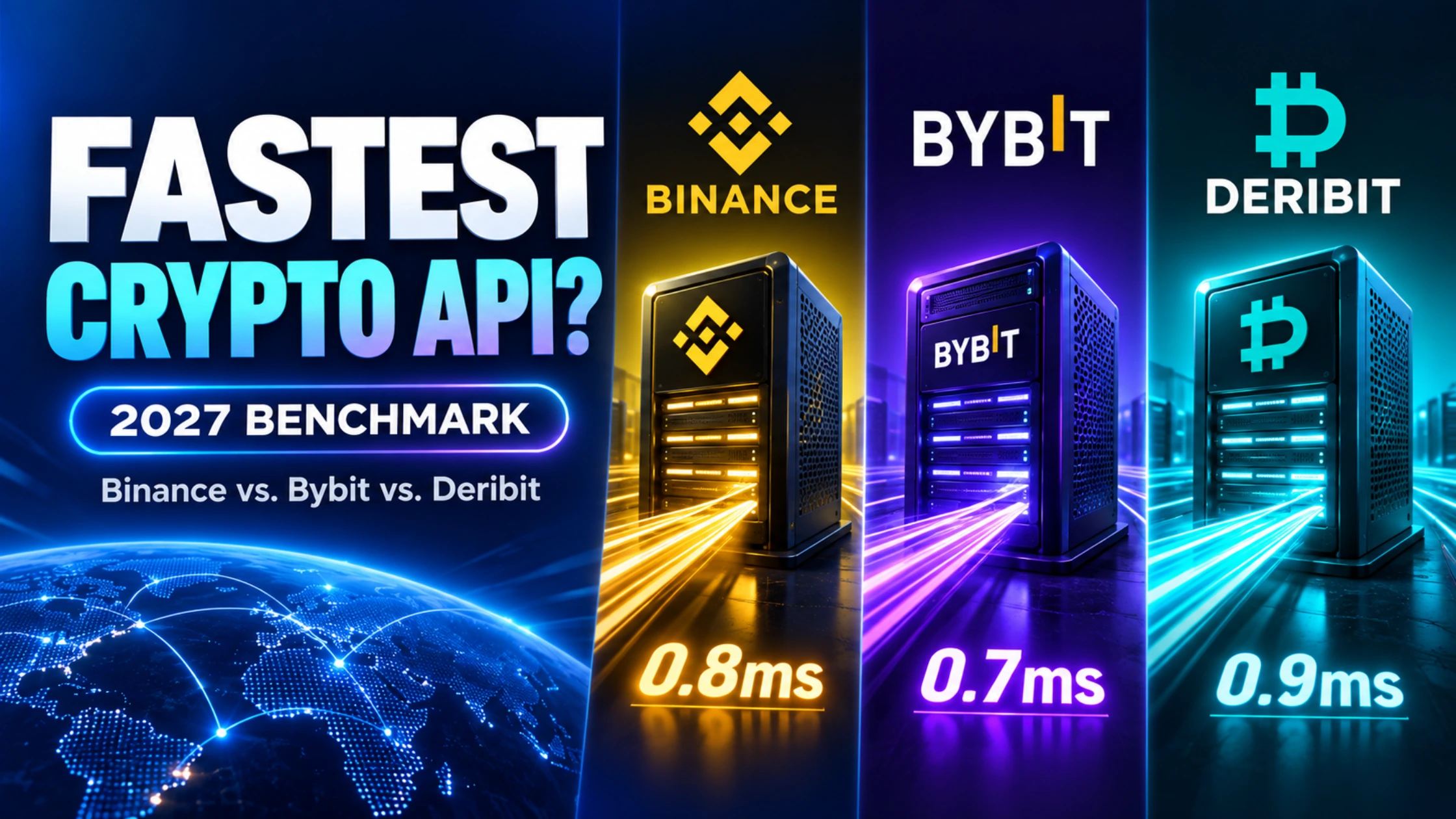
There is no universal “fastest crypto exchange API” because latency depends on both the exchange and the trader’s physical network path. The 2027 DN benchmark therefore separates measured latency from latency readiness. Current documentation gives Deribit, Bybit, Binance, Bitget and Kraken the strongest low-latency architecture signals, while actual millisecond performance must be measured from the trader’s deployment region.
Ping latency is not trading latency. A venue can answer a network ping quickly while still producing inferior order-entry performance because serialization, gateway queues, rate limits, matching-engine load and acknowledgement delivery sit downstream of the network round trip.
The DN Latency Chain
For an automated trader, “API latency” is not one number. An order travels through a chain:
This distinction is critical. A 15 ms network round trip does not mean a trader receives a confirmed exchange acknowledgement in 15 ms. Nor does an acknowledgement necessarily mean the local order book has already incorporated the resulting state change.
For market makers, arbitrage systems and high-frequency execution engines, the relevant metric is therefore the entire decision-to-confirmation loop.
DN API Latency Readiness Score
Until DN has synchronized physical measurement nodes operating across all benchmark regions, this edition publishes a Latency Readiness Score, not a fabricated geographic latency ranking.
The model allocates 100 points:
| Component | Weight | What DN Tests |
|---|---|---|
| Protocol efficiency | 25% | FIX, SBE, binary transport, WebSocket order entry and persistent sessions. |
| Market-data architecture | 20% | Push cadence, timestamp precision, depth feeds and deterministic sequencing. |
| Order-entry throughput | 20% | Published order limits, batch handling, VIP/MM allowances and cancellation capacity. |
| Acknowledgement observability | 15% | Gateway timestamps, execution reports and ability to isolate exchange-side delay. |
| Resilience | 10% | Hot-hot gateways, reconnect design, dead-man switches and mass cancellation. |
| Institutional connectivity | 10% | FIX/SBE/MM gateways, specialist institutional access and professional tooling. |
2027 API Latency Readiness Ranking
| Venue | DN Readiness Score | Strongest Signal | Order Architecture | Best Fit |
|---|---|---|---|---|
| Deribit | 96 | SBE Starbase gateways, FIX, hot-hot gateway design | SBE / FIX / WebSocket | Options MM, derivatives HFT |
| Bybit | 95 | SBE MM gateway, fast order response, 10 ms L1 feeds | SBE / WebSocket / REST | Perps, MM, active systematic trading |
| Binance | 92 | FIX, SBE and broad institutional API stack | FIX / WS API / REST | Large multi-market systematic stacks |
| Bitget | 90 | SBE data, microsecond gateway timestamps, VIP throughput | WebSocket / REST / SBE data | Perps, bots, high-rate VIP accounts |
| Kraken | 89 | FIX 4.4, L3 market data, nanosecond event timestamps | FIX / WebSocket / REST | Institutional spot and professional execution |
| OKX | 86 | WebSocket order entry and high sub-account order ceiling | WebSocket / REST | Multi-market systematic trading |
| Gate | 85 | SBE feeds and high futures order/cancel throughput | WebSocket / REST / SBE data | Broad-market systematic futures |
| MEXC | 68 | Fast public streams, but tighter trading limits | REST / WebSocket market data | Altcoin automation with pair checks |
| BloFin | 64 | Accessible REST/WebSocket stack | REST / WebSocket | Standard retail and systematic automation |
Why Deribit Scores So Highly
Deribit has moved beyond a conventional public API stack for latency-sensitive derivatives traders. Its infrastructure includes JSON-RPC over WebSocket, HTTP and FIX, while its newer Starbase architecture exposes dedicated SBE order gateways and binary market-data infrastructure.
The particularly important design choice is gateway redundancy. Starbase documents paired A/B gateways operating in a hot-hot configuration. Traders can connect to both simultaneously rather than treating one as a dormant failover route.
For options market makers this matters because latency, mass quoting, cancellation and market-maker protection have to work as one system.
Bybit: One of the Clearest HFT Architecture Upgrades of 2026
Bybit now deserves particular attention from latency-sensitive traders because its Market Maker Gateway supports SBE-based market data and SBE order entry.
Its documentation describes SBE as reducing payload size and CPU overhead while supporting microsecond timestamp precision. Bybit also exposes a dedicated fast order-response path for qualified market-making infrastructure.
For normal public WebSocket feeds, Bybit publishes 10 ms push frequency for Level-1 spot and linear/inverse order books and 20 ms for Level-50 books.
That does not guarantee a 10 ms trade acknowledgement. It does, however, show that the venue is engineering around latency-sensitive use cases rather than treating WebSocket delivery as an afterthought.
Binance: Broad Institutional Infrastructure Meets Deep Liquidity
Binance's developer stack includes REST, request-response WebSocket APIs, streaming WebSockets, FIX and Simple Binary Encoding.
The important distinction for quants is that Binance explicitly separates API data sources. Some requests are served from the matching engine, some from memory and others from databases. Those categories imply different potential delay characteristics.
For production systems, traders should therefore avoid treating every Binance endpoint as having the same latency profile.
Binance is also unusual because the value of its API infrastructure is reinforced by deep spot and derivatives liquidity. Ultra-fast order submission has limited value if the resulting order book cannot absorb the required size.
Bitget: Microsecond Telemetry Changes the Measurement Game
Bitget became substantially more interesting for systematic traders during 2026.
Its newer SBE market-data feeds use real microsecond timestamps. More importantly for execution benchmarking, Bitget added receiveTime and pushTime fields to WebSocket order-placement, modification and cancellation responses.
This makes it easier for an advanced trader to separate:
- client-to-gateway transport time,
- gateway processing time, and
- gateway-to-client delivery time.
Bitget also increased UTA VIP order limits in August 2026: VIP 1 moved to 60 requests per second, VIP 2 to 80, and VIP 3-7 to 100 requests per second.
The ordinary place-order limit remains substantially lower, which is why account tier belongs inside any serious latency benchmark.
Kraken: FIX, L3 Data and High-Precision Market Timestamps
Kraken's API stack is particularly interesting for institutional spot traders because FIX 4.4 is integrated with its trading infrastructure.
Its Level-3 market-data schema exposes both event timestamps and queue-entry timestamps with nanosecond fractional precision. That is useful for studying queue position, resting time and fill probability.
Kraken also supports atomic amendments that can preserve queue priority when an order is modified, and its futures infrastructure includes a dead-man-switch endpoint designed to cancel orders after a connectivity failure.
OKX: High Order Capacity Matters More Than a Marketing Latency Number
OKX supports direct order management over WebSocket as well as REST.
Its documented WebSocket place-order limit is 60 requests per two seconds at the relevant instrument scope, while the broader sub-account ceiling can reach 1,000 new and amendment order requests per two seconds.
That upper ceiling is important for complex multi-market systems, although traders must still respect instrument-specific and fill-ratio-based restrictions.
The key lesson is that API capacity and network latency are different constraints. A low RTT connection can still become unusable for an HFT strategy if the account hits order throttles.
Gate: Strong Futures Throughput and SBE Market Data
Gate's futures API is more performance-oriented than many traders realize.
Its documentation currently lists a combined 100 requests per second for futures order placement and amendment, with cancellation capacity up to 200 requests per second.
Gate also offers SBE feeds and WebSocket trading. Futures order-book update channels can publish at 100 ms intervals, while response metadata exposes exchange-side timing fields that can help advanced users analyse gateway processing.
One caveat is important: Gate also applies fill-ratio-based controls to behaviour that repeatedly places, modifies or cancels orders without sufficient productive fills.
MEXC: Fast Data Does Not Automatically Mean High Order Throughput
MEXC illustrates why the benchmark separates market-data speed from order-entry capacity.
Its public WebSocket infrastructure can provide very frequent market updates, including trade streams available at short intervals. But MEXC reduced its API spot order limit to five orders per second, and selected spot pairs can have API trading disabled independently.
For altcoin bots, that means the trader must verify API eligibility at the individual pair level.
BloFin: Accessible API Automation, Lower Published Throughput Ceiling
BloFin offers REST and WebSocket infrastructure suitable for conventional automated trading. Its documented trading-related REST limit is 30 requests per ten seconds per user ID.
That can be perfectly adequate for DCA systems, slower execution algorithms and many directional bots, but it is a materially different engineering envelope from a dedicated market-maker gateway.
The Benchmark Most Traders Get Wrong
A typical exchange-API comparison sends a few HTTP requests, averages the response times and declares one platform the winner.
That methodology is inadequate for trading.
A professional benchmark should measure at least five separate intervals:
The fifth metric may matter most.
An API with 18 ms median acknowledgement latency but 400 ms P99 spikes can be more dangerous to a market maker than an API producing a consistent 28 ms acknowledgement.
DN Alpha Thesis: Latency Variance Is More Dangerous Than Median Latency
For many automated crypto strategies, the key infrastructure risk is not raw latency but latency instability.
A bot can compensate for a stable 25 ms delay. It cannot reliably compensate for an execution path oscillating unpredictably between 20 ms and 500 ms.
DN therefore proposes the Latency Stability Ratio:
Example:
- Venue A: median 20 ms, P95 35 ms → ratio 1.75
- Venue B: median 15 ms, P95 90 ms → ratio 6.00
Venue B appears faster in a superficial median comparison. Venue A may be vastly easier to trade against systematically.
DN API Latency Lab
Enter latency measurements from your own server or VPS. The calculator combines your real observations with the DN architecture-readiness layer.
Calculate Your Live API Latency Score
The DN Global Measurement Protocol
The next stage of this index is a synchronized physical benchmark. DN should operate identical probes from:
Every node should run the same client, operating system, cloud class, clock synchronization and measurement sequence.
For each venue DN should collect:
- TCP/TLS connection time
- WebSocket handshake time
- heartbeat RTT
- public market-data event lag
- authenticated order acknowledgement P50
- order acknowledgement P95 and P99
- cancel acknowledgement latency
- amend acknowledgement latency
- disconnect frequency
- sequence-gap frequency
- rate-limit events
- normal versus volatility-stress performance
What API Should Different Traders Use?
| Trader | Priority | DN Infrastructure Shortlist |
|---|---|---|
| Options market maker | Mass quoting, MMP, deterministic execution | Deribit |
| Perpetual futures market maker | SBE, fast ACKs, high throughput | Bybit, Bitget, Binance |
| Institutional spot trader | FIX, L3 data, stable order management | Kraken, Binance |
| Multi-market quant | Order throughput, breadth, subaccounts | OKX, Binance, Bybit |
| Altcoin bot | Asset breadth plus API eligibility | MEXC, Gate, Bitget |
| Retail automation | Simple REST/WS integration | BloFin, Bitget, Bybit, OKX |
What Traders Should Measure Before Moving a Bot
Do not migrate a profitable trading system because another exchange claims lower latency.
Measure:
- Your own deployment route. Geography can dominate the network component.
- P95 and P99 acknowledgement times. Median latency hides tail events.
- Book freshness. A fast order channel paired with stale market data is dangerous.
- Rate-limit headroom. Model peak message rates, not average traffic.
- Cancellation performance. For market makers, cancel latency can matter more than placement latency.
- Reconnect behaviour. Measure what happens after packet loss and dropped sessions.
- Stress periods. Test during volatile markets, not only quiet weekends.
Methodology Shield
DN does not present documentation-based architecture scores as measured latency. The Latency Readiness Score evaluates whether a venue exposes infrastructure that should support latency-sensitive trading.
A future observed benchmark must use synchronized DN-controlled probes and identical instrumentation across every exchange. Until that dataset exists, numeric RTT, ACK and P99 claims must be labelled as user-measured, DN-observed or third-party sourced.
FAQ
Which crypto exchange has the fastest API?
No exchange can be declared universally fastest without controlling geographic location, protocol, account tier, market and measurement method. Current documented architecture gives Deribit, Bybit, Binance, Bitget and Kraken particularly strong latency-sensitive infrastructure, but traders should benchmark from their own deployment region.
Is WebSocket faster than REST for crypto trading?
Persistent WebSocket connections often remove repeated HTTP connection overhead and are generally better suited to real-time trading, but protocol choice alone does not determine execution latency. FIX and SBE infrastructure can provide further efficiency for institutional and market-making workflows.
What is SBE?
Simple Binary Encoding is a compact binary message format designed for high-performance financial systems. It can reduce message size, parsing overhead and encoding variability compared with human-readable JSON.
What latency metric matters most for an HFT crypto bot?
Order acknowledgement P50 is useful, but P95/P99 latency, cancel latency, market-data freshness and latency stability are often more informative for production trading.
What is the DN Latency Stability Ratio?
The DN Latency Stability Ratio divides P95 order acknowledgement latency by median acknowledgement latency. A lower ratio indicates a more consistent execution path.
Final Takeaway
The crypto API race is moving beyond REST endpoints and headline request limits.
The leading infrastructure now increasingly resembles professional electronic-market architecture: persistent order gateways, binary encoding, high-resolution timestamps, L3 feeds, market-maker safeguards and dedicated institutional connectivity.
The first DN conclusion is therefore simple:
The fastest exchange is not the venue with the lowest ping. It is the venue that produces the shortest, most stable and most observable decision-to-confirmation loop for your strategy, from your infrastructure, under real market load.
Primary Research Sources
- Binance Developer Documentation — API types, WebSocket, FIX, SBE and rate-limit architecture.
- Bybit V5 API Documentation — SBE Market Maker Gateway, WebSocket order entry and order-book cadence.
- Bitget API Documentation — SBE market data, microsecond timestamps, UTA order limits and VIP limits.
- OKX V5 API Documentation — WebSocket trading and sub-account rate-limit architecture.
- Kraken API Center — FIX 4.4, Level-3 market data, high-precision timestamps and dead-man switch.
- Deribit API Documentation — JSON-RPC, FIX, Starbase SBE gateway architecture and market-maker tooling.
- Gate API v4 — WebSocket order entry, SBE feeds, futures rate limits and fill-ratio controls.
- MEXC API Documentation — WebSocket market data, spot order limits and pair-specific API availability.
- BloFin API Documentation — REST/WebSocket architecture and trading-related rate limits.
Risk disclosure: Cryptocurrency and derivatives trading involve substantial risk. Latency-sensitive automated trading can amplify losses when connectivity, market data or order state becomes inconsistent. This article is educational and does not constitute financial, investment or trading advice. Platform availability and API functionality vary by jurisdiction, account tier and product.