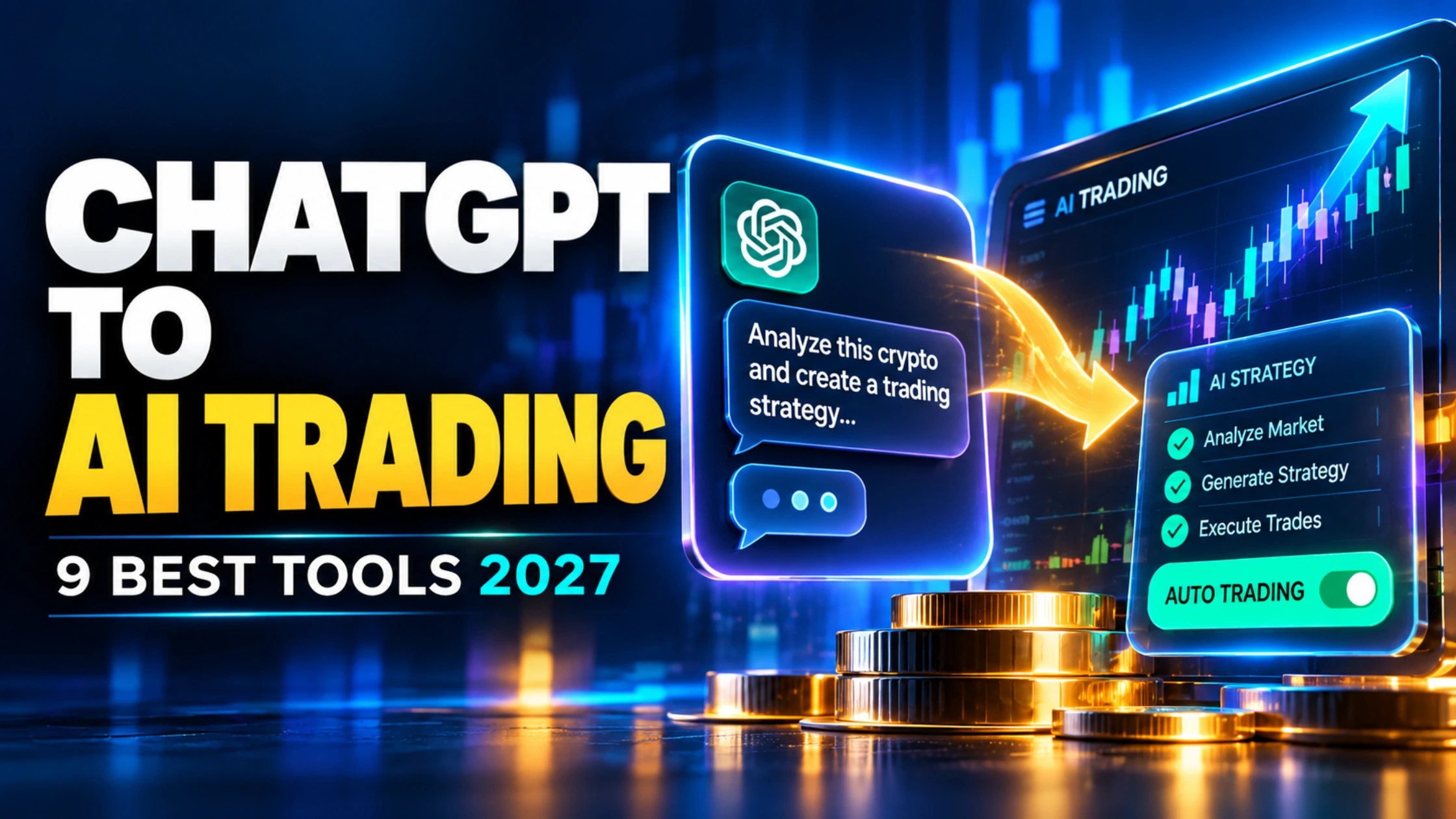
9 Best AI Trading Tools for People Coming From ChatGPT
ChatGPT has trained millions of people to expect software to understand plain English. Trading software is now moving in the same direction. The important question is what happens after the conversation: does the AI research, translate, backtest, alert, build or execute? DN compared nine tools by how safely and faithfully they turn conversational intent into trading workflows.
What Matters
For someone arriving from ChatGPT, Coinrule is currently the clearest direct bridge from conversation to crypto trading tools. But the safest path is not “ask ChatGPT what to buy, then let it trade.” It is conversation → explicit rules → backtest → simulation → approval → tightly bounded execution.
- Coinrule currently offers the most direct ChatGPT-specific workflow in this comparison. Its official MCP documentation includes a dedicated ChatGPT connection guide, OAuth authentication, Read Only and Read + Write scopes, backtesting and strategy management.
- ChatGPT's own MCP capabilities are plan-dependent. OpenAI's current documentation says full MCP write/modify support is still rolling out in beta for Business, Enterprise and Edu, while other plans may have more limited MCP access. Users should verify current ChatGPT plan support before assuming a third-party MCP can execute write actions.
- 3Commas now has two conversational routes. 3Commas v2 supports an MCP connection for compatible AI assistants, while QuantPilot uses a dedicated chat-based agentic interface for research, strategy generation and backtesting.
- Capitalise.ai provides one of the cleanest transitions from ChatGPT-style language to deterministic execution. Users type trading conditions in ordinary English, then backtest or simulate the resulting strategy.
- HaasOnline is particularly interesting for safety. Its MCP-compatible AI layer can inspect bots, write and compile strategy code and run backtests, while the current MCP product explicitly excludes order-placement and fund-transfer tools from the agent's tool registry.
- ASCN AI is a better fit when what you actually want from ChatGPT is better crypto research rather than automatic execution.
- Bitsgap's AI Assistant helps configure bot portfolios but does not independently improvise each trade. Current Bitsgap documentation describes execution as rule-based after AI-assisted configuration.
- TradingView and Cornix form a useful deterministic bridge. A conversational research idea can be converted into explicit alert conditions, then tested before automated execution is added.
- Gunbot is the builder's route. It is better suited to users who want AI to help prototype strategy logic and then test that logic in a controlled simulator.
DN Evidence Block
- Last verified: 30 September 2026.
- Platforms assessed: Coinrule, 3Commas v2 / QuantPilot, Capitalise.ai, HaasOnline, ASCN AI, Bitsgap, TradingView, Cornix and Gunbot.
- ChatGPT evidence: Coinrule publishes a dedicated current ChatGPT MCP connection guide. OpenAI's own documentation was used to verify current MCP availability and write-action limitations.
- Primary-source priority: current official documentation, help centres and product pages.
- Operational gate: products were checked for current operating evidence before inclusion.
- Scoring objective: measure suitability for a user accustomed to conversational AI, not expected profitability.
- AI classification: DN separates LLM tool use, agentic research, natural-language translation, AI-assisted configuration and deterministic automation.
- Commercial independence: affiliate status contributes zero points to the score.
- DN test status: Documented unless future first-hand testing changes the classification.
Quick Answer: Best Trading Tools for ChatGPT Users
| Rank | Tool | Best for | Conversation becomes... | Live execution? | DN Chat-to-Trade Fit |
|---|---|---|---|---|---|
| 1 | Coinrule | Direct ChatGPT-to-trading workflow | Strategies, backtests, portfolio queries and automation | Optional, permission-dependent | 97/100 |
| 2 | 3Commas v2 + QuantPilot | Conversational bot building and agentic research | Research, strategy generation, backtesting and bot workflows | Available through supported execution workflows | 93/100 |
| 3 | Capitalise.ai | Turning plain English into explicit rules | Deterministic trading logic | Yes, after simulation | 91/100 |
| 4 | HaasOnline | Advanced AI-assisted strategy building | Bot inspection, code, compilation and backtests | Not through current MCP agent tools | 89/100 |
| 5 | ASCN AI | Chat-style crypto research | Onchain, market and Web3 analysis | Research-first | 86/100 |
| 6 | Bitsgap AI Assistant | AI-assisted bot portfolio setup | Configured rule-based bots | Yes | 83/100 |
| 7 | TradingView | Turning an idea into observable triggers | Alerts and webhooks | Not by itself | 81/100 |
| 8 | Cornix | Turning signals into deterministic execution | DCA, Grid, Signals and TradingView automation | Yes | 79/100 |
| 9 | Gunbot | Technical users building custom systems | Custom strategy logic and simulation | Yes | 77/100 |
DN Chat-to-Trade Fit: a proprietary editorial score measuring Conversational Fit, Permission Safety, Simulation Access, Intent Fidelity, Learning Value, Execution Bridge and Evidence Freshness. It is not a performance or return forecast.
ChatGPT Changed the Interface. Trading Still Runs on Rules.
The most important change ChatGPT made to software was not simply generative text.
It changed what users expect an interface to feel like.
Instead of:
menu → settings → form → parameter → save
people increasingly expect:
“Tell the software what you want.”
That expectation is now moving into trading.
A trader might type:
“Build me a conservative BTC strategy that buys after a pullback, risks no more than a small percentage of capital and stops trading if volatility becomes extreme.”
The interface may understand the sentence.
But a sentence is not yet a trading system.
Somewhere underneath it must become:
- a defined market,
- an entry condition,
- a position size,
- an exit condition,
- a risk rule,
- a time horizon,
- an order type,
- and an execution policy.
The Chat-to-Trade Translation Gap
DN calls the distance between what a user thinks they asked for and what the trading system actually implements the:
Chat-to-Trade Translation Gap.
Consider the instruction:
“Buy BTC when momentum becomes strong.”
A human understands the rough idea.
Software needs much more.
What is “momentum”?
RSI?
Moving-average crossover?
Rate of change?
Over what interval?
How strong is “strong”?
Which BTC market?
How much should it buy?
What if the condition disappears one second later?
When should it sell?
A conversational interface hides much of that complexity.
It does not eliminate it.
The defining risk of conversational trading may not be that the AI fails to understand English. It may be that the user mistakes linguistic fluency for execution precision.
The DN Chat-to-Trade Ladder
| Stage | User asks | Machine does | Capital authority |
|---|---|---|---|
| 1. Explain | “What happened?” | Researches and explains | None |
| 2. Translate | “Turn this idea into rules.” | Creates explicit logic | None |
| 3. Validate | “Does this rule make sense?” | Checks structure and assumptions | None |
| 4. Backtest | “How would this have behaved?” | Runs historical simulation | None |
| 5. Paper | “Run it without money.” | Forward-tests with virtual capital | Simulated |
| 6. Approve | “Prepare the trade.” | Builds an action for human review | Human controlled |
| 7. Execute | “Run this strategy.” | Uses live trading tools | Real capital |
The key mistake is jumping from stage one directly to stage seven simply because both happen through a chat box.
How DN Ranked the Nine Tools
The DN Chat-to-Trade Fit score uses seven dimensions:
- Conversational Fit - 25%: how naturally can a ChatGPT-style user express intent?
- Permission Safety - 20%: can research, read and write authority be separated?
- Simulation Access - 15%: can the workflow be tested without live capital?
- Intent Fidelity - 15%: can users inspect what their natural-language request became?
- Learning Value - 10%: does the tool help users understand the trading process?
- Execution Bridge - 10%: is there a clear transition from idea to controlled execution?
- Evidence Freshness - 5%: is functionality supported by current first-party evidence?
Affiliate status contributes zero points.
Advertised returns contribute zero points.
A chat interface alone does not qualify a product as an autonomous trading agent.
Coinrule
Coinrule is currently the most literal answer to the question:
“How do I move from asking ChatGPT about trading to letting ChatGPT interact with actual trading software?”
Coinrule operates an official remote MCP server and publishes a dedicated guide for connecting ChatGPT.
Once connected, supported Coinrule tools can expose information such as:
- portfolio balances,
- holdings,
- connected accounts,
- strategies,
- trades,
- recent signals,
- P&L,
- and backtests.
The important feature is permission separation.
Coinrule supports:
- Read Only, and
- Read + Write.
With Read Only access, write tools are not exposed.
With Read + Write, supported AI workflows can validate, create, update, start and stop strategies and run backtests.
Coinrule says the connection uses OAuth 2.1, so the AI assistant does not receive the user's Coinrule password or exchange API keys.
Paper trading also allows the user to test strategies without connecting a live exchange.
Best for: users who specifically want a ChatGPT-style conversational interface connected to crypto strategy infrastructure.
Avoid if: you want AI to invent profitable trades with no explicit strategy or risk rules.
Largest failure mode: assuming a natural-language instruction is equivalent to an unambiguous trading specification.
Explore Coinrule ChatGPT Connection GuideCoinrule documents ChatGPT connectivity, but the capabilities available inside ChatGPT depend on the user's current ChatGPT plan and OpenAI's evolving MCP support.
As of 30 September 2026, OpenAI says full MCP support including write and modify actions is rolling out in beta for ChatGPT Business, Enterprise and Edu. Pro users can use more limited MCP read/fetch functionality through developer mode. Availability may change, so verify the current ChatGPT plan requirements before assuming that a connector can perform trading write actions.
3Commas v2 + QuantPilot
The 3Commas ecosystem now has two distinct conversational routes.
The first is 3Commas v2 itself.
Its current MCP documentation allows a supported external AI assistant to inspect strategies, review account history and, where the relevant permissions are provided, place or close trades using natural-language interaction.
The second is QuantPilot.
QuantPilot is the 3Commas team's dedicated agentic research and strategy-development product.
Its current terms describe a chat-based interface where users can:
- research markets,
- generate technical indicators,
- create trading strategies,
- backtest them,
- iterate on them,
- and export strategy logic for use with 3Commas-hosted execution tooling.
3Commas also describes QuantPilot as an agentic platform in which AI agents can build, backtest and optimize strategies from natural-language ideas.
This is highly relevant to ChatGPT users because the interface model is familiar:
describe the objective first, then refine the output through conversation.
Best for: traders wanting a larger automation ecosystem that increasingly uses conversation as the control layer.
Avoid if: you are following tutorials built for legacy 3Commas v1. The old platform was deactivated on 11 September 2026.
Largest failure mode: allowing conversational convenience to hide how many configuration choices exist underneath the generated strategy.
Explore 3Commas v2 Explore QuantPilotCapitalise.ai
Capitalise.ai does not require the user to connect ChatGPT.
Instead, it takes the interface behavior ChatGPT popularized and applies it directly to trading automation.
Users type a strategy in everyday English.
The platform translates that description into executable conditions.
Users can then:
- backtest the strategy,
- simulate it using real market data,
- review how the conditions were interpreted,
- and later clone the workflow into real execution.
That makes Capitalise.ai particularly valuable for understanding the difference between conversational intent and trading logic.
Best for: ChatGPT users who want conversational strategy creation without immediately introducing a separate AI-agent connection.
Avoid if: you want an open-ended autonomous crypto agent.
Largest failure mode: believing ordinary language is more precise than it really is.
Explore Capitalise.aiHaasOnline
HaasOnline offers one of the most interesting architectures in this category.
Its TradeServer Cloud exposes an MCP endpoint to compatible AI clients.
The connected agent can work conversationally with:
- bots,
- orders,
- positions,
- balances,
- market information,
- HaasScript,
- compilation,
- and backtesting.
But HaasOnline currently states that live trading tools are not included in the MCP registry.
That means the AI agent can research, inspect and build without being able to place an order or move funds through that MCP layer.
That separation is strategically important.
It demonstrates that an AI assistant can be deeply useful inside a trading system without inheriting every action available to the human operator.
Best for: technically curious users who want a safer research-and-build agent architecture.
Avoid if: you want a very simple consumer interface.
Largest failure mode: sophisticated code can still represent a poor trading idea.
Explore HaasOnline MCPASCN AI
Many people asking ChatGPT for trading advice do not actually need automated execution.
They need better information.
ASCN AI focuses on that layer.
Its current platform describes a multi-agent architecture specialized around Web3 data and crypto research.
The system combines conversational analysis with data such as:
- onchain activity,
- wallet behavior,
- DEX activity,
- exchange flows,
- holders,
- market structure,
- news,
- and social signals.
For a ChatGPT user frustrated by generic or stale crypto answers, this is a more logical next step than immediately giving an AI execution authority.
Best for: users who want crypto-specialized conversational research before they automate anything.
Avoid if: you only need a deterministic DCA bot.
Largest failure mode: assuming better data automatically produces better predictions.
4UZ09RW804
Bitsgap AI Assistant
Bitsgap's AI Assistant is useful because its role is narrower than the phrase “AI trader” might imply.
The user selects:
- an exchange,
- an investment amount,
- and an investment horizon.
The Assistant analyzes portfolio balance, market conditions, historical volatility and available pairs to recommend and configure a portfolio of bots.
Bitsgap's own 2026 explanation makes an important distinction:
the AI Assistant does not make each live trade through open-ended discretion.
It helps configure the strategy.
Execution then runs through the underlying rule-based bots.
This is a useful architecture for ChatGPT users because it separates:
AI-assisted configuration
from
deterministic execution.
Best for: users who want AI to reduce bot-configuration complexity.
Avoid if: you specifically want ChatGPT itself controlling the account.
Largest failure mode: attributing future bot performance to “AI” when the actual execution is still governed by deterministic strategy logic.
Explore BitsgapTradingView
TradingView is not a ChatGPT trading agent.
It plays a different role.
Suppose a user asks an AI:
“Tell me when BTC breaks its recent range with unusually high volume.”
Before automating the trade, the user can convert that idea into an explicit alert.
TradingView alerts can monitor price or indicator conditions and send notifications.
They can also send webhook requests to external systems.
This makes TradingView a useful intermediate layer between:
conversation
and
execution.
TradingView also warns users not to include passwords or sensitive credentials in webhook payloads and notes that webhook delivery can fail.
Best for: users who need to turn vague market ideas into something observable.
Avoid if: you expect TradingView alone to provide an autonomous AI trading stack.
Largest failure mode: treating a successfully triggered alert as proof that the original trading thesis was correct.
Explore TradingViewCornix
Cornix is not ranked here because it provides a ChatGPT-like AI agent.
It does not.
It is useful because it can become the deterministic execution layer after a conversational idea has been converted into explicit rules.
Cornix's TradingView Bot can receive a webhook trigger and execute preconfigured:
- entries,
- position sizes,
- take-profit logic,
- stop-loss logic,
- cooldowns,
- and other predefined settings.
Cornix also provides a fully simulated Demo Account with real-time market data and no external exchange API connection required.
This creates a strong sequence:
AI conversation → TradingView condition → Cornix demo execution → controlled live automation.
Best for: users who want deterministic execution after the AI reasoning layer has finished.
Avoid if: you want Cornix itself to reason conversationally about markets.
Largest failure mode: a flawed AI-generated signal can become a perfectly executed flawed trade.
Explore CornixGunbot
Gunbot makes most sense for a ChatGPT user who eventually wants to understand the code and mechanics underneath the automation.
Its current strategy tooling supports configurable conditions, custom strategy development, backtesting and current-market Simulator Mode.
Gunbot's simulator runs the strategy against current market data with virtual balances and simulated order execution.
This makes it useful when AI has generated or helped prototype strategy logic but the trader wants a separate environment in which to inspect and test that logic.
Best for: users graduating from conversational AI into serious bot construction.
Avoid if: you want a zero-configuration experience.
Largest failure mode: assuming AI-generated code is correct because it compiles.
Explore GunbotWhat ChatGPT Users Usually Think They Want
The common request is:
“Can ChatGPT trade for me?”
But that question bundles several different objectives together.
| What the user says | What they may actually need | Lower-authority solution |
|---|---|---|
| “Tell me what to buy.” | Market research | ASCN AI or research-only AI |
| “Build me a strategy.” | Rule translation | Coinrule, Capitalise.ai or QuantPilot |
| “Test whether this works.” | Backtesting / simulation | Coinrule, Capitalise.ai, 3Commas, HaasOnline or Gunbot |
| “Watch this for me.” | Monitoring | TradingView alert |
| “Execute when this happens.” | Deterministic automation | Cornix or bot infrastructure |
| “Manage everything.” | Agentic execution | High-authority workflow requiring much stronger controls |
The best product changes depending on which of these the user really means.
The Prompt-to-Position Risk
Conversational trading introduces a new measurement problem.
How much financial consequence can flow from one natural-language instruction?
DN calls this:
Prompt-to-Position Risk.
A prompt such as:
“Show me my BTC exposure”
has very little direct trading consequence under Read Only access.
A prompt such as:
“Create a BTC strategy and backtest it”
still does not need live capital.
A prompt such as:
“Launch the strategy”
can become economically consequential if the connected tool has live write permission.
In conversational finance, risk is increasingly determined not only by what the model knows, but by how short the path is from a sentence to a financial position.
The Safer Architecture: Conversation Upstream, Rules Downstream
There is a reason several of the strongest tools in this list do not simply let an LLM improvise each trade.
The safer architecture often looks like:
Conversation → strategy definition → validation → deterministic execution.
The AI handles what it is good at:
- interpreting intent,
- asking clarifying questions,
- summarizing information,
- generating candidate rules,
- researching,
- and explaining.
The deterministic layer handles:
- exact trigger conditions,
- order size,
- risk limits,
- allowed assets,
- stops,
- and execution.
This preserves the usability advantage of conversation without making every order dependent on fresh LLM interpretation.
DN Chat-to-Trade Stack Builder
The right next tool depends on what you actually want ChatGPT-style interaction to accomplish.
Chat-to-Trade Stack Builder
Choose what you want conversational AI to do, how much authority you are comfortable granting and whether you want research, rules or execution.
Coinrule
Read-only AI + paper strategy
The Intent Fidelity Test
Before allowing a conversational trading workflow to act, run one simple test.
Ask the system to explain:
- what it thinks you asked for,
- the exact entry rule,
- the exact exit rule,
- the position size,
- the maximum loss condition,
- which markets it can access,
- which tools it will call,
- and what would make it do nothing.
Then compare that explanation with your original intent.
DN calls the match:
Intent Fidelity.
A conversational interface with poor Intent Fidelity is dangerous because errors can feel natural.
The sentence looks right.
The execution can still be wrong.
Five Prompt Patterns That Are Better Than “Trade for Me”
1. “Translate this idea into explicit rules.”
This forces the system to expose assumptions.
2. “What information is missing before this could become executable?”
This helps uncover ambiguity.
3. “Backtest this rule without changing it to improve the result.”
This reduces the temptation to optimize after seeing the answer.
4. “What would make this strategy refuse to trade?”
A system needs a no-trade state.
5. “Explain the exact tools and permissions required for this action.”
This turns software permissions into part of the trading decision.
ChatGPT Should Not Be the Risk Engine
There is a broader architectural lesson.
A prompt saying:
“Never risk more than 1%”
is not the same thing as code that physically refuses an order above the permitted amount.
Conversational instructions are interpreted.
Capital constraints should be enforced.
The ideal stack increasingly looks like:
- AI for interpretation,
- AI for research,
- AI for strategy drafting,
- deterministic code for permissions,
- deterministic code for limits,
- and independently enforced controls for actual capital.
Natural language may become the dominant way traders express intent, but capital governance should remain explicit, inspectable and enforceable outside the conversation itself.
The Tool Surface Escalation Problem
A normal ChatGPT conversation is primarily informational.
Connect external tools and the model's action space expands.
Add portfolio data.
It can inspect.
Add backtesting.
It can test.
Add strategy creation.
It can configure.
Add live write tools.
It can alter trading behavior.
Add transfer tools.
The financial consequences expand again.
DN calls this:
Tool Surface Escalation.
Each new external action expands what a natural-language instruction can ultimately cause.
That is why permission minimization becomes more important as the interface becomes easier.
A Better Journey From ChatGPT to Live Trading
| Week | Experiment | Machine authority | Capital |
|---|---|---|---|
| 1 | Use AI only for research and explanation | None | $0 |
| 1 | Translate one strategy into explicit rules | None | $0 |
| 2 | Backtest the unmodified rule | Simulation | $0 |
| 2 | Forward-test or paper trade | Simulated execution | $0 |
| 3 | Use Read Only account access where available | Inspection only | $0 at risk from execution |
| 3 | Prepare trades for human approval | Bounded | Small optional test |
| 4+ | Enable narrowly defined write tools only if justified | Live execution | Small isolated balance |
What Would Change This Ranking?
This category is evolving extremely quickly.
Coinrule's lead depends partly on its unusually direct ChatGPT documentation, permission separation and paper workflow.
Another platform could move ahead by combining:
- native conversational strategy design,
- clear Read Only and Write scopes,
- paper trading,
- deterministic risk enforcement,
- human approval controls,
- complete action logs,
- and a direct, maintained ChatGPT integration.
3Commas and QuantPilot could move higher as the newer v2 and agentic product ecosystem matures.
HaasOnline could move higher for users prioritizing safety if conversational tooling remains powerful while live execution continues to be excluded from the AI agent surface.
Bitsgap could rise if its AI layer becomes more conversational and more deeply testable inside demo workflows.
Limitations
- ChatGPT MCP availability is plan-dependent. Third-party documentation describing ChatGPT connectivity does not mean every ChatGPT plan currently supports the same read or write capabilities.
- DN has not independently live-traded all nine tools. Their status is Documented unless separately updated after first-hand testing.
- Conversational interfaces are not directly comparable. Some tools connect external AI assistants, some use proprietary chat interfaces, and others only use AI during strategy configuration.
- “AI” remains inconsistently defined. DN separates LLM tool use, machine learning, algorithmic configuration and deterministic execution.
- Backtests and simulations do not reproduce all live-market conditions. Fees, slippage, latency, partial fills, liquidity and outages can differ.
- MCP and plugin ecosystems change quickly. Permissions, product support and plan availability may change after publication.
- Live execution creates substantially more risk than research. A tool suitable for research is not automatically suitable for unattended trading.
- Jurisdiction matters. Exchanges, derivatives and trading functionality may not be available everywhere.
- Affiliate relationships exist. Commercial relationships contribute zero points to the Chat-to-Trade Fit score.
The Bottom Line
ChatGPT changed what software users expect.
They no longer want to learn every menu before expressing an idea.
They want to say:
“Here is what I want.”
And let the software handle the translation.
That interface model is now reaching trading.
But trading introduces a critical difference.
A poorly translated email is inconvenient.
A poorly translated trade can lose money.
That means the winning conversational trading platforms will need to do more than understand natural language.
They need to make the translation visible.
They need to make it testable.
They need to make permissions understandable.
And they need to keep the path from:
sentence → strategy → position
under control.
For someone coming from ChatGPT, the best first question is therefore not:
“Which AI can trade for me?”
It is:
“Which part of my trading workflow should become conversational first?”
Research?
Strategy creation?
Backtesting?
Alerts?
Execution?
Start there.
Then increase the machine's authority one layer at a time.
DN evaluated nine current AI, automation and trading products that provide a plausible bridge for users accustomed to ChatGPT-style conversational software.
The proprietary DN Chat-to-Trade Fit score weights: 25% Conversational Fit, 20% Permission Safety, 15% Simulation Access, 15% Intent Fidelity, 10% Learning Value, 10% Execution Bridge, and 5% Evidence Freshness.
A product does not receive extra points simply because it uses the term AI. DN distinguishes external LLM tool access, proprietary chat interfaces, natural-language rule translation, AI-assisted bot configuration and deterministic automation.
Affiliate relationships contribute zero points. The current DN affiliate master is used only to identify the correct commercial pathway after operational status is independently checked.
Operational classifications remain: LIVE, RESTRICTED, MIGRATING, WINDING DOWN and INACTIVE. Only independently verified LIVE products receive active affiliate CTAs.
DN testing classifications remain: Documented, Paper-Tested and Live-Tested. This edition uses Documented unless explicitly stated otherwise.
Primary Sources & Evidence
- Coinrule, How to Connect ChatGPT to Coinrule MCP, July 2026
- Coinrule, Connect an AI Assistant to Coinrule MCP
- Coinrule, MCP Tools: Complete Capabilities Guide
- OpenAI, Developer Mode and MCP Apps in ChatGPT
- 3Commas, Connect Your AI Assistant to 3Commas MCP, August 2026
- 3Commas, V2: Everything You Need to Know
- 3Commas, QuantPilot Is Now Live, June 2026
- QuantPilot, Current Terms of Use and Service Description
- Capitalise.ai, Platform Overview, August 2026
- Capitalise.ai, Simulations, August 2026
- HaasOnline, Model Context Protocol for Crypto Trading
- HaasOnline, AI Agent Access Documentation
- ASCN, AI Crypto Agent
- Bitsgap, What Is Bitsgap AI Assistant?
- Bitsgap, How to Use Bitsgap AI Assistant, July 2026
- TradingView, Webhook Alerts
- Cornix, Demo Accounts, May 2026
- Cornix, TradingView Bot Overview
- Gunbot, Simulator Mode
Frequently Asked Questions
Can ChatGPT trade crypto?
ChatGPT does not automatically control a crypto account. External platforms can expose authorized tools to compatible AI systems through mechanisms such as MCP. Actual read and write capabilities depend on the external platform, permissions granted and current ChatGPT plan support.
Which trading platform works most directly with ChatGPT?
Among the products reviewed here, Coinrule has the clearest current ChatGPT-specific documentation. It publishes a dedicated guide for connecting ChatGPT to its MCP server and supports separate Read Only and Read + Write scopes.
Can every ChatGPT plan use trading MCP tools?
No. Current ChatGPT MCP capabilities vary by plan. OpenAI's documentation should be checked before assuming that a particular account can use third-party read or write MCP actions.
What is MCP in AI trading?
Model Context Protocol is a standard that allows compatible AI systems to interact with authorized external tools. A trading MCP server can expose functions such as portfolio inspection, backtesting, strategy creation or execution depending on the tools and permissions supplied.
Should I let ChatGPT place live trades immediately?
DN favors a staged progression beginning with research, rule translation, backtesting and paper trading before any live write authority is introduced.
What is the Chat-to-Trade Translation Gap?
The Chat-to-Trade Translation Gap is a DN framework describing the difference between what a user believes they requested in natural language and the exact trading logic the software ultimately implements.
What is Prompt-to-Position Risk?
Prompt-to-Position Risk measures how much financial consequence can flow from a natural-language instruction based on the tools, permissions and capital available to the connected AI system.
What is Intent Fidelity?
Intent Fidelity measures how accurately the final executable strategy reflects what the user originally intended to express in natural language.
Is Capitalise.ai connected to ChatGPT?
Capitalise.ai is included because it applies a ChatGPT-like natural-language interaction model directly to trading strategy construction. Users describe trading logic in ordinary English and can backtest or simulate the interpreted strategy.
Can HaasOnline's AI agent place live trades?
HaasOnline's current MCP product documentation says trading tools are not included in the agent tool registry, allowing the connected agent to research, inspect, code and backtest without placing orders or moving funds through that MCP interface.
Is Bitsgap AI Assistant an autonomous trading agent?
Bitsgap currently describes its AI Assistant as a system that recommends and configures bot portfolios using account and market information. The underlying bots then execute according to rule-based strategy logic rather than an AI model improvising every trade.
What is Tool Surface Escalation?
Tool Surface Escalation is a DN concept describing how a model's potential economic action space expands as additional external tools such as portfolio access, backtesting, trading and transfers become available to it.
Freshness, Change Log & Corrections
| Date | Change |
|---|---|
| 30 September 2026 | Initial 2027 edition published with nine ChatGPT-adjacent AI trading tools. |
| 30 September 2026 | Verified Coinrule's dedicated ChatGPT MCP connection, OAuth architecture and Read Only / Read + Write scopes. |
| 30 September 2026 | Verified current OpenAI MCP availability and plan-dependent write-action limitations. |
| 30 September 2026 | Verified 3Commas v2, QuantPilot, Capitalise.ai, HaasOnline, ASCN AI, Bitsgap, TradingView, Cornix and Gunbot product evidence. |
| 30 September 2026 | Added DN Chat-to-Trade Translation Gap, Prompt-to-Position Risk, Intent Fidelity and Tool Surface Escalation frameworks. |
| 30 September 2026 | Added DN Chat-to-Trade Stack Builder. |
Last verified: 30 September 2026.
Correction policy: AI connectors, MCP support and trading-platform functionality are changing quickly. DN will update this research when ChatGPT plan support, external tool permissions, platform operating status, simulation functionality or execution architecture materially changes.
Readers and companies can report factual errors through the Decentralised News Contact page. Commercial relationships do not prevent corrections, score changes or removal.