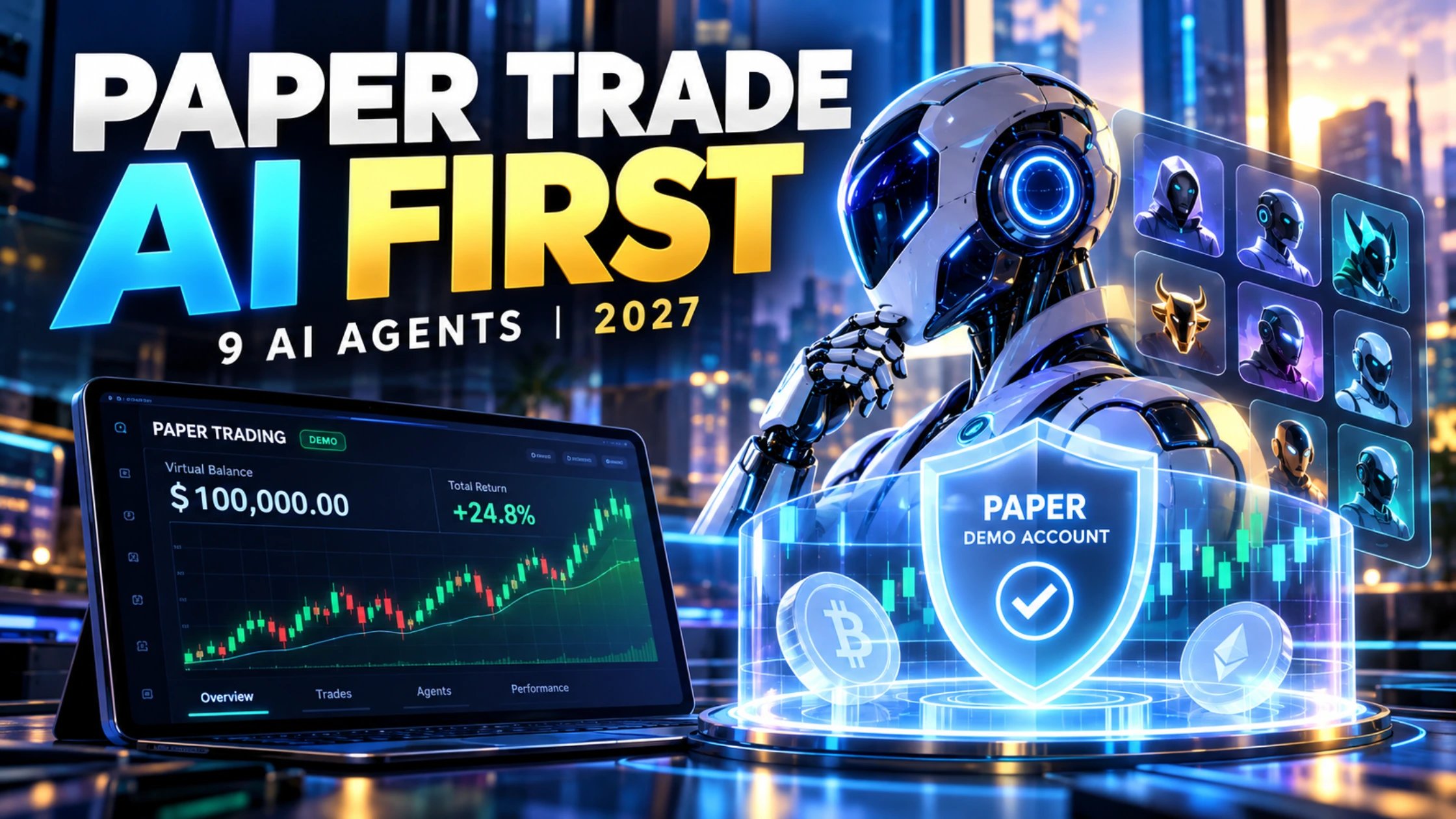
9 Best AI Trading Agents to Try With Paper Money Before Risking Real Cash
The smartest first test of an AI trading system is usually not whether it can make money. It is whether you can understand what it is doing while the money is still imaginary. DN compared nine AI, agentic and automated trading platforms with current paper, demo or simulation workflows, then separated genuine AI functionality from ordinary bot automation.
What Matters
- Coinrule is DN's strongest paper-first fit for users specifically coming from ChatGPT-style AI. Its official MCP can connect compatible assistants to portfolio and strategy tools, and paper trading does not require a live exchange connection.
- 3Commas v2 is the strongest alternative for traders wanting both demo automation and an MCP-connected AI workflow. Its old v1 platform was deactivated on 11 September 2026, so older reviews may now be misleading.
- HaasOnline has one of the most interesting agent-safety designs. Its current TradeServer Cloud allows an MCP-compatible AI assistant to inspect bots, draft HaasScript and run backtests, but the AI-agent connection cannot place trades or move funds.
- Capitalise.ai is one of the clearest no-code experiments. A strategy can be written in everyday English, backtested and simulated against real market data before being cloned into real mode.
- Gunbot is a stronger fit for technically confident users. AI can assist with strategy prototyping while Simulator Mode runs current-market forward tests using virtual balances.
- Not every platform marketed around intelligence is a genuine AI trading agent. Cryptohopper explicitly states that its established “A.I.” means Algorithmic Intelligence, not Artificial Intelligence.
- Bitsgap has a strong demo environment for bots, but its own documentation says the AI Assistant is not included in demo mode. That distinction matters.
- Paper trading removes direct capital risk, but it does not reproduce every live-market problem. Slippage, latency, partial fills, liquidity, market impact, outages and trader psychology can create a substantial Paper-to-Live Gap.
- The CFTC warns that AI cannot predict future market shocks or turn trading bots into guaranteed money machines.
DN Evidence Block
- Verification period: 27 September 2026.
- Platforms assessed in the final nine: Coinrule, 3Commas v2, HaasOnline TradeServer Cloud, Capitalise.ai, Gunbot, Tickeron, Cornix, Cryptohopper and Bitsgap.
- Evidence priority: current first-party help centres, documentation and product pages.
- Paper requirement: a platform needed an independently verifiable paper, demo, simulated, forward-test or comparable no-real-money workflow.
- AI requirement: DN separately classified LLM/MCP functionality, AI/ML functionality, algorithmic adaptation and ordinary deterministic automation.
- Ranking objective: paper-first experimentation quality, not expected profitability.
- Commercial rule: affiliate status was excluded from scoring.
- Testing status: all platforms in this edition are currently Documented, not represented as independently Paper-Tested or Live-Tested by DN.
Quick Answer: Which Paper AI Trading Platform Fits You?
| Platform | Best for | What is actually AI? | Paper / demo | DN Paper-First Fit |
|---|---|---|---|---|
| 1. Coinrule | ChatGPT, Claude and MCP experimentation | Tool-using LLM interface + deterministic execution layer | Yes | 94/100 |
| 2. 3Commas v2 | Crypto bot users wanting AI assistant access | MCP-connected AI assistant + automated bots | Yes | 91/100 |
| 3. HaasOnline | Agent-safe advanced crypto experimentation | MCP agent can inspect, audit, draft and backtest but cannot trade | Yes | 89/100 |
| 4. Capitalise.ai | Plain-English no-code strategy testing | Natural-language strategy translation | Yes | 87/100 |
| 5. Gunbot | Self-hosted and technical users | AI-assisted strategy prototyping + automation | Yes | 84/100 |
| 6. Tickeron | Observing prebuilt AI trading agents | AI Robots and multi-agent trading systems | Paper-trade visibility | 82/100 |
| 7. Cornix | Signals, DCA, Grid and TradingView automation | Primarily deterministic automation | Yes | 79/100 |
| 8. Cryptohopper | Adaptive algorithmic bot testing | Algorithmic Intelligence; separate AI features are evolving | Yes | 77/100 |
| 9. Bitsgap | Polished crypto-bot demo environment | Automation + AI Assistant, but AI Assistant excluded from demo | Yes | 74/100 |
DN Paper-First Fit: a proprietary editorial measure of simulation depth, relevance to AI/agentic trading, permission safety, observability, live-transition discipline and documentation quality. It is not a measure of expected returns.
Why Paper Trading Is the Right Place to Start With AI
An AI trading advertisement usually shows the end of the journey.
The bot is already connected.
Trades are already happening.
The dashboard is already green.
That sequence encourages users to skip the most important part:
learning what the system actually does before it gains authority over real money.
Paper trading reverses the order.
You can observe:
- what triggers a trade,
- how the strategy interprets your instructions,
- how often it trades,
- how it exits,
- whether its claimed risk controls are actually visible,
- how it behaves when nothing happens,
- and whether you can reconstruct why an action occurred.
That is useful even if the simulated P&L eventually proves meaningless.
Paper trading can answer a more fundamental question first:
Do I understand the machine I am considering giving money to?
Paper Trading Is Not Proof of Profitability
This distinction is essential.
A paper account can prove that an automated workflow runs.
It can help identify bad rules.
It can reveal excessive trading.
It can expose unexpected interpretations of a natural-language strategy.
It can demonstrate whether you understand the controls.
But paper trading cannot prove that the same strategy will generate the same result with real capital.
Live trading introduces factors that may be absent, simplified or imperfectly modeled in simulation:
- slippage,
- partial fills,
- latency,
- real exchange minimums,
- API failures,
- funding rates,
- liquidations,
- market impact,
- queue position,
- and the trader's own response to real losses.
Gunbot's own Simulator Mode documentation makes this limitation explicit. Its strategy logic can operate against current market data and simulated execution, but real execution can still differ because of spreads, slippage, latency, partial fills, minimums and outages.
That is a useful standard for evaluating every simulator.
The key question is not simply whether a strategy performs in paper trading. It is how many assumptions must remain true for the paper result to survive contact with live execution. DN calls this the Paper-to-Live Gap.
How DN Ranked the Nine Platforms
The DN Paper-First Fit methodology uses six dimensions:
- Simulation Depth - 30%: how much of the real workflow can be tested without real funds?
- AI / Agent Relevance - 20%: does AI materially contribute, or is “AI” mostly branding?
- Permission Safety - 20%: can users experiment with constrained or non-executing access?
- Observability - 15%: can users see strategies, orders, logs and results clearly?
- Live Transition Discipline - 10%: is there a clear path from simulation to controlled live execution?
- Evidence Freshness - 5%: is the functionality supported by current official documentation?
No points are awarded for affiliate relationships.
No points are awarded for advertised win rates.
No points are awarded simply because a company calls its product AI.
Coinrule
Coinrule currently provides the cleanest bridge between the user behavior driving today's AI-trading interest and a controlled paper environment.
Its official MCP server allows compatible assistants including ChatGPT, Claude and Grok to interact with authorized Coinrule tools.
With Read Only access, an assistant can inspect supported strategies, balances, holdings, trades, signals, P&L and backtests but cannot create or alter trades.
With Read + Write access, it can use supported tools to create and manage strategies.
The important part for this article is that Coinrule says a live exchange connection is not required for paper trading.
That means users can test the conversational workflow before introducing live execution.
Avoid if: you are looking for an opaque black-box agent that promises to invent profitable trades automatically.
Largest failure mode: jumping from conversational convenience to write-enabled live execution before understanding how instructions become strategies.
Explore Coinrule Primary Documentation3Commas v2
3Commas has changed materially enough that old comparisons require care.
The company's v1 platform was deactivated on 11 September 2026.
The current v2 platform is the relevant product.
Current documentation supports a Demo Account using simulated assets with real market data from a selected exchange.
Users can test automated strategies without live funds.
3Commas also introduced an MCP server that lets supported external AI assistants inspect an account and, where permissions permit, carry out supported trading actions using natural language.
The platform recommends narrow API permissions, and its MCP guide specifically discusses read-only access as the safer configuration for account questions and reports.
Avoid if: the guide or YouTube tutorial you are following predates the v2 migration and assumes the old 3Commas product architecture.
Largest failure mode: assuming old bot settings, old interfaces or old reviews still describe the current product.
Explore 3Commas Demo Trading GuideHaasOnline TradeServer Cloud
HaasOnline deserves attention because its architecture separates AI assistance from financial execution unusually clearly.
TradeServer Cloud supports simulated paper trading with live markets, historical backtesting and bot debugging.
Its current product page also allows users to connect an MCP-compatible AI assistant such as Claude or Cursor.
The AI can inspect bots, audit a portfolio, draft and backtest HaasScript and inspect logs.
The important safety boundary is explicit:
the AI-agent connection cannot place a trade or move funds.
That makes HaasOnline a useful example of the architecture DN expects to become more common:
AI can reason about the system without automatically inheriting execution authority.
Avoid if: you want an extremely simple beginner app rather than a trading-automation environment.
Largest failure mode: complex strategies can still be badly designed even when the AI itself cannot execute.
Explore HaasOnlineCapitalise.ai
Capitalise.ai attacks one of the biggest barriers between a trading idea and a testable system:
turning natural language into explicit automation.
Users can describe entry and exit rules in everyday English.
The resulting strategy can be backtested against historical data or run in simulation mode against real market data without executing actual trades.
If the user later wants to move to live trading, the simulated strategy can be cloned into real mode.
This makes Capitalise.ai particularly useful for testing whether a trading idea is actually precise enough to automate.
Avoid if: you want an open-ended autonomous agent deciding what strategy to use without predefined logic.
Largest failure mode: natural language can feel precise to a human while remaining ambiguous as executable trading logic.
Explore Capitalise.ai Simulation DocumentationGunbot
Gunbot is more appropriate for users who want control rather than an opaque hosted black box.
Its current workflow supports AI-assisted custom strategy prototyping.
The important part for this article is Simulator Mode.
Gunbot can run a complete instance using current market data, virtual balances and simulated order execution.
Strategies, AutoConfig jobs and custom spot strategies can operate in the simulated environment.
Gunbot itself distinguishes simulator results from live execution, noting that spreads, slippage, latency, partial fills, exchange minimums and outages can still differ.
Avoid if: you want a lightweight mobile-first experience with minimal configuration.
Largest failure mode: AI can generate logically valid code that still implements a poor or misunderstood trading strategy.
Explore Gunbot Simulator DocumentationTickeron
Tickeron is one of the more literal fits for the phrase “AI trading agent.”
Its current platform presents AI Robots across stocks, ETFs and crypto, including single-agent, multi-agent, signal-only and brokerage-agent categories.
Individual agent pages expose simulated performance and paper-trade information.
That creates a different kind of paper experiment.
Instead of building an agent, you can observe a prebuilt agent's current behavior before considering any real-money use.
This can be useful for studying:
- trade frequency,
- holding periods,
- drawdowns,
- strategy concentration,
- and whether the system behaves differently across market conditions.
Avoid if: your priority is building a custom crypto bot from your own rules.
Largest failure mode: interpreting displayed historical or simulated performance as evidence that the future market will resemble the tested period.
Explore TickeronCornix
Cornix is lower in the ranking because DN does not classify its core product as an autonomous AI agent.
It remains highly relevant to people entering the category through “AI trading bot” advertising because it provides a strong baseline for understanding what deterministic automation actually looks like.
Cornix launched a fully simulated Demo Account environment that mirrors its live platform with real-time market data.
Users do not need to connect a real exchange.
The demo supports its Signals Bot, DCA, Grid and TradingView bots.
A configured demo bot can later be copied into the real environment.
Avoid if: your objective is specifically to test open-ended LLM reasoning or autonomous agent behavior.
Largest failure mode: deterministic automation faithfully executing a bad signal.
Explore Cornix Demo DocumentationCryptohopper
Cryptohopper is an important inclusion precisely because it exposes one of the terminology problems in AI trading.
The platform's established “A.I.” system stands for Algorithmic Intelligence.
Its own documentation explicitly says it is not Artificial Intelligence.
The feature compares available strategies and chooses among them according to market conditions.
Cryptohopper also supports paper trading.
Users can convert an existing trading bot into a paper bot or create a new paper-trading bot through its setup flow.
Cryptohopper is separately introducing newer AI features, but those should not be confused with the established Algorithmic Intelligence feature.
Avoid if: you are specifically searching for a fully autonomous LLM trading agent.
Largest failure mode: assuming the word “intelligence” means the product is independently reasoning about markets.
Explore Cryptohopper Paper Trading GuideBitsgap
Bitsgap provides one of the more developed crypto demo environments.
Demo Mode uses virtual funds and supports bot types including GRID, DCA, DCA Futures and COMBO.
The bots use market data from real exchanges, allowing users to observe automated behavior without exposing real capital.
Bitsgap also has an AI Assistant.
But its own Demo Mode documentation contains an important limitation:
the AI Assistant is not included in the demo version.
That is why Bitsgap appears lower in a list specifically about paper-testing AI trading.
The automation can be tested in demo.
The AI interaction cannot be evaluated inside the same demo environment in the way Coinrule's conversational paper workflow can.
Avoid if: your primary objective is specifically to test conversational AI and simulated execution together.
Largest failure mode: assuming that because the bot can be demo-tested, the AI component has also been validated.
Explore Bitsgap Demo DocumentationThe Biggest Finding: “Paper Trading” Can Mean Four Different Things
The platforms above use several different simulation models.
They should not be treated as interchangeable.
| Simulation type | What it tests | What it does not prove |
|---|---|---|
| Historical backtest | How the strategy would have behaved against past data | Forward performance, real fills or changing market structure |
| Real-time paper trading | Forward behavior against current prices | Real slippage, emotional response and every execution failure |
| Platform demo account | Product workflow, bot setup and simulated execution | Exchange-side API behavior may still differ |
| AI read-only sandbox | How the agent interprets data and tools without execution | Whether write-enabled behavior would remain safe |
The most useful paper environment is not necessarily the one with the prettiest virtual P&L. It is the one that exposes the greatest portion of the eventual live workflow while keeping capital consequences at zero.
The Best Paper Experiment Is Usually Designed to Fail
Most people paper trade to see whether a strategy wins.
That can create confirmation bias.
A stronger experiment deliberately looks for failure.
If you are testing an AI or automated trading workflow, ask:
- What happens if the market trends when the strategy expects a range?
- What happens if the signal fires twice?
- What happens if data arrive late?
- What happens if the model interprets an ambiguous instruction differently from you?
- What happens if the strategy experiences five losses in a row?
- What happens if the system receives contradictory signals?
- Does it trade when nothing is compelling?
- Can it stop?
If a strategy survives only because the test never challenges its assumptions, the simulation has not done much useful work.
DN Paper-First AI Trading Selector
The nine platforms are designed for very different types of users.
The selector below routes users according to the experiment they actually want to run.
Paper-First AI Trading Selector
Choose what you want AI to do, your technical comfort and the market you want to test. DN returns the platform architecture that best matches the experiment.
Coinrule
Read-only AI + paper strategy
The Paper-to-Live Gap: What Simulation Cannot Tell You
A virtual strategy can look excellent for reasons that have nothing to do with sustainable edge.
The gap tends to increase when a strategy depends on:
- high leverage,
- small-cap or thinly traded assets,
- very frequent orders,
- precise entry prices,
- rapid signal-to-order latency,
- cross-exchange transfers,
- or unusually favorable simulated fills.
It tends to be less severe when the strategy is:
- lower frequency,
- trading liquid instruments,
- using conservative order assumptions,
- not dependent on tiny price differences,
- and evaluated over multiple market regimes.
This is why a positive paper result should be interpreted as:
permission to investigate further.
Not:
proof that live profitability has been established.
Paper Trading Can Still Be Faked
There is another reason not to trust screenshots blindly.
Simulation itself can be used deceptively.
The CFTC has repeatedly warned consumers about trading systems promoted with exaggerated AI or bot claims.
Its AI trading advisory specifically discusses schemes using unrealistic or guaranteed return claims.
More recently, on 25 September 2026, the CFTC filed a complaint concerning a separate alleged $950 million fraud in which defendants were accused of falsely claiming that funds were traded through expert traders, proprietary algorithms and artificial intelligence.
A demo dashboard therefore proves almost nothing about custody, actual execution or whether real capital was ever traded.
What to Record During a 30-Day Paper Test
A serious paper experiment should produce a dataset.
For every trade, record:
- timestamp,
- market regime,
- entry condition,
- intended order type,
- simulated fill,
- spread at the time,
- strategy explanation,
- exit condition,
- maximum adverse excursion,
- maximum favorable excursion,
- fees assumed,
- number of strategy interventions,
- and whether a human would realistically have allowed the trade live.
For AI-connected systems, record additional fields:
- the exact instruction,
- the machine's interpretation,
- the tools invoked,
- whether the action matched your intent,
- and whether the model expressed uncertainty.
This creates a much more useful dataset than a single cumulative P&L number.
The DN 30-Day Paper-to-Live Protocol
| Period | What to test | What not to optimize yet |
|---|---|---|
| Days 1-3 | Interface, permissions, strategy interpretation and logs | Profit |
| Days 4-10 | Normal market operation | Fine parameter tuning |
| Days 11-17 | Failure cases and deliberately awkward scenarios | Removing every losing trade |
| Days 18-24 | Strategy stability without intervention | Constant manual overrides |
| Days 25-30 | Paper-to-live assumptions, costs and permissions audit | Scaling capital |
Five Questions That Matter More Than Paper Profit
1. Did the system do what you thought you told it to do?
This matters especially for natural-language systems.
A strategy can lose for perfectly understandable market reasons.
That is different from losing because the software interpreted the instruction differently from the human.
2. Can you explain every category of trade?
You do not need to predict every outcome.
You should understand why the workflow considered each trade valid.
3. Does the strategy know when not to trade?
If an AI or bot remains constantly active simply because it can, paper trading is the cheapest place to discover that behavior.
4. What live-market assumptions are hidden?
Inspect:
- fills,
- fees,
- slippage,
- funding,
- latency,
- and liquidity.
5. What authority would the live version require?
This may be the most important question.
A paper system with broad simulated authority may require much narrower live permissions.
The conventional path is “the paper bot worked, so give it real money.” A stronger path is “the paper bot worked, so identify the smallest live authority required to test whether the result survives real execution.”
When Should You Stop Paper Trading?
Not when the virtual account reaches an arbitrary profit target.
A more defensible transition point is when:
- the workflow is understandable,
- its permissions are clear,
- the strategy has experienced more than one market condition,
- you have deliberately tested failure scenarios,
- the live-cost assumptions have been modeled,
- you know how to stop the automation,
- and the first live experiment can be much smaller than the capital you ultimately expect to use.
Even then, the first live deployment should be treated as another experiment.
The variable being tested has changed.
The question is no longer:
Does the strategy logic run?
It becomes:
How different is reality from the simulator?
Limitations
- DN did not live-trade these nine platforms for this edition. Current status is Documented unless explicitly updated in a future test.
- Scores are editorial research scores. They measure suitability for paper-first experimentation, not profitability or investment quality.
- Simulation architectures differ. A historical backtest, real-time paper account and platform demo account are not directly equivalent.
- Paper trading cannot reproduce all execution conditions. Real fills, latency, slippage, partial execution, liquidation and outages can differ.
- “AI” remains inconsistently defined. DN therefore identifies the specific role of AI or automation for each product.
- Products change rapidly. Features, pricing, venue integrations and paper-mode limitations may change after the verification date.
- Jurisdiction matters. Availability of brokers, crypto venues, derivatives and other financial products varies geographically.
- Commercial relationships exist. Coinrule, 3Commas, Gunbot, Cornix and Cryptohopper have DN affiliate pathways in the current master sheet. Affiliate status was not included in the Paper-First Fit calculation.
What Would Change the Ranking?
This list is designed to change.
Coinrule could lose its lead if another platform combines:
- high-quality real-time paper trading,
- genuine LLM or agent interaction,
- fine-grained permission scopes,
- clear logs,
- independent risk enforcement,
- and a low-friction path into small live experiments.
Bitsgap would move materially higher if its AI Assistant became available inside the demo environment.
Platforms such as Cornix could move higher if more genuinely agentic decision layers were introduced without sacrificing the transparency of deterministic automation.
Any platform would move lower if paper functionality were removed, operational status weakened or documentation became inconsistent with current behavior.
The Bottom Line
The purpose of paper trading is not to pretend that virtual money is real.
It is to make mistakes cheaply.
AI increases the value of that process because there are now more things that can go wrong before market direction even becomes relevant.
The model can misunderstand the instruction.
The tool can invoke the wrong action.
The strategy can trade too often.
The simulator can assume unrealistic fills.
The automation can work perfectly while the strategy itself is poor.
Or the “AI” can turn out to be ordinary automation with a more fashionable label.
Paper trading lets you discover those differences while the account balance is still fictional.
That is why DN's preferred progression remains:
understand → simulate → observe → stress → constrain → then consider live capital.
The best paper AI trading platform is therefore not necessarily the platform with the highest simulated return.
It is the one that teaches you the most about the system before a mistake becomes expensive.
DN evaluated current first-party documentation for nine live trading platforms with verifiable paper, demo, simulated, backtest or comparable no-real-money experimentation workflows.
The proprietary Paper-First Fit score weights: 30% Simulation Depth, 20% AI / Agent Relevance, 20% Permission Safety, 15% Observability, 10% Live Transition Discipline, and 5% Evidence Freshness.
AI functionality is classified separately from deterministic automation. Platforms do not receive AI credit simply for using words such as smart, intelligent, adaptive or automated.
Affiliate status is excluded from scoring. The September 27, 2026 DN affiliate master is used only for the correct commercial link after a product passes the operational-status gate.
Operational classifications remain: LIVE, RESTRICTED, MIGRATING, WINDING DOWN and INACTIVE. Only verified LIVE products receive active promotional CTAs.
DN test classifications remain: Documented, Paper-Tested and Live-Tested. This edition uses Documented unless otherwise stated.
Primary Sources & Evidence
- Coinrule, MCP: AI Trading Inside Your Chatbot, July 2026
- Coinrule, MCP Permissions and Security Explained
- 3Commas, Demo Trading Guide, August 2026
- 3Commas, Connect Your AI Assistant to 3Commas MCP, August 2026
- 3Commas, V2: Everything You Need to Know
- HaasOnline, TradeServer Cloud
- Capitalise.ai, Platform Overview
- Capitalise.ai, Simulations
- Gunbot, Simulator Mode
- Tickeron, AI Trading Agents
- Cornix, Demo Accounts: Risk Free Trading, May 2026
- Cryptohopper, Paper Trading
- Cryptohopper, Algorithm Intelligence
- Bitsgap, Demo Mode
- CFTC, AI Won't Turn Trading Bots Into Money Machines
Frequently Asked Questions
What is paper trading?
Paper trading uses simulated funds rather than real money. Depending on the platform, it may use historical data, current market data or a simulated version of the platform's live execution workflow.
Can I test an AI trading agent without risking money?
Yes, some current platforms allow AI-assisted or automated strategies to be backtested, paper traded, simulated or used in read-only workflows before live funds are involved. The exact capabilities vary substantially by platform.
Which AI trading platform is best for ChatGPT users?
DN currently gives Coinrule the strongest paper-first fit for ChatGPT-style experimentation because its official MCP supports compatible AI assistants, permission scopes and paper trading without requiring a live exchange connection.
Can I paper trade with 3Commas?
Yes. Current 3Commas v2 documentation describes a Demo Trading environment that uses simulated assets and real exchange market data. The old 3Commas v1 platform was deactivated in September 2026.
Is Cryptohopper's A.I. actual artificial intelligence?
Cryptohopper explicitly states that its established A.I. feature stands for Algorithmic Intelligence rather than Artificial Intelligence. It analyzes configured trading strategies and selects among them according to its algorithmic process.
Can I use the Bitsgap AI Assistant in demo mode?
Bitsgap's current Demo Mode documentation states that the AI Assistant is not included in the demo version, although its automated trading bots can be tested with virtual funds.
Does profitable paper trading mean a bot will be profitable live?
No. Live execution can differ because of spreads, fees, slippage, latency, partial fills, liquidity, market impact, outages and other factors that a simulator may not reproduce perfectly.
How long should I paper trade an AI strategy?
There is no universal minimum. DN favors testing long enough to observe more than one market condition and deliberately stress failure cases rather than stopping as soon as a virtual account shows a profit.
What should I measure during paper trading?
Beyond P&L, track strategy interpretation, order frequency, market regime, assumed fees, simulated fills, adverse excursion, interventions, failure cases and whether every trade can be explained after the fact.
What is the Paper-to-Live Gap?
The Paper-to-Live Gap is a DN framework describing the difference between simulated strategy behavior and what may happen under real execution, including slippage, latency, liquidity, fees, funding, outages and human behavior.
Freshness, Change Log & Corrections
| Date | Change |
|---|---|
| 27 September 2026 | Initial 2027 edition published. |
| 27 September 2026 | Verified paper or simulation documentation for all nine included platforms. |
| 27 September 2026 | Confirmed 3Commas v1 deactivation and evaluated current v2 documentation instead. |
| 27 September 2026 | Added DN Paper-First Fit, Paper-to-Live Gap and Paper-First AI Trading Selector. |
| 27 September 2026 | Confirmed Cryptohopper Algorithmic Intelligence terminology and Bitsgap's AI Assistant demo limitation. |
Last verified: 27 September 2026.
Correction policy: AI and automated trading products change quickly. DN will update this page when simulation functionality, agent capabilities, operating status, pricing architecture or permission models materially change.
Factual corrections can be submitted through the Decentralised News Contact page. Affiliate relationships do not prevent a platform from being downgraded or removed.