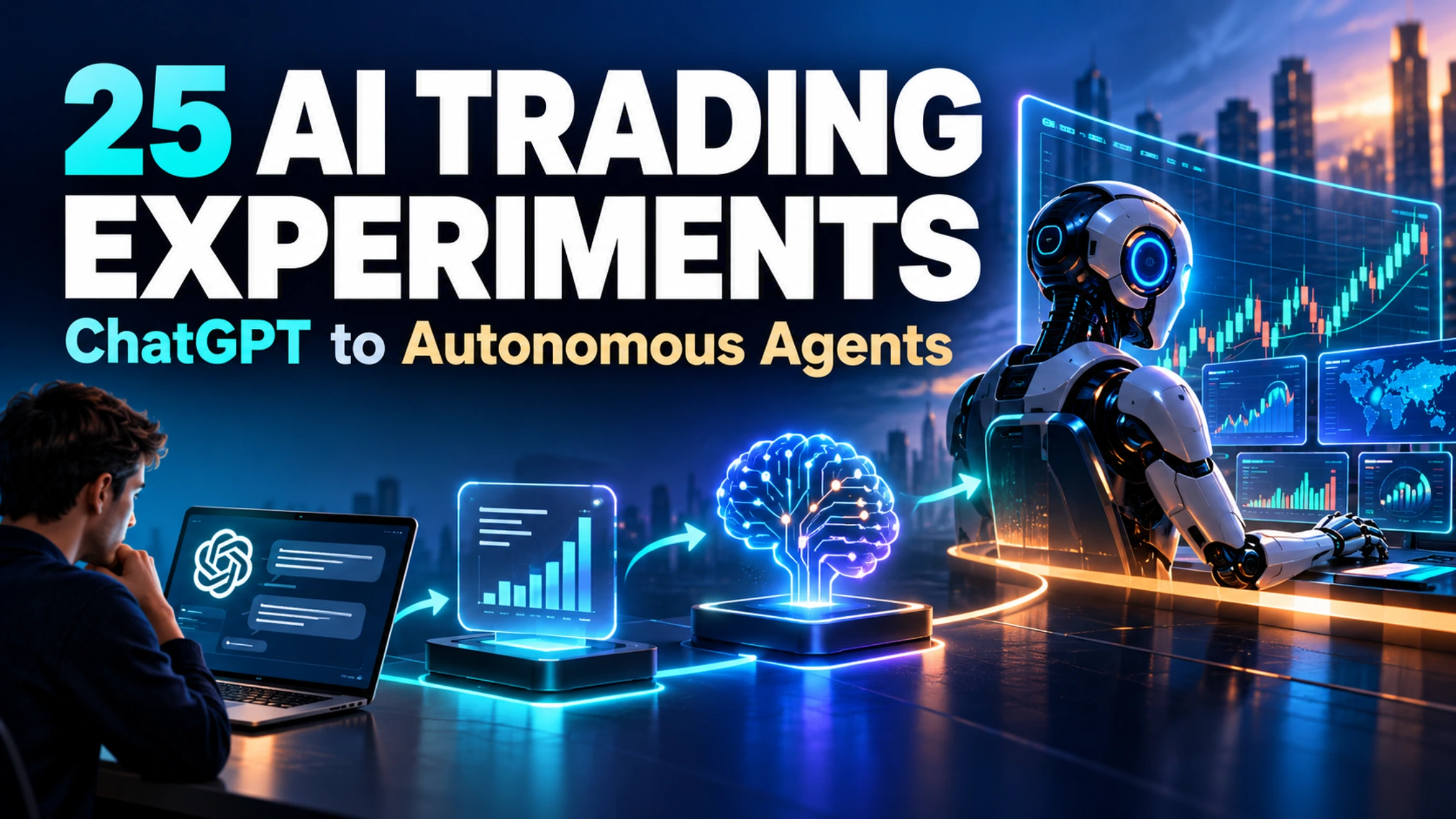
The 25 Best AI Trading Experiments to Try in 2027: From ChatGPT to Fully Autonomous Agents
You do not need to hand an AI your portfolio to understand agentic trading. The smarter path is an autonomy ladder: research first, then monitoring, simulation, human-approved execution, deterministic automation and only finally tightly constrained autonomous agents. This guide maps 25 experiments across that journey.
What Matters
- The best first AI trading experiment is usually not autonomous trading. It is research, monitoring, backtesting or paper trading.
- The phrase “AI trading” now covers very different technologies: ordinary rule bots, quantitative adaptation, LLM copilots, tool-using assistants and autonomous agents.
- Coinrule now operates an official MCP connection that can connect compatible assistants such as ChatGPT to portfolio information, strategy creation, backtesting and authorized strategy-management tools.
- Coinrule separates Read Only from Read + Write access and supports paper trading without a live exchange connection, making permission scope an explicit part of the AI trading workflow.
- 3Commas v1 was deactivated on 11 September 2026. Current 3Commas users should therefore distinguish the newer v2 platform from older tutorials and product comparisons.
- Cryptohopper explicitly states that its existing “A.I.” feature means Algorithmic Intelligence, not Artificial Intelligence. This is one reason DN does not classify a system as AI merely because its marketing uses the term.
- Public's investing Agents provide another emerging architecture: AI helps users create a plan, but once approved, the workflow is deterministic rather than continuously improvising.
- Coinbase AgentKit demonstrates the opposite end of the spectrum. It gives agents wallets and onchain actions, while its own documentation warns that prompt injection can become materially dangerous when untrusted text and funded wallets intersect.
- The CFTC warns that AI cannot predict future market shocks or transform trading bots into guaranteed money machines.
- DN therefore evaluates experiments using Learning Value, Capital Exposure, Reversibility, Observability and Authority Surface, not advertised win rates.
DN Evidence Block
- Verification date: 27 September 2026.
- Scope: AI-assisted research, rule automation, LLM trading copilots, MCP workflows, algorithmic strategy selection, wallet-enabled agents, prediction-market agents and autonomous execution.
- Commercial platforms independently checked: Coinrule, 3Commas v2, Cryptohopper, Gunbot, Cornix, TradingView and ASCN AI.
- Security evidence: Coinbase AgentKit documentation, TradingView webhook guidance and platform-specific permission documentation.
- Consumer-risk evidence: CFTC AI trading-bot advisory and FTC social-media fraud data.
- Commercial rule: affiliate availability is separated from editorial suitability and operational status.
- Testing rule: documentation review is labelled Documented. DN only uses Paper-Tested or Live-Tested after conducting those tests.
- Core conclusion: increase machine authority only after the lower-authority version of the workflow produces understandable, reproducible and reversible results.
- Not measured: this article does not claim that any experiment or platform will outperform the market.
AI Trading in 30 Seconds: Where Should You Start?
The useful starting point depends on what you want AI to do and how much authority you are prepared to give it.
| If you want to... | Start here | Autonomy | Live capital required | Primary risk |
|---|---|---|---|---|
| Understand markets faster | AI market explainer | Level 0 | $0 | Confident but weak analysis |
| Challenge your own trades | Trade-thesis red team | Level 0 | $0 | False balance |
| Stop watching charts constantly | AI-explained alerts | Level 1 | $0 | Alert mistaken for a trade signal |
| Test an AI strategy | Backtesting or paper trading | Level 2 | $0 | Overfitting |
| Use ChatGPT with trading software | Read-only MCP workflow first | Level 1-2 | $0 | Excessive permissions |
| Use AI with real money | Human-approved execution | Level 3 | Small isolated allocation | Rubber-stamping AI decisions |
| Automate an existing strategy | Deterministic bot | Level 4 | Small bounded allocation | Automating flawed rules |
| Experiment with autonomy | Separate wallet + hard controls | Level 5 | Tiny isolated allocation | Unexpected agent action |
If two experiments can achieve the same objective, prefer the one that gives the machine less authority. Autonomy should be earned through evidence, not treated automatically as a product upgrade.
The Wrong Question Is: Which AI Bot Makes the Most Money?
That is the question much of the AI trading internet is designed to provoke.
A trader sees an advertisement.
The advertisement shows a dashboard.
The dashboard is green.
A percentage return is highlighted.
The words “AI powered” appear somewhere nearby.
The natural question becomes:
Which AI should I give money to?
There is a much more useful question:
What is the smallest experiment that can tell me whether AI adds anything useful to my trading process?
That completely changes the journey.
You can experiment with AI trading without allowing AI to place a single live order.
You can test whether it:
- finds information faster,
- compresses market research,
- challenges a trading thesis,
- improves a journal,
- detects changes in market conditions,
- translates natural language into explicit rules,
- backtests those rules,
- monitors conditions continuously,
- or improves execution discipline.
Only after those questions are answered should the next question become:
Should it be allowed to act?
The DN AI Trading Autonomy Ladder
| Level | Machine authority | Capital risk | Example |
|---|---|---|---|
| 0. Research | No trading authority | No execution risk | AI explains a market or challenges a thesis |
| 1. Monitor | Observes and alerts | None unless the human acts | Agent watches volatility and sends an alert |
| 2. Simulate | Backtests or paper trades | Simulated | Bot trades virtual capital |
| 3. Approve | Prepares action, human confirms | Human-controlled | Agent prepares an order and waits |
| 4. Automate | Executes predefined rules | Bounded by configuration | DCA, grid or signal bot |
| 5. Agent | Observes, reasons and acts | Potentially material | Wallet-enabled agent inside hard external limits |
The most important variable in AI trading may not be model intelligence. It is Authority Surface: the range of actions the machine can take, how much capital those actions can affect, how reversible they are and whether an independent control layer can stop them.
DN AI Trading Reality Check
The term “AI trading” now describes technologies with radically different capabilities. DN uses the following classification throughout this research franchise.
| Class | What it actually does | Machine authority | Example use |
|---|---|---|---|
| Rule Automation | Executes predefined conditions without open-ended reasoning | Bounded | DCA, grid or TradingView automation |
| Algorithmic Adaptation | Selects or adjusts among predefined strategies using quantitative logic | Bounded | Market-regime strategy selection |
| LLM Copilot | Interprets natural language, researches or constructs strategies | Usually advisory | Turn an idea into explicit trading rules |
| Tool-Using AI | Can query portfolios, run backtests or invoke authorized external tools | Permission-dependent | MCP-connected AI assistant |
| Bounded Agent | Observes, reasons and takes actions inside predetermined controls | Material | Agent with asset, size and loss limits |
| Autonomous Agent | Can repeatedly observe, decide, execute and adapt with limited intervention | High | Loss-limited autonomous trading sandbox |
DN rule: a product is not classified as an autonomous AI agent merely because its marketing uses words such as AI, smart, adaptive, automatic or intelligent.
The 25 Best AI Trading Experiments for 2027
Ask AI to Explain One Market Move Without Asking It to Predict the Next One
Start with analysis.
Ask a tightly framed question such as:
“What materially changed in BTC over the last 24 hours, which explanations are supported by evidence and what remains uncertain?”
The objective is not price prediction.
It is testing whether AI improves information compression.
Use AI as a Trade-Thesis Red Team
Instead of asking AI what to buy, give it the trade you already want to make.
Then ask it to build the strongest evidence-based case against you.
Ask for:
- hidden assumptions,
- invalidating evidence,
- correlated risks,
- liquidity risks,
- and the conditions under which your thesis should be abandoned.
Turn Your Trading Journal Into an AI Post-Trade Critic
Feed structured records of entries, exits, size, thesis, planned invalidation, actual behavior and outcome into an AI analysis workflow.
The useful output is not hindsight.
Look for recurring behavior such as:
- chasing,
- widening stops,
- increasing size after losses,
- exiting winners prematurely,
- or repeatedly entering the wrong market regime.
Compare General AI With Crypto-Native Research AI
Ask the same question of a general-purpose assistant and a crypto-specific system connected to market, onchain or sentiment data.
ASCN currently describes a multi-agent system built around specialized Web3 analysis, including whale activity, market structure and social data.
The experiment is not “which AI predicts price?”
Measure:
- freshness,
- source quality,
- traceability,
- relevant market context,
- and whether uncertainty is communicated clearly.
Ask AI to Produce a No-Trade Decision
Most trading prompts contain an invisible assumption:
There must be a trade.
Reverse the prompt.
Ask:
“What conditions would make doing nothing the highest-quality decision?”
This tests whether the system can recognize uncertainty rather than manufacture activity.
Build an AI-Explained TradingView Alert
Let a deterministic condition monitor the market.
When it triggers, use AI to explain what changed before deciding whether to act.
TradingView supports webhook alerts to external applications, but it explicitly warns users not to include credentials or passwords in webhook payloads.
It also states that its alerts are not themselves designed as a secure automated-trading credential layer.
Build a Market-Regime Watcher
Have AI classify the environment rather than guess the next candle.
Possible regimes include:
- trending,
- range-bound,
- high volatility,
- low volatility,
- risk-on,
- and risk-off.
Record each classification and compare it with subsequent market behavior.
Monitor Whale and Onchain Activity Without Auto-Trading It
Use AI to surface unusual:
- wallet activity,
- exchange flows,
- funding anomalies,
- token-holder concentration changes,
- or liquidity shifts.
Then require a separate market check before considering a trade.
Run a Paper-Trading DCA Agent
Begin simulated execution with something simple enough to understand.
A DCA experiment can alter timing or position size according to rules you can inspect while keeping the entire process off real capital.
Paper-Test a Grid Strategy Across Different Market Regimes
Do not only test the period in which the grid performs well.
Run it through:
- sideways markets,
- strong uptrends,
- strong downtrends,
- high volatility,
- low volatility,
- and sudden gaps.
The value of the experiment is discovering when the strategy should not operate.
Turn a Plain-English Trading Idea Into Rules and Backtest It
Describe your trading idea in normal language.
Then require the system to translate every part into explicit conditions that can be tested.
Coinrule's official MCP connection allows compatible assistants such as ChatGPT to access authorized strategy and backtesting tools.
It supports Read Only and Read + Write permission scopes, and its documentation states that paper trading can be used without connecting a live exchange.
Compare a Static Bot With an Adaptive Strategy Selector
Run one fixed strategy against a system that selects among predefined strategies as market conditions change.
Cryptohopper is useful for illustrating the distinction between AI and algorithmic automation because its documentation explicitly defines its “A.I.” as Algorithmic Intelligence.
It analyzes configured strategies and selects among them based on market conditions.
Prototype a Trading Strategy With AI-Generated Code
Describe a strategy in natural language.
Let AI generate a first implementation.
Then treat that code as an untrusted draft until it has been reviewed and simulated.
Gunbot currently offers AI-assisted strategy prototyping and explicitly recommends testing machine-generated strategies in its simulator before real trading.
Its simulator uses current market data with virtual balances and simulated execution, while its documentation notes that real fills can still differ because of slippage, latency, partial fills, exchange minimums and outages.
Let AI Prepare the Trade but Require Human Approval
Move one step closer to execution.
The system can:
- identify a trigger,
- calculate position size,
- prepare an entry,
- prepare an invalidation level,
- prepare exits,
- and explain the reasoning.
Nothing reaches the venue until you approve it.
Connect ChatGPT to Trading Software With Read-Only Access First
This is an important intermediate architecture.
The AI interprets natural-language requests.
The trading platform remains the underlying account and strategy-management layer.
Coinrule MCP currently allows users to choose between Read Only and Read + Write access.
With Read Only access, the assistant can inspect supported balances, holdings, strategies, signals, trades, P&L and backtests but cannot place or change trades.
That makes read-only MCP a much more sensible first experiment than immediately enabling write permissions.
Run a Trade-Only API Bot With Withdrawal Disabled
When moving into automated execution, reduce the authority surface.
Where the venue supports separate API permissions, the key used for automation should not have withdrawal authority unless that capability is genuinely required.
Grant the automation only the permissions needed for the experiment.
Automate TradingView Alerts Into a Deterministic Bot
TradingView detects a predefined condition.
The automation platform executes according to rules configured in advance.
Cornix currently documents TradingView-triggered bots as well as DCA, Grid and Signals bots.
Its TradingView bot can automate configured entries, take-profit levels, stops and other predefined settings after receiving the relevant webhook trigger.
Automate Position Management but Keep Entry Decisions Human
A useful compromise is to retain the most discretionary decision while automating the repetitive work after entry.
The system might manage:
- stop-losses,
- take-profit ladders,
- trailing exits,
- time-based exits,
- or position reduction.
Build a Funding-Rate or Basis Monitor Before Automating the Trade
Have software monitor:
- perpetual funding,
- spot-perp basis,
- venue fees,
- collateral requirements,
- and estimated carrying cost.
Do not allow execution until the apparent spread still survives realistic costs.
Use Prediction-Market Probabilities as an AI Trading Signal
An AI-enabled workflow can monitor the implied probability of a future event and trigger a predefined response if the probability reaches a threshold.
Public currently integrates prediction-market data with its investing Agents.
Its documentation says Agents can monitor implied probabilities and use those signals to trigger alerts or actions elsewhere in a portfolio.
Public also states that once the user approves an Agent plan, the workflow executes deterministically rather than improvising each time.
Create a Cross-Asset Event Agent
Move beyond trading the event contract itself.
For example:
“If a market-implied probability crosses a defined threshold, alert me to re-evaluate this predetermined basket of related assets.”
The causal relationship should be specified before the event rather than invented after it.
Build a Three-Agent Desk: Researcher, Risk Critic and Executor
Instead of asking one model to control the entire workflow, separate responsibilities.
Agent one researches.
Agent two tries to reject the proposed trade.
A deterministic execution layer acts only when predefined requirements are satisfied.
This does not eliminate correlated failure.
Two agents built on similar models, data or prompts can still share the same blind spot.
Add a Dedicated No-Trade Agent
Give one component of the trading system a single objective:
stop trades.
It should look for:
- stale data,
- missing data,
- low liquidity,
- unusually wide spreads,
- conflicting signals,
- extreme volatility,
- unexpected API state,
- or model uncertainty above a threshold.
The system becomes more interesting when one participant is rewarded for abstention rather than activity.
Give an Agent a Separate Wallet With Hard External Limits
This is where the experiment becomes genuinely agentic.
Use a wallet or account created specifically for the experiment.
Fund it only with an amount you can afford to lose.
Where the surrounding infrastructure supports it, enforce restrictions such as:
- maximum capital exposed,
- maximum trade size,
- asset allowlists,
- destination allowlists,
- session expiry,
- and immediate revocation.
Do not assume the agent framework itself provides those controls.
Coinbase AgentKit's current documentation is particularly instructive here.
AgentKit gives AI agents wallets and onchain actions, but it explicitly warns that LLMs do not reliably distinguish instructions from data.
It also states that AgentKit itself does not gate transfers behind human approval, enforce spend caps or allowlist destinations.
Those controls therefore need to exist elsewhere in the architecture.
Run a Fully Autonomous Trading Agent Inside a Loss-Limited Sandbox
This is the final experiment, not the first.
The agent may be allowed to:
- observe approved data,
- research,
- select among approved strategies,
- size positions,
- execute,
- monitor,
- and close positions.
But autonomy should sit inside controls that the model cannot rewrite.
The unsafe prompt is:
“AI, trade profitably.”
A more useful experiment looks closer to:
“You may operate only in these markets, with this isolated balance, using these approved actions, subject to these maximum position sizes and this maximum loss. If a hard limit is reached, execution stops independently of your reasoning.”
The DN AI Trading Reality Check Before Connecting Money
Before connecting capital to anything marketed as an AI trading system, answer these questions.
| Question | Why it matters |
|---|---|
| What exactly is AI doing? | Research, rule construction, quantitative adaptation and autonomous execution are different products. |
| Can the system trade? | An analytical assistant has a smaller failure surface than a funded execution agent. |
| Can it withdraw or transfer assets? | Trading authority and movement authority should be treated separately. |
| Where does capital remain? | Exchange custody, a smart account, self-custodied wallet and platform custody create different risks. |
| Can it paper trade? | Simulation provides a reversible learning stage before live capital. |
| Are risk limits deterministic? | A prompt saying “be careful” is not equivalent to an independently enforced limit. |
| Can access be revoked immediately? | Revocation and credential expiry determine failure containment. |
| Can every action be reconstructed? | Logs, timestamps and order IDs improve accountability. |
| Does the performance figure include costs? | Fees, spread, funding, subscription cost and slippage can reverse apparent profitability. |
| What causes the system to abstain? | A system that always finds a trade is not necessarily intelligent. |
The Architecture Matters More Than the Model
A recurring mistake in AI trading is focusing too heavily on which LLM is supposedly the smartest.
For live capital, architecture can matter more.
Consider two systems.
System A uses a highly capable model with broad wallet authority.
System B uses a less capable model that can only generate a proposed action.
A separate deterministic policy layer then checks:
- allowed instrument,
- allowed venue,
- position size,
- daily loss,
- price freshness,
- spread,
- available buying power,
- and whether another risk condition has already been breached.
For most trading systems, System B is the more interesting architecture.
Agentic trading should increasingly separate probabilistic reasoning upstream from deterministic risk control downstream. Let AI interpret messy information. Let code decide what the AI is permitted to do with money.
The Prompt Is Not the Risk Limit
Telling an AI:
“Never risk more than 2%”
is not equivalent to an execution system that refuses orders outside the permitted risk envelope.
Language is interpretation.
Risk controls should be enforcement.
The difference becomes more important as agents gain access to external information and funded wallets.
Coinbase AgentKit's current risk documentation makes the problem unusually clear.
Text from a website, social feed, messaging system or external tool can enter the model context.
If the model is allowed to move funds, malicious instructions hidden in that external data can potentially influence a financial action.
That is a prompt-injection problem.
For trading systems, it is also a capital-governance problem.
The Social-Media AI Trading Ad Problem
AI trading is entering many of the same acquisition channels historically used to promote trading systems, forex signals, copy trading and crypto automation.
The combination is psychologically powerful:
- artificial intelligence,
- automation,
- financial markets,
- screenshots,
- and apparent passive income.
It is also exactly why verification matters.
The CFTC warns that fraudsters exploit enthusiasm around AI to market trading bots, algorithms and crypto schemes promising unusually high or guaranteed returns.
Its guidance is explicit:
AI cannot predict the future or sudden market changes.
FTC data add another reason for caution.
In 2025, people reported losing about $2.1 billion to scams that began on social media.
Investment scams accounted for roughly $1.1 billion of those reported social-media losses.
That does not mean an AI trading product advertised on social media is automatically fraudulent.
It means the advertisement is not evidence.
What DN Would Check Before Moving From Paper to Live Money
A system should not move from simulation to live capital merely because historical P&L is positive.
DN would look for:
- Out-of-sample behavior: did it work outside the period used to build it?
- Regime diversity: was it tested across trends, ranges and volatility shocks?
- Fee realism: are actual venue fees represented?
- Slippage realism: are simulated fills unrealistically favorable?
- Funding realism: for perpetuals, is funding included?
- Failed-order handling: what happens after rejection?
- State reconciliation: does the software verify what actually happened at the venue?
- Stale-data detection: can the system recognize delayed information?
- Loss limits: are limits enforced outside the LLM?
- Revocation: can access be removed immediately?
- Auditability: can every important action be reconstructed?
- Abstention: does the system know when it does not have enough evidence to act?
The 2027 AI Trading Experiment Sequence
| Stage | Experiments | Suggested live capital | Primary goal |
|---|---|---|---|
| Learn | 1-5 | $0 | Test research and reasoning value |
| Observe | 6-8 | $0 | Test monitoring and information freshness |
| Simulate | 9-13 | $0 | Test explicit strategies without live exposure |
| Approve | 14-15 | Small isolated allocation only after validation | Introduce execution while retaining human control |
| Automate | 16-23 | Small and bounded | Automate repetitive processes and enforce policy |
| Agentic | 24-25 | Tiny isolated experimental capital | Test genuine machine autonomy inside hard external controls |
Verified Commercial Pathways
These platforms occupy different positions on the AI Trading Autonomy Ladder. They are not ranked here by hypothetical profitability.
DN testing terminology: “Documented” means DN has verified the relevant capabilities against current first-party documentation. It does not mean the platform has been independently paper-traded or live-traded by DN.
Coinrule
Operational status: LIVE
Actually AI? LLM-connected tool use plus deterministic trading infrastructure.
AI role: Natural-language portfolio queries, strategy creation, backtesting and authorized strategy management through MCP.
Autonomy: Level 0-4 depending on permissions and workflow.
Permission model: Read Only or Read + Write.
Authentication: Coinrule documents OAuth 2.1 for MCP connections.
Paper mode: Yes. Coinrule states paper trading can be used without a live exchange connection.
Minimum sensible starting point: $0 via research, backtesting or paper trading.
Cost: Platform pricing plus any live exchange costs. Verify the current plan required for your intended workflow.
Best for: People moving from ChatGPT-style natural language into explicit strategies and backtests.
Avoid if: You expect an LLM to reliably predict markets on its own.
Largest failure mode: Granting write authority before understanding the strategy and permissions.
DN test status: Documented.
Last verified: 27 September 2026.
Explore Coinrule3Commas v2
Operational status: LIVE v2
Important: Legacy 3Commas v1 was deactivated on 11 September 2026.
Actually AI? AI-assisted trading workflow plus automated execution infrastructure.
Custody: 3Commas states funds remain on connected exchanges rather than being held by 3Commas.
Best for: Traders wanting automated strategy infrastructure from an established trading-bot ecosystem.
Avoid if: You are following old setup material built specifically for 3Commas v1.
Largest failure mode: Assuming old configurations or tutorials remain applicable to the current platform.
DN test status: Documented.
Last verified: 27 September 2026.
Explore 3CommasCryptohopper
Operational status: LIVE
Actually AI? Its existing named A.I. feature means Algorithmic Intelligence, not Artificial Intelligence.
Role: Strategy comparison and adaptive strategy selection among configured approaches.
Autonomy: Primarily algorithmic automation.
Best for: Traders interested in adaptive selection among predefined strategies.
Avoid if: You specifically want an LLM-based autonomous agent.
Largest failure mode: Confusing adaptive algorithmic automation with open-ended AI reasoning.
DN test status: Documented.
Last verified: 27 September 2026.
Explore CryptohopperGunbot
Operational status: LIVE
Actually AI? Primarily configurable algorithmic automation with AI-assisted strategy prototyping.
AI role: Gunbot AI can translate natural-language strategy descriptions into custom strategy prototypes.
Autonomy: Primarily Level 4 once a strategy is deployed.
Simulator: Yes for spot. Current-market simulation uses virtual balances and simulated order execution.
Best for: Technical traders wanting deep control, custom strategies and self-hosted automation.
Avoid if: You want a simple hands-off conversational trading assistant.
Largest failure mode: Strategy or configuration mistakes becoming persistent automated behavior.
DN test status: Documented.
Last verified: 27 September 2026.
Explore GunbotCornix
Operational status: LIVE
Actually AI? Primarily deterministic trading automation rather than a general autonomous AI agent.
Role: Signals, DCA, Grid and TradingView-triggered automation.
Autonomy: Level 4.
Demo capability: Cornix documents a demo workflow for TradingView bots.
Best for: Traders who already have signals or explicit rules they want executed automatically.
Avoid if: You want the platform itself to invent a market thesis.
Largest failure mode: A bad signal can be executed correctly and repeatedly.
DN test status: Documented.
Last verified: 27 September 2026.
Explore CornixTradingView
Operational status: LIVE
Actually AI? Not classified by DN as an autonomous AI trading platform.
Role: Charting, deterministic alerts, technical conditions and webhook triggers.
Autonomy: Level 1 by itself. It can become part of a Level 4 architecture when paired with external execution automation.
Best for: Separating market detection from execution.
Avoid if: You expect TradingView alerts themselves to provide a secure autonomous-trading architecture.
Largest failure mode: Treating webhook delivery and credential handling casually.
Security note: TradingView explicitly warns users not to include passwords or login credentials in webhook messages or URLs.
DN test status: Documented.
Last verified: 27 September 2026.
Explore TradingViewASCN AI
Operational status: LIVE
Actually AI? Yes, a crypto-native multi-agent research architecture.
AI role: Web3 research, blockchain-data interpretation, market structure and social/sentiment analysis.
Autonomy: Primarily research and analysis in the workflow assessed here.
Best for: Users wanting crypto-native AI research before making trading decisions.
Avoid if: You simply need a deterministic DCA or Grid bot.
Largest failure mode: Treating richer analytics as reliable price prediction.
DN test status: Documented.
Last verified: 27 September 2026.
4UZ09RW804
Commercial disclosure: The links above may compensate Decentralised News if a reader signs up or purchases through them. Commercial relationships are disclosed separately from operational status, editorial classification and DN testing status.
The list tells you what is possible. It cannot tell you which experiment creates the best learning-to-risk trade-off for your experience, capital and desired level of autonomy. That is the decision gap the Pathfinder is designed to solve.
The Pathfinder does not ask which bot you think will make the most money.
It asks:
- How experienced are you?
- How much capital are you prepared to expose?
- How much authority can the machine have?
- What are you actually trying to improve?
- How technical are you?
It then recommends the lowest-authority experiment capable of addressing that objective.
DN AI Trading Pathfinder
AI Trading Pathfinder
Choose your experience, capital, technical comfort, preferred authority level and objective. The Pathfinder recommends an experiment rather than pretending there is one universally best AI trading bot.
Paper-Trading Strategy
Level 2
Research + simulation
Your Next Step After the Pathfinder
This hub is designed to become the navigation layer for DN's wider AI Trading and Agentic Finance research system.
As each specialist article is published, this page can route readers into deeper evidence instead of simply expanding into an increasingly generic ranking.
| Pathfinder result | DN specialist research | Status |
|---|---|---|
| Paper trading | 9 Best AI Trading Agents to Try With Paper Money Before Risking Real Cash | Next in production |
| Beginner AI tools | 11 Best AI Crypto Trading Tools for Complete Beginners in 2027 | Planned |
| Limited permissions | 7 Best AI Trading Platforms You Can Try Without Giving Them Withdrawal Access | Planned |
| ChatGPT → trading | 9 Best AI Trading Tools for People Coming From ChatGPT | Planned |
| Small accounts | 7 Best AI Trading Apps for Testing With $100, $500 or $1,000 | Planned |
| AI authenticity | 10 “AI Trading Bots” Ranked by How Much AI They Actually Use | Planned |
| Prediction markets | 9 Best AI Tools for Prediction Market Trading in 2027 | Planned |
| Perpetual futures | 9 Best AI Trading Setups for Crypto Perpetual Futures | Planned |
| Advanced agency | Multi-Agent Trading Systems, Human-Agent Desks and Agent Risk Architecture | Planned |
DN should only convert these titles into internal links after the corresponding pages are live.
The AI Trading Metric Nobody Talks About: Authority Surface
Most AI benchmarks measure capability.
Trading introduces another dimension:
permission.
A mediocre model with broad account access can be more dangerous than a more capable model with no execution authority.
DN defines Authority Surface as the combination of:
- actions available,
- markets accessible,
- capital accessible,
- transfer authority,
- maximum order size,
- duration of access,
- ability to modify its own workflow,
- and reversibility after an error.
This provides a more useful way to compare agentic trading systems than simply asking which model is smartest.
The Agent Blast Radius
A second useful concept is the:
Agent Blast Radius.
It asks:
If this agent makes the worst plausible mistake allowed by its permissions, what can actually happen?
A research assistant has a small direct financial blast radius.
A read-only portfolio assistant has more privacy exposure but limited direct execution risk.
A trade-enabled bot can damage a portfolio through bad orders.
An agent with transfer authority has a much larger failure surface.
This is why custody and permissions belong in the same comparison table as AI capability.
The market is likely to spend years improving model intelligence. The more important financial-control problem may be ensuring that improvements in intelligence do not automatically produce equivalent increases in financial authority.
What Would Change Our View?
DN would become more comfortable with higher levels of autonomous AI trading if several things improved.
- Code-enforced transaction and portfolio limits became standard.
- Prompt-injection defenses improved materially.
- Agent identities, permissions and tool scopes became easier to audit.
- Execution histories became portable and independently verifiable.
- Models became meaningfully better calibrated about uncertainty.
- Agents demonstrated reliable abstention when data quality was poor.
- Independent policy layers became normal rather than optional.
- Real-world evidence showed autonomous strategies surviving multiple market regimes without hidden human rescue.
Conversely, enthusiasm should decline if more capable agents simply generate more activity without improving risk-adjusted outcomes.
Limitations
- No profitability ranking: DN does not rank these experiments by expected return. Performance depends on strategy, market regime, implementation, fees, slippage, leverage and many other variables.
- Documentation is not testing: capabilities labelled Documented have been checked against current first-party material but have not necessarily been independently paper-tested or live-tested by DN.
- Backtests can mislead: historical simulations can overfit the past and may omit realistic liquidity, latency, spreads, failed orders and market impact.
- Product features change: AI trading products are evolving quickly. Permissions, integrations, pricing and workflows may change after the verification date.
- AI lacks a universal category definition: vendors use the label for everything from simple automation to tool-using agents. DN therefore applies its own transparent classification.
- Paper trading is incomplete: simulation cannot perfectly reproduce spread, slippage, partial fills, queue position, outages, liquidation mechanics or the psychology of real losses.
- Security depends on architecture: the same model can be deployed safely or dangerously depending on credentials, permissions, custody, surrounding code and the tools it can invoke.
- Availability varies by jurisdiction: platforms, crypto products, derivatives and prediction markets may not be available or permitted everywhere.
- Affiliate relationships exist: commercial relationships are disclosed and are not treated as evidence of quality, safety or operational status.
The Bigger Opportunity May Not Be AI Predicting Every Trade
The strongest AI trading use case may ultimately be less dramatic than the advertisements suggest.
AI does not need to predict tomorrow's Bitcoin price to be useful.
It can:
- read more information,
- monitor more markets,
- translate ideas into rules,
- test those rules,
- challenge assumptions,
- monitor execution,
- identify when conditions changed,
- automate repetitive tasks,
- reduce emotional interference,
- and flag situations in which the evidence is too weak to act.
Those are less exciting claims than:
“AI makes money while you sleep.”
They may be much more economically useful.
The first mass-market winner in AI trading may not be the agent that replaces the trader. It may be the system that removes repetitive work while making human judgment more disciplined, observable and difficult to override emotionally.
The DN AI Trading Reality Check Standard
Every AI trading platform reviewed by Decentralised News in this research franchise should ultimately carry the same structured evidence block:
- Actually AI? Rule automation / algorithmic adaptation / LLM / bounded agent / autonomous agent
- AI role: research / strategy creation / monitoring / execution / adaptation
- Autonomy level: 0-5
- Capital location: exchange / smart account / wallet / platform custody
- Withdrawal or transfer authority: yes / no / configurable
- Paper mode: available / unavailable
- Minimum sensible starting point: based on the workflow, not vendor marketing
- All-in cost: subscription + venue fees + spread + slippage + infrastructure where relevant
- Best for: specific user profile
- Avoid if: specific user profile
- Largest failure mode: clearly identified
- Operational status: LIVE / RESTRICTED / MIGRATING / WINDING DOWN / INACTIVE
- DN test status: Documented / Paper-Tested / Live-Tested
- Last verified: visible date
- Affiliate relationship: separately disclosed
This standard should become more useful as more products begin describing themselves as AI agents.
The Bottom Line
AI trading is becoming real.
But “AI trading” no longer describes one category.
It can mean:
ChatGPT helping with research.
An AI agent reading onchain data.
A model translating plain English into deterministic rules.
An algorithm selecting between predefined strategies.
An MCP connector exposing trading tools to an assistant.
A prediction-market agent monitoring probabilities.
A deterministic workflow executing an AI-created plan.
Or a wallet-enabled agent capable of taking financial actions independently.
Those systems should not be evaluated as though they create the same risk.
The useful question for 2027 is therefore not:
Which AI should trade my money?
It is:
What is the next smallest amount of trading authority I can safely delegate and still learn something valuable?
Start with information.
Then monitoring.
Then simulation.
Then approval.
Then bounded automation.
Autonomy comes last.
That progression is slower than the advertisement.
It is also much more likely to reveal what the technology is actually good for.
This article is designed around two objectives that are deliberately kept separate: produce evidence useful enough to be cited by humans and AI systems, and help readers move from information toward an appropriate action without hiding essential facts behind a commercial funnel.
The 25 experiments are evaluated using five primary dimensions:
- Learning Value: how much the experiment can teach the user about AI, markets or their own trading process.
- Capital Exposure: how much real money can be affected.
- Reversibility: how easily an error can be stopped or undone.
- Observability: whether the user can reconstruct what the system saw, decided and executed.
- Authority Surface: the number and severity of actions the machine is permitted to take.
Commercial platforms are evaluated independently using operational status, actual AI role, autonomy level, custody, permissions, simulation availability, costs where verifiable, appropriate user profile, failure modes and DN testing status.
A platform's presence in the DN affiliate database is used only to identify the correct commercial link or referral code. It is not evidence that the platform is live, suitable or worthy of inclusion.
DN operational classifications are: LIVE, RESTRICTED, MIGRATING, WINDING DOWN and INACTIVE. Only independently verified LIVE products are eligible for active promotion.
DN testing classifications are: Documented, Paper-Tested and Live-Tested. Documentation review is never presented as first-hand product testing.
Primary Sources & Evidence
- Coinrule Help Center, What Is Coinrule MCP? Trade and Manage Strategies With AI Assistants, updated July 2026.
- Coinrule Help Center, Coinrule MCP: AI Trading Inside Your Chatbot, updated July 2026.
- Coinrule Help Center, How to Connect an AI Assistant to Coinrule MCP, updated July 2026.
- Coinrule Help Center, Coinrule MCP Permissions and Security Explained, updated July 2026.
- 3Commas Help Center, 3Commas V2: Everything You Need to Know, September 2026.
- Cryptohopper Help Center, What Is Algorithm Intelligence (A.I.) and How Does It Work?, verified September 2026.
- Gunbot Support, Simulator Mode, verified September 2026.
- Gunbot Support, Strategy Builder documentation.
- Gunbot, Gunbot AI / AI Trading Bot product documentation.
- Cornix Help Center, Trading Bots documentation.
- Cornix Help Center, TradingView Bot documentation, 2026.
- TradingView, How to Configure Webhook Alerts.
- TradingView, Using Credentials for Webhooks.
- ASCN, AI Crypto Agent product documentation.
- Public, Agents: The Basics, June 2026.
- Public, Prediction Markets product documentation.
- Public, Agents: Money, Risk and Rules.
- Coinbase AgentKit, Managing Risk documentation and open-source repository.
- CFTC, AI Won't Turn Trading Bots into Money Machines.
- Federal Trade Commission, New Data Show People Have Lost Billions to Social Media Scams, April 2026.
Frequently Asked Questions
Can ChatGPT trade crypto for me?
A normal ChatGPT conversation does not automatically control a trading account. External platforms can, however, connect compatible AI assistants to authorized trading tools through mechanisms such as MCP or APIs. The important questions are which permissions are granted, what the assistant can actually do and what deterministic controls exist outside the model.
What is the safest AI trading experiment for a beginner?
Research-only, monitoring and paper-trading experiments create the lowest execution risk. They allow a user to evaluate information quality, strategy logic and automation behavior before granting software authority over live capital.
Are AI trading bots profitable?
There is no universal answer. Outcomes depend on strategy, market regime, fees, spreads, slippage, leverage, execution quality, implementation and risk controls. Regulators warn that guaranteed or unusually high AI trading return claims should be treated with skepticism.
What is the difference between an AI trading bot and an AI trading agent?
A traditional bot generally executes predefined rules. An AI trading agent may interpret information, use external tools, make intermediate decisions and choose actions dynamically. Many products marketed as AI still rely heavily on deterministic automation.
What is Authority Surface?
Authority Surface is a Decentralised News concept describing the range and severity of financial actions a machine is permitted to take, including markets accessed, capital available, transfer permissions, position limits and the duration of those permissions.
What is Agent Blast Radius?
Agent Blast Radius is a DN framework asking what could happen if an AI agent made the worst plausible mistake allowed by its current permissions. A research assistant has a small direct financial blast radius, while an agent with broad transfer authority can have a much larger one.
Should an AI trading agent have withdrawal access?
For most retail experiments, separating trading authority from withdrawal or asset-transfer authority reduces the potential impact of software, credential or model failure. Users should grant only the permissions actually required for the workflow.
What is paper trading?
Paper trading simulates orders and portfolio outcomes without risking real capital. It is useful for testing mechanics and strategy logic, but simulation cannot perfectly reproduce live spreads, slippage, liquidity, latency, partial fills or outages.
What is an MCP trading connection?
Model Context Protocol allows compatible AI assistants to access authorized external tools. In trading, an MCP connection can expose supported functions such as portfolio inspection, strategy creation or backtesting while the trading platform remains the underlying system handling those functions.
Can I connect ChatGPT to Coinrule without letting it trade?
Coinrule currently documents a Read Only MCP permission that allows compatible AI assistants to inspect supported account and strategy information without access to write tools that can create or change trading activity.
What should I test before letting an AI trade live money?
At minimum, test the workflow in simulation, include realistic costs, define explicit position and loss limits, restrict permissions, confirm an immediate revocation path, test failed-order behavior and ensure every financial action can be reconstructed from logs.
Freshness, Change Log & Corrections
| Date | Change |
|---|---|
| 27 September 2026 | Initial 2027 edition published with 25 experiments across the DN AI Trading Autonomy Ladder. |
| 27 September 2026 | Verified current product evidence for Coinrule, 3Commas v2, Cryptohopper, Gunbot, Cornix, TradingView and ASCN AI. |
| 27 September 2026 | Added DN AI Trading Reality Check, Authority Surface and Agent Blast Radius frameworks. |
| 27 September 2026 | Added the DN AI Trading Pathfinder, decision table, testing-status terminology, limitations and specialist-research routing. |
| 27 September 2026 | Updated security analysis to distinguish model instructions from externally enforced capital controls. |
Last verified: 27 September 2026.
Correction policy: AI trading products change quickly. If a platform changes its operational status, permissions, custody model, product architecture, pricing or supported features, Decentralised News will update the relevant evidence and record material changes here.
Readers and platforms can report factual errors through the Decentralised News Contact page. Commercial relationships do not prevent corrections, downgrades or removal from recommendations.