
Ethereum development has a data problem disguised as an API problem.
A developer building a wallet does not merely need an ETH balance. A portfolio application needs token balances, prices, historical transactions, DeFi positions and profit-and-loss data. A trading terminal needs sub-second DEX prices, OHLCV charts, pair-level liquidity and WebSocket streams. An explorer needs decoded blocks, contracts and transaction history. A dApp that sends transactions needs raw Ethereum node access.
Those are different jobs.
That distinction matters because there is no universally “best Ethereum API.” The strongest provider depends on whether the application needs application-ready enriched data, historical blockchain state, real-time DEX intelligence, explorer infrastructure or direct RPC access.
For this 2026 ranking, Decentralised News evaluated the Ethereum developer stack around those actual workloads rather than ranking providers simply by the number of endpoints they advertise.
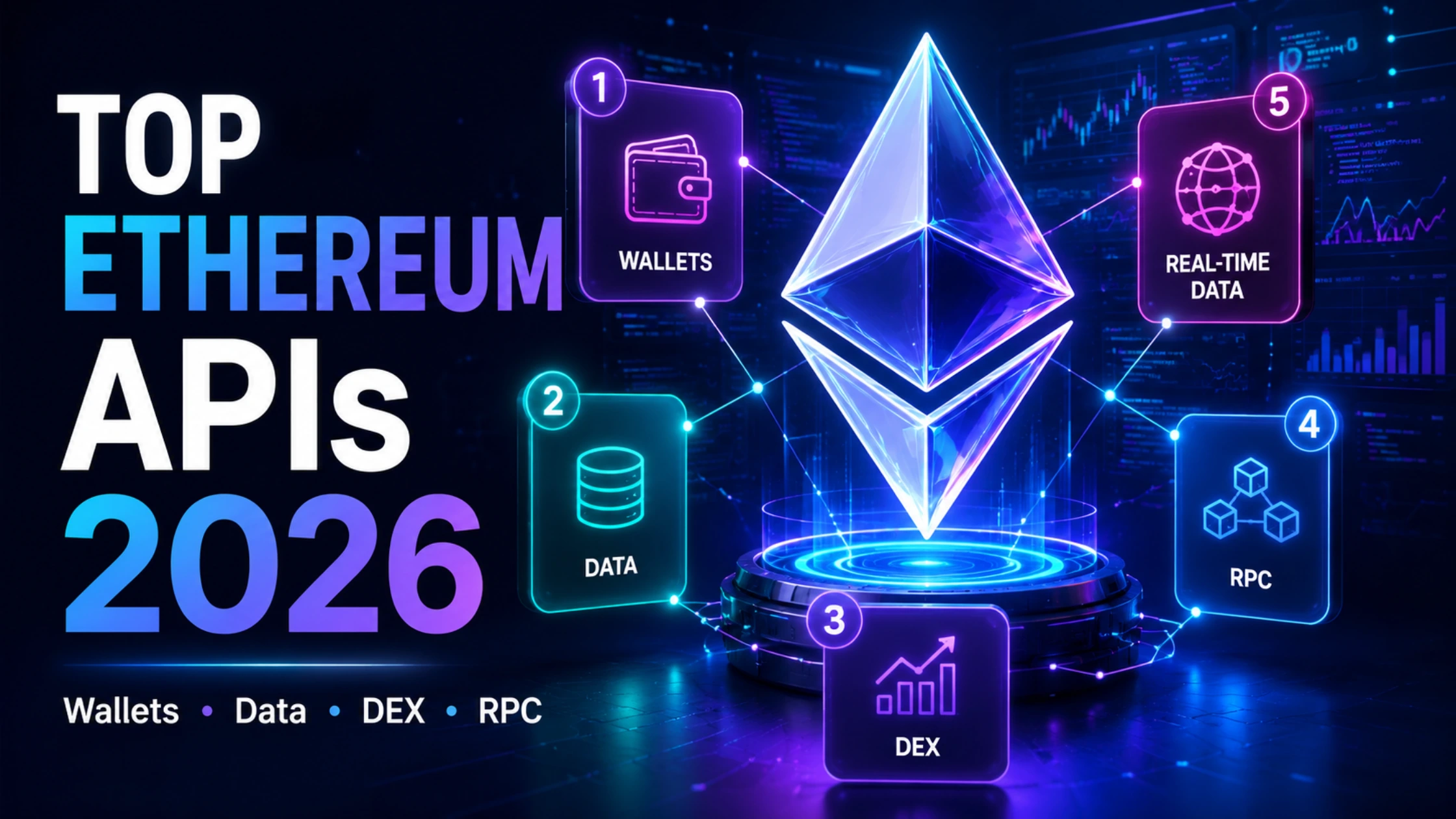
Our top five are:
- CoinStats API: Best overall for application-ready Ethereum wallet, market, DeFi and portfolio data
- GoldRush by Covalent: Best for decoded Ethereum history and historical portfolio intelligence
- Codex: Best for real-time Ethereum DEX, token and trading data
- Blockscout: Best open-source Ethereum explorer and contract-data API
- Tatum: Best for combining Ethereum RPC access with indexed application data
The result is less a winner-takes-all league table than a map of the modern Ethereum data stack.
Key Findings
Best overall Ethereum data API: CoinStats
Best for historical blockchain data: GoldRush
Best for live DEX and trading applications: Codex
Best open-source explorer API: Blockscout
Best for RPC plus indexed data: Tatum
Best for wallet and portfolio applications: CoinStats
Best for AI-agent blockchain data: GoldRush and Codex
Best for submitting transactions: Tatum
Best for live token discovery: Codex
Best for self-hostable explorer infrastructure: Blockscout
Top Ethereum APIs at a Glance
Rank | Ethereum API | Best For | Core Model | Main Strength | Main Limitation |
1 | CoinStats | Wallets, portfolios, DeFi apps | Enriched REST data API | Application-ready unified data | No RPC or transaction submission |
2 | GoldRush | Wallet history, accounting, analytics | Indexed data + RPC | Deep decoded historical data | Less specialized for ultra-low-latency token trading |
3 | Codex | Trading apps, DEX analytics, token discovery | GraphQL + WebSockets | Real-time token and pair intelligence | Not an RPC provider |
4 | Blockscout | Explorers, contracts, transaction lookup | Open-source explorer API | Open infrastructure and familiar API patterns | Less portfolio-enriched than specialist data APIs |
5 | Tatum | dApps needing node access and indexed data | RPC + Data API + WebSockets | Raw node access and enriched data together | Broader infrastructure suite can be more than simple read-only apps need |
How Decentralised News Ranked the APIs
This edition uses the DN Ethereum API Utility Matrix, which looks at six practical developer requirements.
1. Application readiness
How much processing must a developer perform before the returned blockchain data becomes useful inside an application?
Raw blockchain state scores differently from pre-priced balances, decoded DeFi positions or calculated portfolio P&L.
2. Ethereum and L2 coverage
Ethereum increasingly means more than Ethereum mainnet.
We considered whether an integration can extend naturally to networks such as Base, Arbitrum, Optimism and other EVM environments.
3. Historical depth
Can developers obtain full wallet histories, historical valuations, transfers and decoded activity without maintaining their own indexer?
4. Real-time capability
We looked for WebSockets, subscriptions, webhooks and other push-based mechanisms suitable for trading, alerting and live interfaces.
5. Developer experience
This includes documentation, schemas, SDKs, authentication, testing environments, MCP support and how much infrastructure developers must build themselves.
6. Infrastructure breadth
Some applications only need enriched blockchain data. Others need raw RPC calls, contract interaction and transaction submission.
A provider earns additional utility where those functions coexist cleanly.
What DN Verified
Research date: August 14, 2026
For this edition, Decentralised News reviewed the providers’ current Ethereum product pages, developer documentation, API architecture, supported data surfaces, real-time tooling, publicly disclosed access models and current pricing information where available.
This is a documentation and product-capability audit, not a production-load benchmark.
We did not run sustained latency tests, send millions of API requests, benchmark regional response times or independently validate vendor uptime claims. Performance numbers attributed to providers should therefore be understood as provider-published figures unless explicitly stated otherwise.
That distinction is important. An API can have an excellent feature set without necessarily being the fastest API from every region or under every production workload.
1. CoinStats API: Best Overall Ethereum API for Application-Ready Data
Best for: Wallets, portfolio trackers, DeFi applications, accounting products, token-risk tools and applications that need Ethereum data already converted into usable financial information.
Explore the CoinStats Ethereum API
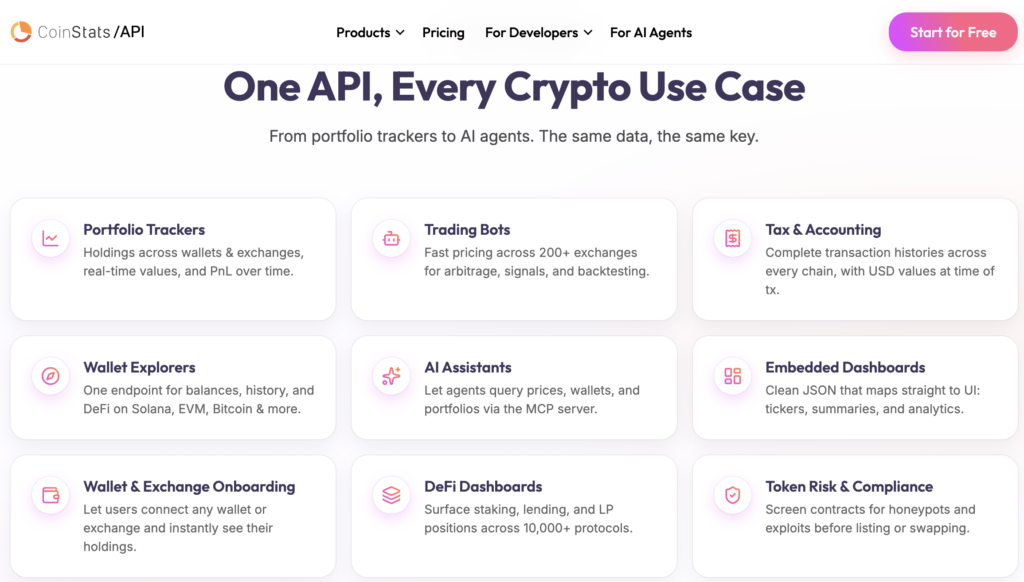
CoinStats takes first place because it solves one of the least glamorous but most expensive problems in blockchain development: turning raw Ethereum activity into information an application can actually display to a user.
The Ethereum API accepts an Ethereum or EVM address and can return native ETH, ERC-20 balances, transaction history, prices and DeFi positions through a unified data model. CoinStats currently documents support for 74 EVM chains within broader coverage spanning more than 120 blockchains.
That makes it particularly useful for products whose users increasingly treat Ethereum, Base, Arbitrum and other EVM environments as one portfolio rather than independent blockchain silos.
Why CoinStats ranks first
A conventional blockchain API may tell an application:
This address owns 14,238,391 units of token contract X.
CoinStats is designed to get closer to:
This wallet owns $4,620 of token X, has $2,100 supplied to a lending protocol, $1,700 in an LP position and has generated a particular historical profit or loss.
That is a much shorter path from blockchain state to user interface.
Its Ethereum endpoints include transaction histories covering ETH movements, ERC-20 transfers, swaps and contract interactions with historical USD values. The API also exposes portfolio analytics including allocation, performance and realized and unrealized P&L.
For DeFi applications, CoinStats says it automatically resolves staking, lending, LP and yield positions across more than 10,000 protocols rather than forcing developers to integrate every protocol independently.
That is why we rank it above providers that may be stronger in a narrower technical category.
The killer feature: one address becomes a financial portfolio
CoinStats’ value is not merely the number of Ethereum endpoints.
It is data enrichment.
Developers can combine:
- ETH balances
- ERC-20 holdings
- token prices
- complete transaction history
- DeFi positions
- portfolio valuation
- historical performance
- realized and unrealized P&L
- token security information
without constructing each layer from unrelated infrastructure.
The Token Risks endpoint is another differentiator. CoinStats says it can screen ERC-20 smart contracts for issues including honeypot behaviour, hidden fees, blacklist functionality, centralized minting, upgradeable proxies and pausable transfers, with the security layer powered by Hexens.
That is particularly relevant for wallets, trading interfaces and routing applications that need more than a token’s symbol and price.
CoinStats and AI agents
CoinStats also now operates an MCP server that exposes wallet, DeFi and portfolio functionality to compatible AI environments. Its Ethereum page lists integrations for agent and developer environments including Claude, Cursor, VS Code and automation tooling.
This matters because blockchain APIs are increasingly being consumed by software agents as well as conventional applications.
Instead of an AI assistant manually parsing explorer pages, it can query structured wallet and portfolio information.
CoinStats pricing
CoinStats currently advertises 20,000 free credits per month at up to two requests per second, with no credit card required for the free tier. Pricing is credit-based, meaning more complex endpoints consume different quantities of credits rather than every request having identical economic weight.
That is enough for meaningful prototyping, although production economics will depend heavily on which endpoints an application uses.
Where CoinStats is weaker
CoinStats is a data API, not an Ethereum node provider.
It does not submit transactions, create wallets or expose raw Ethereum RPC as its core product. CoinStats explicitly recommends pairing its data layer with separate RPC or wallet infrastructure when applications need those capabilities.
That makes the architecture particularly clear:
Use CoinStats when you want to understand Ethereum data.
Use an RPC layer when you need to directly interact with Ethereum state or submit transactions.
DN Verdict
For most consumer-facing applications, that trade-off makes sense.
If we were building a portfolio tracker, wallet intelligence interface, DeFi dashboard, tax application or cross-chain wealth product in 2026, CoinStats would be the first API in this ranking we would evaluate.
2. GoldRush by Covalent: Best for Decoded Ethereum History
Best for: Wallet history, historical portfolios, accounting, tax applications, forensic analytics, transaction exploration, multi-chain portfolio products and AI agents requiring structured blockchain history.
GoldRush is the strongest choice in this ranking when the problem begins with:
What has this Ethereum address actually done?
Its Ethereum API provides structured token balances, transaction histories, decoded event logs, NFT data and token-holder information. GoldRush currently documents 28 supported API endpoints for Ethereum, while the wider platform covers more than 100 EVM and non-EVM chains.
The historical dimension is where GoldRush becomes particularly useful.
Its documented portfolio workflow combines current token balances, historical portfolio value and complete transaction history for cost-basis analysis.
That naturally suits:
- portfolio trackers
- accounting systems
- crypto tax software
- wealth dashboards
- wallet intelligence
- audit trails
- blockchain forensics
GoldRush’s real advantage: decoded history
Raw Ethereum transactions are rarely application-ready.
A transaction may contain contract calls, logs, transfers and internal state changes that must be decoded and reconstructed before an application can explain what happened.
GoldRush’s proposition is to move that burden upstream.
Its Foundational API returns structured historical blockchain information rather than forcing each application to build its own decoding infrastructure.
That becomes increasingly important as Ethereum activity moves across L2s and users interact with dozens of contracts.
Historical portfolio value
One especially valuable GoldRush workflow is getHistoricalPortfolioForWalletAddress, which is designed to retrieve historical portfolio value over time. Combined with current balances and full transaction histories, that creates a useful foundation for wealth-management and accounting interfaces.
This is difficult to reproduce correctly from raw RPC calls alone.
Important 2026 update: GoldRush now also offers JSON-RPC
GoldRush has historically been associated primarily with indexed blockchain data, but its current Ethereum documentation also exposes low-latency EVM JSON-RPC with archive depth and global failover.
That makes the product broader than a pure historical data API.
Across the wider platform, GoldRush says JSON-RPC is available for more than 30 EVM networks while its structured data APIs cover more than 100 chains.
For developers, that potentially reduces the number of providers required for certain applications.
GoldRush is aggressively agent-native
GoldRush has made AI-agent infrastructure a meaningful part of its product rather than adding an “AI” label to ordinary REST documentation.
Its MCP implementation exposes blockchain data as tools and resources for LLMs, while its current agent platform describes a first-party MCP server with more than 27 tools.
GoldRush also supports an x402-based pay-per-request model intended to let autonomous software discover endpoints and pay for blockchain data without conventional account onboarding. Current documentation describes more than 60 published x402 endpoints spanning balances, transactions, blocks, DEX data, pricing, security and cross-chain functions, although the published x402 rollout documentation should be checked for current network/payment availability before production deployment.
Its CLI adds another interesting developer surface, with 17 commands, real-time streaming and native MCP support.
GoldRush pricing
GoldRush currently advertises:
- a 14-day trial with 25,000 credits
- a $10 per month Vibe Coding tier with 10,000 credits
- a $250 per month Professional tier with 300,000 credits
- custom enterprise arrangements
The Professional tier is listed with 50 requests per second, while lower tiers list four requests per second.
Actual cost comparisons require care because credit consumption varies by endpoint and payload size.
Where GoldRush is weaker
If the application is primarily a millisecond-sensitive DEX trading terminal, historical completeness is not necessarily the first design priority.
That is where the next provider becomes more compelling.
DN Verdict
GoldRush ranks second because Ethereum history is not just a collection of blocks. Applications need decoded, contextualized and historically valued activity.
For applications where the question is “what happened to this wallet over time?”, GoldRush may be the strongest choice in the five.
3. Codex: Best for Real-Time Ethereum DEX and Token Data
Best for: Trading terminals, live token charts, DEX analytics, token screeners, newly launched token discovery, wallet analytics, smart-money tools and AI agents consuming real-time blockchain market data.
Codex occupies a very different part of the Ethereum stack.
Where CoinStats is optimized around application-ready portfolios and GoldRush around decoded history, Codex is built for real-time market intelligence.
Its core interface is a unified GraphQL API for token prices, charts, transactions, wallets and related market data, with GraphQL subscriptions for live streaming and webhooks for event-driven applications.
For an Ethereum trading product, that distinction is substantial.
Why Codex ranks third overall but first for trading
A developer building a DEX terminal needs answers to questions such as:
- What is this token worth now?
- What did the last trade execute at?
- What does its OHLCV chart look like?
- Who are the largest holders?
- Which wallets are profitable?
- What is the liquidity?
- Has a new pair just appeared?
- Can the interface update without polling every few seconds?
Codex is designed around that problem.
Its GraphQL architecture lets applications combine token metadata, pricing, holder information, recent trades, pair statistics and chart data in fewer calls than endpoint-heavy REST architectures. Codex also offers WebSocket subscriptions and webhooks for live prices, trades, balances and other events.
Ethereum and L2s through one schema
Codex treats Ethereum as part of a wider multichain trading environment.
Its current product material lists Ethereum, Base, Arbitrum, Optimism and other networks under one schema, while its documentation describes support spanning more than 80 networks.
This is particularly useful for a trading product.
A terminal built around Ethereum mainnet does not need a completely different data architecture when users begin trading on Base or Arbitrum.
The network becomes a parameter rather than an entirely separate integration.
Sub-second trading data
Codex positions its market data as sub-second and trading-ready. Its platform says it indexes and enriches transactions across more than 80 chains and more than 700 million wallets.
The API surfaces:
- token prices
- OHLCV and chart data
- holder information
- token balances
- trades
- pair analytics
- liquidity information
- wallet analytics and P&L
- token discovery
- launchpad data
Its July 2026 updates expanded wallet P&L and introduced route-backed liquidity data designed to avoid overstating liquidity from economically unusable pools.
That is the kind of detail trading applications increasingly need.
Real-time delivery is the key differentiator
Codex supports GraphQL subscriptions over WebSockets.
Instead of asking:
Has the price changed yet?
every few seconds, an application can maintain a persistent subscription and receive updates when the underlying data changes.
For live charts, token alerts, trading screens and automated market monitoring, that is much cleaner than constructing large polling systems.
Webhooks provide a complementary model for server-side workflows where the consumer does not need to maintain an open connection.
Production validation
Codex says its infrastructure supplies data to applications including Coinbase, TradingView, MoonPay, Uniswap, Rainbow, Farcaster and other crypto products. Its customer material says TradingView uses Codex for on-chain data and real-time crypto candlestick delivery.
Those are vendor-published customer references rather than independent DN performance tests, but they provide useful evidence of the type of workloads the system is intended to serve.
Codex and AI agents
Codex has become particularly interesting in 2026 because developers can expose the data layer to agents through:
- a documentation MCP server
- Codex Skills
- GraphQL
- WebSockets
- keyless Machine Payments Protocol access
Its MPP implementation allows an agent or script to make a request without a conventional API key and pay $0.001 USDC per query over the Tempo network. The server returns an HTTP 402 payment challenge, the client pays, and the API returns the requested data.
This is more interesting than it may initially sound.
The traditional API model assumes:
human creates account → human enters payment method → human creates key → software uses key
Agentic infrastructure increasingly points toward:
software discovers API → software evaluates cost → software pays → software consumes data
Codex is one of the clearest examples of that model in this ranking.
Codex pricing
Codex currently provides an entry allowance of 10,000 requests per month. As of August 3, 2026, creating a new account requires a one-time $1 activation payment, although there is no recurring charge on the entry tier.
The Growth plan starts at $350 per month for one million requests, with up to 300 requests per second, five API keys, WebSockets and webhooks.
Developers planning high-volume WebSocket use should model consumption carefully because Codex bills WebSocket messages against usage.
Limitations
Codex is not an Ethereum RPC provider.
It is designed to enrich and serve blockchain data rather than submit raw Ethereum transactions or replace node access.
A trading application may therefore use:
Codex for prices, token intelligence, wallet data and live DEX events
plus:
an RPC provider for transaction submission and raw Ethereum state.
Codex also focuses heavily on on-chain markets. A product requiring centralized exchange order books or execution would need another data source.
DN Verdict
Codex is the most compelling API in this ranking for a team building the Bloomberg Terminal of on-chain Ethereum markets.
Its third-place overall ranking reflects specialization, not weakness.
For a DEX terminal, real-time charting application or Ethereum token screener, we would move it straight to the top of the shortlist.
4. Blockscout: Best Open-Source Explorer API
Best for: Block explorers, transaction search, contract interfaces, address analytics, token transfers, internal transactions and teams that value open-source infrastructure.
Blockscout solves a fundamentally different problem from CoinStats, GoldRush and Codex.
It is an open-source EVM blockchain explorer and API infrastructure layer.
That distinction makes it particularly important for applications that need reliable explorer-style information without building an entire indexing and visualization stack themselves.
Blockscout currently describes support across more than 1,000 EVM-based L1, L2 and L3 networks, including optimistic and zero-knowledge rollups.
Why Blockscout belongs in the top five
Ethereum developers often need basic but foundational data:
- address history
- blocks
- transactions
- token transfers
- internal transactions
- smart contracts
- contract verification
- search
- chain statistics
These jobs do not necessarily require portfolio P&L or trading-grade market data.
They require a dependable view into the chain.
Blockscout’s PRO API provides multichain access while retaining familiar explorer-style endpoint patterns, and its newer REST API adds enriched address metadata, decoded transaction information, NFT details, smart-contract functionality and chain-health information.
That creates a relatively easy migration path for applications already built around traditional explorer API conventions.
Open source is a real differentiator
Blockscout’s open-source model matters for more than ideology.
Developers can inspect the explorer implementation, modify it and self-host components rather than treating the entire infrastructure as an opaque third-party service.
Blockscout describes its explorer, MCP implementation, API endpoints and agent-related tooling as open source.
For blockchain teams building public infrastructure, foundations or applications where transparency matters, that can be more valuable than another collection of proprietary enrichment endpoints.
Developer access
Blockscout now operates a Universal PRO API through its developer portal while continuing to provide free access options. Its documentation emphasizes multichain queries and streamlined migration to the newer API.
A 2026 Blockscout developer guide describes querying balances, transactions, token transfers, contracts, blocks, internal transactions and chain-specific data across multiple EVM networks through a Postman collection.
Where Blockscout is weaker
Blockscout is not trying to be a full financial portfolio analytics platform.
If an application needs:
- portfolio P&L
- DeFi position aggregation
- sophisticated token-risk scoring
- live DEX charting
- trading wallet analytics
then CoinStats or Codex may provide more application-ready outputs.
But that is not the job Blockscout is designed to win.
DN Verdict
Blockscout is the strongest choice here for developers who think:
I need Ethereum explorer infrastructure and structured chain data, but I value an open-source stack.
It earns fourth place because that role is fundamental, even if it is less enriched than the higher-ranked specialist data APIs.
5. Tatum: Best Ethereum API for RPC Plus Indexed Data
Best for: dApps, wallets and infrastructure teams that want raw Ethereum RPC, WebSockets, transaction submission, indexed wallet data and event notifications under one provider.
Tatum rounds out the ranking because it covers the developer requirement the first four do not prioritize equally:
Actually talking directly to Ethereum nodes.
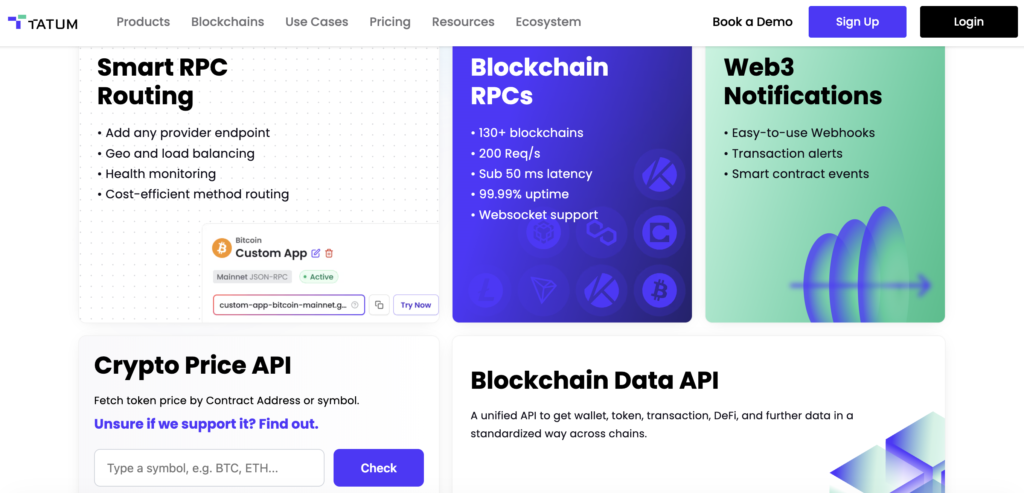
Its Ethereum stack includes an RPC gateway, WebSocket subscriptions, a standardized Data API and blockchain notifications.
This means a developer can use one provider for both low-level and higher-level blockchain interactions.
Ethereum RPC
Through the RPC gateway, developers can perform conventional Ethereum operations such as:
- reading blockchain state
- querying transactions
- interacting with smart contracts
- estimating gas
- submitting transactions
Tatum’s Ethereum documentation exposes standard JSON-RPC methods and supports WebSocket eth_subscribe for new blocks, logs and pending transactions.
That makes it fundamentally different from CoinStats and Codex.
Those platforms primarily tell applications what Ethereum data means.
Tatum can also provide the infrastructure needed to interact with Ethereum itself.
Indexed data without building a separate backend
The higher-level Data API adds standardized indexed information such as wallet token balances, transaction history including internal transfers, exchange-rate information and risk-related address data.
That creates a useful middle ground.
Instead of choosing between:
raw node
and
completely separate indexer
developers can access both infrastructure categories using the same broader platform.
Tatum’s 2026 multichain Data API is designed to standardize blocks, transactions, balances and related information across more than 130 blockchains.
WebSockets and notifications
Tatum also supports real-time Ethereum WebSockets plus a notification layer for monitoring transactions and smart-contract events.
For applications that need:
send transaction → monitor confirmation → update user → refresh indexed balance
the combination is logical.
Performance claims need context
Tatum says its Ethereum RPC gateway has been tested to 10,000 requests per second and advertises production WebSocket support. Its wider platform markets high-throughput RPC infrastructure with automated routing and failover capabilities.
DN has not independently reproduced the 10,000 RPS test, so developers with latency-sensitive production systems should benchmark Tatum from their own deployment regions before relying on the vendor figure.
That same rule should apply to every infrastructure provider.
Where Tatum is weaker
Breadth can also create complexity.
A developer building a simple Ethereum portfolio dashboard may not need:
- RPC routing
- node access
- wallet infrastructure
- notifications
- indexed data
- WebSockets
all from the same provider.
For those teams, CoinStats or GoldRush may produce the required application data more directly.
Tatum becomes most attractive where node-level interaction and higher-level indexed data genuinely need to coexist.
DN Verdict
Tatum is the best fit in this ranking for a developer who wants to minimize the gap between:
raw Ethereum infrastructure
and
application-friendly blockchain data.
It earns fifth place overall, but for transaction-heavy dApps it could easily be the first provider worth testing.
DN Ethereum API Utility Matrix
The rankings become more useful when viewed by workload.
Developer Requirement | CoinStats | GoldRush | Codex | Blockscout | Tatum |
Wallet balances | Excellent | Excellent | Strong | Strong | Strong |
Portfolio analytics | Excellent | Excellent | Strong | Limited | Moderate |
DeFi positions | Excellent | Strong | Moderate | Limited | Moderate |
Historical transactions | Excellent | Excellent | Strong | Excellent | Strong |
Historical portfolio value | Excellent | Excellent | Strong | Limited | Moderate |
Token risk data | Excellent | Strong | Strong | Limited | Moderate |
Real-time DEX data | Moderate | Strong | Excellent | Limited | Moderate |
OHLCV / charts | Strong | Strong | Excellent | Limited | Moderate |
Holder analytics | Strong | Strong | Excellent | Strong | Moderate |
Wallet P&L | Excellent | Strong | Excellent | Limited | Limited |
WebSockets | Limited | Available in product stack | Excellent | Not core | Excellent |
MCP / agent tooling | Strong | Excellent | Excellent | Strong | Emerging/general developer tooling |
Open source | No | Partial tooling | No | Excellent | No |
Raw Ethereum RPC | No | Yes | No | Limited/explorer-oriented | Excellent |
Send transactions | No | Via RPC surface | No | Not primary use | Excellent |
Important: These are capability assessments, not latency scores. “Excellent” means the provider’s documented product is particularly well suited to that workload.
Which Ethereum API Should You Choose?
Choose CoinStats if…
You are building:
- a crypto wallet
- portfolio tracker
- DeFi dashboard
- financial application
- crypto accounting system
- token-risk interface
and you want one Ethereum address to resolve into usable portfolio data.
Best fit
Application developers.
Choose GoldRush if…
You need:
- full wallet history
- decoded transactions
- historical portfolio value
- token balances
- accounting data
- event logs
- cross-chain wallet history
- blockchain data for AI agents
Best fit
Historical analytics and data-intensive applications.
Choose Codex if…
Your product needs:
- live DEX prices
- token discovery
- OHLCV charts
- pair analytics
- holders
- wallet P&L
- smart-money discovery
- WebSocket streams
- trading-grade on-chain data
Best fit
Trading applications.
Choose Blockscout if…
You are building:
- an explorer
- transaction lookup
- contract interface
- block analytics product
- public EVM infrastructure
or value the ability to inspect and self-host open-source components.
Best fit
Explorer and chain-infrastructure developers.
Choose Tatum if…
You need:
- Ethereum RPC
- WebSockets
- transaction submission
- smart-contract interaction
- indexed balances
- transaction history
- notifications
without stitching together several infrastructure providers from day one.
Best fit
Transaction-capable dApps.
The Most Important Distinction: Data API vs RPC
This is where many Ethereum API comparisons become confusing.
An RPC provider gives developers relatively direct access to Ethereum.
You can ask the node:
What is the current balance?
What happened in this transaction?
Execute this contract call.
Broadcast this signed transaction.
That level of access is essential for dApps.
But raw blockchain access does not automatically produce a great portfolio application.
A data API does more processing upstream.
Instead of reconstructing thousands of ERC-20 transfers, querying token prices, decoding DeFi protocols and calculating wallet performance yourself, enriched-data providers attempt to return the result in application-ready form.
Neither model is inherently superior.
They solve different parts of the stack.
The Emerging Three-Layer Ethereum API Architecture
For sophisticated applications, the future may not be choosing a single provider.
It may look more like three layers.
Layer 1: Execution infrastructure
RPC and transaction submission.
Example use case:
Tatum
Layer 2: Portfolio and historical intelligence
Balances, transactions, DeFi and historical wallet state.
Example use cases:
CoinStats
GoldRush
Layer 3: Real-time market intelligence
DEX prices, charts, liquidity, token discovery and live trades.
Example use case:
Codex
Blockscout sits slightly outside this model as an open explorer and chain-intelligence layer.
A serious Ethereum trading application could therefore legitimately use three APIs rather than forcing one infrastructure provider to perform jobs outside its specialization.
A Practical Example: Building an Ethereum Trading Wallet
Imagine a team building a wallet with:
- ETH and ERC-20 balances
- DeFi positions
- token charts
- token risk warnings
- DEX trading
- wallet P&L
- transaction submission
- AI assistant
A possible architecture could use:
CoinStats
Portfolio balances, DeFi positions and token-risk information.
Codex
Real-time token prices, charts, pair information, holders and WebSocket streams.
Tatum
Ethereum RPC and transaction submission.
The AI assistant could then consume structured information through MCP or agent-focused interfaces.
The important lesson is that API consolidation is useful only until it compromises the product’s core workload.
Sometimes one key is better.
Sometimes specialist infrastructure is.
What About Ethereum Layer 2s?
Any Ethereum API strategy built only around mainnet is increasingly incomplete.
Ethereum users routinely move between:
- Ethereum
- Base
- Arbitrum
- Optimism
- other EVM networks
without necessarily thinking of those environments as separate financial portfolios.
That favours providers with unified cross-chain schemas.
CoinStats currently documents 74 EVM networks within its broader multi-chain coverage.
GoldRush supports Ethereum alongside more than 100 EVM and non-EVM chains.
Codex uses the same GraphQL architecture across Ethereum, Base, Arbitrum and dozens of other supported networks.
Blockscout’s explorer infrastructure spans more than 1,000 EVM deployments.
Tatum’s infrastructure covers Ethereum and a wide range of EVM and non-EVM networks through its RPC and standardized Data API products.
For developers, the architectural question is therefore increasingly:
Will the Ethereum integration we build today still work when our users move to L2s tomorrow?
AI Agents Are Becoming an API Customer
One of the clearest changes in the 2026 developer landscape is that APIs are no longer consumed solely by deterministic application code.
AI agents are becoming API users.
This changes infrastructure design.
Traditional API authentication assumes a human developer creates an account and provisions credentials.
Agent-native systems increasingly require:
- machine-readable documentation
- discoverable tools
- standardized schemas
- scoped authentication
- machine payments
- predictable pricing
- structured responses
GoldRush has leaned heavily into MCP, agent skills, a CLI and x402.
Codex offers Docs MCP, agent skills and keyless MPP payment access.
CoinStats now exposes portfolio and wallet functionality over MCP.
Blockscout has developed open-source MCP and agent tooling around explorer data.
This is no longer a novelty feature.
For developers building autonomous treasury tools, wallet assistants, blockchain research agents or trading copilots, agent accessibility is becoming another API selection criterion.
What Developers Should Test Before Choosing an Ethereum API
Feature comparison is only the first stage.
Before committing a production system to any API, DN recommends building a repeatable provider test.
1. Response consistency
Query the same wallet repeatedly.
Do:
- balances change unexpectedly?
- tokens disappear?
- historical transactions reorder?
- prices arrive stale?
2. Freshness
Measure the gap between:
Ethereum block/event time
and:
API visibility time.
For trading applications, seconds matter.
For tax software, they usually do not.
3. Historical completeness
Use wallets with:
- long transaction histories
- DeFi positions
- internal transactions
- token transfers
- L2 activity
Check whether the returned history actually reconciles.
4. Rate-limit behaviour
Do not only read the advertised rate limit.
Test:
- bursts
- sustained traffic
- HTTP 429 handling
- retry headers
- WebSocket reconnect behaviour
5. Failure handling
Disconnect the application intentionally.
Test whether it can:
- reconnect
- resume subscriptions
- detect stale data
- retry safely
- avoid duplicate processing
6. Cost at production scale
A cheap prototype can become expensive when every wallet screen causes 20 API calls.
Calculate:
requests per user × daily active users × refresh rate × endpoint credit cost
before committing.
7. L2 portability
Run the same integration against Ethereum, Base and Arbitrum.
The less chain-specific code required, the more resilient the architecture is likely to be as Ethereum’s execution environment expands.
DN Pro Tip: Do Not Benchmark APIs With Empty Wallets
A simple wallet holding ETH and USDC tells developers almost nothing.
Use test addresses containing:
- dozens of ERC-20s
- spam tokens
- NFTs
- LP positions
- staking
- lending
- swaps
- internal transfers
- failed transactions
- multiple L2s
That is where differences between blockchain data APIs become visible.
DN Pro Tip: Measure Economic Requests, Not HTTP Requests
One API call is not necessarily equivalent to another.
An enriched endpoint returning:
every token + historical price + metadata + DeFi position
may replace dozens or hundreds of underlying node calls.
Comparing API pricing purely on “cost per request” can therefore be misleading.
Measure:
How much does it cost to render the complete feature the user sees?
That is the better engineering metric.
The DN Verdict
The Ethereum API market in 2026 is becoming more specialized, not less.
CoinStats takes the #1 position because it compresses wallets, markets, DeFi, portfolios and token-security intelligence into an unusually application-ready stack. For teams trying to ship a consumer-facing Ethereum product quickly, that reduction in integration complexity has significant value.
GoldRush ranks #2 because few developer problems are harder than reconstructing rich historical blockchain activity. Its decoded transaction history, historical portfolio tools, wide chain coverage and increasingly agent-native tooling make it particularly strong for accounting, wallet intelligence and analytics.
Codex ranks #3 overall but #1 for trading applications. Its GraphQL architecture, real-time WebSockets, token discovery, wallet analytics and trading-focused data make it the standout option when milliseconds and market state matter more than generic blockchain history.
Blockscout ranks #4 because an open-source explorer and API stack remains one of the most useful primitives in Ethereum development. It is particularly attractive for teams that want transparent, inspectable infrastructure rather than another closed data service.
Tatum ranks #5, but developers should not mistake fifth for weak. It solves a different problem. When an application needs RPC calls, WebSockets, smart-contract interaction, transaction submission and indexed blockchain data from the same infrastructure platform, Tatum becomes one of the most logical options in this group.
The bigger lesson is that selecting an Ethereum API should begin with a question that many comparison articles skip:
What work are we actually trying to avoid doing ourselves?
If the answer is portfolio enrichment, start with CoinStats.
If it is rebuilding historical blockchain state, look closely at GoldRush.
If it is real-time DEX intelligence, test Codex.
If it is explorer infrastructure, consider Blockscout.
If it is node access plus indexed data, evaluate Tatum.
That is a more useful way to rank Ethereum APIs than counting endpoints.
Frequently Asked Questions
What is the best Ethereum API in 2026?
Decentralised News ranks CoinStats as the best overall Ethereum data API for application-ready use cases because it combines Ethereum and ERC-20 balances, transactions, prices, DeFi positions, portfolio analytics and token-risk information. Developers requiring raw RPC or transaction submission should instead pair it with node infrastructure.
What is the best Ethereum API for real-time token prices?
Codex is our preferred option for real-time Ethereum DEX and token applications. Its GraphQL API supports live data through WebSocket subscriptions and also provides webhooks for event-driven systems.
What is the best Ethereum API for wallet history?
GoldRush is particularly strong for complete transaction histories, decoded activity and historical portfolio valuation.
What is the best Ethereum API for DeFi portfolios?
CoinStats is particularly well suited to DeFi portfolio applications because it automatically resolves staking, lending, LP and yield positions and attaches USD valuations.
What is the best free Ethereum API?
“Free” depends heavily on the required workload. CoinStats currently provides 20,000 free monthly credits, Blockscout offers free developer access options, Tatum provides free API keys for testing, GoldRush offers a 14-day 25,000-credit trial, and Codex’s entry tier includes 10,000 monthly requests following a one-time $1 activation payment.
Which Ethereum API is best for AI agents?
GoldRush and Codex have particularly strong agent-native infrastructure. GoldRush provides MCP, agent skills, CLI tooling and x402 infrastructure, while Codex provides Docs MCP, agent skills and keyless MPP pay-per-query access. CoinStats also provides MCP access to its wallet, portfolio and DeFi data.
Can Codex submit Ethereum transactions?
No. Codex focuses on enriched on-chain data and real-time market intelligence rather than raw Ethereum RPC. A developer that needs transaction submission would typically pair Codex with an RPC provider.
Can CoinStats replace an Ethereum RPC?
Not for applications that need raw node methods or transaction submission. CoinStats explicitly positions its Ethereum product as a data API rather than an RPC node.
Does GoldRush provide Ethereum RPC?
Yes. GoldRush’s current Ethereum documentation includes both its structured Foundational API and Ethereum JSON-RPC infrastructure.
Is Blockscout open source?
Yes. Blockscout describes itself as a universal open-source EVM blockchain explorer, and its broader explorer and agent infrastructure is available for inspection and self-hosting.
Which Ethereum API is best for sending transactions?
Among the providers ranked here, Tatum is the clearest fit for applications needing direct Ethereum RPC access, smart-contract interaction and transaction submission alongside indexed data.
Methodology Note
The ranking reflects publicly documented product capabilities verified on August 14, 2026. API products, limits, prices, supported chains and features can change rapidly. Decentralised News distinguishes vendor-published performance claims from independently measured results and recommends that production teams run workload-specific latency, completeness, failover and cost tests before selecting infrastructure.
18+ educational content. Nothing in this article constitutes financial or investment advice.
Related Reading:
Best Solana APIs for Developers in 2026: Data, RPC, Trading and Real-Time Infrastructure Compared
Best Crypto API for Developers in 2026: 5 Top Platforms Compared
Top 5 Perpetual DEX APIs for Algorithmic & Bot Trading Ranked





