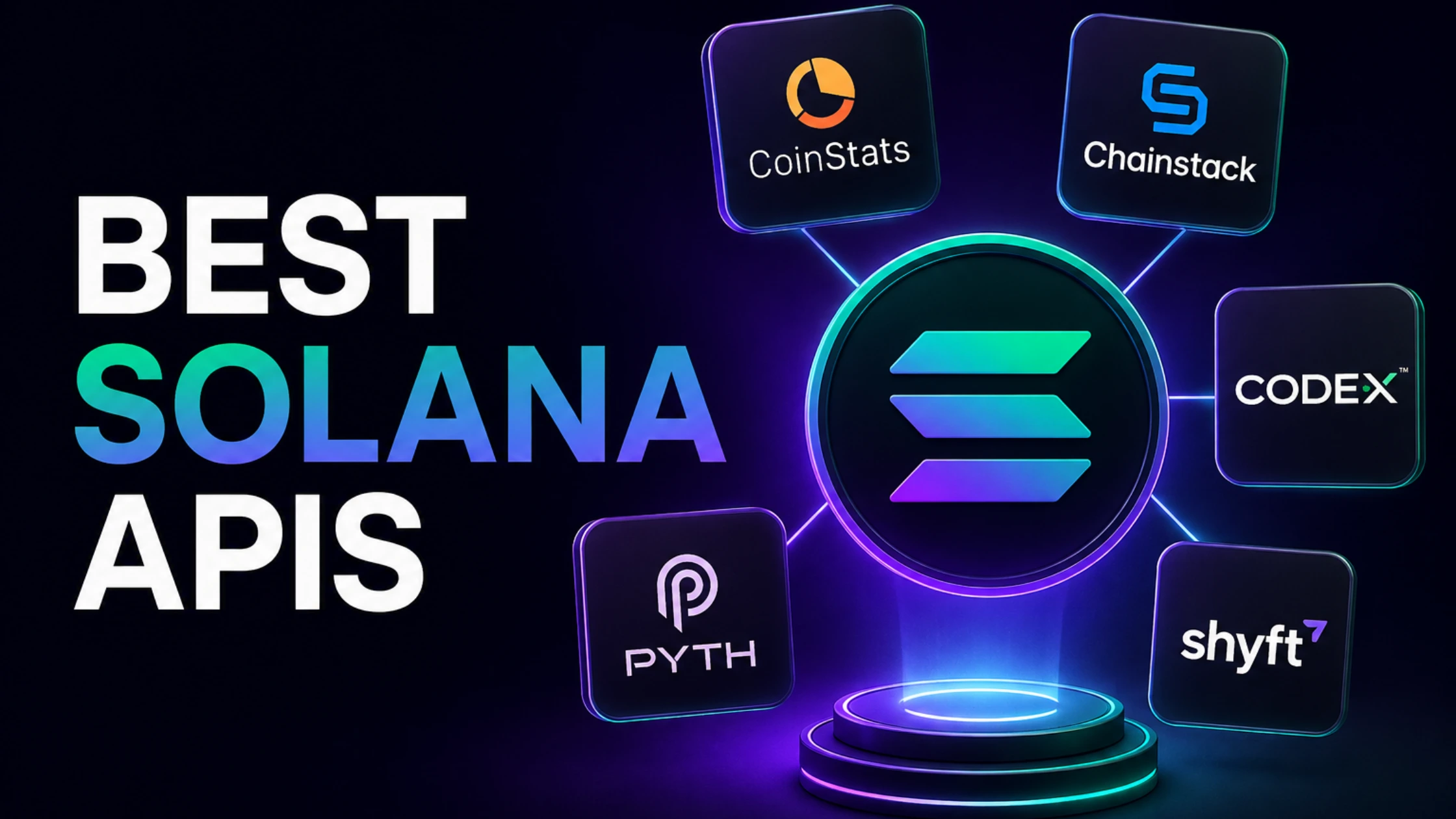
Compare the best Solana APIs for developers in 2026, including CoinStats, Chainstack, Codex, Shyft and Pyth Network for wallet data, RPC, token prices, DeFi, WebSockets, gRPC, charts and real-time market feeds.
Research Verified: 11 August 2026
Summary
Building on Solana no longer means choosing a single generic “Solana API.”
Different providers solve fundamentally different parts of the stack.
A wallet application needs parsed balances, transactions, DeFi positions and prices.
A trading system needs low-latency RPC, WebSockets or gRPC.
A token scanner needs real-time DEX trades, holders, OHLCV data and new-launch detection.
A derivatives application needs reliable market prices and oracle updates.
An analytics product may need all four.
That distinction drives the Decentralised News ranking.
Best Solana APIs in 2026
Rank | Solana API | Best For | API Type | Free Entry |
1 | CoinStats Solana API | Wallets, portfolios, balances, DeFi and P&L | Enriched REST data API | 20,000 credits/month |
2 | Chainstack | RPC, transaction submission, gRPC and production infrastructure | RPC + WebSocket + Yellowstone gRPC | 3M request units/month |
3 | Codex | Real-time token, DEX, holder, OHLCV and launchpad data | GraphQL + WebSocket + webhooks | 10,000 requests/month |
4 | Shyft | Solana-native RPC, gRPC, GraphQL and parsed DeFi data | RPC + gRPC + APIs + GraphQL | Free plan |
5 | Pyth Network | Real-time financial prices and on-chain oracle data | REST + streaming + SDK + Solana feeds | Core/public access plus commercial tiers |
Decentralised News Verdict
CoinStats ranks first for application-ready Solana wallet and portfolio data. It removes much of the parsing, pricing and DeFi-resolution work that developers otherwise need to build themselves.
Chainstack ranks second and is the strongest infrastructure choice in this list. It is the better fit when the application needs raw Solana RPC, transaction submission, WebSockets, Yellowstone gRPC or specialised low-latency infrastructure.
Codex ranks third and is arguably the strongest specialist choice for real-time Solana token and DEX intelligence. It is particularly compelling for scanners, charts, trading applications and launch discovery.
Shyft is one of the most complete Solana-specific developer stacks, combining RPC, gRPC, indexed GraphQL data, DeFi APIs and parsed transactions.
Pyth Network belongs in a different category. It is not a general wallet or RPC API. It is the specialist choice when a Solana application needs real-time financial-market prices or oracle data.
The most sophisticated Solana application may use several of these providers together rather than choosing only one.
What Is a Solana API?
“Solana API” can refer to several different technologies.
Understanding the distinction is more important than choosing the provider with the longest feature list.
Solana RPC API
An RPC endpoint communicates directly with Solana nodes.
Developers use it to:
- Query accounts
- Read balances
- Retrieve blocks
- Request transaction information
- Simulate transactions
- Submit transactions
- Subscribe to network events
Chainstack and Shyft operate in this layer.
Enriched Data API
An enriched data API processes raw blockchain information upstream and returns application-ready information.
Instead of receiving raw token accounts that must be parsed and priced, a developer might receive:
- Token symbol
- Token quantity
- USD price
- USD value
- Transaction history
- Portfolio value
- DeFi position
- Profit and loss
CoinStats operates primarily in this layer.
Blockchain Indexing API
An indexer continuously processes blockchain activity and creates queryable datasets.
This is particularly useful for:
- Token holders
- DEX volume
- Liquidity
- OHLCV candles
- New token launches
- Historical trades
- Wallet activity
Codex specialises in this area, while Shyft provides indexed Solana program data through its SuperIndexer and GraphQL stack.
Oracle and Market-Data API
Financial applications need more than blockchain state.
They may need externally derived market prices for:
- SOL
- BTC
- Stablecoins
- Equities
- FX
- Commodities
- Rates
Pyth Network specialises in this layer.
1. CoinStats API
Best Overall Solana API for Wallet, Portfolio and DeFi Applications
CoinStats API takes first place because it solves one of the biggest practical problems in Solana development: turning fragmented blockchain activity into information that an application can actually display.
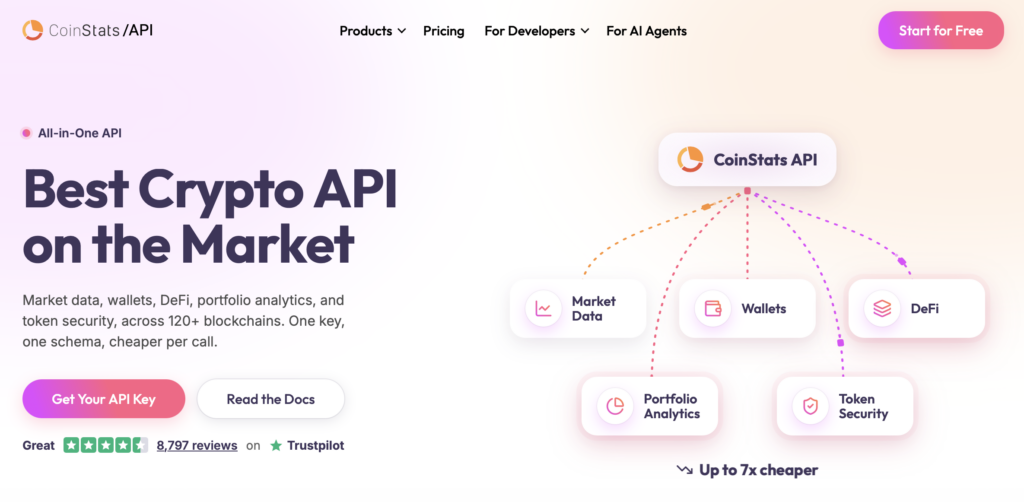
The CoinStats Solana API is a data API, not an RPC service.
Developers pass a Solana address and can retrieve structured information covering SPL tokens, native SOL, transaction history, DeFi positions and USD-denominated values without maintaining their own Solana parsing and pricing infrastructure.
CoinStats currently advertises coverage across more than 120 blockchains, 10,000-plus DeFi protocols and 100,000-plus priced assets. Its Solana API can return balances, historical transactions, swaps and program interactions, while its portfolio layer can calculate realised and unrealised profit and loss.
Why CoinStats Ranks First
Many applications do not actually need raw Solana RPC calls.
Consider a portfolio application displaying:
42.6 SOL, worth $X
18 SPL tokens, worth $Y
3 DeFi positions, worth $Z
Total P&L: $N
A raw RPC provider can supply the blockchain state required to derive this information.
But the developer still needs to:
- Parse token accounts.
- Resolve metadata.
- Identify protocols.
- Price every asset.
- Calculate historical values.
- Reconstruct transactions.
- Resolve DeFi positions.
- Calculate P&L.
CoinStats handles much of that enrichment upstream.
That can remove a considerable amount of infrastructure from wallet, accounting, portfolio and AI-agent products.
CoinStats Solana Data Coverage
Feature | CoinStats |
Native SOL balances | Yes |
SPL token balances | Yes |
USD pricing | Yes |
Transaction history | Yes |
Historical USD values | Yes |
DeFi positions | Yes |
Portfolio analytics | Yes |
Realised / unrealised P&L | Yes |
Multi-chain wallets | Yes |
REST API | Yes |
MCP support | Yes |
Raw Solana RPC | No |
Transaction submission | No |
CoinStats explicitly positions the product as the enriched data layer rather than node infrastructure. It does not create wallets, control keys or submit Solana transactions.
Solana DeFi Data
This is one of CoinStats’ most useful differentiators.
Solana positions involving:
- Staking
- Lending
- Liquidity pools
- Yield strategies
- Protocol positions
can be resolved into application-readable USD values.
CoinStats says its broader DeFi API resolves positions across more than 10,000 protocols and supports Solana alongside EVM and other networks through a common schema.
For a portfolio developer, this can be substantially easier than separately integrating every Solana protocol SDK.
AI Agent Support
CoinStats also exposes its wallet and portfolio capabilities through the Model Context Protocol.
That makes the API particularly relevant to developers building:
- AI portfolio assistants
- Wallet copilots
- Automated research systems
- Natural-language portfolio interfaces
- Accounting agents
The same underlying data can therefore support a conventional REST application or an agentic interface.
CoinStats API Pricing
The current public API structure includes:
Plan | Monthly Allowance | Starting Price |
Free | 20,000 credits | $0 |
Starter | 1 million credits | $49/month |
Standard | 5 million credits | $199/month |
Business | 80 million credits | $999/month |
Enterprise | Custom | Custom |
The Free plan currently provides two requests per second. Pricing is credit-based, so more computationally expensive endpoints consume more credits than simple requests.
CoinStats Strengths
- Portfolio-ready Solana data
- SPL and SOL balances
- Live USD pricing
- DeFi position resolution
- Transaction history
- Profit and loss
- More than 120 chains through one integration
- REST API
- MCP support
- Generous development tier
- Useful for wallet and accounting applications
CoinStats Limitations
- Not a Solana RPC provider
- Cannot submit transactions
- Not designed for validator-level streaming
- Not the specialist choice for millisecond-sensitive DEX feeds
- Advanced portfolio endpoints consume more credits than basic calls
Best For
Wallets, portfolio trackers, tax products, dashboards, fintech applications and AI portfolio agents.
Decentralised News Rating
Best overall for enriched Solana wallet and portfolio data.
2. Chainstack
Best Solana API for RPC, Infrastructure and Production Workloads
Chainstack is fundamentally different from CoinStats.
It provides the infrastructure underneath blockchain applications.
For Solana, developers can deploy RPC endpoints that work with standard Solana libraries and use them to read raw network state or submit transactions. Chainstack currently supports HTTPS and WebSocket access, archive functionality on eligible plans, specialised Trader Nodes and Yellowstone gRPC infrastructure.
Chainstack figures below come from its current pricing page, Solana documentation and support articles, checked August 2026.
Solana RPC
A Chainstack Solana endpoint can be used with standard developer libraries, including:
- @solana/web3.js
- @solana/kit
- solana-py
- Direct JSON-RPC
Developers can therefore migrate existing applications largely by changing the endpoint rather than rewriting the application architecture.
Yellowstone gRPC
This is where Chainstack becomes more interesting for professional Solana workloads.
Yellowstone gRPC streams data directly from Solana validator infrastructure and can deliver:
- Transactions
- Account updates
- Blocks
- Slot changes
rather than repeatedly polling RPC endpoints.
Chainstack says Yellowstone gRPC is available as an add-on beginning with its Growth plan and is currently available for Solana mainnet.
This is useful for:
- Trading systems
- Token scanners
- MEV research
- Wallet alerts
- Indexing pipelines
- DEX analytics
- Real-time transaction monitoring
Jito ShredStream
Chainstack’s current Solana documentation says its nodes have Jito ShredStream enabled by default, intended to improve slot reception and real-time data performance, including Yellowstone gRPC workflows.
That makes Chainstack particularly relevant to teams for whom milliseconds matter.
Trader Nodes and Warp Transactions
Chainstack also offers Trader Nodes for region-specific low-latency endpoints.
Trader Nodes can use Warp transactions, a Chainstack service designed to improve transaction propagation and landing.
Current documentation separates these use cases:
- Global Node for general RPC and real-time infrastructure
- Trader Node for regional, latency-sensitive transaction submission
- Dedicated Node for isolated production infrastructure
Chainstack describes Trader Nodes as combining ShredStream, Yellowstone gRPC streaming and Warp transaction routing behind a single endpoint. Warp is billed separately, as it runs through a bloXroute partnership.
Teams should confirm current add-on availability per node type in the Chainstack console.
Current Chainstack Pricing
Plan | Included Request Units | Throughput |
Developer | 3 million/month | 25 RPS |
Growth | 20 million/month | 250 RPS |
Pro | 80 million/month | 400 RPS |
Business | 200 million/month | 600 RPS |
Enterprise | 400 million/month | Custom |
The Developer plan is currently free. These RPS figures are Chainstack’s global plan limits, and chain-specific exceptions are published separately, so Solana mainnet throughput should be confirmed before sizing a plan.
Growth begins at $49 per month on monthly billing, and Chainstack lists Yellowstone gRPC separately as an add-on starting at $49 per month for one stream. Dedicated compute starts separately from the general plans.
Chainstack Strengths
- Native Solana JSON-RPC
- WebSockets
- Yellowstone gRPC
- Jito ShredStream
- Archive access
- Trader Nodes
- Warp transaction propagation
- Dedicated infrastructure
- Geographic deployment options
- Standard Solana library compatibility
- Free developer tier
- Broad multi-chain infrastructure across 70+ protocols, plus an official MCP server
Chainstack Limitations
- Raw blockchain infrastructure requires more parsing
- Does not replace a portfolio enrichment layer
- Yellowstone gRPC is a paid add-on
- Trader Node and gRPC workloads may require separate infrastructure
- Advanced production architecture is more complex than calling an enriched REST API
Best For
Trading infrastructure, RPC-heavy dApps, indexers, transaction submission, bots and production Solana backends.
Decentralised News Rating
Best pure infrastructure provider in this ranking.
3. Codex
Best Solana API for Real-Time Token, DEX and Launch Data
Codex occupies the middle ground between raw blockchain infrastructure and portfolio aggregation.
It indexes blockchain activity and converts it into trading-ready data.
For Solana developers, that can include:
- Real-time USD token prices
- OHLCV candles
- DEX trades
- Aggregated trading volume
- Liquidity
- Token metadata
- Holder analytics
- Wallet balances
- New-token launches
- Launchpad activity
- Real-time subscriptions
The major advantage is that developers do not need to turn raw Solana transactions into those datasets themselves.
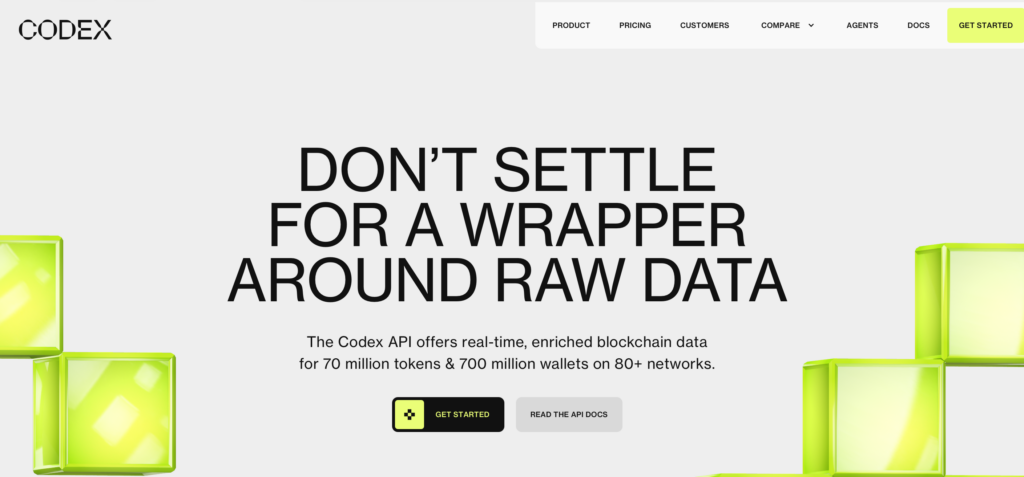
Codex’s current public website lists 90M+ tokens, 700M+ wallets and 80+ networks. The same schema is intended to let applications expand beyond Solana without rebuilding their data layer.
Codex and Solana Launchpads
This is an especially strong feature for Solana applications.
Codex indexes Pump.fun activity directly from the blockchain, including:
- New launches
- Token addresses
- Creator information
- Launch timestamps
- Bonding-curve prices
- Graduation tracking
- Trading activity
- Holder information
Its Solana guide also describes coverage across more than 16 launchpads, including Pump.fun, Raydium LaunchLab and Meteora-related ecosystems.
For developers building a:
- Token discovery engine
- Meme-token dashboard
- New-launch alert system
- DEX terminal
- Market scanner
this is significantly more useful than raw RPC alone.
Real-Time Architecture
Codex advertises 1-second data freshness.
Delivery options include:
- GraphQL
- WebSocket subscriptions
- Webhooks
- TypeScript SDK
WebSocket subscriptions run at 99.9% uptime.
This makes Codex much more naturally suited to financial interfaces than a generic blockchain indexer.
TradingView, Coinbase and Uniswap
Codex is already being used in production by major applications.
Codex powers TradingView, Coinbase, MoonPay, Uniswap and Pump.fun, among hundreds of others.
TradingView’s Codex case study is particularly relevant because TradingView reportedly consolidated several previous on-chain data sources into Codex for its DEX data infrastructure.
Codex API Pricing
Plan | Requests | Rate Limit | Real-Time Streaming |
Free | 10,000/month | 5 RPS | Limited |
Growth | 1 million+/month | 300 RPS | WebSockets + webhooks |
Enterprise | Custom | Custom | Custom |
Growth currently starts at $350 per month for 1 million requests.
Codex’s public pricing page lists WebSockets and webhooks as Growth features.
Codex Is Not a Solana RPC
This distinction matters.
Codex is excellent when the application needs:
“Give me the current price, holders, liquidity and candles for this token.”
It is not designed for:
“Submit this Solana transaction to the network.”
For transaction submission and raw account state, pair Codex with an RPC provider such as Chainstack or Shyft.
Codex Strengths
- Sub-second enriched token data
- Real-time USD prices
- OHLCV
- Holder analytics
- Wallet data
- DEX metrics
- New-launch detection
- Pump.fun integration
- Multi-launchpad coverage
- GraphQL
- WebSockets
- Webhooks
- TypeScript SDK
- Multi-chain expansion
- Production adoption by major applications
Codex Limitations
- Not an RPC provider
- Does not submit Solana transactions
- Free plan is relatively small at 10,000 monthly requests
- Real-time production features push teams toward the $350-plus Growth tier
- Portfolio and decoded DeFi-position use cases may still benefit from CoinStats
Best For
Trading terminals, token scanners, charting systems, launch discovery, DEX analytics and real-time market applications.
Decentralised News Rating
Best enriched Solana API for token and DEX intelligence.
4. Shyft
Best Solana-Native Full-Stack Developer Platform
Shyft is the most Solana-specific platform in this ranking.
Its current developer stack includes:
- Solana RPC
- Region-specific gRPC
- Human-readable transaction APIs
- Parsed callbacks and webhooks
- DeFi APIs
- GraphQL SuperIndexers
- Dedicated RPC nodes
- Staked connections
Shyft’s documentation explicitly describes the service as a full-suite Solana developer experience.
RPC and gRPC
Shyft operates standard Solana RPC endpoints for mainnet and devnet.
For higher-performance applications, it also provides gRPC infrastructure.
Current plans begin with 10 RPC requests per second on the Free tier. Paid plans increase that to 100, 150 and 400 RPS while adding gRPC access.
Shyft also advertises dedicated gRPC infrastructure for applications requiring isolated low-latency systems.
GraphQL SuperIndexers
One of Shyft’s most distinctive features is its GraphQL indexing layer.
Instead of repeatedly calling getProgramAccounts() and building a database around the results, Shyft can index Solana program accounts and expose the data through GraphQL.
Its system:
- Reads an Anchor IDL.
- Maps the program structure into a database schema.
- Backfills existing account data.
- Maintains real-time synchronisation.
- Exposes the indexed state through GraphQL.
This can save substantial engineering work for applications querying complicated Solana protocols.
Cross-DEX DeFi Queries
Shyft also has dedicated DeFi APIs.
Current documentation lists support spanning Solana venues including:
- Raydium AMM
- Raydium CLMM
- Raydium CPMM
- Raydium Launchpad
- Orca
- Meteora
- OpenBook
- Pump.fun AMM
- Fluxbeam
Shyft says its parsed DeFi layer can return cross-protocol pool data without requiring developers to individually integrate each DEX SDK.
That is particularly useful for:
- DEX aggregators
- Liquidity dashboards
- Pool discovery
- Market scanners
- DeFi analytics
Parsed Transaction APIs
Raw Solana transactions can be difficult to turn into readable actions.
Shyft exposes parsed transaction endpoints that classify activity into higher-level actions.
It also supports bulk transaction submission through its APIs.
Current Shyft Pricing
Plan | Monthly Price | RPC RPS | API RPS | gRPC |
Free | $0 | 10 | 1 | No |
Build | $199 | 100 | 10 | Yes |
Grow | $349 | 150 | 30 | Yes |
Accelerate | $649 | 400 | 100 | Yes |
Shyft currently advertises unlimited credits on its newer plans and says there are no bandwidth limits or overage charges under that pricing structure. Dedicated Solana infrastructure begins separately at approximately $1,800 per month.
Shyft Strengths
- Solana-specialist infrastructure
- RPC
- gRPC
- Staked connections
- GraphQL SuperIndexers
- DeFi APIs
- Cross-DEX queries
- Parsed transactions
- Callbacks
- Dedicated nodes
- Useful free plan
- Strong tooling for custom Solana programs
Shyft Limitations
- Solana-focused rather than broadly multi-chain
- Some indexed transaction history has specific retention limitations
- gRPC requires paid plans
- Full dedicated infrastructure is considerably more expensive
- Some legacy API areas have been deprecated over time, so developers should use current documentation
Best For
Solana-native teams that want RPC, indexing and enriched protocol data from one provider.
Decentralised News Rating
Best integrated Solana-specific development stack.
5. Pyth Network
Best Solana API for Real-Time Financial Market Data
Pyth should not be compared with CoinStats or Chainstack as though all three perform the same function.
Pyth is a specialist financial-data network.
Its price feeds cover multiple asset classes including:
- Cryptocurrency
- US equities
- Foreign exchange
- Metals
- Rates
- Commodities
- Energy
Pyth describes these as first-party market data sourced through its network of market participants and data providers.
For a Solana DeFi application, that makes Pyth particularly relevant to:
- Perpetual futures
- Lending
- Synthetic assets
- Stablecoins
- Prediction or risk engines
- Liquidation systems
- Portfolio valuation
- Structured products
Pyth on Solana
Solana has native Pyth price-feed accounts.
Current sponsored Solana feeds include assets such as:
- SOL/USD
- mSOL/USD
- bSOL/USD
- BONK/USD
- USDC-related and other supported markets
with update parameters defined per feed.
Pyth therefore occupies a deeper infrastructure layer than a simple token-price REST API.
Applications can verify market data as part of their on-chain logic.
Hermes API
Pyth’s Hermes service distributes price updates.
Developers can retrieve updates through:
- REST
- Streaming
- SDKs
Hermes listens for Pyth price updates and exposes them in a form that applications can fetch and submit to supported blockchain contracts.
Its public API also supports server-sent event streaming for real-time updates.
Important August 2026 Pyth Migration
Developers integrating Pyth right now should pay attention to timing.
Pyth Core is scheduled to upgrade on 18 August 2026.
Pyth currently recommends that new integrations use the upgraded Solana contracts. Existing contracts are scheduled for DAO-managed migration, and authentication requirements around Hermes are also changing.
For a developer reading this article around the migration period, the live Pyth migration documentation should take precedence over older integration tutorials.
Pyth Pro
Pyth also operates a commercial market-data product for applications requiring higher-frequency institutional feeds.
Current Pyth Pro infrastructure includes REST APIs and channels with update frequencies down to hundreds of milliseconds and, depending on the commercial product, faster delivery options. API keys must remain server-side rather than being exposed directly in client applications.
Its broader commercial offering currently advertises more than 3,000 price feeds across multiple financial asset classes.
Pyth Strengths
- Financial-grade price feeds
- Native Solana integration
- Crypto prices
- Equities
- FX
- Commodities
- Rates
- REST
- Streaming
- SDK support
- Cryptographically verifiable updates
- Suitable for on-chain financial logic
Pyth Limitations
- Not a wallet API
- Not a portfolio API
- Not general Solana RPC infrastructure
- Not intended for token-holder analytics
- Developers need to understand oracle freshness and confidence intervals
- Integration details are changing around the August 2026 Core upgrade
Best For
DEXs, perpetual exchanges, lending protocols, risk engines, stablecoins and other Solana applications needing trustworthy market prices.
Decentralised News Rating
Best Solana financial-market data and oracle API.
Best Solana APIs Compared
Feature | CoinStats | Chainstack | Codex | Shyft | Pyth |
Raw Solana RPC | No | Yes | No | Yes | No |
Transaction submission | No | Yes | No | Yes | Price-update specific |
Wallet balances | Excellent | Raw | Yes | Yes | No |
Portfolio valuation | Excellent | No | Partial | Buildable | No |
DeFi positions | Excellent | Raw | Limited | Strong | No |
Token prices | Yes | Raw | Excellent | Data dependent | Excellent |
OHLCV | Market data | Build yourself | Excellent | DeFi/indexer dependent | Historical market data |
Holder analytics | Basic portfolio context | Build yourself | Excellent | Indexable | No |
New launch data | No specialist focus | Build yourself | Excellent | Buildable | No |
Pump.fun data | No specialist focus | Build yourself | Yes | DeFi APIs | No |
WebSockets | No primary focus | Yes | Yes | Yes | Streaming |
Yellowstone gRPC | No | Yes | No | Yes | No |
GraphQL | No | No | Yes | Yes | No |
MCP / AI integration | Yes | MCP available in platform | Yes | Not primary | Not primary |
Multi-chain | 120+ | 70+ | 80+ | Solana-focused | Multi-chain oracle |
Best use | Portfolio data | Infrastructure | Trading data | Solana full stack | Oracle prices |
Which Solana API Is Fastest?
There is no meaningful single answer because the APIs perform different operations.
Chainstack and Shyft compete at the node, transaction and streaming infrastructure layer.
Codex focuses on how quickly an indexed blockchain event becomes enriched application data.
Pyth focuses on market-data freshness.
CoinStats optimises for usable aggregated output rather than validator-level latency.
A 100 millisecond RPC response and a 100 millisecond portfolio API response are not equivalent tasks.
Developers should benchmark the exact endpoint used by their application.
Best Solana API for Wallet Development
Winner: CoinStats
Use CoinStats when an application needs:
- SPL balances
- SOL
- USD values
- Transactions
- DeFi positions
- Portfolio P&L
- Multi-chain expansion
A wallet may still need an RPC provider for transaction construction or broadcasting.
Recommended Stack
CoinStats + Chainstack
CoinStats handles enriched portfolio information.
Chainstack handles raw Solana communication and transaction submission.
Best Solana API for Trading Bots
Winner: Chainstack for execution infrastructure
Winner: Codex for enriched trading data
A serious bot may use both.
Chainstack can provide:
- RPC
- WebSockets
- Yellowstone gRPC
- Transaction submission
- Low-latency infrastructure
Codex can provide:
- Token prices
- Trades
- OHLCV
- Holders
- Liquidity
- New launches
Pyth can add an independent financial pricing layer.
Professional Stack
Chainstack + Codex + Pyth
This avoids forcing one provider to do three very different jobs.
Best Solana API for Token Scanners
Winner: Codex
The combination of:
- Sub-second indexing
- Pump.fun tracking
- Launchpad coverage
- Holder analytics
- Token pricing
- DEX volume
- Liquidity
- WebSockets
makes Codex particularly well suited to scanners and discovery systems.
A scanner requiring raw transaction-level streaming could pair it with Chainstack or Shyft.
Best Solana API for DeFi Analytics
There are two different winners.
Portfolio-Level DeFi: CoinStats
Best when the question is:
What positions does this wallet have and what are they worth?
Protocol-Level DeFi: Shyft
Best when the question is:
Give me all relevant program accounts or liquidity pools matching these conditions.
Shyft’s GraphQL and DeFi APIs are designed for querying protocol state, while CoinStats focuses more strongly on the end user’s portfolio.
Best Solana RPC API
Winner: Chainstack
Chainstack earns the infrastructure title because it combines standard RPC with:
- WebSockets
- Yellowstone gRPC
- Jito ShredStream
- Trader Nodes
- Warp transaction services
- Dedicated infrastructure
- Archive options
- Multi-region deployment
Shyft is a very strong alternative when the application is exclusively Solana-focused and also benefits from its higher-level indexed APIs.
Best Solana API for AI Agents
Winner: CoinStats for portfolio agents
CoinStats’ MCP support makes it naturally suited to agents that need to answer questions about wallets, balances, DeFi positions and portfolio performance.
Codex is more compelling for real-time market agents because its GraphQL, token intelligence and streaming infrastructure provide the kind of data required by market-monitoring and research systems.
The ideal AI stack can therefore depend on whether the agent is answering:
“What does this wallet own?”
or:
“What is happening in this Solana market right now?”
Best Solana API for Price Feeds
Winner: Pyth Network
A simple USD token price for a wallet UI and a cryptographically verifiable price used to liquidate a $10 million DeFi position are not the same product.
Pyth belongs in the second category.
Its value is strongest when price information becomes part of the financial logic of the protocol itself.
Solana API Pricing Comparison
Provider | Free Tier | First Major Paid Tier | Billing Model |
CoinStats | 20K credits/month | Starter $49/month | Credits |
Chainstack | 3M request units/month | Growth $49/month | Request units + add-ons |
Codex | 10K requests/month | Growth from $350/month | Requests |
Shyft | Free, 10 RPC RPS | Build $199/month | Subscription |
Pyth | Core/public options vary | Commercial data plans vary | Feed/access model |
These allowances are not directly comparable.
One CoinStats credit is not one Chainstack request unit, and one Codex enriched request may replace many raw RPC operations.
The better pricing metric is:
How much does it cost to produce the final feature your user sees?
A Better Way to Choose a Solana API
Before selecting a provider, answer these questions.
1. Do You Need to Submit Transactions?
Choose Chainstack or Shyft.
CoinStats and Codex are primarily data layers.
2. Do You Need Wallet and Portfolio Data?
Start with CoinStats.
3. Do You Need Real-Time DEX and Token Data?
Start with Codex.
4. Do You Need Raw Solana Program State?
Use Chainstack or Shyft.
5. Do You Need Indexed Custom Program Data?
Investigate Shyft SuperIndexers.
6. Do You Need Yellowstone gRPC?
Compare Chainstack and Shyft.
7. Do You Need Oracle Prices Inside a Financial Protocol?
Use Pyth.
8. Do You Plan to Expand Beyond Solana?
CoinStats, Codex and Chainstack provide broader multi-chain paths.
Shyft is more deliberately Solana-specific.