
Decentralised News · Agentic Finance · Decision research
By Heath Muchena · Source review 2026-11-11 · Instrument version 1.0.0
What Matters
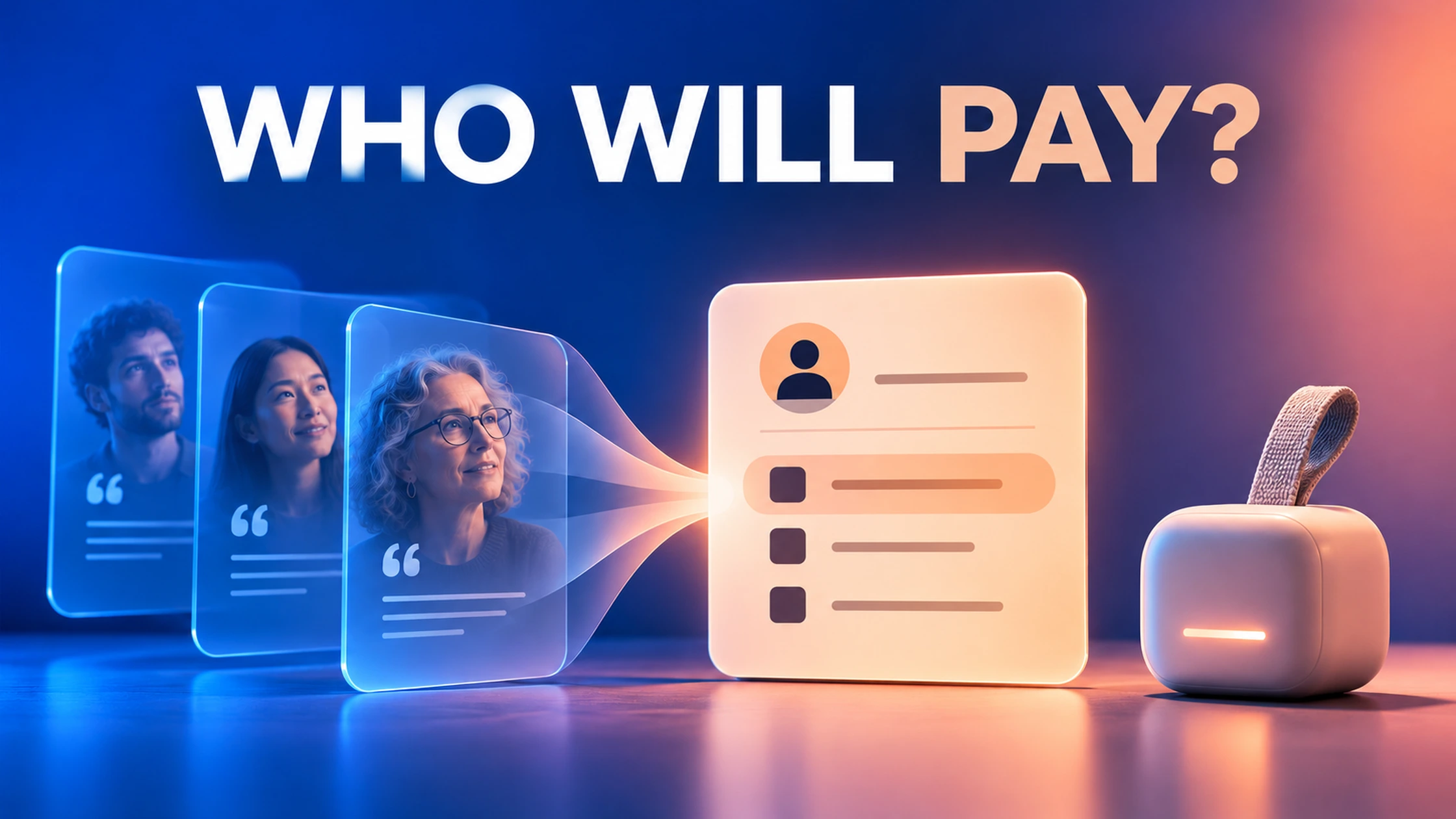
Synthetic customers can generate hypotheses and expose questions to investigate. They cannot, by themselves, show that real buyers will use or pay for an agent product. DN’s demand register separates simulated opinions, observed work, usable prototypes and paid outcomes. It helps decide what to test next without turning a large volume of generated feedback into market validation.
An AI prototype can be quick to build and easy to praise. The scarce evidence is whether a defined buyer has the problem, can use the proposed solution and will commit resources under real conditions. Generating another hundred plausible interviews does not settle those questions.
This article combines synthetic-customer research, prototype triage and feedback-signal selection. All three concern the transition from an interesting idea to a supported product decision. It differs from DN’s internal workflow-readiness ranking: the unit here is an external buyer and a commercial offer.
DN Evidence Block
Sources reviewed: 2026-11-11 · Evidence type: Primary documentation review and original DN method; examples are explicitly synthetic.
Scope: A proposed agent product for one buyer segment, with explicit separation between simulated and observed evidence.
- A research preprint studies statistical augmentation of human conjoint data with LLM output, rather than unrestricted replacement of human respondents: Large Language Models for Market Research: A Data-augmentation Approach.
- GOV.UK guidance covers real user needs and prototype testing; DN adapts these service-design principles to a commercial decision: GOV.UK Service Manual: Start by learning user needs; GOV.UK Service Manual: Making prototypes.
Not established by this work: No interviews, prototype tests, paid pilots or predictive comparison were conducted for this article.
Original DN instrument · version 1.0.0
DN Demand-Evidence Register
Record six distinct evidence gates. A complete self-entered record is not market validation or a product recommendation.
Enter your assumptions or load a labelled example. Required blank numbers stay missing; unknown evidence remains unknown. Use nonpersonal labels only. This instrument makes no network requests and uses no persistent browser storage.
Use your own inputs
No current result. Complete inputs or load an illustrative example.
No respondent recruitment, transcript analysis, demand forecast or scoring of statistical validity. A sequence of yes answers does not establish a representative market.
1. Label simulated answers as hypotheses
The first gate is a clear provenance label. Save the prompt, model version, supplied persona information and generated response. Call it a simulation. Do not present the resulting quotes as customer testimony, count model instances as independent buyers or mix generated answers into an interview sample without explaining the method.
The market-research preprint examines a constrained statistical approach that combines real observations with generated conjoint data and addresses bias. Its scope does not establish that synthetic interviews predict purchase behaviour for a new agent service. DN’s inference is narrower: simulation may help formulate hypotheses, but human evidence and a suitable validation method remain necessary for the intended decision.
Use generated objections to improve the research plan. Ask what evidence would show that an objection is common, consequential or absent in the target population. Preserve surprising real objections that the simulation missed. The comparison becomes useful when it changes what the team investigates, rather than when the generated narrative sounds convincingly human.
2. Establish the need with actual likely buyers
The second gate is an observed need. Learn how actual likely buyers complete the task, what breaks, who pays and which constraints prevent change. A respondent’s enthusiasm about AI is not a description of the job. Neither is a broad complaint such as “admin takes too long.”
The GOV.UK user-needs guidance recommends research with actual or likely users and treats unsupported suggestions as assumptions. DN adapts that distinction by recording the present workflow, its cost boundary and the buyer’s current alternative. The alternative may be manual work, an existing supplier, postponement or simply tolerating the problem.
3. Identify the buyer’s real alternative
The third gate is a credible baseline. Record the buyer’s present workflow, its cost boundary and the alternative it would actually use. That alternative may be manual work, an existing supplier, postponement or simply tolerating the problem. Compare the proposed intervention against that real choice, not against an invented inefficient buyer.
For a synthetic example, consider an invoice-follow-up product. The initial hypothesis is faster message drafting. Real observation might instead reveal that staff cannot determine which invoices are genuinely overdue because payment references are incomplete. That would change the product decision. It is an illustrative possibility, not a finding from interviews. The research plan should be able to discover that kind of mismatch before a polished automation locks it in.
4. Test the critical assumption with a suitable prototype
The fourth gate is a usable test of the proposed intervention. With many prototypes, group those addressing the same job and retire duplicates. For each remaining idea, specify one critical assumption, the smallest test that could challenge it and a stopping condition. A beautiful interface that cannot answer the key demand question should not consume the next research budget.
The GOV.UK prototype guidance distinguishes testing designs from production readiness. A prototype can therefore be suitable for observing comprehension while being unsuitable for handling live customer records. State the test boundary clearly and choose permitted, appropriately protected data. Do not sell an experimental demonstration as a fully supported service.
Use three decisions: continue a specific test, revise the proposition, or stop. “Keep because the demo works” is not a commercial decision rule. A prototype that fails an expensive assumption early may be more valuable than one that earns compliments without testing whether the buyer can adopt it. Preserve the rejected reason so the same idea is not regenerated next week under a new name.
For a portfolio review, use a rejection rule that can actually be triggered. A hypothetical product might require evidence that the target buyer encounters the task weekly and controls a budget for resolving it. If interviews show the task is rare and owned by another department, revise the segment or stop the proposition. Do not merely rewrite the persona until the original prototype seems justified. The decision record should preserve what changed and why.
5. Follow a priced pilot into checked outcomes
The fifth gate is a real commercial commitment under explicit terms. A paid pilot supplies evidence about one buyer’s willingness to purchase that offer; it does not establish a scalable market. Record the price, scope, assistance provided, decision maker and acceptance condition. A heavily customized pilot may validate a service while leaving a self-service product untested.
Separate ratings, self-reported savings and checked outcomes. A high satisfaction score can help explain a result, but it does not establish that the task was completed correctly. For the invoice example, a useful outcome could be accurately identified overdue invoices with reviewed follow-up actions, observed against the current process. Do not infer cash collected solely from messages sent.
A paid pilot also needs a buyer with relevant authority. A friendly user may be willing to test a product while lacking permission to buy it or access the required records. Record the user, sponsor and purchasing decision roles at an appropriate level of detail. Resolving that distinction early can prevent a technically successful demonstration from being mistaken for a commercially executable offer.
6. Establish delivery economics and permitted feedback use
The sixth gate is an economic and evidence boundary that survives delivery. Include support and correction effort, consented feedback use and the cost of obtaining the outcome. If the pilot is only viable because the founder silently rescues every exception, record that work. The feedback signal worth retaining is the one that helps the next product decision, subject to the rights and permissions governing its use.
Compare the feedback signals on cases that were not used to tune the recommendation. For example, test whether stated satisfaction, reported time saved or a checked task outcome better predicts a later paid renewal in a permitted study. Keep the outcome window and missing cases explicit. This is a proposed experiment, not a claim that one signal always predicts demand. A signal can be useful for service improvement while remaining weak evidence of willingness to pay.
Methodology, limitations and corrections
Write the intended decision before collecting feedback. Preserve provenance and do not combine synthetic respondents with actual buyers as if they were interchangeable observations. Recruit and observe real participants with appropriate permission, and record how the sample relates to the target segment.
The three-prototype scenario is synthetic. A useful comparison of synthetic and real research would predefine questions, blind the analysis where practical, identify missing objections and follow predictions into observed behaviour. Report disagreements and inconclusive cases. The cited preprint concerns a particular statistical setting; this article does not generalize its reported savings to product discovery.
Use the register to choose the next research action
Imagine three synthetic prototypes. A has many generated personas but no real-user observation. B has observed need and a usable demonstration, but nobody has accepted a priced pilot. C has a paid pilot and reviewed outcomes, but ongoing support cost is unresolved. The register should send A toward field research, B toward a bounded commercial test and C toward delivery economics.
It should not award C a universal validation score. Each gate answers a particular question, and the remaining uncertainty can still overturn the proposition. One buyer may be unusual; a paid pilot may depend on a temporary budget; the observed outcome may not persist after onboarding assistance ends. State what the evidence supports and what the next test must resolve.
For an archive of a hundred prototypes, maintain a single decision record per underlying job. Link the simulated hypotheses, real observations, prototype versions and paid outcomes to that record. The commercial asset becomes accumulated evidence about a buyer problem, not a count of generated screens. The next build should earn its place by reducing an unresolved uncertainty that matters to a purchase.
For corrections, identify the claim, source and date when contacting Decentralised News. A new record-creation timestamp does not refresh its underlying evidence.
Change log: version1.0.0, 2026-11-11. Initial documentation review, original instrument and labelled examples.
Frequently asked questions
Are synthetic customers useless?
No. They can suggest hypotheses, language and edge cases. Their value depends on what real evidence later confirms or changes.
Does one paid pilot validate the market?
It supports a claim about that buyer, offer and context. Repeatability and broader demand remain separate questions.
How should I rank a hundred prototypes?
Group them by buyer job, identify the critical unresolved assumption and fund the test that can most usefully change the decision.
Which feedback should I retain?
Keep permitted signals linked to checked outcomes and the decision they improve. Avoid collecting personal information without a clear purpose and authorization.
Primary sources
- Large Language Models for Market Research: A Data-augmentation Approach. Research studies augmentation with real human data and bias correction in conjoint settings; it does not validate synthetic interviews as a substitute for all customer research. Reviewed 2026-11-11.
- GOV.UK Service Manual: Start by learning user needs. Service-design guidance distinguishes research with actual users from untested assumptions. Business application here is DN's adaptation. Reviewed 2026-11-11.
- GOV.UK Service Manual: Making prototypes. Prototypes test ideas and are not production-ready implementations by default. Reviewed 2026-11-11.
Turn the finding into a decision
The DN Research Desk can scope a buyer-demand evidence plan and bounded prototype triage, subject to source access and a written quote. Start with one unresolved decision and the records available to answer it. This article does not promise a completed audit, integration or independently verified result.
Related DN research
Disclosure: Analysis and instrument results are editorial. Where labelled affiliate links appear, DN may receive compensation when you sign up or buy through them. Commercial relationships do not determine findings. No tested integration or guaranteed outcome is implied.



