
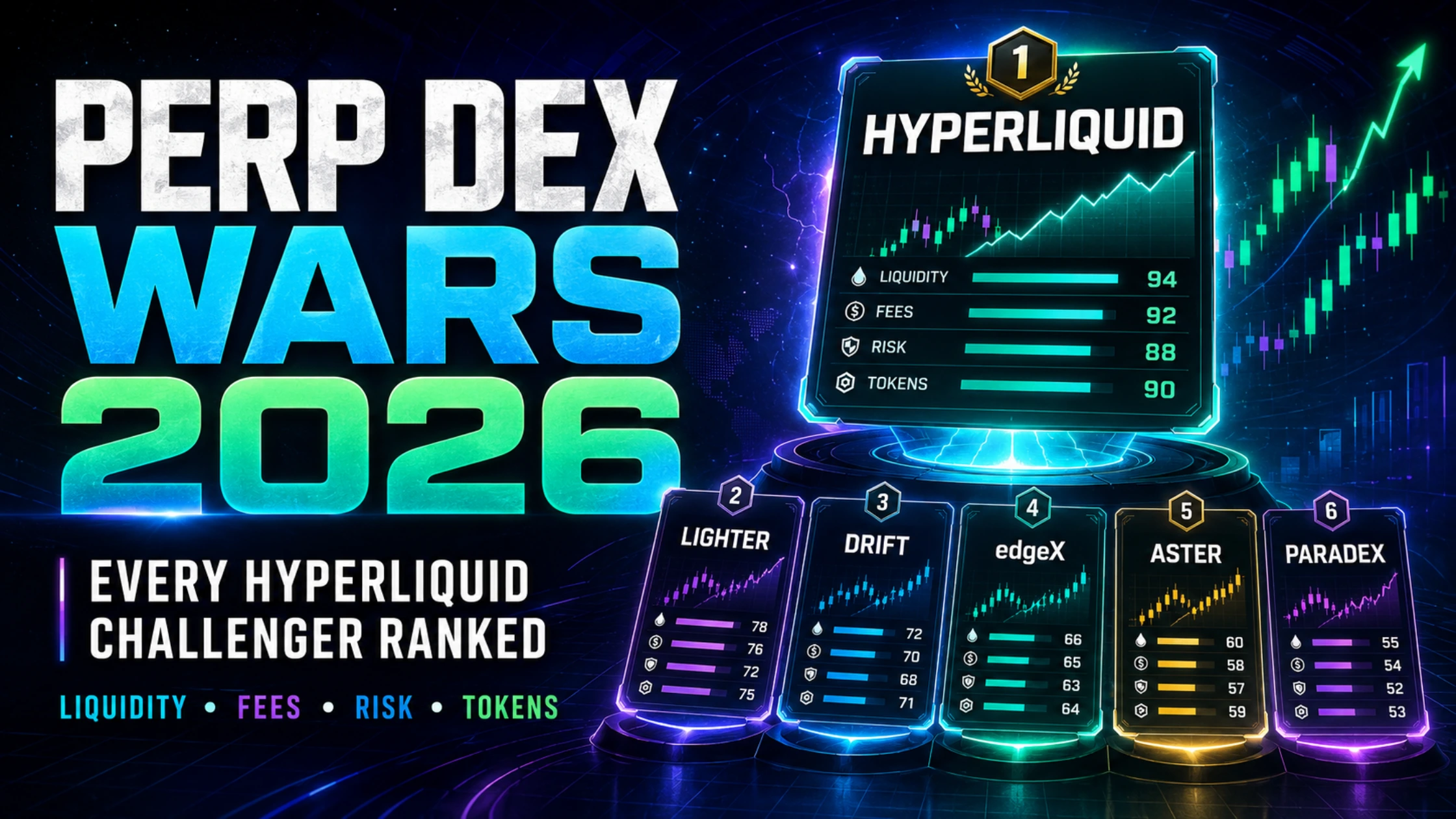
The Perp DEX Wars: Every Hyperliquid Challenger, Ranked
Eleven venues are fighting for the most lucrative territory in crypto. The DN Perp DEX Power Rankings score them on the five things volume charts hide: volume integrity, custody, true cost, depth, and whether the points are worth your churn.
Decentralised News · Q2 2026 edition · Updated June 10, 2026 · Refreshed quarterly · Tool included
The best Hyperliquid alternative depends on what you are optimizing for: Lighter for zk-verified orderbook speed on Ethereum, Drift for Solana-native trading, edgeX for proven risk management, Aster for multichain reach and aggressive leverage, GRVT for a licensed hybrid venue, and Paradex for unified margin across perps and options. The rankings below score all of them, and Hyperliquid itself, on the same five-pillar rubric, so you can see exactly where each one earns and loses its place.
The prize they are fighting over is enormous. Onchain perpetuals stopped being a DeFi curiosity sometime in 2025: quarterly sector volume reached the trillions, with roughly $1.8 trillion traded in a single recent quarter, more than the entire niche managed in all of 2024. On February 5, 2026, when a violent deleveraging swept Bitcoin toward $64,000, perp DEXs processed more than $70 billion in a single day, their second largest ever after the October 2025 crash that liquidated $19 billion in positions. The pipes held. That stress test, which we return to below because it separates the contenders more honestly than any marketing deck, is the moment onchain perps proved they could warehouse serious leverage. Now eleven venues want the flow, and most coverage of them is either a volume chart or a points-farming thread. Neither tells you where your collateral is actually safe, which is the question this page exists to answer.
Why volume rankings lie to you
The default way this sector gets ranked, 24-hour volume on an aggregator dashboard, is the easiest metric in crypto to manufacture. When a venue is running a points program ahead of a token launch, every dollar of expected airdrop value becomes a subsidy for churn: traders run delta-neutral wash strategies, flipping size back and forth to farm allocation, and the volume chart records it all as demand. The tell is the ratio of volume to open interest. A venue where traders genuinely hold positions carries high open interest relative to its turnover. A venue where $1 of deposits generates $8 of daily volume is hosting a points harvest, not a market. By that lens the sector inverts: Hyperliquid has frequently held around two thirds of all perp DEX open interest, more than its three nearest challengers combined, even in weeks when it ranked second or third on raw volume.
This is why the DN Perp DEX Power Rankings exist. Volume is one input. It is weighed against what the volume conceals.
How the rankings are scored
Run the board. Filter by architecture or token status, sort by any pillar, and every venue shows its verdict and its weakest score, because the weakest score is usually the one that matters.
Eleven venues, five pillars, 100 points. Editorially scored, refreshed quarterly. Filter, sort, and route.
BOARD data: editorially maintained scores as of June 10, 2026, refreshed quarterly; not live market data and not financial advice. Hyperliquid is ranked on merit and carries no referral relationship. Route buttons are referral links that support our free tools at no cost to you. Other publications may embed this board with a followed credit link to the canonical page on decentralised.news.
The incumbent
Hyperliquid: still the market, not just the leader
Whatever happens on the daily volume chart, the open interest tells you where leverage actually lives, and a dominant share of it lives on Hyperliquid. The venue runs its own purpose-built layer 1 with a fully onchain orderbook, sub-second finality, and the deepest books in onchain derivatives. Its community-first token distribution, with no venture allocation, built a loyalty no challenger has replicated, and its HLP vault emerged profitable from both the October 2025 crash and the February 2026 deleveraging, the two hardest tests the sector has faced. The honest critiques are validator concentration and the fact that an appchain is only as decentralized as its operator set. We rank it first by a wide margin and have no referral relationship with it; the score is the score.
The challengers
Lighter: the zk thoroughbred with a churn problem
Lighter is the most technically credible challenger: a zk-rollup on Ethereum where matching is provable, fees on select markets are zero, and the engine genuinely feels like a centralized exchange. It backed that up commercially, raising $68 million from Founders Fund and Ribbit Capital at roughly a $1.5 billion valuation, and it delivered its LIT token on December 30, 2025 with a 25 percent airdrop, fully unlocked, no claim process, half the supply reserved for the community. Delivery on those terms earns real token-credibility points. What holds the score down is volume integrity: turnover that ran near eight times deposits at the peak of points farming, a loyalty-driven flow profile, and a February 2026 stress event in which its LLP vault took losses and the venue suffered an outage during peak volatility while older rivals stayed up. The engineering is elite. The market on top of it is still proving it exists without subsidy.
Drift: Solana's flagship, quietly the most organic challenger
Drift has none of the wash-trading aroma. It is Solana's largest perp DEX, with a delivered token, a mature cross-margin system that accepts a wide range of Solana-native collateral, and flow that comes from the chain's own trading culture rather than a points season. Costs are low and composability with the rest of Solana DeFi is its real moat: positions, collateral and yield strategies interlock in ways no appchain can match. The tradeoffs are inherited from the chain itself, including congestion during the most violent windows, and book depth on majors that remains a tier below Hyperliquid. For a Solana-native trader it is the default answer.
edgeX: the risk manager's challenger
edgeX, incubated with backing from Amber Group, is the challenger that wins on the boring pillar: it has cleared hundreds of billions in cumulative volume, carried over a billion dollars of open interest, and its eLP vault stayed profitable straight through the February 2026 stress test that damaged a higher-profile rival. The venue runs validity-proof settlement with a CEX-grade matching engine, and its points program continues ahead of an expected token, which is precisely the unresolved risk: until the token ships, farmers are accumulating a promise. As a place to actually hold leveraged positions through violence, its record is now among the best in the sector.
Aster: the volume machine with an integrity discount
Aster is the sector's id: multichain across BNB Chain, Ethereum, Solana and Arbitrum, leverage quoted up to four figures in its simple mode, a delivered token, and volume spikes that have at moments out-printed every venue in crypto. The discount in our score is the shape of that volume: it expands violently when incentives flow and has halved when they pause, which is the signature of subsidized churn rather than resident liquidity. None of this makes it untradeable; the books on majors are real and the BNB-ecosystem distribution is a genuine asset. It makes it a venue whose top-line number deserves the least trust at face value, which is exactly what a power ranking is for.
The specialists
Paradex: unified margin, perps and options in one account
Paradex, incubated out of the Paradigm orbit, runs its own Starknet-based appchain and is the only challenger pairing perps with perp options under one cross-margined account, a structure serious derivatives traders will recognize as the actual endgame. Depth remains mid-pack and the token question is still in its points phase, but the architecture is aimed somewhere more ambitious than another BTC perp listing.
GRVT: the licensed hybrid
GRVT's bet is that the next cohort of size comes from traders who need a venue that is both self-custodial and licensed, and it has built exactly that: a ZK-stack hybrid exchange holding regulatory licensing, with funds in user-controlled wallets and matching off-chain for speed. The cost of the compliance posture is reach and depth, both currently modest. For the specific reader who cannot touch an unlicensed venue, it may be the only name on this board that qualifies.
Apex Omni: the CEX-adjacent veteran
ApeX has been through more market cycles than most of this list, with a delivered token, a Bybit-adjacent lineage, and billions in daily turnover at peaks. It rarely leads any single pillar but embarrasses itself on none, a profile that suits traders who want a second venue with history rather than a first venue with promises.
The frontier
Three younger venues earn places on the board with caveats attached. Vest is building toward markets beyond crypto with a risk-engine-first design; liquidity is thin and the venue is best treated as an early position, not a primary book. DESK brings a clean orderbook experience and an active points meta; the same undelivered-token risk applies. Aden is the newest of the cohort, an emerging orderbook venue most relevant to points speculators comfortable at the frontier. All three score in the bottom tier precisely because the rubric punishes what they have not yet proven, which is the point of a rubric.
What the stress tests proved
Two dates now define credibility in this sector. October 10, 2025, when $19 billion in liquidations tore through crypto as Bitcoin fell from $117,000 toward $101,800, and February 5, 2026, when more than $70 billion in perp DEX volume cleared in a day as the market deleveraged again. The composite record: Hyperliquid's HLP and edgeX's eLP vaults absorbed the flow profitably both times; Lighter's LLP took losses in February and the venue went down during the worst of it; the long tail mostly survived by being small. Liquidity providers' vaults are the sector's honest accountants, because they cannot spin their own P&L. When you choose a venue to warehouse leverage, you are choosing whose risk engine you trust at 4am on the worst day of the quarter, and the worst days are now on the public record.
Choosing your venue: the practical routing
- Depth and survivability first: Hyperliquid, with edgeX as the proven second book.
- Ethereum-stack purist: Lighter for the engine, Paradex if you also trade options.
- Solana native: Drift, without much debate.
- Maximum reach and leverage, eyes open: Aster, sized with its integrity discount in mind.
- Regulated mandate: GRVT is the licensed hybrid built for exactly that constraint.
- Points farming as a strategy: the undelivered-token venues, edgeX, Paradex, DESK, Vest and Aden, are where allocation still exists, and our Points ROI Model (next in this series) prices whether the churn is worth it.
Whichever venue wins your collateral, the cost mathematics of CEX against DEX execution is its own discipline, covered by the Effective Fee DN Effective Fee instrument, the custody question extends beyond perps into the framework of our DN Counterparty Risk Score, and if your routing question is between this entire category and a centralized venue, start with the Exchange Fit Engine.
Frequently asked questions
Hyperliquid remains the strongest overall venue, holding the majority of onchain perpetuals open interest with the deepest books and a risk engine proven through the October 2025 and February 2026 stress events. The best alternative depends on your stack: Lighter on Ethereum, Drift on Solana, edgeX for proven risk management.
Lighter is the most technically credible challenger, with a zk-verified orderbook and a delivered token. Drift is the best choice for Solana-native traders, edgeX has the strongest stress-test record among challengers, and Aster offers the widest multichain reach.
Safety varies by architecture. Venues differ in who controls funds, what is verifiable onchain, and how their liquidity vaults performed under stress. The February 2026 deleveraging saw some vaults remain profitable while others took losses, which is why custody and stress-test history are scored pillars in the rankings.
Partly. During points programs, expected airdrop value subsidizes wash-style churn, inflating volume. The reliable tell is volume relative to open interest: venues where turnover runs many multiples of deposits are hosting points farming, while high open interest signals genuinely held positions.
Yes. Lighter launched LIT on December 30, 2025, airdropping 25 percent of supply fully unlocked with no claim process, and reserving 50 percent for the community. Post-launch, the open question is how much of its volume persists without a points season.
Venues still in their points phase as of mid-2026 include edgeX, Paradex, DESK, Vest and Aden. Farming them carries undelivered-token risk: you accumulate a promise whose terms are unknown, against real costs in fees, funding and time.
On February 5, 2026, perp DEXs processed over $70 billion in a single day during a sharp deleveraging, their second largest day ever. Hyperliquid's and edgeX's liquidity vaults remained profitable through it, while Lighter's vault took losses and the venue suffered an outage at peak volatility.
It depends on size and chain. DEXs can match or beat CEX taker fees, and some Lighter markets charge zero, but spreads, funding behavior and gas change the all-in cost. Comparing the full round-trip cost, not the headline fee, is the only honest comparison.
The DN Perp DEX Power Rankings are a BOARD instrument: editorially maintained, dated, and refreshed quarterly, with interim updates after major events such as exploits, outages or token launches.
Decentralised News publishes research, not financial advice. Leveraged trading involves substantial risk of loss. Scores reflect our editorial judgment from public data and venue documentation as of June 10, 2026 and will change. Hyperliquid is covered with no referral relationship; route buttons for other venues are referral links that support our free tools at no cost to you. Methodology for the Power Rankings, and the wider DN instrument suite documented in the editor's books Blockchain Applied and Tokenized Trillions, is open to challenge via the contact page.





