
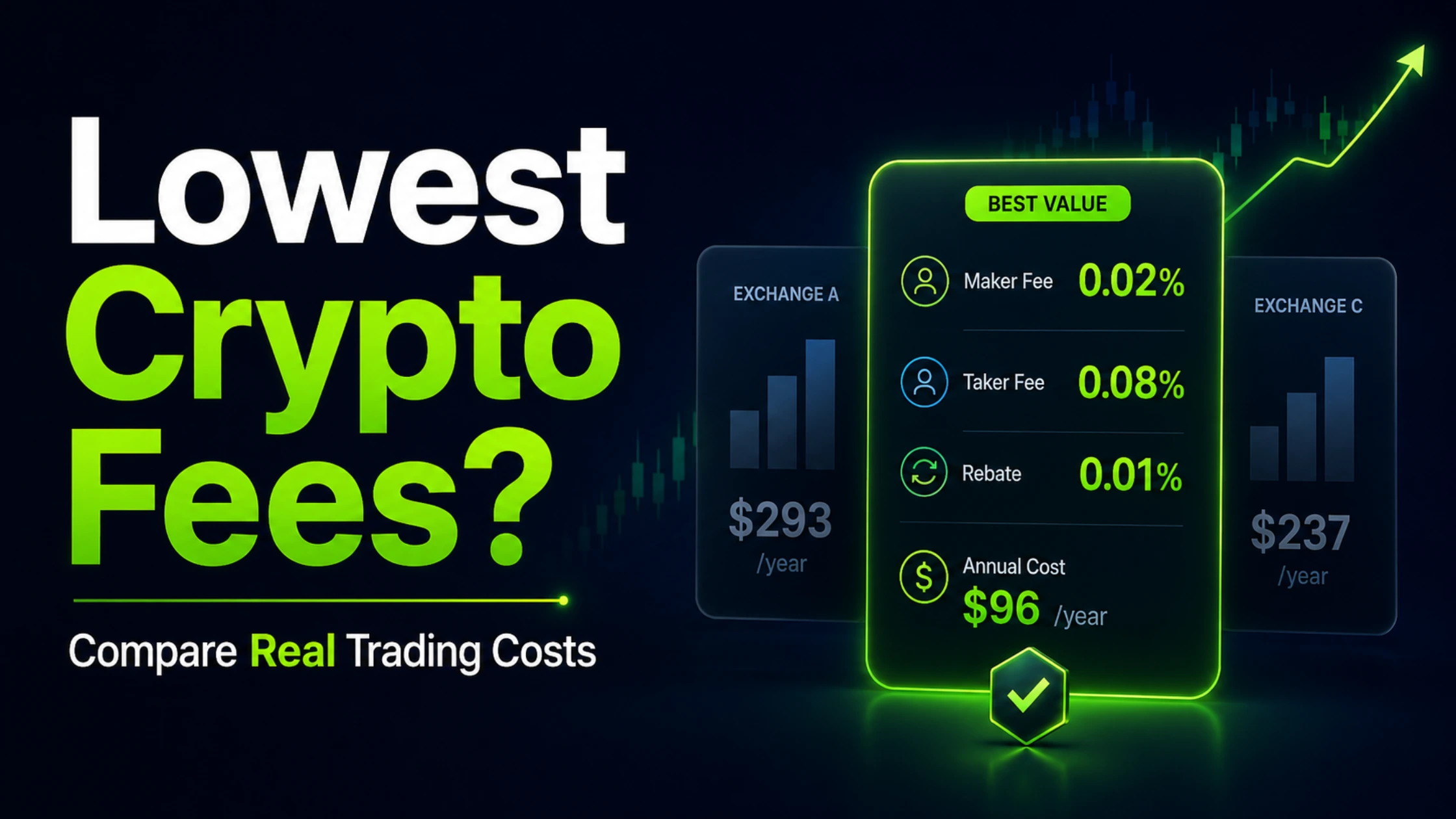
Which Crypto Exchange Has the Lowest Fees in 2026? The DN Exchange Fee & Rebate Optimizer
Enter your real trading volume and see the all-in cost on every major exchange — including the savings from tiers, native-token discounts and referral rebates most traders leave on the table.
The cheapest crypto exchange depends on your trading volume and your maker-versus-taker mix, not on a single headline fee. The true cost is the blended effective fee — base maker/taker rates reduced by VIP volume tiers, native-token fee discounts and referral rebates — applied across a full year of volume, where small differences compound into hundreds or thousands of dollars. The optimizer below computes this DN Effective Fee for each exchange from your own inputs, ranks them cheapest-first, and shows exactly how much a referral rebate saves you each year.
Trading fees are the most underestimated cost in crypto. They are quoted in fractions of a percent, which sounds trivial, so most traders barely glance at them — and then pay them on every single trade, in both directions, all year long. For anyone trading with real size or frequency, the gap between the cheapest and most expensive venue is not a rounding error; it is a recurring tax that can run to thousands of dollars a year, silently compounding against your returns.
This optimizer turns that invisible cost into a hard number. Enter your monthly volume and how much of it is maker versus taker, and it computes the all-in DN Effective Fee on each major exchange — after volume tiers, native-token discounts and referral rebates — then ranks them by what you would actually pay over a year. It answers the real question behind "which exchange has the lowest fees?": which is cheapest for you, and how much you save by signing up the right way.
| Exchange | DN Eff. Fee | Annual cost | DN rebate saves |
|---|
—
Fees compound silently
The reason fees do so much damage is that they are charged on turnover, not on profit. A fee of a few basis points feels negligible on a single trade, but a trader doing meaningful monthly volume turns their capital over many times a year, and the fee applies every time, on the way in and the way out, whether the trade wins or loses. The cost is not a one-off; it is a constant drag that scales with activity and never reverses. Two traders with identical strategies on different exchanges can end the year with materially different returns for no reason other than what they paid to transact.
Worse, fees are paid first, in cash, regardless of outcome, while profits are uncertain. That asymmetry means fee savings are among the highest-certainty edges available to an active trader — a guaranteed, risk-free improvement to net returns, unlike any market bet. Yet because the cost is spread across hundreds of small transactions, it stays invisible. The optimizer's job is to make it visible: to total up a year of those fractions and show what they actually come to.
The optimizer
The tool builds the true cost from the inputs that actually determine it. Your monthly volume sets both the scale of the fees and your VIP tier; your maker/taker mix weights the two fee rates, since posting liquidity as a maker is usually cheaper than taking it. From there it layers on the discounts that most traders never fully use, and expresses the result as one figure — the DN Effective Fee, the real blended rate you pay per dollar traded, all-in.
× VIP-tier benefit × (1 − token discount) × (1 − referral rebate)
Annual fee cost = monthly volume × 12 × DN Effective Fee ÷ 10,000
Ranking every exchange by annual cost answers the question properly. The headline "lowest fee" exchange is often not the cheapest once your real mix and the available discounts are applied, and a venue that looks expensive at base rates can win for a high-volume, maker-heavy trader who uses its token discount. The only honest answer is computed from your own numbers, which is exactly what the optimizer does.
Tiers and token discounts
Two levers cut fees before any referral benefit. The first is the VIP volume tier: every major exchange lowers maker and taker rates as your thirty-day volume rises, so the same strategy gets cheaper to run as it scales. The tool models this benefit approximately — real ladders differ by venue, so the exact tier should always be checked — but the direction is universal and worth planning around, since concentrating volume on one exchange to climb its tiers can beat spreading it thin across several.
The second is the native-token discount. Several exchanges let you pay trading fees in their own token in exchange for a meaningful reduction, often in the region of twenty percent. For an active trader that discount applies to every trade and compounds like everything else, so holding a small working balance of the fee token can pay for itself many times over. The optimizer lets you toggle this on to see its effect, because whether it is worth it depends on your volume — which is precisely the kind of question a model should answer rather than a generic article.
The cheapest venue, plus the rebate
The final lever is the one most traders never think about: the referral rebate. Signing up through a referral link typically grants a standing discount on your fees — not a one-time bonus, but an ongoing reduction applied to every trade for as long as you trade. It costs nothing and changes nothing about how you trade; it simply lowers the rate. Over a year of real volume, that rebate alone can be worth hundreds or thousands of dollars, and the optimizer shows the exact figure for your inputs in the final column.
This is the quiet punchline of fee optimization. The difference between signing up the default way and signing up through a rebate is free money, recovered from a cost you were going to pay regardless. Decentralised News maintains referral arrangements with the major venues precisely so that readers can capture that discount — the same trade, the same exchange, simply at a lower rate. The tool ranks the cheapest venue for your profile and links you to it with the rebate applied; there is no reason to leave that saving on the table.
Frequently asked questions
Which crypto exchange has the lowest fees?
There is no single answer — it depends on your trading volume and maker/taker mix. Once VIP volume tiers, native-token discounts and referral rebates are applied, the cheapest venue varies by trader profile. The optimizer above computes the all-in DN Effective Fee for each exchange from your own inputs and ranks them, so you get the cheapest option for you specifically rather than a generic headline.
What is the DN Effective Fee?
It is Decentralised News's all-in measure of what you actually pay to trade, in basis points: the blended maker/taker rate reduced by your VIP volume tier, any native-token discount and any referral rebate. It is more useful than a headline fee because it reflects the real rate applied to your real trading.
What is the difference between maker and taker fees?
A maker order adds liquidity to the order book by resting until filled, and is usually charged a lower fee; a taker order removes liquidity by executing immediately against existing orders, and is usually charged more. Your maker/taker mix therefore changes your blended fee, which is why the optimizer asks for it.
How much can a referral rebate actually save me?
It depends on your volume, but because the rebate is a standing discount applied to every trade, it compounds. For an active trader it can be worth hundreds or thousands of dollars a year — the optimizer shows the exact annual figure for your inputs. It is a risk-free saving on a cost you would pay anyway.
Are native-token fee discounts worth it?
For active traders, usually yes. Paying fees in an exchange's native token often cuts the rate by around twenty percent, applied to every trade, so a small working balance of the token can pay for itself quickly. Whether it is worthwhile depends on your volume, which you can test by toggling it in the optimizer.
Are these fee figures exact?
No — they are representative, DN-maintained figures used to model and compare costs, and exchange fee schedules change frequently and vary by tier, product and region. Always confirm the current maker/taker rates, VIP tiers and discounts on the exchange itself before deciding. The tool is for comparison and education, not a guarantee of specific pricing.
This tool and article are for educational and informational purposes only and do not constitute financial or trading advice. Exchange fee schedules are representative, DN-maintained figures that change frequently and vary by VIP tier, product, region and promotion; always verify current fees directly with the exchange. VIP-tier benefits are modelled approximately. Trading cryptocurrency, especially with leverage, carries significant risk of loss. Always do your own research. Decentralised News may earn a commission from exchanges linked in this article at no additional cost to you; referral arrangements may also provide you with a fee rebate.





