
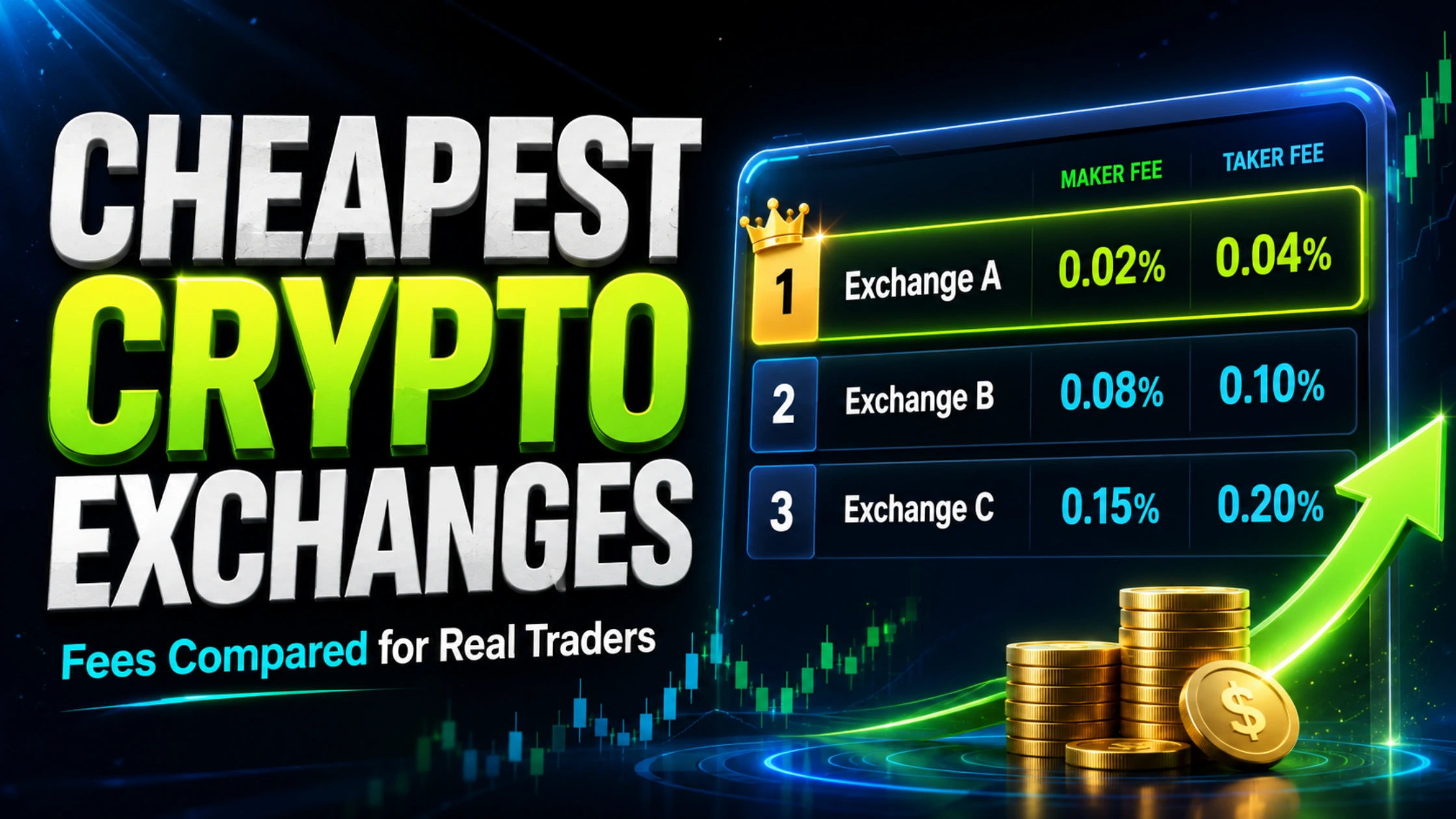
Most crypto traders have no idea how much they pay in exchange fees annually. This comparison tool ranks 10 exchanges by real trade cost for your exact trade size and type — and shows how much you save by switching.
Exchange Fee Comparison Tool 2026 — Find the Cheapest Platform for Your Exact Trade
A $10,000 spot taker trade costs $10 on Binance at standard rates and $0 on MEXC using a limit order. The same $10,000 perp maker order earns you $2 on BloFin through its maker rebate rather than costing anything. Over a full year of active trading, the difference between the most and least expensive exchanges for your specific trade type is not cosmetic. It is the difference between keeping or surrendering hundreds to thousands of dollars that belong in your account.
The Fee Problem Nobody Tracks
Ask a serious crypto trader what their annual fee bill is and most will not know. They know their profit and loss. They know their biggest wins and their worst losses. They do not know the slow, consistent drain that exchange fees apply to every single trade they make, regardless of whether that trade is profitable.
This is not an accident. Exchanges do not show you your cumulative fee payments in a prominent place. They do not send you an annual statement showing the total extracted from your account. The fee is deducted per trade, in small amounts, in a way that keeps it below the threshold of daily attention. The effect is deliberate and efficient: by the time a high-frequency retail trader realises they have paid $2,400 in fees in a single year, they have already paid it.
The comparison tool below fixes this by making fee costs visible, comparable, and actionable in real time. You input your trade size, your trade type, and your monthly volume, and the tool ranks ten exchanges by what they actually charge for that specific combination. The cheapest option is highlighted. The switch-and-save calculation shows your annual saving from moving to the cheapest platform.

The Anatomy of an Exchange Fee
Before using the comparison tool, understanding the fee structure helps interpret the outputs correctly. Exchange fees are not a single number. They are a stack of charges, some visible and some not.
Maker fees are charged when you place a limit order that adds liquidity to the order book. Your order sits in the book waiting to be matched. Because you provided liquidity rather than consuming it, exchanges charge lower fees for maker orders, and some exchanges pay you a rebate for them. BloFin’s perp maker fee is negative, meaning the exchange pays you 0.02% of the trade value for placing limit orders. On a $50,000 limit order, that is a $10 payment to you rather than a charge.
Taker fees are charged when you place a market order or a limit order that immediately fills against existing book orders. You consumed liquidity rather than adding it. Taker fees are consistently higher than maker fees across all exchanges, typically 2 to 3 times higher.
Spot fees apply to outright purchases and sales of crypto. You buy BTC with USDT, you pay the spot fee. MEXC charges zero maker fees on its spot markets, making it the cheapest option for anyone who can execute trades with limit orders and is not in a rush to fill.
Perpetual contract fees apply to leveraged derivatives trading. The fee structure matters more here than in spot because perpetual traders execute more frequently, often at larger notional sizes, creating significantly higher absolute fee costs. The difference between a 0.02% and a 0.06% taker fee on a $100,000 perp position is $40 per trade.
Withdrawal fees sit outside the maker/taker framework and are charged as a fixed amount or percentage per withdrawal. A $3 withdrawal fee matters very little on a $50,000 withdrawal and quite a lot on a $300 withdrawal. For high-frequency traders withdrawing profits regularly, withdrawal fees are a meaningful secondary cost that the comparison tool accounts for separately.
The spread is the invisible fee that does not appear in the fee schedule at all. On illiquid pairs or during high-volatility periods, the gap between the best bid and best ask price costs you money on every market order execution, regardless of the stated taker fee. This is particularly relevant on smaller exchanges where order book depth is thin.

Maker vs Taker — The Most Important Decision You Make Before Every Trade
The choice between placing a limit order (maker) and a market order (taker) is not just a question of whether you want an exact price or immediate execution. It is a fee decision with meaningful financial consequences.
On most major exchanges, the difference between maker and taker fees runs 0.02 to 0.04 percentage points. On a $10,000 trade, that difference is $2 to $4. On $500,000 of monthly trading volume, it is $100 to $200 per month, compounding to $1,200 to $2,400 per year.
This is the single most accessible fee reduction available to any trader without switching exchanges. Placing limit orders rather than market orders, when execution timing allows, reduces the fee rate by 30 to 50% per trade on most platforms. For traders running systematic strategies or grid bots where exact fill timing is flexible, making this switch captures the entire maker/taker discount without any change to the strategy.
The comparison tool highlights this distinction by letting you compare the same exchange across maker and taker trade types. The difference in the ranked table when you switch between “spot maker” and “spot taker” illustrates the value of limit order discipline.

VIP Tiers — When Volume Discounts Actually Make Sense
Every major exchange operates a VIP tier system where higher monthly trading volume unlocks progressively lower fee rates. The system is designed to retain high-value customers and is genuinely beneficial at the volumes where the tiers activate.
Most retail traders never activate a meaningful VIP discount. On Binance, the first meaningful fee reduction (VIP 1) requires $1,000,000 in 30-day spot trading volume or holding 25 BNB. On OKX, VIP 1 requires $5,000,000 in 30-day volume. On Bybit, VIP 1 requires approximately $100,000 in 30-day volume, which is more accessible for active traders.
The practical implication: if your monthly trading volume is below approximately $50,000, VIP tiers are unlikely to provide meaningful fee relief on most tier-1 exchanges. At $50,000 to $500,000 monthly volume, the arithmetic of concentrating trading on a single exchange to maximise VIP tier access becomes relevant. Above $500,000 monthly, the fee reductions are substantial enough that VIP tier optimisation should be a conscious strategic decision.
The comparison tool includes a monthly volume tier input that adjusts the displayed fee rates based on approximate VIP discounts at each volume level. Selecting your realistic monthly volume gives a more accurate picture of your actual fee cost than the standard-rate comparison alone.
The Annual Fee Drain — What Consistent Trading Actually Costs
To understand why fee selection matters, run the maths on a moderately active trader. Someone executing $30,000 of spot taker trades per day, five days per week, generates approximately $600,000 of monthly volume. At 0.1% taker fees on a standard-rate exchange, monthly fees total $600. Annual fees: $7,200.
The same trading activity on an exchange with a 0.05% taker fee costs $300 per month, $3,600 per year. The annual saving from choosing the lower-fee platform: $3,600. Without changing any trade, without improving any strategy, without doing anything except where you execute.
At this volume level, the fee selection is not a minor optimisation. It is a meaningful component of annual return. A trader generating 30% annual return on a $100,000 account ($30,000) who pays $7,200 in fees rather than $3,600 has surrendered 12% of their profits to fee inefficiency. Reducing that fee bill to $3,600 adds 12% to the amount they keep.
The tool’s switch-and-save calculation does this maths for your specific inputs. It shows the annual saving in dollar terms from moving your volume to the cheapest option identified in the ranked table.
Use the Comparison Tool
Select your trade size, trade type, and monthly volume. The table ranks ten exchanges from cheapest to most expensive for your specific combination.
Reading the Results — Who Wins for Which Trade Type
Spot maker orders: MEXC wins at every trade size and volume tier. Zero percent maker fee means you pay nothing to place limit orders on MEXC’s spot markets. MEXC is the rational choice for any spot trader who can use limit orders. The limitation is liquidity: MEXC’s order book depth on major pairs is thinner than Binance or OKX, meaning your limit order may not fill at the desired price during volatile periods, or may fill with partial slippage on large orders.
Spot taker orders: Pionex (0.05% flat) and OKX (0.10%) lead at standard volume tiers. Pionex is specifically compelling for any trader using automated grid bots, because the 0.05% flat fee applies regardless of whether orders are maker or taker, and the built-in bot infrastructure means no third-party subscription fee on top. The effective fee comparison for a grid bot user is Pionex at 0.05% versus 3Commas plus OKX at 0.10%, which often makes Pionex the lower total cost even accounting for its smaller coin selection.
Perp maker orders: BloFin wins by a significant margin due to its negative maker fee. On perp limit orders, BloFin pays you 0.02% of the trade value rather than charging you. This is not a theoretical number. It is real income per limit order placed, and it compounds meaningfully for active traders executing significant perpetual volume with limit orders. At $200,000 of monthly perp maker volume, BloFin’s rebate generates $480 per year while the average exchange charges $480 to $600 per year for equivalent activity. The swing from any standard-rate exchange to BloFin for perp maker orders is substantial.

Perp taker orders: MEXC leads with 0.01% taker fees on futures markets, followed closely by Bybit at 0.055% and OKX at 0.05%. For taker-heavy strategies like market orders into fast-moving positions, the fee difference between MEXC and a standard exchange at 0.06 to 0.075% is meaningful at scale, though MEXC’s futures liquidity is thinner than Bybit or OKX on major pairs.
The Maker Rebate Strategy — Getting Paid to Provide Liquidity
BloFin’s negative maker fee deserves more attention than it typically receives in the crypto media ecosystem, because it represents a genuine structural advantage for limit order traders that does not exist on most other exchanges.
The mechanism is simple. When you place a limit buy or sell order on BloFin’s perpetual markets that adds to the order book rather than immediately consuming existing orders, BloFin credits your account with 0.02% of the trade value at execution. A $50,000 limit order that fills earns $10. A $500,000 limit order earns $100. For a systematic strategy running significant notional through limit orders, this rebate is material income, not a rounding error.
The rebate exists because exchanges need liquidity providers. A market maker who consistently places limit orders that others can fill against is providing a service that improves the exchange’s competitiveness and attracts more trading volume. The rebate is the exchange’s payment for that service.
For retail traders, the actionable implication is straightforward: if you are trading perpetuals and your strategy allows you to enter and exit with limit orders rather than market orders, running those orders through BloFin instead of a standard-rate exchange converts a fee expense into a fee income. The switch requires no change to your strategy, only to where you execute it.

How the VIP System Responds to Volume Concentration
One of the less obvious implications of fee tier systems is the value of volume concentration. A trader executing $300,000 of monthly volume spread across four exchanges achieves VIP tier 1 on none of them. The same $300,000 concentrated on a single exchange achieves VIP tier 2 or 3 on most platforms, unlocking 30 to 50% fee reductions.
The concentration argument is strongest for traders who use multiple exchanges for diversification reasons and could consolidate without meaningfully changing their strategy or access to liquidity. If you are trading BTC and ETH perps on Bybit, OKX, and BloFin simultaneously for no specific functional reason, concentrating all of that volume on the single platform where your combined volume achieves the highest VIP tier is worth calculating.
The switch-and-save output in the comparison tool does not model VIP tier concentration benefits, which are trader-specific and depend on the exchange’s exact tier schedule. But the volume tier input allows you to see approximately what each exchange charges at your combined monthly volume level if you were to concentrate it there.

The Exchanges in the Table — What Each One Is Actually For
BloFin is a derivatives-first exchange with its best competitive advantage in perp maker fees. The spot product exists but BloFin’s strongest use case is perpetual contract trading for limit order strategies. Maker rebate is the defining feature.
Bybit sits in the sweet spot between competitive fees, deep liquidity, and a full product suite. It is not the cheapest on any single metric but it ranks in the top tier consistently across spot, perps, copy trading, and grid bots. For a trader who wants a single exchange for everything, Bybit’s combination of fee competitiveness and product breadth is hard to beat.
OKX has slightly lower standard spot maker fees than Binance and competitive perp rates. The DeFi and Web3 wallet integration makes OKX the natural choice for traders who move between CEX trading and on-chain activity. The fee transparency on OKX is above average for the industry.
MEXC wins purely on fee rate for both spot makers (zero) and futures (near zero). The trade-off is liquidity depth. MEXC’s order book is thinner than the tier-1 exchanges on major pairs, meaning large orders may experience slippage that offsets the fee saving. For smaller trade sizes below $20,000 on major pairs, MEXC’s fee advantage is usually real and uncomplicated by liquidity issues.
Binance wins for high-volume traders reaching upper VIP tiers, where fee rates compress to 0.02% or below. At standard rates, Binance is average. At $5M or more monthly volume, Binance’s scale and VIP rate structure become compelling.
Bitget is mid-table on fees but features a strong copy trading and social trading product. The fee comparison for Bitget users who copy trade must include the profit-sharing fee paid to signal providers, which adds 8 to 12% of profits on top of the standard exchange fees.
BingX occupies a similar position to Bitget. Standard fees are competitive without being exceptional. The social trading layer and World Cup sponsorship brand positioning target a retail audience that values community features alongside competitive pricing.
Tapbit and Bitunix are futures-focused platforms with competitive rates in the 0.012 to 0.06% range for perps. Both are better alternatives to standard-rate exchanges for active derivatives traders who want lower fees without the minimum volume requirements of the tier-1 VIP system.
Pionex is the correct answer for any trader whose primary activity is running grid bots or DCA automation. The 0.05% flat fee across all order types and built-in bot infrastructure eliminates the third-party bot subscription cost while delivering competitive fees. Pionex’s coin selection is narrower than major exchanges, limiting it to traders focused on major pairs.

FAQ
What is a maker fee and why is it lower than a taker fee? A maker fee is charged when you place a limit order that adds liquidity to the order book rather than immediately matching with existing orders. Because you improved the exchange’s order book depth, the exchange charges you less (or in BloFin’s case, pays you a rebate). A taker fee is charged when your order immediately fills against existing book orders, consuming liquidity. Taker fees are consistently higher because you consumed rather than provided liquidity.
How much money can I save by switching to a lower-fee exchange? It depends entirely on your trading volume and trade type. For a trader executing $100,000 of monthly perp taker volume, the difference between a 0.06% and a 0.02% taker fee is $480 per month, $5,760 per year. For a spot maker trader switching from any standard exchange to MEXC (zero maker fees), the saving equals whatever they currently pay in maker fees annually. The switch-and-save calculation in the tool above quantifies this for your specific inputs.
Are VIP tier discounts worth pursuing? At monthly trading volumes below $50,000, VIP tiers rarely provide meaningful fee relief on tier-1 exchanges. Between $50,000 and $500,000 monthly, concentrating volume on a single exchange to reach VIP 1 or 2 can reduce fees by 20 to 40%. Above $500,000 monthly, VIP tier optimisation should be a deliberate strategic decision, including whether to consolidate exchanges for tier purposes.
What is a maker rebate and how does it work? A maker rebate is a negative maker fee. Rather than charging you for placing limit orders, the exchange pays you a small percentage of the trade value for providing liquidity. BloFin’s perp maker rebate of -0.02% means a $100,000 perp limit order earns $20 at execution. Over significant monthly perp maker volume, this rebate becomes material annual income rather than a fee expense.
Does using a lower-fee exchange mean lower liquidity? Not always. MEXC and Bitunix both offer competitive fees with reasonable liquidity on major pairs. The concern about liquidity is most relevant for large orders (above $50,000 notional) on less liquid pairs. For major pairs like BTC/USDT and ETH/USDT at retail trade sizes, most exchanges in the comparison table offer sufficient liquidity. The tool notes liquidity context alongside fee rankings.
Should I use different exchanges for different trade types? Yes, for the largest fee savings. Using MEXC for spot limit orders (zero maker fee), BloFin for perp limit orders (maker rebate), and Bybit or OKX for perp taker orders (competitive taker rates with deep liquidity) is a rational multi-exchange strategy for active traders. The operational overhead of managing multiple exchange accounts is real but manageable, and the annual fee saving at meaningful volumes justifies it.
Access the platforms in this comparison: BloFin — perp maker rebate · Bybit — full-suite competitive fees · OKX — competitive spot and perp rates · MEXC — zero spot maker, near-zero perp taker · Binance — best VIP tiers at high volume · Bitget · BingX · Tapbit · Bitunix · Pionex
Start Here — Build Your Crypto Infrastructure Safely
You don’t need to use everything at once.
Professionals reduce risk by having access to multiple rails so they are never dependent on a single platform.
Below is a simple, practical setup used by many experienced traders and investors.
1) Your Fiat Gateway (Primary Access)
Best starting point for deposits & withdrawals
Binance — reliable onboarding, deep liquidity, global coverage
👉 sign up
Why open this:
- Move from bank → crypto easily
- Convert large amounts efficiently
- Emergency exit capability
2) Your Trading Execution Venue (Fast & Flexible)
Best for active trading and broad market access
MEXC — huge altcoin selection & low trading friction
👉 sign up
Why open this:
- Trade markets not listed elsewhere
- Better execution during volatility
- Lower dependence on a single exchange
3) Your Advanced Tools & Derivatives Platform
Best for leverage, hedging and professional execution
Bybit — strong order controls & derivatives infrastructure
👉 sign up
Why open this:
- Proper stop loss tools
- Hedging capability
- Strategy flexibility

4) Your Yield & Passive Income Layer
Best for structured products and capital efficiency
Gate.com — structured yield & automated earning tools
👉 sign up
Why open this:
- Earn on idle capital
- Diversify platform risk
- Access structured strategies
5) Your Altcoin & Ecosystem Expansion Layer
Best for early market access and wide listings
KuCoin — broad token ecosystem
👉 sign up
Why open this:
- Access emerging markets
- Portfolio diversification
- Redundancy if one platform restricts access
Why This Structure Matters
Using one exchange creates a single point of failure.
Using multiple rails creates:
- Liquidity redundancy
- Faster reaction ability
- Lower operational risk
- Greater opportunity access
You don’t need large capital to start — you just need prepared infrastructure.
Practical Next Step
Open accounts gradually and verify them before you need them.
Most people only prepare during stress —
professionals prepare before it.
(Decentralised News provides infrastructure education, not financial advice. Always use proper security practices.)





