
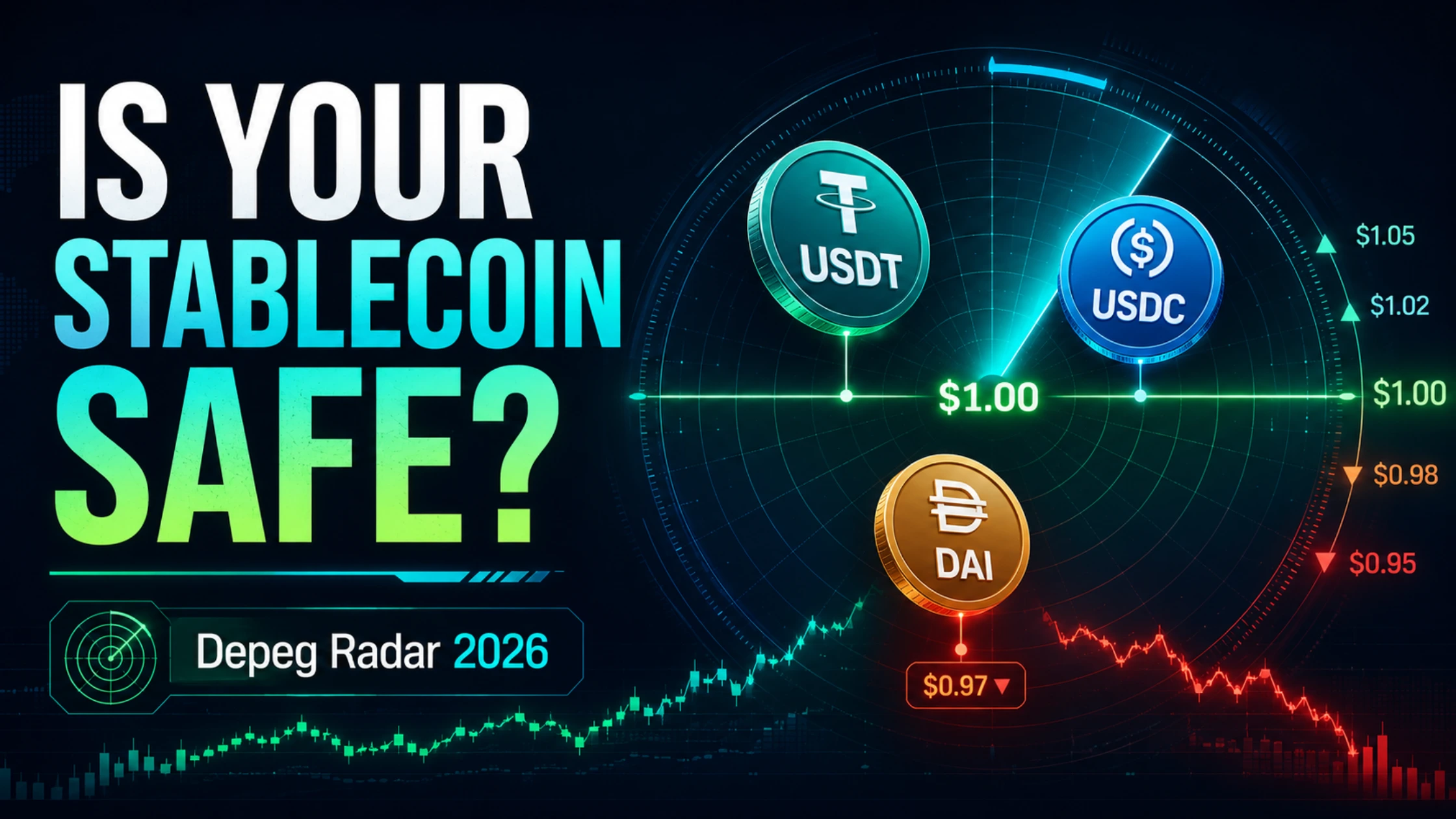
Is USDT or USDC Depegging Right Now? The DN Stablecoin Depeg Radar for 2026
A live grid of every major stablecoin against its dollar peg, with deviation alerts and a Peg Stability Score — calm-day utility, crisis-day lifeline.
A stablecoin depeg is when a coin designed to hold a fixed value, usually one US dollar, trades meaningfully away from it. The radar below pulls live prices for the major stablecoins and flags any that deviate: under 25 basis points is normal, 50 to 100 is a warning, and beyond 100 basis points (one percent) is a genuine depeg. Each coin also carries a DN Peg Stability Score blending how tightly it holds peg right now with how robust its backing is — so a fully-reserved fiat coin scores higher than a synthetic one even when both read a dollar. Check the live status, and use the crisis playbook below if a peg breaks.
Stablecoins are the plumbing of crypto. Almost every trade, every yield position, every cross-border transfer routes through a token that promises to always be worth a dollar. That promise is so foundational that nobody thinks about it — until the day it cracks. When a major stablecoin wobbles, the panic is instant and total, because the entire system assumes that one dollar in equals one dollar out. The traders who survive those moments are the ones who saw it early and acted before the crowd.
This radar exists for both states of the world. On a calm day it is a quiet utility confirming the pegs are holding. In a crisis it becomes the single most important page in crypto: a live, at-a-glance answer to "is this thing actually depegging, or is it noise?" — followed by a clear-headed playbook for what to do about it.
—
Anatomy of a depeg
A stablecoin holds its peg through a mechanism — a promise that it can always be redeemed for, or is always backed by, a dollar of value. A depeg happens when the market stops believing that promise can be honoured at scale, or when the mechanism itself fails. The trigger is usually one of three things: a sudden rush of redemptions that outpaces available liquidity, a revelation that the reserves backing the coin are not what was claimed, or a structural flaw in an algorithmic design that unravels under stress.
The two most instructive episodes sit at opposite ends of the spectrum. The collapse of an algorithmic stablecoin in 2022 was terminal — its design had no real collateral, only a reflexive link to a sister token, and once confidence broke the whole structure spiralled to zero in days. By contrast, when a major fiat-backed stablecoin briefly lost its peg in 2023 after exposure to a failed bank, it fell sharply but recovered fully within days, because the assets were ultimately real and redeemable. The lesson is that not all depegs are equal: one is a liquidity scare, the other is insolvency, and telling them apart in the moment is the entire game.
Reading the radar
The grid shows each major stablecoin's live price, its deviation from a dollar in basis points, a status flag, and its Peg Stability Score. A basis point is one hundredth of a percent, and stablecoins normally drift within a tight band of a few basis points either side of a dollar simply from trading. The thresholds that matter:
Normal trading fluctuation. The peg is holding; nothing to see.
A slight deviation worth noting, often from temporary order-book imbalance. Usually self-corrects.
A notable deviation. Something is straining the peg — thin liquidity, a large seller, or rising doubt. Pay attention.
A genuine depeg. The market is repricing the coin's reliability. Move from watching to acting.
The Peg Stability Score adds the dimension a live price cannot show: structural robustness. It blends how tightly the coin holds peg right now with a rating of how trustworthy its backing mechanism is. This is why a fully-reserved, audited fiat stablecoin trading exactly at a dollar scores higher than a newer synthetic dollar also trading at a dollar — both are pegged today, but their resilience under stress is not the same, and the score reflects that forward-looking risk rather than just the current price.
What backing really means
Every stablecoin is only as stable as whatever stands behind it, and the differences are profound. Fiat-backed coins hold reserves of cash and short-term government debt, redeemable one-for-one; their risk is reserve quality and the solvency of the banks holding them. Crypto-collateralised coins are overcollateralised with on-chain assets you can verify directly, trading custody risk for volatility and smart-contract risk. Synthetic or yield-bearing dollars hold a hedged position — long an asset, short a future — to stay dollar-neutral; they are ingenious but carry funding and basis risks that purely-reserved coins do not. Purely algorithmic designs, backed by nothing but a market-making mechanism, have repeatedly proven fatally fragile.
None of these is automatically safe or unsafe, but they fail in different ways and for different reasons. Understanding which model a coin uses tells you what could break it and how warning signs would appear — a bank-exposure scare for a fiat coin, a collateral crash for a crypto-backed one, a funding-rate inversion for a synthetic one. The backing rating in the Peg Stability Score is our distilled read of that structural risk.
The crisis playbook
When the radar flashes red, panic is the enemy. The traders who lose the most in a depeg are those who dump at the bottom of a liquidity wick that recovers an hour later — and those who freeze and ride a genuine collapse to zero. The discipline is to act fast but think first:
- Diagnose liquidity versus insolvency. Is this a thin-book wick, or is there real news about reserves or redemptions? A fiat coin with sound reserves facing a scare is a different situation from an algorithmic coin unravelling. The cause determines whether to hold or flee.
- Rotate to relative safety. If the doubt is real, move into a stronger stablecoin, into fiat, or off the affected chain entirely. Speed matters; the best exits happen in the first minutes, not after the headlines.
- Mind the redemption arbitrage. A genuinely backed coin trading below a dollar is a buying opportunity for those who can redeem at par — which is exactly the force that snaps a liquidity-driven depeg back. Know whether that backstop exists before you sell into it.
- Don't trade what you don't understand. If you cannot explain why a coin is depegging, the right position is no position. Get to safety and watch.
Where to rotate to safety
Acting on a depeg means moving fast between stablecoins, into fiat, or across venues — which requires liquid, reliable rails:
Frequently asked questions
Is USDT or USDC depegging right now?
Check the live radar above. It pulls current prices for the major stablecoins and flags any deviation from a dollar: under 25 basis points is normal, 50 to 100 is a warning, and over 100 basis points is a genuine depeg. The market peg status at the top summarises whether all majors are holding or any are under stress.
What is a stablecoin depeg?
A depeg is when a stablecoin trades meaningfully away from the value it is designed to hold, usually one US dollar. It happens when the market doubts the coin can be redeemed at par, when reserves are revealed to be inadequate, or when an algorithmic mechanism fails under stress.
How far from a dollar counts as a depeg?
Stablecoins normally trade within a few basis points of a dollar. A deviation beyond about 50 basis points is a warning sign, and beyond 100 basis points — one full percent — is generally considered a genuine depeg worth acting on, though context and the coin's backing matter enormously.
What should I do if a stablecoin depegs?
First diagnose whether it is a temporary liquidity scare or a genuine insolvency, since the cause determines the response. If the doubt is real, rotate quickly into a stronger stablecoin or fiat. Avoid panic-selling into a thin wick that may recover, and never hold a position in a coin whose depeg you cannot explain.
What is the DN Peg Stability Score?
It is a per-coin score from Decentralised News that blends how tightly a stablecoin is holding its peg right now (55%) with a structural rating of how robust its backing mechanism is (45%). It lets you distinguish a coin that is merely pegged today from one that is genuinely resilient under stress.
Which stablecoin is the safest?
There is no single answer, but fully-reserved, independently audited fiat-backed stablecoins are generally considered lower-risk than synthetic or algorithmic designs, because their backing is real and redeemable. Diversifying across reputable stablecoins and not over-concentrating in any one is a common risk-management approach.
This tool and article are for educational and informational purposes only and do not constitute financial, investment or trading advice. Live prices are sourced from a third-party API and may be delayed, incomplete or inaccurate, especially during fast-moving events; always verify across multiple sources before acting. The Peg Stability Score is a model incorporating subjective backing assessments and is not a guarantee of any stablecoin's safety. Stablecoins can and do lose their peg, sometimes permanently, resulting in loss of funds. Always do your own research and consider consulting a licensed financial professional. Decentralised News may earn a commission from services linked in this article at no additional cost to you.