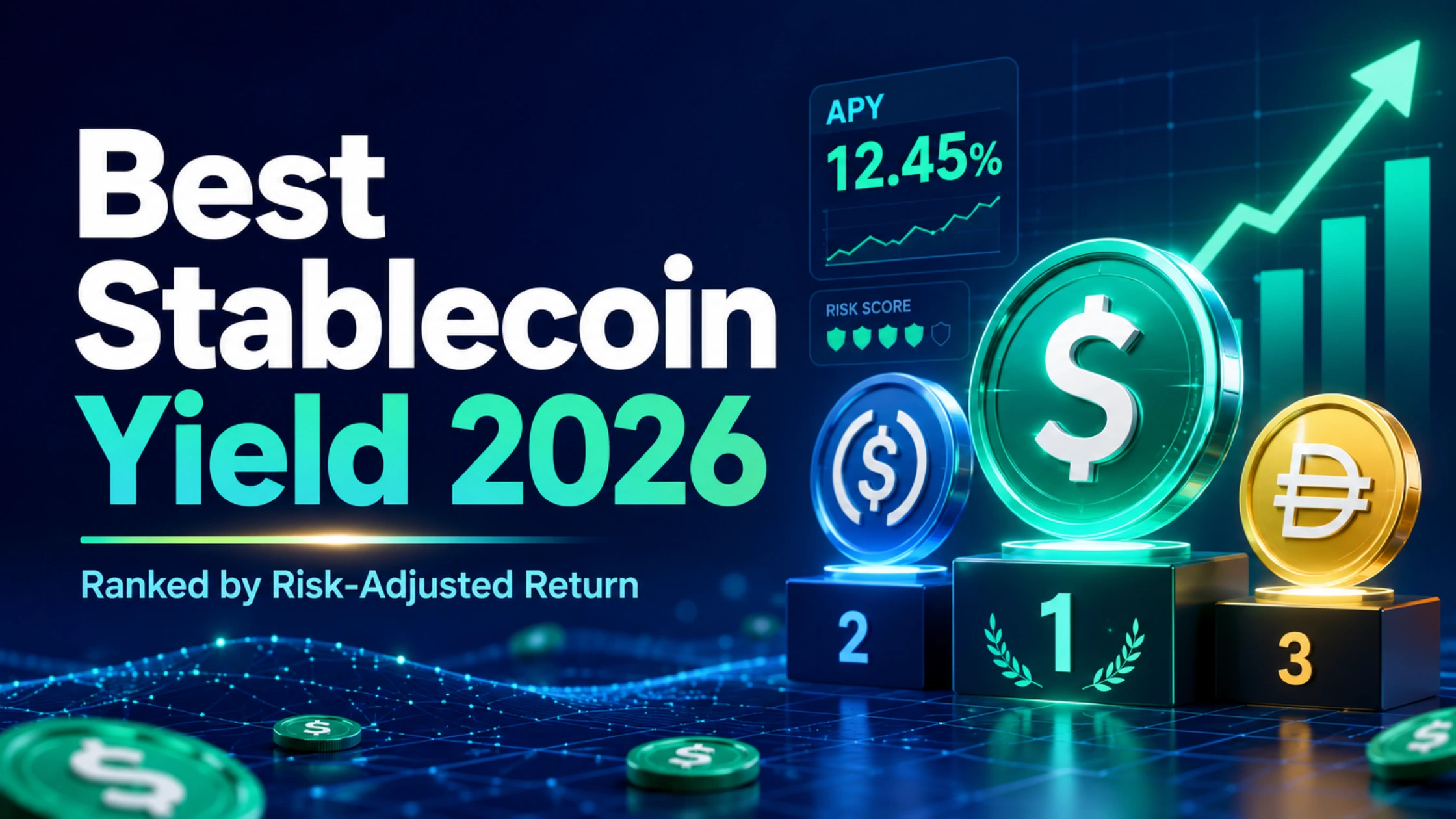
Six stablecoin yield sources compared by APY, risk rating, liquidity, and risk-adjusted return score. Updated May 2026. From Bybit Earn to Ondo USDY to Pendle fixed yield — find where your idle dollars work hardest.
Stablecoin Yield Rankings — May 2026 Update: Where to Park Your Dollars for the Best Risk-Adjusted Return
Leaving USDT or USDC idle on an exchange or in a wallet in 2026 is a quantifiable financial mistake. The six stablecoin yield sources in the table below collectively offer between 4.8% and 9.5% annual return on dollar-denominated capital. The risk-adjusted ranker below sorts them by what they actually pay relative to the risk you take to earn it — which changes the ranking meaningfully compared to sorting by raw APY alone.
The Stablecoin Yield Landscape in 2026
Three things changed the stablecoin yield market between 2023 and 2026.
The first was the Federal Reserve’s rate cycle. When US interest rates rose to 5%+ in 2023, tokenized Treasury products like Ondo Finance’s USDY suddenly became competitive with DeFi yields that had previously dominated the space. The yield on holding tokenized T-bills on-chain — 4.5 to 5% with minimal risk — compressed the premium available from riskier DeFi strategies while raising the floor that any stablecoin yield product needed to clear.
The second was the GENIUS Act. Signed into law in 2025, the Stablecoin Act established regulatory requirements for stablecoin issuers including reserve attestation, capital requirements, and audit obligations. This created a meaningful distinction between compliant stablecoin products — USDC and USDY from regulated issuers — and non-compliant alternatives where the regulatory trajectory remains uncertain. The Act has not destroyed Tether’s market position, but it has changed how institutional allocators think about stablecoin counterparty risk and which products they consider appropriate.
The third was the maturation of DeFi yield infrastructure. Aave v3, Morpho, and Pendle Finance have developed into robust protocols with years of operating history, multiple independent audits, and billions in TVL that has sustained multiple market stress events. The category of “DeFi stable yield” no longer means the same thing it meant in 2021. The risk profile of established lending protocols is materially different from the experimental farm-and-dump strategies that characterized the early DeFi era.
The result is a stablecoin yield market in 2026 that has something for every risk appetite — from Treasury-backed instruments for capital-preservation-first allocators to curated lending vaults and fixed-yield trading for users comfortable with protocol complexity.
The Six Sources — What Each One Actually Is
Bybit Earn USDT is the CeFi savings product that most active Bybit users already have access to without additional setup. Bybit pays a variable rate on USDT deposited into the Earn product, currently in the 6 to 7% range, sourced from the exchange’s lending and market-making operations. Withdrawal is instant. The risk is exchange counterparty risk — Bybit’s custody of the underlying capital — rather than smart contract risk. For users already holding USDT on Bybit for trading purposes, this is the zero-friction yield option.

OKX USDT Savings operates on the same model. OKX Earn pays a variable rate on USDT deposits from the platform’s capital deployment into lending markets and liquidity operations. Rates currently run 5.5 to 6.5%. Instant withdrawal with no lock-up. The risk profile is structurally identical to Bybit Earn — exchange counterparty risk — with OKX’s track record and proof of reserves providing the primary trust signal.
Ondo Finance USDY is the on-chain tokenized Treasury instrument. Ondo purchases short-term US Treasury bills and money market instruments, holds them in a regulated fund structure, and passes the yield to USDT/USDC holders who mint USDY. Current yield is approximately 4.8%, fluctuating with the Federal Reserve’s short-term rate. Redemption is typically 1 business day. The risk profile is low: Ondo Finance is SEC-regulated, the underlying fund holds US government-backed instruments, and the smart contract stack has been audited and operational without incident. For the non-US user wanting dollar yield on their savings, USDY is the cleanest institutional-grade product currently available on-chain.
Aave v3 USDC supply rate is the foundational DeFi lending rate. Depositing USDC into Aave’s lending pool earns the rate paid by borrowers who have posted overcollateralized positions. Current rate sits at approximately 5.2%, varying with borrow demand. Withdrawal is instant when pool liquidity is available. Risk is smart contract risk plus the systemic risk that overcollateralized borrowers fail to get liquidated fast enough during a sharp market crash — a scenario that has been tested in multiple market events without Aave suffering bad debt. The protocol is the most battle-tested in DeFi.
Morpho curated vaults sit above Aave in the yield stack by deploying capital more aggressively through a curator model. A Morpho vault pools USDC from depositors and a curator (Gauntlet, Block Analitica, and others) allocates it across multiple lending markets according to a published risk framework. Current yields run 7 to 9% on well-regarded vaults. Withdrawal is instant on most vaults but subject to queue mechanics during high withdrawal pressure. Risk is meaningfully higher than Aave — protocol risk (Morpho’s own contracts), curator risk (the risk that the curator’s allocation model performs poorly), and underlying market risk (the same overcollateralization risks as Aave, amplified by more aggressive deployment).
Pendle PT USDE fixed yield is the most complex and highest-yielding option in the table. Pendle Finance allows holders to trade future yield, separating yield-bearing assets like Ethena’s USDE into a Principal Token (PT) that trades at a discount and a Yield Token (YT) that captures future yield. Buying PT-USDE at a discount gives the holder a fixed, guaranteed APY if held to maturity — currently approximately 9.5% annualized on near-term expiries. The yield is locked until the expiry date. Risk is multi-layered: Ethena’s synthetic dollar model (long spot + short perp, with funding rate risk), the Pendle smart contract, and the liquidity of the underlying USDE position.

Risk Rating Explained — What the 1 to 5 Scale Actually Measures
The tool’s risk rating is not a general quality score. It measures one specific thing: the probability of a partial or total loss of principal on the deployed capital. A rating of 1 would be reserved for fully insured bank deposits with no conceivable principal risk. No crypto instrument qualifies for 1.
Rating 2 (Very Low Risk): Includes CeFi exchange savings products (Bybit, OKX) and regulated tokenized Treasury instruments (Ondo USDY). Principal loss requires either an exchange insolvency event or a failure of the underlying regulated fund structure — low probability events with historical precedent but not common outcomes.
Rating 3 (Low-Moderate Risk): Includes established overcollateralized DeFi lending markets with years of operating history (Aave) and curated vault systems that extend that infrastructure (Morpho well-rated vaults). Principal loss requires a smart contract exploit, a failure of the liquidation mechanism during an extreme market event, or a curator allocation error. These risks are real and non-theoretical but have not materialized in the top-tier protocols across multiple market cycles.
Rating 4 (Moderate Risk): Includes synthetic stablecoin yield products (Pendle PT USDE) where the collateral model introduces an additional layer of complexity and potential failure mode. Ethena’s USDE has maintained its peg through multiple market stress events, but the funding rate model does have a failure scenario (sustained negative funding) that the reserve fund is designed to mitigate rather than eliminate.
Rating 5 (High Risk): Not currently in the table but represents experimental protocols, levered strategies, or products with limited operating history.
The Risk-Adjusted Score — Why Raw APY Is Misleading
Ranking stablecoin yield sources purely by APY produces a list that most informed allocators would not follow: put everything in the highest-yielding option (Pendle PT USDE at 9.5%) and ignore the risk differential.
The risk-adjusted score in the ranker divides the APY by the risk rating and applies a liquidity modifier. Higher yield with higher risk produces a lower score than moderate yield with low risk. The formula:
Risk-adjusted score = (APY / Risk Rating) × Liquidity Multiplier × 100
Where the liquidity multiplier is 1.0 for instant withdrawal, 0.85 for 1-day redemption, and 0.70 for locked capital.
The practical effect: Bybit Earn at 6.5% with Risk 2 and instant liquidity scores higher than Pendle PT USDE at 9.5% with Risk 4 and locked liquidity. Morpho vaults at 7.8% with Risk 3 and instant liquidity score above Aave at 5.2% with Risk 3, reflecting the higher yield at equivalent risk.
The score is an input to thinking, not a prescription. Your actual allocation should reflect whether the risk differentials are material given your capital size, time horizon, and other portfolio context.
Use the Ranker
Sort by any column to see how the landscape changes depending on your priority.
How to Build a Stablecoin Yield Stack
The most sophisticated approach to stablecoin yield in 2026 is not choosing one product but layering three with different risk profiles.
Layer 1 — The emergency reserve (Rating 2, instant): Keep 30 to 40% of stablecoin capital in an instantly redeemable, low-risk product. Bybit Earn or OKX Earn serve this function — capital that can be withdrawn to deploy into a market opportunity or cover an unexpected expense within minutes. At 6 to 6.5%, this layer is earning meaningfully without any sacrifice of flexibility.
Layer 2 — The stable core (Rating 2-3, 1-day): The majority of stablecoin capital — 40 to 50% — sits in Ondo USDY or Aave USDC. USDY provides the regulated Treasury yield that is appropriate for capital you do not need back immediately but want to keep in a low-risk instrument. Aave provides a similar yield with instant redemption for users comfortable with DeFi smart contract exposure. Access both via deBridge from any chain into the Ethereum ecosystem.
Layer 3 — The yield optimization tranche (Rating 3-4, various): 10 to 20% of stablecoin capital in Morpho vaults or Pendle PT positions. Morpho’s higher yield at the same risk rating as Aave makes it the rational choice for capital that doesn’t need daily liquidity. Pendle PT is appropriate only for users who understand the Ethena model and can commit capital until the expiry date.
This three-layer approach generates a blended yield of approximately 6.5 to 7.5% on the full stablecoin allocation, with clear differentiation between emergency-accessible, medium-term, and optimized layers.
The GENIUS Act Context — Which Products Are Better Positioned
The GENIUS Act’s compliance requirements create an asymmetry in regulatory risk across stablecoin products that matters for medium-to-long-term yield strategy.
USDC (Circle) has invested heavily in GENIUS Act compliance infrastructure, with reserve attestations, bank partnerships, and regulatory relationships that position it as the primary beneficiary of the Act’s implementation. USDY (Ondo) is backed by US Treasuries through a regulated fund structure and is explicitly designed to be compliant.
USDT (Tether) occupies a more complex position. Tether has moved to improve reserve transparency but its Cayman Islands domicile and historical attestation controversies create uncertainty about its long-term GENIUS Act compliance pathway. For stablecoin yield purposes, this matters primarily as a risk factor rather than an immediate threat — USDT has demonstrated extraordinary market resilience — but it is a relevant consideration for capital where regulatory risk is a primary concern.
The practical implication: for capital where regulatory clarity is important, favor USDC-denominated yield products (Aave USDC, Morpho USDC vaults, USDC stablecoin savings) over USDT-denominated alternatives.

FAQ
Is stablecoin yield taxable? In most jurisdictions, yes. Yield earned from CeFi savings accounts is treated as ordinary income at the time of receipt. DeFi yield from Aave or Morpho is similarly treated as income when received. Ondo USDY’s accrual mechanism may constitute a taxable event as the token appreciates in value. Use Koinly to track all yield events across platforms and wallets to avoid a tax reporting problem at year end.
What is the safest stablecoin yield option in 2026? Ondo Finance’s USDY has the strongest claim to the safest high-yield position — US Treasury-backed, SEC-regulated fund structure, on-chain settlement. The yield of 4.8% sits below CeFi platforms but the risk profile is lower because there is no exchange counterparty risk and the underlying assets are US government instruments. For users where safety is the absolute primary concern, USDY is the rational choice.
How often does this ranking update? The tool’s data is updated monthly. Each update reflects current APY rates, any changes to risk ratings based on protocol developments, and adjustments to the risk-adjusted scores. The monthly cadence aligns with how frequently yield rates change meaningfully across these platforms. Bookmark this page and check monthly to see how the ranking shifts.
Can I access Morpho and Pendle from outside Ethereum? Yes. deBridge supports cross-chain transfers from Arbitrum, Base, BNB Chain, Solana, and other networks into Ethereum-native protocols like Morpho and Pendle. The bridge fee is typically $2 to $5 depending on origin chain and network congestion.
How is Ondo USDY different from USDT or USDC? USDT and USDC are payment stablecoins — they hold their $1 peg but pay no yield to holders (the yield on reserves goes to Tether Limited and Circle respectively). USDY is a yield-bearing stablecoin where the income from the underlying Treasury portfolio accrues to USDY holders. Holding USDY is the difference between earning 4.8% annually on your dollar savings and earning 0%.
Access the platforms in this ranking: Bybit Earn · OKX Earn · Ondo Finance (ondo.finance) · deBridge — cross-chain access to Aave and Morpho · Koinly — yield tax tracking

Start Here — Build Your Crypto Infrastructure Safely
You don’t need to use everything at once.
Professionals reduce risk by having access to multiple rails so they are never dependent on a single platform.
Below is a simple, practical setup used by many experienced traders and investors.
1) Your Fiat Gateway (Primary Access)
Best starting point for deposits & withdrawals
Binance — reliable onboarding, deep liquidity, global coverage
👉 sign up
Why open this:
- Move from bank → crypto easily
- Convert large amounts efficiently
- Emergency exit capability

2) Your Trading Execution Venue (Fast & Flexible)
Best for active trading and broad market access
MEXC — huge altcoin selection & low trading friction
👉 sign up
Why open this:
- Trade markets not listed elsewhere
- Better execution during volatility
- Lower dependence on a single exchange
3) Your Advanced Tools & Derivatives Platform
Best for leverage, hedging and professional execution
Bybit — strong order controls & derivatives infrastructure
👉 sign up
Why open this:
- Proper stop loss tools
- Hedging capability
- Strategy flexibility
4) Your Yield & Passive Income Layer
Best for structured products and capital efficiency
Gate.com — structured yield & automated earning tools
👉 sign up
Why open this:
- Earn on idle capital
- Diversify platform risk
- Access structured strategies
5) Your Altcoin & Ecosystem Expansion Layer
Best for early market access and wide listings
KuCoin — broad token ecosystem
👉 sign up
Why open this:
- Access emerging markets
- Portfolio diversification
- Redundancy if one platform restricts access
Why This Structure Matters
Using one exchange creates a single point of failure.
Using multiple rails creates:
- Liquidity redundancy
- Faster reaction ability
- Lower operational risk
- Greater opportunity access
You don’t need large capital to start — you just need prepared infrastructure.
Practical Next Step
Open accounts gradually and verify them before you need them.
Most people only prepare during stress —
professionals prepare before it.
(Decentralised News provides infrastructure education, not financial advice. Always use proper security practices.)